

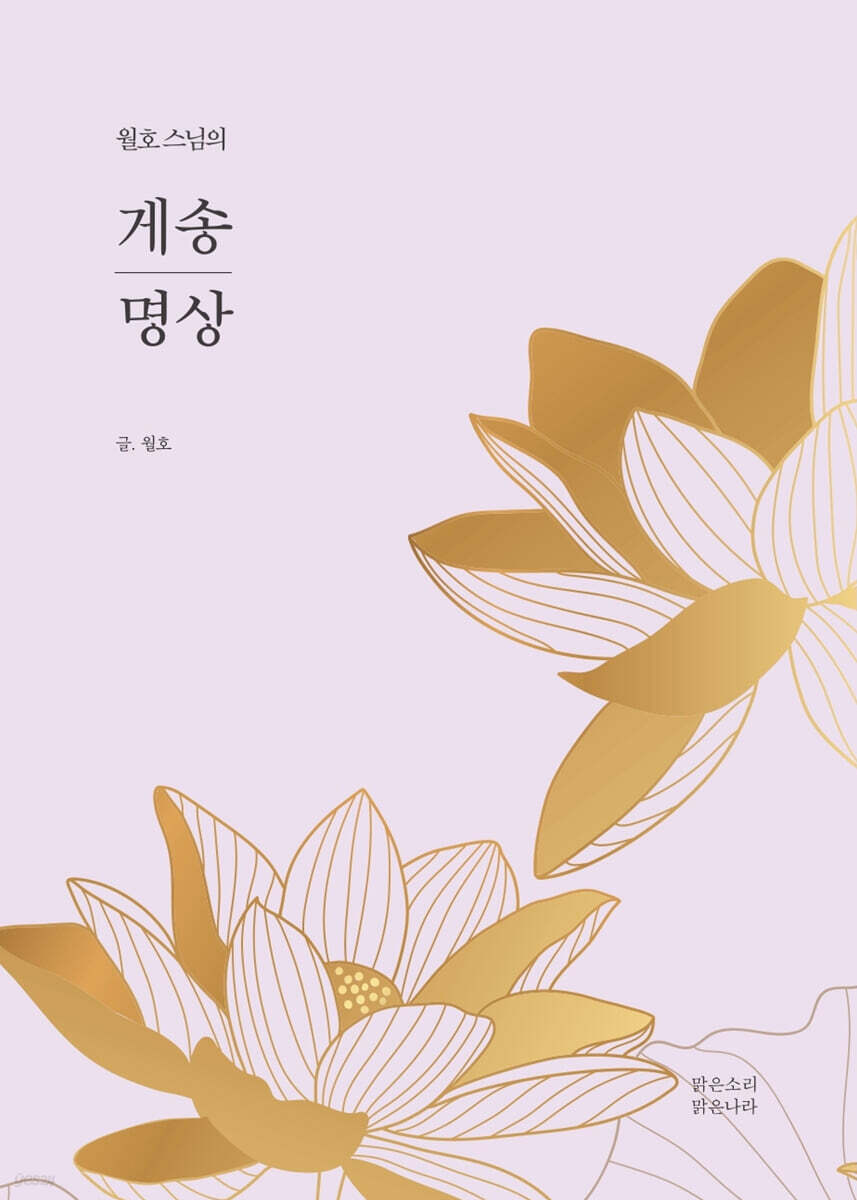
Wolho's meditation on verses
 |
Description
Book Introduction
Monk Wolho studied many sutras and collected selected verses and various instructive anecdotes from the Buddha's time into one paragraph.
While practicing the song meditation, we are also taking the time to reflect on ourselves through various anecdotes.
Therefore, it is good to read the book from beginning to end in one sitting, but I think it would also be good to sit quietly alone at a set time every day, read each paragraph carefully, and practice gatha meditation as guided by Monk Wolho.
By repeating this every day, the meditation on the song becomes established as part of your daily routine.
While practicing the song meditation, we are also taking the time to reflect on ourselves through various anecdotes.
Therefore, it is good to read the book from beginning to end in one sitting, but I think it would also be good to sit quietly alone at a set time every day, read each paragraph carefully, and practice gatha meditation as guided by Monk Wolho.
By repeating this every day, the meditation on the song becomes established as part of your daily routine.
index
Chapter 1
1.
Breathing Meditation 1: If you are new to meditation
2.
Breathing Meditation 2: Observe your inhalation and exhalation.
3.
Meditation on Buddha 1: If you want to receive the Buddha's care
4.
Meditation on the Buddha 2: Take refuge in the Buddha.
5.
Meditation on the Dhamma 1: If you want to realize the truth
6.
Meditation on the Dhamma 2: Meditate on the Dhamma.
7.
Meditation on Sangha 1: If you want to become a true practitioner
8.
Meditation on Sangha 2: Meditate on Sangha.
9.
Diligent Meditation 1: To practice consistently
10.
Meditation 2: Be patient and endure.
11.
Loving-Kindness Meditation 1: If you want to reduce anger
12.
Loving-Kindness Meditation 2: Do loving-kindness meditation.
13.
Meditation Without Signs 1: If you want to gain wisdom
14.
Meditation on Impermanence 2: Observe Impermanence.
15.
Well-dying Meditation 1: If you wish to die well
16.
Well-dying Meditation 2: Meditate on Death.
Chapter 2
17.
Investigation Ship 1: If you want to break it in one go
18.
Surveyor 2: Look at the magnet.
19.
Silent Ship 1: If you think your posture is important
20.
Silent Meditation 2: Sit in meditation.
21.
Ganhwa Line 1: If you think that your mindset is important
22.
Ganhwaseon 2: Pick up the topic.
23.
Pure Land Zen 1: To practice Zen and Pure Land together
24.
Pure Land Zen 2: The Avatar only says 'Amitabha'!
Chapter 3
25.
Avatar Meditation 1 (Seeing the Body): See the body about the body.
26.
Avatar Meditation 2 (Seeing the Body): The body is not me.
27.
Avatar Meditation 3 (Feeling): Just feel it!
28.
Avatar Meditation 4 (Feeling): There is no one who feels.
29.
Avatar Meditation 5 (Mindfulness): Be Aware
30.
Avatar Meditation 6 (Mindfulness): Let It Go
31.
Avatar Meditation 7 (Dharma View): Body and Mind are Avatars
32.
Avatar Meditation 8 (Dharma View): Mountains, Rivers, and Earth are Flowers of the Void
Chapter 4
33.
Amitabha Meditation 1: Saba is a virtual reality game of reincarnation.
34.
Amitabha Meditation 2: Paradise is a virtual reality game of liberation.
35.
Amitabha Meditation 3: The Tathagata is the father of all worlds.
36.
Amitabha Meditation 4: Dwelling in the state of tranquility.
37.
Amitabha Meditation 5: Stay in the state of non-retreat.
38.
Amitabha Meditation 6: It is said that one life is a treasure.
39.
Amitabha Meditation 7: The Great, Upright, and Vast Buddha Flower
40.
Amitabha Meditation 8: The Golden Light Will Shine
41.
Amitabha Meditation 9: Crossing to the Pure Land.
42.
Amitabha Meditation 10: A golden lotus appears.
43.
Amitabha Meditation 11: Amitabha Infinite Light
44.
Amitabha Meditation 12: All Become Buddhas
45.
Guide to Paradise 1: Avalokitesvara and Seji Bodhisattva
46.
Paradise Guide 2: Manjushri and Samantabhadra
47.
Paradise Guide 3: Wonhyo and Uisang
48.
Paradise Guide 4: Meowth and Seosan Daesa
1.
Breathing Meditation 1: If you are new to meditation
2.
Breathing Meditation 2: Observe your inhalation and exhalation.
3.
Meditation on Buddha 1: If you want to receive the Buddha's care
4.
Meditation on the Buddha 2: Take refuge in the Buddha.
5.
Meditation on the Dhamma 1: If you want to realize the truth
6.
Meditation on the Dhamma 2: Meditate on the Dhamma.
7.
Meditation on Sangha 1: If you want to become a true practitioner
8.
Meditation on Sangha 2: Meditate on Sangha.
9.
Diligent Meditation 1: To practice consistently
10.
Meditation 2: Be patient and endure.
11.
Loving-Kindness Meditation 1: If you want to reduce anger
12.
Loving-Kindness Meditation 2: Do loving-kindness meditation.
13.
Meditation Without Signs 1: If you want to gain wisdom
14.
Meditation on Impermanence 2: Observe Impermanence.
15.
Well-dying Meditation 1: If you wish to die well
16.
Well-dying Meditation 2: Meditate on Death.
Chapter 2
17.
Investigation Ship 1: If you want to break it in one go
18.
Surveyor 2: Look at the magnet.
19.
Silent Ship 1: If you think your posture is important
20.
Silent Meditation 2: Sit in meditation.
21.
Ganhwa Line 1: If you think that your mindset is important
22.
Ganhwaseon 2: Pick up the topic.
23.
Pure Land Zen 1: To practice Zen and Pure Land together
24.
Pure Land Zen 2: The Avatar only says 'Amitabha'!
Chapter 3
25.
Avatar Meditation 1 (Seeing the Body): See the body about the body.
26.
Avatar Meditation 2 (Seeing the Body): The body is not me.
27.
Avatar Meditation 3 (Feeling): Just feel it!
28.
Avatar Meditation 4 (Feeling): There is no one who feels.
29.
Avatar Meditation 5 (Mindfulness): Be Aware
30.
Avatar Meditation 6 (Mindfulness): Let It Go
31.
Avatar Meditation 7 (Dharma View): Body and Mind are Avatars
32.
Avatar Meditation 8 (Dharma View): Mountains, Rivers, and Earth are Flowers of the Void
Chapter 4
33.
Amitabha Meditation 1: Saba is a virtual reality game of reincarnation.
34.
Amitabha Meditation 2: Paradise is a virtual reality game of liberation.
35.
Amitabha Meditation 3: The Tathagata is the father of all worlds.
36.
Amitabha Meditation 4: Dwelling in the state of tranquility.
37.
Amitabha Meditation 5: Stay in the state of non-retreat.
38.
Amitabha Meditation 6: It is said that one life is a treasure.
39.
Amitabha Meditation 7: The Great, Upright, and Vast Buddha Flower
40.
Amitabha Meditation 8: The Golden Light Will Shine
41.
Amitabha Meditation 9: Crossing to the Pure Land.
42.
Amitabha Meditation 10: A golden lotus appears.
43.
Amitabha Meditation 11: Amitabha Infinite Light
44.
Amitabha Meditation 12: All Become Buddhas
45.
Guide to Paradise 1: Avalokitesvara and Seji Bodhisattva
46.
Paradise Guide 2: Manjushri and Samantabhadra
47.
Paradise Guide 3: Wonhyo and Uisang
48.
Paradise Guide 4: Meowth and Seosan Daesa
Publisher's Review
Meditation meets verse
Meditation is ‘observing the body and mind.’
Gesong means a song to rest, and song to rest the mind.
Therefore, ‘Gatha meditation’ means ‘listening to gatha and observing the body and mind.’
Most practitioners during the time of Shakyamuni Buddha achieved the fruition of enlightenment in this way.
One day, Sarija saw the Venerable Assaji's unusual behavior on the street and followed him to ask him about it.
“Who is your teacher? And what does he teach?”
The Venerable One said, “My teacher is Shakyamuni Buddha.
He replies, “He speaks thus,” and recites a verse.
Every phenomenon has a cause.
The Tathagata explains the cause.
Also about the result of the disappearance of the cause
The Tathagata also says:
After hearing this verse, Sariputra attained the fruit of Stream-winnerhood and immediately became a monk.
After two weeks of leaving home, he heard the Buddha preach a verse again and attained the state of Arahat.
Later, the Buddha said, 'Even the greatest disciple of wisdom, like Sariputra, would not have attained the level of Stream-enterer if he had not heard the Buddha's verses.'
Kallah, the son of a wealthy man, memorized a song to receive pocket money, and after understanding its meaning, he attained the fruit of Stream-winnerhood.
Then the Buddha recited this verse:
Than becoming the emperor of an empire
Than to become a god in heaven
Than to become the ruler of the universe
It is much more valuable to obtain the knowledge of the Sudawon.
If the purpose of life is happiness, then true happiness is liberation.
Although the emperor, god, or ruler of the universe may be great, there is still no promise of liberation.
On the other hand, Sudawon is the state of 'seven comings and goings', where one achieves liberation while going back and forth between heaven and earth seven times.
Sadaham is a state of 'one-way' travel, and Anaham is a state of 'non-return' travel, where one goes to Jeonggeocheon and does not return.
Lastly, Arahan is the state of ‘non-rebirth’, where one is not reborn.
This state of liberation is achieved through the combination of meditation and gatha.
Meditation is the cause of liberation.
The song is the affinity for liberation.
India must be faithful and faithful to the year
The fruit is substantial.
2569 years after the death of the Buddha
Paradise Guide
Wolho Folding Ceremony
The first sentence of Chapter 1 of the book begins like this:
It is better to live a hundred years without observing your body and mind.
It is much more valuable to live each day observing your body and mind.
- 『Dhammapada』
And then, right after, the author, Monk Wolho, says the following:
The purpose of life is liberation.
The cause of liberation is meditation, and the condition of liberation is verse.
Listening to verses while meditating, or listening to verses while meditating, is a shortcut to liberation.
The preceding is the Golden Mouth Speech, that is, the Buddha's words.
Why did he say that living a day observing body and mind is much more valuable than living a hundred years without doing so?
Regarding this, Monk Wolho introduces “Gatha Meditation,” which states that the purpose of life is liberation, and among the various methods of practice that lead to liberation, is easy for anyone to follow and is also highly effective.
In order to attain the fruit of liberation, one must create the cause of meditation, and liberation and meditation are connected by the condition of the song.
Next, there is the meditation method that the Buddha taught his son Rahula when he was 15 years old.
It is mindfulness of breathing in and breathing out.
This is a breathing practice that focuses the mind under the nose, noticing the inhalation and exhalation, and leaving all discrimination to the empty space under the nose.
It's easy and simple.
For those who are new to meditation, Venerable Wolho introduces the mindful breathing practice taught by the Buddha to his son Rahula.
This is a meditation that anyone can easily follow, even if the goal is not liberation.
Monk Wolho begins with breathing, and then offers a variety of meditations on topics such as the Three Jewels, diligent practice, compassion, impermanence, and death, as well as various Zen methods that have been passed down and flourished in Korea, such as Josaseon, Silent Zen, Ganhwa Zen, and Pure Land Zen.
And we each are just avatars, and this world is a virtual reality where the game of reincarnation takes place, and paradise is a virtual reality where the game of liberation takes place, which explains the groundbreaking concepts of avatar meditation and Amitabha meditation.
In the last chapter, the Bodhisattvas who lead us to Amitabha Buddha's Pure Land and the four great monks of our country are called "Supreme Land Guides."
These are people who remind us that if we chant Amitabha Buddha with utmost sincerity, we can follow Amitabha Buddha to paradise after death.
These are beings who spread the teachings of Buddha that although it is difficult to achieve liberation during one's lifetime, if one sincerely recite Amitabha Buddha and go to paradise after death, one will definitely achieve liberation there.
Regarding this, Monk Wolho says the following:
Heaven and paradise are on completely different levels.
Since Heaven is a virtual reality game of reincarnation set in Saba's binary system, you must go up and down the three good paths and the three evil paths.
Paradise is a virtual reality game of liberation set in the 0-empty system of the vacuum myoyu, so there are no three evil paths and no regression.
Anyone who goes there will become an unyielding bodhisattva and eventually attain Buddhahood.
Anyone who believes in this, wants to go, and single-mindedly recites 'Amitabha' ten times can go.
The threshold is incredibly low, and the benefits are endless.
It's easy to get there, but no one wants to go.
Amitabha!
At the end of the book, the following text is included:
Wisdom without means is bondage, wisdom with means is liberation.
If you ignore the magnificent Pure Land as a means of saving sentient beings, you will fall into emptiness, and if you cling to its reality, you will fall into appearance.
It must be used well.
Also, we should not mistake the ‘original Buddha’ for the ‘current Buddha.’
A living being only has Buddha-nature, but has not become a true Buddha.
While you are alive, you are Buddha.
A monk who preached the Dharma of 'do not seek outside' was recently moved after hearing the author's Pure Land Dharma talk and said:
“Thank you! Thank you so much!”
Monk Wolho studied many sutras and collected selected verses and various instructive anecdotes from the Buddha's time into one paragraph.
While practicing the song meditation, we are also taking the time to reflect on ourselves through various anecdotes.
Therefore, it is good to read the book from beginning to end in one sitting, but I think it would also be good to sit quietly alone at a set time every day, read each paragraph carefully, and practice gatha meditation as guided by Monk Wolho.
By repeating this every day, the meditation on the song becomes established as part of your daily routine.
Meditation is ‘observing the body and mind.’
Gesong means a song to rest, and song to rest the mind.
Therefore, ‘Gatha meditation’ means ‘listening to gatha and observing the body and mind.’
Most practitioners during the time of Shakyamuni Buddha achieved the fruition of enlightenment in this way.
One day, Sarija saw the Venerable Assaji's unusual behavior on the street and followed him to ask him about it.
“Who is your teacher? And what does he teach?”
The Venerable One said, “My teacher is Shakyamuni Buddha.
He replies, “He speaks thus,” and recites a verse.
Every phenomenon has a cause.
The Tathagata explains the cause.
Also about the result of the disappearance of the cause
The Tathagata also says:
After hearing this verse, Sariputra attained the fruit of Stream-winnerhood and immediately became a monk.
After two weeks of leaving home, he heard the Buddha preach a verse again and attained the state of Arahat.
Later, the Buddha said, 'Even the greatest disciple of wisdom, like Sariputra, would not have attained the level of Stream-enterer if he had not heard the Buddha's verses.'
Kallah, the son of a wealthy man, memorized a song to receive pocket money, and after understanding its meaning, he attained the fruit of Stream-winnerhood.
Then the Buddha recited this verse:
Than becoming the emperor of an empire
Than to become a god in heaven
Than to become the ruler of the universe
It is much more valuable to obtain the knowledge of the Sudawon.
If the purpose of life is happiness, then true happiness is liberation.
Although the emperor, god, or ruler of the universe may be great, there is still no promise of liberation.
On the other hand, Sudawon is the state of 'seven comings and goings', where one achieves liberation while going back and forth between heaven and earth seven times.
Sadaham is a state of 'one-way' travel, and Anaham is a state of 'non-return' travel, where one goes to Jeonggeocheon and does not return.
Lastly, Arahan is the state of ‘non-rebirth’, where one is not reborn.
This state of liberation is achieved through the combination of meditation and gatha.
Meditation is the cause of liberation.
The song is the affinity for liberation.
India must be faithful and faithful to the year
The fruit is substantial.
2569 years after the death of the Buddha
Paradise Guide
Wolho Folding Ceremony
The first sentence of Chapter 1 of the book begins like this:
It is better to live a hundred years without observing your body and mind.
It is much more valuable to live each day observing your body and mind.
- 『Dhammapada』
And then, right after, the author, Monk Wolho, says the following:
The purpose of life is liberation.
The cause of liberation is meditation, and the condition of liberation is verse.
Listening to verses while meditating, or listening to verses while meditating, is a shortcut to liberation.
The preceding is the Golden Mouth Speech, that is, the Buddha's words.
Why did he say that living a day observing body and mind is much more valuable than living a hundred years without doing so?
Regarding this, Monk Wolho introduces “Gatha Meditation,” which states that the purpose of life is liberation, and among the various methods of practice that lead to liberation, is easy for anyone to follow and is also highly effective.
In order to attain the fruit of liberation, one must create the cause of meditation, and liberation and meditation are connected by the condition of the song.
Next, there is the meditation method that the Buddha taught his son Rahula when he was 15 years old.
It is mindfulness of breathing in and breathing out.
This is a breathing practice that focuses the mind under the nose, noticing the inhalation and exhalation, and leaving all discrimination to the empty space under the nose.
It's easy and simple.
For those who are new to meditation, Venerable Wolho introduces the mindful breathing practice taught by the Buddha to his son Rahula.
This is a meditation that anyone can easily follow, even if the goal is not liberation.
Monk Wolho begins with breathing, and then offers a variety of meditations on topics such as the Three Jewels, diligent practice, compassion, impermanence, and death, as well as various Zen methods that have been passed down and flourished in Korea, such as Josaseon, Silent Zen, Ganhwa Zen, and Pure Land Zen.
And we each are just avatars, and this world is a virtual reality where the game of reincarnation takes place, and paradise is a virtual reality where the game of liberation takes place, which explains the groundbreaking concepts of avatar meditation and Amitabha meditation.
In the last chapter, the Bodhisattvas who lead us to Amitabha Buddha's Pure Land and the four great monks of our country are called "Supreme Land Guides."
These are people who remind us that if we chant Amitabha Buddha with utmost sincerity, we can follow Amitabha Buddha to paradise after death.
These are beings who spread the teachings of Buddha that although it is difficult to achieve liberation during one's lifetime, if one sincerely recite Amitabha Buddha and go to paradise after death, one will definitely achieve liberation there.
Regarding this, Monk Wolho says the following:
Heaven and paradise are on completely different levels.
Since Heaven is a virtual reality game of reincarnation set in Saba's binary system, you must go up and down the three good paths and the three evil paths.
Paradise is a virtual reality game of liberation set in the 0-empty system of the vacuum myoyu, so there are no three evil paths and no regression.
Anyone who goes there will become an unyielding bodhisattva and eventually attain Buddhahood.
Anyone who believes in this, wants to go, and single-mindedly recites 'Amitabha' ten times can go.
The threshold is incredibly low, and the benefits are endless.
It's easy to get there, but no one wants to go.
Amitabha!
At the end of the book, the following text is included:
Wisdom without means is bondage, wisdom with means is liberation.
If you ignore the magnificent Pure Land as a means of saving sentient beings, you will fall into emptiness, and if you cling to its reality, you will fall into appearance.
It must be used well.
Also, we should not mistake the ‘original Buddha’ for the ‘current Buddha.’
A living being only has Buddha-nature, but has not become a true Buddha.
While you are alive, you are Buddha.
A monk who preached the Dharma of 'do not seek outside' was recently moved after hearing the author's Pure Land Dharma talk and said:
“Thank you! Thank you so much!”
Monk Wolho studied many sutras and collected selected verses and various instructive anecdotes from the Buddha's time into one paragraph.
While practicing the song meditation, we are also taking the time to reflect on ourselves through various anecdotes.
Therefore, it is good to read the book from beginning to end in one sitting, but I think it would also be good to sit quietly alone at a set time every day, read each paragraph carefully, and practice gatha meditation as guided by Monk Wolho.
By repeating this every day, the meditation on the song becomes established as part of your daily routine.
GOODS SPECIFICS
- Date of issue: September 10, 2025
- Page count, weight, size: 240 pages | 458g | 152*220*16mm
- ISBN13: 9791193385234
- ISBN10: 1193385237
You may also like
카테고리
korean


korean

![GQ KOREA Mark (Monthly): December [2025]](http://librairie.coreenne.fr/cdn/shop/files/8ef265dbbfbf186523ed75ba7319009d.jpg?v=1765340328&width=3840)


