

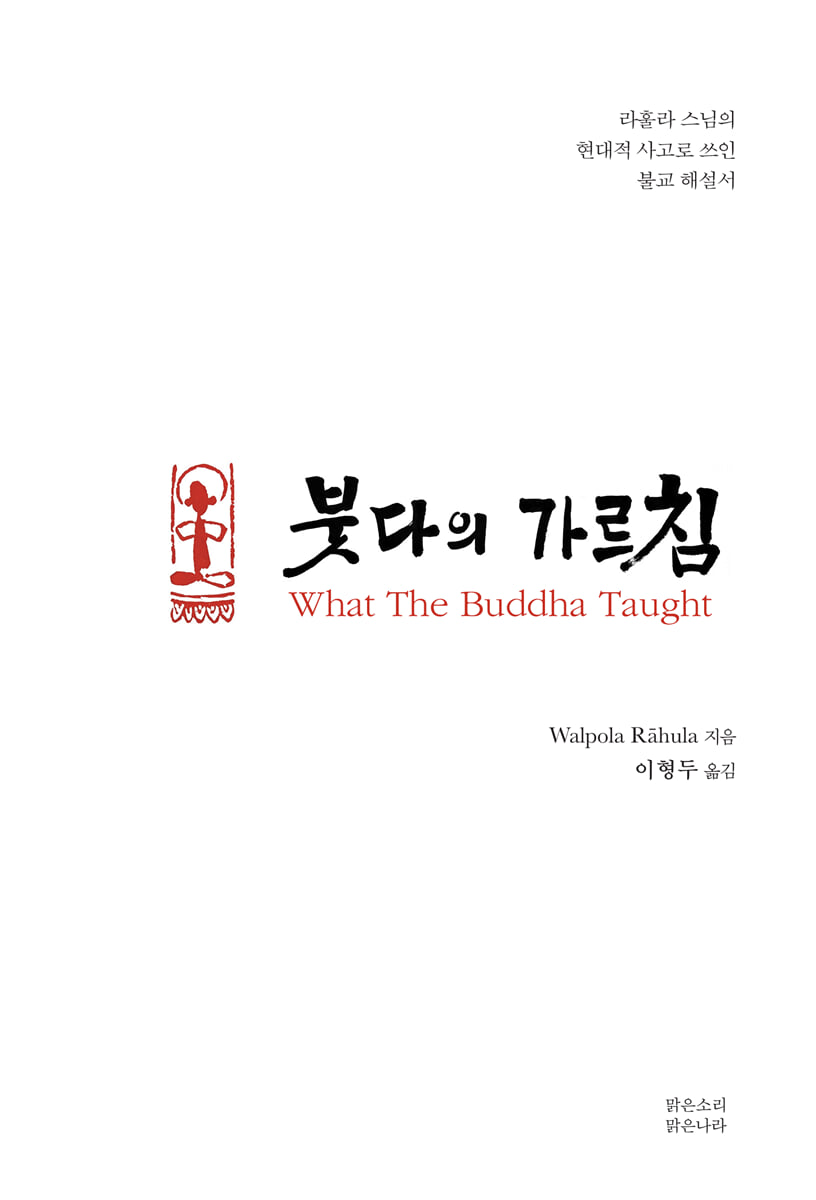
Buddha's teachings
 |
Description
Book Introduction
This book, which he politely asked me to introduce to the Western public, clearly explains the basic principles of Buddhist doctrine as contained in the oldest ancient scriptures, called the Agamas in Sanskrit and the Nikayas in Pali, so that everyone can understand them.
Dr. Rahula, who possesses unparalleled knowledge of these scriptures, continues to quote only the contents of the scriptures.
The authority of these scriptures is accepted without dispute by all schools of Buddhism, past and present, and no part of this book deviates from the ancient scriptures, except that which is intended to better interpret the spirit between the lines.
As Buddhism spread across vast areas over the centuries, its interpretations have indeed changed, and the Dharma (the Buddha's teachings) has acquired many perspectives.
However, the Buddhist view presented here by Dr. Rahula is in some ways humanistic, rationalistic, and Socratic, in others missionary, and in others almost scientific, and is supported by extensive original sources where documentary evidence is needed for explanation.
Venerable Rahula always translates the explanations he adds to the quotations meticulously and accurately, making them clear, simple, direct, and free from any esoteric elements.
As he hopes to rediscover all the Mahayana doctrines from Pāli material, some of the content may require discussion.
However, he is so well versed in the original Pali texts that he is bringing new light to those materials.
Although Rahula calls himself a modern man, he is careful not to compare himself to the ideas he has picked up here and there - to socialism, atheism, existentialism, and psychoanalysis, which can be produced with any current of thought in the contemporary world.
In this heartfelt and scholarly work, the reader is left grateful for the explanations given with modern sensibilities and thought, and for a monk well versed in the Pāli Buddhist texts, it opens up the possibility of translating Buddhist doctrines.
Dr. Rahula, who possesses unparalleled knowledge of these scriptures, continues to quote only the contents of the scriptures.
The authority of these scriptures is accepted without dispute by all schools of Buddhism, past and present, and no part of this book deviates from the ancient scriptures, except that which is intended to better interpret the spirit between the lines.
As Buddhism spread across vast areas over the centuries, its interpretations have indeed changed, and the Dharma (the Buddha's teachings) has acquired many perspectives.
However, the Buddhist view presented here by Dr. Rahula is in some ways humanistic, rationalistic, and Socratic, in others missionary, and in others almost scientific, and is supported by extensive original sources where documentary evidence is needed for explanation.
Venerable Rahula always translates the explanations he adds to the quotations meticulously and accurately, making them clear, simple, direct, and free from any esoteric elements.
As he hopes to rediscover all the Mahayana doctrines from Pāli material, some of the content may require discussion.
However, he is so well versed in the original Pali texts that he is bringing new light to those materials.
Although Rahula calls himself a modern man, he is careful not to compare himself to the ideas he has picked up here and there - to socialism, atheism, existentialism, and psychoanalysis, which can be produced with any current of thought in the contemporary world.
In this heartfelt and scholarly work, the reader is left grateful for the explanations given with modern sensibilities and thought, and for a monk well versed in the Pāli Buddhist texts, it opens up the possibility of translating Buddhist doctrines.
index
While moving
preface
introduction
Buddha
Chapter 1: The Mindset Taught by the Buddha
Chapter 2 The First Holy Truth
Chapter 3: The Second Holy Truth
Chapter 4 The Third Holy Truth
Chapter 5 The Fourth Holy Truth
Chapter 6: There is no immortal entity called the self.
Chapter 7: Meditation, or Mental Cultivation
Chapter 8: The Buddha's Teachings and Today's World
Selected scriptures
Selected References for English Readers
List of terms
Search
preface
introduction
Buddha
Chapter 1: The Mindset Taught by the Buddha
Chapter 2 The First Holy Truth
Chapter 3: The Second Holy Truth
Chapter 4 The Third Holy Truth
Chapter 5 The Fourth Holy Truth
Chapter 6: There is no immortal entity called the self.
Chapter 7: Meditation, or Mental Cultivation
Chapter 8: The Buddha's Teachings and Today's World
Selected scriptures
Selected References for English Readers
List of terms
Search
Publisher's Review
Translator's Preface - While Translating
While searching Buddhist literature to find material for my calligraphy work, I came across 『What the Buddha Taught』 by the Venerable Walpola Sri Rāhula (1907-1997), the greatest sage.
This book is a famous introductory book to Buddhism in English, and has been translated into Korean several times and has already received favorable reviews from many people.
However, there are some errors, and there are parts that are difficult to understand between Korean and Chinese Buddhist terms, and it is out of print and difficult to obtain, so I am translating it again and sharing it with those who have a connection to it.
Although I was worried that I might not be able to convey the monk's true intentions well due to my shallow knowledge, I took courage in the hope that it would be of some help to those who are studying Buddhism for the first time.
Translation is the act of transferring text from one language to another. It is explained as a combination of the Chinese characters ‘飜’, meaning ‘to turn over’, and ‘譯’, meaning ‘to interpret’.
A good translation requires excellent knowledge of the subject matter, as well as the writing skills to delicately express the nuances of both languages.
However, unless there is complete synonymy between the two languages, the translation is bound to be imperfect, making it very difficult to convey the original author's intent to the reader, even when moving between literal and free translation.
In the Biographies of Eminent Monks, Kumarajiva, who translated many Buddhist scriptures into Chinese so that they could be read in China, Korea, and Japan, is mentioned, saying, "If you change a Sanskrit sentence into Chinese, it loses its beautiful writing style. It's like chewing rice and giving it to someone else. It not only loses its original flavor, but also makes you feel sick." This is a warning that is like a dagger to the translator.
『What the Buddha Taught』 is a book written with the intention of introducing the Buddha's teachings to the general public in the West, most of whom are non-Buddhists.
Venerable Rahula describes the early Buddhist concepts in Pāli using appropriate English vocabulary. However, it is difficult to find English words that exactly match the nuance of the original Pāli words. Of course, this is why the Pāli words were included, but there are bound to be limitations in conveying the meaning.
Moreover, if this English version is translated into Korean, it will result in a double translation, which runs the risk of becoming even more distant from the original Pali text.
Another difficulty is that we are already somewhat familiar with Chinese Buddhist terminology through the Buddhist scriptures translated into Chinese by Kumarajiva. If we directly translate the original English text into everyday Korean vocabulary, readers may get confused with the existing Chinese Buddhist terminology, making it difficult to understand the meaning.
So, I had no choice but to wander between everyday Korean expressions and Chinese-style Buddhist terminology, so I will rely on the wisdom of the readers to make up for any shortcomings.
- January 5, 2025 AD, Bishan Hepal
While searching Buddhist literature to find material for my calligraphy work, I came across 『What the Buddha Taught』 by the Venerable Walpola Sri Rāhula (1907-1997), the greatest sage.
This book is a famous introductory book to Buddhism in English, and has been translated into Korean several times and has already received favorable reviews from many people.
However, there are some errors, and there are parts that are difficult to understand between Korean and Chinese Buddhist terms, and it is out of print and difficult to obtain, so I am translating it again and sharing it with those who have a connection to it.
Although I was worried that I might not be able to convey the monk's true intentions well due to my shallow knowledge, I took courage in the hope that it would be of some help to those who are studying Buddhism for the first time.
Translation is the act of transferring text from one language to another. It is explained as a combination of the Chinese characters ‘飜’, meaning ‘to turn over’, and ‘譯’, meaning ‘to interpret’.
A good translation requires excellent knowledge of the subject matter, as well as the writing skills to delicately express the nuances of both languages.
However, unless there is complete synonymy between the two languages, the translation is bound to be imperfect, making it very difficult to convey the original author's intent to the reader, even when moving between literal and free translation.
In the Biographies of Eminent Monks, Kumarajiva, who translated many Buddhist scriptures into Chinese so that they could be read in China, Korea, and Japan, is mentioned, saying, "If you change a Sanskrit sentence into Chinese, it loses its beautiful writing style. It's like chewing rice and giving it to someone else. It not only loses its original flavor, but also makes you feel sick." This is a warning that is like a dagger to the translator.
『What the Buddha Taught』 is a book written with the intention of introducing the Buddha's teachings to the general public in the West, most of whom are non-Buddhists.
Venerable Rahula describes the early Buddhist concepts in Pāli using appropriate English vocabulary. However, it is difficult to find English words that exactly match the nuance of the original Pāli words. Of course, this is why the Pāli words were included, but there are bound to be limitations in conveying the meaning.
Moreover, if this English version is translated into Korean, it will result in a double translation, which runs the risk of becoming even more distant from the original Pali text.
Another difficulty is that we are already somewhat familiar with Chinese Buddhist terminology through the Buddhist scriptures translated into Chinese by Kumarajiva. If we directly translate the original English text into everyday Korean vocabulary, readers may get confused with the existing Chinese Buddhist terminology, making it difficult to understand the meaning.
So, I had no choice but to wander between everyday Korean expressions and Chinese-style Buddhist terminology, so I will rely on the wisdom of the readers to make up for any shortcomings.
- January 5, 2025 AD, Bishan Hepal
GOODS SPECIFICS
- Date of issue: July 30, 2025
- Page count, weight, size: 288 pages | 538g | 152*225*18mm
- ISBN13: 9791193385203
- ISBN10: 1193385202
You may also like
카테고리
korean


korean

![GQ KOREA Mark (Monthly): December [2025]](http://librairie.coreenne.fr/cdn/shop/files/8ef265dbbfbf186523ed75ba7319009d.jpg?v=1765340328&width=3840)


