

Open the Hebrew Bible
 |
Description
Book Introduction
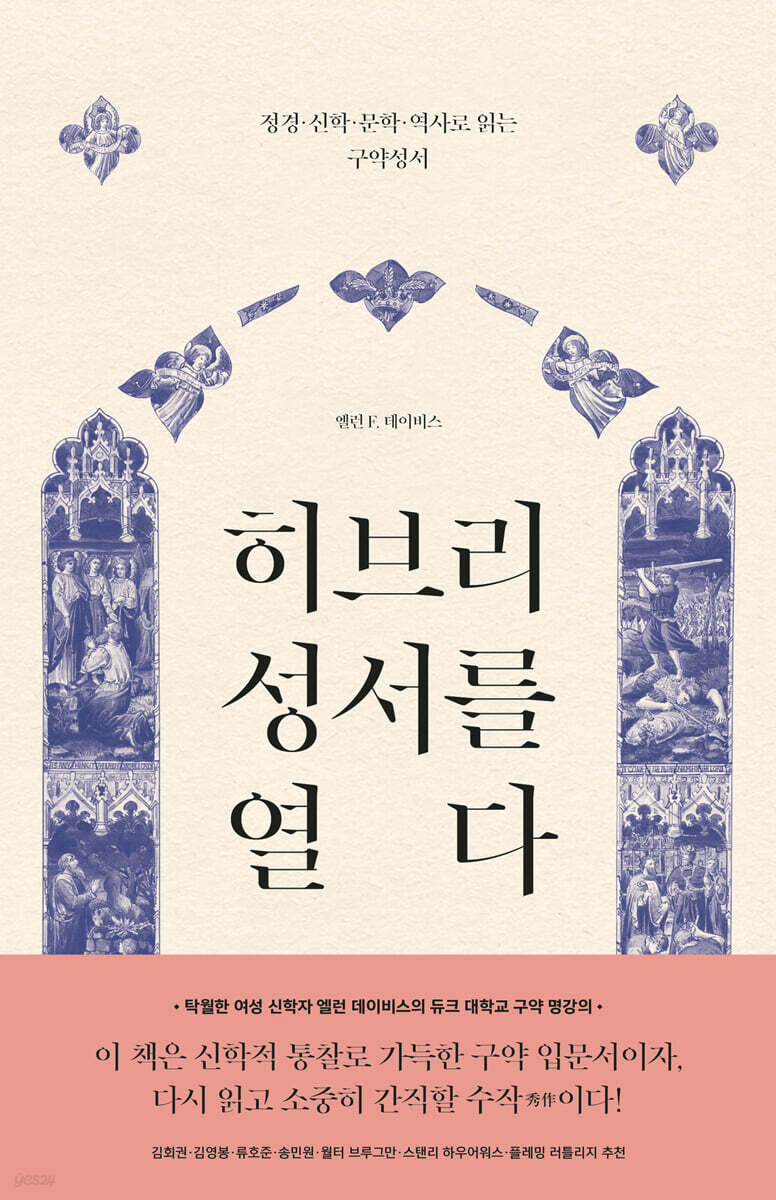
Duke University's renowned Old Testament lecture series by prominent female theologian Ellen Davis
“This book is an introduction to the Old Testament filled with theological insights,
“This is a masterpiece that I will read again and cherish!”
- Recommended by Kim Hoe-kwon, Kim Young-bong, Ryu Ho-jun, Song Min-won, Walter Brueggemann, Stanley Hauerwas, and Fleming Rutledge
This book is an introduction to the Old Testament written by Ellen Davis based on her 35 years of teaching experience at a theological seminary.
The author wrote this book for both Christians and Jews, and, out of consideration for Jewish readers, refers to the Old Testament as the "Scripture of Israel" or the "Hebrew Bible."
This book, a culmination of the author's lifelong lectures and research, offers a close reading of each book of the Old Testament, illuminating canonical, theological, literary, and historical approaches in a compelling way.
The 42 Old Testament essays, covering a wide range of topics, are comprehensive and detailed, scholarly and artistic, intellectually intriguing and full of engaging insights.
The author sharply analyzes the Old Testament from a historical-critical perspective, while rereading the text as a unified whole, drawing from it rich theological implications, enlightenment for the church, and pastoral resonance.
It also integrates classical sources from Christian and Jewish traditions with the latest research findings to provide a model for modern biblical commentary.
Throughout the book, the author focuses on the experiences and concerns of the modern reader, and through numerous examples, he demonstrates that biblical interpretation is a tentative and open-ended process, a long-term collaboration between past and present, across generations and cultures.
This author's study of the Old Testament breaks down the barriers between theological schools and churches, academia and practice, Christianity and Judaism, and leads readers into a new and expansive world of the Bible.
This book, which combines profound scholarship with a delicate pastoral sensibility, will be a valuable gift to pastors and seminarians interested in a holistic and practical biblical hermeneutics that transcends a critical perspective, as well as to all readers who wish to fully understand the Old Testament.
“This book is an introduction to the Old Testament filled with theological insights,
“This is a masterpiece that I will read again and cherish!”
- Recommended by Kim Hoe-kwon, Kim Young-bong, Ryu Ho-jun, Song Min-won, Walter Brueggemann, Stanley Hauerwas, and Fleming Rutledge
This book is an introduction to the Old Testament written by Ellen Davis based on her 35 years of teaching experience at a theological seminary.
The author wrote this book for both Christians and Jews, and, out of consideration for Jewish readers, refers to the Old Testament as the "Scripture of Israel" or the "Hebrew Bible."
This book, a culmination of the author's lifelong lectures and research, offers a close reading of each book of the Old Testament, illuminating canonical, theological, literary, and historical approaches in a compelling way.
The 42 Old Testament essays, covering a wide range of topics, are comprehensive and detailed, scholarly and artistic, intellectually intriguing and full of engaging insights.
The author sharply analyzes the Old Testament from a historical-critical perspective, while rereading the text as a unified whole, drawing from it rich theological implications, enlightenment for the church, and pastoral resonance.
It also integrates classical sources from Christian and Jewish traditions with the latest research findings to provide a model for modern biblical commentary.
Throughout the book, the author focuses on the experiences and concerns of the modern reader, and through numerous examples, he demonstrates that biblical interpretation is a tentative and open-ended process, a long-term collaboration between past and present, across generations and cultures.
This author's study of the Old Testament breaks down the barriers between theological schools and churches, academia and practice, Christianity and Judaism, and leads readers into a new and expansive world of the Bible.
This book, which combines profound scholarship with a delicate pastoral sensibility, will be a valuable gift to pastors and seminarians interested in a holistic and practical biblical hermeneutics that transcends a critical perspective, as well as to all readers who wish to fully understand the Old Testament.
- You can preview some of the book's contents.
Preview
index
Acknowledgements
Introduction_Handling Fairly: Practical and Critical Biblical Interpretation
01 Genesis
“In our image”
Complement and Disconnection
A journey that began with blessings
02 Exodus
Exodus from Egypt
Becoming God's People
03 Leviticus
Embodying holiness
Oneness with Yahweh and the Land
04 Numbers
A sign of blessing, a disaster brought on by sin
Reading Violence Slowly
05 Deuteronomy
Learning love and awe
Torah and Life in the Promised Land
06 Joshua
Unconquered narrative
The Great Chaos: Canaan in the 13th Century BC
07 Judges
Leadership and Discontent
08 Ruth
vulnerable caregivers
09 1 and 2 Samuel and 1 Kings
A Unified Kingdom: A (Almost) Failed Hope
The Tragedy of the Chosen: Saul's Kingship
How should we view David?
Wisdom, Power, and Worship: Solomon's Reign
The reign of prophetic words
10 Minor Prophets
Impromptu Poetry Recitals of the 8th Century BC: Performances by the Prophets
Questions Raised About Prosperity
Justice and Intimacy
hate the enemy
11 Isaiah
Behold the King
Expanding Vision
12 Jeremiah and Lamentations
One who knows sorrow
Tell the truth to God
Disaster and Love Poem
13 Ezekiel
Predicting the end of the world
Psalm 14
Reality and Praise
The Wisdom of Sighs
15 Proverbs and Ecclesiastes
Poetry of Ordinary People
16 Job and Song of Solomon
Intimacy with God: Agony and Ecstasy
Learning to Conflict with God
The joy of intimacy
17 Esther and Daniel
The World of the Gentiles and the Jewish Imagination
Mass murder and humor
Surviving the ravages of history
18 Ezra-Nehemiah and 1-2 Chronicles
Identity negotiation
Second settlement
Rereading the story
main
Glossary of Terms
Index of people, place names, and scriptures
Introduction_Handling Fairly: Practical and Critical Biblical Interpretation
01 Genesis
“In our image”
Complement and Disconnection
A journey that began with blessings
02 Exodus
Exodus from Egypt
Becoming God's People
03 Leviticus
Embodying holiness
Oneness with Yahweh and the Land
04 Numbers
A sign of blessing, a disaster brought on by sin
Reading Violence Slowly
05 Deuteronomy
Learning love and awe
Torah and Life in the Promised Land
06 Joshua
Unconquered narrative
The Great Chaos: Canaan in the 13th Century BC
07 Judges
Leadership and Discontent
08 Ruth
vulnerable caregivers
09 1 and 2 Samuel and 1 Kings
A Unified Kingdom: A (Almost) Failed Hope
The Tragedy of the Chosen: Saul's Kingship
How should we view David?
Wisdom, Power, and Worship: Solomon's Reign
The reign of prophetic words
10 Minor Prophets
Impromptu Poetry Recitals of the 8th Century BC: Performances by the Prophets
Questions Raised About Prosperity
Justice and Intimacy
hate the enemy
11 Isaiah
Behold the King
Expanding Vision
12 Jeremiah and Lamentations
One who knows sorrow
Tell the truth to God
Disaster and Love Poem
13 Ezekiel
Predicting the end of the world
Psalm 14
Reality and Praise
The Wisdom of Sighs
15 Proverbs and Ecclesiastes
Poetry of Ordinary People
16 Job and Song of Solomon
Intimacy with God: Agony and Ecstasy
Learning to Conflict with God
The joy of intimacy
17 Esther and Daniel
The World of the Gentiles and the Jewish Imagination
Mass murder and humor
Surviving the ravages of history
18 Ezra-Nehemiah and 1-2 Chronicles
Identity negotiation
Second settlement
Rereading the story
main
Glossary of Terms
Index of people, place names, and scriptures
Into the book
The purpose of this book is to present a model for the ongoing practice of theological exegesis today.
I wrote this book for both Jews and Christians, with those who teach and study in academic or congregational settings, including those who perform exegesis from the pulpit.
This book is a work of practical theology.
In other words, this book reflects my understanding that the Bible itself is never less than realistic and honest about human circumstances and tendencies, and that it unwaveringly focuses on how our experience of God defines and shapes our existence.
The articles contained herein present a close reading of nearly every book of the Hebrew Bible, highlighting key passages from each book.
The approach of this book reflects another of my understandings of the Bible.
I understand that each book of the Bible makes a unique contribution to the canon, drawing on, complementing, and challenging the perspectives of other parts of Scripture.
Furthermore, the value of the biblical canon as a guide for those who regard it as authoritative (a term not clearly defined in my Anglican tradition) lies largely in the diverse and sometimes differing perspectives expressed in its individual books (and even within a single book).
--- From the "Preface"
It may be impossible to read Genesis quickly.
Because there are so many factors that slow things down.
Genesis contains enigmatic passages, unfamiliar concepts that must be kept in mind as you read, recurring literary patterns and theological dynamics, a portrayal of God that defies the Sunday school picture we unconsciously have of him, and some of the richest character studies in all of Scripture.
Therefore, when reading this book, you should take your time and read it slowly.
--- From "Genesis - "In Our Image"
The theme that runs throughout Exodus is how the Israelites came to 'know' (in the deeper sense of recognition and embrace) Yahweh as their God.
That primary theme expands into two other topics.
First, the process of Israel's formation as a nation and its tumultuous growth as Yahweh's special "possession" chosen "out of all peoples," and second, Pharaoh's continued refusal to know Yahweh.
--- From "Exodus - The Escape from Egypt"
Another element of Leviticus' theology, closely related to offerings and food, is the profound connection between humans and the land, especially the cultivated land.
This land is the close source from which all plants and animals receive life.
Leviticus views the land as a complex material reality imbued with religious and spiritual meaning.
The most obvious fact is that the land was the means of livelihood for almost all the Israelites.
Thus, as Leviticus suggests, the land can be seen as a mirror of human existence, an extended sanctuary, a covenant partner, and an executor of covenantal justice.
--- From "Leviticus - Oneness with Yahweh and the Land"
The impression that the book of Numbers is random is understandable, considering it deals with thirty-nine years of wandering “in the wilderness.”
The Hebrew title of this book is also “In the Wilderness” (Bemidbar).
To fully understand the Book of Numbers, it requires patience and effort to grasp the details.
There are certain patterning elements that emerge, most fundamentally the alternation of stories on the one hand and legal or ceremonial regulations on the other throughout the book.
Other patterning elements on a smaller scale, such as parallel structure, repetition, and inverse repetition, provide structure to individual paragraphs.
All these elements tell us that this book was not put together by chance.
--- From "Numbers - A Sign of Blessing, A Disaster Caused by Sin"
It is instructive to note how the Shema (6:4-9) proceeds.
The Shema begins with “hearing” God’s incomparable uniqueness, moves on to responding with love that encompasses every aspect of the self, engraves God’s “word” in our hearts, and teaches it repeatedly to our children.
Significantly, however, the teachings presented here are not rote memorization lessons.
It is a continuing “lecture.”
It is not simply “recited” as in traditional translation.
The lecture should continue all the time, whether you are sitting at home, going out to do business, going to bed, or getting up.
I wrote this book for both Jews and Christians, with those who teach and study in academic or congregational settings, including those who perform exegesis from the pulpit.
This book is a work of practical theology.
In other words, this book reflects my understanding that the Bible itself is never less than realistic and honest about human circumstances and tendencies, and that it unwaveringly focuses on how our experience of God defines and shapes our existence.
The articles contained herein present a close reading of nearly every book of the Hebrew Bible, highlighting key passages from each book.
The approach of this book reflects another of my understandings of the Bible.
I understand that each book of the Bible makes a unique contribution to the canon, drawing on, complementing, and challenging the perspectives of other parts of Scripture.
Furthermore, the value of the biblical canon as a guide for those who regard it as authoritative (a term not clearly defined in my Anglican tradition) lies largely in the diverse and sometimes differing perspectives expressed in its individual books (and even within a single book).
--- From the "Preface"
It may be impossible to read Genesis quickly.
Because there are so many factors that slow things down.
Genesis contains enigmatic passages, unfamiliar concepts that must be kept in mind as you read, recurring literary patterns and theological dynamics, a portrayal of God that defies the Sunday school picture we unconsciously have of him, and some of the richest character studies in all of Scripture.
Therefore, when reading this book, you should take your time and read it slowly.
--- From "Genesis - "In Our Image"
The theme that runs throughout Exodus is how the Israelites came to 'know' (in the deeper sense of recognition and embrace) Yahweh as their God.
That primary theme expands into two other topics.
First, the process of Israel's formation as a nation and its tumultuous growth as Yahweh's special "possession" chosen "out of all peoples," and second, Pharaoh's continued refusal to know Yahweh.
--- From "Exodus - The Escape from Egypt"
Another element of Leviticus' theology, closely related to offerings and food, is the profound connection between humans and the land, especially the cultivated land.
This land is the close source from which all plants and animals receive life.
Leviticus views the land as a complex material reality imbued with religious and spiritual meaning.
The most obvious fact is that the land was the means of livelihood for almost all the Israelites.
Thus, as Leviticus suggests, the land can be seen as a mirror of human existence, an extended sanctuary, a covenant partner, and an executor of covenantal justice.
--- From "Leviticus - Oneness with Yahweh and the Land"
The impression that the book of Numbers is random is understandable, considering it deals with thirty-nine years of wandering “in the wilderness.”
The Hebrew title of this book is also “In the Wilderness” (Bemidbar).
To fully understand the Book of Numbers, it requires patience and effort to grasp the details.
There are certain patterning elements that emerge, most fundamentally the alternation of stories on the one hand and legal or ceremonial regulations on the other throughout the book.
Other patterning elements on a smaller scale, such as parallel structure, repetition, and inverse repetition, provide structure to individual paragraphs.
All these elements tell us that this book was not put together by chance.
--- From "Numbers - A Sign of Blessing, A Disaster Caused by Sin"
It is instructive to note how the Shema (6:4-9) proceeds.
The Shema begins with “hearing” God’s incomparable uniqueness, moves on to responding with love that encompasses every aspect of the self, engraves God’s “word” in our hearts, and teaches it repeatedly to our children.
Significantly, however, the teachings presented here are not rote memorization lessons.
It is a continuing “lecture.”
It is not simply “recited” as in traditional translation.
The lecture should continue all the time, whether you are sitting at home, going out to do business, going to bed, or getting up.
--- From "Deuteronomy - Learning Love and Awe"
Publisher's Review
characteristic
- The masterpiece of Ellen Davis, a prominent Old Testament scholar and the most influential female theologian.
- The author's 35 years of teaching, research, and pastoral work at Duke University are condensed into this one book.
- You can experience a comprehensive and practical interpretation of the Old Testament along with a sharp and critical analysis.
Target audience
- Those who want to understand the Old Testament comprehensively and in detail.
- Those who want to approach the Old Testament in various ways
- Those who want to use the Old Testament as a source of theology and the foundation of life.
- The masterpiece of Ellen Davis, a prominent Old Testament scholar and the most influential female theologian.
- The author's 35 years of teaching, research, and pastoral work at Duke University are condensed into this one book.
- You can experience a comprehensive and practical interpretation of the Old Testament along with a sharp and critical analysis.
Target audience
- Those who want to understand the Old Testament comprehensively and in detail.
- Those who want to approach the Old Testament in various ways
- Those who want to use the Old Testament as a source of theology and the foundation of life.
GOODS SPECIFICS
- Date of issue: February 24, 2025
- Page count, weight, size: 712 pages | 140*217*40mm
- ISBN13: 9791170832416
- ISBN10: 1170832415
You may also like
카테고리
korean


korean

![GQ KOREA Mark (Monthly): December [2025]](http://librairie.coreenne.fr/cdn/shop/files/8ef265dbbfbf186523ed75ba7319009d.jpg?v=1765340328&width=3840)


