

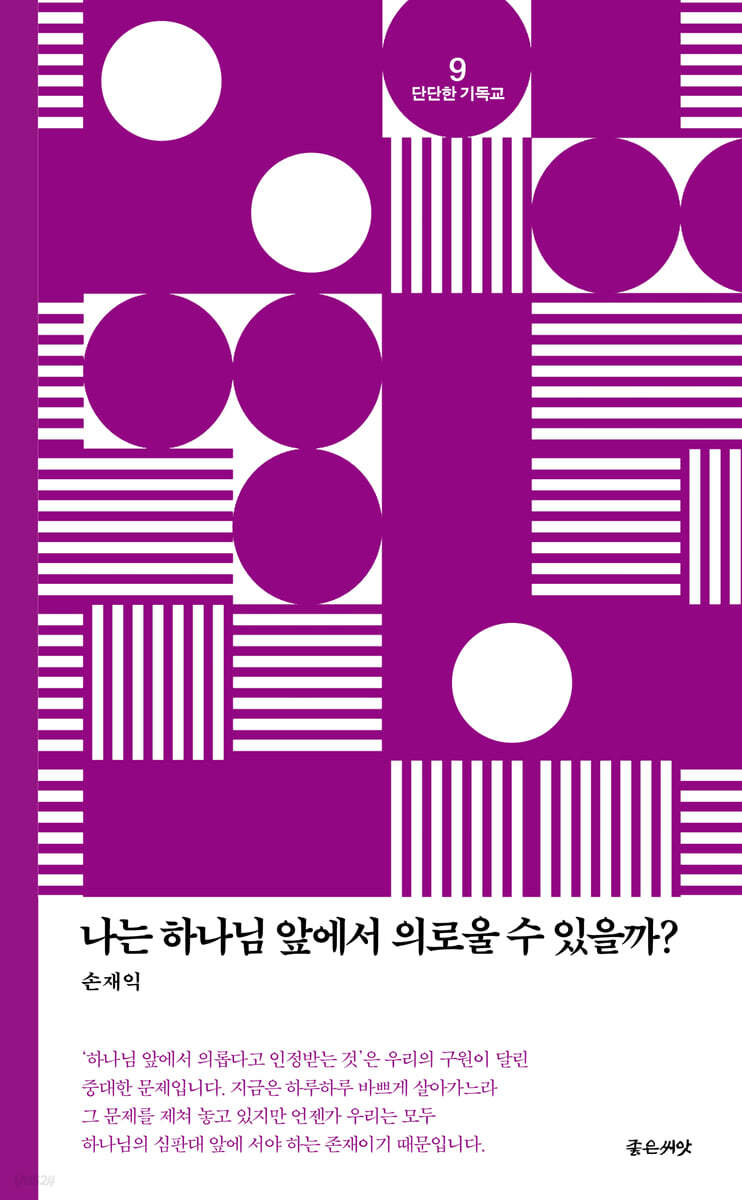
Can I be righteous before God?
 |
Description
Book Introduction
This is the ninth book in the "Solid Christianity" series, and it clearly illuminates the doctrine of justification by faith as learned from the Bible, confessions of faith, and catechism.
“Can a person be righteous before God?” This question was at the heart of the Reformation and a crucial question that taught the essence of the Christian faith.
Martin Luther initiated the Reformation amidst this struggle, and Calvin called it the essence of faith in his Institutes of the Christian Religion.
"Can I Be Righteous Before God?" explores, based on the Bible and the Reformed Confessions of Faith, how sinful humans can be declared righteous before God.
This book unravels the doctrine of justification based on the essence of the Reformed faith, including the Westminster Confession of Faith, the Heidelberg Catechism, and the Canons of Dort, and clearly illuminates the differences between the Roman Catholic and Reformed doctrines of justification.
“Can a person be righteous before God?” This question was at the heart of the Reformation and a crucial question that taught the essence of the Christian faith.
Martin Luther initiated the Reformation amidst this struggle, and Calvin called it the essence of faith in his Institutes of the Christian Religion.
"Can I Be Righteous Before God?" explores, based on the Bible and the Reformed Confessions of Faith, how sinful humans can be declared righteous before God.
This book unravels the doctrine of justification based on the essence of the Reformed faith, including the Westminster Confession of Faith, the Heidelberg Catechism, and the Canons of Dort, and clearly illuminates the differences between the Roman Catholic and Reformed doctrines of justification.
- You can preview some of the book's contents.
Preview
index
Recommendation Letterㆍ6
Opening Remarksㆍ8
1.
Holy God, Sinful Manㆍ15
2.
People Who Cannot Be Justified by Law and Worksㆍ29
3.
Christ, the Righteousness of Godㆍ35
4.
The righteousness of Christ is given to meㆍ47
5.
Justification by Faith Aloneㆍ57
6.
Is Action Necessary?ㆍ71
Appendix_ Roman Catholicism's Doctrine of Justificationㆍ84
Closing Remarksㆍ92
Author's Noteㆍ99
Recommended Reading on Justificationㆍ101
Americasㆍ105
Opening Remarksㆍ8
1.
Holy God, Sinful Manㆍ15
2.
People Who Cannot Be Justified by Law and Worksㆍ29
3.
Christ, the Righteousness of Godㆍ35
4.
The righteousness of Christ is given to meㆍ47
5.
Justification by Faith Aloneㆍ57
6.
Is Action Necessary?ㆍ71
Appendix_ Roman Catholicism's Doctrine of Justificationㆍ84
Closing Remarksㆍ92
Author's Noteㆍ99
Recommended Reading on Justificationㆍ101
Americasㆍ105
Into the book
We have never experienced a state of sinlessness.
So I'm not sure what it means to be completely holy.
To help you understand, let me give you an analogy.
Put a very small dot on a blank sheet of paper.
So, is it a pure white sheet of paper? It may seem so to our eyes, but a closer look with a magnifying glass reveals otherwise.
In reality, it is not a blank sheet of paper.
There should not be even a 0.00001 millimeter dot in it.
Only then will it truly be a blank sheet of paper.
That perfect whiteness can be likened to the holiness of God.
--- 「1.
From “Holy God, Sinful Man”
No one can practice perfectly.
To do that, the motive, process, and result must all be good.
But no one can do that.
Even the holiest person in the world would be unable to do such a thing.
No one who has ever lived has ever kept the law perfectly.
Even people who have served their neighbors their entire lives commit sins.
Unfortunately, the many sins we commit cannot be remedied by our good deeds.
You can't say, "I did one good deed, so please forgive me for the sin I committed last time."
The sin remains.
--- 「2.
Among those who cannot be justified by the law and works
A sinner cannot be righteous before a holy God.
No matter how hard you try, the problem of sin will not be solved.
There are ways to keep the law, but you can never keep all of the law and therefore be righteous.
So what should we do? Is there really no other way than to wait for God's punishment?
--- 「3.
From “Christ, the Righteousness of God”
What sin could the goat have committed? The goat has committed no sin.
It is a flawless goat.
But when Aaron laid his hands on the goat, it would bear all the iniquities and sins of the Israelites.
The sin is transferred to the goat.
It's passed on.
The sins of all the people of Israel are now transferred to the innocent goat.
A goat will bear the sins of the Israelites.
The goat carries the sins of the people and goes to an inaccessible land, a vast wilderness.
In that place where there is no one, he eventually meets death.
In this way, all the people of Israel receive atonement.
--- 「4.
From “The Righteousness of Christ to Me”
The word “only” here is an expression added during the translation process.
This word is not found in the Greek Bible or the English translation, and was probably added by the Korean Bible translators.
The expression “only” does not appear in other Korean translations of the Bible, such as the Common Translation and the New Standard Version.
--- 「5.
From “Justification by Faith Alone”
Even though the teachings of the Bible are so clear, people at the time the Bible was written had such misunderstandings.
The question was whether emphasizing faith would lead to neglecting actions.
Of course, Luther was also misunderstood.
Luther was accused of being an abolitionist by the Roman Catholic Church at the time, claiming that his enlightenment and teachings were leading believers to lead licentious lives.
So I'm not sure what it means to be completely holy.
To help you understand, let me give you an analogy.
Put a very small dot on a blank sheet of paper.
So, is it a pure white sheet of paper? It may seem so to our eyes, but a closer look with a magnifying glass reveals otherwise.
In reality, it is not a blank sheet of paper.
There should not be even a 0.00001 millimeter dot in it.
Only then will it truly be a blank sheet of paper.
That perfect whiteness can be likened to the holiness of God.
--- 「1.
From “Holy God, Sinful Man”
No one can practice perfectly.
To do that, the motive, process, and result must all be good.
But no one can do that.
Even the holiest person in the world would be unable to do such a thing.
No one who has ever lived has ever kept the law perfectly.
Even people who have served their neighbors their entire lives commit sins.
Unfortunately, the many sins we commit cannot be remedied by our good deeds.
You can't say, "I did one good deed, so please forgive me for the sin I committed last time."
The sin remains.
--- 「2.
Among those who cannot be justified by the law and works
A sinner cannot be righteous before a holy God.
No matter how hard you try, the problem of sin will not be solved.
There are ways to keep the law, but you can never keep all of the law and therefore be righteous.
So what should we do? Is there really no other way than to wait for God's punishment?
--- 「3.
From “Christ, the Righteousness of God”
What sin could the goat have committed? The goat has committed no sin.
It is a flawless goat.
But when Aaron laid his hands on the goat, it would bear all the iniquities and sins of the Israelites.
The sin is transferred to the goat.
It's passed on.
The sins of all the people of Israel are now transferred to the innocent goat.
A goat will bear the sins of the Israelites.
The goat carries the sins of the people and goes to an inaccessible land, a vast wilderness.
In that place where there is no one, he eventually meets death.
In this way, all the people of Israel receive atonement.
--- 「4.
From “The Righteousness of Christ to Me”
The word “only” here is an expression added during the translation process.
This word is not found in the Greek Bible or the English translation, and was probably added by the Korean Bible translators.
The expression “only” does not appear in other Korean translations of the Bible, such as the Common Translation and the New Standard Version.
--- 「5.
From “Justification by Faith Alone”
Even though the teachings of the Bible are so clear, people at the time the Bible was written had such misunderstandings.
The question was whether emphasizing faith would lead to neglecting actions.
Of course, Luther was also misunderstood.
Luther was accused of being an abolitionist by the Roman Catholic Church at the time, claiming that his enlightenment and teachings were leading believers to lead licentious lives.
--- 「6.
Is action unnecessary?
Is action unnecessary?
Publisher's Review
ㆍA summary of the core principles of biblical justification
This book explains in detail the nature of justification as described in the Bible, clearly presenting the biblical teaching that we are justified by faith alone.
ㆍExplanation based on the Reformed confessions and creeds
Based on Reformed documents such as the Westminster Confession of Faith, the Heidelberg Catechism, and the Canons of Dort, this book systematically organizes how the doctrine of justification has been understood and taught throughout Christian history.
ㆍExplanation of the principle of justification by faith alone, not by works of the law.
It emphasizes that justification is achieved entirely by the grace of Christ, not by human works or merit, and clearly distinguishes between the Roman Catholic concept of justification (justificatio) and the 'justification by faith alone' taught by Reformed theology.
ㆍPractical application and connection to the lives of saints
Justification is not a mere doctrine; it is a truth that forms the foundation of Christian faith and life.
This book helps readers examine their faith and realize the true gospel.
Benefits to readers
√ You can clearly understand the biblical doctrine of justification.
√ You can correctly define the relationship between the law and the gospel.
√ You can learn the doctrine of justification taught in the Reformed Confession of Faith.
√ You can examine your own faith and realize the true meaning of the gospel.
√ You can experience that the gospel is not just a doctrine, but a power that changes lives.
"Justification is the doctrine by which the church stands and falls."
I hope that through this book, believers will understand the true gospel and clearly see the path to righteousness before God.
This book explains in detail the nature of justification as described in the Bible, clearly presenting the biblical teaching that we are justified by faith alone.
ㆍExplanation based on the Reformed confessions and creeds
Based on Reformed documents such as the Westminster Confession of Faith, the Heidelberg Catechism, and the Canons of Dort, this book systematically organizes how the doctrine of justification has been understood and taught throughout Christian history.
ㆍExplanation of the principle of justification by faith alone, not by works of the law.
It emphasizes that justification is achieved entirely by the grace of Christ, not by human works or merit, and clearly distinguishes between the Roman Catholic concept of justification (justificatio) and the 'justification by faith alone' taught by Reformed theology.
ㆍPractical application and connection to the lives of saints
Justification is not a mere doctrine; it is a truth that forms the foundation of Christian faith and life.
This book helps readers examine their faith and realize the true gospel.
Benefits to readers
√ You can clearly understand the biblical doctrine of justification.
√ You can correctly define the relationship between the law and the gospel.
√ You can learn the doctrine of justification taught in the Reformed Confession of Faith.
√ You can examine your own faith and realize the true meaning of the gospel.
√ You can experience that the gospel is not just a doctrine, but a power that changes lives.
"Justification is the doctrine by which the church stands and falls."
I hope that through this book, believers will understand the true gospel and clearly see the path to righteousness before God.
GOODS SPECIFICS
- Date of issue: January 20, 2025
- Page count, weight, size: 112 pages | 130*210*20mm
- ISBN13: 9788958744115
- ISBN10: 8958744111
You may also like
카테고리
korean


korean

![GQ KOREA Mark (Monthly): December [2025]](http://librairie.coreenne.fr/cdn/shop/files/8ef265dbbfbf186523ed75ba7319009d.jpg?v=1765340328&width=3840)


