

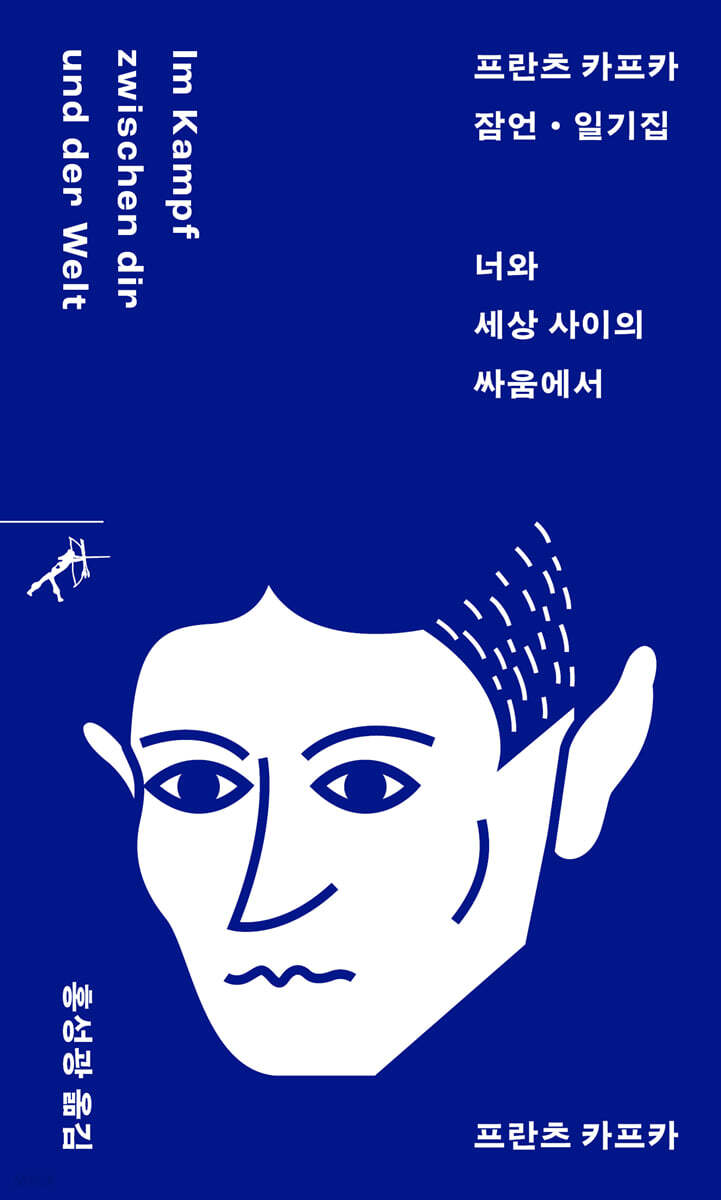
In the fight between you and the world
 |
Description
Book Introduction
A collection of proverbs and diaries commemorating the 100th anniversary of Franz Kafka's death.
Proverbs containing Kafka's thoughts, worldview, and religious views
Kafka's diary, filled with his anxiety, love, and passion for literature.
Proverbs containing Kafka's thoughts, worldview, and religious views
Kafka's diary, filled with his anxiety, love, and passion for literature.
- You can preview some of the book's contents.
Preview
index
Proverbs 7
Diary - 53
Commentary - 121
Diary - 53
Commentary - 121
Into the book
“Humans have free will.
There are three types of it.
First, man was free when he wanted this life, but now, of course, he can no longer turn it back.
Because he wasn't the person who wanted that life at the time.
However, if you live and put into practice the will of the time, it may be possible.
Second, humans are free in that they can choose the way and direction of their lives.
Third, as someone who will exist again someday, humans are free in that they can move through life under any conditions and have the will to return to themselves in this way.
Moreover, it is free in that it is a maze-like path, although it is a choice path.
But humans cannot pass through this path without touching some point in this life.
These are the three properties of free will.
But these three exist simultaneously, so they are one.
In fact, it is so one that there is no space for will, whether free or not.”
---From "Proverbs"
“The anxiety that must be endured from all sides.
The doctor's examination seemed to be directed straight at me.
I reveal my true self.
“I keep his empty words within me, and I despise them, but I do not refute them.”
There are three types of it.
First, man was free when he wanted this life, but now, of course, he can no longer turn it back.
Because he wasn't the person who wanted that life at the time.
However, if you live and put into practice the will of the time, it may be possible.
Second, humans are free in that they can choose the way and direction of their lives.
Third, as someone who will exist again someday, humans are free in that they can move through life under any conditions and have the will to return to themselves in this way.
Moreover, it is free in that it is a maze-like path, although it is a choice path.
But humans cannot pass through this path without touching some point in this life.
These are the three properties of free will.
But these three exist simultaneously, so they are one.
In fact, it is so one that there is no space for will, whether free or not.”
---From "Proverbs"
“The anxiety that must be endured from all sides.
The doctor's examination seemed to be directed straight at me.
I reveal my true self.
“I keep his empty words within me, and I despise them, but I do not refute them.”
---From "Diary"
Publisher's Review
A sign of 20th century literature, the author Franz Kafka, who created the most unique literary world of all time and is like an "axe breaking the frozen sea within," has compiled his diaries and proverbs into a book titled "Franz Kafka Proverbs? Diary_In the Fight Between You and the World" published by Minumsa in the Sossal Munko format.
It includes excerpts from Kafka's diaries written from 1909 to 1922, as well as excerpts from the collection of proverbs, Reflections on Sin, Anguish, Hope and the True Path, published by Max Brod in 1920, including 'On the State of False Death'.
Kafka's diaries contain autobiographical reflections, his own views on writing, as well as drafts of novels and short stories.
Kafka recorded aphorisms containing his thoughts, worldview, and religious views in an eight-section notebook between 1917 and the spring of 1918. 『Franz Kafka Proverbs? Diary_In the Fight Between You and the World』 does not include all of them, but rather excerpts that are key to understanding Kafka.
Through Kafka's proverbs and diary entries included in this book, readers can not only get a full picture of Kafka's true self, but also learn about a side of him that is different from the commonly known impression of him.
In particular, when we look at the diary, the bizarre and absurd, unpredictable image felt in Kafka's works disappears, and the image of a serious, romantic, lyrical and passionate lover appears.
Kafka's Proverbs
Words that frequently appear in Kafka's proverbs are world, life, human, and road.
Judging from the fact that the path Kafka speaks of has something in common with the Tao of Taoist thought, it seems that Kafka was interested in and read Confucius's Analects, Laozi's Tao Te Ching, and Zhuangzi's Nan Hua Jing.
Kafka's aphorisms and prose complement each other and form a single whole, so reading proverbs is helpful in understanding Kafka's prose.
In Kafka's writing style, resolution is difficult as long as life continues, and resolution becomes meaningless the moment life ends.
For Kafka, writing is a kind of séance.
As a Jew who considered emigrating to Palestine and even learned Hebrew, Kafka was also deeply interested in Eastern Jewish religion and culture, and this foundation had an invisible influence on his work.
According to Gustav Janouch, author of Conversations with Kafka, Kafka was a man struggling to find an authentic life.
After having numerous conversations with Kafka and keenly observing Kafka's quiet struggle for human existence, Janouch wrote:
“It is a force associated with anxiety and delicacy, and Kafka considered every little thing important.”
Kafka's Diary
Kafka began keeping a diary in earnest in 1910, and after meeting and befriending Felice Bauer in 1912, he wrote numerous letters and wrote his honest feelings in his diary.
Kafka's diary is an inner record that he never intended to show to others.
The diary honestly records discussions about book editing with Max Brod, handing over the diary to Milena, being scolded by her father with whom she had a love-hate relationship, and thoughts about tuberculosis.
Kafka confesses that his two engagements to Felice Bauer, and the subsequent break-up of them, led to a serious illness caused by insomnia and headaches, which ultimately led to the gushing of blood from overwork.
Kafka's intimate diary has the character of a romance novel, and its central axis is anxiety.
It centers around not only anxiety about illness, but also anxiety as a Jew who has lost his homeland, and the metaphysical anxiety of life.
Milena Jesenska, Kafka's lover, received his diary and the manuscript of his unfinished novel, The Disappeared, in 1921.
According to records, Kafka maintained a strictly austere lifestyle to make time for writing.
I finished work at the company from 8 AM to 2 PM, came home, and slept from 3 PM to 7:30 PM.
Then I took a walk for about an hour with friends or alone, and had dinner with my family.
After that, I started writing around 11 PM and wrote until 2 or 3 AM, or even later.
Kafka's life was all about literature.
For Kafka, who could not settle for reality and dreamed of freedom and liberation by going beyond the walls of reality, reality became literature and literature became reality.
According to the memoirs of Georg Langer, a Jewish writer and friend of Kafka, when Kafka asked Langer to burn his unpublished writings, Langer asked him why he would write and publish them if that was the case.
Then Kafka replied:
“I don’t know either.
Despite all that, something compels me to remember.” Kafka’s writings may have been flawed works that should have been burned, but the many writings he left behind are precious records that are essential for looking into the profound world of the writer Kafka today.
It includes excerpts from Kafka's diaries written from 1909 to 1922, as well as excerpts from the collection of proverbs, Reflections on Sin, Anguish, Hope and the True Path, published by Max Brod in 1920, including 'On the State of False Death'.
Kafka's diaries contain autobiographical reflections, his own views on writing, as well as drafts of novels and short stories.
Kafka recorded aphorisms containing his thoughts, worldview, and religious views in an eight-section notebook between 1917 and the spring of 1918. 『Franz Kafka Proverbs? Diary_In the Fight Between You and the World』 does not include all of them, but rather excerpts that are key to understanding Kafka.
Through Kafka's proverbs and diary entries included in this book, readers can not only get a full picture of Kafka's true self, but also learn about a side of him that is different from the commonly known impression of him.
In particular, when we look at the diary, the bizarre and absurd, unpredictable image felt in Kafka's works disappears, and the image of a serious, romantic, lyrical and passionate lover appears.
Kafka's Proverbs
Words that frequently appear in Kafka's proverbs are world, life, human, and road.
Judging from the fact that the path Kafka speaks of has something in common with the Tao of Taoist thought, it seems that Kafka was interested in and read Confucius's Analects, Laozi's Tao Te Ching, and Zhuangzi's Nan Hua Jing.
Kafka's aphorisms and prose complement each other and form a single whole, so reading proverbs is helpful in understanding Kafka's prose.
In Kafka's writing style, resolution is difficult as long as life continues, and resolution becomes meaningless the moment life ends.
For Kafka, writing is a kind of séance.
As a Jew who considered emigrating to Palestine and even learned Hebrew, Kafka was also deeply interested in Eastern Jewish religion and culture, and this foundation had an invisible influence on his work.
According to Gustav Janouch, author of Conversations with Kafka, Kafka was a man struggling to find an authentic life.
After having numerous conversations with Kafka and keenly observing Kafka's quiet struggle for human existence, Janouch wrote:
“It is a force associated with anxiety and delicacy, and Kafka considered every little thing important.”
Kafka's Diary
Kafka began keeping a diary in earnest in 1910, and after meeting and befriending Felice Bauer in 1912, he wrote numerous letters and wrote his honest feelings in his diary.
Kafka's diary is an inner record that he never intended to show to others.
The diary honestly records discussions about book editing with Max Brod, handing over the diary to Milena, being scolded by her father with whom she had a love-hate relationship, and thoughts about tuberculosis.
Kafka confesses that his two engagements to Felice Bauer, and the subsequent break-up of them, led to a serious illness caused by insomnia and headaches, which ultimately led to the gushing of blood from overwork.
Kafka's intimate diary has the character of a romance novel, and its central axis is anxiety.
It centers around not only anxiety about illness, but also anxiety as a Jew who has lost his homeland, and the metaphysical anxiety of life.
Milena Jesenska, Kafka's lover, received his diary and the manuscript of his unfinished novel, The Disappeared, in 1921.
According to records, Kafka maintained a strictly austere lifestyle to make time for writing.
I finished work at the company from 8 AM to 2 PM, came home, and slept from 3 PM to 7:30 PM.
Then I took a walk for about an hour with friends or alone, and had dinner with my family.
After that, I started writing around 11 PM and wrote until 2 or 3 AM, or even later.
Kafka's life was all about literature.
For Kafka, who could not settle for reality and dreamed of freedom and liberation by going beyond the walls of reality, reality became literature and literature became reality.
According to the memoirs of Georg Langer, a Jewish writer and friend of Kafka, when Kafka asked Langer to burn his unpublished writings, Langer asked him why he would write and publish them if that was the case.
Then Kafka replied:
“I don’t know either.
Despite all that, something compels me to remember.” Kafka’s writings may have been flawed works that should have been burned, but the many writings he left behind are precious records that are essential for looking into the profound world of the writer Kafka today.
GOODS SPECIFICS
- Date of issue: May 31, 2024
- Format: Paperback book binding method guide
- Page count, weight, size: 156 pages | 154g | 113*188*10mm
- ISBN13: 9788937438363
- ISBN10: 8937438364
You may also like
카테고리
korean


korean

![GQ KOREA Mark (Monthly): December [2025]](http://librairie.coreenne.fr/cdn/shop/files/8ef265dbbfbf186523ed75ba7319009d.jpg?v=1765340328&width=3840)


