

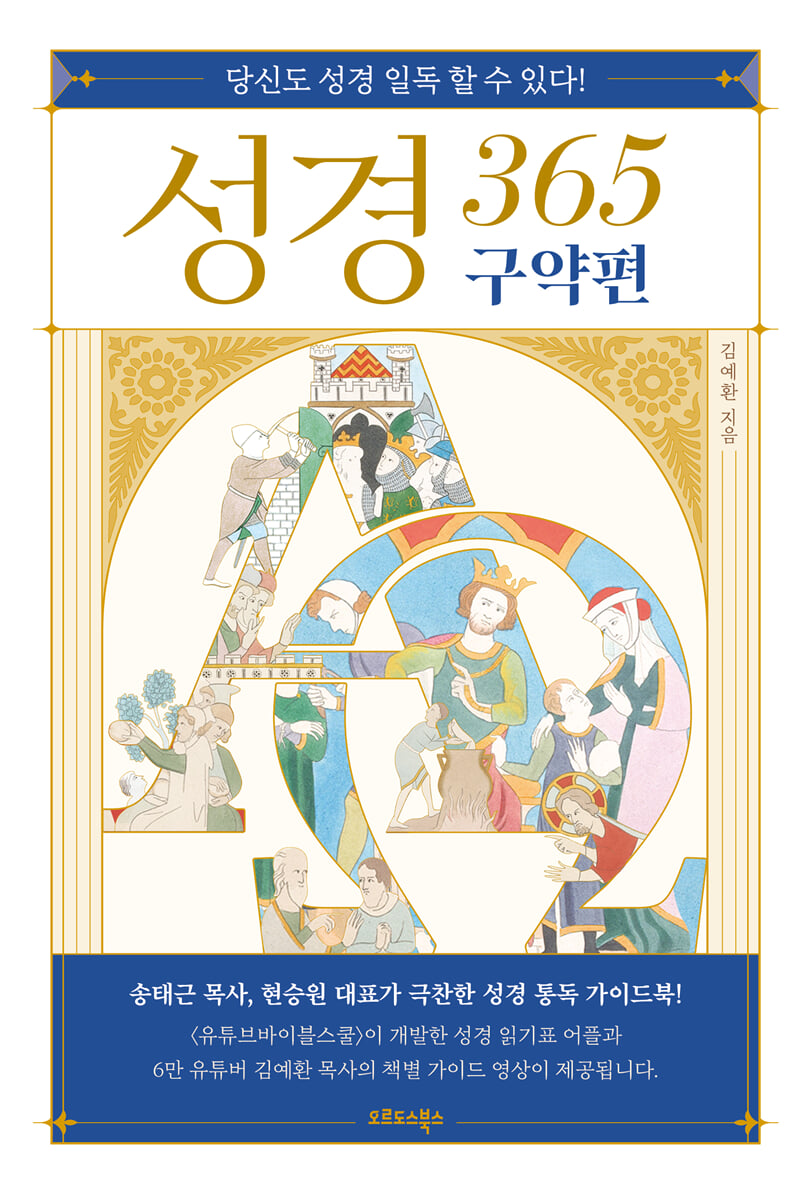
Bible 365 Old Testament
 |
Description
Book Introduction
*There has never been a more complete Bible reading guide!* *Korea's first! Read the entire Bible with [Guidebook + Bible Reading App + YouTube Lectures]!* *A Bible reading guidebook highly recommended by Pastor Song Tae-geun and CEO Hyun Seung-won! “As a regular subscriber to YouTube Bible School, I have been greatly helped by Pastor Kim Ye-hwan’s content whenever it comes out. “In particular, this ‘Bible 365’ is the final edition of the pastor’s books that covers all aspects of the Bible, including the Word, QT, and a general understanding of the Bible.” - Representative Hyun Seung-won “This book not only provides a quick understanding of the core message of each book of the Bible in a few easy sentences, but also provides a concise and clear summary of the historical and theological context of each book. “I would like to recommend this book not only to believers who wish to read the Bible in its entirety, but also to all readers who wish to study the Bible in detail, book by book.” - Pastor Song Tae-geun *The Bible reading content that has been a hit with the members of Samil Church (Yongsan) and the 60,000 subscribers of [YouTube Bible School] for the past several years has finally been published as a book! This book guides readers through the Bible chronologically, following the order in which it was written. Pastor Kim Ye-hwan's unique, easy-to-understand language not only summarizes the Bible's core elements, but also its historical background and theology, organized by book. Additionally, complex biblical events and theology are presented in a way that anyone can easily understand through pictures and tables. |
- You can preview some of the book's contents.
Preview
index
prolog
Bible 365 User Manual
Days 1-57: The Book of the Law
1.
Genesis: The Reason for Choice
2.
Exodus: Who Is God?
3.
Leviticus: Why Did He Save You?
4.
Numbers: God's Will for the Land
5.
Deuteronomy: Shema Yisrael
Days 58-106, Deuteronomy History
6.
Joshua: How will we win?
7.
Judges: Because there is no king?
8.
Ruth: Don't Go Empty-Handed
9.
1 Samuel: To obey is better than sacrifice.
10.
2 Samuel: A Heart Broken More Than a Sacrifice
11.
1 Kings: The Kingdom's Division and Idolatry
12.
2 Kings: The Sins of Jeroboam and Manasseh
Days 107-128, 8th century BC, Prophecy
13.
Hosea: Knowledge of God
14.
Amos: Let justice and righteousness flow.
15.
Jonah: How could I not spare you?
16.
Isaiah: God's Amazing Solution to Sin
17.
Micah: There is no one like you
Days 129-167 Prophecy of the 7th-6th century BC
18.
Nahum: Judgment is from God
19.
Zephaniah: Destruction and Return
20.
Jeremiah: The Weeping Prophet and the Stubborn People
21.
Habakkuk: Is this justice?
22.
Ezekiel: Jehovah Shammah
23.
Daniel: God's World Rule and Victory
24.24~25.
Lamentations and Obadiah: A Book of Comfort
Days 168-176: Poetry (1)
26.
Baby: Love is stronger than death
27.
Job: The Benefits of Suffering
Days 177-208: History and Prophecy of the Return
28. 1 Chronicles: David's Story for Those Who Returned
29.
2 Chronicles: Only the Covenant, Only the Temple
30.
Ezra: God's Work Flows Prosperously
31.
Haggai: God with the Covenant and the Spirit
32.
Zechariah: The Return of the King on a Donkey
33.
Nehemiah: A 52-Day Miracle
34.
Esther: Peripeteia
35.
Malachi: I will bring you back
36.
Joel: The Day of the Lord
Days 209-241: Poetry (2)
37.
Proverbs: Reading Proverbs in Christ
38.
Ecclesiastes: Faith for Now
39.
Psalms: Songs of David and Israel
Bible 365 User Manual
Days 1-57: The Book of the Law
1.
Genesis: The Reason for Choice
2.
Exodus: Who Is God?
3.
Leviticus: Why Did He Save You?
4.
Numbers: God's Will for the Land
5.
Deuteronomy: Shema Yisrael
Days 58-106, Deuteronomy History
6.
Joshua: How will we win?
7.
Judges: Because there is no king?
8.
Ruth: Don't Go Empty-Handed
9.
1 Samuel: To obey is better than sacrifice.
10.
2 Samuel: A Heart Broken More Than a Sacrifice
11.
1 Kings: The Kingdom's Division and Idolatry
12.
2 Kings: The Sins of Jeroboam and Manasseh
Days 107-128, 8th century BC, Prophecy
13.
Hosea: Knowledge of God
14.
Amos: Let justice and righteousness flow.
15.
Jonah: How could I not spare you?
16.
Isaiah: God's Amazing Solution to Sin
17.
Micah: There is no one like you
Days 129-167 Prophecy of the 7th-6th century BC
18.
Nahum: Judgment is from God
19.
Zephaniah: Destruction and Return
20.
Jeremiah: The Weeping Prophet and the Stubborn People
21.
Habakkuk: Is this justice?
22.
Ezekiel: Jehovah Shammah
23.
Daniel: God's World Rule and Victory
24.24~25.
Lamentations and Obadiah: A Book of Comfort
Days 168-176: Poetry (1)
26.
Baby: Love is stronger than death
27.
Job: The Benefits of Suffering
Days 177-208: History and Prophecy of the Return
28. 1 Chronicles: David's Story for Those Who Returned
29.
2 Chronicles: Only the Covenant, Only the Temple
30.
Ezra: God's Work Flows Prosperously
31.
Haggai: God with the Covenant and the Spirit
32.
Zechariah: The Return of the King on a Donkey
33.
Nehemiah: A 52-Day Miracle
34.
Esther: Peripeteia
35.
Malachi: I will bring you back
36.
Joel: The Day of the Lord
Days 209-241: Poetry (2)
37.
Proverbs: Reading Proverbs in Christ
38.
Ecclesiastes: Faith for Now
39.
Psalms: Songs of David and Israel
Detailed image

Into the book
Finally, the Hebrew people began their journey into the wilderness, led by the pillar of fire and cloud, leaving behind the overflowing Red Sea and the drowning Egyptian soldiers.
At that time, there were two roads leading to the Promised Land of Canaan: one was the 'way through the land of the Philistines' and the other was the 'way through the wilderness of the Red Sea' (Exodus 13:18-18).
Of the two routes, if you took the 'Way of the Land of the Philistines', you could reach the Promised Land in just a few days, while the 'Way of the Red Sea' was a long, circuitous route, but above all, it was an extremely harsh wilderness route, so it was actually a route that should never be chosen.
--- p.36, from “Exodus”
The promise of 'land and descendants' to Abraham was also literally fulfilled over a long period of time, despite Israel's unfaithfulness.
Of course, no one can blame God if he were to break his promise.
However, God places limits on His own promises and ultimately fulfills them throughout history.
That is the God that the Bible has always emphasized.
Therefore, from 2 Samuel 7 onwards, we need to watch with interest to see how God fulfills the promise He made to David.
How will God preserve David's throne amidst the countless ups and downs of history? And how will he simultaneously fulfill his more fundamental promise to save humanity?
--- p.129, from 2 Samuel
It is also necessary to look at the deeds of Elijah and Elisha. First of all, Elijah overlaps with Moses in many ways.
The first is that Moses, pretending to be a hero, fled into the wilderness and later reached Mount Horeb, where he met God (Exodus 3).
Similarly, Elijah, exhausted from his ministry, ran away and met God at Mount Horeb (1 Kings 19).
Second, Moses died in the nearby land of Moab while looking out over the land of Canaan, and Elijah also met his end in Gilgal, near Canaan (2 Kings 2:1).
The third and final one is that in Deuteronomy 34:6, it is recorded that after Moses died, no one could find a trace of him, but strangely enough, Elijah also ascended to heaven and there was no trace of him (2 Kings 2:11).
--- p.151, from “2 Kings”
Baal, the native god of Canaan, Hadad, the god of Aram, Chemosh or Milcom, the god of Moab and Ammon east of the Jordan, and Dagon of the Philistines—these were all gods so greedy and obscene that they could not even reach the level of higher religions, and they were infinitely cruel to the weak.
Israel was so blinded by their desires that they were busy serving such gods rather than Jehovah, but if only they had ears to hear the prophecies of the prophets Jehovah sent, everyone would have confessed, “Who is a god like the Lord?”
It is now time to listen to the message of Micah, the last of the 8th century BC prophets.
Micah's name means, "Who is a God like the Lord?" (7:18), and as you read the book of Micah, you will experience the same wonder and admiration as his name.
--- p.211, from "Micah"
Meditating on the Song of Songs requires a great deal of imagination.
This book is because it depicts the love and marriage of a passionately loving man and woman in a 'musical format' to tell the story of what love is.
The male and female protagonists take turns singing, and behind them, a 'choir' (variously composed) of 'women' and 'men' sings.
This song is a story.
The story consists of seven acts, and the first act is set at a 'wedding'.
The story structure is deductive.
Even though it may be old-fashioned, isn't the wedding the culmination of love?
--- p.351, from "Aga"
The Book of Joel begins with a story about a terrible plague of locusts.
Some argue that the plague of locusts in Joel 1 should be interpreted as a metaphor, but the description of the plague is too realistic and specific to be interpreted that way.
Also, when locusts are used as a metaphor in the prophetic books, they are usually expressed in a simile manner, such as “like locusts” (Nahum 3:15, 17, Jeremiah 51:27, Isaiah 40:22, etc.).
Therefore, it seems more reasonable to view the locust plague described in Chapter 1 as an actual event.
At that time, there were two roads leading to the Promised Land of Canaan: one was the 'way through the land of the Philistines' and the other was the 'way through the wilderness of the Red Sea' (Exodus 13:18-18).
Of the two routes, if you took the 'Way of the Land of the Philistines', you could reach the Promised Land in just a few days, while the 'Way of the Red Sea' was a long, circuitous route, but above all, it was an extremely harsh wilderness route, so it was actually a route that should never be chosen.
--- p.36, from “Exodus”
The promise of 'land and descendants' to Abraham was also literally fulfilled over a long period of time, despite Israel's unfaithfulness.
Of course, no one can blame God if he were to break his promise.
However, God places limits on His own promises and ultimately fulfills them throughout history.
That is the God that the Bible has always emphasized.
Therefore, from 2 Samuel 7 onwards, we need to watch with interest to see how God fulfills the promise He made to David.
How will God preserve David's throne amidst the countless ups and downs of history? And how will he simultaneously fulfill his more fundamental promise to save humanity?
--- p.129, from 2 Samuel
It is also necessary to look at the deeds of Elijah and Elisha. First of all, Elijah overlaps with Moses in many ways.
The first is that Moses, pretending to be a hero, fled into the wilderness and later reached Mount Horeb, where he met God (Exodus 3).
Similarly, Elijah, exhausted from his ministry, ran away and met God at Mount Horeb (1 Kings 19).
Second, Moses died in the nearby land of Moab while looking out over the land of Canaan, and Elijah also met his end in Gilgal, near Canaan (2 Kings 2:1).
The third and final one is that in Deuteronomy 34:6, it is recorded that after Moses died, no one could find a trace of him, but strangely enough, Elijah also ascended to heaven and there was no trace of him (2 Kings 2:11).
--- p.151, from “2 Kings”
Baal, the native god of Canaan, Hadad, the god of Aram, Chemosh or Milcom, the god of Moab and Ammon east of the Jordan, and Dagon of the Philistines—these were all gods so greedy and obscene that they could not even reach the level of higher religions, and they were infinitely cruel to the weak.
Israel was so blinded by their desires that they were busy serving such gods rather than Jehovah, but if only they had ears to hear the prophecies of the prophets Jehovah sent, everyone would have confessed, “Who is a god like the Lord?”
It is now time to listen to the message of Micah, the last of the 8th century BC prophets.
Micah's name means, "Who is a God like the Lord?" (7:18), and as you read the book of Micah, you will experience the same wonder and admiration as his name.
--- p.211, from "Micah"
Meditating on the Song of Songs requires a great deal of imagination.
This book is because it depicts the love and marriage of a passionately loving man and woman in a 'musical format' to tell the story of what love is.
The male and female protagonists take turns singing, and behind them, a 'choir' (variously composed) of 'women' and 'men' sings.
This song is a story.
The story consists of seven acts, and the first act is set at a 'wedding'.
The story structure is deductive.
Even though it may be old-fashioned, isn't the wedding the culmination of love?
--- p.351, from "Aga"
The Book of Joel begins with a story about a terrible plague of locusts.
Some argue that the plague of locusts in Joel 1 should be interpreted as a metaphor, but the description of the plague is too realistic and specific to be interpreted that way.
Also, when locusts are used as a metaphor in the prophetic books, they are usually expressed in a simile manner, such as “like locusts” (Nahum 3:15, 17, Jeremiah 51:27, Isaiah 40:22, etc.).
Therefore, it seems more reasonable to view the locust plague described in Chapter 1 as an actual event.
--- p.420, from "Joel"
Publisher's Review
Pastor Kim Ye-hwan, author of “Bible 365,” has been working hard to teach the Bible to believers in the field for a long time.
In particular, the two books, “Traveling the Bible” and “Bible Spectrum,” which deal with the history of salvation in the Bible, are widely loved by Korean churches to the point that they are about to enter their sixth printing.
Unlike existing books that have covered the broad framework of biblical history or biblical theology, this book is particularly significant in that it painstakingly organizes the core of the 66 books of the Bible, one by one, as if it were embroidering them.
In particular, this book is a compilation of the research and study that the author, Pastor Kim Ye-hwan, conducted while reading the Bible chronologically with 700 students and 60,000 YouTube subscribers during the harsh COVID-19 period.
Therefore, I am confident that this book will be very helpful to all believers who wish to read the entire Bible or study it book by book.
This book has the following four characteristics:
First, Pastor Kim Ye-hwan's characteristically simple language and outstanding insight clearly organized the historical background, paragraph structure, and key themes of each book of the Bible.
Second, for believers who wish to read the Bible in chronological order, the books are organized by era.
Third, in addition to the book itself, you can read the entire book by following the reading schedule through a dedicated app and use the guide video for each book.
Fourth, numerous tables and figures have been included to facilitate a more three-dimensional and efficient understanding of the complex historical background and theology.
If you follow the guide in this book and read and study the Bible, you will have the amazing experience of grasping the core content of each scripture with surprising ease and speed, and immersing yourself in the deep grace of the Bible.
"Bible 365" is a book for those who are challenging themselves to read the entire Bible, those who want to study each book of the Bible in more detail, and all who want to understand and know the Bible more deeply.
In particular, the two books, “Traveling the Bible” and “Bible Spectrum,” which deal with the history of salvation in the Bible, are widely loved by Korean churches to the point that they are about to enter their sixth printing.
Unlike existing books that have covered the broad framework of biblical history or biblical theology, this book is particularly significant in that it painstakingly organizes the core of the 66 books of the Bible, one by one, as if it were embroidering them.
In particular, this book is a compilation of the research and study that the author, Pastor Kim Ye-hwan, conducted while reading the Bible chronologically with 700 students and 60,000 YouTube subscribers during the harsh COVID-19 period.
Therefore, I am confident that this book will be very helpful to all believers who wish to read the entire Bible or study it book by book.
This book has the following four characteristics:
First, Pastor Kim Ye-hwan's characteristically simple language and outstanding insight clearly organized the historical background, paragraph structure, and key themes of each book of the Bible.
Second, for believers who wish to read the Bible in chronological order, the books are organized by era.
Third, in addition to the book itself, you can read the entire book by following the reading schedule through a dedicated app and use the guide video for each book.
Fourth, numerous tables and figures have been included to facilitate a more three-dimensional and efficient understanding of the complex historical background and theology.
If you follow the guide in this book and read and study the Bible, you will have the amazing experience of grasping the core content of each scripture with surprising ease and speed, and immersing yourself in the deep grace of the Bible.
"Bible 365" is a book for those who are challenging themselves to read the entire Bible, those who want to study each book of the Bible in more detail, and all who want to understand and know the Bible more deeply.
GOODS SPECIFICS
- Date of issue: January 11, 2024
- Page count, weight, size: 464 pages | 662g | 152*225*23mm
- ISBN13: 9791197919961
- ISBN10: 1197919961
You may also like
카테고리
korean


korean

![GQ KOREA Mark (Monthly): December [2025]](http://librairie.coreenne.fr/cdn/shop/files/8ef265dbbfbf186523ed75ba7319009d.jpg?v=1765340328&width=3840)


