

People of the Old Testament
 |
Description
Book Introduction
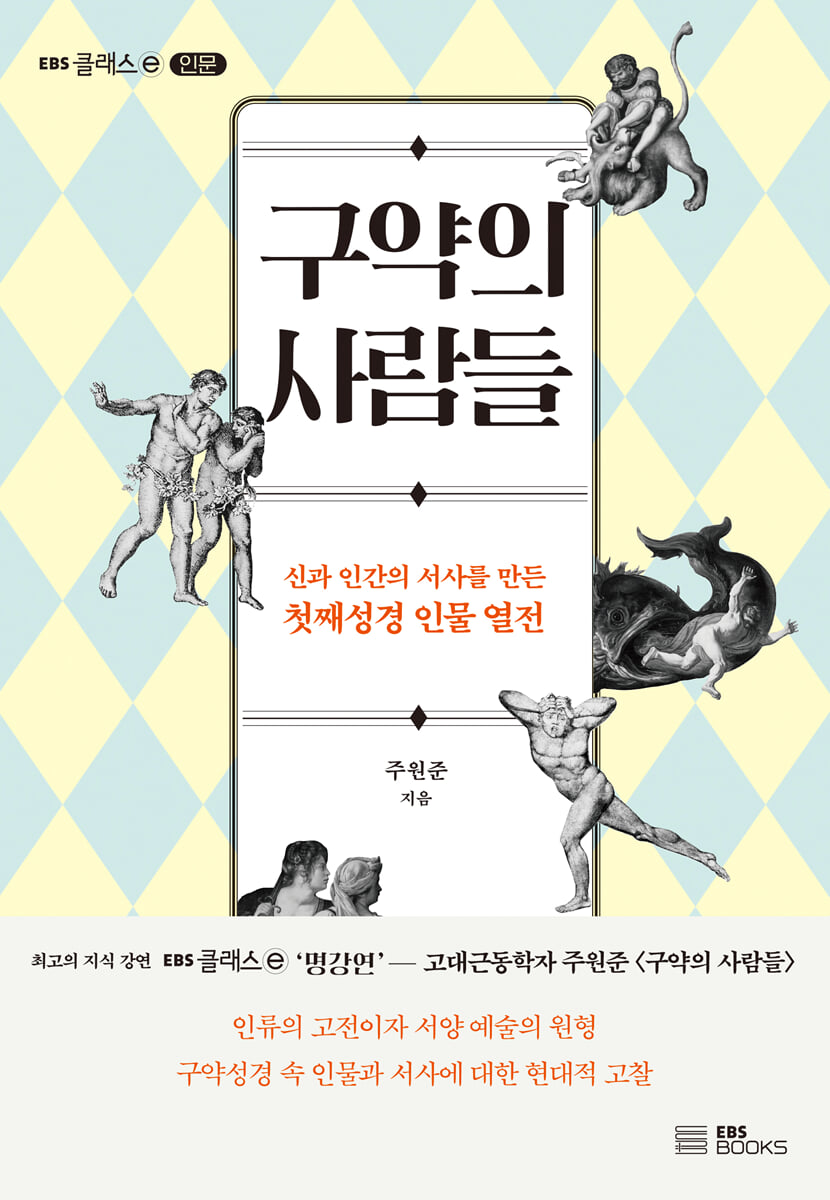
The Best Knowledge Lecture EBS Classⓔ 'Famous Lecture' -- Ancient Near Eastern Scholar Wonjun Joo's "People of the Old Testament"
A classic of humanity and the prototype of Western art
A Modern Look at the Characters and Narratives of the Old Testament
Ancient Near Eastern scholar Wonjun Joo names each character in the First Bible (Old Testament) and tells their true stories.
We examine these myths in the context of the ancient Near East, alongside other myths, while also delving into their lives against a historical backdrop to offer new reflections and interpretations.
Above all, it revives the present meaning of the story that God tells us.
From the first humans, 'Adam and Eve', to the icon of obedience, 'Job', the story unfolds through the most famous figures of the Old Testament, as well as the women of the Genesis family, 'Judith' who saved a weak nation, and 'Ilimalku', the scribe of Ugarit, a city-state referenced by Israel, each story is colorful and completes the big picture.
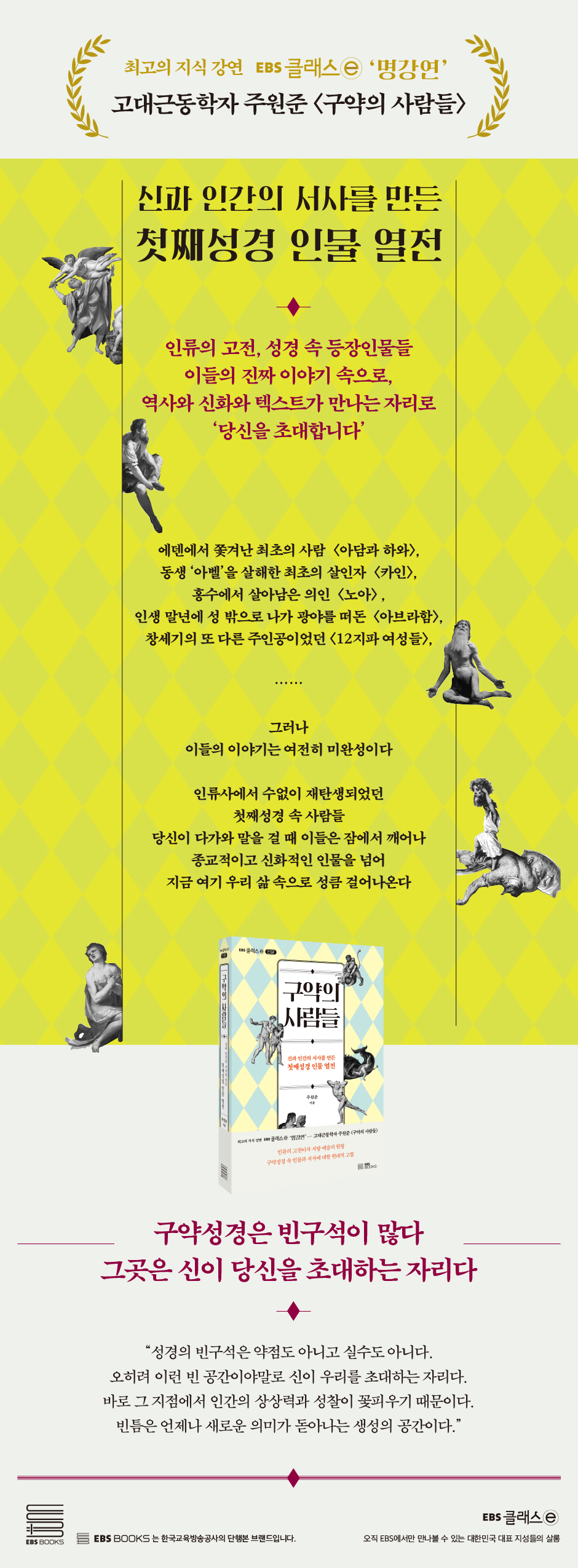
The Bible has many blank spaces.
Reading the gaps, omissions, and leaps is an active participation of the reader.
Through this, numerous artists and philosophers have brought new meaning to it.
The author repeatedly emphasizes that “these ‘empty corners’ are the greatest thing about the first Bible” and “the place where God invites you.”
The first people in the Bible who have been called and revived countless times throughout human history.
But their story remains unfinished.
When we open the black cover and approach them to speak, they awaken from their slumber and step beyond religious and mythological figures into our lives here and now.
“I recommend a subversive perspective that values the little ones and finds hope in marginalized areas.” ―From the text
A classic of humanity and the prototype of Western art
A Modern Look at the Characters and Narratives of the Old Testament
Ancient Near Eastern scholar Wonjun Joo names each character in the First Bible (Old Testament) and tells their true stories.
We examine these myths in the context of the ancient Near East, alongside other myths, while also delving into their lives against a historical backdrop to offer new reflections and interpretations.
Above all, it revives the present meaning of the story that God tells us.
From the first humans, 'Adam and Eve', to the icon of obedience, 'Job', the story unfolds through the most famous figures of the Old Testament, as well as the women of the Genesis family, 'Judith' who saved a weak nation, and 'Ilimalku', the scribe of Ugarit, a city-state referenced by Israel, each story is colorful and completes the big picture.
The Bible has many blank spaces.
Reading the gaps, omissions, and leaps is an active participation of the reader.
Through this, numerous artists and philosophers have brought new meaning to it.
The author repeatedly emphasizes that “these ‘empty corners’ are the greatest thing about the first Bible” and “the place where God invites you.”
The first people in the Bible who have been called and revived countless times throughout human history.
But their story remains unfinished.
When we open the black cover and approach them to speak, they awaken from their slumber and step beyond religious and mythological figures into our lives here and now.
“I recommend a subversive perspective that values the little ones and finds hope in marginalized areas.” ―From the text
- You can preview some of the book's contents.
Preview
index
In publishing a book
1 Adam and Eve - The history of humans and God began
2 Cain and Abel - We are descendants of forgiven sinners.
3 Noah - Only the righteous survived
4 Abraham - God Outside the City, People Outside the City
Genesis 5 - The Grandmothers of a Small Family
6 Joseph - A Lost Brother is Hope
7 Moses - My Outward Gaze
8 Samson - The hero overthrows
9 David - Rise above your mistakes
10 Judith - The Story of a Female Hero Who Saved Her Nation
11 Ilimalku - Ugarit, the city-state referenced by Israel
12 Elijah - The unique ministry began from below
13 Jeremiah - The Exquisite History of a Resistance Prophet
14 Jonah - What is a Calling?
Job 15 - Who is the righteous man who suffers?
1 Adam and Eve - The history of humans and God began
2 Cain and Abel - We are descendants of forgiven sinners.
3 Noah - Only the righteous survived
4 Abraham - God Outside the City, People Outside the City
Genesis 5 - The Grandmothers of a Small Family
6 Joseph - A Lost Brother is Hope
7 Moses - My Outward Gaze
8 Samson - The hero overthrows
9 David - Rise above your mistakes
10 Judith - The Story of a Female Hero Who Saved Her Nation
11 Ilimalku - Ugarit, the city-state referenced by Israel
12 Elijah - The unique ministry began from below
13 Jeremiah - The Exquisite History of a Resistance Prophet
14 Jonah - What is a Calling?
Job 15 - Who is the righteous man who suffers?
Detailed image
Into the book
Man is not God, and God is not man.
So I feel a little relieved.
To say that humans and gods are different is to say that all humans are the same.
There is no demigod between God and man.
So Genesis is a book about universality and equality.
---From "Adam and Eve: The History of Man and God Begins, p. 27"
Pain and absurdity will never disappear from this world.
Such a world was already created by the sin of the beginning.
The path back to paradise is blocked, and we, as descendants of Cain, must live in this world with other Cains.
God has given us all the opportunity to break the chains of sin.
Suffering may be a tool of God's teaching to mankind.
(…) Isn’t it our job to face pain, not to break down in front of it, but to overcome it together?
---From "Cain and Abel: We Are the Descendants of Forgiven Sinners, p. 60"
The Bible may seem like a story from a distant past, but it is a book that tells my story here and now.
The story of Noah contains the message that a forgiving God saves the righteous.
Living righteously is not easy, past or present, and the conditions for such living are no different now than they were in the past.
---From "Noah: Only the Righteous Survived, p. 86"
Among the numerous gods of the ancient Near East, only Yahweh, a minor god outside the city walls, has been passed down to modern times, while all other gods have been forgotten.
(…) The more I think about it, the more I realize that it is a paradox in the history of human religion.
The gods who settled in great temples and ruled over great people were all forgotten, but only the gods who chose the small people who wandered in the borderlands spread greatly in later generations.
What Yahweh and Jesus have in common is that they chose the small and poor and walked with them.
---From "Abraham: The God Outside the City, Those Who Went Outside the City, p. 103"
Moses' way was participatory and practical.
He did not remain in awareness or realization.
He gathered the people together and stood up against Pharaoh, boldly demanding that they go out.
It was a choice that caused political conflict.
And he also demanded bold decisions from the people.
It wasn't about improving or fixing things little by little.
Rather, I wanted to imagine and embrace a new dimension of order, a divine solution.
---From "Moses: My Outward Gaze, pp. 153-154"
Among all those who live on earth, there is no one who is perfect.
Even the greatest hero must obtain divine power.
In order to follow only the power of God, we must be able to view even things that seem great to humans, such as large capital and power, in a relative way.
So, we stand at a crossroads: either surrender to the world order created by capital and power, or serve God and be free from all human order.
---From "Samson: The Hero Overthrows, p. 186"
David's greatness lies not in the great accomplishments he accomplished, but in the fact that he never gave up.
I fell down and got up, pulled myself together and made another mistake, failed and fought the world again, over and over again.
He dedicated his life to taking on challenges without fear of injury.
---From "David: Rise above your mistakes, p. 205"
If we overlook the fact that the story of Judith is about a weak nation that has experienced invasion, Judith remains nothing more than a fatal femme fatale.
But if you look closely, you can see the women who carried stones in their hemp skirts to build a mountain fortress during the Imjin War, or the sight of Nongae, a Jinju gisaeng who jumped into the Namgang River carrying a Japanese general, or the martyr Yu Gwan-sun who led the independence movement at the age of seventeen during the Japanese colonial period.
A huge enemy was attacking, but our country was so weak and confused that it was like a light in the wind.
At that time, a woman who was considered the weakest in society turned the situation around.
A woman broke the will of the empire and saved the community.
---From "Judith: The Story of a Female Hero Who Saved a Nation, p. 229"
Elijah points out the core of monotheism in a simple and fundamental way.
Is the argument for the existence of other gods the core of monotheism? Perhaps the core of monotheism lies not in debating the existence of other gods, but in following the one and only God with all your heart and soul.
Faith is not simply believing in a being, but serving that being with all your body and mind (believe in).
Elijah gets to the heart of it.
---From "Elijah: The Only Service Began from Below, p. 282"
Words often speak louder than words.
Jonah knew how heavy a burden it was to live a life holding the word of God.
The mediators who convey God's will are those who face the suffering of the world head-on.
And we must live with the fate of facing that pain.
So I feel a little relieved.
To say that humans and gods are different is to say that all humans are the same.
There is no demigod between God and man.
So Genesis is a book about universality and equality.
---From "Adam and Eve: The History of Man and God Begins, p. 27"
Pain and absurdity will never disappear from this world.
Such a world was already created by the sin of the beginning.
The path back to paradise is blocked, and we, as descendants of Cain, must live in this world with other Cains.
God has given us all the opportunity to break the chains of sin.
Suffering may be a tool of God's teaching to mankind.
(…) Isn’t it our job to face pain, not to break down in front of it, but to overcome it together?
---From "Cain and Abel: We Are the Descendants of Forgiven Sinners, p. 60"
The Bible may seem like a story from a distant past, but it is a book that tells my story here and now.
The story of Noah contains the message that a forgiving God saves the righteous.
Living righteously is not easy, past or present, and the conditions for such living are no different now than they were in the past.
---From "Noah: Only the Righteous Survived, p. 86"
Among the numerous gods of the ancient Near East, only Yahweh, a minor god outside the city walls, has been passed down to modern times, while all other gods have been forgotten.
(…) The more I think about it, the more I realize that it is a paradox in the history of human religion.
The gods who settled in great temples and ruled over great people were all forgotten, but only the gods who chose the small people who wandered in the borderlands spread greatly in later generations.
What Yahweh and Jesus have in common is that they chose the small and poor and walked with them.
---From "Abraham: The God Outside the City, Those Who Went Outside the City, p. 103"
Moses' way was participatory and practical.
He did not remain in awareness or realization.
He gathered the people together and stood up against Pharaoh, boldly demanding that they go out.
It was a choice that caused political conflict.
And he also demanded bold decisions from the people.
It wasn't about improving or fixing things little by little.
Rather, I wanted to imagine and embrace a new dimension of order, a divine solution.
---From "Moses: My Outward Gaze, pp. 153-154"
Among all those who live on earth, there is no one who is perfect.
Even the greatest hero must obtain divine power.
In order to follow only the power of God, we must be able to view even things that seem great to humans, such as large capital and power, in a relative way.
So, we stand at a crossroads: either surrender to the world order created by capital and power, or serve God and be free from all human order.
---From "Samson: The Hero Overthrows, p. 186"
David's greatness lies not in the great accomplishments he accomplished, but in the fact that he never gave up.
I fell down and got up, pulled myself together and made another mistake, failed and fought the world again, over and over again.
He dedicated his life to taking on challenges without fear of injury.
---From "David: Rise above your mistakes, p. 205"
If we overlook the fact that the story of Judith is about a weak nation that has experienced invasion, Judith remains nothing more than a fatal femme fatale.
But if you look closely, you can see the women who carried stones in their hemp skirts to build a mountain fortress during the Imjin War, or the sight of Nongae, a Jinju gisaeng who jumped into the Namgang River carrying a Japanese general, or the martyr Yu Gwan-sun who led the independence movement at the age of seventeen during the Japanese colonial period.
A huge enemy was attacking, but our country was so weak and confused that it was like a light in the wind.
At that time, a woman who was considered the weakest in society turned the situation around.
A woman broke the will of the empire and saved the community.
---From "Judith: The Story of a Female Hero Who Saved a Nation, p. 229"
Elijah points out the core of monotheism in a simple and fundamental way.
Is the argument for the existence of other gods the core of monotheism? Perhaps the core of monotheism lies not in debating the existence of other gods, but in following the one and only God with all your heart and soul.
Faith is not simply believing in a being, but serving that being with all your body and mind (believe in).
Elijah gets to the heart of it.
---From "Elijah: The Only Service Began from Below, p. 282"
Words often speak louder than words.
Jonah knew how heavy a burden it was to live a life holding the word of God.
The mediators who convey God's will are those who face the suffering of the world head-on.
And we must live with the fate of facing that pain.
---From "Jonah: What is a Calling, pp. 325-326"
Publisher's Review
Gaps in the Bible,
A creative space where imagination and reflection flourish
Ancient Near Eastern scholar Wonjun Joo names each character in the Old Testament and tells their true stories.
Within the context of the ancient Near East, we examine these myths in parallel with other myths, while also focusing on the historical background and the text itself, entering into their lives and undertaking new reflections and interpretations.
Above all, it revives the present meaning of the story that God tells us.
From 'Adam and Eve' to 'Job', the stories unfold through the women of the Genesis family, 'Judith' who saved a small nation, and 'Ilimalku', the scribe of Ugarit, a city-state referenced by Israel, are each colorful and complete the big picture.
The author first proposes calling the 'Old Testament' the 'Erstes Testament', a term coined and used by Father Erich Zenger.
The author explains that the Old Testament (old covenant) is a book that contains God's 'first promise' and 'first love' and that it is "not a useless and faded promise, but a scripture that contains God's 'original intention' to save mankind."
The first people in the Bible were people from the ancient Near East.
The stories of Adam and Eve, Cain and Abel, the Tower of Babel, and Noah were also collected, recorded, and edited by the ancient Near Easterners, so they are the main characters.
First, the Bible is literature from the ancient Near East.
There are many gaps in the stories of the characters in the Bible.
This is a characteristic of mythological stories.
The author says, “If you look a little closely, you can find logical flaws in the Bible,” and “it’s not difficult at all.”
Reading the gaps, omissions, and leaps in the Bible is an active participation of the reader.
Through this, numerous artists and philosophers have brought new meaning to it.
The author repeatedly emphasizes that “these ‘empty corners’ are the greatest thing about the first Bible” and “the place where God invites you.”
The gaps in the Bible are neither weaknesses nor mistakes.
Rather, it is this empty space that God invites us to.
Because it is at that very point that human imagination and reflection blossom.
Gaps are always spaces of creation where new meaning emerges.
(Page 19)
First, the Bible has been and will remain a treasure trove of human history, possessing universality and extensibility beyond the scriptures of a single religion.
The characters appearing in it have become the subject of numerous works of art, including paintings, literature, music, and films, and narratives based on their stories are also commonly encountered.
So, regardless of our religious affiliation, we have a vague idea of the stories of the people who appear in the first Bible.
Biblical figures I only briefly knew
Their real story
Adam and Eve, the first people to be driven out of Eden; Cain, the first murderer who killed his younger brother Abel; Noah, the righteous man who survived the flood; Joseph, who was sold by his brothers and lived the life of an immigrant; Moses, who escaped Egypt and died just before the promised land; Samson, who had the strength of a hero; David, the young shepherd who defeated the giant Goliath; Judith, the female hero who beheaded the enemy general; Jonah, who survived three days in the belly of a large fish… … .
How much do we know about them and their true stories? First, the ancient Near Easterners, the writers and protagonists of the Bible, lived with God, and among them, the ancient Israelites maintained a special uniqueness.
The author says that “to understand their uniqueness, one must delve deeply into the world of the ancient Near East, be able to read and interpret the biblical texts,” and also synthesize “the reflections accumulated over time.”
To approach them, we must first know about the god they believed in.
In the ancient Near East, humans and gods had such a close personal relationship that to understand someone, you had to know which god they served.
The author first points out that the first characteristic of the Bible is that it does not feature many superhuman beings, such as half-human, half-beast or monsters, that appear in ancient Near Eastern mythology.
There were no beings who claimed to be descendants of gods or who claimed to be gods themselves, like the Pharaohs of Egypt or Naram-Sin of Akkad.
Through this, the author emphasizes that “saying that humans and God are different means that all humans are the same,” and says that “Genesis is a book about universality and equality.”
Moreover, Yahweh God was a god outside the city walls with the multitudes outside the city walls.
Just as he had asked Abraham to leave everything and come out of Ur, he constantly demanded that we turn 'downward' and 'to the borders'.
He was also a god who was with the women of the twelve tribes of Genesis, along with small and poor families.
He was also a god who considered ‘righteousness’ to be a particularly important value.
The reason Noah survived the flood, the reason he was chosen by God, was because he was a 'righteous man.'
The entire Bible is full of stories about righteousness.
Abraham, who left the city in his later years and wandered in the wilderness; the women of the 12 tribes, who were other main characters in Genesis; Moses, who escaped Egypt and died before reaching the Promised Land; Elijah, the sole serving reformer; Jeremiah, the resisting prophet; Job, who lost everything in one day…
Their lives were nothing less than a narrative written in the company of God, neighbors, and the world, a ‘path we walk together (synodos).’
Bumpy, confused, and messy,
A narrative of twists and turns among problematic characters
Are the major characters and stories in the Old Testament flawless and perfect? The author asserts that they are not.
These adults who are respected and loved are more like dark heroes than heroes, and sometimes even villains. They are just imperfect and flawed humans just like us.
Samson, like the heroes in the movies, had innate strength and ultimately saved his people, but he was a real problem child.
David, who was brave and versatile, stood out from a young age, but he coveted another man's woman and even attempted to destroy evidence, and the prophet Jonah, upon receiving God's command, ran away in the opposite direction and was eaten by a large fish.
Even Abraham, known as the 'father of faith', and Moses, who wrote the story of the Exodus from Egypt, were weak human beings who wavered and sometimes complained.
The great saints we revere and even name our sons and daughters after were just human beings.
First, the Bible records in detail and without omission the good and bad deeds of those who have been called by God.
The author says this through the story of Samson:
The power that a hero possesses is the power of the god that exists within him.
A hero is just a human being.
When the divine is taken out of human greatness, when the sacred is taken out, it loses its power.
(Page 184)
Without their special powers, these heroes are just ordinary, weak humans.
In fact, everyone has at least one special talent.
The author emphasizes that the great power possessed by humans is the power of God.
The power of God is nothing other than the power of holiness, the power of righteousness, the power of faith, and the power of communal values.
The author says, “The story of Samson contains a subversive narrative in which a blind hero turns the world upside down through introspection.”
Even Moses, who wrote the history of liberation through the Exodus from Egypt, Elijah, who single-handedly confronted 450 prophets of Baal on Mount Carmel, and Judith, a woman from a weak nation who beheaded an enemy general, all contain exhilarating narratives of subversion.
What matters is what we can reflect on in our lives here and now through this.
Beyond religious and mythological figures
Living figures who stride into our lives
As the author reveals, this book was written in an attempt to “three-dimensionally introduce and reflect” on the characters of the First Bible here and now.
As if reading the message that we must overturn the world order and strive for a different life through the story of Samson, the characters tell stories that are spoken here and now.
Through the story of Cain and Abel, he mentions René Girard's 'scapegoat mechanism' and raises concerns about the phenomenon of 'alternative violence' in our society, and through the story of Noah, he emphasizes that the value of 'righteousness' that sprouts from within survives more when it is invested in the world.
This message is also conveyed through Joseph, who lived the life of an immigrant.
We are focusing on something higher and more central.
We are caught up in an endless competition to get ahead and occupy more.
(…) The Bible tells us to look outward and downward.
Rather than looking only at the top and center, I recommend a subversive perspective that values the little ones and finds hope in the marginalized peripheries.
(Page 141)
The story of Moses emphasizes that Moses's escape from colonial rule was "participatory and practical," and that he imagined and embraced a "new level of order" rather than "improvement."
Especially for the youth of this era, the story of David is told.
“David’s greatness lies not in his accomplishments, but in the fact that he never gave up,” he says, urging people to take on challenges without fear of failure.
Through the final story of Job, we are once again told about 'righteousness' and 'the suffering righteous'.
There are many people in the world who suffer even though they do the right thing.
There are small and weak beings, beings who are not understood by the world, beings who are oppressed, beings who groan in absurdity and pain.
(…) Even if the whole world does not acknowledge them, God will embrace them in the end.
(Pages 353-354)
The first people in the Bible who have been called and revived countless times throughout human history.
But their story remains unfinished.
When we open the black cover and approach them to speak, they awaken from their slumber and step beyond religious and mythological figures into our lives here and now.
A creative space where imagination and reflection flourish
Ancient Near Eastern scholar Wonjun Joo names each character in the Old Testament and tells their true stories.
Within the context of the ancient Near East, we examine these myths in parallel with other myths, while also focusing on the historical background and the text itself, entering into their lives and undertaking new reflections and interpretations.
Above all, it revives the present meaning of the story that God tells us.
From 'Adam and Eve' to 'Job', the stories unfold through the women of the Genesis family, 'Judith' who saved a small nation, and 'Ilimalku', the scribe of Ugarit, a city-state referenced by Israel, are each colorful and complete the big picture.
The author first proposes calling the 'Old Testament' the 'Erstes Testament', a term coined and used by Father Erich Zenger.
The author explains that the Old Testament (old covenant) is a book that contains God's 'first promise' and 'first love' and that it is "not a useless and faded promise, but a scripture that contains God's 'original intention' to save mankind."
The first people in the Bible were people from the ancient Near East.
The stories of Adam and Eve, Cain and Abel, the Tower of Babel, and Noah were also collected, recorded, and edited by the ancient Near Easterners, so they are the main characters.
First, the Bible is literature from the ancient Near East.
There are many gaps in the stories of the characters in the Bible.
This is a characteristic of mythological stories.
The author says, “If you look a little closely, you can find logical flaws in the Bible,” and “it’s not difficult at all.”
Reading the gaps, omissions, and leaps in the Bible is an active participation of the reader.
Through this, numerous artists and philosophers have brought new meaning to it.
The author repeatedly emphasizes that “these ‘empty corners’ are the greatest thing about the first Bible” and “the place where God invites you.”
The gaps in the Bible are neither weaknesses nor mistakes.
Rather, it is this empty space that God invites us to.
Because it is at that very point that human imagination and reflection blossom.
Gaps are always spaces of creation where new meaning emerges.
(Page 19)
First, the Bible has been and will remain a treasure trove of human history, possessing universality and extensibility beyond the scriptures of a single religion.
The characters appearing in it have become the subject of numerous works of art, including paintings, literature, music, and films, and narratives based on their stories are also commonly encountered.
So, regardless of our religious affiliation, we have a vague idea of the stories of the people who appear in the first Bible.
Biblical figures I only briefly knew
Their real story
Adam and Eve, the first people to be driven out of Eden; Cain, the first murderer who killed his younger brother Abel; Noah, the righteous man who survived the flood; Joseph, who was sold by his brothers and lived the life of an immigrant; Moses, who escaped Egypt and died just before the promised land; Samson, who had the strength of a hero; David, the young shepherd who defeated the giant Goliath; Judith, the female hero who beheaded the enemy general; Jonah, who survived three days in the belly of a large fish… … .
How much do we know about them and their true stories? First, the ancient Near Easterners, the writers and protagonists of the Bible, lived with God, and among them, the ancient Israelites maintained a special uniqueness.
The author says that “to understand their uniqueness, one must delve deeply into the world of the ancient Near East, be able to read and interpret the biblical texts,” and also synthesize “the reflections accumulated over time.”
To approach them, we must first know about the god they believed in.
In the ancient Near East, humans and gods had such a close personal relationship that to understand someone, you had to know which god they served.
The author first points out that the first characteristic of the Bible is that it does not feature many superhuman beings, such as half-human, half-beast or monsters, that appear in ancient Near Eastern mythology.
There were no beings who claimed to be descendants of gods or who claimed to be gods themselves, like the Pharaohs of Egypt or Naram-Sin of Akkad.
Through this, the author emphasizes that “saying that humans and God are different means that all humans are the same,” and says that “Genesis is a book about universality and equality.”
Moreover, Yahweh God was a god outside the city walls with the multitudes outside the city walls.
Just as he had asked Abraham to leave everything and come out of Ur, he constantly demanded that we turn 'downward' and 'to the borders'.
He was also a god who was with the women of the twelve tribes of Genesis, along with small and poor families.
He was also a god who considered ‘righteousness’ to be a particularly important value.
The reason Noah survived the flood, the reason he was chosen by God, was because he was a 'righteous man.'
The entire Bible is full of stories about righteousness.
Abraham, who left the city in his later years and wandered in the wilderness; the women of the 12 tribes, who were other main characters in Genesis; Moses, who escaped Egypt and died before reaching the Promised Land; Elijah, the sole serving reformer; Jeremiah, the resisting prophet; Job, who lost everything in one day…
Their lives were nothing less than a narrative written in the company of God, neighbors, and the world, a ‘path we walk together (synodos).’
Bumpy, confused, and messy,
A narrative of twists and turns among problematic characters
Are the major characters and stories in the Old Testament flawless and perfect? The author asserts that they are not.
These adults who are respected and loved are more like dark heroes than heroes, and sometimes even villains. They are just imperfect and flawed humans just like us.
Samson, like the heroes in the movies, had innate strength and ultimately saved his people, but he was a real problem child.
David, who was brave and versatile, stood out from a young age, but he coveted another man's woman and even attempted to destroy evidence, and the prophet Jonah, upon receiving God's command, ran away in the opposite direction and was eaten by a large fish.
Even Abraham, known as the 'father of faith', and Moses, who wrote the story of the Exodus from Egypt, were weak human beings who wavered and sometimes complained.
The great saints we revere and even name our sons and daughters after were just human beings.
First, the Bible records in detail and without omission the good and bad deeds of those who have been called by God.
The author says this through the story of Samson:
The power that a hero possesses is the power of the god that exists within him.
A hero is just a human being.
When the divine is taken out of human greatness, when the sacred is taken out, it loses its power.
(Page 184)
Without their special powers, these heroes are just ordinary, weak humans.
In fact, everyone has at least one special talent.
The author emphasizes that the great power possessed by humans is the power of God.
The power of God is nothing other than the power of holiness, the power of righteousness, the power of faith, and the power of communal values.
The author says, “The story of Samson contains a subversive narrative in which a blind hero turns the world upside down through introspection.”
Even Moses, who wrote the history of liberation through the Exodus from Egypt, Elijah, who single-handedly confronted 450 prophets of Baal on Mount Carmel, and Judith, a woman from a weak nation who beheaded an enemy general, all contain exhilarating narratives of subversion.
What matters is what we can reflect on in our lives here and now through this.
Beyond religious and mythological figures
Living figures who stride into our lives
As the author reveals, this book was written in an attempt to “three-dimensionally introduce and reflect” on the characters of the First Bible here and now.
As if reading the message that we must overturn the world order and strive for a different life through the story of Samson, the characters tell stories that are spoken here and now.
Through the story of Cain and Abel, he mentions René Girard's 'scapegoat mechanism' and raises concerns about the phenomenon of 'alternative violence' in our society, and through the story of Noah, he emphasizes that the value of 'righteousness' that sprouts from within survives more when it is invested in the world.
This message is also conveyed through Joseph, who lived the life of an immigrant.
We are focusing on something higher and more central.
We are caught up in an endless competition to get ahead and occupy more.
(…) The Bible tells us to look outward and downward.
Rather than looking only at the top and center, I recommend a subversive perspective that values the little ones and finds hope in the marginalized peripheries.
(Page 141)
The story of Moses emphasizes that Moses's escape from colonial rule was "participatory and practical," and that he imagined and embraced a "new level of order" rather than "improvement."
Especially for the youth of this era, the story of David is told.
“David’s greatness lies not in his accomplishments, but in the fact that he never gave up,” he says, urging people to take on challenges without fear of failure.
Through the final story of Job, we are once again told about 'righteousness' and 'the suffering righteous'.
There are many people in the world who suffer even though they do the right thing.
There are small and weak beings, beings who are not understood by the world, beings who are oppressed, beings who groan in absurdity and pain.
(…) Even if the whole world does not acknowledge them, God will embrace them in the end.
(Pages 353-354)
The first people in the Bible who have been called and revived countless times throughout human history.
But their story remains unfinished.
When we open the black cover and approach them to speak, they awaken from their slumber and step beyond religious and mythological figures into our lives here and now.
GOODS SPECIFICS
- Date of issue: March 31, 2023
- Page count, weight, size: 356 pages | 558g | 145*210*22mm
- ISBN13: 9788954773331
- ISBN10: 8954773338
You may also like
카테고리
korean


korean

![GQ KOREA Mark (Monthly): December [2025]](http://librairie.coreenne.fr/cdn/shop/files/8ef265dbbfbf186523ed75ba7319009d.jpg?v=1765340328&width=3840)


