

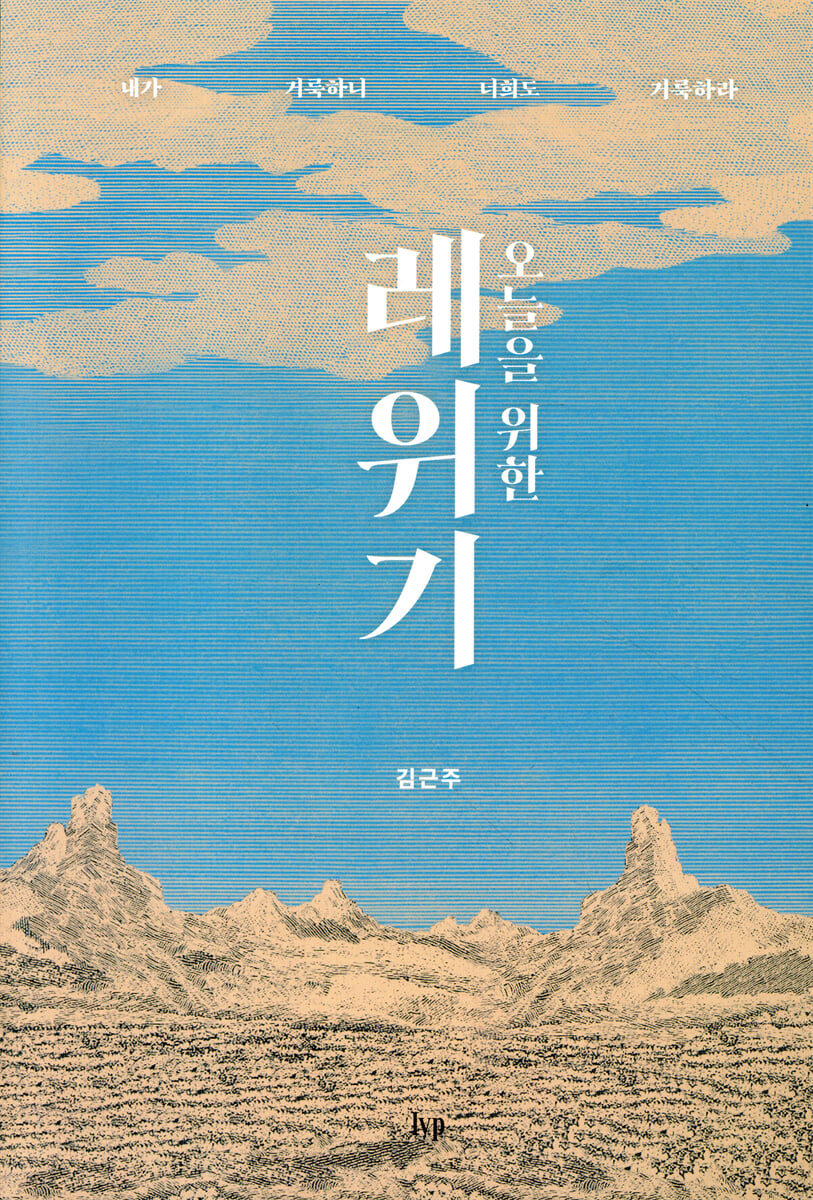
Leviticus for Today
 |
Description
Book Introduction
“I am the Lord your God.
“Consecrate yourselves and be holy, for I am holy.”_Leviticus 11:44
This book is a commentary on Leviticus that brings together the rarely read yesterday and the must-read today to help us live tomorrow.
Leviticus is a book that is difficult to read and understand at first glance due to its unfamiliar sacrificial system and laws.
Is it simply because the reasons are unfamiliar and complex? Is it because our faith today has been reduced to "the merits of the blood" or "a life justified by faith?"
Leviticus is not a collection of parables explaining atonement or justification, but rather the holy life that God commands us, his people.
Leviticus is a book that shows us what God's holiness and presence are in every area of our daily lives.
“Consecrate yourselves and be holy, for I am holy.”_Leviticus 11:44
This book is a commentary on Leviticus that brings together the rarely read yesterday and the must-read today to help us live tomorrow.
Leviticus is a book that is difficult to read and understand at first glance due to its unfamiliar sacrificial system and laws.
Is it simply because the reasons are unfamiliar and complex? Is it because our faith today has been reduced to "the merits of the blood" or "a life justified by faith?"
Leviticus is not a collection of parables explaining atonement or justification, but rather the holy life that God commands us, his people.
Leviticus is a book that shows us what God's holiness and presence are in every area of our daily lives.
- You can preview some of the book's contents.
Preview
index
preface
abbreviation
Part 1 Overview
1.
introduction
Part 2: The Sacrifice Before Jehovah (Chapters 1-16)
2.
Burnt Offerings (Chapter 1; 6:8-13)
3.
The Burning Ceremony (Chapter 2; 6:14-23)
4.
Peace Offering (Chapter 3; 7:11-34)
5.
Sin Offering (4:1-5:13; 6:24-30)
6.
Drying agent (5:14-6:7; 7:1-5)
7.
Conclusion to the Sacrificial Regulations (6:8-7:38)
8.
Historical section (chapters 8-10)
9.
Purification Rules and Restoration (Chapters 11-15)
10.
The Compendium of Sacrifice, the Day of Atonement (Chapter 16)
Part 3: Living Before Jehovah: Holiness in Everyday Life (Chapters 17-27)
11.
The Law Concerning Offerings and Blood (Chapter 17)
12.
Forbidden Sex (Chapters 18 and 20)
13.
Holy Life (Chapter 19)
14.
Priests and the Holy (chapters 21-22)
15.
Seasons (Chapters 23-25)
16.
Blessings and Curses (Chapter 26)
17.
Appendix (Chapter 27)
Part 4 Conclusion
18.
Old Testament Law and Our Lives Today
References
abbreviation
Part 1 Overview
1.
introduction
Part 2: The Sacrifice Before Jehovah (Chapters 1-16)
2.
Burnt Offerings (Chapter 1; 6:8-13)
3.
The Burning Ceremony (Chapter 2; 6:14-23)
4.
Peace Offering (Chapter 3; 7:11-34)
5.
Sin Offering (4:1-5:13; 6:24-30)
6.
Drying agent (5:14-6:7; 7:1-5)
7.
Conclusion to the Sacrificial Regulations (6:8-7:38)
8.
Historical section (chapters 8-10)
9.
Purification Rules and Restoration (Chapters 11-15)
10.
The Compendium of Sacrifice, the Day of Atonement (Chapter 16)
Part 3: Living Before Jehovah: Holiness in Everyday Life (Chapters 17-27)
11.
The Law Concerning Offerings and Blood (Chapter 17)
12.
Forbidden Sex (Chapters 18 and 20)
13.
Holy Life (Chapter 19)
14.
Priests and the Holy (chapters 21-22)
15.
Seasons (Chapters 23-25)
16.
Blessings and Curses (Chapter 26)
17.
Appendix (Chapter 27)
Part 4 Conclusion
18.
Old Testament Law and Our Lives Today
References
Into the book
Ultimately, reading, studying, and meditating on Leviticus is the beginning of a faith that pursues the gospel proclaimed and testified to in the Old Testament, the gospel of complete truth. It is a powerful opposition to today's church, which has degenerated into a religion that sings of salvation with its lips while abandoning life, and an expression of a yearning for a new life where women and men, the poor and the affluent, live together.
--- From the preface
We see Leviticus as being divided into two parts, chapters 1-16 and 17-27, with the texts of the first and second halves corresponding to each other and interconnected.
This structure of Leviticus reflects the cycle of Israel's life before God, showing that the entire book is interconnected without any one section being particularly important.
As mentioned earlier, the very structure of Leviticus clearly shows that it is not simply a book dealing with sacrificial regulations, but a book dealing with the life of Israel before God.
--- 「1.
From the Introduction
Considering that the verb 'kipher' is mentioned only once in the burnt offering and is clearly distinct from its frequent occurrences in the sin offering and guilt offering, it is inappropriate to conclude that the burnt offering is a sacrifice for sin based on this single usage and its atoning function taken from a context outside the Pentateuch.
The burnt offering symbolizes the devotion of the worshiper, and the life offered in this way is the life that New Testament Christians should live.
And Jesus showed us an example of a life offered as a burnt offering.
--- 「2.
From “Burnt Offering (Chapter 1; 6:8-13)”
In the case of offerings as burnt offerings, it would have been prepared in the homes of common Israelites and the work would have been performed by women (Kamionkowski: 16-17).
It is possible that the men offered the offerings prepared by the women in the sanctuary, but in either case it must be remembered that the women did their work.
The offering shows that our daily lives are offered to God, and in that daily life, there is the labor of women that is not often mentioned.
--- 「3.
From “The Sojourner (Chapter 2; 6:14-23)”
The body of Christ has the character of a peace offering given to those who believe in and serve the Lord to share and rejoice with one another.
John 13, another important passage about the Passover meal shared by the Lord, also concludes with a message emphasizing serving one another (verses 13-14) and a new commandment: “Love one another as I have loved you” (verse 34).
The Lord gave His body as a burnt offering, setting an example for us to offer our whole selves to God. And every time we partake of His body through the fellowship offering of the Holy Communion, He reminds us to look after our brothers and sisters who are with us, rejoice with them, and share in their joy.
--- 「4.
From “The Peace Offering (Chapter 3; 7:11-34)”
The ordinance of the sin offering presupposes that a person will always acknowledge and confess his or her wrongdoings before Jehovah and offer a sacrifice.
Furthermore, the reason we mention 'sins committed unknowingly' is because they are the most trivial and insignificant sins that we tend to consider insignificant.
The seriousness of sin is highlighted by mentioning something that can be taken lightly.
In view of this, the ordinance of the sin offering is fundamentally ideal.
This does not mean that it is impossible to achieve, but that it contains an image that is worthy and desirable before God.
--- 「5.
From "Sin Offering (4:1-5:13; 6:24-30)"
The conversion of sin begins with the acknowledgment of sin, and only after the sin has been reconciled to the neighbor who has sinned against him, does the formal process of forgiveness through sacrifice begin.
Indeed, if someone has wronged his brother, he must first go and ask his brother's forgiveness before coming and offering his gift at the altar (Matthew 5:23-24).
The lesson from the quick-drying agent is that this order is important.
Worship offered to God must first be about love and restoration for our brothers and sisters, not the other way around.
--- 「6.
From "The Quick-drying Agent (5:14-6:7; 7:1-5)"
God's holiness is an attribute of God that distinguishes Him from us and testifies to a God who cannot be grasped by our understanding and reason.
To confess God's holiness is to acknowledge that we cannot confine or limit God by our own will or plans.
Therefore, God's holiness and God's presence constitute the essence of the Levitical sacrificial system.
We know and serve Jehovah through sacrifice, but we must always acknowledge the God who cannot be fully grasped within us.
--- 「7.
From the Conclusion of the Sacrificial Regulations (6:8-7:38)
Living a life interpreting the law is not simply clear; it has ambiguous corners like this, and we live within them.
In this respect, it is worth considering the suggestion (Christophe Nihan; cited in Kamionkowski: 79) that the very attempt to explain clearly both the deaths of Nadab and Abihu and Aaron's actions may be ruining the secret of priestly performance presented in Leviticus 10.
The Levitical regulations were not applied mechanically, literally, from the beginning.
“In this way, the authority of the Torah demands continued study of the Torah.
“The law must always be renewed” (Roemer: 134).
Interpreting the law is something that is never avoidable, but it is also something that must be handled with much caution and care.
Moses and Aaron are no exception here.
--- 「8.
From the historical part (chapters 8-10)
Sin offerings and burnt offerings are offered after a mother gives birth, after she recovers from leprosy, and after a man or woman recovers from an abnormal discharge.
In these cases, illness and impurity are identified, and recovery from illness signifies recovery of purity.
Through the sin offering and burnt offering offered in this way, they are completely restored to the purity necessary to worship before God.
The fact that not only the sin offering but also the burnt offering was offered signifies that Israel was completely restored to worshipping Jehovah.
In contrast, if one touches an unclean animal, has a normal discharge from a man or woman, or comes into contact with an unclean person, one automatically becomes clean by washing one's clothes, washing oneself, and waiting until evening.
This is why God called Israel to keep the ordinances properly and not defile their bodies (Lev. 20:25-26).
--- 「9.
From “Purity Rules and Restoration (Chapters 11-15)”
Although the Book of Hebrews describes the annual Day of Atonement as very imperfect and cumbersome, it actually represents God's grace continually renewing His people.
Therefore, the statement that 'the imperfect sacrifices of the Old Testament were perfected in the New Testament' is an inaccurate expression.
Instead, it would be more appropriate to say, 'What was known through the Old Testament sacrificial system was fully and clearly revealed through Jesus Christ.'
Whether in the Old Testament or the New Testament, only God's grace is the only basis for Israel to begin again.
--- 「10.
From “The Comprehensive Sacrifice, the Day of Atonement (Chapter 16)”
It is important to love a concrete person, symbolized by 'blood', a concrete person made of flesh and blood, rather than loving an unidentifiable thing like 'soul'.
And that includes not killing animals that have flesh and blood indiscriminately.
Leviticus, which represents the Old Testament faith, is not a book that teaches us to love the soul, but a book that teaches us to cherish the flesh and not to treat it carelessly.
--- 「11.
From “The Ordinances on Offerings and Blood (Chapter 17)”
Chapter 18 exhorts them not to defile themselves with the practices of foreigners, and chapter 20 exhorts them to keep themselves holy to the Lord by following God's statutes and ordinances.
If the foreign practices that Israel must abandon are discussed in chapters 18 and 20, the statutes and ordinances of Jehovah that Israel must follow are discussed in chapter 19.
And the beginning of chapter 19, which deals with this, is logically and obviously, “You shall be holy.
It begins with “For I, the Lord your God, am holy” (verse 2).
If practicing foreign customs in God's land is an 'abomination' that goes beyond boundaries and distinctions and is mixed together, then living a life that follows God's statutes and ordinances in that land would naturally be a 'holy life.'
--- 「12.
From "Forbidden Sex (Chapters 18 and 20)"
Holiness can be said to be a life of righteous sacrifice before God and justice toward one's neighbor.
So, ultimately, holiness can be said to be 'a world where I think of my neighbor as myself', or it can be expressed as 'a world where we live together' or 'an equal world'.
And the greatest principle of this life of sacrifice and justice is 'love', which the first and second half of Chapter 19 have in common.
Ultimately, holiness is embodied and realized through love.
“Growth in holiness means growth in love” (Gane: 343).
Since God is love (1 John 4:8), it is very clear that holiness, which becomes like God, grows in love.
--- 「13.
From “Holy Life (Chapter 19)”
The last part of chapter 22 deals with the customary eating of the thank offering (vv. 29-30).
The first part of Chapter 22 deals with the distinction when eating holy things, and the last part deals with the same topic.
In that respect, Chapter 22 is arranged so that the beginning and the end interlock with each other.
What further confirms this is the fact that the words, “Do not blaspheme God’s holy name” are in verses 2 and 32.
Not profaning God's name means not doing things arbitrarily but keeping the regulations when eating the holy things God gave to the priests or the thank offerings God gave to the priests and Israel.
--- 「14.
From “The Priest and the Holy (Chapters 21-22)”
Rather than calling Sunday the Sabbath, it is more important to emphasize the importance of rest in modern life.
In a world where it's difficult to survive without constant work, we need to call for legal and institutional changes to ensure that people can enjoy proper rest.
The Feast of Tabernacles is not a day to collect offerings again, but a day to give thanks to God for the income He has given us, to look after our poor neighbors, and to leave a corner to live together with Him.
The Feast of Tabernacles is a day to remember the beginning of our faith and the time when we set out on our journey with faith, reflecting on fear, anticipation, and equality.
The Jubilee year forces us to reflect on whether our society has a strong social safety net that allows anyone to start anew, and whether our community is a community that supports one another in our struggles, a community that takes responsibility for one another.
--- From “15. Seasons (Chapters 23-25)”
Leviticus 26 and the similarly oriented Deuteronomy 28 also discuss curses at greater length than blessings.
As mentioned before, through the blessings of material wealth and the experience of victory in war, we can stand upright and walk as citizens of the kingdom of God.
‘A life of standing upright and walking’ truly encompasses the entirety of a rich and blessed life.
Therefore, there is no need to enumerate further blessings.
If a life is one of upright walking, then no matter what you do, where you go, or even if you have little to eat and live a difficult life, a person who is already walking with God will walk without worrying about anything.
In contrast, curses come from disobedience.
The purpose is to help us realize that disobedience and the various disasters that appear in our lives because of it are not just disasters, but the hand of God's rebuke.
--- 「16.
From “Blessings and Curses (Chapter 26)”
The end of Leviticus reveals that the subject matter covered in this text is “the commandments given to Moses on Mount Sinai for the children of Israel.”
This passage narrowly aligns with 25:1 and following, which refers to Mount Sinai.
Broadly speaking, it encompasses the entire contents of Leviticus as the commandment of Jehovah proclaimed to all Israel from Mount Sinai.
A similar expression is used in Numbers 36:13, which concludes the entire book of Numbers.
--- 「17.
From the Appendix (Chapter 27)
Leviticus is a book written thousands of years ago, in the ancient Israel period, with the people of that time as its audience and readers.
This book expresses the relationship between God and His people, Israel, through the mindset, culture, and worldview of the people of that time.
Therefore, rather than applying the contents of Leviticus literally to today's reality, it is essential to carefully examine what the law intended as expressed through the context of ancient times.
Otherwise, the law that is meant to save life and enable us to live as God's people will instead become a tool for condemning people and carrying out exclusion and hatred.
--- From the preface
We see Leviticus as being divided into two parts, chapters 1-16 and 17-27, with the texts of the first and second halves corresponding to each other and interconnected.
This structure of Leviticus reflects the cycle of Israel's life before God, showing that the entire book is interconnected without any one section being particularly important.
As mentioned earlier, the very structure of Leviticus clearly shows that it is not simply a book dealing with sacrificial regulations, but a book dealing with the life of Israel before God.
--- 「1.
From the Introduction
Considering that the verb 'kipher' is mentioned only once in the burnt offering and is clearly distinct from its frequent occurrences in the sin offering and guilt offering, it is inappropriate to conclude that the burnt offering is a sacrifice for sin based on this single usage and its atoning function taken from a context outside the Pentateuch.
The burnt offering symbolizes the devotion of the worshiper, and the life offered in this way is the life that New Testament Christians should live.
And Jesus showed us an example of a life offered as a burnt offering.
--- 「2.
From “Burnt Offering (Chapter 1; 6:8-13)”
In the case of offerings as burnt offerings, it would have been prepared in the homes of common Israelites and the work would have been performed by women (Kamionkowski: 16-17).
It is possible that the men offered the offerings prepared by the women in the sanctuary, but in either case it must be remembered that the women did their work.
The offering shows that our daily lives are offered to God, and in that daily life, there is the labor of women that is not often mentioned.
--- 「3.
From “The Sojourner (Chapter 2; 6:14-23)”
The body of Christ has the character of a peace offering given to those who believe in and serve the Lord to share and rejoice with one another.
John 13, another important passage about the Passover meal shared by the Lord, also concludes with a message emphasizing serving one another (verses 13-14) and a new commandment: “Love one another as I have loved you” (verse 34).
The Lord gave His body as a burnt offering, setting an example for us to offer our whole selves to God. And every time we partake of His body through the fellowship offering of the Holy Communion, He reminds us to look after our brothers and sisters who are with us, rejoice with them, and share in their joy.
--- 「4.
From “The Peace Offering (Chapter 3; 7:11-34)”
The ordinance of the sin offering presupposes that a person will always acknowledge and confess his or her wrongdoings before Jehovah and offer a sacrifice.
Furthermore, the reason we mention 'sins committed unknowingly' is because they are the most trivial and insignificant sins that we tend to consider insignificant.
The seriousness of sin is highlighted by mentioning something that can be taken lightly.
In view of this, the ordinance of the sin offering is fundamentally ideal.
This does not mean that it is impossible to achieve, but that it contains an image that is worthy and desirable before God.
--- 「5.
From "Sin Offering (4:1-5:13; 6:24-30)"
The conversion of sin begins with the acknowledgment of sin, and only after the sin has been reconciled to the neighbor who has sinned against him, does the formal process of forgiveness through sacrifice begin.
Indeed, if someone has wronged his brother, he must first go and ask his brother's forgiveness before coming and offering his gift at the altar (Matthew 5:23-24).
The lesson from the quick-drying agent is that this order is important.
Worship offered to God must first be about love and restoration for our brothers and sisters, not the other way around.
--- 「6.
From "The Quick-drying Agent (5:14-6:7; 7:1-5)"
God's holiness is an attribute of God that distinguishes Him from us and testifies to a God who cannot be grasped by our understanding and reason.
To confess God's holiness is to acknowledge that we cannot confine or limit God by our own will or plans.
Therefore, God's holiness and God's presence constitute the essence of the Levitical sacrificial system.
We know and serve Jehovah through sacrifice, but we must always acknowledge the God who cannot be fully grasped within us.
--- 「7.
From the Conclusion of the Sacrificial Regulations (6:8-7:38)
Living a life interpreting the law is not simply clear; it has ambiguous corners like this, and we live within them.
In this respect, it is worth considering the suggestion (Christophe Nihan; cited in Kamionkowski: 79) that the very attempt to explain clearly both the deaths of Nadab and Abihu and Aaron's actions may be ruining the secret of priestly performance presented in Leviticus 10.
The Levitical regulations were not applied mechanically, literally, from the beginning.
“In this way, the authority of the Torah demands continued study of the Torah.
“The law must always be renewed” (Roemer: 134).
Interpreting the law is something that is never avoidable, but it is also something that must be handled with much caution and care.
Moses and Aaron are no exception here.
--- 「8.
From the historical part (chapters 8-10)
Sin offerings and burnt offerings are offered after a mother gives birth, after she recovers from leprosy, and after a man or woman recovers from an abnormal discharge.
In these cases, illness and impurity are identified, and recovery from illness signifies recovery of purity.
Through the sin offering and burnt offering offered in this way, they are completely restored to the purity necessary to worship before God.
The fact that not only the sin offering but also the burnt offering was offered signifies that Israel was completely restored to worshipping Jehovah.
In contrast, if one touches an unclean animal, has a normal discharge from a man or woman, or comes into contact with an unclean person, one automatically becomes clean by washing one's clothes, washing oneself, and waiting until evening.
This is why God called Israel to keep the ordinances properly and not defile their bodies (Lev. 20:25-26).
--- 「9.
From “Purity Rules and Restoration (Chapters 11-15)”
Although the Book of Hebrews describes the annual Day of Atonement as very imperfect and cumbersome, it actually represents God's grace continually renewing His people.
Therefore, the statement that 'the imperfect sacrifices of the Old Testament were perfected in the New Testament' is an inaccurate expression.
Instead, it would be more appropriate to say, 'What was known through the Old Testament sacrificial system was fully and clearly revealed through Jesus Christ.'
Whether in the Old Testament or the New Testament, only God's grace is the only basis for Israel to begin again.
--- 「10.
From “The Comprehensive Sacrifice, the Day of Atonement (Chapter 16)”
It is important to love a concrete person, symbolized by 'blood', a concrete person made of flesh and blood, rather than loving an unidentifiable thing like 'soul'.
And that includes not killing animals that have flesh and blood indiscriminately.
Leviticus, which represents the Old Testament faith, is not a book that teaches us to love the soul, but a book that teaches us to cherish the flesh and not to treat it carelessly.
--- 「11.
From “The Ordinances on Offerings and Blood (Chapter 17)”
Chapter 18 exhorts them not to defile themselves with the practices of foreigners, and chapter 20 exhorts them to keep themselves holy to the Lord by following God's statutes and ordinances.
If the foreign practices that Israel must abandon are discussed in chapters 18 and 20, the statutes and ordinances of Jehovah that Israel must follow are discussed in chapter 19.
And the beginning of chapter 19, which deals with this, is logically and obviously, “You shall be holy.
It begins with “For I, the Lord your God, am holy” (verse 2).
If practicing foreign customs in God's land is an 'abomination' that goes beyond boundaries and distinctions and is mixed together, then living a life that follows God's statutes and ordinances in that land would naturally be a 'holy life.'
--- 「12.
From "Forbidden Sex (Chapters 18 and 20)"
Holiness can be said to be a life of righteous sacrifice before God and justice toward one's neighbor.
So, ultimately, holiness can be said to be 'a world where I think of my neighbor as myself', or it can be expressed as 'a world where we live together' or 'an equal world'.
And the greatest principle of this life of sacrifice and justice is 'love', which the first and second half of Chapter 19 have in common.
Ultimately, holiness is embodied and realized through love.
“Growth in holiness means growth in love” (Gane: 343).
Since God is love (1 John 4:8), it is very clear that holiness, which becomes like God, grows in love.
--- 「13.
From “Holy Life (Chapter 19)”
The last part of chapter 22 deals with the customary eating of the thank offering (vv. 29-30).
The first part of Chapter 22 deals with the distinction when eating holy things, and the last part deals with the same topic.
In that respect, Chapter 22 is arranged so that the beginning and the end interlock with each other.
What further confirms this is the fact that the words, “Do not blaspheme God’s holy name” are in verses 2 and 32.
Not profaning God's name means not doing things arbitrarily but keeping the regulations when eating the holy things God gave to the priests or the thank offerings God gave to the priests and Israel.
--- 「14.
From “The Priest and the Holy (Chapters 21-22)”
Rather than calling Sunday the Sabbath, it is more important to emphasize the importance of rest in modern life.
In a world where it's difficult to survive without constant work, we need to call for legal and institutional changes to ensure that people can enjoy proper rest.
The Feast of Tabernacles is not a day to collect offerings again, but a day to give thanks to God for the income He has given us, to look after our poor neighbors, and to leave a corner to live together with Him.
The Feast of Tabernacles is a day to remember the beginning of our faith and the time when we set out on our journey with faith, reflecting on fear, anticipation, and equality.
The Jubilee year forces us to reflect on whether our society has a strong social safety net that allows anyone to start anew, and whether our community is a community that supports one another in our struggles, a community that takes responsibility for one another.
--- From “15. Seasons (Chapters 23-25)”
Leviticus 26 and the similarly oriented Deuteronomy 28 also discuss curses at greater length than blessings.
As mentioned before, through the blessings of material wealth and the experience of victory in war, we can stand upright and walk as citizens of the kingdom of God.
‘A life of standing upright and walking’ truly encompasses the entirety of a rich and blessed life.
Therefore, there is no need to enumerate further blessings.
If a life is one of upright walking, then no matter what you do, where you go, or even if you have little to eat and live a difficult life, a person who is already walking with God will walk without worrying about anything.
In contrast, curses come from disobedience.
The purpose is to help us realize that disobedience and the various disasters that appear in our lives because of it are not just disasters, but the hand of God's rebuke.
--- 「16.
From “Blessings and Curses (Chapter 26)”
The end of Leviticus reveals that the subject matter covered in this text is “the commandments given to Moses on Mount Sinai for the children of Israel.”
This passage narrowly aligns with 25:1 and following, which refers to Mount Sinai.
Broadly speaking, it encompasses the entire contents of Leviticus as the commandment of Jehovah proclaimed to all Israel from Mount Sinai.
A similar expression is used in Numbers 36:13, which concludes the entire book of Numbers.
--- 「17.
From the Appendix (Chapter 27)
Leviticus is a book written thousands of years ago, in the ancient Israel period, with the people of that time as its audience and readers.
This book expresses the relationship between God and His people, Israel, through the mindset, culture, and worldview of the people of that time.
Therefore, rather than applying the contents of Leviticus literally to today's reality, it is essential to carefully examine what the law intended as expressed through the context of ancient times.
Otherwise, the law that is meant to save life and enable us to live as God's people will instead become a tool for condemning people and carrying out exclusion and hatred.
--- 「18.
From “The Law of the Old Testament and Our Life Today”
From “The Law of the Old Testament and Our Life Today”
Publisher's Review
Leviticus, written thousands of years ago to be delivered to Israel.
This book uniquely portrays the relationship between God and the Israelites through the mindset, culture, and worldview of the people of that time.
Therefore, it is necessary to carefully examine what sacrifices and regulations were in the context of the ancient Near East.
We must carefully examine Leviticus on the theme of "holiness," for the very laws that save lives and enable us to live as God's people can easily become tools for condemning people and inflicting exclusion and hatred.
Holy God
Holiness is ‘a sacrifice that goes before God.’
The complex and difficult sacrifices and ordinances are an invitation to holiness.
God's holiness is an attribute that is distinct from us and cannot be grasped by our reason.
God's holiness is not something we can learn and practice through our own will and plans.
Such holiness of God is the essence of the Levitical sacrificial system.
We serve Jehovah through sacrifices, but through sacrifices and ordinances we acknowledge that there are limits to our knowledge of God.
Holy Community
Holiness is ‘a life of righteousness that goes before God.’
Holiness is ‘loving my neighbor as myself’ and creating an equal world where we can live together through love.
Holiness is embodied and realized through love.
Since God is love (1 John 4:8), it is clear that holiness, which becomes like God, grows in love.
The author introduces reading Leviticus as the first step to fundamentally understanding the relationship between the Old and New Testaments.
Just as the Pentateuch, including Leviticus, shows how those who directly experienced God's guidance lived as God's people in their daily lives, it emphasizes that we who live today must also live as God's people.
Therefore, readers should read Leviticus, which is expressed according to the culture and customs of ancient Israel, with the goal of finding a way of life that pleases God. Just as the sacrificial regulations do not apply literally to us today, readers should strive to find the essence of Leviticus while keeping in mind the sensibilities of our time.
characteristic
- A Logical Bible Commentary
- An exegetical book that examines the meaning and intent of the Leviticus text within its historical context.
- A commentary that connects theological integrity with modern social sensitivity.
- A scholarly book rich in practical material for recent Leviticus research and preaching.
- A guide to living a holy life in everyday life, not through vague rituals, rules, or regulations.
Main Readers
- All Christians
- Professors, pastors, and seminarians interested in Leviticus studies
- Christians interested in Leviticus and its commentaries
- A believer who accepts Leviticus as an invitation to a holy life and has the insight to view it with today's social sensitivity.
This book uniquely portrays the relationship between God and the Israelites through the mindset, culture, and worldview of the people of that time.
Therefore, it is necessary to carefully examine what sacrifices and regulations were in the context of the ancient Near East.
We must carefully examine Leviticus on the theme of "holiness," for the very laws that save lives and enable us to live as God's people can easily become tools for condemning people and inflicting exclusion and hatred.
Holy God
Holiness is ‘a sacrifice that goes before God.’
The complex and difficult sacrifices and ordinances are an invitation to holiness.
God's holiness is an attribute that is distinct from us and cannot be grasped by our reason.
God's holiness is not something we can learn and practice through our own will and plans.
Such holiness of God is the essence of the Levitical sacrificial system.
We serve Jehovah through sacrifices, but through sacrifices and ordinances we acknowledge that there are limits to our knowledge of God.
Holy Community
Holiness is ‘a life of righteousness that goes before God.’
Holiness is ‘loving my neighbor as myself’ and creating an equal world where we can live together through love.
Holiness is embodied and realized through love.
Since God is love (1 John 4:8), it is clear that holiness, which becomes like God, grows in love.
The author introduces reading Leviticus as the first step to fundamentally understanding the relationship between the Old and New Testaments.
Just as the Pentateuch, including Leviticus, shows how those who directly experienced God's guidance lived as God's people in their daily lives, it emphasizes that we who live today must also live as God's people.
Therefore, readers should read Leviticus, which is expressed according to the culture and customs of ancient Israel, with the goal of finding a way of life that pleases God. Just as the sacrificial regulations do not apply literally to us today, readers should strive to find the essence of Leviticus while keeping in mind the sensibilities of our time.
characteristic
- A Logical Bible Commentary
- An exegetical book that examines the meaning and intent of the Leviticus text within its historical context.
- A commentary that connects theological integrity with modern social sensitivity.
- A scholarly book rich in practical material for recent Leviticus research and preaching.
- A guide to living a holy life in everyday life, not through vague rituals, rules, or regulations.
Main Readers
- All Christians
- Professors, pastors, and seminarians interested in Leviticus studies
- Christians interested in Leviticus and its commentaries
- A believer who accepts Leviticus as an invitation to a holy life and has the insight to view it with today's social sensitivity.
GOODS SPECIFICS
- Publication date: January 27, 2021
- Page count, weight, size: 648 pages | 153*224*35mm
- ISBN13: 9788932819167
- ISBN10: 8932819165
You may also like
카테고리
korean


korean

![GQ KOREA Mark (Monthly): December [2025]](http://librairie.coreenne.fr/cdn/shop/files/8ef265dbbfbf186523ed75ba7319009d.jpg?v=1765340328&width=3840)


