

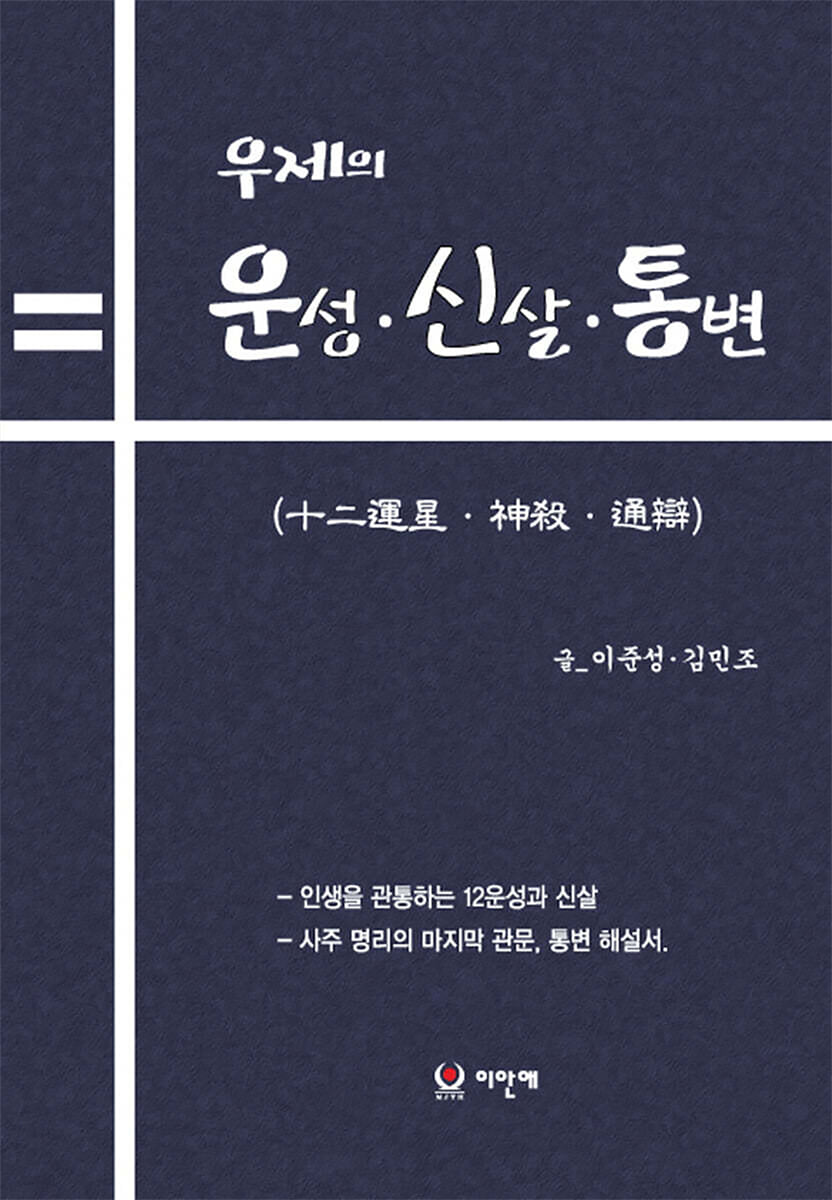
The 12 constellations of Uje, Shinsal, and Tongbyeon
 |
Description
Book Introduction
Wooje's Yun·Sin·Tong (12 Yunseong, Sinsal, Tongbyeon) is a book on fortune telling written by a doctor of medicine, a natural scientist who traces the trajectory of all phenomena and changes with a coherent theory, and a fortune teller with 35 years of diverse and rich clinical experience in interpreting the four pillars of destiny that represent human life, sharing their wisdom.
index
Chapter 1: The Twelve Constellations
1.
The meaning of the 12 constellations
2.
The meaning of the 12 constellations
3.
Finding the 12 constellations
4.
12-constellation substitution method
5.
Types of the 12 constellations
1) Absolute
2) Fetus
3) Sheep
4) Longevity
5) Bathing
6) Crown and belt
7) Construction salary
8) Emperor
9) Decay
10) Disease
11) Death
12) Grave
6.
Application of the 12 constellations
Chapter 2: The Twelve Godskills
1.
The meaning of the 12 Godskills
2.
Find the 12 Gods of Death
3.
The meaning and good and bad fortune of the 12 gods
4.
Types of the Twelve Gods
1) Fear of killing
2) Disaster
3) Heavenly Killing
4) Earth killing
5) Yearly killing
6) Wolsal (月殺)
7) Disgrace
8) General
9) Saddle-lifting
10) Post horse
11) Six Harms
12) Hwagae (華蓋)
Chapter 3: General Godslaying
1.
The meaning of Shinsal (神殺)
2.
The God-killing between the Heavenly Stems and Earthly Branches
3.
God's killing between the Earthly Branches
4.
Types of God's Killing
〈Gwan-Gwi-Hakgwan (Government and Noble Academy)〉
〈 Mungok Gwiin (文曲貴人) 〉
〈 Noble Person of Munchang 〉
〈 School Noble Person (學堂貴人) 〉
〈Golden God〉
〈Golden Pavilion〉
〈Bokseongguiin (福星貴人)〉
〈Samgisung (Three Strange Stars)〉
〈 Dark Salary 〉
〈Heavenly Noble Person〉
〈Cheonsaeseong (Heavenly Pardon Star)〉
〈 Noble Person by Heaven's Virtue, Noble Person by Moon's Virtue 〉
〈Cheon-eul-gwi-in (Heavenly Noble Person)〉
〈Cheonmunseong (天門星)〉
〈Cheonui-seong (Heavenly Doctor Star)〉
〈 Heavenly Noble Person 〉
〈Taegeuk Gwiin (太極貴人)〉
〈Great Amnesty of the Emperor〉
〈Killing a Lonely Bird〉
〈 Overcooked 〉
〈 Old Body 〉
〈Curved Leg Kill〉
〈Killing〉
〈 Sudden killing 〉
〈 Empty 〉
〈Gwaegang (魁)〉
〈 Falling Well Killing 〉
〈Breaking the Bridge and Killing the Pass〉
〈Baekhosal (White Tiger Killing)〉
The Three Calamities
〈Mourners and mourners〉
〈 Yangin (陽刃, 羊刃) 〉
Flying Blade
〈Resentment〉
〈Gwimun Gwansal (Killing the Ghost Gate)〉
〈Yin-Yang Killing〉
〈Yin and Yang Errors〉
〈 Heaven and Earth Net 〉
〈Tanghwasal (湯火殺)〉
〈 Taebaekseong (太white star) 〉
〈Pyeongdusalmyeon (Flat Head Killing)〉
〈Hyeonchimsal(懸針殺)〉
〈 Hongyeon (Red Gloss) 〉
〈Hyoshin (梟神)〉
Chapter 4: Punishment, Conflict, Breakdown, Harm
1.
Murder
1) Types of punishment
(1) Three punishments for Yeo-Hyeon-Sin (no punishment)
(2) Three punishments (持勢之刑)
(3) Punishment without ceremonial punishment
(4) 辰辰, 午午, 酉酉, 亥亥 (self-examination)
2) The effect of punishment
2.
Yukchong (六沖)
3.
Six harms
4.
Break
Chapter 5: Interpretation of Four Pillars of Destiny
1.
A
2.
B
3.
Bing (丙)
4.
Jeong (丁)
5.
Mu (戊)
6.
Self
7.
Gyeong (庚)
8.
spicy
9.
Im (壬)
10.
Gye (癸)
1.
The meaning of the 12 constellations
2.
The meaning of the 12 constellations
3.
Finding the 12 constellations
4.
12-constellation substitution method
5.
Types of the 12 constellations
1) Absolute
2) Fetus
3) Sheep
4) Longevity
5) Bathing
6) Crown and belt
7) Construction salary
8) Emperor
9) Decay
10) Disease
11) Death
12) Grave
6.
Application of the 12 constellations
Chapter 2: The Twelve Godskills
1.
The meaning of the 12 Godskills
2.
Find the 12 Gods of Death
3.
The meaning and good and bad fortune of the 12 gods
4.
Types of the Twelve Gods
1) Fear of killing
2) Disaster
3) Heavenly Killing
4) Earth killing
5) Yearly killing
6) Wolsal (月殺)
7) Disgrace
8) General
9) Saddle-lifting
10) Post horse
11) Six Harms
12) Hwagae (華蓋)
Chapter 3: General Godslaying
1.
The meaning of Shinsal (神殺)
2.
The God-killing between the Heavenly Stems and Earthly Branches
3.
God's killing between the Earthly Branches
4.
Types of God's Killing
〈Gwan-Gwi-Hakgwan (Government and Noble Academy)〉
〈 Mungok Gwiin (文曲貴人) 〉
〈 Noble Person of Munchang 〉
〈 School Noble Person (學堂貴人) 〉
〈Golden God〉
〈Golden Pavilion〉
〈Bokseongguiin (福星貴人)〉
〈Samgisung (Three Strange Stars)〉
〈 Dark Salary 〉
〈Heavenly Noble Person〉
〈Cheonsaeseong (Heavenly Pardon Star)〉
〈 Noble Person by Heaven's Virtue, Noble Person by Moon's Virtue 〉
〈Cheon-eul-gwi-in (Heavenly Noble Person)〉
〈Cheonmunseong (天門星)〉
〈Cheonui-seong (Heavenly Doctor Star)〉
〈 Heavenly Noble Person 〉
〈Taegeuk Gwiin (太極貴人)〉
〈Great Amnesty of the Emperor〉
〈Killing a Lonely Bird〉
〈 Overcooked 〉
〈 Old Body 〉
〈Curved Leg Kill〉
〈Killing〉
〈 Sudden killing 〉
〈 Empty 〉
〈Gwaegang (魁)〉
〈 Falling Well Killing 〉
〈Breaking the Bridge and Killing the Pass〉
〈Baekhosal (White Tiger Killing)〉
The Three Calamities
〈Mourners and mourners〉
〈 Yangin (陽刃, 羊刃) 〉
Flying Blade
〈Resentment〉
〈Gwimun Gwansal (Killing the Ghost Gate)〉
〈Yin-Yang Killing〉
〈Yin and Yang Errors〉
〈 Heaven and Earth Net 〉
〈Tanghwasal (湯火殺)〉
〈 Taebaekseong (太white star) 〉
〈Pyeongdusalmyeon (Flat Head Killing)〉
〈Hyeonchimsal(懸針殺)〉
〈 Hongyeon (Red Gloss) 〉
〈Hyoshin (梟神)〉
Chapter 4: Punishment, Conflict, Breakdown, Harm
1.
Murder
1) Types of punishment
(1) Three punishments for Yeo-Hyeon-Sin (no punishment)
(2) Three punishments (持勢之刑)
(3) Punishment without ceremonial punishment
(4) 辰辰, 午午, 酉酉, 亥亥 (self-examination)
2) The effect of punishment
2.
Yukchong (六沖)
3.
Six harms
4.
Break
Chapter 5: Interpretation of Four Pillars of Destiny
1.
A
2.
B
3.
Bing (丙)
4.
Jeong (丁)
5.
Mu (戊)
6.
Self
7.
Gyeong (庚)
8.
spicy
9.
Im (壬)
10.
Gye (癸)
Detailed image

Publisher's Review
Wooje's Yun·Sin·Tong (12 Yunseong, Sinsal, Tongbyeon) is a book on fortune telling written by a doctor of medicine, a natural scientist who traces the trajectory of all phenomena and changes with a coherent theory, and a fortune teller with 35 years of diverse and rich clinical experience in interpreting the four pillars of destiny that represent human life, sharing their wisdom.
The special feature of this book is that it clearly and easily summarizes the 12 constellations, 12 gods, general gods, type, conflict, damage, etc., so that they can be easily understood and practically used for interpreting the four pillars of destiny.
In addition, by providing examples of interpreting various fortune-telling, it goes beyond simply acquiring knowledge of horoscopes and allows one to acquire a method to interpret the four pillars of destiny to fit the real-life of a person by utilizing these. This is another feature.
The four pillars of destiny can be said to be a bar code that can predict a person's life and its course.
A true fortune teller accurately interprets these bar codes to provide direction and good or bad fortune for your future life, and to suggest the attitude and method to wisely accept and overcome them.
There are two main ways to interpret one's fortune: the single-day method and the double-day method.
The double-eating method is interpreted as the generation and inhibition of the five elements of yin and yang, and the single-eating method is applied to the 12 constellations, 12 gods and curses, and general gods and curses.
The basic principle of Sajupalja Ganmyeong is the double-edged sword method that interprets the creation and inhibition of yin and yang and the five elements, but by adding and applying the 12 zodiac signs or Shinsal, etc., it is possible to predict and express an individual's life and destiny, such as the flow of the Saju or the individual's character, in a richer and more diverse way.
This book is a comprehensive book that presents the 12 zodiac signs, 12 gods, general gods, and types, conflicts, failures, and harms. I believe that by studying this book, you will be able to master almost all of the fasting methods necessary for interpreting your fortune.
It describes individually how to easily learn the 12 constellations and 12 gods, the basic meaning of each constellation and godsal, and how they affect the four pillars when they are in the original country of the four pillars and when they are encountered in fortune, and how to interpret them.
In addition, the interpretation and interpretation of each branch or six relatives when they are present are described simply and clearly so that it is easy to understand and can be easily and beneficially utilized when interpreting the four pillars of destiny.
The best part of fortune telling is interpretation.
Although I understand each puzzle, such as the five elements of yin and yang, the heavenly stems and earthly branches, and the six relatives, it is not easy to assemble each of these puzzles to create a single story, and I think that many people get frustrated and give up halfway because they cannot do this properly even after studying the mechanics for a long time.
In other words, this can be said to be the last and most difficult hurdle to overcome in the study of mechanics.
There are many books published on fortune telling, and I tried to find solutions from them, but I was disappointed.
So, in an effort to alleviate some of this regret in interpreting the four pillars of destiny, I have added some examples of interpretations of the four pillars of destiny.
Although we have tried to provide solutions based on accurate theoretical grounds to ensure that they are as realistic and reproducible as possible, there may be shortcomings.
All humans belong to one of the ten heavenly stems, from Gap (甲) to Gye (癸).
An example of a hypothetical four pillars of destiny for each daily stem is presented.
And in each Saju, the general characteristics of each day (Gap-Gwi), the nature of the day according to the month of birth, the country of conflict and the dragon god, spouse, parents, children, wealth, occupation, etc. were described.
In particular, since it describes in more detail the changes in life according to the flow of fortune, I think it will be of great help to those who are thirsty for an interpretation of fortune.
Although the four pillars of destiny are virtual, their interpretations are based on 35 years of rich clinical experience and an attempt is made to interpret them based on accurate theoretical grounds. Therefore, if the life of a person with a similar four pillars of destiny were to be interpreted, I believe that the interpretation would have fewer errors and would accurately predict that person's life.
If you diligently read and study these interpretation cases, I expect that you will surely pass the final hurdle of fortune-telling and gain insight into the interpretation of fortune-telling.
Application of the 12 constellations
Each stage of the 12 zodiac signs is merely a language that expresses the cycle of life by dividing it into periods, and does not signify the occurrence of actual events.
For example, illness, death, and grave (病, 死, 墓) do not actually indicate the time when one becomes ill, dies, and is buried in a grave. Rather, they only mean that when that time comes, one becomes in a virtual state of becoming ill, dying, and being buried in a grave, and that the physical and mental state becomes similar to this.
For example, a person born with the characters for decline, illness, or death in the monthly or daily branches, which are the roots of the six heavenly stems, may be physically young, but his or her actions and mind, regardless of age, display the temperament and nature of an old person who is already old and sick.
On the other hand, the 12 zodiac signs, such as Jangsaeng and Yukyok, whose roots are in the 10 heavenly stems, always retain their childlike feelings and emotions, so even if their bodies grow old, their hearts do not age.
And in the case of those with strong roots, Geonrok and Jewang, they have the temperament and personality of a mature adult by nature, so they think and act meticulously from a young age, and they appear mature from an early age.
So, by observing the stages of each of the 12 zodiac signs that the six relatives of the heavenly stems meet, we can easily infer the nature and physical and mental state of those relatives.
reference
Everything that exists has two sides.
Murder is not always absolutely evil, but can also be auspicious in many cases.
The 12 gods and spirits are also composed of gods and death, so the terms alone do not have a good or bad effect.
If you do good deeds, you become a god, and if you do bad deeds, you become a murderer.
But fear, death, and a thousand deaths...
What gave life to it was fear, ashes, and heaven...
If you write it like that, it will cause confusion in terms, so I added flesh to reduce the confusion.
Also, shame, rebellion, and rebellion...
The reason why it is not fleshed out is because it does not cause any confusion in the terms.
So, fear, death, a thousand deaths...
This does not necessarily mean a bad thing. If it plays a good role, it is not killing, but rather the role of God. If it plays a bad role, it is killing.
Shame, disgrace...
Likewise, if it plays a good role, it becomes a god, and if it plays a bad role, it becomes murder.
Therefore, the 12 gods and slaughter must be judged by distinguishing between gods and slaughter.
In this book, the positive aspects of Shinsal (神, 殺) are also given weight, and some 殺 are described interchangeably, such as excluding 殺.
It may be confusing, but I hope you understand. (The same goes for regular Shinsal)
The meaning of Shinsal (神殺)
General Shinsal (神殺) is an ancient theory of fortune telling that was used for fortune telling along with Dangsaju before the introduction of Japyeong Myeongrihak. There are differing opinions on its usefulness among fortune tellers.
In the word “Sinsal” (神殺), “Sin” (神) means a god of good fortune and “Sal” (殺) means an evil death. The types vary from about 250 (Shinbong Tonggo Myeongri Jeongjong, Jangnam) to about 500 (Hyeopgi Byeonbangseo, Mae Pyeongseong), but only some of them are currently used in Ganmyeong.
Byeong (丙) Saju Tongbyeon Daily Kun (female)
Jeongjae, the self, the universal Jeongjae
辛 丙 庚 辛
卯申子丑
Jeong In-pyeonjae Jeong Gwan-gwan
甲乙 戊壬庚 甲癸 癸辛己
Bath bottle sun
Shame on the dead, disgrace on the land and sea, and a disaster on the earth and sea
73 63 53 43 33 23 13 3
Sik-sin, Gyeop-jae, Bi-gyeon, Jeong-in, Pyeon-in, Jeong-gwan, Pyeon-gwan, Jeong-jae
戊 丁 丙 乙 甲 癸 壬 辛
申未午巳辰卯寅丑
Pyeonjae, Sang-gwan, Gyeop-jae, Bi-gyeon, Shik-sin, Jeong-in, Pyeon-in, Sang-gwan
Bottle, Iron Emperor, Gunrok, Generous Bath, Longevity, Sheep
Shame, death by the month, death by the year, death by the land, death by the thousandth death, death by the second death, fear, and anger
Bing (fire) is a very strong yang energy and is the sun in the sky.
It signifies brightness and heat, illuminating the world to bring justice, and emitting heat to keep the world warm and help all things grow.
The fundamental nature of Fire is to unfold and express, so the personality of the Bing (Fire) day is cheerful, cannot hide one's inner feelings, reveals them, and is good at speaking.
However, sometimes he has a hasty and choleric personality like a blazing volcano, but he doesn't have any lingering feelings.
The sun is the highest in the sky and is the only one in the world, so it has strong pride and hates being ignored by others the most.
However, this personality appears slightly differently depending on the composition of the four pillars.
personality
It is the winter sun of Bing (fire) in the month of Rat, so it is not as strong as in summer, and the surrounding gold and water are too strong, making it weak.
The original personality is bright and there is a harmony (子丑, 申子) in the support, so he tries to get along well with others, but the daily Bing (火) has no root in the support, so he does not have a clear subjectivity, is timid, introverted, and depressed, and there is a Wonjinsal (申卯) so when things do not go as planned, he may blame others or become frustrated, and in severe cases, he may fall into depression.
Meanwhile, Bing (Fire)'s original mission is to grow trees, but the protagonist is weak and lacks the ability to grow trees.
But fortunately, the great fortune flows into the Wood-Fire fortune, strengthening the daily strength, so the tree grows well and as you live, you feel a sense of fulfillment in life, and your personality also becomes active.
To grow trees in winter, they need the sun, so they have to move around outside like sunflowers follow the sun.
The special feature of this book is that it clearly and easily summarizes the 12 constellations, 12 gods, general gods, type, conflict, damage, etc., so that they can be easily understood and practically used for interpreting the four pillars of destiny.
In addition, by providing examples of interpreting various fortune-telling, it goes beyond simply acquiring knowledge of horoscopes and allows one to acquire a method to interpret the four pillars of destiny to fit the real-life of a person by utilizing these. This is another feature.
The four pillars of destiny can be said to be a bar code that can predict a person's life and its course.
A true fortune teller accurately interprets these bar codes to provide direction and good or bad fortune for your future life, and to suggest the attitude and method to wisely accept and overcome them.
There are two main ways to interpret one's fortune: the single-day method and the double-day method.
The double-eating method is interpreted as the generation and inhibition of the five elements of yin and yang, and the single-eating method is applied to the 12 constellations, 12 gods and curses, and general gods and curses.
The basic principle of Sajupalja Ganmyeong is the double-edged sword method that interprets the creation and inhibition of yin and yang and the five elements, but by adding and applying the 12 zodiac signs or Shinsal, etc., it is possible to predict and express an individual's life and destiny, such as the flow of the Saju or the individual's character, in a richer and more diverse way.
This book is a comprehensive book that presents the 12 zodiac signs, 12 gods, general gods, and types, conflicts, failures, and harms. I believe that by studying this book, you will be able to master almost all of the fasting methods necessary for interpreting your fortune.
It describes individually how to easily learn the 12 constellations and 12 gods, the basic meaning of each constellation and godsal, and how they affect the four pillars when they are in the original country of the four pillars and when they are encountered in fortune, and how to interpret them.
In addition, the interpretation and interpretation of each branch or six relatives when they are present are described simply and clearly so that it is easy to understand and can be easily and beneficially utilized when interpreting the four pillars of destiny.
The best part of fortune telling is interpretation.
Although I understand each puzzle, such as the five elements of yin and yang, the heavenly stems and earthly branches, and the six relatives, it is not easy to assemble each of these puzzles to create a single story, and I think that many people get frustrated and give up halfway because they cannot do this properly even after studying the mechanics for a long time.
In other words, this can be said to be the last and most difficult hurdle to overcome in the study of mechanics.
There are many books published on fortune telling, and I tried to find solutions from them, but I was disappointed.
So, in an effort to alleviate some of this regret in interpreting the four pillars of destiny, I have added some examples of interpretations of the four pillars of destiny.
Although we have tried to provide solutions based on accurate theoretical grounds to ensure that they are as realistic and reproducible as possible, there may be shortcomings.
All humans belong to one of the ten heavenly stems, from Gap (甲) to Gye (癸).
An example of a hypothetical four pillars of destiny for each daily stem is presented.
And in each Saju, the general characteristics of each day (Gap-Gwi), the nature of the day according to the month of birth, the country of conflict and the dragon god, spouse, parents, children, wealth, occupation, etc. were described.
In particular, since it describes in more detail the changes in life according to the flow of fortune, I think it will be of great help to those who are thirsty for an interpretation of fortune.
Although the four pillars of destiny are virtual, their interpretations are based on 35 years of rich clinical experience and an attempt is made to interpret them based on accurate theoretical grounds. Therefore, if the life of a person with a similar four pillars of destiny were to be interpreted, I believe that the interpretation would have fewer errors and would accurately predict that person's life.
If you diligently read and study these interpretation cases, I expect that you will surely pass the final hurdle of fortune-telling and gain insight into the interpretation of fortune-telling.
Application of the 12 constellations
Each stage of the 12 zodiac signs is merely a language that expresses the cycle of life by dividing it into periods, and does not signify the occurrence of actual events.
For example, illness, death, and grave (病, 死, 墓) do not actually indicate the time when one becomes ill, dies, and is buried in a grave. Rather, they only mean that when that time comes, one becomes in a virtual state of becoming ill, dying, and being buried in a grave, and that the physical and mental state becomes similar to this.
For example, a person born with the characters for decline, illness, or death in the monthly or daily branches, which are the roots of the six heavenly stems, may be physically young, but his or her actions and mind, regardless of age, display the temperament and nature of an old person who is already old and sick.
On the other hand, the 12 zodiac signs, such as Jangsaeng and Yukyok, whose roots are in the 10 heavenly stems, always retain their childlike feelings and emotions, so even if their bodies grow old, their hearts do not age.
And in the case of those with strong roots, Geonrok and Jewang, they have the temperament and personality of a mature adult by nature, so they think and act meticulously from a young age, and they appear mature from an early age.
So, by observing the stages of each of the 12 zodiac signs that the six relatives of the heavenly stems meet, we can easily infer the nature and physical and mental state of those relatives.
reference
Everything that exists has two sides.
Murder is not always absolutely evil, but can also be auspicious in many cases.
The 12 gods and spirits are also composed of gods and death, so the terms alone do not have a good or bad effect.
If you do good deeds, you become a god, and if you do bad deeds, you become a murderer.
But fear, death, and a thousand deaths...
What gave life to it was fear, ashes, and heaven...
If you write it like that, it will cause confusion in terms, so I added flesh to reduce the confusion.
Also, shame, rebellion, and rebellion...
The reason why it is not fleshed out is because it does not cause any confusion in the terms.
So, fear, death, a thousand deaths...
This does not necessarily mean a bad thing. If it plays a good role, it is not killing, but rather the role of God. If it plays a bad role, it is killing.
Shame, disgrace...
Likewise, if it plays a good role, it becomes a god, and if it plays a bad role, it becomes murder.
Therefore, the 12 gods and slaughter must be judged by distinguishing between gods and slaughter.
In this book, the positive aspects of Shinsal (神, 殺) are also given weight, and some 殺 are described interchangeably, such as excluding 殺.
It may be confusing, but I hope you understand. (The same goes for regular Shinsal)
The meaning of Shinsal (神殺)
General Shinsal (神殺) is an ancient theory of fortune telling that was used for fortune telling along with Dangsaju before the introduction of Japyeong Myeongrihak. There are differing opinions on its usefulness among fortune tellers.
In the word “Sinsal” (神殺), “Sin” (神) means a god of good fortune and “Sal” (殺) means an evil death. The types vary from about 250 (Shinbong Tonggo Myeongri Jeongjong, Jangnam) to about 500 (Hyeopgi Byeonbangseo, Mae Pyeongseong), but only some of them are currently used in Ganmyeong.
Byeong (丙) Saju Tongbyeon Daily Kun (female)
Jeongjae, the self, the universal Jeongjae
辛 丙 庚 辛
卯申子丑
Jeong In-pyeonjae Jeong Gwan-gwan
甲乙 戊壬庚 甲癸 癸辛己
Bath bottle sun
Shame on the dead, disgrace on the land and sea, and a disaster on the earth and sea
73 63 53 43 33 23 13 3
Sik-sin, Gyeop-jae, Bi-gyeon, Jeong-in, Pyeon-in, Jeong-gwan, Pyeon-gwan, Jeong-jae
戊 丁 丙 乙 甲 癸 壬 辛
申未午巳辰卯寅丑
Pyeonjae, Sang-gwan, Gyeop-jae, Bi-gyeon, Shik-sin, Jeong-in, Pyeon-in, Sang-gwan
Bottle, Iron Emperor, Gunrok, Generous Bath, Longevity, Sheep
Shame, death by the month, death by the year, death by the land, death by the thousandth death, death by the second death, fear, and anger
Bing (fire) is a very strong yang energy and is the sun in the sky.
It signifies brightness and heat, illuminating the world to bring justice, and emitting heat to keep the world warm and help all things grow.
The fundamental nature of Fire is to unfold and express, so the personality of the Bing (Fire) day is cheerful, cannot hide one's inner feelings, reveals them, and is good at speaking.
However, sometimes he has a hasty and choleric personality like a blazing volcano, but he doesn't have any lingering feelings.
The sun is the highest in the sky and is the only one in the world, so it has strong pride and hates being ignored by others the most.
However, this personality appears slightly differently depending on the composition of the four pillars.
personality
It is the winter sun of Bing (fire) in the month of Rat, so it is not as strong as in summer, and the surrounding gold and water are too strong, making it weak.
The original personality is bright and there is a harmony (子丑, 申子) in the support, so he tries to get along well with others, but the daily Bing (火) has no root in the support, so he does not have a clear subjectivity, is timid, introverted, and depressed, and there is a Wonjinsal (申卯) so when things do not go as planned, he may blame others or become frustrated, and in severe cases, he may fall into depression.
Meanwhile, Bing (Fire)'s original mission is to grow trees, but the protagonist is weak and lacks the ability to grow trees.
But fortunately, the great fortune flows into the Wood-Fire fortune, strengthening the daily strength, so the tree grows well and as you live, you feel a sense of fulfillment in life, and your personality also becomes active.
To grow trees in winter, they need the sun, so they have to move around outside like sunflowers follow the sun.
GOODS SPECIFICS
- Publication date: December 20, 2021
- Page count, weight, size: 414 pages | 172*245*25mm
- ISBN13: 9791195275342
- ISBN10: 119527534X
You may also like
카테고리
korean


korean

![GQ KOREA Mark (Monthly): December [2025]](http://librairie.coreenne.fr/cdn/shop/files/8ef265dbbfbf186523ed75ba7319009d.jpg?v=1765340328&width=3840)


