

The Lotus Sutra
 |
Description
Book Introduction
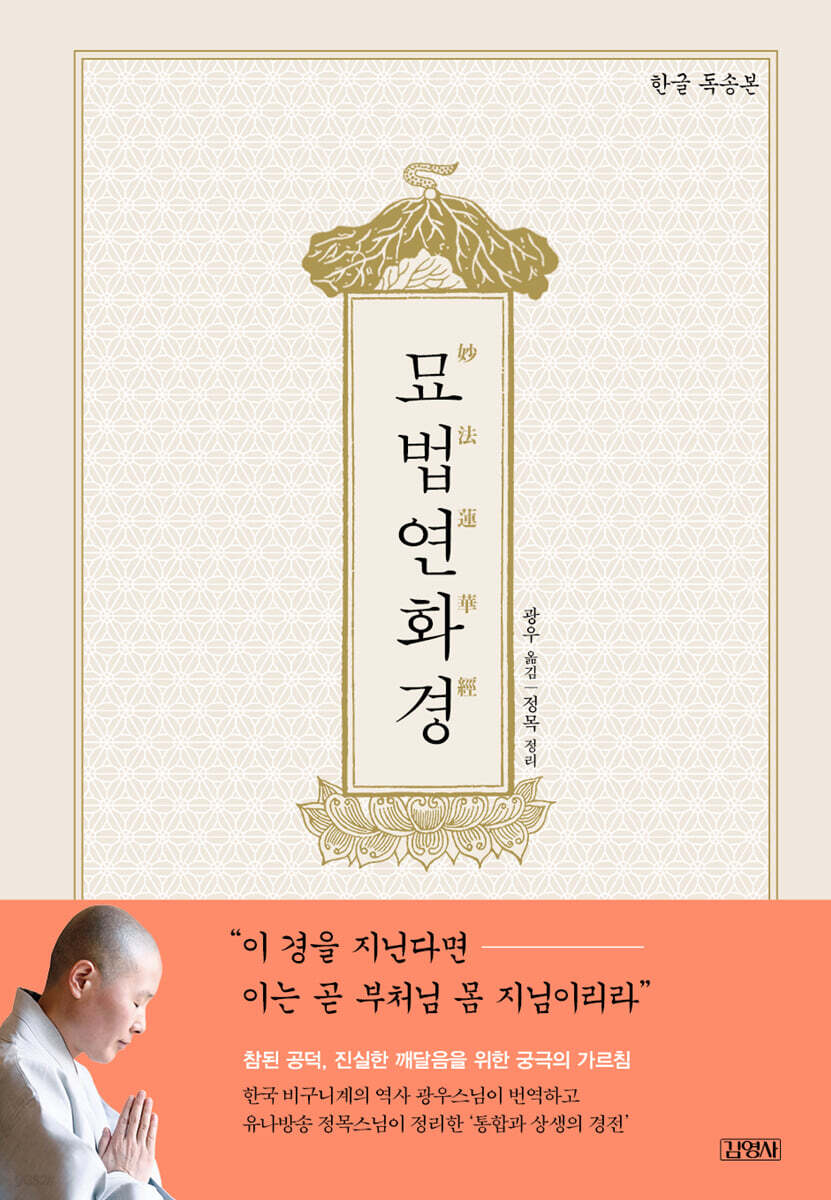
“If you hold this sutra, you will have the body of the Buddha.” The history of Korean nuns was translated by Gwangwoo Lotus Sutra for recitation, compiled by Monk Jeongmok of Yuna Broadcasting The ‘sutra of sutras’, considered one of the major Mahayana sutras along with the ‘Diamond Sutra’ and the ‘Avatamsaka Sutra’. The ultimate teaching, the Lotus Sutra, responds to the bewildered minds of beginners and the long-standing concerns of practitioners. Among the many translations, the one by Taeheo Gwangwoo, which is widely loved for its good rhythm and clear meaning, was compiled by Monk Jeongmok. A scripture of 'integration' that encompasses various Buddhist theories and a scripture of 'mutual existence' that embodies the Mahayana spirit. A guide to living in the present moment with true virtue and true enlightenment. |
- You can preview some of the book's contents.
Preview
index
Volume 1
1. Preface
2 Expedient Means
Volume 2
3 Parables
4 Sinhaepum
Volume 3
5 Herbal memorabilia
6. Handwritten Notes
7. Martian Relics
Volume 4
8 The Five Hundred Disciples' Handicrafts
9. The Infamous Record of the Uneducated
10. Chapter of the Dharma Master
11. The Treasure Tower
12 Devadal Dapum
13. The Book of Advice
Volume 5
14 Comfortable Goods
15. Products from the earth
Chapter 16: The Measure of the Lifespan of the Tathagata
17. Discrimination of Merit and Virtue
Volume 6
18 Suhi Merit Chapter
19. Chapter on the Merits of the Dharma Master
20. The Chapter on the Always Unlightened Bodhisattva
21 The Tathagata's Divine Powers
22 Four ropes
23 Chapter on the Original Affairs of the Medicine King Bodhisattva
Volume 7
24 Chapter of the Wonderful Sound Bodhisattva
25. The Universal Gate of Avalokitesvara Bodhisattva
Chapter 26 Dharani
27 The Book of the Wonderful and Erect King
28 Chapter on the Advancement of Samantabhadra Bodhisattva
Translator's Note - Gwangwoo
Dedicated to the republication - Jeongmok
1. Preface
2 Expedient Means
Volume 2
3 Parables
4 Sinhaepum
Volume 3
5 Herbal memorabilia
6. Handwritten Notes
7. Martian Relics
Volume 4
8 The Five Hundred Disciples' Handicrafts
9. The Infamous Record of the Uneducated
10. Chapter of the Dharma Master
11. The Treasure Tower
12 Devadal Dapum
13. The Book of Advice
Volume 5
14 Comfortable Goods
15. Products from the earth
Chapter 16: The Measure of the Lifespan of the Tathagata
17. Discrimination of Merit and Virtue
Volume 6
18 Suhi Merit Chapter
19. Chapter on the Merits of the Dharma Master
20. The Chapter on the Always Unlightened Bodhisattva
21 The Tathagata's Divine Powers
22 Four ropes
23 Chapter on the Original Affairs of the Medicine King Bodhisattva
Volume 7
24 Chapter of the Wonderful Sound Bodhisattva
25. The Universal Gate of Avalokitesvara Bodhisattva
Chapter 26 Dharani
27 The Book of the Wonderful and Erect King
28 Chapter on the Advancement of Samantabhadra Bodhisattva
Translator's Note - Gwangwoo
Dedicated to the republication - Jeongmok
Into the book
You should not enjoy being in the three-worldly house, and should not desire the mediocre colors, sounds, smells, tastes, and textures.
If you covet and become attached to it, you will soon be burned by fire.
If you quickly come out of this three realms, you will surely attain the three vehicles: the vehicle of the holy hearers, the vehicle of the pristine land, and the vehicle of the Buddha.
I am now responsible for this work for you and guarantee that it will never be in vain. Just practice diligently and diligently.
The Tathagata uses these expedient means to guide living beings to the right path.
---From "Parables"
World-Honored One, the wealthy man is the Tathagata, and we are like the sons of the Buddha.
The Tathagata always called us his sons.
World-Honored One, because we are entangled in the three sufferings, we suffer from various hot pains in the world of birth and death, and because we are deluded and ignorant, we only enjoy and cling to the Hinayana Dharma.
Today, the World-Honored One has made us think about eliminating all the filth of the dharma talk.
We worked diligently among them and earned a day's wages that would lead us to extinction.
---From "Shin Haepum"
In this way, Kasyapa, the Buddha's teachings are like a great cloud that sprinkles a drop of rain on human flowers, causing them to bear fruit.
Kasyapa, you should know this.
Through these connections and various parables, I open the way to Buddhism. This is my expedient method, and all Buddhas are like this.
I will now tell you the final truth: not all the saints have gone extinct. What you should do is the Bodhisattva way. If you continue to practice and learn, you will all attain Buddhahood.
---From "Herbal Relics"
Again, do not practice the laws of superior, middle, and inferior, of conditioned and unconditioned, of true and untrue laws, and do not discriminate between male and female. Do not say that you have obtained all laws, do not say that you know all laws, and do not say that you have seen all laws. This is called the practice of a Bodhisattva.
All laws are empty, there is no permanent abiding, and there is no arising or cessation.
This is called the friendliness of the wise.
---From "Comfortable Goods"
With a deluded mind, you discriminate between existence and non-existence, reality and non-reality, arising and non-arising. Therefore, while staying in a quiet place, cultivate and gather your mind, remain at ease and remain unmoved, like Mount Sumeru.
It governs all laws, but there is none.
---From "Comfortable Goods"
Manjushri, this Lotus Sutra is the foremost sermon of all the Tathagatas, the most profound of all sermons, and is being expounded at the very end. It is like a powerful king giving away a pearl he has kept for a long time.
Manjushri, this Lotus Sutra is the secret Dharma storehouse of all Buddhas.
It is the highest of all sutras. It has been protected for a long time and not spoken of carelessly, and only today is it spoken to you.
---From "Comfortable Goods"
Just as a cool pond quenches all thirst, as a cold person finds fire, as a naked person finds clothes, as a merchant finds the owner of his goods, as a son finds his mother, as a ferryman finds a boat, as a sick person finds a doctor, as a lamp in the darkness, as a poor person finds a treasure, as a commoner meets a king, as a merchant meets the sea, as a torch drives away the darkness, this Lotus Sutra is also like this, able to relieve all suffering and illness of all living beings and to free them from all bonds of birth and death.
---From “The Chapter of the Medicine King Bodhisattva’s Original Works”
You are so handsome, my good man.
If you are able to accept, uphold, recite, meditate on, and expound this sutra among the teachings of Shakyamuni Buddha, the blessings you will gain will be immeasurable and boundless. Fire will not be able to burn it, nor will water be able to drown it. Even if a thousand Buddhas were to expound it together, they would not be able to exhaust your merits.
If you covet and become attached to it, you will soon be burned by fire.
If you quickly come out of this three realms, you will surely attain the three vehicles: the vehicle of the holy hearers, the vehicle of the pristine land, and the vehicle of the Buddha.
I am now responsible for this work for you and guarantee that it will never be in vain. Just practice diligently and diligently.
The Tathagata uses these expedient means to guide living beings to the right path.
---From "Parables"
World-Honored One, the wealthy man is the Tathagata, and we are like the sons of the Buddha.
The Tathagata always called us his sons.
World-Honored One, because we are entangled in the three sufferings, we suffer from various hot pains in the world of birth and death, and because we are deluded and ignorant, we only enjoy and cling to the Hinayana Dharma.
Today, the World-Honored One has made us think about eliminating all the filth of the dharma talk.
We worked diligently among them and earned a day's wages that would lead us to extinction.
---From "Shin Haepum"
In this way, Kasyapa, the Buddha's teachings are like a great cloud that sprinkles a drop of rain on human flowers, causing them to bear fruit.
Kasyapa, you should know this.
Through these connections and various parables, I open the way to Buddhism. This is my expedient method, and all Buddhas are like this.
I will now tell you the final truth: not all the saints have gone extinct. What you should do is the Bodhisattva way. If you continue to practice and learn, you will all attain Buddhahood.
---From "Herbal Relics"
Again, do not practice the laws of superior, middle, and inferior, of conditioned and unconditioned, of true and untrue laws, and do not discriminate between male and female. Do not say that you have obtained all laws, do not say that you know all laws, and do not say that you have seen all laws. This is called the practice of a Bodhisattva.
All laws are empty, there is no permanent abiding, and there is no arising or cessation.
This is called the friendliness of the wise.
---From "Comfortable Goods"
With a deluded mind, you discriminate between existence and non-existence, reality and non-reality, arising and non-arising. Therefore, while staying in a quiet place, cultivate and gather your mind, remain at ease and remain unmoved, like Mount Sumeru.
It governs all laws, but there is none.
---From "Comfortable Goods"
Manjushri, this Lotus Sutra is the foremost sermon of all the Tathagatas, the most profound of all sermons, and is being expounded at the very end. It is like a powerful king giving away a pearl he has kept for a long time.
Manjushri, this Lotus Sutra is the secret Dharma storehouse of all Buddhas.
It is the highest of all sutras. It has been protected for a long time and not spoken of carelessly, and only today is it spoken to you.
---From "Comfortable Goods"
Just as a cool pond quenches all thirst, as a cold person finds fire, as a naked person finds clothes, as a merchant finds the owner of his goods, as a son finds his mother, as a ferryman finds a boat, as a sick person finds a doctor, as a lamp in the darkness, as a poor person finds a treasure, as a commoner meets a king, as a merchant meets the sea, as a torch drives away the darkness, this Lotus Sutra is also like this, able to relieve all suffering and illness of all living beings and to free them from all bonds of birth and death.
---From “The Chapter of the Medicine King Bodhisattva’s Original Works”
You are so handsome, my good man.
If you are able to accept, uphold, recite, meditate on, and expound this sutra among the teachings of Shakyamuni Buddha, the blessings you will gain will be immeasurable and boundless. Fire will not be able to burn it, nor will water be able to drown it. Even if a thousand Buddhas were to expound it together, they would not be able to exhaust your merits.
---From “The Chapter of the Medicine King Bodhisattva’s Original Works”
Publisher's Review
“This Lotus Sutra is the secret Dharma field of all Buddhas.
It is the highest of all scriptures,
After protecting it for a long time and not speaking carelessly,
“It is only today that I can tell you this.” _From ‘Anrakhaengpum’
The Lotus Sutra (abbreviated as the Lotus Sutra), which is considered one of the major Mahayana sutras along with the Diamond Sutra and the Avatamsaka Sutra, is a monumental sutra that integrates various Buddhist theories and is called the “king of sutras.”
Among the many translations, Gwangwoo's collection of poems has been widely loved for its good rhythm and clear meaning.
Monk Jeongmok compiled this and published it at Kim Youngsa.
Translated by Gwang-u, a pioneer monk in the Korean Buddhist nun community
The Lotus Sutra, a Korean version of the Lotus Sutra, compiled by Monk Jeongmok, a guide to comfort and healing.
Gwangwoo, a giant in Korean Buddhism, was the first Korean nun to graduate from the Department of Buddhist Studies at Dongguk University. She has devoted her life to education, social welfare, and scholarship work, spreading the fragrance of the Dharma throughout the world.
In particular, he devoted himself to practicing the Lotus Sutra, and for many years he opened the Lotus Forest. After completing his morning and evening prayers, he would read one chapter of the Lotus Sutra.
Thus, in 1985, the year he celebrated his 60th birthday, he personally translated and published the Lotus Sutra (published by Jeonggaksa), which he declared to be “the most precious sutra of his life.”
Since 2009, Venerable Jeongmok, who has succeeded Venerable Gwangwoo as the head priest of Jeonggaksa Temple, has been following in his teacher's footsteps and spreading a positive influence on society that transcends religion.
He, who has been spreading messages of courage and wisdom through the specialized media outlet for mind study, 'Yuna Broadcasting', has compiled and re-released the translated version of the Lotus Sutra by Gwangwoo.
To ensure that anyone can easily connect with the Lotus Sutra, I have revised the text by reciting it repeatedly with the monks.
To make the meaning clearer, we refined the sentences by considering rhythm and meaning units, and translated Chinese characters into Korean without damaging the original meaning.
Additionally, the font size was increased to allow for easy reading, but was adjusted to the size of a standard paperback to ensure portability.
When Monk Jeongmok published the Lotus Sutra, he praised it as “a wondrous scripture that conveys boundless information and a guide to living in the present moment.”
“The affinity and merit of reciting and holding the Lotus Sutra are like receiving an invitation to enter the world of Buddha.” _From Monk Jeongmok’s ‘Dedication to Republication’
A sutra of 'integration' that embraces the practices of all sects without conflict
The sutra of 'Sangsaeng', embodying the Mahayana spirit of helping everyone achieve nirvana.
This sutra, which the Buddha declared to be “the most profound and therefore the very last,” focuses on core doctrines such as the One Buddha Vehicle and Buddhahood, thereby harmoniously synthesizing the practices of each sect that were divided by differences in detailed methods.
For example, the Bodhisattva in the Lotus Sutra, who dedicates the fruits of his practice and postpones nirvana until everyone is liberated, possesses both the highest level of early Buddhist practice, the 'arhat', and the ideal of Mahayana Buddhism, the 'bodhisattva'.
The Lotus Sutra also conveys the values of equality and coexistence that we must reflect on today.
This sutra, which contains scenes of women who were traditionally considered incapable of attaining Buddhahood, says, “Do not discriminate between men and women,” and “If you practice and learn more and more, you will all become Buddhas.”
In this way, the Buddha, who transcends worldly discrimination and bestows trust upon humans with Buddha-nature, leads all living beings to nirvana.
By providing parables and explanations tailored to the abilities of each living being, no one is left behind.
This sutra, which has been praised as “the last true teaching (by Master Gamsan)” and “the sutra that best expresses the true meaning of the Buddha’s appearance on this earth (by Master Ji-i),” is also highly regarded for its literary value.
Regarding this sutra, which explains the truth through exquisite metaphors and rich examples, martial arts writer Kim Yong praised it as “great literature.”
The Lotus Sutra is widely regarded as a piece of literature praising the Buddha that is imbued with the vitality to inspire faith.
“All these living beings are my sons, so I will equally grant them the Mahayana. I will not allow any of them to attain extinction alone, but will cause them all to attain extinction through the Tathagata’s extinction.” _From ‘Parables’
“Do not enjoy being in a burning house.”
The Buddha's clear diagnosis and prescription for sentient beings deeply entangled in suffering.
*Sources of core doctrines and key concepts
The theme of the Lotus Sutra is 'the union of the three and the return to one', which states that the ultimate goal of all practice is to realize the teachings of Buddhahood, and 'original Buddhahood', which states that all living beings can attain Buddhahood.
This is a monumental sutra that transcends the limitations of sectarian Buddhism, which has disparaged other methods of practice, and focuses on the core, recognizing the three types of monks: the saintly monk, the enlightened monk, and the bodhisattva monk, each with their own legitimacy, as methods of saving sentient beings.
The way the core content is conveyed is also exceptional.
Through parables and examples such as 'The story of a father who saved his three sons from a burning house' and 'The story of a man who suffered while wandering the world without knowing that he had a jewel', he persuades all living beings who read the sutra to accept it as their own story.
In this process, key Buddhist terms that are familiar to many people, such as ‘Bulja (佛子)’ and ‘Hwataek (火宅)’, are introduced for the first time.
*Diagnosis and Prescription for Living Beings Trapped in Suffering
The Buddha emphasizes the importance of practicing the Lotus Sutra, advising the living beings he regards as his children to stop dwelling in the world of “craving for insignificant colors, sounds, smells, tastes, and textures.”
By diligently reading and copying this sutra, you can purify your senses, escape from the fire, and realize Buddha nature.
In this way, the Lotus Sutra provides practical solutions on how to escape suffering.
Furthermore, it explains the source of suffering and why we enjoy the fire pit, diagnoses the situation of living beings entangled in suffering, and presents a fundamental prescription.
This sutra answers questions that represent the bewildered minds of beginners, such as, "Where and how can we find the Buddha-nature that exists in everyone?" and "Are there high and low levels of paths to Buddhahood?", as well as questions that have long been a concern for practitioners, such as, "Where is the Buddha and what does he do for us?" and "What can a Bodhisattva do for those who suffer?"
Readers who follow the process of questions and answers will face the ultimate question, "Am I truly living well?" and thus take a big step toward the truth.
If we diligently practice, guided by the accurate interpretations of Monk Gwang-woo, who has walked ahead and paved the way for us, and the kind guidance of Monk Jeongmok, we will be freed from the bonds of life and death, “like a poor person finding a treasure” and “like a torch dispelling the darkness,” and receive immeasurable joy and blessings.
“For the sake of the Buddha, I have preached many sutras widely throughout the immeasurable lands from the beginning until now, but among them, this sutra is the best. If one can uphold this sutra, he will possess the body of the Buddha.” _From the ‘Gyeonbotap Chapter’
It is the highest of all scriptures,
After protecting it for a long time and not speaking carelessly,
“It is only today that I can tell you this.” _From ‘Anrakhaengpum’
The Lotus Sutra (abbreviated as the Lotus Sutra), which is considered one of the major Mahayana sutras along with the Diamond Sutra and the Avatamsaka Sutra, is a monumental sutra that integrates various Buddhist theories and is called the “king of sutras.”
Among the many translations, Gwangwoo's collection of poems has been widely loved for its good rhythm and clear meaning.
Monk Jeongmok compiled this and published it at Kim Youngsa.
Translated by Gwang-u, a pioneer monk in the Korean Buddhist nun community
The Lotus Sutra, a Korean version of the Lotus Sutra, compiled by Monk Jeongmok, a guide to comfort and healing.
Gwangwoo, a giant in Korean Buddhism, was the first Korean nun to graduate from the Department of Buddhist Studies at Dongguk University. She has devoted her life to education, social welfare, and scholarship work, spreading the fragrance of the Dharma throughout the world.
In particular, he devoted himself to practicing the Lotus Sutra, and for many years he opened the Lotus Forest. After completing his morning and evening prayers, he would read one chapter of the Lotus Sutra.
Thus, in 1985, the year he celebrated his 60th birthday, he personally translated and published the Lotus Sutra (published by Jeonggaksa), which he declared to be “the most precious sutra of his life.”
Since 2009, Venerable Jeongmok, who has succeeded Venerable Gwangwoo as the head priest of Jeonggaksa Temple, has been following in his teacher's footsteps and spreading a positive influence on society that transcends religion.
He, who has been spreading messages of courage and wisdom through the specialized media outlet for mind study, 'Yuna Broadcasting', has compiled and re-released the translated version of the Lotus Sutra by Gwangwoo.
To ensure that anyone can easily connect with the Lotus Sutra, I have revised the text by reciting it repeatedly with the monks.
To make the meaning clearer, we refined the sentences by considering rhythm and meaning units, and translated Chinese characters into Korean without damaging the original meaning.
Additionally, the font size was increased to allow for easy reading, but was adjusted to the size of a standard paperback to ensure portability.
When Monk Jeongmok published the Lotus Sutra, he praised it as “a wondrous scripture that conveys boundless information and a guide to living in the present moment.”
“The affinity and merit of reciting and holding the Lotus Sutra are like receiving an invitation to enter the world of Buddha.” _From Monk Jeongmok’s ‘Dedication to Republication’
A sutra of 'integration' that embraces the practices of all sects without conflict
The sutra of 'Sangsaeng', embodying the Mahayana spirit of helping everyone achieve nirvana.
This sutra, which the Buddha declared to be “the most profound and therefore the very last,” focuses on core doctrines such as the One Buddha Vehicle and Buddhahood, thereby harmoniously synthesizing the practices of each sect that were divided by differences in detailed methods.
For example, the Bodhisattva in the Lotus Sutra, who dedicates the fruits of his practice and postpones nirvana until everyone is liberated, possesses both the highest level of early Buddhist practice, the 'arhat', and the ideal of Mahayana Buddhism, the 'bodhisattva'.
The Lotus Sutra also conveys the values of equality and coexistence that we must reflect on today.
This sutra, which contains scenes of women who were traditionally considered incapable of attaining Buddhahood, says, “Do not discriminate between men and women,” and “If you practice and learn more and more, you will all become Buddhas.”
In this way, the Buddha, who transcends worldly discrimination and bestows trust upon humans with Buddha-nature, leads all living beings to nirvana.
By providing parables and explanations tailored to the abilities of each living being, no one is left behind.
This sutra, which has been praised as “the last true teaching (by Master Gamsan)” and “the sutra that best expresses the true meaning of the Buddha’s appearance on this earth (by Master Ji-i),” is also highly regarded for its literary value.
Regarding this sutra, which explains the truth through exquisite metaphors and rich examples, martial arts writer Kim Yong praised it as “great literature.”
The Lotus Sutra is widely regarded as a piece of literature praising the Buddha that is imbued with the vitality to inspire faith.
“All these living beings are my sons, so I will equally grant them the Mahayana. I will not allow any of them to attain extinction alone, but will cause them all to attain extinction through the Tathagata’s extinction.” _From ‘Parables’
“Do not enjoy being in a burning house.”
The Buddha's clear diagnosis and prescription for sentient beings deeply entangled in suffering.
*Sources of core doctrines and key concepts
The theme of the Lotus Sutra is 'the union of the three and the return to one', which states that the ultimate goal of all practice is to realize the teachings of Buddhahood, and 'original Buddhahood', which states that all living beings can attain Buddhahood.
This is a monumental sutra that transcends the limitations of sectarian Buddhism, which has disparaged other methods of practice, and focuses on the core, recognizing the three types of monks: the saintly monk, the enlightened monk, and the bodhisattva monk, each with their own legitimacy, as methods of saving sentient beings.
The way the core content is conveyed is also exceptional.
Through parables and examples such as 'The story of a father who saved his three sons from a burning house' and 'The story of a man who suffered while wandering the world without knowing that he had a jewel', he persuades all living beings who read the sutra to accept it as their own story.
In this process, key Buddhist terms that are familiar to many people, such as ‘Bulja (佛子)’ and ‘Hwataek (火宅)’, are introduced for the first time.
*Diagnosis and Prescription for Living Beings Trapped in Suffering
The Buddha emphasizes the importance of practicing the Lotus Sutra, advising the living beings he regards as his children to stop dwelling in the world of “craving for insignificant colors, sounds, smells, tastes, and textures.”
By diligently reading and copying this sutra, you can purify your senses, escape from the fire, and realize Buddha nature.
In this way, the Lotus Sutra provides practical solutions on how to escape suffering.
Furthermore, it explains the source of suffering and why we enjoy the fire pit, diagnoses the situation of living beings entangled in suffering, and presents a fundamental prescription.
This sutra answers questions that represent the bewildered minds of beginners, such as, "Where and how can we find the Buddha-nature that exists in everyone?" and "Are there high and low levels of paths to Buddhahood?", as well as questions that have long been a concern for practitioners, such as, "Where is the Buddha and what does he do for us?" and "What can a Bodhisattva do for those who suffer?"
Readers who follow the process of questions and answers will face the ultimate question, "Am I truly living well?" and thus take a big step toward the truth.
If we diligently practice, guided by the accurate interpretations of Monk Gwang-woo, who has walked ahead and paved the way for us, and the kind guidance of Monk Jeongmok, we will be freed from the bonds of life and death, “like a poor person finding a treasure” and “like a torch dispelling the darkness,” and receive immeasurable joy and blessings.
“For the sake of the Buddha, I have preached many sutras widely throughout the immeasurable lands from the beginning until now, but among them, this sutra is the best. If one can uphold this sutra, he will possess the body of the Buddha.” _From the ‘Gyeonbotap Chapter’
GOODS SPECIFICS
- Date of issue: December 1, 2021
- Format: Hardcover book binding method guide
- Page count, weight, size: 544 pages | 894g | 152*225*35mm
- ISBN13: 9788934912064
- ISBN10: 8934912065
You may also like
카테고리
korean


korean

![GQ KOREA Mark (Monthly): December [2025]](http://librairie.coreenne.fr/cdn/shop/files/8ef265dbbfbf186523ed75ba7319009d.jpg?v=1765340328&width=3840)


