

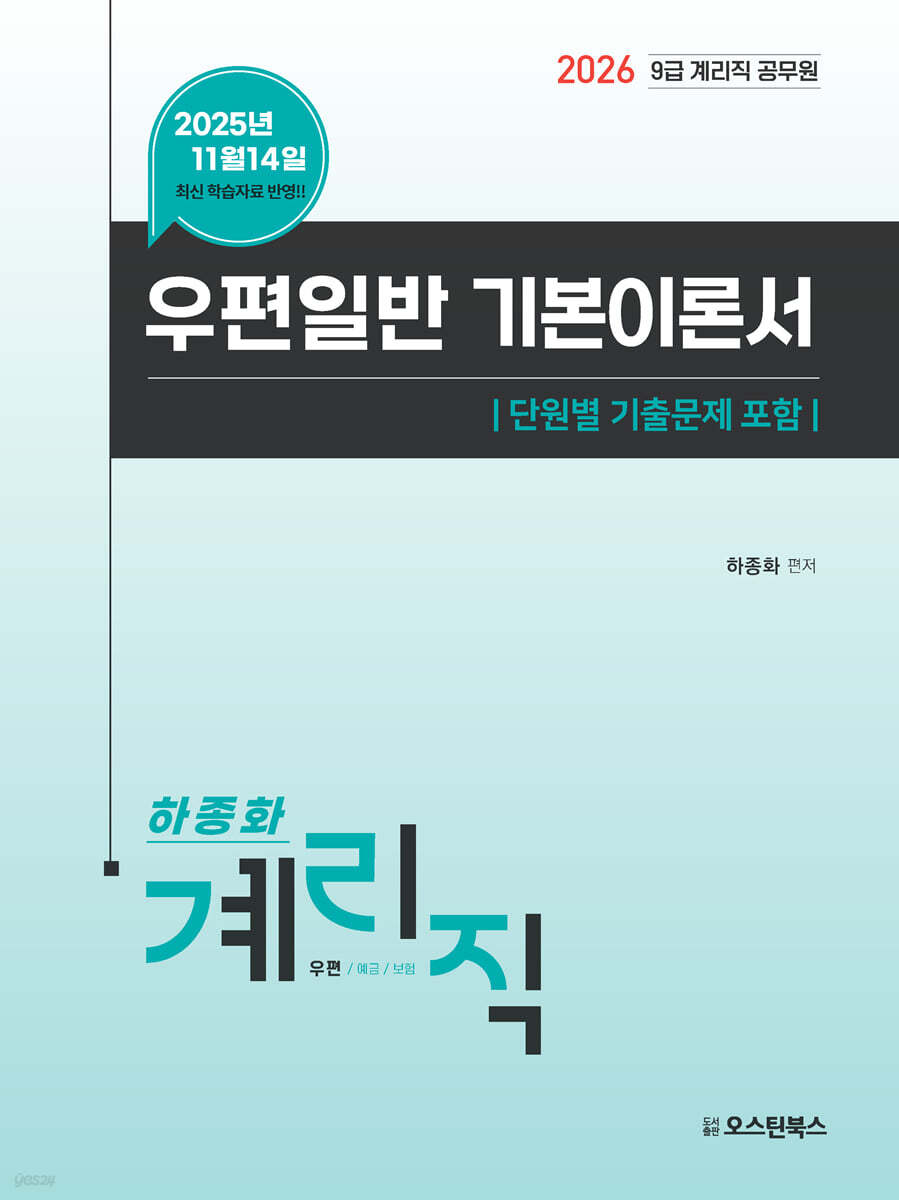
2026 Grade 9 Accounting Civil Servant Postal General Basic Theory Book (Including Past Questions by Unit)
 |
Description
Book Introduction
Updated study materials as of November 14, 2025 / 9th Grade Accounting Civil Service Exam Preparation.
Includes past exam questions and solutions.
Summary and comparison of key contents.
Readability has been enhanced by bolding and underlining the main content that can be tested.
Includes past exam questions and solutions.
Summary and comparison of key contents.
Readability has been enhanced by bolding and underlining the main content that can be tested.
- You can preview some of the book's contents.
Preview
index
Part 1 Domestic Mail 9
Chapter 1 General Theory 10
Section 1: The Significance of Postal Service and the Characteristics of its Business 10
Chapter 2 Types of Postal Services and Terms of Use 22
Section 1. Classification of postal services and delivery deadlines 22
Section 2: Ordinary Mail 25
Section 3 Parcel Post 35
Section 4 Parcels received at the door (post office parcels) 40
Chapter 3: Receiving Mail 44
Section 1. Inspection of Mail Upon Receipt 44
Section 2 Packaging of Mail 45
Section 3: Limits on the volume and weight of mail 46
Chapter 4 Additional Services for Domestic Mail 48
Section 1 Registration Handling 48
Section 2 Insurance Handling 57
Section 3 Handling of Proofs Types of proof handling are presented in 61
Section 4 Special Treatment 65
Section 5 Other Additional Handling 66
Chapter 5 Other Postal Services 76
Section 1 Post Office Shopping 76
Section 2 E-mail Service 81
Section 3: Lifestyle Information Promotion Mail Service 86
Section 4 Other Additional Services 90
Chapter 6 Postal Charges 102
Section 1. Postage-paid mail 102
Section 2 Postage Postage 103
Section 3: Mail using postage labels 105
Section 4 Collector's Fee Mail 109
Section 5: Postage Reduction 112
Section 6 Request for refund of postage, etc. 130
Section 7 Free Mail *Additional information from the 26-year notice 133
Section 8: Correspondence Office Mail *Additional information from the 26-year notice 137
Chapter 7 Compensation for Damages and Losses 140
Section 1: Compensation System for Domestic Mail 140
Section 2 Loss Compensation System 145
Section 3: User Expense Payment System 146
Chapter 8 Other Claims and Contracts 150
Section 1. Requests for Changes to the Address or Name of the Recipient of Domestic Mail and Requests for Return of Mail 150
Section 2 Requests for Change of Storage Office and Delivery of Domestic Mail 151
Section 3 Post Office Box Use Agreement 152
Section 4 Management and Sale of Stamps *Newly added in the 26th Announcement 157
Section 5: Private Postbox Installation Contract *Newly added in the 26-year notice 164
Part 2 Postal Logistics 169
Chapter 1: Launching, Departure, and Transportation Operations 170
Section 1: Departure and Transportation Operations 170
Section 2: Collection and Delivery of Mail 196
Part 3 International Mail 247
Chapter 1: General Provisions on International Mail 248
Section 1: The Significance of International Mail 248
Section 2 International Organizations Relating to Postal Services 248
Section 3: Types of International Mail and Classification of Postal Offices Handling It 263
Chapter 2: Guidelines for Accepting International Mail by Type 286
Section 1: Reception of International Mail 286
Section 2: Application Methods by Type 288
Section 3 Receipt of Other Special Mail 302
Chapter 3 International Postage Rates 310
Section 1 Overview 310
Section 2 Separate Payment of International Postage 312
Section 3 Postpaid International Postage 313
Section 4 International Business Reply Service (IBRS) 315
Section 5 Return Service for Overseas E-Commerce (IBRS EMS) 316
Section 6 International Reply Coupons *Name changed from International Reply Coupons to International Reply Coupons in the 2022 announcement. 318
Chapter 4 Additional Services and Systems 324
Section 1 EMS Delivery Guarantee Service 324
Section 2 Export Mail Delivery Confirmation Service 325
Section 3 Provision of Pre-Customs Clearance Information 328
Section 4: International Postal Rate Reduction System 335
Section 5 Other Major Additional Services and Systems 339
Chapter 5 EMS Premium Service 344
Section 1 EMS Premium Service (Private International Courier Partnership Service) 344
Chapter 6 Various Billing Systems 352
Section 1: Whereabouts Investigation Request System 352
Section 2 International Mail Damage Compensation System 358
Chapter 7 International Mail and Return of International Postage Charges 364
Section 1. Changes, Corrections, or Returns of External Records of International Mail 364
Section 2 Request for Refund of International Postage Charges 369
Chapter 8 International Mail Fee Notice 372
Section 1 Postal Service Headquarters Notice 372
Appendix Related Laws 377
Postal Service Act 378
Enforcement Decree of the Postal Service Act 394
Enforcement Regulations of the Postal Service Act 408
Postal Service Regulation 446
International Postal Regulations 532
Chapter 1 General Theory 10
Section 1: The Significance of Postal Service and the Characteristics of its Business 10
Chapter 2 Types of Postal Services and Terms of Use 22
Section 1. Classification of postal services and delivery deadlines 22
Section 2: Ordinary Mail 25
Section 3 Parcel Post 35
Section 4 Parcels received at the door (post office parcels) 40
Chapter 3: Receiving Mail 44
Section 1. Inspection of Mail Upon Receipt 44
Section 2 Packaging of Mail 45
Section 3: Limits on the volume and weight of mail 46
Chapter 4 Additional Services for Domestic Mail 48
Section 1 Registration Handling 48
Section 2 Insurance Handling 57
Section 3 Handling of Proofs Types of proof handling are presented in 61
Section 4 Special Treatment 65
Section 5 Other Additional Handling 66
Chapter 5 Other Postal Services 76
Section 1 Post Office Shopping 76
Section 2 E-mail Service 81
Section 3: Lifestyle Information Promotion Mail Service 86
Section 4 Other Additional Services 90
Chapter 6 Postal Charges 102
Section 1. Postage-paid mail 102
Section 2 Postage Postage 103
Section 3: Mail using postage labels 105
Section 4 Collector's Fee Mail 109
Section 5: Postage Reduction 112
Section 6 Request for refund of postage, etc. 130
Section 7 Free Mail *Additional information from the 26-year notice 133
Section 8: Correspondence Office Mail *Additional information from the 26-year notice 137
Chapter 7 Compensation for Damages and Losses 140
Section 1: Compensation System for Domestic Mail 140
Section 2 Loss Compensation System 145
Section 3: User Expense Payment System 146
Chapter 8 Other Claims and Contracts 150
Section 1. Requests for Changes to the Address or Name of the Recipient of Domestic Mail and Requests for Return of Mail 150
Section 2 Requests for Change of Storage Office and Delivery of Domestic Mail 151
Section 3 Post Office Box Use Agreement 152
Section 4 Management and Sale of Stamps *Newly added in the 26th Announcement 157
Section 5: Private Postbox Installation Contract *Newly added in the 26-year notice 164
Part 2 Postal Logistics 169
Chapter 1: Launching, Departure, and Transportation Operations 170
Section 1: Departure and Transportation Operations 170
Section 2: Collection and Delivery of Mail 196
Part 3 International Mail 247
Chapter 1: General Provisions on International Mail 248
Section 1: The Significance of International Mail 248
Section 2 International Organizations Relating to Postal Services 248
Section 3: Types of International Mail and Classification of Postal Offices Handling It 263
Chapter 2: Guidelines for Accepting International Mail by Type 286
Section 1: Reception of International Mail 286
Section 2: Application Methods by Type 288
Section 3 Receipt of Other Special Mail 302
Chapter 3 International Postage Rates 310
Section 1 Overview 310
Section 2 Separate Payment of International Postage 312
Section 3 Postpaid International Postage 313
Section 4 International Business Reply Service (IBRS) 315
Section 5 Return Service for Overseas E-Commerce (IBRS EMS) 316
Section 6 International Reply Coupons *Name changed from International Reply Coupons to International Reply Coupons in the 2022 announcement. 318
Chapter 4 Additional Services and Systems 324
Section 1 EMS Delivery Guarantee Service 324
Section 2 Export Mail Delivery Confirmation Service 325
Section 3 Provision of Pre-Customs Clearance Information 328
Section 4: International Postal Rate Reduction System 335
Section 5 Other Major Additional Services and Systems 339
Chapter 5 EMS Premium Service 344
Section 1 EMS Premium Service (Private International Courier Partnership Service) 344
Chapter 6 Various Billing Systems 352
Section 1: Whereabouts Investigation Request System 352
Section 2 International Mail Damage Compensation System 358
Chapter 7 International Mail and Return of International Postage Charges 364
Section 1. Changes, Corrections, or Returns of External Records of International Mail 364
Section 2 Request for Refund of International Postage Charges 369
Chapter 8 International Mail Fee Notice 372
Section 1 Postal Service Headquarters Notice 372
Appendix Related Laws 377
Postal Service Act 378
Enforcement Decree of the Postal Service Act 394
Enforcement Regulations of the Postal Service Act 408
Postal Service Regulation 446
International Postal Regulations 532
Into the book
Part 1 Domestic Mail
Chapter 1 General Theory
Chapter 2 Types of Postal Services and Terms of Use
Chapter 3 Receipt of Mail
Chapter 4 Additional Services for Domestic Mail
Chapter 5 Other Postal Services
Chapter 6 Postal Charges
Chapter 7 Compensation for Damages and Losses
Chapter 8 Other Claims and Contracts
Chapter 1 General Theory
Section 1. Significance of postal service and characteristics of business
1. The meaning of mail
go.
Narrow meaning: The postal service headquarters is responsible for sending documents, calls, and other items that convey intentions, such as letters, inside and outside the country.
Broad meaning: A general term for the work of postal offices to deliver documents or goods or provide additional services thereto.
me.
Postal service is one of the basic social services provided by the government to enable citizens to lead an average life in their daily lives.
Accordingly, many countries, including ours, have laws requiring the provision of universal postal services.
all.
The post office is one of the main means of communication and serves as the central nervous system that transmits information in all fields, including politics, economy, society, culture, and administration.
la.
However, it is different from telecommunications, which transmits information by electrical means, in that it transmits physical objects such as letters or objects.
2 Characteristics of the postal service
go.
The postal service is designated as a government enterprise* according to the Government Enterprise Budget Act.
Since the members are civil servants and the overall business is regulated by law, there are many management restrictions, but when there is a deficit, support can be received from other accounting sources.
* Government enterprise: An enterprise invested in, managed, and operated by the government to pursue the interests of the people.
me.
The accounting system of the postal service adopts an independent accounting system as a special accounting system to ensure management rationality, operational efficiency, and flexible use of the budget.
The postal service has both a public interest as a government enterprise and an accounting business, so the challenge is to balance these two aspects.
all.
According to Colin Clark's classification of industries, the postal service belongs to the tertiary industry, which is highly labor-intensive.
Because of the nature of the business, which requires a large workforce, labor costs are a significant burden on business management.
3. Postal service usage
go.
Concept
1) The postal service relationship is a relationship in which users utilize human and physical facilities established for the purpose of providing postal services.
2) It is a private law contractual relationship (common sense) that contains a contract for delivery of mail between a postal user and a postal office.
08 Previous Question However, since the postal service is managed by the state and has a public interest nature, it has a somewhat authoritarian aspect in the user relationship.
me.
Postal users
The postal users are the post office, sender, and recipient.
08 Past Questions
Distinguish between the postal contracting parties, the post office and the sender!!
all.
Rights and Obligations of the Postal Delivery Contract
Postal offices have rights and obligations, including the obligation to deliver mail and the right to collect fees and charges; senders have rights and obligations, including the right to request delivery and the right to request return of mail; and recipients have rights and obligations, including the right to receive mail and the right to refuse to receive mail.
la.
Postal Service Contract Formation Period 08 Previous Questions
The relationship of rights and obligations between the contracting parties arises only when a postal service contract is established. (Compare this to the timing of establishment of deposit contracts and insurance contracts!!)
1) The time of contract establishment is considered to be the time when the employee receives the document at the post office window or when it is placed in the mailbox.
2) In case of a visit to the store or a delivery person receiving the order, the contract is established when the receipt is issued.
※ In cases where a postal worker receives a semi-registered document, etc., it may be transferred to the receiving department.
When the postman received it X
Time of establishment of postal service contract
⑴ When receiving at the post office window? When receiving
⑵ When using a mailbox? When putting it in the mailbox
⑶ When the delivery person receives the package and issues a receipt
⑷ If a postal worker receives a semi-registered document, etc., it may be transferred to the receiving department.
4 Postal Service Management Entities and Related Laws
go.
Management entity
1) The postal service is managed by the state and supervised by the Minister of Science and ICT.
08 However, the Minister of Science and ICT may have some of the postal business managed by individuals, corporations, or organizations, and matters related thereto shall be separately determined by law.
(Article 2, Paragraph 1 of the Postal Service Act)
“Management” refers to management and control, and refers to the management entity and the owner itself.
2) The government directly manages the system to provide prompt and accurate postal services at reasonable rates throughout the country.
me.
Postal Law
The Minister of Science and ICT is the management entity, and the government directly manages the system to provide prompt and accurate postal services at reasonable rates by establishing a systematic organization nationwide.
1) Postal Act
The Postal Act is essentially the basic law concerning postal services, and stipulates basic matters such as the form of postal business management, postal privileges, types of postal services, terms of use, compensation for damages, and penalties.
※ First enacted: Law No. 542 (February 1, 1960), most recently revised Law No. 20063 (February 1, 2024).
7. 24.)
2) Act on the Consignment of Post Office Counter Services
This law is a statute that regulates the work of postal offices, user protection, and distribution of goods, which are operated by individuals who are delegated postal office work.
A post office is a business that entrusts the operation of postal service windows to the general public in order to meet the public's demand for postal service.
The post office only operates postal services.
※ First enacted: Law No. 3601 (1983.
4. 1.), recently revised Act No. 14839 (2017.
7. 26.)
3) Special Act on Postal Service Operation 10
This is a special regulation to improve the management rationality of postal business and the quality of postal services.
The scope of business includes postal, money orders, postal transfer, postal savings, postal insurance, and related businesses.
It regulates organization, personnel, budget, management evaluation, rate and fee determination, and use of postal assets.
※ First enacted: Law No. 5216 (1997.
1. 1.), recently revised Act No. 20149 (2024.
1. 30.)
4) Special Post Office Act
This law is a statute that regulates matters related to the work, employee service, and salaries of special post offices* operated by individuals under the mandate of the state.
* Special Post Office: A post office operated by a private individual with a mandate from the government to build and operate a building and facilities to eliminate inconveniences for residents in areas without a post office.
※ First enacted: Law No. 683 (August 17, 1961), most recently revised Law No. 20260 (August 17, 2024)
7. 24.)
The order of enactment of the Postal Act: Postal Act → Special Postal Office Act → Act on Entrustment of Postal Office Counter Services → Special Act on the Operation of Postal Services
5) International law
a) UPU Treaty
⑴ Universal Postal Union Charter (Convention No. 197, 1966.
5. 20.
horror)
⑵ Additional Protocol No. 9 to the Universal Postal Union Charter (2018.
1. 1.)
⑶ Additional Protocol 1 to the General Rules of the Universal Postal Union (2018.
1. 1.)
⑷ Universal Postal Convention and Final Act
⑸ Postal Payment Service Agreement
⑹ Universal Postal Convention Letter Post Regulations and Final Acts
⑺ Universal Postal Convention Parcel Post Regulations and Final Acts
⑻ Postal Payment Business Agreement Rules
b) Asia-Pacific Postal Union (APPU) Treaty
Founded on April 1, 1962, the Asia-Pacific Postal Union (APPU, formerly the Asia-Oceania Postal Union) aims to establish and develop extensive cooperative relations between postal administrations in the Asia-Pacific region.
This treaty is a treaty between member countries and aims to promote cooperation for the smooth exchange of mail and development of postal services among member countries.
D) Standard multilateral agreement or bilateral agreement
There are standard multilateral agreements or bilateral agreements (bilateral agreements) between our country and the country(ies) to exchange international express mail (EMS).
08 Past Questions
※ Memorandum of Understanding (MOU): A written agreement between our country and the other country.
5. Postal Service Protection Regulations
The nature of the postal service has a significant impact on people's lives.
Therefore, in order to protect the public interest and the rights of the people and to provide stable postal services, legal protective regulations are in place.
(Constitution X)
go.
Exclusive right to correspondence
1) Article 2, Paragraph 2 of the Postal Service Act stipulates, “No person shall engage in the business of delivering letters for others, except in the cases of Paragraphs 1 and 5, and shall not use his or her organization or system to deliver others’ letters,” thereby clearly stating that the state has the monopoly on letters.
2) The subject of the exclusive right is correspondence.
“Letter” means a document or leaflet of any type indicated by letters, symbols, signs, or pictures, sent to a specific person or address for the purpose of communication (Article 1-2, Paragraph 7 of the Postal Act). However, newspapers, periodicals, books, product guides, etc., as prescribed by Presidential Decree, are excluded (Article 3 of the Enforcement Decree of the Postal Act).
3) Exclusive scope of correspondence 19, 25
a) Letters weighing less than 350g and paying less than 10 times the standard postage rate (both requirements must be met).
That is, and)
b) Registered mail sent by a national agency or local government
※ Exclusions for letters (Article 3 of the Enforcement Decree of the Postal Service Act)
- Newspapers according to Article 2, Paragraph 1 of the Act on the Promotion of Newspapers, etc.
- Periodicals according to Article 2, Paragraph 1, Subparagraph A of the Act on the Promotion of Periodicals, including Magazines
- A book that meets all of the following requirements: ? Printed and bound in the form of a booklet with at least 48 pages excluding the cover; ? Issued with the name of either the publisher, publishing house, or printing house indicated; ? Issued with the page number indicated.
- A product guidebook in the form of a booklet with 16 or more pages (including the cover) printed with text, photos, and pictures detailing the product's price, functions, characteristics, etc. 19 previous questions
- Unsealed attachments or invoices attached to cargo 24.
- International documents exchanged with foreign countries
- Commercial documents that require delivery within 12 hours (not within 24 hours) of sending as mail between the head office and branches of a company (including public institutions under the Act on the Management of Public Institutions) or between branches within the country
- Credit card 24 questions corresponding to Article 2, Paragraph 3 of the Specialized Financial Business Act
4) Correspondence delivery business reporting system (newly added in 2025)
a) Mandatory reporting to manage correspondence monopoly rights, protect users, and maintain market order.
b) Reporting matters
- Those who wish to engage in the letter delivery business must submit a report to the head of the local post office.
※ Attach a business plan (including business operations, facility information, and balance sheet) to the report.
- In case of changes in business name, location, representative, or business plan, please report the changes.
- Submit a report even when resuming business after closure or suspension of business for more than 30 days.
5) Legal regulations in case of violation (newly added in 25 years)
? Sender (person who entrusted delivery of the letter)
Violations
(In case of entrusting delivery of the relevant letter*)
Basis for the amount of the penalty
1st violation 2nd violation 3rd or more violations Legal provisions
If the postage for receiving the letter at the post office is less than 10 million won
7.5 million won 10 million won 20 million won Postal Service Act Article 54-2 (Fines)
If the postage for receiving the letter at the post office exceeds 10 million won
An amount not exceeding twice the applicable postal fee within the range of 50 million won
* (Relevant letter) Letters weighing less than 350g and with a delivery fee of less than 10 times the standard postal fee (meaning cases subject to the letter monopoly)
? Letter delivery service provider
Legal basis for penalty for violation: When sending a letter weighing less than 350g and having a delivery fee less than 10 times the standard postal fee
Article 46 of the Postal Service Act (Crime of Infringement of Business Monopoly Rights) (imprisonment for not more than 3 years or a fine of not more than 30 million won)
Opening, damaging, concealing, or abandoning a letter is punishable by imprisonment for not more than 5 years or a fine of not more than 50 million won. Article 48 of the Postal Service Act (Crime of opening or damaging mail, etc.)
Article 51 of the Postal Service Act (Crime of Violation of the Secrecy of Correspondence)
If you do not report your letter delivery business
3 million won for the first violation, 6 million won for the second violation, and 10 million won for the third or more violations.
Article 54-2 of the Postal Service Act (Fines)
(Subject to fines, not criminal penalties for violation of the letter delivery business!!)
If you do not report the closure or resumption of business after closure
If you do not respond to the request for submission of materials
Use of names such as post, mail, post office and similar
In case of violation of the prohibition on lending of the name of a letter delivery business
Administrative Disposition Standards for Violations: 1st Violation, 2nd Violation, 3rd or More Violations, Legal Provisions
Closure of business offices upon submission of false business plans
Article 45-6 of the Postal Service Act (Closure of Business Offices, etc.)
If you handle letters in violation of weight and rate standards, you will be subject to a 1-month suspension of business, a 3-month suspension of business, or a 6-month suspension of business.
In case of violation of the prohibition on rental of letter delivery business, suspension of business for 1 month, suspension of business for 3 months, suspension of business for 6 months
Failure to comply with the business improvement order will result in a warning, suspension of business for 1 month, or suspension of business for 3 months.
If business is conducted during the period in violation of the business suspension order
Closure of business office
(If you submit a false business plan or violate a suspension order, your business will be immediately closed!! / If you do not follow the business improvement order, the first warning is the weakest punishment!!)
Part 2 Postal Logistics
Chapter 1: Departure and Transportation Operations
Chapter 1: Departure and Transportation Operations
Section 1. Launching and Transportation Operations
1. Processing of mail
The mail processing process refers to the overall sequence from receipt to delivery of mail. The process of handling mail according to its flow is roughly as shown in the following figure.
12 past questions
2 New additions to the 2022 announcement for departure and arrival work
go.
concept
The postal dispatch and delivery process is the process of sorting and sending out received mail by destination, or sorting and handing over mail to be delivered by postal worker or team at the delivery office. The process consists of sorting and organizing, sorting, sending, and arrival.
22 Past Questions
[Scope of departure and arrival work (※ within the dotted line)]
※ Dispatch center (dispatch center): A postal center that has jurisdiction over the post office (receiving office) that receives mail. Mail received at the receiving office is transported to the dispatch center.
※ Arrival postal collection center (arrival collection center): A postal collection center that has jurisdiction over the post office (delivery office) that delivers mail. The arrival collection center transports mail to the delivery office.
【Concept and Main Functions of Postal Editing Centers】
? Concept: A postal processing office that collects the work of sorting mail for dispatch and arrival, which was previously handled separately at post offices, into one place and processes it in bulk using postal machine facilities, by setting up jurisdictional areas considering the volume of mail and transportation distance.
? Main function: While directly receiving bulk mail, it collects mail received from post offices within its jurisdiction, sorts and dispatches it to each postal center, and sorts mail arriving from other regions and distributes it to delivery offices within its jurisdiction.
① Classification of mail received at post offices within the jurisdiction (region) and classification of arrival of mail to be delivered at delivery offices within the jurisdiction (region)
② Reception of bulk mail
③ Acting as a transportation hub for the national transportation network
④ Manage the supply and demand of transport containers
me.
work detail
1) Classification and organization work
a) Sort mail by mail type
b) To make sorting easier, sort the mail into machine-sorted mail and hand-sorted mail, and organize the machine-sorted mail so that it can be fed into the sorting machine. 22 Previous questions
2) Sorting work: This includes sorting by dispatch and arrival, sorting by postal center, and sorting by delivery person (or team).
3) Sending work: This is the work of creating a delivery receipt, concluding the transaction, and loading the mail to send the sorted mail.
22 Past Questions
4) Arrival work: This is the work of inspecting, opening, and confirming the arrived shipping container.
all.
Sorting of mail
1) In the postal receiving office, mail must be sorted by type, machine-sorted mail, hand-sorted mail, and domestic reception-domestic delivery mail, to facilitate sorting at the postal distribution center (logistics center).
2) Classification by type of mail: Classify by type of mail, such as regular mail, registered mail, and parcel mail.
3) Classification into machine-sorted mail and hand-sorted mail
a) Machine-sorted mail
⑴ If the mail is suitable for machine processing and can be sorted by machine, it is classified as machine-sortable mail.
⑵ However, additional handling mail is classified as hand-sorted mail regardless of its size, but in postal centers and regional offices where registered mail sorting machines are installed, small registered mail of the same size can be classified as machine-sorted mail.
b) Postal mail
⑴ Additional mail, incorrectly delivered mail, returned mail, and mail that cannot be sorted by machine are sorted manually. (Sort out mail by hand!!)
⑵ The following are mail items that cannot be distinguished by machines:
? 23 Postal items without addresses or zip codes
? Mail with an incorrectly recorded address and zip code
? Mail with the address and zip code written in handwriting
? Postal items 22 and 23 with different characters around the address and zip code
? 23 Postal items with poor address and postal code clarity
? Uneven surface mail (mail containing stamps, coins, bottle caps, etc.) 23 Previous Questions
? Dark envelope color mail 23
? Mail with the ends of the envelope folded or unsealed
? Mail sealed with staples, pins, etc.
? 23 Postal items with visible writing on the envelope
? Round parcels, rice sacks and fragile parcels, etc.
4) Domestic reception - classification of domestic delivery mail, etc.
a) Among the received mail, mail to be delivered within the country is sorted separately and handed over to the country's distribution office.
However, in the case of general bulk mail, the mail may be sent to the postal center in its entirety without being sorted only when it is difficult to extract the domestic delivery portion from the received mail or to sort it by postal worker (team).
D) Mail with insufficient or unpaid fees, lost items, mail in violation of regulations, etc. are sorted out and processed according to regulations.
la.
Organizing mail
1) When putting mail in a mailbox, arrange the front side with the address, etc. written in the same direction and put it in with the front side facing upward.
2) When loading parcels onto a postal vehicle or postal carrier, load them with the front side with the recipient's address facing upward.
22 Past Questions
3) Things to keep in mind when organizing mail
a) Mail made from computer paper is organized by removing the perforations on both ends.
b) If multiple pieces of mail are stuck together due to adhesive applied to seal envelopes or affix stamps, they should be separated and organized individually to avoid inconvenience in sorting out the mail.
3. Classification of mail
go.
Principle of distinction
1) The principle is to sort mail by address, and when sorting by machine, it can be sorted by address, postal code, and barcode.
2) Mail is separated using a separator, but if it is unavoidable due to its shape, it can be separated directly on the transport container.
3) Postal centers and delivery offices classify mail by type (next-day express, parcel, registered mail, and general mail, in that order) taking into account communication conditions such as working hours.
4) When sorting mail, be sure to do so accurately to avoid missorting, and prioritize sorting mail that arrives incorrectly so that it can be routed to the fastest route as soon as it is discovered.
5) The delivery office immediately sorts special mail upon arrival and hands it over to the postal worker so that it can be delivered by the delivery deadline (time).
me.
Means of distinction
1) Machine classification
a) Types of machine classification
Small parcel sorting machine, large parcel sorting machine, parcel sorting machine, registered mail sorting machine, etc.
b) Reading method of machine classification
⑴ Optical character recognition: Automatically recognizes and reads the address or postal code of a postal item.
⑵ Barcode reading: Recognize and read the barcode on the mail
* Barcode reading has a higher reading rate than optical character reading, and the classification according to optical reading is based on the font in which the postal code is printed. Gulim has a higher reading rate than Batang, Graphic, and Myeongjo.
2) Water level
a) Individual sorting: Individually sorting mail in a manual sorting box.
B) Bundle classification: Separate bundles of mail from mail bags and postal vehicles.
* Bundling mail: To prevent it from coming loose or coming loose during handling, tie it tightly with string in the shape of the letter '+'.
[Example] Example of a bundle of numbers
all.
Functional designation for classification (Article 207 of the Postal Service Regulations)
1) Postal distribution center (logistics center)
a) Dispatch classification: The process of classifying received mail by destination.
(1) By arrival (mail) center
(2) By delivery station group (unit) of the arrival (mail) center
(3) By delivery country of arrival (mail) center
b) Arrival classification: The process of classifying delivered mail
(1) By delivery agent of the delivery office
(2) By group or dong of delivery agents
(3) By delivery country
2) Delivery office
a) The delivery office separates the delivered mail by delivery person.
b) Separate the delivered mail by the designated separation box.
D) Mail that arrives incorrectly (misdirect mail) and returned mail must be sorted by postal center, but must be sorted accurately by address to prevent further missorting.
la.
Machine classification
1) Postal distribution center (logistics center)
a) Mail processing process
⑴ Mail received at each post office or bulk mail reception window is placed on postal vehicles or postal carts and arrives at the postal center.
⑵ Arrived mail is sorted into small letters, large letters, parcels, and additional mail and transported to the relevant work site.
⑶ In the relevant workplace, mail is separated into machine-sorted and manual mail.
⑷ Machine-sorted mail is placed into various sorting machines (small regular sorter, large regular sorter, etc.) after checking whether the machine operation method is set and the mail is sorted and organized.
⑸ Regular mail
㈎ Machine-sorted regular mail is checked for any errors and placed in a mailbox.
㈏ Mail boxes containing mail are moved to the dispatch center using a postal vehicle and sorted by destination.
㈐ At the dispatch center, separated mailboxes are loaded onto postal vehicles or box transport vehicles for each destination and sent.
⑹ Parcel mail: Machine-sorted parcel mail is checked for any errors, loaded onto a postal vehicle or postal carrier, and moved to the dispatch center before being sent.
2) Considerations when operating the machine
a) Machine operation precautions to prevent safety accidents
⑴ When operating a machine, be careful not to let your hands or other objects touch the moving machinery.
⑵ When stopping the machine due to blockage, etc., remove the mail after it has come to a complete stop.
⑶ Do not wear loose clothing as it may get caught in the conveyor belt or rollers.
⑷ When restarting the machine, be sure to check that no one is in contact with the moving parts of the machine before starting operation.
⑸ Untrained people cannot operate machinery.
⑹ Do not place other objects on top of or near the emergency switch.
A) Things to know when receiving small parcels of mail
⑴ Window envelope mail
㈎ Mail with the address or postal code hidden in a part other than the window of the window envelope shall be placed after organizing the address and postal code so that they are visible.
Part 3 International Mail
Chapter 1 General Introduction to International Mail
Chapter 2 Guidelines for Accepting International Mail by Type
Chapter 3 International Postage Rates
Chapter 4 Additional Services and Systems
Chapter 5 EMS Premium Service
Chapter 6 Various Billing Systems
Chapter 7 International Mail and Return of International Postage
Chapter 8 International Mail Fee Notice
Chapter 1 General Introduction to International Mail
Section 1 Significance of International Mail
go.
International mail is a system for transmitting, mediating, or delivering goods or ideas between countries or their territories across national borders. Mail handled for this purpose is defined as international mail.
me.
In the early days, international mail was exchanged through treaties between individual countries. However, due to the development of transportation methods and the expansion of trade, the demand for postal services increased, and to resolve inconveniences arising from differences in terms of use and handling methods, the Universal Postal Union (UPU), a global international postal organization, was established.
all.
International mail is an exchange of mail between countries (regions), so it has different and unique handling contents and procedures compared to domestic mail, such as the method of determining rates, customs clearance of mail, and settlement of rates and transportation fees between postal authorities.
Section 2 International Organizations Relating to Postal Services
1 Universal Postal Union (UPU)
A. Creation of the UPU
1) In 1868, Heinrich von Stephan, the postmaster general of the Northern German Confederation, proposed the formation of a Postal Union of Civilized Countries.
2) In 1874, plenipotentiaries from 22 countries, including Germany, the United States, and Russia, met in Bern, Switzerland, reviewed the treaty drafted by Stephen, and signed it on October 9 of the same year, thereby adopting the '1874 Treaty of Bern', the first international agreement governing international postal services.
As of September 2025, it consists of 192 member states.
3) Accordingly, the General Postal Union was created and the treaty came into force on July 1, 1875.
It was renamed the Universal Postal Union at the Second Paris Congress in 1878.
B. Mission of the UPU
To promote communication among people around the world, we promote the continuous development of efficient and convenient universal postal services as follows:
1) Ensure the free exchange of mail within a single, interconnected postal area;
2) Adopt fair and common standards and promote the use of technology.
3) Ensuring cooperation and interaction among stakeholders
4) Promoting effective technological cooperation
5) Ensures meeting customers' changing needs
D. Organization of the UPU
1) Congress
As the highest decision-making body of the Union, it meets every four years and is composed of plenipotentiary representatives from all member countries, setting the basic development direction of the global postal service. 08 Previous Questions
2) Union's standing organization 08 previous questions
a) Council of Administration (CA): Responsible for matters related to government policies and audits regarding postal services.
b) Postal Operations Council (POC): Responsible for operational, commercial, technical, and economic issues related to postal services.
c) International Bureau (IB): Functions as an agency for carrying out, supporting, contacting, notifying, and consulting on the Union's work. 25 Previous Questions
Other matters concerning the UPU
1) Base Currency 08 Previous Exam
SDR (Special Drawing Right), the international reserve currency of the International Monetary Fund (IMF).
All fees, transit fees, transportation fees, and various allocation fees related to international mail are converted into the national currency at a certain rate based on the SDR.
25 past questions
2) Official Language 08 Previous Questions
The official language is French (Article 6 of the Universal Postal Union Charter), and French and English are used as working languages within the International Bureau (Article 154 of the Universal Postal Union General Regulations).
Therefore, when there is a problem in the interpretation of the treaty, French is the standard, but since it is inconvenient to use only one language in the UPU, French, English, Arabic, Spanish, Russian, Chinese, German, and Portuguese are used together for various meetings and document publications.
25 past questions
mind.
Relations between our country and the UPU
1) Our country attended the 5th Washington Convention in 1897, submitted an application for membership, and officially joined on January 1, 1900, under the name of the ‘Empire of Korea.’
In 1922, Japan changed its name to 'Joseon', but in 1949, it regained its membership under the name 'Republic of Korea'.
* North Korea joined the Lausanne General Assembly on June 6, 1974.
2) It has continuously dispatched representatives since the 13th UPU Brussels General Assembly in 1952, was elected as a member of the Executive Council (EC) at the UPU Washington General Assembly in 1989, and served as the Chairman of the Postal and Financial Committee, one of the 10 EC committees, for 5 years.
3) The 21st UPU General Assembly was successfully held in Seoul from August 22 to September 14, 1994.
As the host country of the 25th Seoul General Assembly, it served as the Chairman of the Council of Administrators (CA) from 1995 to 1999, and was elected as a member of the Postal Operations Council (POC), serving until 2012.
Re-elected as a member of the two boards at the 2016 Istanbul General Assembly.
Elected as a member of the Postal Operations Council (POC) at the 2021 Abidjan General Assembly
01 Which of the following is a correct statement regarding international postal organizations and regulations? [2008.
8. 30]
① The Universal Postal Union (UPU) General Assembly is the highest decision-making body, held every two years, and is composed of plenipotentiary representatives from all member countries.
② The permanent organs of the Universal Postal Union (UPU) are the Management Board, the Postal Operations Board, and the Executive Board.
③ The currency unit of the Universal Postal Union (UPU) is the Special Drawing Rights (SDR), and the official language is English.
④ The exchange of international express mail (EMS) is carried out in accordance with standard multilateral agreements or bilateral agreements concluded between our country and the relevant country(ies).
④ The exchange of international express mail (EMS) is carried out in accordance with standard multilateral agreements or bilateral agreements concluded between our country and the relevant country(ies).
Through an agreement (treaty), which is a written agreement between countries, the countries participating in the agreement become bound and assume the rights and obligations under the agreement.
① The Universal Postal Union (UPU) General Assembly is the highest decision-making body, held every four years, and is composed of plenipotentiary representatives from all member countries.
That is, it is held every four years, not every two years.
② The permanent organs of the Universal Postal Union (UPU) are the Management Board, the Postal Operations Board, and the International Secretariat. The Executive Board is an organ of the APPU and is held once a year in principle to maintain continuity of the union's work between general meetings.
③ It is true that the currency unit of the Universal Postal Union (UPU) is the SDR (Special Drawing Rights), but the official language is French.
④
02 Which of the following statements about the Universal Postal Union (UPU) are correct? [2025.
7. 5]
The 21st UPU General Assembly was held in Seoul in 1995.
you.
The Management Board, the permanent body of the Federation, functions as an organization for carrying out, supporting, contacting, notifying, and consulting on the Federation's work.
do.
The base currency is the Special Drawing Right (SDR), the international reserve currency of the International Monetary Fund (IMF).
(1 SDR = 1,749 won)
L.
The official language is French, but French, English, Spanish, German, Portuguese, Russian, Chinese, and Arabic are also used for meetings and publication of documents.
① A, B ② A, D
③ ㄴ, ㄹ ④ ㄷ, ㄹ
do.
Following last year, the issue of 1 SDR = 1,749 won was raised again.
L.
That's correct. The language used in UPU must be memorized.
go.
The 21st UPU General Assembly was successfully held in Seoul from August 22 to September 14, 1994.
you.
This is a description of the International Secretariat.
④
2. Asian-Pacific Postal Union (APPU)
go.
outline
1) Established on January 23, 1961 in Manila by the joint proposal of Korea and the Philippines, and the signing of the agreement by the four countries of Korea, Thailand, Taiwan, and the Philippines.
2) The Asia-Pacific Postal Agreement signed accordingly came into effect on April 1, 1962, and has since contributed to mutual cooperation and technical collaboration within the region.
3) Taiwan's membership in the UN and UPU was replaced by China's in 1974, and so was its membership in this union.
4) The secretariat is located in Bangkok, Thailand, and there are currently 32 member countries.
me.
Purpose of establishment
1) In accordance with Article 8 of the UPU Charter, which allows for the formation of regional postal unions, the purpose is to expand, promote and improve postal relations between member countries within the region and to enhance international cooperation in the field of postal services.
12 past questions
2) For the purpose of research on the development and improvement of postal services, agreements may be concluded to exchange or independently dispatch postal staff.
12 past questions
3) English is the official language. (The official language of the Universal Postal Union is French)
all.
Institution 12 past questions
1) Congress: The highest body of the union and a non-permanent organization held every four years.
It is composed of plenipotentiaries of member states and is convened to amend the APPU Charter and General Rules or to discuss matters of common interest.
The 9th General Assembly was held in Seoul, Korea in 2005, the 10th General Assembly was held in Auckland, New Zealand in 2009, and the 11th General Assembly was held in New Delhi, India in 2013.
2) Executive Council: Held once a year in principle to maintain continuity of the union's work between general meetings.
Perform assigned duties according to the decisions of the General Assembly and review and approve the annual budget of the Union.
* Our country hosted the 9th APPU General Assembly in 2005 and served as the Chair of the Executive Board from 2006 to 2009.
3) Asian-Pacific Postal College (APPC)
a) A regional training center established on September 10, 1970 by four countries (Korea, Thailand, the Philippines, and Taiwan) with support from the United Nations Development Programme (UNDP) (Universal Postal Union X) for the purpose of training postal workers to improve and develop postal services in the Asia-Pacific region. Located in Bangkok, Thailand.
* Name at the time of establishment: Asian-Pacific Postal Training Center (APPTC)
A) As the founding country of the training center and also the managing board (GB), our country dispatched the first professor director and other faculty members and advisors, and the curriculum includes about 20 subjects including the Postal Management Course (PMC).
Dispatched approximately 15 trainees annually since 1971
4) Bureau: Acts as an intermediary for contact, notification and inquiries for member states under the supervision of the Executive Board (General Assembly X).
Located in Bangkok, Thailand
Appendix Related Laws
? Postal Service Act [Law No. 35651, 2025.
7. 15.]
Enforcement Decree of the Postal Service Act [Presidential Decree No. 35651, 2025.
7. 15.]
Enforcement Decree of the Postal Service Act [Ministry of Science and ICT Decree No. 154, 2025.
8. 18.]
? Postal Service Regulations [Postal Service Headquarters Instruction No. 961, 2025.
2. 25.]
International Postal Regulations [Presidential Decree No. 31380, 2021.
1. 5.]
Appendix Postal Law
[Effective 2025.
7. 15.] [Law No. 35651, 2025.
7. 15., Partially revised]
Ministry of Science and ICT (Postal Policy Division, Korea Post Headquarters) 044-200-8162
Chapter 1 General Provisions
〈Revised 2011.
12.
2.〉
Article 1 (Purpose) The purpose of this Act is to contribute to the promotion of public welfare by establishing basic matters concerning postal use and providing fair and appropriate postal services.
[Professionally revised 2011.
12.
2.]
Article 1-2 (Definitions) The terms used in this Act have the following meanings.
1.
“Postal items” refers to regular mail and parcel mail.
2.
“Regular mail” refers to correspondence and other communication items, currency (including remittance notices), and small packaged mail.
3.
“Parcel post” refers to mail containing items other than regular postal items.
4.
“Postage” refers to the amount that the sender or recipient of mail must pay to the post office for delivery.
5.
“Stamp” refers to a certificate issued to promote prepayment of postage and the culture of stamp collecting.
6.
“Postage stamp” means a postcard, airmail letter, or envelope with a postage stamp (such as a New Year’s card or
(including those with a greeting card)
7.
“Letter” means a document or leaflet of any type indicated by letters, symbols, signs or pictures, sent to a specific person or address for the purpose of communication.
However, newspapers, periodicals, books, product guides, etc., as prescribed by Presidential Decree, are excluded.
[Professionally revised 2011.
12.
2.]
Article 2 (Management entity and business monopoly, etc.) ① The postal service is managed by the state and supervised by the Minister of Science and ICT.
However, the Minister of Science and ICT may have some of the postal services managed by individuals, corporations, or organizations, and matters related thereto shall be separately determined by law.
〈Revised 2013.
March 23, 2017.
7. 26.〉
② Except in the cases of Paragraphs 1 and 5, no person may engage in the act of delivering letters for others as a profession, and may not use his or her organization or system to deliver letters for others.
③ Notwithstanding paragraph 2, if the weight of a letter (excluding registered mail letters sent by government agencies or local governments) exceeds 350 grams or the fee received by a person engaged in the letter delivery business pursuant to Article 45-2 exceeds 10 times the standard postal rate prescribed by Presidential Decree, the act of delivering letters for others may be carried out as a business.
〈Revised 2014.
6. 3.〉
④ No one may entrust the delivery of a letter to a person who violates Paragraph 2 or Paragraph 3.
〈Revised 2014.
6. 3.〉
⑤ Matters concerning the consignment of postal business or postal window work shall be separately determined by law.
However, the Minister of Science and ICT may delegate part of the postal work other than postal window work to another person in accordance with the provisions of the Presidential Decree.
〈Revised 2013.
March 23, 2017.
7. 26.〉
⑥ A person who falls under any of the following items may not engage in the work of delivering mail among the duties entrusted by the Minister of Science and ICT pursuant to the proviso of Paragraph 5.
1.
A person who has been sentenced to imprisonment or heavier punishment for committing any of the following crimes and has not yet completed the period prescribed by Presidential Decree, taking into account the type of crime, nature of crime, length of sentence, and risk of recidivism, within a maximum of 20 years from the date of completion of execution or exemption from execution.
go.
Crimes under each subparagraph of Article 2, Paragraph 1 of the Act on Special Cases Concerning the Punishment of Specific Heinous Crimes
me.
Crimes under Articles 5-2, 5-4, 5-5, 5-9, and 11 of the Act on the Aggravated Punishment, etc. of Specific Crimes
all.
Crimes under the Narcotics Control Act
la.
Crimes under Article 2, Paragraph 1, Subparagraphs 2 through 4, Articles 3 through 9, and Article 15 (excluding attempted crimes under Article 14) of the Act on Special Cases Concerning the Punishment, etc. of Sexual Crimes
mind.
Crimes under Article 2, Paragraph 2 of the Act on the Protection of Children and Youth from Sexual Abuse
2.
A person who has committed a crime under No. 1 and has been sentenced to a suspended sentence of imprisonment or heavier punishment and is in the suspended sentence period is also not eligible to be in charge of delivery work.
⑦ The Minister of Science and ICT may request the Commissioner General of the National Police Agency to inquire about criminal records, limited to the information necessary to confirm criminal records pursuant to Paragraph 6.
〈Newly established 2022.
6. 10.〉
[Professionally revised 2011.
12.
2.]
Article 2-2 Deleted 〈2014.
6. 3.〉
Article 3 (Confidentiality of mail, etc.) Any person who is or has been engaged in postal work or the letter delivery business pursuant to Article 45-2 shall not disclose any secret of another person learned about mail or letters during his/her employment.
〈Revised 2014.
6. 3.〉
[Professionally revised 2011.
12.
2.]
[Title revised 2014.
6. 3.]
Article 3-2 (Order to transport mail) ① The Minister of Science and ICT may order any of the following persons to transport mail in accordance with the provisions of the Presidential Decree.
〈Revised 2013.
March 23, 2017.
7. 26.〉
1.
A person who runs a railway or track business
2.
A person who operates a transportation business for automobiles, ships, and aircraft on a regular or temporary basis by setting a route for use in general transportation.
② The Minister of Science and ICT shall provide fair compensation to the person who transported the mail in accordance with paragraph 1.
〈Revised 2013.
March 23, 2017.
7. 26.〉
[Professionally revised 2011.
12.
2.]
Article 3-3 (Priority Handling of Mail) ① When a person transporting mail unloads mail loaded on a vehicle, ship or aircraft at its destination or changes the load during transport due to an accident or disaster, he or she must unload or change the load with priority over other cargo.
② In cases where a person transporting mail must dispose of cargo due to a dangerous disaster, the mail must be disposed of last.
[Professionally revised 2011.
12.
2.]
Article 4 (Right to request assistance from transporters, etc.) ① When a postal transporter, postal delivery person performing postal work, or an aircraft, vehicle, ship, etc. transporting mail suffers an accident, a person who is requested to provide assistance by a postal transporter, postal delivery person, or postal office official may not refuse such request without justifiable reason.
In this case, the post office must pay appropriate compensation to the person who provided assistance upon request.
〈Revised 2014.
6. 3.〉
② In the event of a national emergency such as war, incident, or similar situation, transport workers who handle administrative mail exchanged between national agencies and local governments may request the provision of transportation or other assistance necessary for transporting administrative mail from organizations other than postal offices and their employees.
[Professionally revised 2011.
12.
2.]
Article 5 (Right of passage for postal carriers, etc.) ① Postal carriers, postal delivery workers, and postal aircraft, vehicles, ships, etc. performing postal work may pass through residential areas, fields, and other places without walls or fences when passage is difficult due to road obstructions.
In this case, the post office must compensate for the loss according to the victim's request.
② Postal transport workers, postal delivery workers, and postal aircraft, vehicles, and ships performing postal duties may pass through a ferry terminal, canal, road, bridge, or other location without paying tolls.
However, when there is a claim from the claimant, the post office must provide reasonable compensation.
③ Postal carriers and postal workers transporting mail may request pilotage at the ferry terminal at any time.
④ A person who receives a request under paragraph 3 may not refuse it without justifiable reason.
[Professionally revised 2011.
12.
2.]
Article 6 (Restrictions on Use and Suspension of Business, etc.) ① In the event of a national emergency such as war, incident or similar, natural disaster or other unavoidable circumstances, the Minister of Science and ICT may restrict the use of postal items or suspend part of postal services if he/she deems it necessary to protect the lives and bodies of postal carriers and postal delivery workers or to ensure the handling of important mail.
〈Revised 2013.
March 23, 2017.
July 26, 2018.
2. 21.〉
② The Minister of Science and ICT shall not treat postal carriers and postal delivery workers whose postal work has been partially suspended pursuant to paragraph 1 unfavorably in terms of promotion, transfer, education, awards, and welfare.
〈Newly established 2018.
February 21, 2020.
6. 9〉〉
③ The standards for restrictions on the use of postal items and partial suspension of postal services pursuant to Paragraph 1 shall be determined by Presidential Decree.
〈Newly established 2018.
2. 21.〉
[Professionally revised 2011.
12.
2.]
[Title revised 2018.
2. 21.]
Article 7 (Prohibition on seizure and exemption from taxation of items used exclusively for postal purposes, etc.) ① Items used exclusively for postal purposes and items being used for postal purposes cannot be seized.
② Items used solely for postal purposes (including postal documents) are not subject to various taxes and public charges. (Amended 2020.)
6. 9.〉
③ No damage to mail or items necessary for its handling shall be borne by the carrier.
[Professionally revised 2011.
12.
2.]
Article 8 (Right to refuse seizure of mail) A postal office may refuse to seize mail only while it is in transit or after preparations for sending the mail have been completed.
[Professionally revised 2011.
12.
2.]
Article 9 (Quarantine of mail) When mail must be quarantined, it shall be quarantined with priority over other items.
[Professionally revised 2011.
12.
2.]
Article 10 (Agenda regarding acts of incompetent persons) Any act committed by a person with limited capacity against a postal office with regard to sending or receiving mail or other use of the postal service shall be deemed to have been committed by a person with capacity. (Amended 2019.
12.
10.〉
[Professionally revised 2011.
12.
2.]
[Title revised 2019.
12.
10.]
Chapter 1 General Theory
Chapter 2 Types of Postal Services and Terms of Use
Chapter 3 Receipt of Mail
Chapter 4 Additional Services for Domestic Mail
Chapter 5 Other Postal Services
Chapter 6 Postal Charges
Chapter 7 Compensation for Damages and Losses
Chapter 8 Other Claims and Contracts
Chapter 1 General Theory
Section 1. Significance of postal service and characteristics of business
1. The meaning of mail
go.
Narrow meaning: The postal service headquarters is responsible for sending documents, calls, and other items that convey intentions, such as letters, inside and outside the country.
Broad meaning: A general term for the work of postal offices to deliver documents or goods or provide additional services thereto.
me.
Postal service is one of the basic social services provided by the government to enable citizens to lead an average life in their daily lives.
Accordingly, many countries, including ours, have laws requiring the provision of universal postal services.
all.
The post office is one of the main means of communication and serves as the central nervous system that transmits information in all fields, including politics, economy, society, culture, and administration.
la.
However, it is different from telecommunications, which transmits information by electrical means, in that it transmits physical objects such as letters or objects.
2 Characteristics of the postal service
go.
The postal service is designated as a government enterprise* according to the Government Enterprise Budget Act.
Since the members are civil servants and the overall business is regulated by law, there are many management restrictions, but when there is a deficit, support can be received from other accounting sources.
* Government enterprise: An enterprise invested in, managed, and operated by the government to pursue the interests of the people.
me.
The accounting system of the postal service adopts an independent accounting system as a special accounting system to ensure management rationality, operational efficiency, and flexible use of the budget.
The postal service has both a public interest as a government enterprise and an accounting business, so the challenge is to balance these two aspects.
all.
According to Colin Clark's classification of industries, the postal service belongs to the tertiary industry, which is highly labor-intensive.
Because of the nature of the business, which requires a large workforce, labor costs are a significant burden on business management.
3. Postal service usage
go.
Concept
1) The postal service relationship is a relationship in which users utilize human and physical facilities established for the purpose of providing postal services.
2) It is a private law contractual relationship (common sense) that contains a contract for delivery of mail between a postal user and a postal office.
08 Previous Question However, since the postal service is managed by the state and has a public interest nature, it has a somewhat authoritarian aspect in the user relationship.
me.
Postal users
The postal users are the post office, sender, and recipient.
08 Past Questions
Distinguish between the postal contracting parties, the post office and the sender!!
all.
Rights and Obligations of the Postal Delivery Contract
Postal offices have rights and obligations, including the obligation to deliver mail and the right to collect fees and charges; senders have rights and obligations, including the right to request delivery and the right to request return of mail; and recipients have rights and obligations, including the right to receive mail and the right to refuse to receive mail.
la.
Postal Service Contract Formation Period 08 Previous Questions
The relationship of rights and obligations between the contracting parties arises only when a postal service contract is established. (Compare this to the timing of establishment of deposit contracts and insurance contracts!!)
1) The time of contract establishment is considered to be the time when the employee receives the document at the post office window or when it is placed in the mailbox.
2) In case of a visit to the store or a delivery person receiving the order, the contract is established when the receipt is issued.
※ In cases where a postal worker receives a semi-registered document, etc., it may be transferred to the receiving department.
When the postman received it X
Time of establishment of postal service contract
⑴ When receiving at the post office window? When receiving
⑵ When using a mailbox? When putting it in the mailbox
⑶ When the delivery person receives the package and issues a receipt
⑷ If a postal worker receives a semi-registered document, etc., it may be transferred to the receiving department.
4 Postal Service Management Entities and Related Laws
go.
Management entity
1) The postal service is managed by the state and supervised by the Minister of Science and ICT.
08 However, the Minister of Science and ICT may have some of the postal business managed by individuals, corporations, or organizations, and matters related thereto shall be separately determined by law.
(Article 2, Paragraph 1 of the Postal Service Act)
“Management” refers to management and control, and refers to the management entity and the owner itself.
2) The government directly manages the system to provide prompt and accurate postal services at reasonable rates throughout the country.
me.
Postal Law
The Minister of Science and ICT is the management entity, and the government directly manages the system to provide prompt and accurate postal services at reasonable rates by establishing a systematic organization nationwide.
1) Postal Act
The Postal Act is essentially the basic law concerning postal services, and stipulates basic matters such as the form of postal business management, postal privileges, types of postal services, terms of use, compensation for damages, and penalties.
※ First enacted: Law No. 542 (February 1, 1960), most recently revised Law No. 20063 (February 1, 2024).
7. 24.)
2) Act on the Consignment of Post Office Counter Services
This law is a statute that regulates the work of postal offices, user protection, and distribution of goods, which are operated by individuals who are delegated postal office work.
A post office is a business that entrusts the operation of postal service windows to the general public in order to meet the public's demand for postal service.
The post office only operates postal services.
※ First enacted: Law No. 3601 (1983.
4. 1.), recently revised Act No. 14839 (2017.
7. 26.)
3) Special Act on Postal Service Operation 10
This is a special regulation to improve the management rationality of postal business and the quality of postal services.
The scope of business includes postal, money orders, postal transfer, postal savings, postal insurance, and related businesses.
It regulates organization, personnel, budget, management evaluation, rate and fee determination, and use of postal assets.
※ First enacted: Law No. 5216 (1997.
1. 1.), recently revised Act No. 20149 (2024.
1. 30.)
4) Special Post Office Act
This law is a statute that regulates matters related to the work, employee service, and salaries of special post offices* operated by individuals under the mandate of the state.
* Special Post Office: A post office operated by a private individual with a mandate from the government to build and operate a building and facilities to eliminate inconveniences for residents in areas without a post office.
※ First enacted: Law No. 683 (August 17, 1961), most recently revised Law No. 20260 (August 17, 2024)
7. 24.)
The order of enactment of the Postal Act: Postal Act → Special Postal Office Act → Act on Entrustment of Postal Office Counter Services → Special Act on the Operation of Postal Services
5) International law
a) UPU Treaty
⑴ Universal Postal Union Charter (Convention No. 197, 1966.
5. 20.
horror)
⑵ Additional Protocol No. 9 to the Universal Postal Union Charter (2018.
1. 1.)
⑶ Additional Protocol 1 to the General Rules of the Universal Postal Union (2018.
1. 1.)
⑷ Universal Postal Convention and Final Act
⑸ Postal Payment Service Agreement
⑹ Universal Postal Convention Letter Post Regulations and Final Acts
⑺ Universal Postal Convention Parcel Post Regulations and Final Acts
⑻ Postal Payment Business Agreement Rules
b) Asia-Pacific Postal Union (APPU) Treaty
Founded on April 1, 1962, the Asia-Pacific Postal Union (APPU, formerly the Asia-Oceania Postal Union) aims to establish and develop extensive cooperative relations between postal administrations in the Asia-Pacific region.
This treaty is a treaty between member countries and aims to promote cooperation for the smooth exchange of mail and development of postal services among member countries.
D) Standard multilateral agreement or bilateral agreement
There are standard multilateral agreements or bilateral agreements (bilateral agreements) between our country and the country(ies) to exchange international express mail (EMS).
08 Past Questions
※ Memorandum of Understanding (MOU): A written agreement between our country and the other country.
5. Postal Service Protection Regulations
The nature of the postal service has a significant impact on people's lives.
Therefore, in order to protect the public interest and the rights of the people and to provide stable postal services, legal protective regulations are in place.
(Constitution X)
go.
Exclusive right to correspondence
1) Article 2, Paragraph 2 of the Postal Service Act stipulates, “No person shall engage in the business of delivering letters for others, except in the cases of Paragraphs 1 and 5, and shall not use his or her organization or system to deliver others’ letters,” thereby clearly stating that the state has the monopoly on letters.
2) The subject of the exclusive right is correspondence.
“Letter” means a document or leaflet of any type indicated by letters, symbols, signs, or pictures, sent to a specific person or address for the purpose of communication (Article 1-2, Paragraph 7 of the Postal Act). However, newspapers, periodicals, books, product guides, etc., as prescribed by Presidential Decree, are excluded (Article 3 of the Enforcement Decree of the Postal Act).
3) Exclusive scope of correspondence 19, 25
a) Letters weighing less than 350g and paying less than 10 times the standard postage rate (both requirements must be met).
That is, and)
b) Registered mail sent by a national agency or local government
※ Exclusions for letters (Article 3 of the Enforcement Decree of the Postal Service Act)
- Newspapers according to Article 2, Paragraph 1 of the Act on the Promotion of Newspapers, etc.
- Periodicals according to Article 2, Paragraph 1, Subparagraph A of the Act on the Promotion of Periodicals, including Magazines
- A book that meets all of the following requirements: ? Printed and bound in the form of a booklet with at least 48 pages excluding the cover; ? Issued with the name of either the publisher, publishing house, or printing house indicated; ? Issued with the page number indicated.
- A product guidebook in the form of a booklet with 16 or more pages (including the cover) printed with text, photos, and pictures detailing the product's price, functions, characteristics, etc. 19 previous questions
- Unsealed attachments or invoices attached to cargo 24.
- International documents exchanged with foreign countries
- Commercial documents that require delivery within 12 hours (not within 24 hours) of sending as mail between the head office and branches of a company (including public institutions under the Act on the Management of Public Institutions) or between branches within the country
- Credit card 24 questions corresponding to Article 2, Paragraph 3 of the Specialized Financial Business Act
4) Correspondence delivery business reporting system (newly added in 2025)
a) Mandatory reporting to manage correspondence monopoly rights, protect users, and maintain market order.
b) Reporting matters
- Those who wish to engage in the letter delivery business must submit a report to the head of the local post office.
※ Attach a business plan (including business operations, facility information, and balance sheet) to the report.
- In case of changes in business name, location, representative, or business plan, please report the changes.
- Submit a report even when resuming business after closure or suspension of business for more than 30 days.
5) Legal regulations in case of violation (newly added in 25 years)
? Sender (person who entrusted delivery of the letter)
Violations
(In case of entrusting delivery of the relevant letter*)
Basis for the amount of the penalty
1st violation 2nd violation 3rd or more violations Legal provisions
If the postage for receiving the letter at the post office is less than 10 million won
7.5 million won 10 million won 20 million won Postal Service Act Article 54-2 (Fines)
If the postage for receiving the letter at the post office exceeds 10 million won
An amount not exceeding twice the applicable postal fee within the range of 50 million won
* (Relevant letter) Letters weighing less than 350g and with a delivery fee of less than 10 times the standard postal fee (meaning cases subject to the letter monopoly)
? Letter delivery service provider
Legal basis for penalty for violation: When sending a letter weighing less than 350g and having a delivery fee less than 10 times the standard postal fee
Article 46 of the Postal Service Act (Crime of Infringement of Business Monopoly Rights) (imprisonment for not more than 3 years or a fine of not more than 30 million won)
Opening, damaging, concealing, or abandoning a letter is punishable by imprisonment for not more than 5 years or a fine of not more than 50 million won. Article 48 of the Postal Service Act (Crime of opening or damaging mail, etc.)
Article 51 of the Postal Service Act (Crime of Violation of the Secrecy of Correspondence)
If you do not report your letter delivery business
3 million won for the first violation, 6 million won for the second violation, and 10 million won for the third or more violations.
Article 54-2 of the Postal Service Act (Fines)
(Subject to fines, not criminal penalties for violation of the letter delivery business!!)
If you do not report the closure or resumption of business after closure
If you do not respond to the request for submission of materials
Use of names such as post, mail, post office and similar
In case of violation of the prohibition on lending of the name of a letter delivery business
Administrative Disposition Standards for Violations: 1st Violation, 2nd Violation, 3rd or More Violations, Legal Provisions
Closure of business offices upon submission of false business plans
Article 45-6 of the Postal Service Act (Closure of Business Offices, etc.)
If you handle letters in violation of weight and rate standards, you will be subject to a 1-month suspension of business, a 3-month suspension of business, or a 6-month suspension of business.
In case of violation of the prohibition on rental of letter delivery business, suspension of business for 1 month, suspension of business for 3 months, suspension of business for 6 months
Failure to comply with the business improvement order will result in a warning, suspension of business for 1 month, or suspension of business for 3 months.
If business is conducted during the period in violation of the business suspension order
Closure of business office
(If you submit a false business plan or violate a suspension order, your business will be immediately closed!! / If you do not follow the business improvement order, the first warning is the weakest punishment!!)
Part 2 Postal Logistics
Chapter 1: Departure and Transportation Operations
Chapter 1: Departure and Transportation Operations
Section 1. Launching and Transportation Operations
1. Processing of mail
The mail processing process refers to the overall sequence from receipt to delivery of mail. The process of handling mail according to its flow is roughly as shown in the following figure.
12 past questions
2 New additions to the 2022 announcement for departure and arrival work
go.
concept
The postal dispatch and delivery process is the process of sorting and sending out received mail by destination, or sorting and handing over mail to be delivered by postal worker or team at the delivery office. The process consists of sorting and organizing, sorting, sending, and arrival.
22 Past Questions
[Scope of departure and arrival work (※ within the dotted line)]
※ Dispatch center (dispatch center): A postal center that has jurisdiction over the post office (receiving office) that receives mail. Mail received at the receiving office is transported to the dispatch center.
※ Arrival postal collection center (arrival collection center): A postal collection center that has jurisdiction over the post office (delivery office) that delivers mail. The arrival collection center transports mail to the delivery office.
【Concept and Main Functions of Postal Editing Centers】
? Concept: A postal processing office that collects the work of sorting mail for dispatch and arrival, which was previously handled separately at post offices, into one place and processes it in bulk using postal machine facilities, by setting up jurisdictional areas considering the volume of mail and transportation distance.
? Main function: While directly receiving bulk mail, it collects mail received from post offices within its jurisdiction, sorts and dispatches it to each postal center, and sorts mail arriving from other regions and distributes it to delivery offices within its jurisdiction.
① Classification of mail received at post offices within the jurisdiction (region) and classification of arrival of mail to be delivered at delivery offices within the jurisdiction (region)
② Reception of bulk mail
③ Acting as a transportation hub for the national transportation network
④ Manage the supply and demand of transport containers
me.
work detail
1) Classification and organization work
a) Sort mail by mail type
b) To make sorting easier, sort the mail into machine-sorted mail and hand-sorted mail, and organize the machine-sorted mail so that it can be fed into the sorting machine. 22 Previous questions
2) Sorting work: This includes sorting by dispatch and arrival, sorting by postal center, and sorting by delivery person (or team).
3) Sending work: This is the work of creating a delivery receipt, concluding the transaction, and loading the mail to send the sorted mail.
22 Past Questions
4) Arrival work: This is the work of inspecting, opening, and confirming the arrived shipping container.
all.
Sorting of mail
1) In the postal receiving office, mail must be sorted by type, machine-sorted mail, hand-sorted mail, and domestic reception-domestic delivery mail, to facilitate sorting at the postal distribution center (logistics center).
2) Classification by type of mail: Classify by type of mail, such as regular mail, registered mail, and parcel mail.
3) Classification into machine-sorted mail and hand-sorted mail
a) Machine-sorted mail
⑴ If the mail is suitable for machine processing and can be sorted by machine, it is classified as machine-sortable mail.
⑵ However, additional handling mail is classified as hand-sorted mail regardless of its size, but in postal centers and regional offices where registered mail sorting machines are installed, small registered mail of the same size can be classified as machine-sorted mail.
b) Postal mail
⑴ Additional mail, incorrectly delivered mail, returned mail, and mail that cannot be sorted by machine are sorted manually. (Sort out mail by hand!!)
⑵ The following are mail items that cannot be distinguished by machines:
? 23 Postal items without addresses or zip codes
? Mail with an incorrectly recorded address and zip code
? Mail with the address and zip code written in handwriting
? Postal items 22 and 23 with different characters around the address and zip code
? 23 Postal items with poor address and postal code clarity
? Uneven surface mail (mail containing stamps, coins, bottle caps, etc.) 23 Previous Questions
? Dark envelope color mail 23
? Mail with the ends of the envelope folded or unsealed
? Mail sealed with staples, pins, etc.
? 23 Postal items with visible writing on the envelope
? Round parcels, rice sacks and fragile parcels, etc.
4) Domestic reception - classification of domestic delivery mail, etc.
a) Among the received mail, mail to be delivered within the country is sorted separately and handed over to the country's distribution office.
However, in the case of general bulk mail, the mail may be sent to the postal center in its entirety without being sorted only when it is difficult to extract the domestic delivery portion from the received mail or to sort it by postal worker (team).
D) Mail with insufficient or unpaid fees, lost items, mail in violation of regulations, etc. are sorted out and processed according to regulations.
la.
Organizing mail
1) When putting mail in a mailbox, arrange the front side with the address, etc. written in the same direction and put it in with the front side facing upward.
2) When loading parcels onto a postal vehicle or postal carrier, load them with the front side with the recipient's address facing upward.
22 Past Questions
3) Things to keep in mind when organizing mail
a) Mail made from computer paper is organized by removing the perforations on both ends.
b) If multiple pieces of mail are stuck together due to adhesive applied to seal envelopes or affix stamps, they should be separated and organized individually to avoid inconvenience in sorting out the mail.
3. Classification of mail
go.
Principle of distinction
1) The principle is to sort mail by address, and when sorting by machine, it can be sorted by address, postal code, and barcode.
2) Mail is separated using a separator, but if it is unavoidable due to its shape, it can be separated directly on the transport container.
3) Postal centers and delivery offices classify mail by type (next-day express, parcel, registered mail, and general mail, in that order) taking into account communication conditions such as working hours.
4) When sorting mail, be sure to do so accurately to avoid missorting, and prioritize sorting mail that arrives incorrectly so that it can be routed to the fastest route as soon as it is discovered.
5) The delivery office immediately sorts special mail upon arrival and hands it over to the postal worker so that it can be delivered by the delivery deadline (time).
me.
Means of distinction
1) Machine classification
a) Types of machine classification
Small parcel sorting machine, large parcel sorting machine, parcel sorting machine, registered mail sorting machine, etc.
b) Reading method of machine classification
⑴ Optical character recognition: Automatically recognizes and reads the address or postal code of a postal item.
⑵ Barcode reading: Recognize and read the barcode on the mail
* Barcode reading has a higher reading rate than optical character reading, and the classification according to optical reading is based on the font in which the postal code is printed. Gulim has a higher reading rate than Batang, Graphic, and Myeongjo.
2) Water level
a) Individual sorting: Individually sorting mail in a manual sorting box.
B) Bundle classification: Separate bundles of mail from mail bags and postal vehicles.
* Bundling mail: To prevent it from coming loose or coming loose during handling, tie it tightly with string in the shape of the letter '+'.
[Example] Example of a bundle of numbers
all.
Functional designation for classification (Article 207 of the Postal Service Regulations)
1) Postal distribution center (logistics center)
a) Dispatch classification: The process of classifying received mail by destination.
(1) By arrival (mail) center
(2) By delivery station group (unit) of the arrival (mail) center
(3) By delivery country of arrival (mail) center
b) Arrival classification: The process of classifying delivered mail
(1) By delivery agent of the delivery office
(2) By group or dong of delivery agents
(3) By delivery country
2) Delivery office
a) The delivery office separates the delivered mail by delivery person.
b) Separate the delivered mail by the designated separation box.
D) Mail that arrives incorrectly (misdirect mail) and returned mail must be sorted by postal center, but must be sorted accurately by address to prevent further missorting.
la.
Machine classification
1) Postal distribution center (logistics center)
a) Mail processing process
⑴ Mail received at each post office or bulk mail reception window is placed on postal vehicles or postal carts and arrives at the postal center.
⑵ Arrived mail is sorted into small letters, large letters, parcels, and additional mail and transported to the relevant work site.
⑶ In the relevant workplace, mail is separated into machine-sorted and manual mail.
⑷ Machine-sorted mail is placed into various sorting machines (small regular sorter, large regular sorter, etc.) after checking whether the machine operation method is set and the mail is sorted and organized.
⑸ Regular mail
㈎ Machine-sorted regular mail is checked for any errors and placed in a mailbox.
㈏ Mail boxes containing mail are moved to the dispatch center using a postal vehicle and sorted by destination.
㈐ At the dispatch center, separated mailboxes are loaded onto postal vehicles or box transport vehicles for each destination and sent.
⑹ Parcel mail: Machine-sorted parcel mail is checked for any errors, loaded onto a postal vehicle or postal carrier, and moved to the dispatch center before being sent.
2) Considerations when operating the machine
a) Machine operation precautions to prevent safety accidents
⑴ When operating a machine, be careful not to let your hands or other objects touch the moving machinery.
⑵ When stopping the machine due to blockage, etc., remove the mail after it has come to a complete stop.
⑶ Do not wear loose clothing as it may get caught in the conveyor belt or rollers.
⑷ When restarting the machine, be sure to check that no one is in contact with the moving parts of the machine before starting operation.
⑸ Untrained people cannot operate machinery.
⑹ Do not place other objects on top of or near the emergency switch.
A) Things to know when receiving small parcels of mail
⑴ Window envelope mail
㈎ Mail with the address or postal code hidden in a part other than the window of the window envelope shall be placed after organizing the address and postal code so that they are visible.
Part 3 International Mail
Chapter 1 General Introduction to International Mail
Chapter 2 Guidelines for Accepting International Mail by Type
Chapter 3 International Postage Rates
Chapter 4 Additional Services and Systems
Chapter 5 EMS Premium Service
Chapter 6 Various Billing Systems
Chapter 7 International Mail and Return of International Postage
Chapter 8 International Mail Fee Notice
Chapter 1 General Introduction to International Mail
Section 1 Significance of International Mail
go.
International mail is a system for transmitting, mediating, or delivering goods or ideas between countries or their territories across national borders. Mail handled for this purpose is defined as international mail.
me.
In the early days, international mail was exchanged through treaties between individual countries. However, due to the development of transportation methods and the expansion of trade, the demand for postal services increased, and to resolve inconveniences arising from differences in terms of use and handling methods, the Universal Postal Union (UPU), a global international postal organization, was established.
all.
International mail is an exchange of mail between countries (regions), so it has different and unique handling contents and procedures compared to domestic mail, such as the method of determining rates, customs clearance of mail, and settlement of rates and transportation fees between postal authorities.
Section 2 International Organizations Relating to Postal Services
1 Universal Postal Union (UPU)
A. Creation of the UPU
1) In 1868, Heinrich von Stephan, the postmaster general of the Northern German Confederation, proposed the formation of a Postal Union of Civilized Countries.
2) In 1874, plenipotentiaries from 22 countries, including Germany, the United States, and Russia, met in Bern, Switzerland, reviewed the treaty drafted by Stephen, and signed it on October 9 of the same year, thereby adopting the '1874 Treaty of Bern', the first international agreement governing international postal services.
As of September 2025, it consists of 192 member states.
3) Accordingly, the General Postal Union was created and the treaty came into force on July 1, 1875.
It was renamed the Universal Postal Union at the Second Paris Congress in 1878.
B. Mission of the UPU
To promote communication among people around the world, we promote the continuous development of efficient and convenient universal postal services as follows:
1) Ensure the free exchange of mail within a single, interconnected postal area;
2) Adopt fair and common standards and promote the use of technology.
3) Ensuring cooperation and interaction among stakeholders
4) Promoting effective technological cooperation
5) Ensures meeting customers' changing needs
D. Organization of the UPU
1) Congress
As the highest decision-making body of the Union, it meets every four years and is composed of plenipotentiary representatives from all member countries, setting the basic development direction of the global postal service. 08 Previous Questions
2) Union's standing organization 08 previous questions
a) Council of Administration (CA): Responsible for matters related to government policies and audits regarding postal services.
b) Postal Operations Council (POC): Responsible for operational, commercial, technical, and economic issues related to postal services.
c) International Bureau (IB): Functions as an agency for carrying out, supporting, contacting, notifying, and consulting on the Union's work. 25 Previous Questions
Other matters concerning the UPU
1) Base Currency 08 Previous Exam
SDR (Special Drawing Right), the international reserve currency of the International Monetary Fund (IMF).
All fees, transit fees, transportation fees, and various allocation fees related to international mail are converted into the national currency at a certain rate based on the SDR.
25 past questions
2) Official Language 08 Previous Questions
The official language is French (Article 6 of the Universal Postal Union Charter), and French and English are used as working languages within the International Bureau (Article 154 of the Universal Postal Union General Regulations).
Therefore, when there is a problem in the interpretation of the treaty, French is the standard, but since it is inconvenient to use only one language in the UPU, French, English, Arabic, Spanish, Russian, Chinese, German, and Portuguese are used together for various meetings and document publications.
25 past questions
mind.
Relations between our country and the UPU
1) Our country attended the 5th Washington Convention in 1897, submitted an application for membership, and officially joined on January 1, 1900, under the name of the ‘Empire of Korea.’
In 1922, Japan changed its name to 'Joseon', but in 1949, it regained its membership under the name 'Republic of Korea'.
* North Korea joined the Lausanne General Assembly on June 6, 1974.
2) It has continuously dispatched representatives since the 13th UPU Brussels General Assembly in 1952, was elected as a member of the Executive Council (EC) at the UPU Washington General Assembly in 1989, and served as the Chairman of the Postal and Financial Committee, one of the 10 EC committees, for 5 years.
3) The 21st UPU General Assembly was successfully held in Seoul from August 22 to September 14, 1994.
As the host country of the 25th Seoul General Assembly, it served as the Chairman of the Council of Administrators (CA) from 1995 to 1999, and was elected as a member of the Postal Operations Council (POC), serving until 2012.
Re-elected as a member of the two boards at the 2016 Istanbul General Assembly.
Elected as a member of the Postal Operations Council (POC) at the 2021 Abidjan General Assembly
01 Which of the following is a correct statement regarding international postal organizations and regulations? [2008.
8. 30]
① The Universal Postal Union (UPU) General Assembly is the highest decision-making body, held every two years, and is composed of plenipotentiary representatives from all member countries.
② The permanent organs of the Universal Postal Union (UPU) are the Management Board, the Postal Operations Board, and the Executive Board.
③ The currency unit of the Universal Postal Union (UPU) is the Special Drawing Rights (SDR), and the official language is English.
④ The exchange of international express mail (EMS) is carried out in accordance with standard multilateral agreements or bilateral agreements concluded between our country and the relevant country(ies).
④ The exchange of international express mail (EMS) is carried out in accordance with standard multilateral agreements or bilateral agreements concluded between our country and the relevant country(ies).
Through an agreement (treaty), which is a written agreement between countries, the countries participating in the agreement become bound and assume the rights and obligations under the agreement.
① The Universal Postal Union (UPU) General Assembly is the highest decision-making body, held every four years, and is composed of plenipotentiary representatives from all member countries.
That is, it is held every four years, not every two years.
② The permanent organs of the Universal Postal Union (UPU) are the Management Board, the Postal Operations Board, and the International Secretariat. The Executive Board is an organ of the APPU and is held once a year in principle to maintain continuity of the union's work between general meetings.
③ It is true that the currency unit of the Universal Postal Union (UPU) is the SDR (Special Drawing Rights), but the official language is French.
④
02 Which of the following statements about the Universal Postal Union (UPU) are correct? [2025.
7. 5]
The 21st UPU General Assembly was held in Seoul in 1995.
you.
The Management Board, the permanent body of the Federation, functions as an organization for carrying out, supporting, contacting, notifying, and consulting on the Federation's work.
do.
The base currency is the Special Drawing Right (SDR), the international reserve currency of the International Monetary Fund (IMF).
(1 SDR = 1,749 won)
L.
The official language is French, but French, English, Spanish, German, Portuguese, Russian, Chinese, and Arabic are also used for meetings and publication of documents.
① A, B ② A, D
③ ㄴ, ㄹ ④ ㄷ, ㄹ
do.
Following last year, the issue of 1 SDR = 1,749 won was raised again.
L.
That's correct. The language used in UPU must be memorized.
go.
The 21st UPU General Assembly was successfully held in Seoul from August 22 to September 14, 1994.
you.
This is a description of the International Secretariat.
④
2. Asian-Pacific Postal Union (APPU)
go.
outline
1) Established on January 23, 1961 in Manila by the joint proposal of Korea and the Philippines, and the signing of the agreement by the four countries of Korea, Thailand, Taiwan, and the Philippines.
2) The Asia-Pacific Postal Agreement signed accordingly came into effect on April 1, 1962, and has since contributed to mutual cooperation and technical collaboration within the region.
3) Taiwan's membership in the UN and UPU was replaced by China's in 1974, and so was its membership in this union.
4) The secretariat is located in Bangkok, Thailand, and there are currently 32 member countries.
me.
Purpose of establishment
1) In accordance with Article 8 of the UPU Charter, which allows for the formation of regional postal unions, the purpose is to expand, promote and improve postal relations between member countries within the region and to enhance international cooperation in the field of postal services.
12 past questions
2) For the purpose of research on the development and improvement of postal services, agreements may be concluded to exchange or independently dispatch postal staff.
12 past questions
3) English is the official language. (The official language of the Universal Postal Union is French)
all.
Institution 12 past questions
1) Congress: The highest body of the union and a non-permanent organization held every four years.
It is composed of plenipotentiaries of member states and is convened to amend the APPU Charter and General Rules or to discuss matters of common interest.
The 9th General Assembly was held in Seoul, Korea in 2005, the 10th General Assembly was held in Auckland, New Zealand in 2009, and the 11th General Assembly was held in New Delhi, India in 2013.
2) Executive Council: Held once a year in principle to maintain continuity of the union's work between general meetings.
Perform assigned duties according to the decisions of the General Assembly and review and approve the annual budget of the Union.
* Our country hosted the 9th APPU General Assembly in 2005 and served as the Chair of the Executive Board from 2006 to 2009.
3) Asian-Pacific Postal College (APPC)
a) A regional training center established on September 10, 1970 by four countries (Korea, Thailand, the Philippines, and Taiwan) with support from the United Nations Development Programme (UNDP) (Universal Postal Union X) for the purpose of training postal workers to improve and develop postal services in the Asia-Pacific region. Located in Bangkok, Thailand.
* Name at the time of establishment: Asian-Pacific Postal Training Center (APPTC)
A) As the founding country of the training center and also the managing board (GB), our country dispatched the first professor director and other faculty members and advisors, and the curriculum includes about 20 subjects including the Postal Management Course (PMC).
Dispatched approximately 15 trainees annually since 1971
4) Bureau: Acts as an intermediary for contact, notification and inquiries for member states under the supervision of the Executive Board (General Assembly X).
Located in Bangkok, Thailand
Appendix Related Laws
? Postal Service Act [Law No. 35651, 2025.
7. 15.]
Enforcement Decree of the Postal Service Act [Presidential Decree No. 35651, 2025.
7. 15.]
Enforcement Decree of the Postal Service Act [Ministry of Science and ICT Decree No. 154, 2025.
8. 18.]
? Postal Service Regulations [Postal Service Headquarters Instruction No. 961, 2025.
2. 25.]
International Postal Regulations [Presidential Decree No. 31380, 2021.
1. 5.]
Appendix Postal Law
[Effective 2025.
7. 15.] [Law No. 35651, 2025.
7. 15., Partially revised]
Ministry of Science and ICT (Postal Policy Division, Korea Post Headquarters) 044-200-8162
Chapter 1 General Provisions
〈Revised 2011.
12.
2.〉
Article 1 (Purpose) The purpose of this Act is to contribute to the promotion of public welfare by establishing basic matters concerning postal use and providing fair and appropriate postal services.
[Professionally revised 2011.
12.
2.]
Article 1-2 (Definitions) The terms used in this Act have the following meanings.
1.
“Postal items” refers to regular mail and parcel mail.
2.
“Regular mail” refers to correspondence and other communication items, currency (including remittance notices), and small packaged mail.
3.
“Parcel post” refers to mail containing items other than regular postal items.
4.
“Postage” refers to the amount that the sender or recipient of mail must pay to the post office for delivery.
5.
“Stamp” refers to a certificate issued to promote prepayment of postage and the culture of stamp collecting.
6.
“Postage stamp” means a postcard, airmail letter, or envelope with a postage stamp (such as a New Year’s card or
(including those with a greeting card)
7.
“Letter” means a document or leaflet of any type indicated by letters, symbols, signs or pictures, sent to a specific person or address for the purpose of communication.
However, newspapers, periodicals, books, product guides, etc., as prescribed by Presidential Decree, are excluded.
[Professionally revised 2011.
12.
2.]
Article 2 (Management entity and business monopoly, etc.) ① The postal service is managed by the state and supervised by the Minister of Science and ICT.
However, the Minister of Science and ICT may have some of the postal services managed by individuals, corporations, or organizations, and matters related thereto shall be separately determined by law.
〈Revised 2013.
March 23, 2017.
7. 26.〉
② Except in the cases of Paragraphs 1 and 5, no person may engage in the act of delivering letters for others as a profession, and may not use his or her organization or system to deliver letters for others.
③ Notwithstanding paragraph 2, if the weight of a letter (excluding registered mail letters sent by government agencies or local governments) exceeds 350 grams or the fee received by a person engaged in the letter delivery business pursuant to Article 45-2 exceeds 10 times the standard postal rate prescribed by Presidential Decree, the act of delivering letters for others may be carried out as a business.
〈Revised 2014.
6. 3.〉
④ No one may entrust the delivery of a letter to a person who violates Paragraph 2 or Paragraph 3.
〈Revised 2014.
6. 3.〉
⑤ Matters concerning the consignment of postal business or postal window work shall be separately determined by law.
However, the Minister of Science and ICT may delegate part of the postal work other than postal window work to another person in accordance with the provisions of the Presidential Decree.
〈Revised 2013.
March 23, 2017.
7. 26.〉
⑥ A person who falls under any of the following items may not engage in the work of delivering mail among the duties entrusted by the Minister of Science and ICT pursuant to the proviso of Paragraph 5.
1.
A person who has been sentenced to imprisonment or heavier punishment for committing any of the following crimes and has not yet completed the period prescribed by Presidential Decree, taking into account the type of crime, nature of crime, length of sentence, and risk of recidivism, within a maximum of 20 years from the date of completion of execution or exemption from execution.
go.
Crimes under each subparagraph of Article 2, Paragraph 1 of the Act on Special Cases Concerning the Punishment of Specific Heinous Crimes
me.
Crimes under Articles 5-2, 5-4, 5-5, 5-9, and 11 of the Act on the Aggravated Punishment, etc. of Specific Crimes
all.
Crimes under the Narcotics Control Act
la.
Crimes under Article 2, Paragraph 1, Subparagraphs 2 through 4, Articles 3 through 9, and Article 15 (excluding attempted crimes under Article 14) of the Act on Special Cases Concerning the Punishment, etc. of Sexual Crimes
mind.
Crimes under Article 2, Paragraph 2 of the Act on the Protection of Children and Youth from Sexual Abuse
2.
A person who has committed a crime under No. 1 and has been sentenced to a suspended sentence of imprisonment or heavier punishment and is in the suspended sentence period is also not eligible to be in charge of delivery work.
⑦ The Minister of Science and ICT may request the Commissioner General of the National Police Agency to inquire about criminal records, limited to the information necessary to confirm criminal records pursuant to Paragraph 6.
〈Newly established 2022.
6. 10.〉
[Professionally revised 2011.
12.
2.]
Article 2-2 Deleted 〈2014.
6. 3.〉
Article 3 (Confidentiality of mail, etc.) Any person who is or has been engaged in postal work or the letter delivery business pursuant to Article 45-2 shall not disclose any secret of another person learned about mail or letters during his/her employment.
〈Revised 2014.
6. 3.〉
[Professionally revised 2011.
12.
2.]
[Title revised 2014.
6. 3.]
Article 3-2 (Order to transport mail) ① The Minister of Science and ICT may order any of the following persons to transport mail in accordance with the provisions of the Presidential Decree.
〈Revised 2013.
March 23, 2017.
7. 26.〉
1.
A person who runs a railway or track business
2.
A person who operates a transportation business for automobiles, ships, and aircraft on a regular or temporary basis by setting a route for use in general transportation.
② The Minister of Science and ICT shall provide fair compensation to the person who transported the mail in accordance with paragraph 1.
〈Revised 2013.
March 23, 2017.
7. 26.〉
[Professionally revised 2011.
12.
2.]
Article 3-3 (Priority Handling of Mail) ① When a person transporting mail unloads mail loaded on a vehicle, ship or aircraft at its destination or changes the load during transport due to an accident or disaster, he or she must unload or change the load with priority over other cargo.
② In cases where a person transporting mail must dispose of cargo due to a dangerous disaster, the mail must be disposed of last.
[Professionally revised 2011.
12.
2.]
Article 4 (Right to request assistance from transporters, etc.) ① When a postal transporter, postal delivery person performing postal work, or an aircraft, vehicle, ship, etc. transporting mail suffers an accident, a person who is requested to provide assistance by a postal transporter, postal delivery person, or postal office official may not refuse such request without justifiable reason.
In this case, the post office must pay appropriate compensation to the person who provided assistance upon request.
〈Revised 2014.
6. 3.〉
② In the event of a national emergency such as war, incident, or similar situation, transport workers who handle administrative mail exchanged between national agencies and local governments may request the provision of transportation or other assistance necessary for transporting administrative mail from organizations other than postal offices and their employees.
[Professionally revised 2011.
12.
2.]
Article 5 (Right of passage for postal carriers, etc.) ① Postal carriers, postal delivery workers, and postal aircraft, vehicles, ships, etc. performing postal work may pass through residential areas, fields, and other places without walls or fences when passage is difficult due to road obstructions.
In this case, the post office must compensate for the loss according to the victim's request.
② Postal transport workers, postal delivery workers, and postal aircraft, vehicles, and ships performing postal duties may pass through a ferry terminal, canal, road, bridge, or other location without paying tolls.
However, when there is a claim from the claimant, the post office must provide reasonable compensation.
③ Postal carriers and postal workers transporting mail may request pilotage at the ferry terminal at any time.
④ A person who receives a request under paragraph 3 may not refuse it without justifiable reason.
[Professionally revised 2011.
12.
2.]
Article 6 (Restrictions on Use and Suspension of Business, etc.) ① In the event of a national emergency such as war, incident or similar, natural disaster or other unavoidable circumstances, the Minister of Science and ICT may restrict the use of postal items or suspend part of postal services if he/she deems it necessary to protect the lives and bodies of postal carriers and postal delivery workers or to ensure the handling of important mail.
〈Revised 2013.
March 23, 2017.
July 26, 2018.
2. 21.〉
② The Minister of Science and ICT shall not treat postal carriers and postal delivery workers whose postal work has been partially suspended pursuant to paragraph 1 unfavorably in terms of promotion, transfer, education, awards, and welfare.
〈Newly established 2018.
February 21, 2020.
6. 9〉〉
③ The standards for restrictions on the use of postal items and partial suspension of postal services pursuant to Paragraph 1 shall be determined by Presidential Decree.
〈Newly established 2018.
2. 21.〉
[Professionally revised 2011.
12.
2.]
[Title revised 2018.
2. 21.]
Article 7 (Prohibition on seizure and exemption from taxation of items used exclusively for postal purposes, etc.) ① Items used exclusively for postal purposes and items being used for postal purposes cannot be seized.
② Items used solely for postal purposes (including postal documents) are not subject to various taxes and public charges. (Amended 2020.)
6. 9.〉
③ No damage to mail or items necessary for its handling shall be borne by the carrier.
[Professionally revised 2011.
12.
2.]
Article 8 (Right to refuse seizure of mail) A postal office may refuse to seize mail only while it is in transit or after preparations for sending the mail have been completed.
[Professionally revised 2011.
12.
2.]
Article 9 (Quarantine of mail) When mail must be quarantined, it shall be quarantined with priority over other items.
[Professionally revised 2011.
12.
2.]
Article 10 (Agenda regarding acts of incompetent persons) Any act committed by a person with limited capacity against a postal office with regard to sending or receiving mail or other use of the postal service shall be deemed to have been committed by a person with capacity. (Amended 2019.
12.
10.〉
[Professionally revised 2011.
12.
2.]
[Title revised 2019.
12.
10.]
--- From the text
GOODS SPECIFICS
- Date of issue: December 5, 2025
- Page count, weight, size: 540 pages | 210*280*35mm
- ISBN13: 9791124051221
- ISBN10: 1124051228
You may also like
카테고리
korean


korean

![GQ KOREA Mark (Monthly): December [2025]](http://librairie.coreenne.fr/cdn/shop/files/8ef265dbbfbf186523ed75ba7319009d.jpg?v=1765340328&width=3840)


