

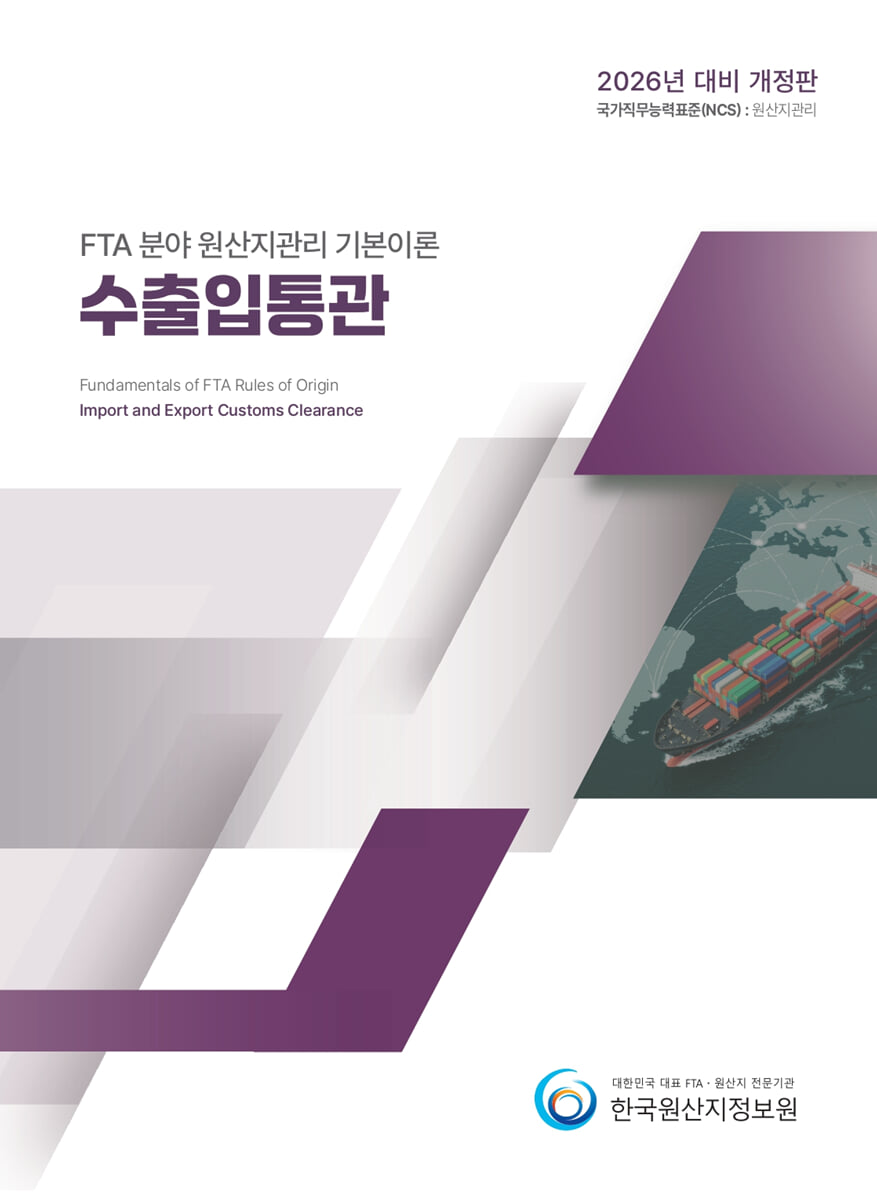
2026 FTA Field Origin Management Basic Theory Import and Export Customs Clearance
 |
Description
Book Introduction
This textbook primarily covers "import and export customs clearance" as a reference for practice and study of country of origin management in the FTA field. It includes content on import and export customs clearance, the fundamental foundation of trade, to foster professionals capable of efficiently utilizing FTAs and handling practical matters. Wherever possible, the textbook focuses on customs laws, regulations, and regulations rather than public notices.
index
- Chapter 1 General Provisions of Customs Law
Section 1 Overview of Customs Tariffs
Section 2 Purpose and Character of the Customs Act
Section 3 Definition of Terms
Section 4 Period and deadline
- Chapter 2. Requirements
Section 1 Taxable Goods
Section 2 Tax base
Section 3 Tax rates
Section 4 Taxpayers
Section 5 Preliminary Examination
- Chapter 3 Reporting and Payment
Section 1 Price Report
Section 2 Determination of tax amount
Section 3 Payment of Taxes
Section 4 Changes in tax amount
Section 5 Surcharge
- Chapter 4 Extinction of Payment Obligation and Refund
Section 1. Proof of payment obligation
Section 2. Period of limitation for tariff imposition
Section 3. Statute of limitations for customs duty collection
Section 4 Refund of Customs Duties
- Chapter 5 Customs Clearance
Section 1 Overview of Customs Clearance
Section 2 Requirements and Restrictions for Customs Clearance
Section 3 Confirmation of Origin
Section 4 Import Declaration
Section 5 Export Declaration
Section 6 Exceptions and Special Cases of Customs Clearance
- Chapter 6 Bonded System
Section 1 Bonded Area
Section 2 General Rules for Bonded Areas
Section 3 Designated Bonded Area
Section 4 Patent Bonded Area
- Chapter 7 Trade Conditions and Transport Documents
Section 1. Usage and Features of Incoterms 2020 Rules
Section 2 Bill of Lading
Section 3 Electronic Bill of Lading
Section 4 Marine Waybill
Section 5 Air Waybill
Section 1 Overview of Customs Tariffs
Section 2 Purpose and Character of the Customs Act
Section 3 Definition of Terms
Section 4 Period and deadline
- Chapter 2. Requirements
Section 1 Taxable Goods
Section 2 Tax base
Section 3 Tax rates
Section 4 Taxpayers
Section 5 Preliminary Examination
- Chapter 3 Reporting and Payment
Section 1 Price Report
Section 2 Determination of tax amount
Section 3 Payment of Taxes
Section 4 Changes in tax amount
Section 5 Surcharge
- Chapter 4 Extinction of Payment Obligation and Refund
Section 1. Proof of payment obligation
Section 2. Period of limitation for tariff imposition
Section 3. Statute of limitations for customs duty collection
Section 4 Refund of Customs Duties
- Chapter 5 Customs Clearance
Section 1 Overview of Customs Clearance
Section 2 Requirements and Restrictions for Customs Clearance
Section 3 Confirmation of Origin
Section 4 Import Declaration
Section 5 Export Declaration
Section 6 Exceptions and Special Cases of Customs Clearance
- Chapter 6 Bonded System
Section 1 Bonded Area
Section 2 General Rules for Bonded Areas
Section 3 Designated Bonded Area
Section 4 Patent Bonded Area
- Chapter 7 Trade Conditions and Transport Documents
Section 1. Usage and Features of Incoterms 2020 Rules
Section 2 Bill of Lading
Section 3 Electronic Bill of Lading
Section 4 Marine Waybill
Section 5 Air Waybill
Publisher's Review
Beginning with the FTA with Chile in 2004, our country has concluded FTAs with all three major global economies: the EU, the United States, and China. As a trade environment based on FTAs is rapidly being established, FTA trade is expected to expand further.
Accordingly, this book has been reviewed and reflected to reflect the parts that should be included in the textbook and those deemed unnecessary, in order to keep pace with the changing customs environment, such as the expansion of FTA-signing countries and trade facilitation agreements.
Additionally, parts that overlap with existing textbooks have been integrated or subdivided by reorganizing the table of contents, and parts that have been excluded include indications of origin and intellectual property rights.
Additionally, relevant legal provisions and references are located at the bottom of each page to facilitate easier understanding of the content. Furthermore, the textbook focuses on laws, regulations, and rules rather than public notices whenever possible.
The exam is practical and useful, but it is frequently revised and sometimes contains excessive details, making it unsuitable for test takers.
Additionally, any parts that do not match the current laws and regulations, such as the Customs Act and related notices, have been revised to be consistent with the currently enforced laws and regulations.
Accordingly, this book has been reviewed and reflected to reflect the parts that should be included in the textbook and those deemed unnecessary, in order to keep pace with the changing customs environment, such as the expansion of FTA-signing countries and trade facilitation agreements.
Additionally, parts that overlap with existing textbooks have been integrated or subdivided by reorganizing the table of contents, and parts that have been excluded include indications of origin and intellectual property rights.
Additionally, relevant legal provisions and references are located at the bottom of each page to facilitate easier understanding of the content. Furthermore, the textbook focuses on laws, regulations, and rules rather than public notices whenever possible.
The exam is practical and useful, but it is frequently revised and sometimes contains excessive details, making it unsuitable for test takers.
Additionally, any parts that do not match the current laws and regulations, such as the Customs Act and related notices, have been revised to be consistent with the currently enforced laws and regulations.
GOODS SPECIFICS
- Date of issue: October 1, 2025
- Page count, weight, size: 305 pages | 190*260*30mm
- ISBN13: 9791185815800
- ISBN10: 1185815805
You may also like
카테고리
korean


korean

![GQ KOREA Mark (Monthly): December [2025]](http://librairie.coreenne.fr/cdn/shop/files/8ef265dbbfbf186523ed75ba7319009d.jpg?v=1765340328&width=3840)


