

Art Museum that Meets Me
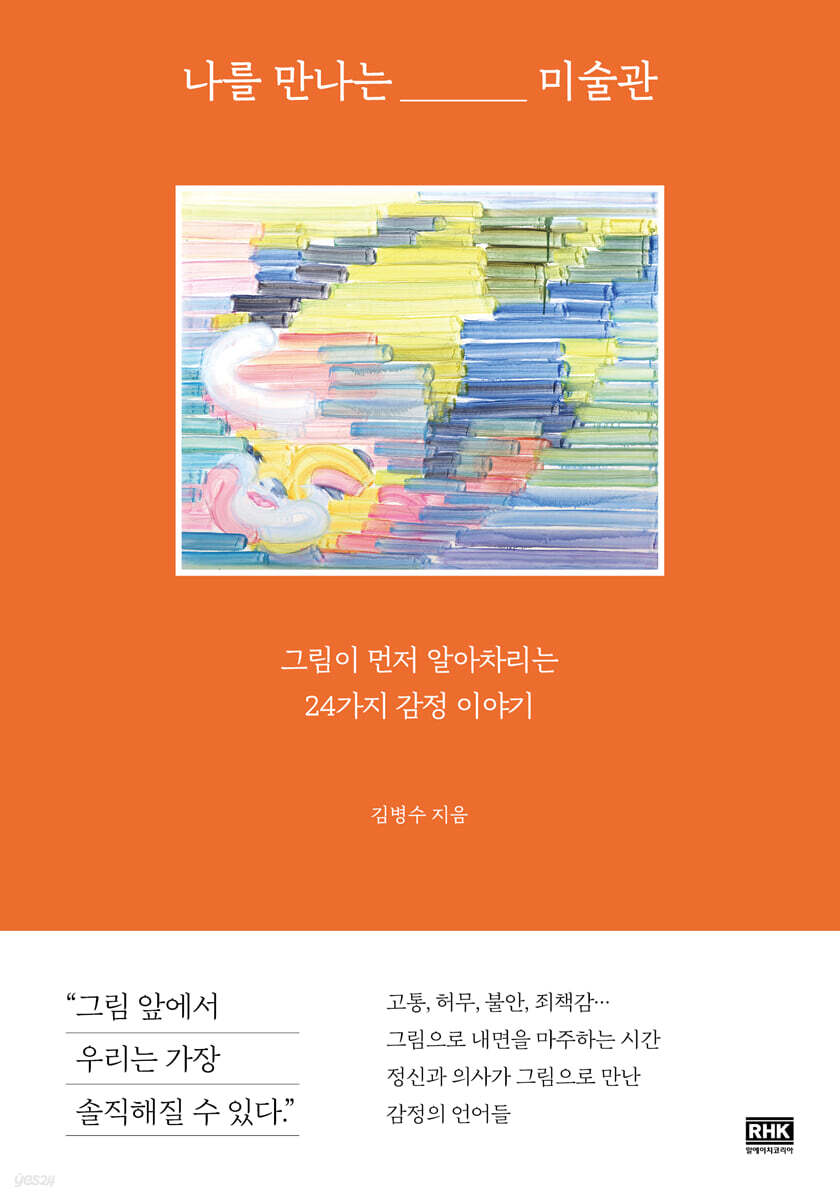 |
Description
Book Introduction
“Many of life’s problems ultimately originate in the ‘mind.’
“Only when you look into your heart properly can you see the clue.”
A pictorial prescription for the inner self compiled by Dr. Kim Byeong-su, a psychiatrist.
Feelings that are difficult to explain, memories I thought I had forgotten, and wounds buried deep inside.
Painting is a mirror that quietly reflects these fragments of the mind.
When we look at the picture before us in silence, people become most honest.
In his 20 years of experience in counseling and treatment, psychiatrist Dr. Kim Byeong-su has witnessed countless moments like this.
He opened the hearts of his patients with drawings, and confirmed that a single picture resonates more deeply than countless words.
《Meet Me, Art Gallery》 is an inner prescription that weaves together 24 emotions, including passion, pain, self-esteem, and happiness, and paintings that reflect them, centered around scenes of healing he experienced.
With 42 works by major artists in world art history, including Paul Cézanne, Mark Rothko, William Turner, Henri Matisse, Philip Guston, Carol Waite, Edward Hopper, and Georgia O'Keeffe, we will rediscover our emotions in the paintings, soothe old wounds, and embark on a path to encountering our true selves.
“Only when you look into your heart properly can you see the clue.”
A pictorial prescription for the inner self compiled by Dr. Kim Byeong-su, a psychiatrist.
Feelings that are difficult to explain, memories I thought I had forgotten, and wounds buried deep inside.
Painting is a mirror that quietly reflects these fragments of the mind.
When we look at the picture before us in silence, people become most honest.
In his 20 years of experience in counseling and treatment, psychiatrist Dr. Kim Byeong-su has witnessed countless moments like this.
He opened the hearts of his patients with drawings, and confirmed that a single picture resonates more deeply than countless words.
《Meet Me, Art Gallery》 is an inner prescription that weaves together 24 emotions, including passion, pain, self-esteem, and happiness, and paintings that reflect them, centered around scenes of healing he experienced.
With 42 works by major artists in world art history, including Paul Cézanne, Mark Rothko, William Turner, Henri Matisse, Philip Guston, Carol Waite, Edward Hopper, and Georgia O'Keeffe, we will rediscover our emotions in the paintings, soothe old wounds, and embark on a path to encountering our true selves.
- You can preview some of the book's contents.
Preview
index
introduction
1. Meet Myself Through Respect and Art
2 Passion: You have to feel it to realize it.
3. Colors of diversity and emotions
4 Moving forward through pain and storms
5 Optimism: Seeing Beyond the Visual
6. Confronting Meaninglessness with Dignity
7 Fun: The Real Reason We Work
8 Growing Old in a Vanishingly Brilliant Way
9 Love, Love is a Misunderstanding
10 Existentialism: Humans are ultimately sad beings.
11 Stop feeling guilty and blaming yourself.
12 Narcissism and Breaking Free from Myself
13 Anxiety and thoughts are clouds
14 Guilt and guilt are gifts
15 There is no end to the time of mourning and mourning.
16 Depression/Depression is my strength
17 What Envy Taught Me
18 Pure and innocent courage
19 Where is happiness?
20 Self-esteem: Self-esteem increases when you use your body, not your mind.
21 Nature Love/Biophilia
22 Identity: I am the protagonist of the play called life.
23. Humans are beautiful because they are unknowable beings.
24 Self-Worth: We All Become Great in Our Own Way
List of works
1. Meet Myself Through Respect and Art
2 Passion: You have to feel it to realize it.
3. Colors of diversity and emotions
4 Moving forward through pain and storms
5 Optimism: Seeing Beyond the Visual
6. Confronting Meaninglessness with Dignity
7 Fun: The Real Reason We Work
8 Growing Old in a Vanishingly Brilliant Way
9 Love, Love is a Misunderstanding
10 Existentialism: Humans are ultimately sad beings.
11 Stop feeling guilty and blaming yourself.
12 Narcissism and Breaking Free from Myself
13 Anxiety and thoughts are clouds
14 Guilt and guilt are gifts
15 There is no end to the time of mourning and mourning.
16 Depression/Depression is my strength
17 What Envy Taught Me
18 Pure and innocent courage
19 Where is happiness?
20 Self-esteem: Self-esteem increases when you use your body, not your mind.
21 Nature Love/Biophilia
22 Identity: I am the protagonist of the play called life.
23. Humans are beautiful because they are unknowable beings.
24 Self-Worth: We All Become Great in Our Own Way
List of works
Detailed image

Into the book
Let's enter the art gallery surrounded by white walls and quietly look at the works of art.
Rather than just passing through and appreciating the work, let's stay in front of it for at least 10 minutes and connect deeply.
Take a deep breath and exhale, looking at the lines and colors spread across the canvas.
Rather than just taking a picture in front of a work of art, let's focus completely on one painting for just 10 minutes.
It gives the work time to reveal itself to us.
No special knowledge is required to appreciate art.
The important thing is to pay full attention to the picture unfolding before your eyes.
When you become so absorbed in it, you find yourself looking at the work in a completely different way than when you just glance at it.
---p.15
Roscoe wanted the viewer to connect with the matiere (the materiality of a painting, where the paint is thickly layered on the canvas or the texture is prominent, giving the impression of being tangible even when seen with the eyes).
He wanted art to reach directly into the soul of the viewer.
In order to create a space of empathy, the exhibition hall, its lighting, and its atmosphere were decided upon with great care.
I hoped there would be no obstacles between the work and the audience.
In fact, his work, as he himself says, must be viewed from a distance of 45 centimeters and in a meditative atmosphere to achieve the ultimate emotional experience.
The number of viewers per work is also limited to a certain extent, so that each person can stay long enough to fully engage with the work.
---p.26
As Matisse said, 'Art is a comfortable chair for the weary mind,' but at the same time, it is also a mirror of uncomfortable truths that stir our emotions.
And through art, we can borrow the inner selves of others for a moment.
We experience fear in the paintings of Francisco de Goya, loneliness in the colors of Rothko, and screams in the lines of Edvard Munch.
But it's not just about conveying emotions.
The viewer connects with the experience within himself through that emotion.
Art asks questions in silence.
"What did you feel? Why did you feel that way?" ---p.54
The world is a sea where typhoons rage.
No matter how painful it is, life continues to flow without stopping.
I can't just frown all day because I'm in pain.
Instead of panicking and panicking, you should finish your work, exercise, listen to music, read a book, chat with a friend, take a warm bath, pray, and eat with your family.
Although this may not calm the storm, it can soothe our wounded souls.
Even if you are afraid on a ship drifting on a raging sea, you must stay with your loved one and find out what is truly important in your life.
And we must keep rowing for that precious thing without stopping.
----p.61
Falling leaves are a metaphor for finite life.
It is born, it blooms, it reaches its peak, and then it eventually falls to the ground.
The leaves fall slowly in the air, waiting for 'that moment' that everyone will experience someday.
But those fallen leaves don't simply disappear.
The keeper turned the withered leaves golden as if by magic.
The leaves that have lost their lives are shining like gold.
The moisture that had once been there has disappeared, and the dry fallen leaves look like they will crumble if you touch them.
But those fallen leaves are sacred, noble, and beautiful.
This is the paradoxical truth of life and death that Keeper shows us.
---p.96~98
What if you can't stop worrying, even though you know it's excessive? In that case, consider Vassily Kandinsky's "Blue Sky."
This is the best work that teaches us “How to deal with negative thoughts that float around in our minds.”
The background is blue like the sky and white like clouds.
Shapes that cannot be precisely defined are floating in the air.
The vivid colors make these shapes appear to move across the canvas like living creatures.
Amorphous life forms, unrestrained, unfettered, and seemingly indestructible, roam the blue sky without restraint.
---p.147
Friedrich offers no comfort.
Instead, it teaches us how to coexist with sadness.
It shows how we live on, embracing the absence of someone who has disappeared, rather than forgetting them.
Mourning is not about covering up the wounds, but about learning to exist with them.
Time may dull its depth, but sorrow never goes away.
Even after losing someone, we still eat, walk, and work.
Even as I live each day like that, there is always a quiet empty space in my heart where that person is.
The essence of mourning is not to erase the sadness, but to remain by the person's side as a being who can live with that sadness.
---p.
168~169
Art is silent.
In the quiet screen, the character is silent.
There is an invisible inner life breathing within it.
The reason we don't fully understand it is simple.
Because we cannot fathom the pain, thoughts, longings, and fears of others by looking at their appearance alone.
Art places us before the wall of 'incomprehension' and at the same time makes us imagine what lies beyond that wall.
We can never fully understand others.
But there are things that are possible only within that impossibility.
It is an attitude of imagining, approaching carefully, and staring quietly.
Just as Lynette Iadom Boake's paintings silently capture our gaze, so too do human beings leave their deepest impressions when they remain unexplained and unexplained.
The moment we look into the face of an unknown stranger and the quiet unknown world contained within it, we realize.
That humans are not beings to be interpreted, but beings to be felt, and that humans are beautiful because they are ultimately unknowable.
Rather than just passing through and appreciating the work, let's stay in front of it for at least 10 minutes and connect deeply.
Take a deep breath and exhale, looking at the lines and colors spread across the canvas.
Rather than just taking a picture in front of a work of art, let's focus completely on one painting for just 10 minutes.
It gives the work time to reveal itself to us.
No special knowledge is required to appreciate art.
The important thing is to pay full attention to the picture unfolding before your eyes.
When you become so absorbed in it, you find yourself looking at the work in a completely different way than when you just glance at it.
---p.15
Roscoe wanted the viewer to connect with the matiere (the materiality of a painting, where the paint is thickly layered on the canvas or the texture is prominent, giving the impression of being tangible even when seen with the eyes).
He wanted art to reach directly into the soul of the viewer.
In order to create a space of empathy, the exhibition hall, its lighting, and its atmosphere were decided upon with great care.
I hoped there would be no obstacles between the work and the audience.
In fact, his work, as he himself says, must be viewed from a distance of 45 centimeters and in a meditative atmosphere to achieve the ultimate emotional experience.
The number of viewers per work is also limited to a certain extent, so that each person can stay long enough to fully engage with the work.
---p.26
As Matisse said, 'Art is a comfortable chair for the weary mind,' but at the same time, it is also a mirror of uncomfortable truths that stir our emotions.
And through art, we can borrow the inner selves of others for a moment.
We experience fear in the paintings of Francisco de Goya, loneliness in the colors of Rothko, and screams in the lines of Edvard Munch.
But it's not just about conveying emotions.
The viewer connects with the experience within himself through that emotion.
Art asks questions in silence.
"What did you feel? Why did you feel that way?" ---p.54
The world is a sea where typhoons rage.
No matter how painful it is, life continues to flow without stopping.
I can't just frown all day because I'm in pain.
Instead of panicking and panicking, you should finish your work, exercise, listen to music, read a book, chat with a friend, take a warm bath, pray, and eat with your family.
Although this may not calm the storm, it can soothe our wounded souls.
Even if you are afraid on a ship drifting on a raging sea, you must stay with your loved one and find out what is truly important in your life.
And we must keep rowing for that precious thing without stopping.
----p.61
Falling leaves are a metaphor for finite life.
It is born, it blooms, it reaches its peak, and then it eventually falls to the ground.
The leaves fall slowly in the air, waiting for 'that moment' that everyone will experience someday.
But those fallen leaves don't simply disappear.
The keeper turned the withered leaves golden as if by magic.
The leaves that have lost their lives are shining like gold.
The moisture that had once been there has disappeared, and the dry fallen leaves look like they will crumble if you touch them.
But those fallen leaves are sacred, noble, and beautiful.
This is the paradoxical truth of life and death that Keeper shows us.
---p.96~98
What if you can't stop worrying, even though you know it's excessive? In that case, consider Vassily Kandinsky's "Blue Sky."
This is the best work that teaches us “How to deal with negative thoughts that float around in our minds.”
The background is blue like the sky and white like clouds.
Shapes that cannot be precisely defined are floating in the air.
The vivid colors make these shapes appear to move across the canvas like living creatures.
Amorphous life forms, unrestrained, unfettered, and seemingly indestructible, roam the blue sky without restraint.
---p.147
Friedrich offers no comfort.
Instead, it teaches us how to coexist with sadness.
It shows how we live on, embracing the absence of someone who has disappeared, rather than forgetting them.
Mourning is not about covering up the wounds, but about learning to exist with them.
Time may dull its depth, but sorrow never goes away.
Even after losing someone, we still eat, walk, and work.
Even as I live each day like that, there is always a quiet empty space in my heart where that person is.
The essence of mourning is not to erase the sadness, but to remain by the person's side as a being who can live with that sadness.
---p.
168~169
Art is silent.
In the quiet screen, the character is silent.
There is an invisible inner life breathing within it.
The reason we don't fully understand it is simple.
Because we cannot fathom the pain, thoughts, longings, and fears of others by looking at their appearance alone.
Art places us before the wall of 'incomprehension' and at the same time makes us imagine what lies beyond that wall.
We can never fully understand others.
But there are things that are possible only within that impossibility.
It is an attitude of imagining, approaching carefully, and staring quietly.
Just as Lynette Iadom Boake's paintings silently capture our gaze, so too do human beings leave their deepest impressions when they remain unexplained and unexplained.
The moment we look into the face of an unknown stranger and the quiet unknown world contained within it, we realize.
That humans are not beings to be interpreted, but beings to be felt, and that humans are beautiful because they are ultimately unknowable.
---p.
253
253
Publisher's Review
“We can be most honest in front of a painting.”
The Language of Emotions Encountered by a Psychiatrist Through Drawing
There are pictures that stay in my mind for a long time.
When your emotions are out of control, when you lose someone close to you and fall into a deep pit of loss.
In such cases, paintings often perceive our emotions before we do.
The new book, “Meeting Myself at the Art Museum,” by psychiatrist Dr. Kim Byeong-su, is neither a commentary on art psychology nor a traditional psychological treatment book.
The author says, “I tried to walk carefully through the narrow passage where these two intersect.”
This book calmly conveys the insights gained from crossing the boundaries between art and clinical practice, art museums and clinics.
Director Kim Byung-soo combines his personal experience encountering paintings around the world, including at the Musée d'Orsay in Paris, the Tate Gallery in London, and the Guggenheim Museum in Bilbao, Spain, with his clinical records from over 20 years to build a delicate channel where emotions and art meet.
“Paintings are the first to notice your emotions.”
Pain, emptiness, anxiety, guilt… A time to face your inner self through painting.
The 42 works of art featured in the book, including Paul Cézanne's Mont Sainte-Victoire, Mark Rothko's Untitled, Henri Matisse's Icarus, and Philip Guston's The Studio, touch on the layers of emotions that a person carries throughout their life.
The colors and shapes in the painting, the artist's life and psychology, and the emotional responses felt by the viewer intersect, and the reader discovers, one by one, pieces of emotions that he or she had unknowingly suppressed.
Each of the 24 emotions, including passion, diversity, pain, meaninglessness, nihilism, love, existence, narcissism, depression, purity, happiness, and identity, can be experienced as an independent chapter.
Readers slowly look at a piece of work in front of each emotion, and have time for 'inner exploration' that reflects their own hearts.
Appreciating a painting reveals a completely different face depending on the emotional state of the viewer.
Looking at the same picture, some people feel anxious, while others are struck by a deep sense of peace.
Even the same red color is a memory of passionate love for some, and a remnant of war and trauma for others.
Moreover, readers will go beyond simply appreciating paintings and experience the reconstructing of deep-seated emotions through art.
When you feel emotionally drained, when you want to know where your heart is right now, when you feel depressed for no reason.
At such times, “The Art Museum that Meets Me” will become a ‘map of the inner self’ that can be quietly opened.
The Language of Emotions Encountered by a Psychiatrist Through Drawing
There are pictures that stay in my mind for a long time.
When your emotions are out of control, when you lose someone close to you and fall into a deep pit of loss.
In such cases, paintings often perceive our emotions before we do.
The new book, “Meeting Myself at the Art Museum,” by psychiatrist Dr. Kim Byeong-su, is neither a commentary on art psychology nor a traditional psychological treatment book.
The author says, “I tried to walk carefully through the narrow passage where these two intersect.”
This book calmly conveys the insights gained from crossing the boundaries between art and clinical practice, art museums and clinics.
Director Kim Byung-soo combines his personal experience encountering paintings around the world, including at the Musée d'Orsay in Paris, the Tate Gallery in London, and the Guggenheim Museum in Bilbao, Spain, with his clinical records from over 20 years to build a delicate channel where emotions and art meet.
“Paintings are the first to notice your emotions.”
Pain, emptiness, anxiety, guilt… A time to face your inner self through painting.
The 42 works of art featured in the book, including Paul Cézanne's Mont Sainte-Victoire, Mark Rothko's Untitled, Henri Matisse's Icarus, and Philip Guston's The Studio, touch on the layers of emotions that a person carries throughout their life.
The colors and shapes in the painting, the artist's life and psychology, and the emotional responses felt by the viewer intersect, and the reader discovers, one by one, pieces of emotions that he or she had unknowingly suppressed.
Each of the 24 emotions, including passion, diversity, pain, meaninglessness, nihilism, love, existence, narcissism, depression, purity, happiness, and identity, can be experienced as an independent chapter.
Readers slowly look at a piece of work in front of each emotion, and have time for 'inner exploration' that reflects their own hearts.
Appreciating a painting reveals a completely different face depending on the emotional state of the viewer.
Looking at the same picture, some people feel anxious, while others are struck by a deep sense of peace.
Even the same red color is a memory of passionate love for some, and a remnant of war and trauma for others.
Moreover, readers will go beyond simply appreciating paintings and experience the reconstructing of deep-seated emotions through art.
When you feel emotionally drained, when you want to know where your heart is right now, when you feel depressed for no reason.
At such times, “The Art Museum that Meets Me” will become a ‘map of the inner self’ that can be quietly opened.
GOODS SPECIFICS
- Date of issue: December 10, 2025
- Page count, weight, size: 268 pages | 480g | 140*200*20mm
- ISBN13: 9788925573113
- ISBN10: 8925573113
You may also like
카테고리
korean


korean

![GQ KOREA Mark (Monthly): December [2025]](http://librairie.coreenne.fr/cdn/shop/files/8ef265dbbfbf186523ed75ba7319009d.jpg?v=1765340328&width=3840)


