

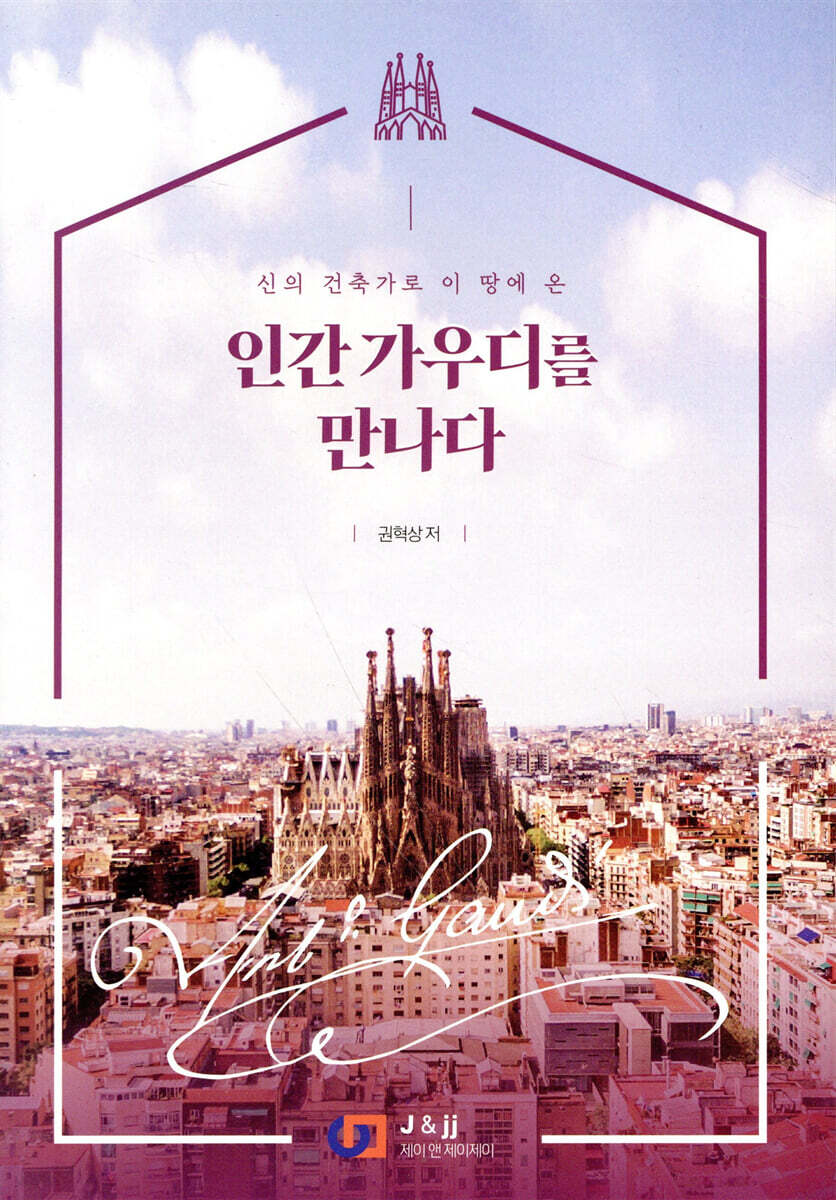
Meet the human Gaudí
 |
Description
Book Introduction
Meet Gaudí, the master of Barcelona, Spain
This book tells the story of a man who built several buildings that have been designated UNESCO World Heritage Sites.
The buildings born from his fingertips are in themselves magnificent works of art, inspiring everyone, and when you look inside them, you will find the architect's life and philosophy fully imbued within them.
He is Antoni Gaudi, who designed the extraordinary building called the Sagrada Familia in Barcelona.
To understand Gaudí's artistic sensibility, it is necessary to examine his life and philosophy. The author weaves together the footsteps of Gaudí's life into a way to understand his art through the material of architecture.
Through this, we examine how an architect's life was born as art through the canvas of architecture.
L'originalitat consisteix en tornar a l'origen.
Originality is going back to the origins.
-Antoni Gaudí i Cornet
Gaudi once said, 'Originality is returning to the origin.'
His philosophy is that originality is necessary for a work to become art, and that this originality can be achieved by returning to the origin.
This book explores the origins of Gaudí's life and his originality based on his philosophy.
Through the life of an architect, it provides readers with an opportunity to reflect on what art is and what originality is that moves so many people.
Through this, you will be able to meet ‘the human Gaudi’ who came to this land as ‘the architect of God.’
This book tells the story of a man who built several buildings that have been designated UNESCO World Heritage Sites.
The buildings born from his fingertips are in themselves magnificent works of art, inspiring everyone, and when you look inside them, you will find the architect's life and philosophy fully imbued within them.
He is Antoni Gaudi, who designed the extraordinary building called the Sagrada Familia in Barcelona.
To understand Gaudí's artistic sensibility, it is necessary to examine his life and philosophy. The author weaves together the footsteps of Gaudí's life into a way to understand his art through the material of architecture.
Through this, we examine how an architect's life was born as art through the canvas of architecture.
L'originalitat consisteix en tornar a l'origen.
Originality is going back to the origins.
-Antoni Gaudí i Cornet
Gaudi once said, 'Originality is returning to the origin.'
His philosophy is that originality is necessary for a work to become art, and that this originality can be achieved by returning to the origin.
This book explores the origins of Gaudí's life and his originality based on his philosophy.
Through the life of an architect, it provides readers with an opportunity to reflect on what art is and what originality is that moves so many people.
Through this, you will be able to meet ‘the human Gaudi’ who came to this land as ‘the architect of God.’
- You can preview some of the book's contents.
Preview
index
Prologue 10
Little Architect
El Petit Arquitecte
1 small cane 17
2 Flowers that bloomed in the blacksmith shop 23
3 The Three Musketeers of Reus 29
The light and dark of youth
Llums i Ombres de la Joventut
4 Diamonds Made in Barcelona 39
5 Unbroken Stones 53
6 Friendship with Guell I: Paris Casting 65
7 The Seed of Singleness and the Fruit of Loneliness 77
Appendix I: Geniuses' Favorite Cabaret 87
30 years of heyday
Trenta anys de l'Esplendor
8 Pin Flower on Tile / Casa Vicens 97
9 Friendship with Güell II: Exclusive Contract / Güell Farm and Güell Mansion 109
10 Utopia on the Hill / Park Güell 125
11 The Apple of Discord / Casa Batlló 141
12 Architects Who Ruined Their Clients / Casa Mila 157
The unfinished story
Un Conte inacabat
13 The Unfinished House of God / Sagrada Familia 175
14 Adios, a Dios 209
Appendix II: The God of Architecture to the Architect of God 215
Epilogue 220
Little Architect
El Petit Arquitecte
1 small cane 17
2 Flowers that bloomed in the blacksmith shop 23
3 The Three Musketeers of Reus 29
The light and dark of youth
Llums i Ombres de la Joventut
4 Diamonds Made in Barcelona 39
5 Unbroken Stones 53
6 Friendship with Guell I: Paris Casting 65
7 The Seed of Singleness and the Fruit of Loneliness 77
Appendix I: Geniuses' Favorite Cabaret 87
30 years of heyday
Trenta anys de l'Esplendor
8 Pin Flower on Tile / Casa Vicens 97
9 Friendship with Güell II: Exclusive Contract / Güell Farm and Güell Mansion 109
10 Utopia on the Hill / Park Güell 125
11 The Apple of Discord / Casa Batlló 141
12 Architects Who Ruined Their Clients / Casa Mila 157
The unfinished story
Un Conte inacabat
13 The Unfinished House of God / Sagrada Familia 175
14 Adios, a Dios 209
Appendix II: The God of Architecture to the Architect of God 215
Epilogue 220
Detailed image

Into the book
An old man emerges from the construction site of the Sagrada Familia cathedral, its skeleton exposed, dusting himself off.
Looking at the hands of this old man with white hair and a white beard, he looks like a construction worker, as they are dirty, calloused, and covered in wounds.
--- p.10
The name we call Gaudi is not actually his name.
His full name is Antoni Gaudii Cornet, which can be written as 'Antoni of the father Saint GaudI and i of the mother Saint Cornet'.
--- p.19
Wasn't it God's will, as his mother said, that he, a "little man," saw through pain the architecture and nature of God that others could not see?
--- p.22
If you fix both ends of an iron chain and let the middle part hang naturally, a curve will be created by gravity. If you look at this hanging curve in a mirror, the image will be reversed and the curve will appear as a raised arch.
This is called a 'Catenary Arch'.
--- p.26
Gaudí, Toda, and Rivera stand in front of a monastery that has been left in ruins after suffering hardships for the past 35 years.
Just like the Peach Garden Oath of Liu Bei, Guan Yu, and Zhang Fei, he vowed to “restore not only what remains now, but also everything that once existed, and revive the glory of the monastery.”
--- p.34
The ornate appearance of Casa Vicens may be criticized as being overly symbolic and focused on decoration, but Gaudi's quotes show that he never forgot the fundamentals of architecture.
--- p.101
His dream is well reflected in the name of Park Guell. Instead of the Catalan word for park, 'parc', or the Spanish word 'parque', he used the English word because he modeled it after an English garden city*.
--- p.127
Gaudí, who was stubborn when it came to construction, pushed ahead with the construction with his characteristic sarcasm, saying, “If they want, tell them I will cut the column like cheese and inscribe on its clean cut surface ‘Cut by the city’s desk-bound order.’”
--- p.161
However, the neo-Gothic cathedral designed by Villar, measuring 40 meters wide, 97 meters long, and 85 meters high, was so overwhelmingly tall that I could not feel the same emotion I had felt at Santa Casa.
(...) because he was a veteran and expert in cathedral architecture, and was a famous architect who later became the president of the Barcelona School of Architecture after Lusent.
--- p.179
The 'Nativity Façade' consists of four doors, from bottom to top, three large gables (triangular walls projecting outward) covering the doors, and four bell towers.
--- p.185
In 1925, Gaudí felt that he did not have much time left.
He is already 73 years old and does not have much time left to live, but after seeing the Sagrada Familia Cathedral, which still has a lot of construction left, he decides to move.
Looking at the hands of this old man with white hair and a white beard, he looks like a construction worker, as they are dirty, calloused, and covered in wounds.
--- p.10
The name we call Gaudi is not actually his name.
His full name is Antoni Gaudii Cornet, which can be written as 'Antoni of the father Saint GaudI and i of the mother Saint Cornet'.
--- p.19
Wasn't it God's will, as his mother said, that he, a "little man," saw through pain the architecture and nature of God that others could not see?
--- p.22
If you fix both ends of an iron chain and let the middle part hang naturally, a curve will be created by gravity. If you look at this hanging curve in a mirror, the image will be reversed and the curve will appear as a raised arch.
This is called a 'Catenary Arch'.
--- p.26
Gaudí, Toda, and Rivera stand in front of a monastery that has been left in ruins after suffering hardships for the past 35 years.
Just like the Peach Garden Oath of Liu Bei, Guan Yu, and Zhang Fei, he vowed to “restore not only what remains now, but also everything that once existed, and revive the glory of the monastery.”
--- p.34
The ornate appearance of Casa Vicens may be criticized as being overly symbolic and focused on decoration, but Gaudi's quotes show that he never forgot the fundamentals of architecture.
--- p.101
His dream is well reflected in the name of Park Guell. Instead of the Catalan word for park, 'parc', or the Spanish word 'parque', he used the English word because he modeled it after an English garden city*.
--- p.127
Gaudí, who was stubborn when it came to construction, pushed ahead with the construction with his characteristic sarcasm, saying, “If they want, tell them I will cut the column like cheese and inscribe on its clean cut surface ‘Cut by the city’s desk-bound order.’”
--- p.161
However, the neo-Gothic cathedral designed by Villar, measuring 40 meters wide, 97 meters long, and 85 meters high, was so overwhelmingly tall that I could not feel the same emotion I had felt at Santa Casa.
(...) because he was a veteran and expert in cathedral architecture, and was a famous architect who later became the president of the Barcelona School of Architecture after Lusent.
--- p.179
The 'Nativity Façade' consists of four doors, from bottom to top, three large gables (triangular walls projecting outward) covering the doors, and four bell towers.
--- p.185
In 1925, Gaudí felt that he did not have much time left.
He is already 73 years old and does not have much time left to live, but after seeing the Sagrada Familia Cathedral, which still has a lot of construction left, he decides to move.
--- p.210
Publisher's Review
There is a famous cathedral in Spain that everyone knows.
It is a huge cathedral called 'Sagrada Familia'.
This cathedral is a building imbued with a variety of religious messages, but it is a major landmark that inspires many people, even those without religious understanding or faith, and draws them to Barcelona, Spain.
Why does this building, which inspires so many people, resonate with so many? Driven by this curiosity, the author delved into the architect's work to understand the building.
The book explores the reasons for this through four parts: “The Little Architect,” “The Light and Shadow of Youth,” “The 30 Years of Heyday,” and “The Unfinished Story.”
The first two parts begin with Gaudí's childhood and introduce the life background that solidified his aesthetics of architecture.
Through the lens of Gaudí's life, we examine the mindset he embodied in his designs and construction, and the reasons why the resulting works of art are praised as moving and captivating, drawing countless visitors.
And in the latter two parts, we explore Gaudí's thoughts and philosophy by looking back at Gaudí's representative buildings through the author's architectural perspective and the expert perspective of a Gaudí tour.
The first and second half of the book contain stories about humans and architecture, respectively, and as a result, they can be seen as complementary.
After exploring the life of Gaudí, we can learn about the aesthetics contained in his architecture and discover what kind of aspirations he sought to realize through architecture.
In other words, this means that we can break away from the stereotype of Gaudí, the famous architect of God, and examine the process by which Gaudí, a man, projected his own philosophy.
By following these four strands of the story, we can learn about the story the author wants to explore: what kind of person Antoni Gaudi, a renowned artist and architect praised as the “Architect of God,” was as a “human,” and how he came to be called the “Architect of God.”
This is a humanities book that puts into practice his philosophy, which is similar to Gaudi's saying, 'Originality comes from the origin.'
It is a huge cathedral called 'Sagrada Familia'.
This cathedral is a building imbued with a variety of religious messages, but it is a major landmark that inspires many people, even those without religious understanding or faith, and draws them to Barcelona, Spain.
Why does this building, which inspires so many people, resonate with so many? Driven by this curiosity, the author delved into the architect's work to understand the building.
The book explores the reasons for this through four parts: “The Little Architect,” “The Light and Shadow of Youth,” “The 30 Years of Heyday,” and “The Unfinished Story.”
The first two parts begin with Gaudí's childhood and introduce the life background that solidified his aesthetics of architecture.
Through the lens of Gaudí's life, we examine the mindset he embodied in his designs and construction, and the reasons why the resulting works of art are praised as moving and captivating, drawing countless visitors.
And in the latter two parts, we explore Gaudí's thoughts and philosophy by looking back at Gaudí's representative buildings through the author's architectural perspective and the expert perspective of a Gaudí tour.
The first and second half of the book contain stories about humans and architecture, respectively, and as a result, they can be seen as complementary.
After exploring the life of Gaudí, we can learn about the aesthetics contained in his architecture and discover what kind of aspirations he sought to realize through architecture.
In other words, this means that we can break away from the stereotype of Gaudí, the famous architect of God, and examine the process by which Gaudí, a man, projected his own philosophy.
By following these four strands of the story, we can learn about the story the author wants to explore: what kind of person Antoni Gaudi, a renowned artist and architect praised as the “Architect of God,” was as a “human,” and how he came to be called the “Architect of God.”
This is a humanities book that puts into practice his philosophy, which is similar to Gaudi's saying, 'Originality comes from the origin.'
GOODS SPECIFICS
- Date of issue: May 15, 2023
- Page count, weight, size: 224 pages | 152*220*20mm
- ISBN13: 9791192924045
- ISBN10: 1192924045
You may also like
카테고리
korean


korean

![GQ KOREA Mark (Monthly): December [2025]](http://librairie.coreenne.fr/cdn/shop/files/8ef265dbbfbf186523ed75ba7319009d.jpg?v=1765340328&width=3840)


