

Jiseon Cinema Mind
 |
Description
Book Introduction
What if a criminal psychologist analyzed a movie?
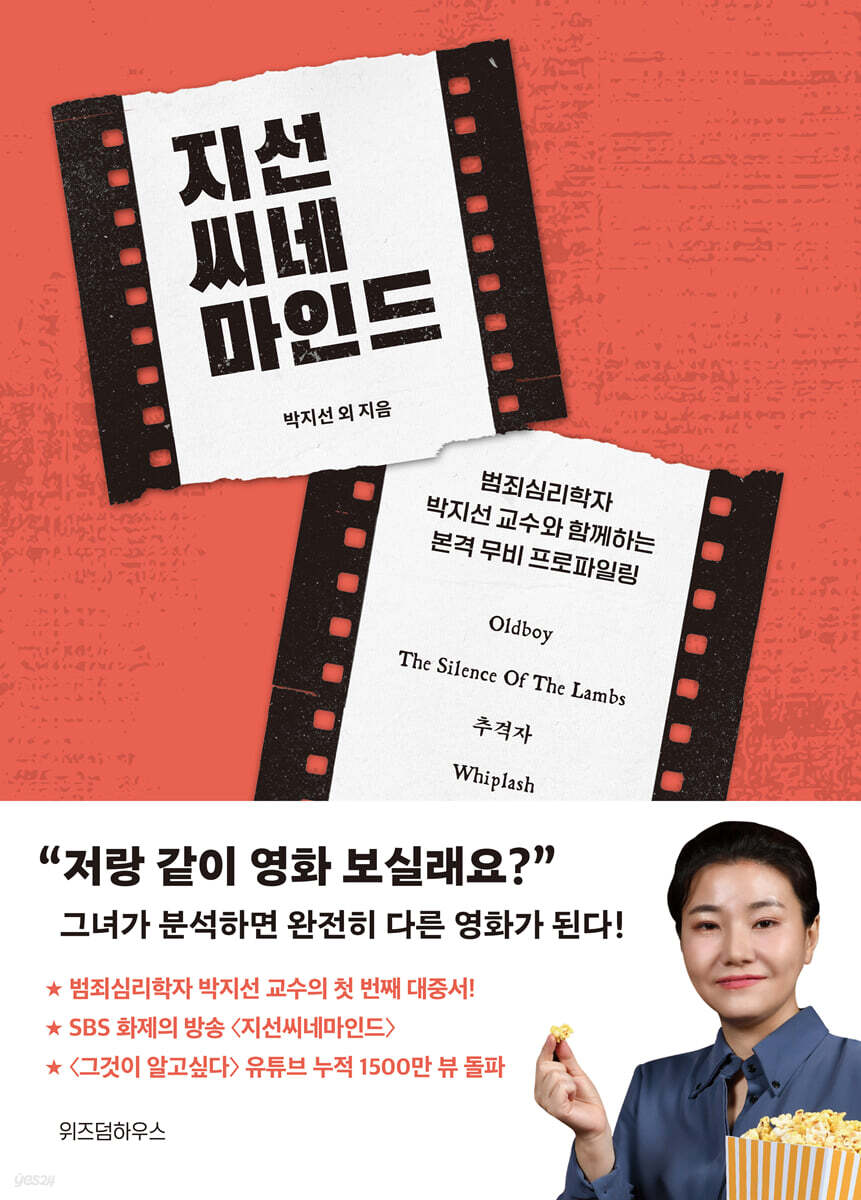
* Surpassing 15 million cumulative YouTube views! SBS's hit show [Jiseon Cinema Mind]
* Professor Ji-seon Park, a criminal psychologist, publishes his first popular book!
* Highly recommended by broadcaster Jang Do-yeon!
How do criminal psychologists analyze films? Driven by this curiosity, the YouTube channel [I Want to Know That] launched [Jisun Cinema Mind], a series featuring film analysis by Professor Park Ji-sun, Korea's leading criminal psychologist.
The video has already generated a huge buzz among subscribers who are interested in crime and movie lovers, garnering over 15 million cumulative views. [Jiseon Cinema Mind], which was also regularly broadcast on SBS TV, is now available to readers as a book.
Professor Park Ji-seon examines 14 domestic and international masterpieces, including the classic crime film [The Silence of the Lambs], [The Chaser], [Secret Sunshine], and [Whiplash], through his own specialized and unique perspective, allowing readers to gain a deeper understanding of people and the world.
* Surpassing 15 million cumulative YouTube views! SBS's hit show [Jiseon Cinema Mind]
* Professor Ji-seon Park, a criminal psychologist, publishes his first popular book!
* Highly recommended by broadcaster Jang Do-yeon!
How do criminal psychologists analyze films? Driven by this curiosity, the YouTube channel [I Want to Know That] launched [Jisun Cinema Mind], a series featuring film analysis by Professor Park Ji-sun, Korea's leading criminal psychologist.
The video has already generated a huge buzz among subscribers who are interested in crime and movie lovers, garnering over 15 million cumulative views. [Jiseon Cinema Mind], which was also regularly broadcast on SBS TV, is now available to readers as a book.
Professor Park Ji-seon examines 14 domestic and international masterpieces, including the classic crime film [The Silence of the Lambs], [The Chaser], [Secret Sunshine], and [Whiplash], through his own specialized and unique perspective, allowing readers to gain a deeper understanding of people and the world.
- You can preview some of the book's contents.
Preview
index
Prologue: A Criminal Psychologist Analyzing a Film
Chapter 1: Why Did He Look in the Mirror Before the Murder? [The Chaser]
Chapter 2: What True Comfort and Forgiveness Are [Miryang]
Chapter 3: The Essence of Profiling in Film [The Silence of the Lambs]
Chapter 4: If you want to experience real horror that reflects reality, [Cart]
Chapter 5: This isn't a music film, it's a thriller! [Whiplash]
Chapter 6: Unpredictable psychological warfare unfolds on a Hwatu board [Tazza]
Chapter 7: The Greatest Pain I Ever Received [Oldboy]
Chapter 8: A Heart Healing Note Disguised as Romance [Silver Linings Playbook]
Chapter 9: The Final Choices of Three Men Who Dreamed Different Dreams [New World]
Chapter 10: Conflicting Views, Tangled Desires [Burning]
Chapter 11: A Must-See Movie for Those Interested in Criminal Psychology: Seven Days
Chapter 12: Can a Murderer Really Recognize Another Murderer? [The Murderer's Memory]
Chapter 13: How Geniuses Solve Life's Difficulties [Good Will Hunting]
Chapter 14: A Crazy, Delicate Film of Truth and Lies [The Shameless]
Chapter 1: Why Did He Look in the Mirror Before the Murder? [The Chaser]
Chapter 2: What True Comfort and Forgiveness Are [Miryang]
Chapter 3: The Essence of Profiling in Film [The Silence of the Lambs]
Chapter 4: If you want to experience real horror that reflects reality, [Cart]
Chapter 5: This isn't a music film, it's a thriller! [Whiplash]
Chapter 6: Unpredictable psychological warfare unfolds on a Hwatu board [Tazza]
Chapter 7: The Greatest Pain I Ever Received [Oldboy]
Chapter 8: A Heart Healing Note Disguised as Romance [Silver Linings Playbook]
Chapter 9: The Final Choices of Three Men Who Dreamed Different Dreams [New World]
Chapter 10: Conflicting Views, Tangled Desires [Burning]
Chapter 11: A Must-See Movie for Those Interested in Criminal Psychology: Seven Days
Chapter 12: Can a Murderer Really Recognize Another Murderer? [The Murderer's Memory]
Chapter 13: How Geniuses Solve Life's Difficulties [Good Will Hunting]
Chapter 14: A Crazy, Delicate Film of Truth and Lies [The Shameless]
Detailed image

Into the book
The conversations, expressions, and actions of people in movie scenes are a mirror that reflects the human relationships in our real lives.
Additionally, the background and situational context in which the events unfold in the film reflect the social environment in which we live.
The film's depiction of crime and the way people are viewed, along with the anger, hatred, and prejudice hidden within, provides an opportunity to reconsider the biased perspectives on crime in our society.
--- p.8~9
For Ji Young-min, murder was also an 'achievement' he wanted to brag about.
That's why he confessed to murder without being asked.
You probably knew it was a dangerous thing to say.
It was just that the attention that would be poured on him the moment he said he killed someone was more important.
Jiyoungmin previously said that he felt inferiority complex about his existence.
It is an expression of the desire to show off by boasting about killing people and wanting to show off one's presence.
--- p.16
We don't know what expression Shin-ae had on her face as she looked at the body of her young son found in the reservoir.
Because the camera captured the scene from very far away.
I think this scene symbolically expresses what the movie [Miryang] was trying to say.
We often say we know a particular incident and its victims well after reading news articles and hearing stories from those around us.
But in reality, he is just standing far away, like the camera that was watching Shin-ae checking Jun's body.
I can't even imagine how the victims feel living through this incident.
Isn't it all we can do to leave forgiveness for the criminal and healing for herself to Shin-ae and watch?
--- p.40
As such, Buffalo Bill is a character created by Thomas Harris, the original author of [The Silence of the Lambs], by combining several criminals.
That's why traits that are difficult to coexist in one person appear all at once.
As I mentioned earlier, Ted Bundy was confident in communicating with others.
He was someone who could easily employ the bold tactic of approaching a victim and talking to them while pretending to ask for help, and then attacking them.
However, Buffalo Bill is portrayed as being extremely socially inept throughout the film.
If that's the case, it's more likely that he would attack the victim or kidnap them right away instead of talking to them.
--- p.49
As Neiman plays the drums, Fletcher verbally and physically abuses him, demanding that he keep to the tempo he demands.
This is the scene where Fletcher's abuse of Neiman begins in earnest.
This scene gives us a glimpse into why victims of psychological domination have difficulty quickly escaping from their dependent relationships.
Nayman's self-esteem must have hit rock bottom after being humiliated in front of so many people.
But no student helps him.
It's isolated like the Mets.
I've experienced being ostracized by all my colleagues, and it's become difficult to tell my family or others about this and ask for help.
That's the outcome Fletcher hopes for.
The more isolated Neiman becomes, the more he can strengthen his dependence.
--- p.88
Madam Jeong is very good at designing boards.
This point is clearly revealed in the scene where Chief Pyeong and Goni enter Madam Jeong's office.
Madam Jeong pretends to answer the phone right before the two people enter, and ends the call inevitably.
In reality, it's a situation where you have to make a regrettable request, but you cover it up by saying, 'I'm a very busy person and I just called you because I have a proposal for you.'
This is something we can do because we know full well that the moment we ask for something in a humble manner, power is transferred to the other person.
--- p.100~101
The movie metaphorically shows Pat's self-healing process, but there's one practical task we have to do.
It's called 'self-compassion'.
It's important to be considerate and kind to others, but the first person you should be showing that attitude to is yourself.
This process of paying attention to and accepting one's own pain is necessary.
That is, an effort to heal wounds and pain by being generous and kind to oneself.
This is the prerequisite for climbing higher.
--- p.139
Criminals and ordinary people sometimes have completely different ways of thinking.
There is one question that illustrates this point well.
If you were offered 3,000 won for a 10-minute ride or 50,000 won for an hour, which would you choose? Most people would probably choose the latter.
This answer, which is obvious to us, may not be obvious to criminals.
In particular, enduring and controlling present desires for greater future value is called delayed gratification.
Criminals have a significantly reduced ability to delay gratification, which is the ability to control momentary desires.
Even though I could make a bigger profit of 50,000 won by investing an hour, I can't stand it.
I think it's more important to get even a small profit of 3,000 won quickly.
They are eager to pursue immediate gains.
--- p.201~202
If I had to pick my favorite dish from [The Outlaws], I would choose this Japchae dish.
In this scene, did you see Hye-kyung's universe opening and closing in an instant? Jae-gon was the one who opened that universe, and Jae-gon was the one who closed it.
Hye-kyung's eyes tremble immediately after Jae-gon says, "Can't you live with me?"
When Hye-kyung cautiously asks if he is sincere, Jae-gon tries to cover it up by asking if he believes it.
For a moment, Hye-kyung lowers her head and stuffs the poor Japchae into her mouth to hide her disappointment.
I thought that the moment when the entire universe opened and closed was revealed in that expression.
Additionally, the background and situational context in which the events unfold in the film reflect the social environment in which we live.
The film's depiction of crime and the way people are viewed, along with the anger, hatred, and prejudice hidden within, provides an opportunity to reconsider the biased perspectives on crime in our society.
--- p.8~9
For Ji Young-min, murder was also an 'achievement' he wanted to brag about.
That's why he confessed to murder without being asked.
You probably knew it was a dangerous thing to say.
It was just that the attention that would be poured on him the moment he said he killed someone was more important.
Jiyoungmin previously said that he felt inferiority complex about his existence.
It is an expression of the desire to show off by boasting about killing people and wanting to show off one's presence.
--- p.16
We don't know what expression Shin-ae had on her face as she looked at the body of her young son found in the reservoir.
Because the camera captured the scene from very far away.
I think this scene symbolically expresses what the movie [Miryang] was trying to say.
We often say we know a particular incident and its victims well after reading news articles and hearing stories from those around us.
But in reality, he is just standing far away, like the camera that was watching Shin-ae checking Jun's body.
I can't even imagine how the victims feel living through this incident.
Isn't it all we can do to leave forgiveness for the criminal and healing for herself to Shin-ae and watch?
--- p.40
As such, Buffalo Bill is a character created by Thomas Harris, the original author of [The Silence of the Lambs], by combining several criminals.
That's why traits that are difficult to coexist in one person appear all at once.
As I mentioned earlier, Ted Bundy was confident in communicating with others.
He was someone who could easily employ the bold tactic of approaching a victim and talking to them while pretending to ask for help, and then attacking them.
However, Buffalo Bill is portrayed as being extremely socially inept throughout the film.
If that's the case, it's more likely that he would attack the victim or kidnap them right away instead of talking to them.
--- p.49
As Neiman plays the drums, Fletcher verbally and physically abuses him, demanding that he keep to the tempo he demands.
This is the scene where Fletcher's abuse of Neiman begins in earnest.
This scene gives us a glimpse into why victims of psychological domination have difficulty quickly escaping from their dependent relationships.
Nayman's self-esteem must have hit rock bottom after being humiliated in front of so many people.
But no student helps him.
It's isolated like the Mets.
I've experienced being ostracized by all my colleagues, and it's become difficult to tell my family or others about this and ask for help.
That's the outcome Fletcher hopes for.
The more isolated Neiman becomes, the more he can strengthen his dependence.
--- p.88
Madam Jeong is very good at designing boards.
This point is clearly revealed in the scene where Chief Pyeong and Goni enter Madam Jeong's office.
Madam Jeong pretends to answer the phone right before the two people enter, and ends the call inevitably.
In reality, it's a situation where you have to make a regrettable request, but you cover it up by saying, 'I'm a very busy person and I just called you because I have a proposal for you.'
This is something we can do because we know full well that the moment we ask for something in a humble manner, power is transferred to the other person.
--- p.100~101
The movie metaphorically shows Pat's self-healing process, but there's one practical task we have to do.
It's called 'self-compassion'.
It's important to be considerate and kind to others, but the first person you should be showing that attitude to is yourself.
This process of paying attention to and accepting one's own pain is necessary.
That is, an effort to heal wounds and pain by being generous and kind to oneself.
This is the prerequisite for climbing higher.
--- p.139
Criminals and ordinary people sometimes have completely different ways of thinking.
There is one question that illustrates this point well.
If you were offered 3,000 won for a 10-minute ride or 50,000 won for an hour, which would you choose? Most people would probably choose the latter.
This answer, which is obvious to us, may not be obvious to criminals.
In particular, enduring and controlling present desires for greater future value is called delayed gratification.
Criminals have a significantly reduced ability to delay gratification, which is the ability to control momentary desires.
Even though I could make a bigger profit of 50,000 won by investing an hour, I can't stand it.
I think it's more important to get even a small profit of 3,000 won quickly.
They are eager to pursue immediate gains.
--- p.201~202
If I had to pick my favorite dish from [The Outlaws], I would choose this Japchae dish.
In this scene, did you see Hye-kyung's universe opening and closing in an instant? Jae-gon was the one who opened that universe, and Jae-gon was the one who closed it.
Hye-kyung's eyes tremble immediately after Jae-gon says, "Can't you live with me?"
When Hye-kyung cautiously asks if he is sincere, Jae-gon tries to cover it up by asking if he believes it.
For a moment, Hye-kyung lowers her head and stuffs the poor Japchae into her mouth to hide her disappointment.
I thought that the moment when the entire universe opened and closed was revealed in that expression.
--- p.241
Publisher's Review
“Would you like to watch a movie with me?”
Full-scale movie profiling with criminal psychologist Professor Park Ji-seon
Professor Park Ji-seon, Korea's top criminal psychologist who has coolly analyzed and advised on the psychology of criminals on SBS's [I Want to Know That] and has appeared on various TV programs and garnered attention for her charismatic appearance, has published her first popular book.
Professor Ji-seon Park, who is also a 'criminal psychologist who loves movies', profiles characters and incidents in movies in this book and provides new fun and knowledge about watching movies.
Fourteen masterpieces from Korea and abroad, spanning a variety of genres including crime, thriller, and even romance, are completely reinterpreted through the eyes of Professor Park Ji-seon.
The author uses criminal psychology to interpret the characters' psychology in greater depth and detail, and dissects the events in the film one by one.
Professor Park Ji-seon's unique film analysis, unlike anything seen anywhere else, is enough to elicit empathy and admiration from readers.
Moreover, the author does not simply analyze the film, but applies the characters and crimes in the film to society, making us face our current reality.
“Ultimately, we see people through movies, through the crimes in movies.
It all begins with understanding people, and this book ultimately aims to bring us closer to understanding people through various films that portray our lives.”
As Professor Park Ji-seon said, movies make us see ‘people.’
Through this book, readers will experience a richer understanding of people and an expanded perspective on the world.
You can't miss a single scene!
The final episode of [Jiseon Cinema Mind] that was not revealed on air!
Why does serial killer Ji Young-min of "The Chaser" look in the mirror before killing? Why does "Cart" strike modern viewers as more frightening than horror films? Is "Whiplash" a musical or a thriller? Did Oh Dae-su and Lee Woo-jin in "Oldboy" succeed in their revenge?
This book makes us forget the movies we have seen and understood so far.
Even movie fans would have overlooked the delicate and complex psychology of the characters in the film, and the minor scenes that were overlooked, but were captured by Professor Park Ji-seon, creating a completely new film.
In fact, the author watched over 60 films for [Jiseon Cinema Mind] and prepared with such passion that he even analyzed English scripts when necessary.
Additionally, thanks to the efforts of the [Jiseon Cinema Mind] production team, the 14 films included in this book were able to reach readers in a more realistic and multi-layered way, regardless of genre.
Thanks to Professor Park Ji-seon's captivating film analysis, the [Ji-seon Cinema Mind] video content on YouTube's [I Want to Know That] has accumulated over 15 million views, and has also garnered hundreds of comments such as, "Professor Park Ji-seon's analysis is so creepy," "I can feel her warm gaze on the characters," and "Can you analyze a film like this?"
Thanks to its popularity, it was made a regular SBS TV program and received great response from viewers.
This book can be considered a true "complete edition" containing Professor Park Ji-seon's excellent commentary and sharp insights that were not included in YouTube content and TV programs.
As broadcaster Jang Do-yeon said, “Professor Park Ji-seon’s wasted talent(?) has added a new joy to watching movies,” readers will also have the opportunity to look at movies from a different and diverse perspective through this book.
Full-scale movie profiling with criminal psychologist Professor Park Ji-seon
Professor Park Ji-seon, Korea's top criminal psychologist who has coolly analyzed and advised on the psychology of criminals on SBS's [I Want to Know That] and has appeared on various TV programs and garnered attention for her charismatic appearance, has published her first popular book.
Professor Ji-seon Park, who is also a 'criminal psychologist who loves movies', profiles characters and incidents in movies in this book and provides new fun and knowledge about watching movies.
Fourteen masterpieces from Korea and abroad, spanning a variety of genres including crime, thriller, and even romance, are completely reinterpreted through the eyes of Professor Park Ji-seon.
The author uses criminal psychology to interpret the characters' psychology in greater depth and detail, and dissects the events in the film one by one.
Professor Park Ji-seon's unique film analysis, unlike anything seen anywhere else, is enough to elicit empathy and admiration from readers.
Moreover, the author does not simply analyze the film, but applies the characters and crimes in the film to society, making us face our current reality.
“Ultimately, we see people through movies, through the crimes in movies.
It all begins with understanding people, and this book ultimately aims to bring us closer to understanding people through various films that portray our lives.”
As Professor Park Ji-seon said, movies make us see ‘people.’
Through this book, readers will experience a richer understanding of people and an expanded perspective on the world.
You can't miss a single scene!
The final episode of [Jiseon Cinema Mind] that was not revealed on air!
Why does serial killer Ji Young-min of "The Chaser" look in the mirror before killing? Why does "Cart" strike modern viewers as more frightening than horror films? Is "Whiplash" a musical or a thriller? Did Oh Dae-su and Lee Woo-jin in "Oldboy" succeed in their revenge?
This book makes us forget the movies we have seen and understood so far.
Even movie fans would have overlooked the delicate and complex psychology of the characters in the film, and the minor scenes that were overlooked, but were captured by Professor Park Ji-seon, creating a completely new film.
In fact, the author watched over 60 films for [Jiseon Cinema Mind] and prepared with such passion that he even analyzed English scripts when necessary.
Additionally, thanks to the efforts of the [Jiseon Cinema Mind] production team, the 14 films included in this book were able to reach readers in a more realistic and multi-layered way, regardless of genre.
Thanks to Professor Park Ji-seon's captivating film analysis, the [Ji-seon Cinema Mind] video content on YouTube's [I Want to Know That] has accumulated over 15 million views, and has also garnered hundreds of comments such as, "Professor Park Ji-seon's analysis is so creepy," "I can feel her warm gaze on the characters," and "Can you analyze a film like this?"
Thanks to its popularity, it was made a regular SBS TV program and received great response from viewers.
This book can be considered a true "complete edition" containing Professor Park Ji-seon's excellent commentary and sharp insights that were not included in YouTube content and TV programs.
As broadcaster Jang Do-yeon said, “Professor Park Ji-seon’s wasted talent(?) has added a new joy to watching movies,” readers will also have the opportunity to look at movies from a different and diverse perspective through this book.
GOODS SPECIFICS
- Publication date: December 14, 2022
- Page count, weight, size: 248 pages | 370g | 140*195*15mm
- ISBN13: 9791168125568
- ISBN10: 1168125561
You may also like
카테고리
korean


korean

![GQ KOREA Mark (Monthly): December [2025]](http://librairie.coreenne.fr/cdn/shop/files/8ef265dbbfbf186523ed75ba7319009d.jpg?v=1765340328&width=3840)


