

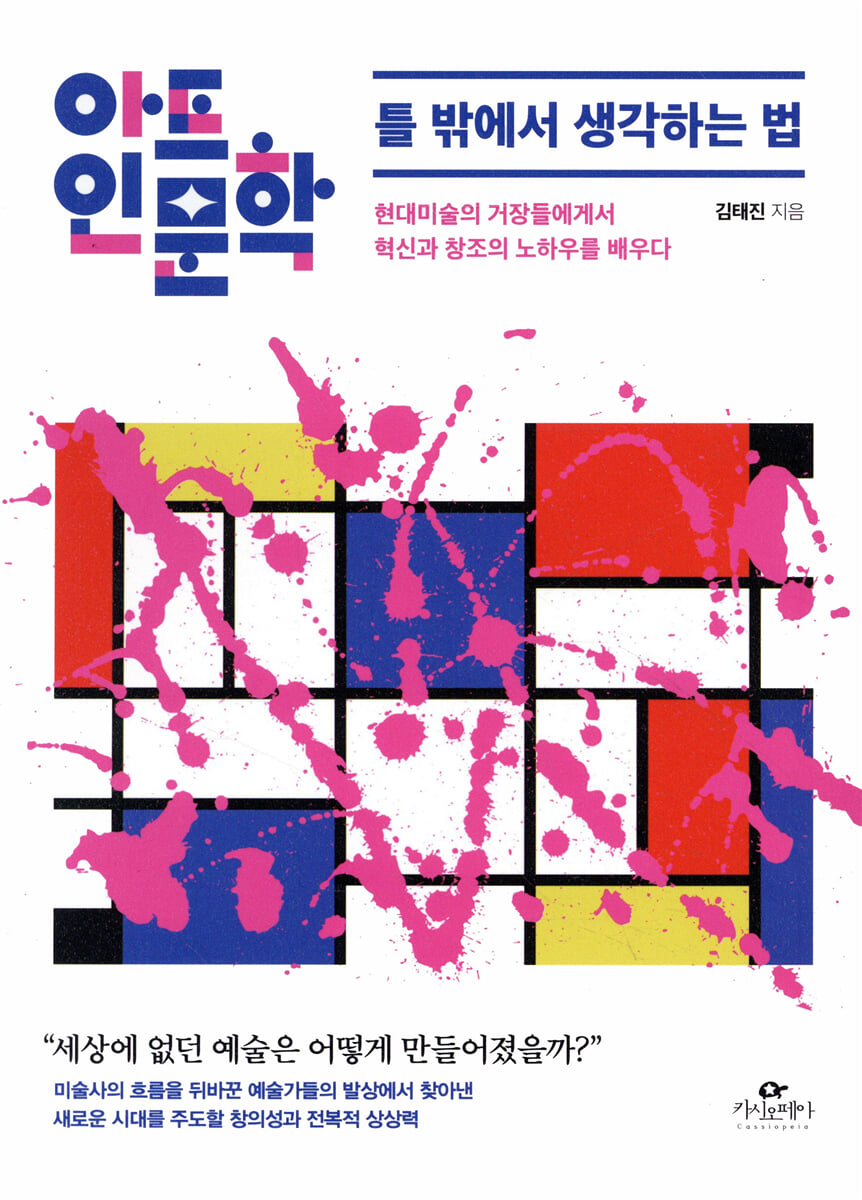
Art and Humanities: How to Think Outside the Box
 |
Description
Book Introduction
“How did they lead the new world?”
A revolutionary change in the landscape of 20th-century culture and arts
Twenty-five defining moments in contemporary art!
The wave of change brought about by the Fourth Industrial Revolution, including artificial intelligence, the Internet of Things, the metaverse, and blockchain technology, is deeply permeating our daily lives today.
To avoid being swept away or overwhelmed by this huge wave, but rather to willingly ride it and lead its flow, bold planning ahead of its time and unconventional imagination are essential.
Contemporary art, which has constantly overturned contemporary stereotypes and presented new directions in art and lifestyle, is the most excellent textbook for learning the fundamentals of creative thinking.
《Art Humanities: How to Think Outside the Box》 is a book written by author Taejin Kim, who is renowned for his captivating storytelling that blends humanities with art stories, four years after the publication of 《Art Humanities: How to See the Invisible》, focusing on the keyword, “The Secret of Creativity Learned from Contemporary Art.”
In this book, the author identifies twenty-five key moments that broadened the horizons of 20th-century culture and art, informing readers about the old frameworks of the past that artists who became the creators of modern art shed, and the leaps in thinking that came to them.
Through the lives of artists like Cezanne, Matisse, Pollock, Warhol, Duchamp, and Nam June Paik, who did not follow the established path but presented their own ‘art’ and ultimately became ‘icons of the times,’ readers will be able to learn the know-how of innovation and creation that will break through to a new era.
As you follow the author's explanations, which clearly summarize the dazzling achievements of modern art in five keywords along with approximately 140 illustrations, you will encounter moments when the flow of modern art is naturally drawn at a glance.
A revolutionary change in the landscape of 20th-century culture and arts
Twenty-five defining moments in contemporary art!
The wave of change brought about by the Fourth Industrial Revolution, including artificial intelligence, the Internet of Things, the metaverse, and blockchain technology, is deeply permeating our daily lives today.
To avoid being swept away or overwhelmed by this huge wave, but rather to willingly ride it and lead its flow, bold planning ahead of its time and unconventional imagination are essential.
Contemporary art, which has constantly overturned contemporary stereotypes and presented new directions in art and lifestyle, is the most excellent textbook for learning the fundamentals of creative thinking.
《Art Humanities: How to Think Outside the Box》 is a book written by author Taejin Kim, who is renowned for his captivating storytelling that blends humanities with art stories, four years after the publication of 《Art Humanities: How to See the Invisible》, focusing on the keyword, “The Secret of Creativity Learned from Contemporary Art.”
In this book, the author identifies twenty-five key moments that broadened the horizons of 20th-century culture and art, informing readers about the old frameworks of the past that artists who became the creators of modern art shed, and the leaps in thinking that came to them.
Through the lives of artists like Cezanne, Matisse, Pollock, Warhol, Duchamp, and Nam June Paik, who did not follow the established path but presented their own ‘art’ and ultimately became ‘icons of the times,’ readers will be able to learn the know-how of innovation and creation that will break through to a new era.
As you follow the author's explanations, which clearly summarize the dazzling achievements of modern art in five keywords along with approximately 140 illustrations, you will encounter moments when the flow of modern art is naturally drawn at a glance.
- You can preview some of the book's contents.
Preview
index
Prologue: Since when have we been walking home?
Before reading this book
/ Art before modern art
/ Masters of the late 19th century
/ 20th Century Art Map
Part 1: Art, Escape from Home
Chapter 1.
Painting, becoming flat again_The collapse of space
/ The Beasts Surrounding Donatello_Matisse and Fauvism
/ I never copy, I only steal_Braque and Cubism
/ Cézanne's Broken Fruit Plate, Don't Put It Back Together_Delaunay and Orphism
/ Eliminating all previous art and starting over_Malevich and Suprematism
/ Paint flowed down the floor_Pollock and Action Painting
Think Outside the Box 1: De-Perspective: Hammer and Iron
A glimpse into the modern world, a glimpse into the times, and pride in prosperity.
The Age of Contemporary Art: The Magnifying Glass and the Collector
Chapter 2.
What You See Isn't Everything_The Deconstruction of Perception
Painters who spent time with young girls_Kirchner and Expressionism
/ Following the Woman Who Summons the Spirit_Kandinsky and Abstraction
/ The Man Who Didn't Die Even Among Countless Shells_Breton and Surrealism
/ Eight months of reflection on the meaning of one's own work_Newman and color field painting
/ The smell of human blood lingers in my eyes_Bacon and British Expressionism
Think Outside the Box 2: De-Perception: The Invisible God and the Great Temple
A glimpse into the times: The 1937 Counterattack: The Decadent Art Exhibition
A Spotlight on Modern Art But Why Was It Abstract Art?
Part 2: Art Spreads Out into the Wide World
Chapter 3.
Nothing was right from the beginning_Beyond Authority
/ What happens when a genius goes mad?_Duchamp
/ Art born from playing around and causing chaos_Dada
/ If the work was produced in a factory_Warhol and Pop Art
/ What You See Is What You See_Stella and Minimalism
/ The Mentalists Have Escaped!_Nam June Paik and Fluxus
Think Outside the Box 3: De-Authorization: The Golden Calf and the Beggarly Prophet
A glimpse into the times: a naked man and woman surrounded by hidden materialistic spirits.
New York, the center of contemporary art, has become the center of global art.
Chapter 4.
Whatever you bring becomes art_Beyond Form
/ The real guest of Mudepo, driven out by Picasso_Tatlin and Constructivism
/ This is neither a painting nor a sculpture_Morris and Minimalism
Art is what the world cares about_Klain and Neorealism
/ Visiting the place where the dirt was poured 50 years later_Smithson and land art
/ Cellist who played while hugging the TV_Nam June Paik and video art
Think Outside the Box 4: Post-Formalism: Settlers and Nomads
A glimpse into the times: 1968, the year in which these people poured into the world.
Contemporary Art: A Look Inside: Postmodernism and Postmodernism
Chapter 5.
The work as a result does not have to be beyond the material.
Concrete Wall Made of Bread and Jam_Capro and Happening
/ If an artist poops, is even poop a work of art?_Manzoni
/ The painter who burned all of his paintings in the crematorium_Baldessari and conceptual art
/ How to explain a work to a dead rabbit?_Voice and social sculpture
/ A couple who walked thousands of miles to part ways_Abramović and body art
Think Outside the Box 5: Dematerialization: Producers, Actors, and Planners
A glimpse into the times: The day the Berlin Wall fell
Contemporary Art Spotlight: How will art unfold in the 21st century?
Epilogue: There is no original path anywhere in this world.
References
Illustration provided
Before reading this book
/ Art before modern art
/ Masters of the late 19th century
/ 20th Century Art Map
Part 1: Art, Escape from Home
Chapter 1.
Painting, becoming flat again_The collapse of space
/ The Beasts Surrounding Donatello_Matisse and Fauvism
/ I never copy, I only steal_Braque and Cubism
/ Cézanne's Broken Fruit Plate, Don't Put It Back Together_Delaunay and Orphism
/ Eliminating all previous art and starting over_Malevich and Suprematism
/ Paint flowed down the floor_Pollock and Action Painting
Think Outside the Box 1: De-Perspective: Hammer and Iron
A glimpse into the modern world, a glimpse into the times, and pride in prosperity.
The Age of Contemporary Art: The Magnifying Glass and the Collector
Chapter 2.
What You See Isn't Everything_The Deconstruction of Perception
Painters who spent time with young girls_Kirchner and Expressionism
/ Following the Woman Who Summons the Spirit_Kandinsky and Abstraction
/ The Man Who Didn't Die Even Among Countless Shells_Breton and Surrealism
/ Eight months of reflection on the meaning of one's own work_Newman and color field painting
/ The smell of human blood lingers in my eyes_Bacon and British Expressionism
Think Outside the Box 2: De-Perception: The Invisible God and the Great Temple
A glimpse into the times: The 1937 Counterattack: The Decadent Art Exhibition
A Spotlight on Modern Art But Why Was It Abstract Art?
Part 2: Art Spreads Out into the Wide World
Chapter 3.
Nothing was right from the beginning_Beyond Authority
/ What happens when a genius goes mad?_Duchamp
/ Art born from playing around and causing chaos_Dada
/ If the work was produced in a factory_Warhol and Pop Art
/ What You See Is What You See_Stella and Minimalism
/ The Mentalists Have Escaped!_Nam June Paik and Fluxus
Think Outside the Box 3: De-Authorization: The Golden Calf and the Beggarly Prophet
A glimpse into the times: a naked man and woman surrounded by hidden materialistic spirits.
New York, the center of contemporary art, has become the center of global art.
Chapter 4.
Whatever you bring becomes art_Beyond Form
/ The real guest of Mudepo, driven out by Picasso_Tatlin and Constructivism
/ This is neither a painting nor a sculpture_Morris and Minimalism
Art is what the world cares about_Klain and Neorealism
/ Visiting the place where the dirt was poured 50 years later_Smithson and land art
/ Cellist who played while hugging the TV_Nam June Paik and video art
Think Outside the Box 4: Post-Formalism: Settlers and Nomads
A glimpse into the times: 1968, the year in which these people poured into the world.
Contemporary Art: A Look Inside: Postmodernism and Postmodernism
Chapter 5.
The work as a result does not have to be beyond the material.
Concrete Wall Made of Bread and Jam_Capro and Happening
/ If an artist poops, is even poop a work of art?_Manzoni
/ The painter who burned all of his paintings in the crematorium_Baldessari and conceptual art
/ How to explain a work to a dead rabbit?_Voice and social sculpture
/ A couple who walked thousands of miles to part ways_Abramović and body art
Think Outside the Box 5: Dematerialization: Producers, Actors, and Planners
A glimpse into the times: The day the Berlin Wall fell
Contemporary Art Spotlight: How will art unfold in the 21st century?
Epilogue: There is no original path anywhere in this world.
References
Illustration provided
Detailed image
.jpg)
Into the book
What Cézanne passed on to the Fauvist painters was the message, 'Abandon representation and express.'
Depending on how you look at it, you might wonder what the Fauvist painters who inherited it added to this.
However, just as water that never boils at 99.9 degrees suddenly begins to boil when the temperature rises by 0.1 degrees, the attempts of the Fauvist painters were works that crossed a certain critical point.
For this reason, Fauvism has come to occupy a very honorable position in the history of modern art.
It is considered to be the art movement that opened the door to modern art.
In particular, they gave modern art the gift of infinite freedom of color by breaking away from certain stereotypes that even painters had clung to in regards to the use of color.
---From "The Beasts Surrounding Donatello_Matisse and Fauvism"
Pollock's work is accidental.
The hand moves through the air, and gravity intervenes.
There may be a momentary intention, but even the artist cannot know exactly what the outcome will be.
This is unlike any painting from the past.
In painting with a brush, the hand movements and the result are almost completely identical.
But in Pollock's paintings, these two do not match.
At this point, the painter's actions, separated from what is drawn, are given special significance.
The possibility of it being considered art in itself has arisen.
So critics started calling his paintings 'action paintings'.
(…) Pollock's work showed that the act of painting itself could be art.
---From "Paint Flowed on the Floor_Pollock and Action Painting"
What makes Newman's work completely different from these is that it breaks the frame of vision.
Previous paintings and sculptures depicted gods and magnificent landscapes.
Although it was intended to be an experience of the sublime, it relied on visual perception.
But the visual rather weakens and hinders the experience of the sublime.
This passage brings to mind the iconoclasm that took place during the Middle Ages and the Reformation.
At the time, fundamentalists considered visual representations of divine beings to be blasphemous and literally destroyed everything.
What happened as a result? Art disappeared, but in its place, God returned.
Becoming an incredibly scary being again.
It is in this context that Newman is called an iconoclast.
Thanks to Newman, we were able to break free from the framework of art being something to be appreciated.
---From "Thinking about the meaning of one's own work for 8 months_Newman and color field painting"
We have been thinking of seeing too simply.
Without any distinction between perception and sensation.
When the advent of photography brought limitations to art as a form of representation, painters sought answers in a world beyond what was visible.
The primal world, religious experiences, and the world of the unconscious were all things explored through this series of efforts.
Until now, we have simply defined them as a 'pursuit of what is beyond the visible', but now we can define them more precisely.
In other words, their efforts were to liberate art trapped in perception and to transform art understood with the head into art felt with the body.
---From "The Smell of Human Blood Never Leaves My Eyes_Bacon and British Expressionism"
In Fluxus art, there is no distinction between art and life.
He argues that everything can be art and that anyone can make art.
At the same time, it emphasizes the participation of the audience more than any other art movement.
This allows us to understand the slogan and goal of Fluxus, ‘Non-art reality.’
Art at this time is fixed art, and reality refers to vivid life stripped of artificial art.
In other words, it is a slogan to reject stereotypical art and make life into art.
(…) Fluxus was a movement that went beyond the realm of art and aimed to change life.
Fluxus dreamed of a life without attachment.
Life becomes routine and repetitive, relationships become familiar, and we become complacent with past successes and memories... I sought to move forward, transcending all these fixed patterns.
This message still resonates today.
---From "The Mentally Ill Have Escaped!_Nam June Paik and Fluxus"
Boyce believed that the rationality that had continued since the modern era had taken away human vitality and creativity, and in this respect he was a disciple of Nietzsche.
He suffered from the worst slump and depression as an artist for three years starting in 1955, and through that crisis, he was reborn as a shaman.
His dreams and visions were also formed at that time.
He believed that the role of the artist was to overcome the loss of connection with nature and the spiritual world due to being bound by power, systems, and customs, and to restore the energy of life and creative passion.
Beuys, who is evaluated as a figure who sublimated the spirit of the 1968 revolution into art, had an absolute influence on artists active in our time.
The themes he advocated, such as life, environment, democratization, and overcoming discrimination, are being explored in the most profound way in art today.
In that sense, if Duchamp is called a prophet who predicted the latter half of the 20th century, then Beuys can be called a prophet who taught us the direction of the 21st century.
Depending on how you look at it, you might wonder what the Fauvist painters who inherited it added to this.
However, just as water that never boils at 99.9 degrees suddenly begins to boil when the temperature rises by 0.1 degrees, the attempts of the Fauvist painters were works that crossed a certain critical point.
For this reason, Fauvism has come to occupy a very honorable position in the history of modern art.
It is considered to be the art movement that opened the door to modern art.
In particular, they gave modern art the gift of infinite freedom of color by breaking away from certain stereotypes that even painters had clung to in regards to the use of color.
---From "The Beasts Surrounding Donatello_Matisse and Fauvism"
Pollock's work is accidental.
The hand moves through the air, and gravity intervenes.
There may be a momentary intention, but even the artist cannot know exactly what the outcome will be.
This is unlike any painting from the past.
In painting with a brush, the hand movements and the result are almost completely identical.
But in Pollock's paintings, these two do not match.
At this point, the painter's actions, separated from what is drawn, are given special significance.
The possibility of it being considered art in itself has arisen.
So critics started calling his paintings 'action paintings'.
(…) Pollock's work showed that the act of painting itself could be art.
---From "Paint Flowed on the Floor_Pollock and Action Painting"
What makes Newman's work completely different from these is that it breaks the frame of vision.
Previous paintings and sculptures depicted gods and magnificent landscapes.
Although it was intended to be an experience of the sublime, it relied on visual perception.
But the visual rather weakens and hinders the experience of the sublime.
This passage brings to mind the iconoclasm that took place during the Middle Ages and the Reformation.
At the time, fundamentalists considered visual representations of divine beings to be blasphemous and literally destroyed everything.
What happened as a result? Art disappeared, but in its place, God returned.
Becoming an incredibly scary being again.
It is in this context that Newman is called an iconoclast.
Thanks to Newman, we were able to break free from the framework of art being something to be appreciated.
---From "Thinking about the meaning of one's own work for 8 months_Newman and color field painting"
We have been thinking of seeing too simply.
Without any distinction between perception and sensation.
When the advent of photography brought limitations to art as a form of representation, painters sought answers in a world beyond what was visible.
The primal world, religious experiences, and the world of the unconscious were all things explored through this series of efforts.
Until now, we have simply defined them as a 'pursuit of what is beyond the visible', but now we can define them more precisely.
In other words, their efforts were to liberate art trapped in perception and to transform art understood with the head into art felt with the body.
---From "The Smell of Human Blood Never Leaves My Eyes_Bacon and British Expressionism"
In Fluxus art, there is no distinction between art and life.
He argues that everything can be art and that anyone can make art.
At the same time, it emphasizes the participation of the audience more than any other art movement.
This allows us to understand the slogan and goal of Fluxus, ‘Non-art reality.’
Art at this time is fixed art, and reality refers to vivid life stripped of artificial art.
In other words, it is a slogan to reject stereotypical art and make life into art.
(…) Fluxus was a movement that went beyond the realm of art and aimed to change life.
Fluxus dreamed of a life without attachment.
Life becomes routine and repetitive, relationships become familiar, and we become complacent with past successes and memories... I sought to move forward, transcending all these fixed patterns.
This message still resonates today.
---From "The Mentally Ill Have Escaped!_Nam June Paik and Fluxus"
Boyce believed that the rationality that had continued since the modern era had taken away human vitality and creativity, and in this respect he was a disciple of Nietzsche.
He suffered from the worst slump and depression as an artist for three years starting in 1955, and through that crisis, he was reborn as a shaman.
His dreams and visions were also formed at that time.
He believed that the role of the artist was to overcome the loss of connection with nature and the spiritual world due to being bound by power, systems, and customs, and to restore the energy of life and creative passion.
Beuys, who is evaluated as a figure who sublimated the spirit of the 1968 revolution into art, had an absolute influence on artists active in our time.
The themes he advocated, such as life, environment, democratization, and overcoming discrimination, are being explored in the most profound way in art today.
In that sense, if Duchamp is called a prophet who predicted the latter half of the 20th century, then Beuys can be called a prophet who taught us the direction of the 21st century.
---From "How to Explain a Work to a Dead Rabbit: Voice and Social Sculpture"
Publisher's Review
“How was art created that never existed before?”
Discovered from the ideas of artists who changed the course of art history
Creativity and subversive imagination that will lead a new era
In January 2016, at the World Economic Forum (WWF) in Switzerland, Klaus Schwab declared that "the era of the Fourth Industrial Revolution has arrived."
In the spring of the same year, in a match between the artificial intelligence AlphaGo and the genius Go player Lee Sedol, AlphaGo won against the human player in all but one game.
At the time, most media outlets predicted that countless jobs would soon be replaced by artificial intelligence robots, and raised questions about the unique areas of human activity that could not be replaced by artificial intelligence.
People must have felt a great deal of anxiety, big or small, looking back and wondering if the job they are doing now will disappear in the future.
In addition, the coronavirus pandemic that has swept the world has fundamentally shaken humanity's daily lives and the established order.
In these times of upheaval, people are broadly divided into two groups.
Those who are overwhelmed by the rapidly changing world and cannot keep up with the changes, and those who are quick to grasp the changes of the times, go beyond the existing order, and present a new way of life.
And we call the latter 'creators'.
《Art Humanities: How to Think Outside the Box》 is a book written by author Taejin Kim, who is renowned for his captivating storytelling that blends humanities with art stories, four years after the publication of 《Art Humanities: How to See the Invisible》, focusing on the keyword, “The Secret of Creativity Learned from Contemporary Art.”
Contemporary art, which has constantly overturned contemporary stereotypes and presented new directions in art and lifestyle, is the most excellent textbook for learning the fundamentals of creative thinking.
This book, which examines the lives of artists such as Cezanne, Matisse, Pollock, Warhol, Duchamp, and Nam June Paik, who did not follow the established path but presented their own ‘art’ and ultimately became icons of their time, contains the secrets of innovation and creation that will break through in a new era.
“In the face of a global pandemic, we have been forcibly thrown into the information age.
We're already adapting to remote learning and working from home, and we're becoming more comfortable with services that don't involve human contact.
Companies are accelerating the adoption of robots and artificial intelligence.
It's time to stop worrying about change.
Because the world has changed, as if another dimension has unfolded.
But our thinking and choices are still stuck in the ways of the last century.
The future is unknown and scary, so we end up taking a step back to the familiar past.
(…) In this situation, there is one skill that everyone absolutely needs.
That is the power of original thinking, the power to think outside the box.
If we can achieve this, we will have a powerful weapon to pioneer new areas with our own uniqueness and continue to differentiate ourselves.
If there's one best way to learn something difficult, it's probably to expose yourself to lots of great success stories.
“If so, then it is clear that modern art is the best textbook.” (From the ‘Prologue’)
Cezanne, Matisse, Pollock, Warhol, Duchamp, Nam June Paik, etc.
Creators who became icons of their time by presenting ‘their own art’
About the ‘order they dismantled and destroyed’ and the ‘new art’ that took its place.
In the book, the author traces the surprising and exciting journeys of artists who have made their mark on the creation of modern art.
The virtue of this book is that it goes beyond simply listing the history of modern art, spanning about 100 years, chronologically.
To help readers understand more clearly and easily the old frameworks of the past that the creators of modern art shed, and the leaps in thinking that came to them, the author meticulously captures 25 crucial moments in the history of modern art that can be said to have innovatively transformed the landscape of 20th-century culture and art.
The author calls those moments 'creation points' and names them 'the moments when new art was born.'
If you connect those dots naturally, five lines are drawn, and these five lines represent the process by which modern art dismantled and destroyed the art of the past, and introduced new art styles in its place.
The 25 spawn points and 5 path lines form the backbone of this book.
If you follow the structure of the book, which the author has painstakingly planned over a long period of time, you will feel as if you can grasp the flow of modern art, which had seemed difficult and complex, at your fingertips by the time you close the book.
Part 1, “Art, Breaking Out of Home,” examines the process by which art breaks free from the shackles of the past.
Until the 19th century, art aimed to draw and create objects identically based on perspective.
It was during this period that art as a representation was destroyed.
The path from Henri Matisse to Jackson Pollock connects the points of creation that formally destroyed previous art, showing a journey through which perspective was dismantled, the space beyond the canvas collapsed, and a complete plane was reached (Chapter 1).
The path from Ernst Kirchner to Francis Bacon shows the search for what to draw if not representation.
By pursuing beyond what is visible, it connects the points of creation that destroyed past art in terms of subject matter (Chapter 2).
Part 2, "Art, Unfolding in the Wide World," examines the process by which art, completely liberated from classical art, continues to expand its horizons.
The path from Marcel Duchamp to Nam June Paik of Fluxus shows a post-authoritarian art through an attempt to fundamentally redefine art by denying even the many achievements born in the first part (Chapter 3); the path from Vladimir Tatlin to Nam June Paik of video art shows the process of moving towards post-formality with an outpouring of unimaginable new forms of art (Chapter 4); and the final path from Alan Kaprow to Marina Abramović shows a tendency towards post-materiality that goes beyond the work as a result through scenes where art that emphasizes concepts and actions emerges (Chapter 5).
(From '20th Century Art Map')
A sensory and three-dimensional reading experience provided by over 140 illustrations.
The captivating storytelling of the 'Art Humanities' series, which I believe in.
All the dazzling achievements of modern art are contained in this one book!
The pleasure of reading "Art and Humanities: Thinking Outside the Box" lies not only in the solidity of its content and structure.
Along with author Taejin Kim's captivating storytelling, the 140 or so contemporary art plates that comprise the text bring the artworks created by the artists mentioned in the book to life, providing a sensory and three-dimensional reading experience.
Additionally, by adding three separate points at the end of each chapter, I tried to summarize the meaning of the path line explained in that chapter once more ('Think outside the box'), and to broaden the understanding of history/culture in general through major events of the 20th century that had a great influence on the art of the time ('A Panoramic View of the Times').
In addition, we added a story that was very helpful in looking into the overall flow of art history by looking deeply into the content that was not covered in the main text ('Modern Art Magnifying Glass').
"Art and Humanities: How to Think Outside the Box" is a profound humanities textbook that explores the major moments of modern art that unfolded in the 20th century. It is also an excellent self-help book perfectly suited to the needs of the times, using past history as a foundation and providing concrete examples of how we should move forward into the future.
Let's explore the solutions to face the Fourth Industrial Revolution and the post-COVID era without fear in "Art and Humanities: How to Think Outside the Box."
Let's learn how to become a wonderful planner and performer of our own lives, not content with the status quo, through the artistic lives of pioneers who fought against the art of the past, broke free from clichés and complacency, and pioneered a new era.
As Joseph Beuys said, we are all born artists.
“Thinking outside the box means opening new horizons.
That is, it is an expansion of the width.
However, for us to create something, breadth alone is not enough; we must also have depth.
The depth we are talking about here is insight.
To develop insight, you must be truly immersed in the field.
We've all probably had a moment where we solved a problem with a sudden idea that came to us in a state of peak immersion.
That's how insight comes.
If you can choose one field and focus on it, insight will definitely come.
There is no law that never betrays.
Let's combine this with thinking outside the box.
Experience the thrill of insightful thinking that turns everyone's stereotypes on their head.
That's how creation happens.
(…) you are an artist.
And your life should be art.
So don't blindly follow others.
“Wherever you go now, the road is yours.” (From ‘Epilogue’)
Discovered from the ideas of artists who changed the course of art history
Creativity and subversive imagination that will lead a new era
In January 2016, at the World Economic Forum (WWF) in Switzerland, Klaus Schwab declared that "the era of the Fourth Industrial Revolution has arrived."
In the spring of the same year, in a match between the artificial intelligence AlphaGo and the genius Go player Lee Sedol, AlphaGo won against the human player in all but one game.
At the time, most media outlets predicted that countless jobs would soon be replaced by artificial intelligence robots, and raised questions about the unique areas of human activity that could not be replaced by artificial intelligence.
People must have felt a great deal of anxiety, big or small, looking back and wondering if the job they are doing now will disappear in the future.
In addition, the coronavirus pandemic that has swept the world has fundamentally shaken humanity's daily lives and the established order.
In these times of upheaval, people are broadly divided into two groups.
Those who are overwhelmed by the rapidly changing world and cannot keep up with the changes, and those who are quick to grasp the changes of the times, go beyond the existing order, and present a new way of life.
And we call the latter 'creators'.
《Art Humanities: How to Think Outside the Box》 is a book written by author Taejin Kim, who is renowned for his captivating storytelling that blends humanities with art stories, four years after the publication of 《Art Humanities: How to See the Invisible》, focusing on the keyword, “The Secret of Creativity Learned from Contemporary Art.”
Contemporary art, which has constantly overturned contemporary stereotypes and presented new directions in art and lifestyle, is the most excellent textbook for learning the fundamentals of creative thinking.
This book, which examines the lives of artists such as Cezanne, Matisse, Pollock, Warhol, Duchamp, and Nam June Paik, who did not follow the established path but presented their own ‘art’ and ultimately became icons of their time, contains the secrets of innovation and creation that will break through in a new era.
“In the face of a global pandemic, we have been forcibly thrown into the information age.
We're already adapting to remote learning and working from home, and we're becoming more comfortable with services that don't involve human contact.
Companies are accelerating the adoption of robots and artificial intelligence.
It's time to stop worrying about change.
Because the world has changed, as if another dimension has unfolded.
But our thinking and choices are still stuck in the ways of the last century.
The future is unknown and scary, so we end up taking a step back to the familiar past.
(…) In this situation, there is one skill that everyone absolutely needs.
That is the power of original thinking, the power to think outside the box.
If we can achieve this, we will have a powerful weapon to pioneer new areas with our own uniqueness and continue to differentiate ourselves.
If there's one best way to learn something difficult, it's probably to expose yourself to lots of great success stories.
“If so, then it is clear that modern art is the best textbook.” (From the ‘Prologue’)
Cezanne, Matisse, Pollock, Warhol, Duchamp, Nam June Paik, etc.
Creators who became icons of their time by presenting ‘their own art’
About the ‘order they dismantled and destroyed’ and the ‘new art’ that took its place.
In the book, the author traces the surprising and exciting journeys of artists who have made their mark on the creation of modern art.
The virtue of this book is that it goes beyond simply listing the history of modern art, spanning about 100 years, chronologically.
To help readers understand more clearly and easily the old frameworks of the past that the creators of modern art shed, and the leaps in thinking that came to them, the author meticulously captures 25 crucial moments in the history of modern art that can be said to have innovatively transformed the landscape of 20th-century culture and art.
The author calls those moments 'creation points' and names them 'the moments when new art was born.'
If you connect those dots naturally, five lines are drawn, and these five lines represent the process by which modern art dismantled and destroyed the art of the past, and introduced new art styles in its place.
The 25 spawn points and 5 path lines form the backbone of this book.
If you follow the structure of the book, which the author has painstakingly planned over a long period of time, you will feel as if you can grasp the flow of modern art, which had seemed difficult and complex, at your fingertips by the time you close the book.
Part 1, “Art, Breaking Out of Home,” examines the process by which art breaks free from the shackles of the past.
Until the 19th century, art aimed to draw and create objects identically based on perspective.
It was during this period that art as a representation was destroyed.
The path from Henri Matisse to Jackson Pollock connects the points of creation that formally destroyed previous art, showing a journey through which perspective was dismantled, the space beyond the canvas collapsed, and a complete plane was reached (Chapter 1).
The path from Ernst Kirchner to Francis Bacon shows the search for what to draw if not representation.
By pursuing beyond what is visible, it connects the points of creation that destroyed past art in terms of subject matter (Chapter 2).
Part 2, "Art, Unfolding in the Wide World," examines the process by which art, completely liberated from classical art, continues to expand its horizons.
The path from Marcel Duchamp to Nam June Paik of Fluxus shows a post-authoritarian art through an attempt to fundamentally redefine art by denying even the many achievements born in the first part (Chapter 3); the path from Vladimir Tatlin to Nam June Paik of video art shows the process of moving towards post-formality with an outpouring of unimaginable new forms of art (Chapter 4); and the final path from Alan Kaprow to Marina Abramović shows a tendency towards post-materiality that goes beyond the work as a result through scenes where art that emphasizes concepts and actions emerges (Chapter 5).
(From '20th Century Art Map')
A sensory and three-dimensional reading experience provided by over 140 illustrations.
The captivating storytelling of the 'Art Humanities' series, which I believe in.
All the dazzling achievements of modern art are contained in this one book!
The pleasure of reading "Art and Humanities: Thinking Outside the Box" lies not only in the solidity of its content and structure.
Along with author Taejin Kim's captivating storytelling, the 140 or so contemporary art plates that comprise the text bring the artworks created by the artists mentioned in the book to life, providing a sensory and three-dimensional reading experience.
Additionally, by adding three separate points at the end of each chapter, I tried to summarize the meaning of the path line explained in that chapter once more ('Think outside the box'), and to broaden the understanding of history/culture in general through major events of the 20th century that had a great influence on the art of the time ('A Panoramic View of the Times').
In addition, we added a story that was very helpful in looking into the overall flow of art history by looking deeply into the content that was not covered in the main text ('Modern Art Magnifying Glass').
"Art and Humanities: How to Think Outside the Box" is a profound humanities textbook that explores the major moments of modern art that unfolded in the 20th century. It is also an excellent self-help book perfectly suited to the needs of the times, using past history as a foundation and providing concrete examples of how we should move forward into the future.
Let's explore the solutions to face the Fourth Industrial Revolution and the post-COVID era without fear in "Art and Humanities: How to Think Outside the Box."
Let's learn how to become a wonderful planner and performer of our own lives, not content with the status quo, through the artistic lives of pioneers who fought against the art of the past, broke free from clichés and complacency, and pioneered a new era.
As Joseph Beuys said, we are all born artists.
“Thinking outside the box means opening new horizons.
That is, it is an expansion of the width.
However, for us to create something, breadth alone is not enough; we must also have depth.
The depth we are talking about here is insight.
To develop insight, you must be truly immersed in the field.
We've all probably had a moment where we solved a problem with a sudden idea that came to us in a state of peak immersion.
That's how insight comes.
If you can choose one field and focus on it, insight will definitely come.
There is no law that never betrays.
Let's combine this with thinking outside the box.
Experience the thrill of insightful thinking that turns everyone's stereotypes on their head.
That's how creation happens.
(…) you are an artist.
And your life should be art.
So don't blindly follow others.
“Wherever you go now, the road is yours.” (From ‘Epilogue’)
GOODS SPECIFICS
- Publication date: August 27, 2021
- Page count, weight, size: 416 pages | 656g | 150*210*30mm
- ISBN13: 9791190776905
- ISBN10: 1190776901
You may also like
카테고리
korean


korean

![GQ KOREA Mark (Monthly): December [2025]](http://librairie.coreenne.fr/cdn/shop/files/8ef265dbbfbf186523ed75ba7319009d.jpg?v=1765340328&width=3840)


