

Drawing living, moving animals
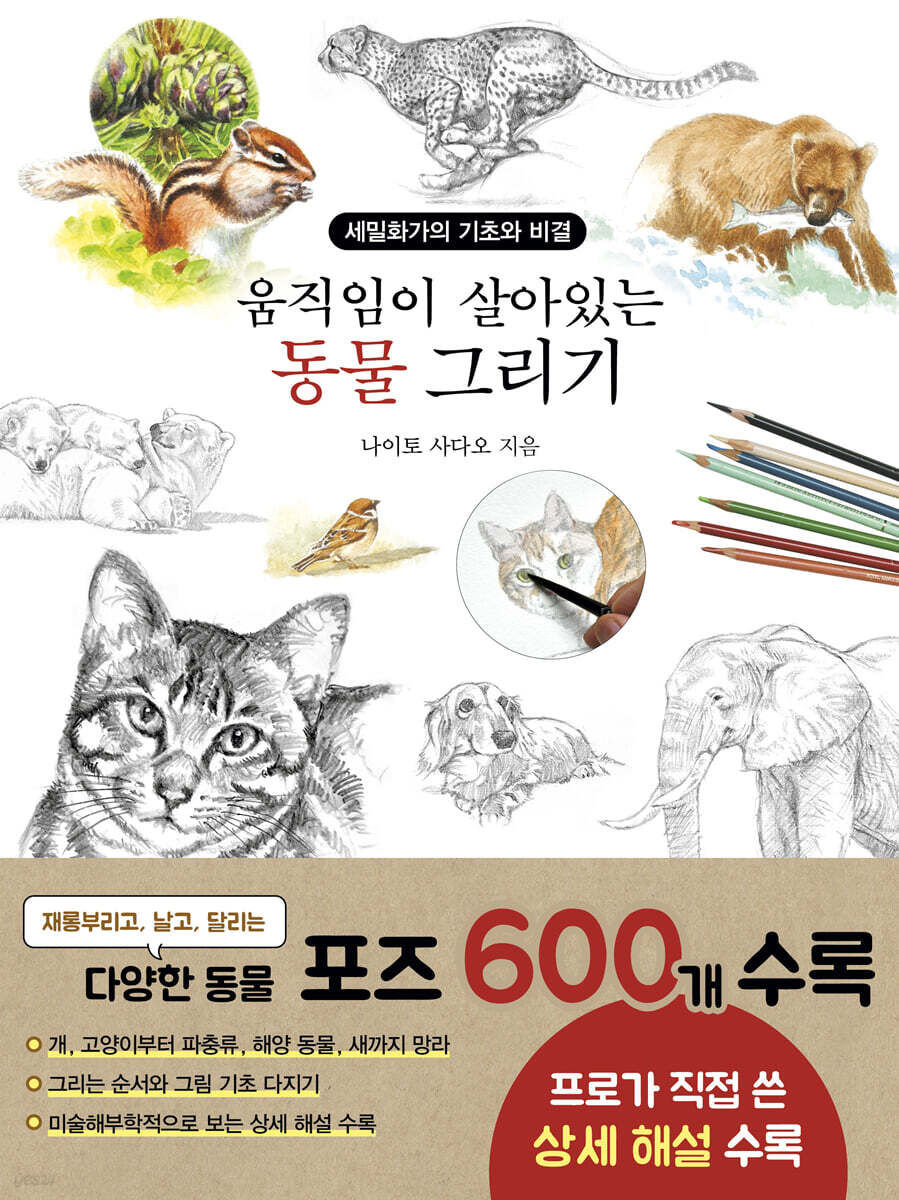 |
Description
Book Introduction
What are some things to keep in mind when drawing animals?
I want to draw in more detail, but where and how should I start?
Is it possible to draw animals so that they appear to be alive?
How can we express the characteristics and traits of animals in a drawing?
What kind of picture would be created if we drew animals from an anatomical perspective?
Sadao Naito, a leading expert in animal detailing, shares his fundamentals and unique expertise! We'll delve into the essential points and procedures for drawing animals, as well as the practical techniques for detailing down to the last hair.
- Includes 600 different animal poses
- Covering everything from dogs and cats to reptiles, marine animals, and birds
- Drawing order and laying the foundation for drawing
- Includes detailed explanations from an artistic anatomy perspective
If you know the points presented in 『Drawing Living Animals』 and pick up a pencil, you can take a step further into the sharp world of detailed drawing.
If you can create the poses and expressions of moving animals with just a touch of pencil line and a hint of humor, this book is ready to take you to the top of your game.
I want to draw in more detail, but where and how should I start?
Is it possible to draw animals so that they appear to be alive?
How can we express the characteristics and traits of animals in a drawing?
What kind of picture would be created if we drew animals from an anatomical perspective?
Sadao Naito, a leading expert in animal detailing, shares his fundamentals and unique expertise! We'll delve into the essential points and procedures for drawing animals, as well as the practical techniques for detailing down to the last hair.
- Includes 600 different animal poses
- Covering everything from dogs and cats to reptiles, marine animals, and birds
- Drawing order and laying the foundation for drawing
- Includes detailed explanations from an artistic anatomy perspective
If you know the points presented in 『Drawing Living Animals』 and pick up a pencil, you can take a step further into the sharp world of detailed drawing.
If you can create the poses and expressions of moving animals with just a touch of pencil line and a hint of humor, this book is ready to take you to the top of your game.
- You can preview some of the book's contents.
Preview
index
Entering
Five Things to Know When Drawing Animals
Gallery of finished works: Animals featured in this book
Chapter 1
HOW TO DRAW ① Drawing
[Feline]
cat
Basic sketch
1.
Various postures
2.
cat's expression
3.
Capture movement
4.
Types of cats
lion
Basic sketch
tiger
leopard
cheetah
Hyena and Tsushima cat
Sracoon, ocelot, etc.
[Canine]
dog
Basic sketch
1.
Various postures
2.
Capture movement
3.
Types of dogs
wolf
Basic sketch
Dingo, etc.
Foxes, raccoons, etc.
[Other mammals]
word
Basic sketch
Horses and zebras
With deer
Sotgwa
wild boar
African elephant
giraffe
hippo
rhinoceros
bear
With a bear
raccoon
capybara
kangaroo
koala
Sciuridae and Muridae
Prairie dogs, flying squirrels, etc.
rabbit
monkey family
gorilla
[Marine Mammals]
whale
Basic sketch
Dolphins and seals
[creeping things]
Lizards and crocodiles
[amphibia]
Frog family
[birds]
sparrow
Basic sketch
hawks and eagles
Owls, etc.
domestic pigeon
crane
Penguin and Spot-cheeked Duck
Chapter 2
HOW TO DRAW ② Coloring
Painting materials and tools
Data collection
coloring
Watercolor - Work 01 Cat
Watercolor - Work 02
Watercolor - Work 03 Wolf
Watercolor - Work 04 Squirrel
Watercolor - Work 05 Bird
Let's complete it in a dreamy way - Work 06 Panda
Contrast with colored pencils - Work 0 7 Bear
Acrylic Paint - Work 08 Wolf
COLUMN Drawing from an Anatomical Perspective
01 How to Draw a Cat
02 How to draw dogs and animals
03 How to Draw Mammals
04 How to Draw Marine Animals
05 How to Draw Birds
Bonus: How to Draw Fantasy Animals
COLUMN 06 Techniques for Revive Your Drawings When You Ruin Them
Sadao Naito's Works Gallery
Five Things to Know When Drawing Animals
Gallery of finished works: Animals featured in this book
Chapter 1
HOW TO DRAW ① Drawing
[Feline]
cat
Basic sketch
1.
Various postures
2.
cat's expression
3.
Capture movement
4.
Types of cats
lion
Basic sketch
tiger
leopard
cheetah
Hyena and Tsushima cat
Sracoon, ocelot, etc.
[Canine]
dog
Basic sketch
1.
Various postures
2.
Capture movement
3.
Types of dogs
wolf
Basic sketch
Dingo, etc.
Foxes, raccoons, etc.
[Other mammals]
word
Basic sketch
Horses and zebras
With deer
Sotgwa
wild boar
African elephant
giraffe
hippo
rhinoceros
bear
With a bear
raccoon
capybara
kangaroo
koala
Sciuridae and Muridae
Prairie dogs, flying squirrels, etc.
rabbit
monkey family
gorilla
[Marine Mammals]
whale
Basic sketch
Dolphins and seals
[creeping things]
Lizards and crocodiles
[amphibia]
Frog family
[birds]
sparrow
Basic sketch
hawks and eagles
Owls, etc.
domestic pigeon
crane
Penguin and Spot-cheeked Duck
Chapter 2
HOW TO DRAW ② Coloring
Painting materials and tools
Data collection
coloring
Watercolor - Work 01 Cat
Watercolor - Work 02
Watercolor - Work 03 Wolf
Watercolor - Work 04 Squirrel
Watercolor - Work 05 Bird
Let's complete it in a dreamy way - Work 06 Panda
Contrast with colored pencils - Work 0 7 Bear
Acrylic Paint - Work 08 Wolf
COLUMN Drawing from an Anatomical Perspective
01 How to Draw a Cat
02 How to draw dogs and animals
03 How to Draw Mammals
04 How to Draw Marine Animals
05 How to Draw Birds
Bonus: How to Draw Fantasy Animals
COLUMN 06 Techniques for Revive Your Drawings When You Ruin Them
Sadao Naito's Works Gallery
Detailed image

Into the book
The biggest difference between large cats like lions and domestic cats is the bridge of the nose.
As lions grew larger, their canines and incisors developed and their noses became longer.
The eyeballs are small compared to the head, and the angle of the bridge of the nose is smaller than that of a dog.
--- p.57
The shape of a dog's head can be divided as follows:
If the mouth is shorter than the length of the skull, it is brachycephalic, if it is similar, it is mesocephalous, and if it is longer, it is dolichocephalic.
Brachycephalic breeds include French bulldogs and pugs, mediocephalic breeds include Welsh corgis, retrievers, and Pomeranians, and long-cephalic breeds include Great Danes, collies, and Siberian huskies.
--- p.73
Mammals typically have seven cervical vertebrae, but there are exceptions, such as sloths (eight) and dugongs (six).
The number of cervical vertebrae has nothing to do with neck length.
A sloth can hang from a branch with its face down, which is equivalent to a human being with their body facing forward and their face turned backward.
--- p.115
The biggest difference between marine mammals and fish is the number of fins.
Fish, being marine creatures, have more fins than marine mammals because they use their fins for balance.
Marine mammals propel themselves by moving their tail fins up and down, while fish propel themselves by moving them side to side.
--- p.121
The body of a bird is covered with feathers, wings, and beaks, which are hard and keratinous.
The number of cervical vertebrae is much greater than that of mammals, allowing for a wider range of neck motion.
The larger the bird, the smaller its head compared to its body.
The body of a bird resting on a branch is nearly vertical, and the tail feathers are lower than the legs.
High-flying birds have a developed keel on their sternum, whereas birds that run on land, such as ostriches, do not have a keel.
--- p.134
Many imaginary animals, such as the 'Sphinx', which combines the head of a human and the body of a lion, and 'Cupid', which has wings on a human body, are expressed by synthesizing real creatures.
We can't forget the 'Dragon', which combines the head of a lizard or crocodile, the body of a dinosaur, and the wings of a bat.
The internal structural contradiction that occurs at the joint is not natural from an artistic anatomical perspective.
It is better to create fantasy animals by focusing on their appearance without worrying about the internal structure of the body.
--- p.136
You can draw on any paper, but a sketchbook is still easier to use.
If you are going to paint, you will need a certain thickness.
There are differences in the amount of pressure applied to the tip of the brush and the style of the brush stroke, so try out different types of brushes and use the one that suits you.
--- p.
138
If you plan on drawing an animal in detail, I recommend taking a photo of it.
If you have the opportunity, it is helpful to buy stuffed animals, specimens, bird wings, etc. in advance when drawing in detail.
As lions grew larger, their canines and incisors developed and their noses became longer.
The eyeballs are small compared to the head, and the angle of the bridge of the nose is smaller than that of a dog.
--- p.57
The shape of a dog's head can be divided as follows:
If the mouth is shorter than the length of the skull, it is brachycephalic, if it is similar, it is mesocephalous, and if it is longer, it is dolichocephalic.
Brachycephalic breeds include French bulldogs and pugs, mediocephalic breeds include Welsh corgis, retrievers, and Pomeranians, and long-cephalic breeds include Great Danes, collies, and Siberian huskies.
--- p.73
Mammals typically have seven cervical vertebrae, but there are exceptions, such as sloths (eight) and dugongs (six).
The number of cervical vertebrae has nothing to do with neck length.
A sloth can hang from a branch with its face down, which is equivalent to a human being with their body facing forward and their face turned backward.
--- p.115
The biggest difference between marine mammals and fish is the number of fins.
Fish, being marine creatures, have more fins than marine mammals because they use their fins for balance.
Marine mammals propel themselves by moving their tail fins up and down, while fish propel themselves by moving them side to side.
--- p.121
The body of a bird is covered with feathers, wings, and beaks, which are hard and keratinous.
The number of cervical vertebrae is much greater than that of mammals, allowing for a wider range of neck motion.
The larger the bird, the smaller its head compared to its body.
The body of a bird resting on a branch is nearly vertical, and the tail feathers are lower than the legs.
High-flying birds have a developed keel on their sternum, whereas birds that run on land, such as ostriches, do not have a keel.
--- p.134
Many imaginary animals, such as the 'Sphinx', which combines the head of a human and the body of a lion, and 'Cupid', which has wings on a human body, are expressed by synthesizing real creatures.
We can't forget the 'Dragon', which combines the head of a lizard or crocodile, the body of a dinosaur, and the wings of a bat.
The internal structural contradiction that occurs at the joint is not natural from an artistic anatomical perspective.
It is better to create fantasy animals by focusing on their appearance without worrying about the internal structure of the body.
--- p.136
You can draw on any paper, but a sketchbook is still easier to use.
If you are going to paint, you will need a certain thickness.
There are differences in the amount of pressure applied to the tip of the brush and the style of the brush stroke, so try out different types of brushes and use the one that suits you.
--- p.
138
If you plan on drawing an animal in detail, I recommend taking a photo of it.
If you have the opportunity, it is helpful to buy stuffed animals, specimens, bird wings, etc. in advance when drawing in detail.
--- p.140
Publisher's Review
The thrill of sketching presented by Sadao Naito!
▲When humans capture animals, and animals capture humans
Whether in nature, in zoos, or at home, we encounter countless animals.
Although indiscriminate ecological destruction and environmental pollution due to rapid urbanization are hindering the coexistence of animals and humans, no one can deny that animals and humans have lived, are living, and will continue to live as a single community within the same space.
Through this book, you will learn not only sketching techniques, but also the essence of animal and human life!
▲Experience the harmony of various animals and paintings.
From animals that closely resemble humans to those that appear too unfamiliar to be the same creature, we now try to capture them in pictures.
This has a different level of texture than when you draw an object, and at the same time, it provides a unique sensation of the picture being visualized in your mind.
Of course, a picture that follows the form as it is is enough if it is suitable for the eyes to enjoy, but what this book ultimately focuses on is the reality beyond reality, the reality beyond reality.
That is also why the title is ‘Drawing Animals with Living Movements’.
▲If you follow along well, you'll get a mango?
‘Technology’ is important, but more important than that is ‘understanding.’
Because there is a huge difference between drawing knowingly and drawing without knowing.
This means that only by meticulously exploring the subtle tremors and movements of bones and muscles, the speed and direction of the trembling of hair and feathers, and the habits and tendencies of each individual can one present the highest level of depiction at the tip of a pencil.
This book helps with that ‘understanding’ first.
If you follow the manual slowly, you will soon be able to move beyond the scope of a beginner detail artist.
▲In the end, details determine victory or defeat.
What is a picture and what is a detail?
How and where should I start to draw detailed drawings well?
If you have this book in your hands, you already have all the answers you need.
Understanding the size of muscles, the structure of the skeleton, and the habits and tendencies of each animal are also very detailed elements that require meticulous attention to detail, and this book touches on even these delicate and difficult aspects without any burden.
In addition to basic sketches, you can also find a separate column that brings the painting to life from an "art anatomy perspective," and the author's know-how in collecting materials, tools, and data needed for painting will also be an absolute charm that cannot be missed in this book.
▲The message contained in this book
No matter how long you observe an animal, what's the point if you can't express it in a drawing?
We invite you to the world of sketching, which is easily accessible with just simple materials.
This book will provide readers who love animals and sketching with the right values and direction for drawing, and will also serve as a valuable resource for protecting and preserving the ecology and habits of various animals distributed around the world.
I hope this book flows to the very place where you stand, wanting to draw.
▲When humans capture animals, and animals capture humans
Whether in nature, in zoos, or at home, we encounter countless animals.
Although indiscriminate ecological destruction and environmental pollution due to rapid urbanization are hindering the coexistence of animals and humans, no one can deny that animals and humans have lived, are living, and will continue to live as a single community within the same space.
Through this book, you will learn not only sketching techniques, but also the essence of animal and human life!
▲Experience the harmony of various animals and paintings.
From animals that closely resemble humans to those that appear too unfamiliar to be the same creature, we now try to capture them in pictures.
This has a different level of texture than when you draw an object, and at the same time, it provides a unique sensation of the picture being visualized in your mind.
Of course, a picture that follows the form as it is is enough if it is suitable for the eyes to enjoy, but what this book ultimately focuses on is the reality beyond reality, the reality beyond reality.
That is also why the title is ‘Drawing Animals with Living Movements’.
▲If you follow along well, you'll get a mango?
‘Technology’ is important, but more important than that is ‘understanding.’
Because there is a huge difference between drawing knowingly and drawing without knowing.
This means that only by meticulously exploring the subtle tremors and movements of bones and muscles, the speed and direction of the trembling of hair and feathers, and the habits and tendencies of each individual can one present the highest level of depiction at the tip of a pencil.
This book helps with that ‘understanding’ first.
If you follow the manual slowly, you will soon be able to move beyond the scope of a beginner detail artist.
▲In the end, details determine victory or defeat.
What is a picture and what is a detail?
How and where should I start to draw detailed drawings well?
If you have this book in your hands, you already have all the answers you need.
Understanding the size of muscles, the structure of the skeleton, and the habits and tendencies of each animal are also very detailed elements that require meticulous attention to detail, and this book touches on even these delicate and difficult aspects without any burden.
In addition to basic sketches, you can also find a separate column that brings the painting to life from an "art anatomy perspective," and the author's know-how in collecting materials, tools, and data needed for painting will also be an absolute charm that cannot be missed in this book.
▲The message contained in this book
No matter how long you observe an animal, what's the point if you can't express it in a drawing?
We invite you to the world of sketching, which is easily accessible with just simple materials.
This book will provide readers who love animals and sketching with the right values and direction for drawing, and will also serve as a valuable resource for protecting and preserving the ecology and habits of various animals distributed around the world.
I hope this book flows to the very place where you stand, wanting to draw.
GOODS SPECIFICS
- Date of issue: August 26, 2021
- Pages, weight, size: 182 pages | 700g | 210*280*12mm
- ISBN13: 9791166035050
- ISBN10: 1166035050
You may also like
카테고리
korean


korean

![GQ KOREA Mark (Monthly): December [2025]](http://librairie.coreenne.fr/cdn/shop/files/8ef265dbbfbf186523ed75ba7319009d.jpg?v=1765340328&width=3840)


