

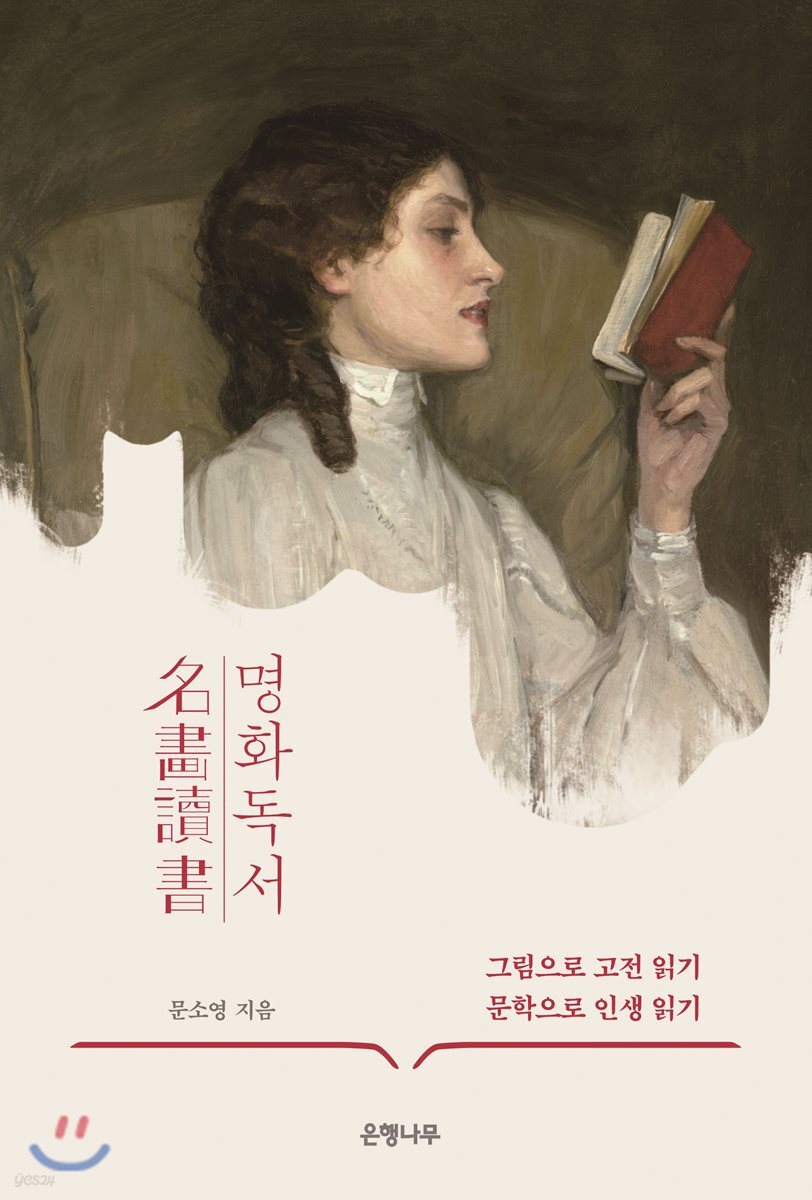
Reading famous paintings
 |
Description
Book Introduction
When life feels bleak and existence feels shaky,
Reading famous paintings
Reading classics through pictures, reading life through literature
Verbs that give strength to those who are groping in the dark
Reading famous paintings
Literature and art have been sources of inspiration for each other throughout history and the present.
Mythology, the oldest literature, has been a regular subject of Western painting, and in the East, it was said that poetry and painting must be created through the same ideology and process to have high value.
Some people claim that if they had not been captivated by the paintings here, they would never have revisited the classics.
This is the story of Moon So-young (Korea JoongAng Daily-New York Times reporter), who has consistently uncovered hidden stories in visual culture, in her new book, 『Reading Masterpieces』 (published by Eunhaengnamu).
As can be guessed from the subtitle, ‘Reading Classics through Paintings, Reading Life through Literature,’ 『Reading Masterpieces』 proceeds in the format of taking out a famous painting and unfolding a classic related to it.
Although it also features paintings inspired by literature, most of the paintings feature paintings that the author connects to social, economic, and political history.
When we read the classics through famous paintings, the message of the work naturally leads to questions about how to live life.
The range of literary works covered is wide, starting with the poetry of the truly classic Roman poet Horace, and extending to Shakespeare, Flaubert, Dostoevsky, Borges, Beckett and Brecht, and even Park Wan-seo.
The artworks are also diverse, with artists and works introduced ranging from Michelangelo's murals in the Sistine Chapel to the colored prints of Victorian painter John William Waterhouse, Impressionist Vincent van Gogh, William Blake, 19th-century book illustrations, and Nam June Paik's installations.
The author's sophisticated interpretation of these literary works, connecting the meaning of visual culture with contemporary concerns, stands out.
When you have lost the imagination you had when you read 『Alice in Wonderland』, and when you are suffering from the gap between dreams and reality that cannot be narrowed like 『Madame Bovary』, when life feels bleak like 『Phantoms』 and your existence is shaken like 『Hamlet』, I suggest a method of reading famous paintings that will guide you like constellations in the dark night.
Reading famous paintings
Reading classics through pictures, reading life through literature
Verbs that give strength to those who are groping in the dark
Reading famous paintings
Literature and art have been sources of inspiration for each other throughout history and the present.
Mythology, the oldest literature, has been a regular subject of Western painting, and in the East, it was said that poetry and painting must be created through the same ideology and process to have high value.
Some people claim that if they had not been captivated by the paintings here, they would never have revisited the classics.
This is the story of Moon So-young (Korea JoongAng Daily-New York Times reporter), who has consistently uncovered hidden stories in visual culture, in her new book, 『Reading Masterpieces』 (published by Eunhaengnamu).
As can be guessed from the subtitle, ‘Reading Classics through Paintings, Reading Life through Literature,’ 『Reading Masterpieces』 proceeds in the format of taking out a famous painting and unfolding a classic related to it.
Although it also features paintings inspired by literature, most of the paintings feature paintings that the author connects to social, economic, and political history.
When we read the classics through famous paintings, the message of the work naturally leads to questions about how to live life.
The range of literary works covered is wide, starting with the poetry of the truly classic Roman poet Horace, and extending to Shakespeare, Flaubert, Dostoevsky, Borges, Beckett and Brecht, and even Park Wan-seo.
The artworks are also diverse, with artists and works introduced ranging from Michelangelo's murals in the Sistine Chapel to the colored prints of Victorian painter John William Waterhouse, Impressionist Vincent van Gogh, William Blake, 19th-century book illustrations, and Nam June Paik's installations.
The author's sophisticated interpretation of these literary works, connecting the meaning of visual culture with contemporary concerns, stands out.
When you have lost the imagination you had when you read 『Alice in Wonderland』, and when you are suffering from the gap between dreams and reality that cannot be narrowed like 『Madame Bovary』, when life feels bleak like 『Phantoms』 and your existence is shaken like 『Hamlet』, I suggest a method of reading famous paintings that will guide you like constellations in the dark night.
- You can preview some of the book's contents.
Preview
index
Introduction
Chapter 1 | When you wonder why you live and how you should live
Gather today, the roses of life.
Carpe Diem_ A poem on the theme of 'Carpe Diem' by Horace and Robert Herrick
Lovely idealist or troublesome radical_ Miguel de Cervantes' Don Quixote
The dilemma of a thirty-year-old college student, Hamlet: To live or not to live_ William Shakespeare's Hamlet
Why is April so cruel_ T.
S. Eliot's The Waste Land
Face the plague of absurdity like Sisyphus - Albert Camus's The Plague and The Myth of Sisyphus
What altitude are we waiting for? - Samuel Beckett's "Waiting for Godot"
Chapter 2 | When Love Can't Sleep
Do you know the true ending of The Little Mermaid? - Hans Christian Andersen's "The Little Mermaid" · 85
Between Uncle Fan's Whispers and Dionysian Ecstasy_ Thomas Mann's Death in Venice · 97
The Beautiful but Cruel Nature of Fantasy_ John Keats's "The Unforgiving Beauty" · 109
Was that true love? Dante and Beatrice, Rossetti and Elizabeth Siddal_ Dante Alighieri's "Nouveau Vitality" translated by Dante Gabriel Rossetti
Why Five Days of Immature Love Became Immortal_ William Shakespeare's 'Romeo and Juliet'
Chapter 3 | Looking at the Darkness of Humanity and the World
The Devil's Three Questions, Humanity's Eternal Homework_ Fyodor Dostoevsky's The Brothers Karamazov
Weakness breeds evil_ William Shakespeare's Macbeth
Tears of Black Dots in White Snow_ William Blake's The Chimney Sweep
The Anxiety and Screams of Everyday Life and Society as Seen by Ibsen and Munch_ Henrik Ibsen's "Ghosts"
The Light and Shadow of a Persecuted Creator and a Revolutionary Creation_ Aeschylus's Prometheus Bound
Chapter 4 | In Search of Lost Imagination
What will happen if you chase the white rabbit? - Lewis Carroll's Alice's Adventures in Wonderland
The Day Humans Become Creators: A Thing to Remember - Mary Shelley's Frankenstein
A gruesome fairy tale featuring 19th-century robots_ ETA
Hoffmann's The Sandman
The God of Death at the Ball_ Edgar Allan Poe's "The Masque of the Red Death" and "Hopprog"
Even if the universe were made of books, would we still be able to read them? - Jorge Borges' "The Library of Babel"
Chapter 5 | When the Gap Between Dreams and Reality Suffer
Romance Turns to Adultery and Luxury Addiction_ Gustave Flaubert's Madame Bovary
Meeting a Fairy on the Banks of the Daedong River on an Autumn Moonlit Night - "Chwiyububyeokjeonggi" from Kim Si-seup's "Geumo Shinhwa"
A refuge for hopeless youth, The Glass Menagerie_ Tennessee Williams's The Glass Menagerie
Leaving the island paradise for the real 'brave new world' - William Shakespeare's 'The Tempest'
Starbucks, which has nothing to do with coffee, and the sublimity of the madman and the whale_ Herman Melville's Moby-Dick
Exiled Fairy or Old Literary Hallyu Star_ Heo Nanseolheon's "Mangseonyo"
Chapter 6 | In Search of Beauty and Humanism in Everyday Life
When everyday life becomes poetry, the beauty and regret of that moment_ Ezra Pound's "In the Subway Station"
How a trick of the eye saved a life_ O. Henry's "The Last Leaf"
Parental Qualities? Ask the Chalk Circle_Bertold Brecht's "The Chalk Circle of the Caucasus"
A painter who soothed hearts wounded by war_ Park Wan-seo's "Namok" and "Was That Mountain Really There?"
References
Chapter 1 | When you wonder why you live and how you should live
Gather today, the roses of life.
Carpe Diem_ A poem on the theme of 'Carpe Diem' by Horace and Robert Herrick
Lovely idealist or troublesome radical_ Miguel de Cervantes' Don Quixote
The dilemma of a thirty-year-old college student, Hamlet: To live or not to live_ William Shakespeare's Hamlet
Why is April so cruel_ T.
S. Eliot's The Waste Land
Face the plague of absurdity like Sisyphus - Albert Camus's The Plague and The Myth of Sisyphus
What altitude are we waiting for? - Samuel Beckett's "Waiting for Godot"
Chapter 2 | When Love Can't Sleep
Do you know the true ending of The Little Mermaid? - Hans Christian Andersen's "The Little Mermaid" · 85
Between Uncle Fan's Whispers and Dionysian Ecstasy_ Thomas Mann's Death in Venice · 97
The Beautiful but Cruel Nature of Fantasy_ John Keats's "The Unforgiving Beauty" · 109
Was that true love? Dante and Beatrice, Rossetti and Elizabeth Siddal_ Dante Alighieri's "Nouveau Vitality" translated by Dante Gabriel Rossetti
Why Five Days of Immature Love Became Immortal_ William Shakespeare's 'Romeo and Juliet'
Chapter 3 | Looking at the Darkness of Humanity and the World
The Devil's Three Questions, Humanity's Eternal Homework_ Fyodor Dostoevsky's The Brothers Karamazov
Weakness breeds evil_ William Shakespeare's Macbeth
Tears of Black Dots in White Snow_ William Blake's The Chimney Sweep
The Anxiety and Screams of Everyday Life and Society as Seen by Ibsen and Munch_ Henrik Ibsen's "Ghosts"
The Light and Shadow of a Persecuted Creator and a Revolutionary Creation_ Aeschylus's Prometheus Bound
Chapter 4 | In Search of Lost Imagination
What will happen if you chase the white rabbit? - Lewis Carroll's Alice's Adventures in Wonderland
The Day Humans Become Creators: A Thing to Remember - Mary Shelley's Frankenstein
A gruesome fairy tale featuring 19th-century robots_ ETA
Hoffmann's The Sandman
The God of Death at the Ball_ Edgar Allan Poe's "The Masque of the Red Death" and "Hopprog"
Even if the universe were made of books, would we still be able to read them? - Jorge Borges' "The Library of Babel"
Chapter 5 | When the Gap Between Dreams and Reality Suffer
Romance Turns to Adultery and Luxury Addiction_ Gustave Flaubert's Madame Bovary
Meeting a Fairy on the Banks of the Daedong River on an Autumn Moonlit Night - "Chwiyububyeokjeonggi" from Kim Si-seup's "Geumo Shinhwa"
A refuge for hopeless youth, The Glass Menagerie_ Tennessee Williams's The Glass Menagerie
Leaving the island paradise for the real 'brave new world' - William Shakespeare's 'The Tempest'
Starbucks, which has nothing to do with coffee, and the sublimity of the madman and the whale_ Herman Melville's Moby-Dick
Exiled Fairy or Old Literary Hallyu Star_ Heo Nanseolheon's "Mangseonyo"
Chapter 6 | In Search of Beauty and Humanism in Everyday Life
When everyday life becomes poetry, the beauty and regret of that moment_ Ezra Pound's "In the Subway Station"
How a trick of the eye saved a life_ O. Henry's "The Last Leaf"
Parental Qualities? Ask the Chalk Circle_Bertold Brecht's "The Chalk Circle of the Caucasus"
A painter who soothed hearts wounded by war_ Park Wan-seo's "Namok" and "Was That Mountain Really There?"
References
Detailed image
Into the book
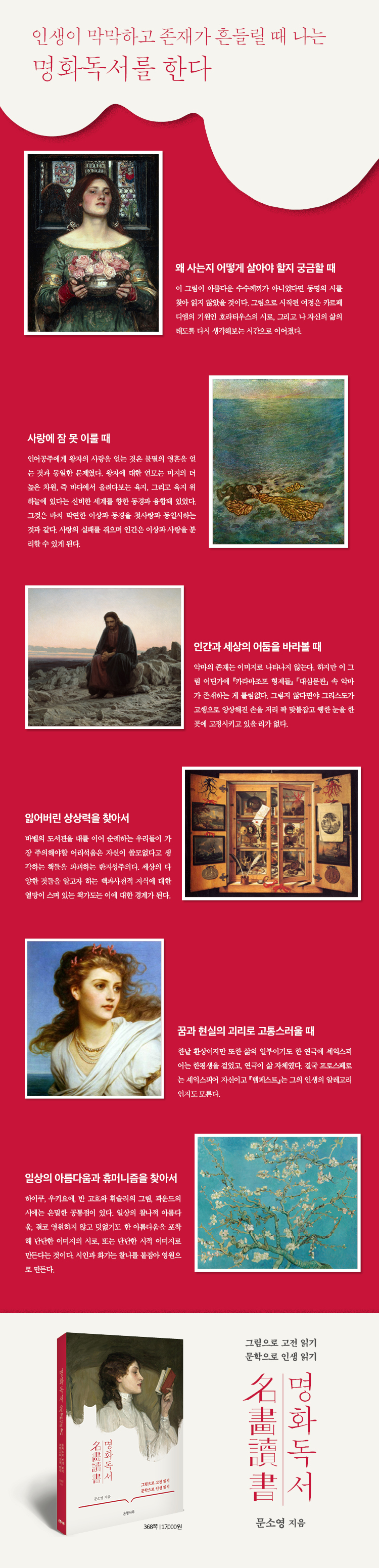
Let's look at Danwon Kim Hong-do's painting "Red Cliff Night Tiger."
Towering, majestic cliffs, a vast river stretching endlessly into the sky, and, in contrast, a small boat and people chatting there.
Even without reading Su Dongpo's poetry, one can sense the interplay of sadness over the insignificance of humanity and the joy of becoming one with the vastness of nature.
Su Dongpo's poetry and Duan Yuan's paintings have the power to pierce the heart and resonate even when they are not together.
But when the two are together, the feeling becomes even more grand and expansive.
When life feels bleak and my existence feels shaky, I read this poem.
And look at this picture.
--- p.11
Despite Don Quixote's progressive ideas and noble character, most of his exploits end up being comical, and sometimes even cause serious trouble.
Herein lies the profoundness of Cervantes.
He didn't always end Don Quixote's exploits in such an absurd way just to avoid the scrutiny of the ruling class.
Because he knew better than anyone that uncompromising idealism, which is full of ups and downs, carries not only light but also shadows.
--- p.32
“Weak one, your name is woman!”
Modern people who don't know the context often quote this line incorrectly.
The strict translation of 'frailty' is 'vulnerability'.
This does not refer to a lack of physical or intellectual strength, but rather to a vulnerability in not being able to remain faithful to one's spouse and being susceptible to the temptations of others.
From a modern perspective, this line could be considered counterproductive, considering that men have been more likely to show such 'vulnerability' throughout history.
--- p.44
Sisyphus faces the absurdity of the world, which repeats itself like a rock rolling downhill, and does not harbor any vain hopes or optimism about it.
On the contrary, we do not give in to despair.
He is in a state of perpetual tension with the absurd, and feels both pain and pleasure from it.
--- p.70
For the Little Mermaid, winning the prince's love was as much a matter as winning an immortal soul.
Her love for the prince was fused with a longing for a higher, unknown dimension: the land seen from the sea, and the mysterious world in the sky above the land.
It's like identifying all your vague ideals and longings with your first love during adolescence.
As people experience failure in love, they learn to separate ideals from love.
--- p.94
The greatest folly we, who have made pilgrimages to the Library of Babel for generations, must be wary of is the anti-intellectualism of destroying books we deem useless.
The bookstore, imbued with the desire for encyclopedic knowledge to know the various things of the world, serves as a warning against this.
--- p.256
If we seek answers by absorbing knowledge with the curiosity and open mind contained in the bookstore, wouldn't we be able to escape the temptation of anti-intellectualism, which is like destroying the books deemed useless in the Library of Babel, by falling into camp logic or self-righteousness and fitting knowledge and information into predetermined answers?
And if we continue this pilgrimage for generations, we might discover, as Borges said, “a divine order that is a repetition of disorder.”
--- p.257
Shakespeare devoted his entire life to theatre, which is merely an illusion but also a part of life, and theatre was life itself.
Ultimately, Prospero may be Shakespeare himself, and The Tempest may be an allegory of his life.
--- p.299
In Moby Dick, there are many aesthetic depictions of whales and the sea, such as comparing the powerful beauty of a whale's tail to the robust works of Renaissance master Michelangelo.
So, no matter how vast it is, it is a novel worth reading from beginning to end.
If only to see how the sublimity of Turner's paintings was expressed in language.
Towering, majestic cliffs, a vast river stretching endlessly into the sky, and, in contrast, a small boat and people chatting there.
Even without reading Su Dongpo's poetry, one can sense the interplay of sadness over the insignificance of humanity and the joy of becoming one with the vastness of nature.
Su Dongpo's poetry and Duan Yuan's paintings have the power to pierce the heart and resonate even when they are not together.
But when the two are together, the feeling becomes even more grand and expansive.
When life feels bleak and my existence feels shaky, I read this poem.
And look at this picture.
--- p.11
Despite Don Quixote's progressive ideas and noble character, most of his exploits end up being comical, and sometimes even cause serious trouble.
Herein lies the profoundness of Cervantes.
He didn't always end Don Quixote's exploits in such an absurd way just to avoid the scrutiny of the ruling class.
Because he knew better than anyone that uncompromising idealism, which is full of ups and downs, carries not only light but also shadows.
--- p.32
“Weak one, your name is woman!”
Modern people who don't know the context often quote this line incorrectly.
The strict translation of 'frailty' is 'vulnerability'.
This does not refer to a lack of physical or intellectual strength, but rather to a vulnerability in not being able to remain faithful to one's spouse and being susceptible to the temptations of others.
From a modern perspective, this line could be considered counterproductive, considering that men have been more likely to show such 'vulnerability' throughout history.
--- p.44
Sisyphus faces the absurdity of the world, which repeats itself like a rock rolling downhill, and does not harbor any vain hopes or optimism about it.
On the contrary, we do not give in to despair.
He is in a state of perpetual tension with the absurd, and feels both pain and pleasure from it.
--- p.70
For the Little Mermaid, winning the prince's love was as much a matter as winning an immortal soul.
Her love for the prince was fused with a longing for a higher, unknown dimension: the land seen from the sea, and the mysterious world in the sky above the land.
It's like identifying all your vague ideals and longings with your first love during adolescence.
As people experience failure in love, they learn to separate ideals from love.
--- p.94
The greatest folly we, who have made pilgrimages to the Library of Babel for generations, must be wary of is the anti-intellectualism of destroying books we deem useless.
The bookstore, imbued with the desire for encyclopedic knowledge to know the various things of the world, serves as a warning against this.
--- p.256
If we seek answers by absorbing knowledge with the curiosity and open mind contained in the bookstore, wouldn't we be able to escape the temptation of anti-intellectualism, which is like destroying the books deemed useless in the Library of Babel, by falling into camp logic or self-righteousness and fitting knowledge and information into predetermined answers?
And if we continue this pilgrimage for generations, we might discover, as Borges said, “a divine order that is a repetition of disorder.”
--- p.257
Shakespeare devoted his entire life to theatre, which is merely an illusion but also a part of life, and theatre was life itself.
Ultimately, Prospero may be Shakespeare himself, and The Tempest may be an allegory of his life.
--- p.299
In Moby Dick, there are many aesthetic depictions of whales and the sea, such as comparing the powerful beauty of a whale's tail to the robust works of Renaissance master Michelangelo.
So, no matter how vast it is, it is a novel worth reading from beginning to end.
If only to see how the sublimity of Turner's paintings was expressed in language.
--- p.306
Publisher's Review
The answer to how to survive while enduring fate and others.
With a book by your side and a picture in front of you
Enduring anxiety while struggling with the incomprehensibility of life
What is a classic? Italian novelist Italo Calvino said that a classic is a book about which people say, "I'm reading this now," rather than "I'm rereading this now."
Anyone can easily recite a list of must-read classics during adolescence, but the truth is that many classics are read far less often than they are talked about.
Fortunately, Calvino also said this:
“Reading a great book for the first time in adulthood is a pleasure of a different kind from that of reading it in younger years.
“Younger age gives reading a certain flavor and conscious importance, while mature age perceives more details, perspectives, and meanings.”
The author also wants to say that he has read all the books covered in 『Reading Masterpieces』 at least two or three times, but he says that there were some books that he was reading for the first time.
But it was only now, not then, that I was able to feel heartbroken by the fact that Madame Bovary's longing for romance ended up as a mere, banal, nuisance-causing deviation in reality, empathize with Macbeth's lust for power, who was swayed by prophecy without even becoming a pure devil, and find myself in The Tempest, where he returns to reality on his own feet even after seeing paradise.
He said that his motivation for writing was to share the joy and enlightenment he gained.
That's why Calvino said, "Rereading a classic is a journey of new discovery, just like reading it for the first time."
He also said, “The stories told by classics never end.”
So, even 『The Little Mermaid』, 『Alice in Wonderland』, and "The Last Leaf" that I read as a child can be read anew as a long journey to learn about the relationship between love and ideals, as a satire of reality, and as another artistic value of trompe l'oeil, a mere illusionary painting that was once disparaged.
The author, who majored in economics, worked in the workforce, and then majored in art again, always has pictures accompanying him in his process of reinterpreting classics in a new way.
Anyone who has seen Millais' famous painting, Ophelia, will have had the experience of being unable to take their eyes off her liberated expression.
Looking at that face, we can notice the meaning of her crazy song that passes by in Hamlet.
Fuselli's grotesque paintings of witches also make me want to open Macbeth right now and check it out.
Reading the conversational passages of Madame Bovary, one finds one nodding in agreement with the author's words that they share similarities with the paintings of the realist master, Courbet.
Indeed, there is a unique and tremendous joy in viewing classics alongside famous paintings.
Literature and art face each other, relate to each other, and unfold
A map of stars leading to you
A beautiful, enigmatic Waterhouse painting, "Gather Your Rosebuds While You May," captures the teaching of Mr. Keating in the film "Dead Poets Society": "Carpe Diem."
The origin of Koreans' favorite adage, 'Carpe diem', is a poem by the ancient Roman poet Horace.
This unraveling journey, from Victorian England to 1980s America, from ancient Rome to the present, is the author's unique way of reading to examine his own attitude toward life.
What the author particularly notices in Munch's "Ghosts" is the black armchair with its back turned.
This chair soon leads to Ibsen's play "Ghosts".
The author's unique insight into the anxiety squirming beneath the hypocritical calm and his mature skill in interpreting the meaning of details stand out in 'Black Armchair'.
When introducing Kramskoy's "Christ in the Wilderness," I almost implore you to read "The Grand Inquisitor," the culmination of "The Brothers Karamazov."
When you watch Dostoevsky and Kramskoy, two 'realists of the abyss of the human soul' who resemble each other, together, you can vividly feel the thunderous sound of the Grand Inquisitor's questions.
This book is divided into the following sections: 'When you wonder why you live and how you should live,' 'When you can't sleep because of love,' 'When you look at the darkness of humanity and the world,' 'In search of lost imagination,' 'When you suffer from the gap between dreams and reality,' and 'In search of beauty and humanism in everyday life,' and it categorizes works that are good to read together according to the concerns of life.
However, often a book or a picture falls into multiple categories.
Literature and painting, facing each other, intersecting, and intricately related, seem to unfold an ideological constellation.
The effort to grasp the traces of life and the origins of philosophy latent in visual culture leads to an understanding of literature and human life.
Isn't understanding the world ultimately about understanding an abstraction?
Detecting the gaps between dots and lines, contradictions or unresolved issues, and adding interpretations to fill in the gaps is very similar to asking and answering questions about life.
With a book by your side and a picture in front of you
Enduring anxiety while struggling with the incomprehensibility of life
What is a classic? Italian novelist Italo Calvino said that a classic is a book about which people say, "I'm reading this now," rather than "I'm rereading this now."
Anyone can easily recite a list of must-read classics during adolescence, but the truth is that many classics are read far less often than they are talked about.
Fortunately, Calvino also said this:
“Reading a great book for the first time in adulthood is a pleasure of a different kind from that of reading it in younger years.
“Younger age gives reading a certain flavor and conscious importance, while mature age perceives more details, perspectives, and meanings.”
The author also wants to say that he has read all the books covered in 『Reading Masterpieces』 at least two or three times, but he says that there were some books that he was reading for the first time.
But it was only now, not then, that I was able to feel heartbroken by the fact that Madame Bovary's longing for romance ended up as a mere, banal, nuisance-causing deviation in reality, empathize with Macbeth's lust for power, who was swayed by prophecy without even becoming a pure devil, and find myself in The Tempest, where he returns to reality on his own feet even after seeing paradise.
He said that his motivation for writing was to share the joy and enlightenment he gained.
That's why Calvino said, "Rereading a classic is a journey of new discovery, just like reading it for the first time."
He also said, “The stories told by classics never end.”
So, even 『The Little Mermaid』, 『Alice in Wonderland』, and "The Last Leaf" that I read as a child can be read anew as a long journey to learn about the relationship between love and ideals, as a satire of reality, and as another artistic value of trompe l'oeil, a mere illusionary painting that was once disparaged.
The author, who majored in economics, worked in the workforce, and then majored in art again, always has pictures accompanying him in his process of reinterpreting classics in a new way.
Anyone who has seen Millais' famous painting, Ophelia, will have had the experience of being unable to take their eyes off her liberated expression.
Looking at that face, we can notice the meaning of her crazy song that passes by in Hamlet.
Fuselli's grotesque paintings of witches also make me want to open Macbeth right now and check it out.
Reading the conversational passages of Madame Bovary, one finds one nodding in agreement with the author's words that they share similarities with the paintings of the realist master, Courbet.
Indeed, there is a unique and tremendous joy in viewing classics alongside famous paintings.
Literature and art face each other, relate to each other, and unfold
A map of stars leading to you
A beautiful, enigmatic Waterhouse painting, "Gather Your Rosebuds While You May," captures the teaching of Mr. Keating in the film "Dead Poets Society": "Carpe Diem."
The origin of Koreans' favorite adage, 'Carpe diem', is a poem by the ancient Roman poet Horace.
This unraveling journey, from Victorian England to 1980s America, from ancient Rome to the present, is the author's unique way of reading to examine his own attitude toward life.
What the author particularly notices in Munch's "Ghosts" is the black armchair with its back turned.
This chair soon leads to Ibsen's play "Ghosts".
The author's unique insight into the anxiety squirming beneath the hypocritical calm and his mature skill in interpreting the meaning of details stand out in 'Black Armchair'.
When introducing Kramskoy's "Christ in the Wilderness," I almost implore you to read "The Grand Inquisitor," the culmination of "The Brothers Karamazov."
When you watch Dostoevsky and Kramskoy, two 'realists of the abyss of the human soul' who resemble each other, together, you can vividly feel the thunderous sound of the Grand Inquisitor's questions.
This book is divided into the following sections: 'When you wonder why you live and how you should live,' 'When you can't sleep because of love,' 'When you look at the darkness of humanity and the world,' 'In search of lost imagination,' 'When you suffer from the gap between dreams and reality,' and 'In search of beauty and humanism in everyday life,' and it categorizes works that are good to read together according to the concerns of life.
However, often a book or a picture falls into multiple categories.
Literature and painting, facing each other, intersecting, and intricately related, seem to unfold an ideological constellation.
The effort to grasp the traces of life and the origins of philosophy latent in visual culture leads to an understanding of literature and human life.
Isn't understanding the world ultimately about understanding an abstraction?
Detecting the gaps between dots and lines, contradictions or unresolved issues, and adding interpretations to fill in the gaps is very similar to asking and answering questions about life.
GOODS SPECIFICS
- Date of issue: January 30, 2018
- Page count, weight, size: 368 pages | 652g | 146*216*30mm
- ISBN13: 9791188810062
- ISBN10: 1188810065
You may also like
카테고리
korean


korean

![GQ KOREA Mark (Monthly): December [2025]](http://librairie.coreenne.fr/cdn/shop/files/8ef265dbbfbf186523ed75ba7319009d.jpg?v=1765340328&width=3840)


