

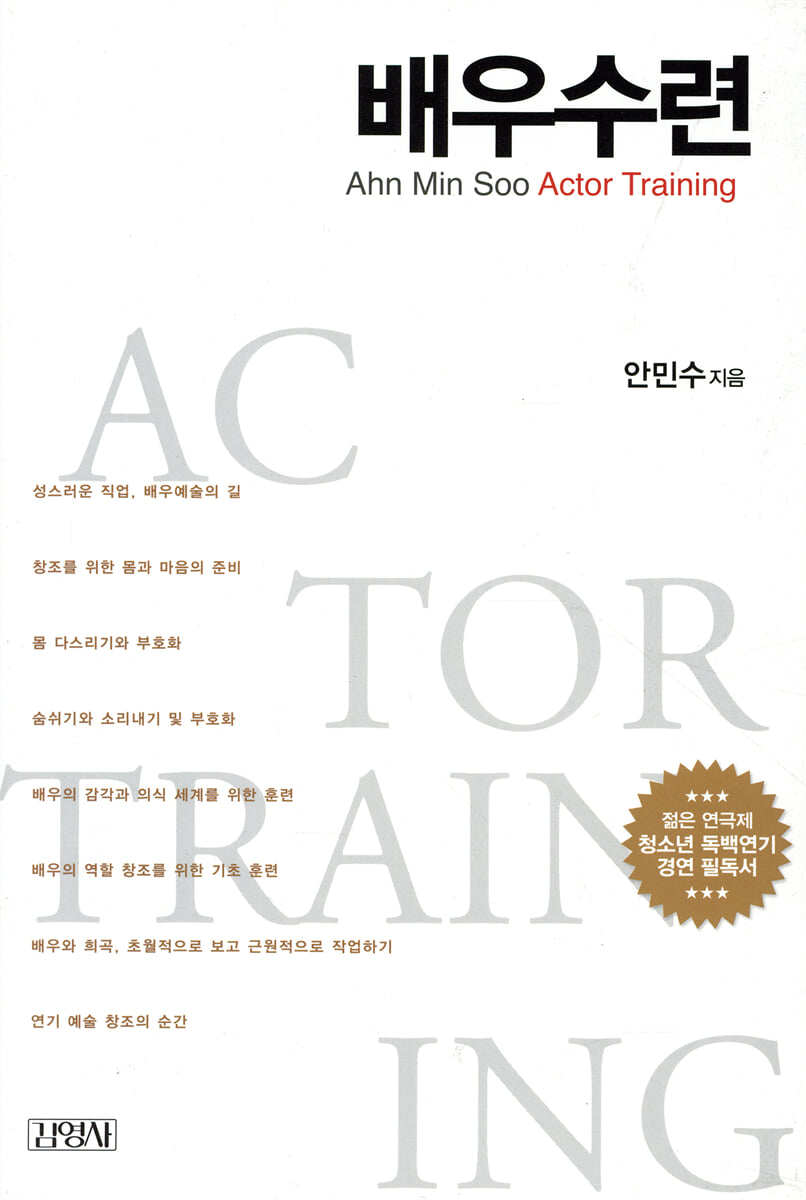
Actor training
 |
Description
Book Introduction
Professor Ahn Min-soo, an acting instructor and director who is considered the best teacher by influential Korean actors such as Choi Min-sik, Park Shin-yang, Chae Si-ra, Kim Hye-soo, and Yoo Jun-sang, reveals the process and training methods for becoming an actor.
Having taught acting at a university for a long time and guiding countless students on the path to becoming actors, he teaches not only acting techniques but also the attitude and mindset required of an actor, ensuring that students build a solid foundation from the basics.
This book contains meaningful training movements in a calculated order, just like his acting philosophy that "acting is both science and technique."
He covers every detail, from vocalization and basic movements to analyzing and creating new characters in a play. He unfolds the content of each chapter as if he were giving an actual lecture, making it easier to read.
Having taught acting at a university for a long time and guiding countless students on the path to becoming actors, he teaches not only acting techniques but also the attitude and mindset required of an actor, ensuring that students build a solid foundation from the basics.
This book contains meaningful training movements in a calculated order, just like his acting philosophy that "acting is both science and technique."
He covers every detail, from vocalization and basic movements to analyzing and creating new characters in a play. He unfolds the content of each chapter as if he were giving an actual lecture, making it easier to read.
index
Lecture 1.
The sacred profession, the path of acting art
1.
Interacting with strangers
2.
Life and the Art of Acting
3.
A skill that you learn by yourself
4.
A promise that the actor himself must keep
Lecture 2.
Preparing your body and mind for creation
1.
A space of creation, a training center
2.
Meditation filled with creative energy
3rd lecture.
Body control and encoding
1.
Stretching and conditioning
2.
Movement of the head and facial organs
3.
The body's cells remember movements as codes
4.
Communicate through movement between characters
5.
Try making meaningful moves
Semifinals.
Breathing, vocalization, and encoding
1.
The right way to breathe
2.
Breathing in various postures
3.
Make a sound with your torso
4.
Preparation for correct Korean
5.
Remembering sounds as symbols
Lecture 5.
Training for the actor's senses and conscious world
1.
Focus your attention
2.
Sensory responses and emotions
3.
Experiencing the density and size of emotions
4.
Observation and imagination
Lecture 6.
Basic training for creating actor roles
1.
Characters and Conflicts
2.
Character Creation Practice
Lesson 7.
Actors and plays,
Seeing transcendentally and working fundamentally
1.
Script Analysis
2.
Character analysis and construction
3.
Create a role
Quarterfinals.
The moment of creative acting art
1.
There is only one theater
2.
For the depth of a pearl and the brilliance of a diamond
The sacred profession, the path of acting art
1.
Interacting with strangers
2.
Life and the Art of Acting
3.
A skill that you learn by yourself
4.
A promise that the actor himself must keep
Lecture 2.
Preparing your body and mind for creation
1.
A space of creation, a training center
2.
Meditation filled with creative energy
3rd lecture.
Body control and encoding
1.
Stretching and conditioning
2.
Movement of the head and facial organs
3.
The body's cells remember movements as codes
4.
Communicate through movement between characters
5.
Try making meaningful moves
Semifinals.
Breathing, vocalization, and encoding
1.
The right way to breathe
2.
Breathing in various postures
3.
Make a sound with your torso
4.
Preparation for correct Korean
5.
Remembering sounds as symbols
Lecture 5.
Training for the actor's senses and conscious world
1.
Focus your attention
2.
Sensory responses and emotions
3.
Experiencing the density and size of emotions
4.
Observation and imagination
Lecture 6.
Basic training for creating actor roles
1.
Characters and Conflicts
2.
Character Creation Practice
Lesson 7.
Actors and plays,
Seeing transcendentally and working fundamentally
1.
Script Analysis
2.
Character analysis and construction
3.
Create a role
Quarterfinals.
The moment of creative acting art
1.
There is only one theater
2.
For the depth of a pearl and the brilliance of a diamond
Into the book
We were not originally meant to be this tense in body and mind.
Let's look back on our childhood.
How free I was, both mentally and physically.
You speak in a barely audible voice, but the children cry loudly and express their hunger without hesitation.
As we grow, a shell-like thing gradually covers our body and mind.
This shell, which may originate from our home environment, social conventions, or educational environment, becomes a factor that prevents us from naturally expressing our inner impulses outwardly.
So how do we unleash our inner impulses?
This is the ultimate problem and the whole point of actor training.
Actor training is the process of removing unnecessary rigidity from the actor's body, which contains both soul and body.
There are a variety of approaches to tension-relieving training for this purpose.
Since the mind governs the body and the body governs the mind, if you govern the body and mind, sound and movement will be governed.
The opposite also holds true.
In conclusion, acting training is a training that frees the mind and body by approaching from the inside out and from the outside in, whether through physical training or mental training.
---「Lecture 1.
From “The Sacred Profession, the Path of Acting Art: ‘Communicating with Strangers’”
The following body stretch is performed while maintaining balance in a standing posture, remembering that the body is organic.
Whenever you begin a new movement, you always need to make sure you are starting with the correct posture.
Training 6 Soaring into the Sky
It is an exercise that stimulates the joints of the entire body and relaxes the muscles.
① Low jump: Jump high towards the sky from a standing position.
Stretch by jumping up and down with your feet pointed and your hands comfortably lowered, while your head rises and the soles of your feet push down.
At this time, make sure that your shoulders and head do not rise together.
When you jump up, make sure your feet are pointed.
② Mid-height jump: Jump as high as you can.
③ Jump very high: Slightly bend your knees and jump very high as if your whole body is piercing the sky.
Even if you don't actually soar high, you must consciously strive to soar higher, more, and bigger psychologically.
---「3rd lecture.
From "Body Control and Encoding" "Body Relaxation and Refining"
Training 1: Experience the Character Using a Mask
Step 1: First, place the mask on the floor and observe its features with your eyes only.
We examine the size of the mask, facial features, and expression, and even analyze the age and occupation.
Step 2: Pick up the mask and feel its weight and texture, whether it is heavy or light and whether it is made of wood, bronze, or cloth.
And I imagine many things.
What would the sound be like if I wore the mask? What would the person wearing it be like? How would they move? What would their tone be? How would my movements change?
Step 3: Now, to become more intimate with the mask, try hugging it, walking with it by your side like the mask would walk, and even having a conversation with it, all while doing various things you would do with the mask.
Step 4: Move as if you were friends with the mask, and then naturally put the mask on your face.
Imagine yourself as the character in the mask and become that character.
Step 5: This time, lift the mask up and place it on your head, and try to make your face into the mask's face.
---「6th class.
From the basic training for creating an actor's role, "Character Creation Exercise"
A play must be 'viewed' objectively and accurately.
For this purpose, it may be a good idea for an actor to have someone else read the script for them when they first read it while they listen comfortably.
Listening comfortably means objectively visualizing the drama without being bound by the meaning of the printed medium, literary figures, or explanations.
In my case, when I'm directing, I try to have a third party read the script or have the writer read it to me whenever possible.
If you have read the play objectively like this, write down your feelings and impressions from the first time you read it.
Write down the most powerful impressions you had from the first reading, without any fancy sentences or literary decorations, and without any intention of showing them to anyone.
For example, write things like, 'This part is hilarious, laugh-out-loud funny,' 'This character is humorous, comical, and cute,' 'This part is too monotonous,' and write as many as you can.
The information organized in this way is broadly classified into A, B, and C.
A can be categorized as something related to the plot connected to the work's goal, philosophy, or idea; B as something related to the work's atmosphere, style, or form; and C as something related to the characters.
Let's look back on our childhood.
How free I was, both mentally and physically.
You speak in a barely audible voice, but the children cry loudly and express their hunger without hesitation.
As we grow, a shell-like thing gradually covers our body and mind.
This shell, which may originate from our home environment, social conventions, or educational environment, becomes a factor that prevents us from naturally expressing our inner impulses outwardly.
So how do we unleash our inner impulses?
This is the ultimate problem and the whole point of actor training.
Actor training is the process of removing unnecessary rigidity from the actor's body, which contains both soul and body.
There are a variety of approaches to tension-relieving training for this purpose.
Since the mind governs the body and the body governs the mind, if you govern the body and mind, sound and movement will be governed.
The opposite also holds true.
In conclusion, acting training is a training that frees the mind and body by approaching from the inside out and from the outside in, whether through physical training or mental training.
---「Lecture 1.
From “The Sacred Profession, the Path of Acting Art: ‘Communicating with Strangers’”
The following body stretch is performed while maintaining balance in a standing posture, remembering that the body is organic.
Whenever you begin a new movement, you always need to make sure you are starting with the correct posture.
Training 6 Soaring into the Sky
It is an exercise that stimulates the joints of the entire body and relaxes the muscles.
① Low jump: Jump high towards the sky from a standing position.
Stretch by jumping up and down with your feet pointed and your hands comfortably lowered, while your head rises and the soles of your feet push down.
At this time, make sure that your shoulders and head do not rise together.
When you jump up, make sure your feet are pointed.
② Mid-height jump: Jump as high as you can.
③ Jump very high: Slightly bend your knees and jump very high as if your whole body is piercing the sky.
Even if you don't actually soar high, you must consciously strive to soar higher, more, and bigger psychologically.
---「3rd lecture.
From "Body Control and Encoding" "Body Relaxation and Refining"
Training 1: Experience the Character Using a Mask
Step 1: First, place the mask on the floor and observe its features with your eyes only.
We examine the size of the mask, facial features, and expression, and even analyze the age and occupation.
Step 2: Pick up the mask and feel its weight and texture, whether it is heavy or light and whether it is made of wood, bronze, or cloth.
And I imagine many things.
What would the sound be like if I wore the mask? What would the person wearing it be like? How would they move? What would their tone be? How would my movements change?
Step 3: Now, to become more intimate with the mask, try hugging it, walking with it by your side like the mask would walk, and even having a conversation with it, all while doing various things you would do with the mask.
Step 4: Move as if you were friends with the mask, and then naturally put the mask on your face.
Imagine yourself as the character in the mask and become that character.
Step 5: This time, lift the mask up and place it on your head, and try to make your face into the mask's face.
---「6th class.
From the basic training for creating an actor's role, "Character Creation Exercise"
A play must be 'viewed' objectively and accurately.
For this purpose, it may be a good idea for an actor to have someone else read the script for them when they first read it while they listen comfortably.
Listening comfortably means objectively visualizing the drama without being bound by the meaning of the printed medium, literary figures, or explanations.
In my case, when I'm directing, I try to have a third party read the script or have the writer read it to me whenever possible.
If you have read the play objectively like this, write down your feelings and impressions from the first time you read it.
Write down the most powerful impressions you had from the first reading, without any fancy sentences or literary decorations, and without any intention of showing them to anyone.
For example, write things like, 'This part is hilarious, laugh-out-loud funny,' 'This character is humorous, comical, and cute,' 'This part is too monotonous,' and write as many as you can.
The information organized in this way is broadly classified into A, B, and C.
A can be categorized as something related to the plot connected to the work's goal, philosophy, or idea; B as something related to the work's atmosphere, style, or form; and C as something related to the characters.
---「Lecture 7.
From "Analysis of the Script": Seeing Actors and Plays Transcendentally and Working Fundamentally
From "Analysis of the Script": Seeing Actors and Plays Transcendentally and Working Fundamentally
Publisher's Review
Acting isn't about talent; it's about science and skill.
A systematic acting training method to control your body and mind!
What do actors Choi Min-sik, Park Shin-yang, Chae Shi-ra, Kim Hye-soo, and Yoo Jun-sang have in common, delivering distinctive performances on both screen and television? It's the shared experience of their acting mentor, Ahn Min-soo, who provided them with profound teachings about the art of acting.
In the 1970s, Ahn Min-soo, who worked as a director at the Drama Center Dongrang Repertory Theatre Company and demonstrated experimental directing, received rave reviews from overseas media when his work "Prince Hamyeol" toured the United States and Europe for the first time in Korean theater history in 1977.
Since then, he has worked as an acting instructor at a university, bringing out the hidden talents and passion of numerous actors.
This book is a systematic compilation of experiments he conducted in a university acting class based on his long-term directing experience. It contains practical training methods such as breathing, warming up, vocalization, role creation, and script analysis, as well as profound teachings that actors should keep in mind, such as the meaning and role of the art of acting.
In keeping with his acting philosophy that "acting is both science and technique," this book, which organizes meaningful training movements into calculated sequences, covers not only basic acting but also intermediate and advanced acting courses, offering universally effective methods for many actors.
What makes the publication of this book most significant is that, in a situation where there has been no systematic domestic acting training book for aspiring or professional actors, and most have relied on translated books, it is the first acting training book to systematically provide training methods suited to our format.
So, training methods such as 'Making Korean consonants' provide actors with realistic advice that cannot be found in translated books.
This book is a compilation of lectures given over several years, organized into eight lectures.
The first lecture covers the true meaning of the art of acting, the second lecture covers the physical and mental preparation that an actor must have before training, and the third lecture covers training methods for controlling the body, which is the essence of an actor's medium of expression, and a training process for experiencing the body as an object with meaning.
Lesson 4 covers the methods needed for vocal and speaking training, and Lesson 5 covers training the actor's feelings and thoughts.
In addition, in Lesson 6, we will experience training methods that can help actors create roles in practice, and in Lesson 7, we will cover training methods that can help actors actually build characters while reading a script.
In the quarterfinals, it is emphasized that performance, which is the creative site of acting art, is the end of practice and the beginning of the next performance, and thus, performance is also a training process for actors.
As he said, “Even when an actor is 70 years old, he should still seek out a teacher and receive lessons and corrections when needed,” this book will be a “great acting teacher” that can be kept by aspiring actors and professional actors who need lessons until the very end of their acting roles, and can be referred to at any time.
* Recommendation
『Actor Training』 is a ‘scientific methodology for systematizing acting education’ based on the teacher’s philosophy that ‘acting cannot be taught, but it can be learned.’
- Shin Young-seop (Professor, Department of Theater, Dongguk University)
I am happy to have come across a book that contains the keen insight of a teacher who never wastes a single breath on actors, as well as his warm philosophy toward them.
It is a specific training book for the actor's body, mind, and movements, and is a unique book that leads to creative acting art.
- Seo Chung-sik (Professor of Acting, School of Theater, Korea National University of Arts)
It's tearful... and really, I'm so relieved.
Thank you for giving me the opportunity to study again….
Thank you, teacher.
I will study hard.
- Choi Min-sik (actor)
The only one who can teach "theater and acting" as an "art"! Just as your teachings completely transformed my life and soul, this book will help those who still hesitate, unsure of what acting is, how to do it, and why to pursue it, discover new meaning in the act.
I sincerely hope that many sincere and conscious 'acting geniuses' will emerge who read this book and pour all their passion into acting.
- Park Shin-yang (actor)
It is an honor for us living in this era to have the teacher's passionate teachings, that acting is a precise science, but that science is created by the body heat of living, breathing humans, preserved as a precious record.
- Lim Hyung-taek (Professor of Acting, Seoul Institute of the Arts)
I remember the teacher's sharp teachings.
The teacher's voice contained in this book will surely remain in the hearts of all those who dream of becoming actors.
- Chae Shi-ra (actress)
Have you ever met a teacher you can truly bow your head to? Mr. Ahn Min-soo is that kind of teacher for me.
If you have the courage to forge ahead on the difficult path, if you are willing to throw your passion into this glorious and arduous journey, the teacher's guidance will sustain you from the very bottom.
- Kim Hye-soo (actress)
“You must keep a learning journal.” Following the teachings of my most respected teacher, I still keep a journal without fail, even now, 20 years after graduating.
I remember that class where you gave us everything while dancing Chaplin.
I want to read this book as if I were back in time again.
The teacher still speaks today.
An actor's training is endless, they tell you to chew on your words and chew on your thoughts...
- Yoo Jun-sang (actor)
A systematic acting training method to control your body and mind!
What do actors Choi Min-sik, Park Shin-yang, Chae Shi-ra, Kim Hye-soo, and Yoo Jun-sang have in common, delivering distinctive performances on both screen and television? It's the shared experience of their acting mentor, Ahn Min-soo, who provided them with profound teachings about the art of acting.
In the 1970s, Ahn Min-soo, who worked as a director at the Drama Center Dongrang Repertory Theatre Company and demonstrated experimental directing, received rave reviews from overseas media when his work "Prince Hamyeol" toured the United States and Europe for the first time in Korean theater history in 1977.
Since then, he has worked as an acting instructor at a university, bringing out the hidden talents and passion of numerous actors.
This book is a systematic compilation of experiments he conducted in a university acting class based on his long-term directing experience. It contains practical training methods such as breathing, warming up, vocalization, role creation, and script analysis, as well as profound teachings that actors should keep in mind, such as the meaning and role of the art of acting.
In keeping with his acting philosophy that "acting is both science and technique," this book, which organizes meaningful training movements into calculated sequences, covers not only basic acting but also intermediate and advanced acting courses, offering universally effective methods for many actors.
What makes the publication of this book most significant is that, in a situation where there has been no systematic domestic acting training book for aspiring or professional actors, and most have relied on translated books, it is the first acting training book to systematically provide training methods suited to our format.
So, training methods such as 'Making Korean consonants' provide actors with realistic advice that cannot be found in translated books.
This book is a compilation of lectures given over several years, organized into eight lectures.
The first lecture covers the true meaning of the art of acting, the second lecture covers the physical and mental preparation that an actor must have before training, and the third lecture covers training methods for controlling the body, which is the essence of an actor's medium of expression, and a training process for experiencing the body as an object with meaning.
Lesson 4 covers the methods needed for vocal and speaking training, and Lesson 5 covers training the actor's feelings and thoughts.
In addition, in Lesson 6, we will experience training methods that can help actors create roles in practice, and in Lesson 7, we will cover training methods that can help actors actually build characters while reading a script.
In the quarterfinals, it is emphasized that performance, which is the creative site of acting art, is the end of practice and the beginning of the next performance, and thus, performance is also a training process for actors.
As he said, “Even when an actor is 70 years old, he should still seek out a teacher and receive lessons and corrections when needed,” this book will be a “great acting teacher” that can be kept by aspiring actors and professional actors who need lessons until the very end of their acting roles, and can be referred to at any time.
* Recommendation
『Actor Training』 is a ‘scientific methodology for systematizing acting education’ based on the teacher’s philosophy that ‘acting cannot be taught, but it can be learned.’
- Shin Young-seop (Professor, Department of Theater, Dongguk University)
I am happy to have come across a book that contains the keen insight of a teacher who never wastes a single breath on actors, as well as his warm philosophy toward them.
It is a specific training book for the actor's body, mind, and movements, and is a unique book that leads to creative acting art.
- Seo Chung-sik (Professor of Acting, School of Theater, Korea National University of Arts)
It's tearful... and really, I'm so relieved.
Thank you for giving me the opportunity to study again….
Thank you, teacher.
I will study hard.
- Choi Min-sik (actor)
The only one who can teach "theater and acting" as an "art"! Just as your teachings completely transformed my life and soul, this book will help those who still hesitate, unsure of what acting is, how to do it, and why to pursue it, discover new meaning in the act.
I sincerely hope that many sincere and conscious 'acting geniuses' will emerge who read this book and pour all their passion into acting.
- Park Shin-yang (actor)
It is an honor for us living in this era to have the teacher's passionate teachings, that acting is a precise science, but that science is created by the body heat of living, breathing humans, preserved as a precious record.
- Lim Hyung-taek (Professor of Acting, Seoul Institute of the Arts)
I remember the teacher's sharp teachings.
The teacher's voice contained in this book will surely remain in the hearts of all those who dream of becoming actors.
- Chae Shi-ra (actress)
Have you ever met a teacher you can truly bow your head to? Mr. Ahn Min-soo is that kind of teacher for me.
If you have the courage to forge ahead on the difficult path, if you are willing to throw your passion into this glorious and arduous journey, the teacher's guidance will sustain you from the very bottom.
- Kim Hye-soo (actress)
“You must keep a learning journal.” Following the teachings of my most respected teacher, I still keep a journal without fail, even now, 20 years after graduating.
I remember that class where you gave us everything while dancing Chaplin.
I want to read this book as if I were back in time again.
The teacher still speaks today.
An actor's training is endless, they tell you to chew on your words and chew on your thoughts...
- Yoo Jun-sang (actor)
GOODS SPECIFICS
- Date of issue: October 9, 2009
- Page count, weight, size: 360 pages | 153*224*30mm
- ISBN13: 9788934970460
- ISBN10: 8934970464
You may also like
카테고리
korean


korean

![GQ KOREA Mark (Monthly): December [2025]](http://librairie.coreenne.fr/cdn/shop/files/8ef265dbbfbf186523ed75ba7319009d.jpg?v=1765340328&width=3840)


