

Art Spirit
 |
Description
Book Introduction
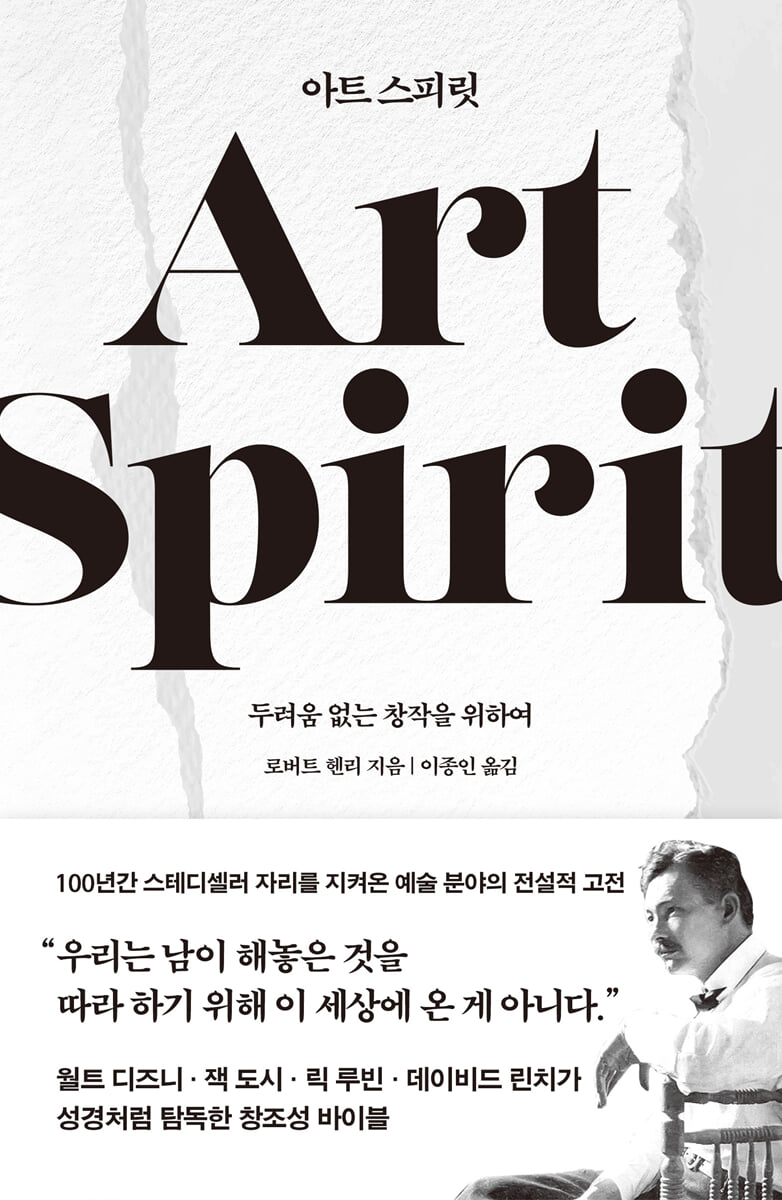
A legendary classic in the art world that has maintained its position as a steady seller for 100 years.
“For aspiring creators seeking advice on
“I always recommend this book instead of giving direct advice.”
─Walt Disney
“I read it every time I wanted to make a change or start something new.”
─Jack Dorsey (founder of Twitter)
“This book is my ‘art bible.’”
David Lynch (film director)
★The Life Books of Walt Disney, Jack Dorsey, David Lynch, Rick Rubin, and Keith Haring★
★Edward Hopper's legendary teacher★
Great creators read it like the Bible
A Bible of Creativity: Reviving 100 Years of Dry Inspiration
For over a century after its publication, there's one book that has remained a beloved favorite among creators, entrepreneurs, and countless others seeking to realize their true selves.
Artist Keith Haring, film director David Lynch, and Twitter founder Jack Dorsey all testified that the book changed their lives.
This book is a landmark that unique creators return to whenever they feel lost, seeking direction and renewed inspiration.
Robert Henri was a leading American painter of the early 20th century, but his greatest talent was discovering and inspiring the potential of others.
He was always surrounded by disciples who yearned for original expression.
In 1923, in his later years, unable to resist the repeated requests of his students to publish this book, he published it, discussing the creator's perspective and way of thinking, the source of creativity, and the direction in which art should proceed.
This book was not only extremely popular with art students of the time, but it has never gone out of print in the over 100 years since its publication, and has been translated into dozens of editions around the world without much promotion, taking on a life of its own.
This legendary classic will serve as a timeless and powerful inspiration to creators in this age of discovering and expressing their own uniqueness amidst the deluge of information and noise.
“For aspiring creators seeking advice on
“I always recommend this book instead of giving direct advice.”
─Walt Disney
“I read it every time I wanted to make a change or start something new.”
─Jack Dorsey (founder of Twitter)
“This book is my ‘art bible.’”
David Lynch (film director)
★The Life Books of Walt Disney, Jack Dorsey, David Lynch, Rick Rubin, and Keith Haring★
★Edward Hopper's legendary teacher★
Great creators read it like the Bible
A Bible of Creativity: Reviving 100 Years of Dry Inspiration
For over a century after its publication, there's one book that has remained a beloved favorite among creators, entrepreneurs, and countless others seeking to realize their true selves.
Artist Keith Haring, film director David Lynch, and Twitter founder Jack Dorsey all testified that the book changed their lives.
This book is a landmark that unique creators return to whenever they feel lost, seeking direction and renewed inspiration.
Robert Henri was a leading American painter of the early 20th century, but his greatest talent was discovering and inspiring the potential of others.
He was always surrounded by disciples who yearned for original expression.
In 1923, in his later years, unable to resist the repeated requests of his students to publish this book, he published it, discussing the creator's perspective and way of thinking, the source of creativity, and the direction in which art should proceed.
This book was not only extremely popular with art students of the time, but it has never gone out of print in the over 100 years since its publication, and has been translated into dozens of editions around the world without much promotion, taking on a life of its own.
This legendary classic will serve as a timeless and powerful inspiration to creators in this age of discovering and expressing their own uniqueness amidst the deluge of information and noise.
- You can preview some of the book's contents.
Preview
index
Introduction
human affairs
What did you come for?
When a masterpiece is born
Discovery is everywhere
record
Artistic solidarity
Encounter with Leonardo da Vinci
Starting point
Elements and Wholes
Capture the moment
Detecting signals
The essential and the incidental
Characters and Background
What remains when reason retreats
The night is not black
nudity
Art in the Age of Excess
How to use intelligence
prolongation
experiment
art connoisseur
Why does it appear like that?
pattern
tree
Originality
Letter to a Young Artist
Where you will be
What do you think
bad habits
If you want to know people
Can you go below the surface?
A life of talent
People who draw undercurrents
What you need for sketching
Letter of Criticism
About appreciation
About the evaluation
What Makes an Interesting Work
troublemaker
An Art Student's Exploration
Whole and Part
human eyes
human movement
What Rodin saw
Don't throw away your work
About the line
About color
Go beyond what you know
The artist's driving force
Two types of art students
How to use the school
The technique is second
Artist's Rest
Aging and Beauty
Should I follow trends?
Artist's Self-Development
Appreciation method
sense of things
Fill it with vitality
Can you cross the border?
patience
Letters on the Spirit of Art
unconscious
order
Simplicity of Creation
Where art exists
The birth of a technique
Inventor of individuality
What is engraved in the work
Beauty is not in the object
How to Support Artists
state of happiness
My people
movement
That's not a failure
Principles of composition
The Artist's Reading
Realism
What the work testifies to
Reality and Art
gesture
Artist's judgment
The Benefits of Creation
slow-seeing eyes
Learning how to appreciate
stroke
Reasons for creating works
stereotypes
Why Painting Regresses
A rare study
Beyond appreciation
Back to the original idea
See beyond things
The courage to be free
Change must have a reason.
Relationship with the public
The impulse to create
Time captured in a moment
A longing for beauty
Seeing things 'properly'
How to handle materials and tools
What kind of commentary should I listen to?
A true art student
Arts Patronage and Self-Judgment
The Art of Life and Discovery
Records of history
Don't expect results
Something anyone can do
If you choose to be alone
The reason for the existence of art schools
The Joy of Creation
Recognition comes a little late
Decisive factor
immersion
True expressiveness
Author's perspective
Meaningless training
Love for humanity and nature
Don't become an old person
About the line
geometry
How to handle the target
A Child's World
self-taught person
If there is pain
How to capture a landscape
The artist's mind
Look at these people
What their work says
Suggestion
eternity
Translator's Note
human affairs
What did you come for?
When a masterpiece is born
Discovery is everywhere
record
Artistic solidarity
Encounter with Leonardo da Vinci
Starting point
Elements and Wholes
Capture the moment
Detecting signals
The essential and the incidental
Characters and Background
What remains when reason retreats
The night is not black
nudity
Art in the Age of Excess
How to use intelligence
prolongation
experiment
art connoisseur
Why does it appear like that?
pattern
tree
Originality
Letter to a Young Artist
Where you will be
What do you think
bad habits
If you want to know people
Can you go below the surface?
A life of talent
People who draw undercurrents
What you need for sketching
Letter of Criticism
About appreciation
About the evaluation
What Makes an Interesting Work
troublemaker
An Art Student's Exploration
Whole and Part
human eyes
human movement
What Rodin saw
Don't throw away your work
About the line
About color
Go beyond what you know
The artist's driving force
Two types of art students
How to use the school
The technique is second
Artist's Rest
Aging and Beauty
Should I follow trends?
Artist's Self-Development
Appreciation method
sense of things
Fill it with vitality
Can you cross the border?
patience
Letters on the Spirit of Art
unconscious
order
Simplicity of Creation
Where art exists
The birth of a technique
Inventor of individuality
What is engraved in the work
Beauty is not in the object
How to Support Artists
state of happiness
My people
movement
That's not a failure
Principles of composition
The Artist's Reading
Realism
What the work testifies to
Reality and Art
gesture
Artist's judgment
The Benefits of Creation
slow-seeing eyes
Learning how to appreciate
stroke
Reasons for creating works
stereotypes
Why Painting Regresses
A rare study
Beyond appreciation
Back to the original idea
See beyond things
The courage to be free
Change must have a reason.
Relationship with the public
The impulse to create
Time captured in a moment
A longing for beauty
Seeing things 'properly'
How to handle materials and tools
What kind of commentary should I listen to?
A true art student
Arts Patronage and Self-Judgment
The Art of Life and Discovery
Records of history
Don't expect results
Something anyone can do
If you choose to be alone
The reason for the existence of art schools
The Joy of Creation
Recognition comes a little late
Decisive factor
immersion
True expressiveness
Author's perspective
Meaningless training
Love for humanity and nature
Don't become an old person
About the line
geometry
How to handle the target
A Child's World
self-taught person
If there is pain
How to capture a landscape
The artist's mind
Look at these people
What their work says
Suggestion
eternity
Translator's Note
Detailed image

Into the book
Artworks that deeply inspire us never come from the hands of those who are hesitant or hesitant.
The work of art is a work of art that is full of great joy and reveals a very positive nature.
Only in such moments of joy are masterpieces born.
--- p.19, from “When a Masterpiece is Born”
Let's start with the best, most interesting, and most profound impression we received from the subject.
Throughout your work, you must maintain a plan to express that impression in your work.
Anything else can be completely ignored.
We must not allow anything to deviate from that plan.
If you only find traces of such impressions in the subject and select them as elements of the work, you can create an organic work.
All elements contained in the work are structural, structuring ideas and expressing emotions.
When these elements are placed in their proper place in the composition of the whole and act as living parts, they will acquire beauty as living lines, living forms, and living colors.
--- p.31, from “Starting Point”
The sketch of this piece is very beautiful.
Even the colors are excellent, fully revealing the talent.
So, why not explore and research this subject further, developing it into a complete work? Perhaps a large-scale work measuring, say, 66 centimeters wide and 81 centimeters tall.
Instead of rushing into a topic or rushing into something, try to create something that will completely satisfy you.
Finish the painting not in a conventional way, but in a way that pleases you.
If you fight like this, even if you don't finish the painting the way you want, you will find yourself growing greatly in the end.
If you focus and work hard to achieve what you love, you will not fail.
--- p.112-113, from "Letter of Criticism"
What we received from Whitman was a gift, but for a long time we accepted it with little reluctance.
It was the same with Ibsen.
They created good works but were ridiculed first.
Inventor Stevenson was ridiculed, and the Wright brothers were initially laughed at.
An artist must give his talent like a bird singing.
Artists teach the world the concept of life.
Any artist who thinks money is his goal is deluding himself.
The artist tells the world that the purpose of life should be to have fun like a child.
The only difference is that it is a mature play that allows one to fully exercise their intellectual abilities.
So we have art and invention at the same time.
--- p.143, from “The Artist’s Driving Force”
Artists must realize that they are not competitors.
We must teach young artists how to overcome financial difficulties and support their talents to blossom.
But we shouldn't ask them to do things in a way that pleases us.
Let's buy the work of young artists we personally like and encourage others to buy their work as well, according to their own choice.
Even this kind of behavior already involves considerable judgment.
If we buy the paintings of young artists and participate in their world of art, our judgment may broaden accordingly.
So I try to buy not only old paintings, but also adventurous paintings from today.
--- p.191, from “How to Support Artists”
We must put aside these self-limiting influences and resist the trends of our time, becoming who we truly are.
The only people who are interesting to others as well as to themselves are those who are willing to face themselves head on.
The work of a master is a testament to the person who dared to act as himself, and so it proves their existence.
Most of them paid a high price, but it was worth it.
The master was interesting to himself first, and thus became interesting to us.
--- p.222, from “What the Work Testifies”
Ultimately, the goal is not to leave behind a work of art, but to live a fulfilling life.
Those who live their lives faithfully leave behind true art.
Art is a result.
Artworks are traces of people who lived their lives faithfully.
Art is interesting because you can read about their struggles and the successes they achieved along the way.
The most important question is this:
“What is worthwhile?” Those who do not ask themselves this serious question will never receive a serious answer.
The work of art is a work of art that is full of great joy and reveals a very positive nature.
Only in such moments of joy are masterpieces born.
--- p.19, from “When a Masterpiece is Born”
Let's start with the best, most interesting, and most profound impression we received from the subject.
Throughout your work, you must maintain a plan to express that impression in your work.
Anything else can be completely ignored.
We must not allow anything to deviate from that plan.
If you only find traces of such impressions in the subject and select them as elements of the work, you can create an organic work.
All elements contained in the work are structural, structuring ideas and expressing emotions.
When these elements are placed in their proper place in the composition of the whole and act as living parts, they will acquire beauty as living lines, living forms, and living colors.
--- p.31, from “Starting Point”
The sketch of this piece is very beautiful.
Even the colors are excellent, fully revealing the talent.
So, why not explore and research this subject further, developing it into a complete work? Perhaps a large-scale work measuring, say, 66 centimeters wide and 81 centimeters tall.
Instead of rushing into a topic or rushing into something, try to create something that will completely satisfy you.
Finish the painting not in a conventional way, but in a way that pleases you.
If you fight like this, even if you don't finish the painting the way you want, you will find yourself growing greatly in the end.
If you focus and work hard to achieve what you love, you will not fail.
--- p.112-113, from "Letter of Criticism"
What we received from Whitman was a gift, but for a long time we accepted it with little reluctance.
It was the same with Ibsen.
They created good works but were ridiculed first.
Inventor Stevenson was ridiculed, and the Wright brothers were initially laughed at.
An artist must give his talent like a bird singing.
Artists teach the world the concept of life.
Any artist who thinks money is his goal is deluding himself.
The artist tells the world that the purpose of life should be to have fun like a child.
The only difference is that it is a mature play that allows one to fully exercise their intellectual abilities.
So we have art and invention at the same time.
--- p.143, from “The Artist’s Driving Force”
Artists must realize that they are not competitors.
We must teach young artists how to overcome financial difficulties and support their talents to blossom.
But we shouldn't ask them to do things in a way that pleases us.
Let's buy the work of young artists we personally like and encourage others to buy their work as well, according to their own choice.
Even this kind of behavior already involves considerable judgment.
If we buy the paintings of young artists and participate in their world of art, our judgment may broaden accordingly.
So I try to buy not only old paintings, but also adventurous paintings from today.
--- p.191, from “How to Support Artists”
We must put aside these self-limiting influences and resist the trends of our time, becoming who we truly are.
The only people who are interesting to others as well as to themselves are those who are willing to face themselves head on.
The work of a master is a testament to the person who dared to act as himself, and so it proves their existence.
Most of them paid a high price, but it was worth it.
The master was interesting to himself first, and thus became interesting to us.
--- p.222, from “What the Work Testifies”
Ultimately, the goal is not to leave behind a work of art, but to live a fulfilling life.
Those who live their lives faithfully leave behind true art.
Art is a result.
Artworks are traces of people who lived their lives faithfully.
Art is interesting because you can read about their struggles and the successes they achieved along the way.
The most important question is this:
“What is worthwhile?” Those who do not ask themselves this serious question will never receive a serious answer.
--- p.247, from “The Courage to Be Free”
Publisher's Review
“We did not come into this world to follow others.
When you feel strong emotions and are lost in deep thoughts
“Everyone gets to create their own art.”
Robert Henry was a man of prophetic vision.
Having studied abroad in Paris, France in his youth and witnessed the Impressionist scene, he returned to the United States in 1891 and opposed conservative academism represented by the National Academy of Design.
He advocated the concept of art as 'self-expression' against the American art world, which had until then been centered on skill and tradition.
What he consistently emphasized to his colleagues and disciples was originality and truthfulness.
He led American realism by urging the creation of a new art that appealed directly to the times and experience.
Art students who wanted to create unique works rather than follow familiar conventions could not help but be drawn to his dedication and passion.
According to Henry, people can be divided into two categories.
There are people who are students and people who are not.
The students Henry speaks of are those who strive to fully express their spirit.
They listen to their inner voice, take action, and connect with people like themselves.
Also, find the right tools to express yourself.
The writings included in this book embody the teacher's conviction to lead all his disciples along this 'path of the student.'
“You have to figure out what you really like and what’s important to you.
Then, when you have something to sing, if you sing your own song, your whole heart will be put into it.” (p. 160)
Edward Hopper and other disciples who believed in and followed Henry's teachings wholeheartedly eventually achieved their own things by taking a path not taken by others.
Likewise, if you're a creator searching for your own unique edge right now, this century-old book will provide you with profound inspiration on how creative acts occur in all fields, beyond art, and how we can become inspired creators.
Through this book, Henry seeks to convey to us the true artistic experience of breaking free from the passivity we have been carrying around without even realizing it and boldly expressing ourselves by following our own intuition.
“To fully utilize and enjoy your talents,
“That is the fullness of life, that is art.”
Even for those who enjoy reading literature and listening to music, ‘art’ often feels distant.
But when you meet Robert Henri, art is no longer something that happens at exhibitions or concert halls, or a craft enjoyed only by a select few.
Robert Henri speaks to the essence of art in this book.
According to his definition, art is an attempt to express sensibilities that cannot be expressed in language.
Art is not something that exists separately from life, but something that completes life when one is deeply faithful to one's own life.
Artworks are the traces left on the world by those who lived their lives faithfully.
In this way, Henry focused on the creative and beautiful aspects of life and truly believed that they were possible in every life.
Borrowing his perspective that life and art are not separate, everyone who cultivates their own 'work' becomes an artist.
We live connected to the world by creating something in some way.
Henry says that anyone who feels a sense of purpose and pride in life in moments like those is already living as an artist.
“I reject the belief that art is limited to painters, sculptors, musicians, and poets.” (p. 40) Robert Henri’s voice, which makes us feel that there is nothing meaningless in life’s choices, elevates the mind that thought that the repetitive daily life was ordinary and boring, and makes us think about how to discover and express the possibilities within ourselves.
So, reading this book goes beyond the question of defining great art to exploring the good life.
Henry reminds us concretely of the joy and meaning we can gain by becoming more deeply connected to our work and daily lives.
“You are a natural born master.
Inspiration is already within you.
Now it's time for it to burst out into the world."
Robert Henri had one more thing besides a pure and unwavering belief in art.
It is the outstanding linguistic ability to express that very belief.
This book has a unique structure, freely compiling lecture notes, letters with students, and articles written over 23 years without any chapter or section distinction, and fully captures Henry's characteristically passionate tone and expression.
As you read this book, you will understand why so many people followed him so fervently and how he was able to leave such an overwhelming influence on the American art world.
But he never preaches in a definitive tone or tries to teach hastily.
Like any great teacher, he encourages people to imagine and desire change rather than simply showing them the way to change.
This is also why he is consistently skeptical of government-sponsored academies and typical art education.
He says that truly important education is 'self-education', which is teaching oneself, and helps creators flexibly accept and actively digest school education, art commentary, and evaluations from others.
Perhaps this educational philosophy and method, which allows readers to maintain their own focus and perspective, are the reasons why this book has remained vibrant for over a century.
Today, planners and creators are constantly being asked to think independently and create something new.
But in an age where everything is available, it has become more difficult to discover uniqueness due to exposure to too much media and noise.
Robert Henri also said that the era he lived in was an 'age of excess' in which too many decorations and objects were produced, and he emphasized that in such an age, artists should not simply copy things, but should become true pioneers.
Even when he talks about mixing paints or composing a canvas, he constantly presents clues that overturn existing notions that hinder free thinking and liberate independent sensibilities.
It's rare to find a book that so clearly illuminates what it means to live as an artist and what we must pursue to discover the artistic being hidden deep within.
“I’m not really interested in teaching you what I know.
Rather, I want to encourage you to tell me what you know.” (p. 18) This book will be a powerful spark to help you share your stories with the world and begin creating freely and fearlessly.
When you feel strong emotions and are lost in deep thoughts
“Everyone gets to create their own art.”
Robert Henry was a man of prophetic vision.
Having studied abroad in Paris, France in his youth and witnessed the Impressionist scene, he returned to the United States in 1891 and opposed conservative academism represented by the National Academy of Design.
He advocated the concept of art as 'self-expression' against the American art world, which had until then been centered on skill and tradition.
What he consistently emphasized to his colleagues and disciples was originality and truthfulness.
He led American realism by urging the creation of a new art that appealed directly to the times and experience.
Art students who wanted to create unique works rather than follow familiar conventions could not help but be drawn to his dedication and passion.
According to Henry, people can be divided into two categories.
There are people who are students and people who are not.
The students Henry speaks of are those who strive to fully express their spirit.
They listen to their inner voice, take action, and connect with people like themselves.
Also, find the right tools to express yourself.
The writings included in this book embody the teacher's conviction to lead all his disciples along this 'path of the student.'
“You have to figure out what you really like and what’s important to you.
Then, when you have something to sing, if you sing your own song, your whole heart will be put into it.” (p. 160)
Edward Hopper and other disciples who believed in and followed Henry's teachings wholeheartedly eventually achieved their own things by taking a path not taken by others.
Likewise, if you're a creator searching for your own unique edge right now, this century-old book will provide you with profound inspiration on how creative acts occur in all fields, beyond art, and how we can become inspired creators.
Through this book, Henry seeks to convey to us the true artistic experience of breaking free from the passivity we have been carrying around without even realizing it and boldly expressing ourselves by following our own intuition.
“To fully utilize and enjoy your talents,
“That is the fullness of life, that is art.”
Even for those who enjoy reading literature and listening to music, ‘art’ often feels distant.
But when you meet Robert Henri, art is no longer something that happens at exhibitions or concert halls, or a craft enjoyed only by a select few.
Robert Henri speaks to the essence of art in this book.
According to his definition, art is an attempt to express sensibilities that cannot be expressed in language.
Art is not something that exists separately from life, but something that completes life when one is deeply faithful to one's own life.
Artworks are the traces left on the world by those who lived their lives faithfully.
In this way, Henry focused on the creative and beautiful aspects of life and truly believed that they were possible in every life.
Borrowing his perspective that life and art are not separate, everyone who cultivates their own 'work' becomes an artist.
We live connected to the world by creating something in some way.
Henry says that anyone who feels a sense of purpose and pride in life in moments like those is already living as an artist.
“I reject the belief that art is limited to painters, sculptors, musicians, and poets.” (p. 40) Robert Henri’s voice, which makes us feel that there is nothing meaningless in life’s choices, elevates the mind that thought that the repetitive daily life was ordinary and boring, and makes us think about how to discover and express the possibilities within ourselves.
So, reading this book goes beyond the question of defining great art to exploring the good life.
Henry reminds us concretely of the joy and meaning we can gain by becoming more deeply connected to our work and daily lives.
“You are a natural born master.
Inspiration is already within you.
Now it's time for it to burst out into the world."
Robert Henri had one more thing besides a pure and unwavering belief in art.
It is the outstanding linguistic ability to express that very belief.
This book has a unique structure, freely compiling lecture notes, letters with students, and articles written over 23 years without any chapter or section distinction, and fully captures Henry's characteristically passionate tone and expression.
As you read this book, you will understand why so many people followed him so fervently and how he was able to leave such an overwhelming influence on the American art world.
But he never preaches in a definitive tone or tries to teach hastily.
Like any great teacher, he encourages people to imagine and desire change rather than simply showing them the way to change.
This is also why he is consistently skeptical of government-sponsored academies and typical art education.
He says that truly important education is 'self-education', which is teaching oneself, and helps creators flexibly accept and actively digest school education, art commentary, and evaluations from others.
Perhaps this educational philosophy and method, which allows readers to maintain their own focus and perspective, are the reasons why this book has remained vibrant for over a century.
Today, planners and creators are constantly being asked to think independently and create something new.
But in an age where everything is available, it has become more difficult to discover uniqueness due to exposure to too much media and noise.
Robert Henri also said that the era he lived in was an 'age of excess' in which too many decorations and objects were produced, and he emphasized that in such an age, artists should not simply copy things, but should become true pioneers.
Even when he talks about mixing paints or composing a canvas, he constantly presents clues that overturn existing notions that hinder free thinking and liberate independent sensibilities.
It's rare to find a book that so clearly illuminates what it means to live as an artist and what we must pursue to discover the artistic being hidden deep within.
“I’m not really interested in teaching you what I know.
Rather, I want to encourage you to tell me what you know.” (p. 18) This book will be a powerful spark to help you share your stories with the world and begin creating freely and fearlessly.
GOODS SPECIFICS
- Date of issue: November 26, 2025
- Page count, weight, size: 356 pages | 546g | 135*210*21mm
- ISBN13: 9791130673301
- ISBN10: 1130673308
You may also like
카테고리
korean


korean

![GQ KOREA Mark (Monthly): December [2025]](http://librairie.coreenne.fr/cdn/shop/files/8ef265dbbfbf186523ed75ba7319009d.jpg?v=1765340328&width=3840)


