

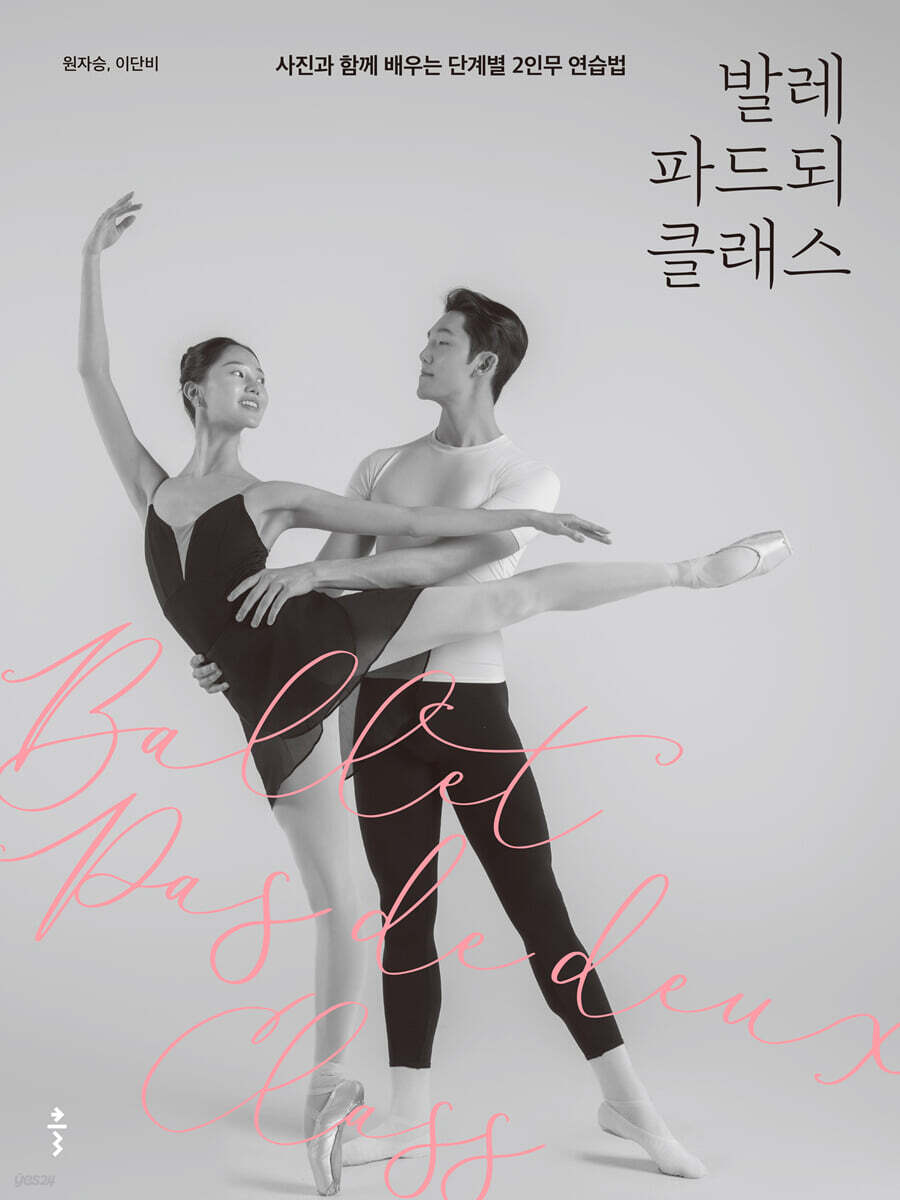
Ballet pas de deux class
 |
Description
Book Introduction
From hobby ballet students to majors
If you follow along, the movements will become perfect.
The first ballet pas de deux workbook published in Korea!
Although the number of people taking up ballet as a hobby is increasing and dancers who are active on the world stage are also being produced, it is difficult to find a book in Korea that systematically organizes ballet practice methods.
《Ballet Pas de Deux Class》 is Korea's first pas de deux workbook that will quench this thirst.
《Ballet Pas de Deux Class》 is a book that comprehensively covers the practice of pas de deux movements.
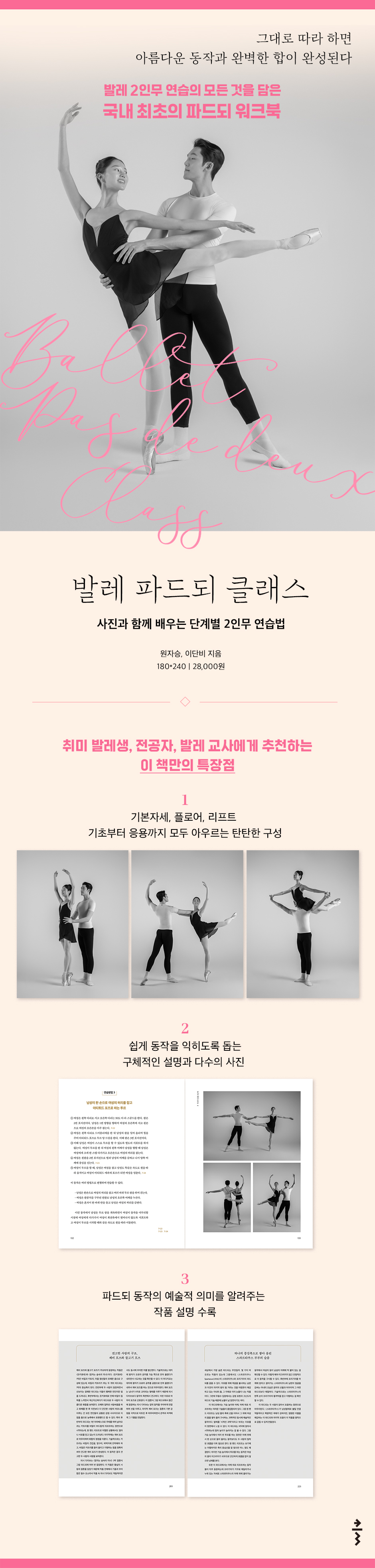
It is organized by difficulty level from basics to lifts, and includes numerous photos along with specific movement sequences to help those practicing paddocks easily learn the movements.
In particular, this book will serve as a helpful guide for amateur ballet students taking pas de deux classes and for major students who want to practice with a partner even when there is no instructor. It will also serve as a rich reference for teachers who teach pas de deux classes.
If you follow along, the movements will become perfect.
The first ballet pas de deux workbook published in Korea!
Although the number of people taking up ballet as a hobby is increasing and dancers who are active on the world stage are also being produced, it is difficult to find a book in Korea that systematically organizes ballet practice methods.
《Ballet Pas de Deux Class》 is Korea's first pas de deux workbook that will quench this thirst.
《Ballet Pas de Deux Class》 is a book that comprehensively covers the practice of pas de deux movements.
It is organized by difficulty level from basics to lifts, and includes numerous photos along with specific movement sequences to help those practicing paddocks easily learn the movements.
In particular, this book will serve as a helpful guide for amateur ballet students taking pas de deux classes and for major students who want to practice with a partner even when there is no instructor. It will also serve as a rich reference for teachers who teach pas de deux classes.
- You can preview some of the book's contents.
Preview
index
Prologue - Before we begin practicing Paddock 5
7 Ballet Terms from This Book
Preparation - Positions and Directions for Paddock 12
Part 1: The First Step of Paddoe, Basic Movements, Connecting Movements, Basic Support Movements 22
Chapter 1: The Basics of Paddock 24
Chapter 2 Connection Action 30
Lelevé - Shifting the Center of Gravity 32
Pas de boure, pas cru, pas chasse, flick flac - connecting the main movements 34
Pa Balanche, Pa Glissade - Approaching Partner 36
Debloppé, Passé, Grand Long de Jambo, Panchet - 38 movements that create a line by gradually moving the legs
Pose - The Power to Complete Action and Scenes 44
Chapter 3: The Basics of Support 48
Support 49 with both hands
One-handed support 52
Paddock, Floor 56, which takes place on the second floor
Chapter 4: The Basics of Tour 58
Step 1 - Tour 60, rotating along the waistline
Step 2 - Hand-holding Tour 65
Stage 3 - Tour 69, focused on speed and connection
Tour 74 with 5 large poses
75 Basics of Tour with Big Pose Movements
Chapter 6 Tour Lang 78
Step 1 - Basic Tour Lang 80
Step 2 - Tour Lang 81 with both hands
Step 3 - Tour Lang 88 with one hand or with each other's shoulders
Chapter 7: Application of Tours, Step 3, 98
Step 1 - Tour 99 in Basic Pose
Stage 2 - Tour 115 starting from A La Sgonde, Croisette, Attitude, Arabesque
Step 3 - Various tours starting with hands or waist holding 128
Description of the Work 1 - Balance and Interval of Pas de Deux in Classical Ballet Works 135
Chapter 8: Three-Step Movement Method for the Axis-Inclined Pose 136
Step 1 - Basic movement of tilting the axis 138
Step 2 - Tilting the axis supported by both hands 142
Step 3 - Tilting the axis supported by one hand 154
Description of the work 2 - The tilted posture of the axis as seen through the neoclassical ballet "Apollo" 162
Part 3: Flowers Blooming in the Sky, Lift 164
Chapter 9: Lift Basics 166
Chapter 10 Low-Height Lifts 170
Small Jumps - Lifting the chest and shoulders of a man 171
Lift 172, where a man holds a woman's waist with both hands
Application of Two-Hand Lift 178
Lift 186 with one hand
190 different lifts for the waist and thighs
Description of the work 3 - The solid structure of love, swallow pose and fish pose 203
Chapter 11: Chest-Height Lifts 204
Basic movement when lifting at chest height 205
Lift 206 at chest height
Lift 210 fixed on chest and shoulders
Description of the work 4 - The sorrow of the Spartacus couple, built around a single central axis 223
Chapter 12 Shoulder-Height Lifts 224
Lift 225 with shoulder jumps
241 Various lifts that lead to fish pose or swallow pose on the shoulder
Lift 246 for the big jump
Description of the Work 5 - Romantic Ballet Pas de Deux 250, Perfecting Dreamy Beauty
Chapter 13: Lifting Overhead 256
Lift 258 with a pose held on both arms
Lift 268 with a fixed pose on one arm
275 Pose Changes in the Air
Description of the Work 6 - The Lift Scene 281: The Ultimate Expression of Love's Welcome and Soaring Emotions
Reference 282
Epilogue Pas de Deux: The Magic of the Stage Created by the Perfect Synchronization of Two Dancers - Won Ja-seung 284
Dreaming of "Good Dance," a Pod of Writing and Dance - Lee Dan-bi 286
7 Ballet Terms from This Book
Preparation - Positions and Directions for Paddock 12
Part 1: The First Step of Paddoe, Basic Movements, Connecting Movements, Basic Support Movements 22
Chapter 1: The Basics of Paddock 24
Chapter 2 Connection Action 30
Lelevé - Shifting the Center of Gravity 32
Pas de boure, pas cru, pas chasse, flick flac - connecting the main movements 34
Pa Balanche, Pa Glissade - Approaching Partner 36
Debloppé, Passé, Grand Long de Jambo, Panchet - 38 movements that create a line by gradually moving the legs
Pose - The Power to Complete Action and Scenes 44
Chapter 3: The Basics of Support 48
Support 49 with both hands
One-handed support 52
Paddock, Floor 56, which takes place on the second floor
Chapter 4: The Basics of Tour 58
Step 1 - Tour 60, rotating along the waistline
Step 2 - Hand-holding Tour 65
Stage 3 - Tour 69, focused on speed and connection
Tour 74 with 5 large poses
75 Basics of Tour with Big Pose Movements
Chapter 6 Tour Lang 78
Step 1 - Basic Tour Lang 80
Step 2 - Tour Lang 81 with both hands
Step 3 - Tour Lang 88 with one hand or with each other's shoulders
Chapter 7: Application of Tours, Step 3, 98
Step 1 - Tour 99 in Basic Pose
Stage 2 - Tour 115 starting from A La Sgonde, Croisette, Attitude, Arabesque
Step 3 - Various tours starting with hands or waist holding 128
Description of the Work 1 - Balance and Interval of Pas de Deux in Classical Ballet Works 135
Chapter 8: Three-Step Movement Method for the Axis-Inclined Pose 136
Step 1 - Basic movement of tilting the axis 138
Step 2 - Tilting the axis supported by both hands 142
Step 3 - Tilting the axis supported by one hand 154
Description of the work 2 - The tilted posture of the axis as seen through the neoclassical ballet "Apollo" 162
Part 3: Flowers Blooming in the Sky, Lift 164
Chapter 9: Lift Basics 166
Chapter 10 Low-Height Lifts 170
Small Jumps - Lifting the chest and shoulders of a man 171
Lift 172, where a man holds a woman's waist with both hands
Application of Two-Hand Lift 178
Lift 186 with one hand
190 different lifts for the waist and thighs
Description of the work 3 - The solid structure of love, swallow pose and fish pose 203
Chapter 11: Chest-Height Lifts 204
Basic movement when lifting at chest height 205
Lift 206 at chest height
Lift 210 fixed on chest and shoulders
Description of the work 4 - The sorrow of the Spartacus couple, built around a single central axis 223
Chapter 12 Shoulder-Height Lifts 224
Lift 225 with shoulder jumps
241 Various lifts that lead to fish pose or swallow pose on the shoulder
Lift 246 for the big jump
Description of the Work 5 - Romantic Ballet Pas de Deux 250, Perfecting Dreamy Beauty
Chapter 13: Lifting Overhead 256
Lift 258 with a pose held on both arms
Lift 268 with a fixed pose on one arm
275 Pose Changes in the Air
Description of the Work 6 - The Lift Scene 281: The Ultimate Expression of Love's Welcome and Soaring Emotions
Reference 282
Epilogue Pas de Deux: The Magic of the Stage Created by the Perfect Synchronization of Two Dancers - Won Ja-seung 284
Dreaming of "Good Dance," a Pod of Writing and Dance - Lee Dan-bi 286
Detailed image
Into the book
*
In order to dance the paddock, you must first be able to maintain your center of gravity and balance well and perform the solo dance sufficiently.
Because you need to be able to control your body and dance, you can dance in sync with your partner's center, distance, and breathing.
Therefore, this book is recommended to ballet majors and non-majors who have been consistently practicing ballet.
This book is organized by difficulty level, so it is better to learn it correctly from the first level, floor, rather than rushing to practice the later parts.
--- From "Before Entering Prologue Paddock Practice"
*
The more the woman's body rises from the ground and reaches towards the sky, and the more the distance between the man and the woman increases at the point where their bodies touch, the more difficult the paddock becomes.
If you learn the basics of support well from the practice room floor, you can easily learn the more difficult paddocks later and reduce the risk of injury.
And each technique and movement should be practiced so that it flows like water, not as a fragmented, isolated sequence.
--- From "Chapter 1: The Basics of Paddoe"
*
The basic posture of paddoe is for the man to stand behind the woman and support her waist with both hands.
At this time, the man holds the woman along her waistline, placing his thumb on the erector spinae muscle (erector spinae) that runs across the middle of the back and his palm on the waist.
--- From "Chapter 1: The Basics of Paddoe"
*
When a woman starts the tour in the 5th position wearing pointe shoes, she does so in the same way as when doing the battman suitnu, but this time the man uses both hands.
Hold the woman's waist and stand behind her.
--- From "Chapter 4: The Basics of Tours"
*
When performing the basic tour lang, the man holds the woman's waist with both hands and turns in a circle, the center of which is the tip of the woman's standing leg.
When turning a woman to the right, the man takes the first step with his left leg and places his right leg toward the woman's left heel.
When turning to the left, do the opposite.
--- From "Chapter 6 Tour Lang"
*
In paddocks, there are often jumping movements where a man lifts a female dancer's hand or wrist with one hand.
The lift where partners hold each other's hands with only one hand is a bit more difficult than the previously practiced two-handed lift or the man lifting the woman with both hands.
As the distance between partners increases, you must control the axis of your body so that it does not become disoriented when shifting the axis, and after shifting the axis, you must concentrate on not losing balance with your partner.
In order to dance the paddock, you must first be able to maintain your center of gravity and balance well and perform the solo dance sufficiently.
Because you need to be able to control your body and dance, you can dance in sync with your partner's center, distance, and breathing.
Therefore, this book is recommended to ballet majors and non-majors who have been consistently practicing ballet.
This book is organized by difficulty level, so it is better to learn it correctly from the first level, floor, rather than rushing to practice the later parts.
--- From "Before Entering Prologue Paddock Practice"
*
The more the woman's body rises from the ground and reaches towards the sky, and the more the distance between the man and the woman increases at the point where their bodies touch, the more difficult the paddock becomes.
If you learn the basics of support well from the practice room floor, you can easily learn the more difficult paddocks later and reduce the risk of injury.
And each technique and movement should be practiced so that it flows like water, not as a fragmented, isolated sequence.
--- From "Chapter 1: The Basics of Paddoe"
*
The basic posture of paddoe is for the man to stand behind the woman and support her waist with both hands.
At this time, the man holds the woman along her waistline, placing his thumb on the erector spinae muscle (erector spinae) that runs across the middle of the back and his palm on the waist.
--- From "Chapter 1: The Basics of Paddoe"
*
When a woman starts the tour in the 5th position wearing pointe shoes, she does so in the same way as when doing the battman suitnu, but this time the man uses both hands.
Hold the woman's waist and stand behind her.
--- From "Chapter 4: The Basics of Tours"
*
When performing the basic tour lang, the man holds the woman's waist with both hands and turns in a circle, the center of which is the tip of the woman's standing leg.
When turning a woman to the right, the man takes the first step with his left leg and places his right leg toward the woman's left heel.
When turning to the left, do the opposite.
--- From "Chapter 6 Tour Lang"
*
In paddocks, there are often jumping movements where a man lifts a female dancer's hand or wrist with one hand.
The lift where partners hold each other's hands with only one hand is a bit more difficult than the previously practiced two-handed lift or the man lifting the woman with both hands.
As the distance between partners increases, you must control the axis of your body so that it does not become disoriented when shifting the axis, and after shifting the axis, you must concentrate on not losing balance with your partner.
--- From "10 Low-Height Lifts"
Publisher's Review
From basics to lifts,
A skill that builds up step by step
When we think of a paddock, we usually expect the man to perform a lifting motion, lifting the woman over his head.
However, when you first start doing paddocks, it is very likely that you will get injured if you lift the bar overhead all at once, so it is important to build a solid foundation.
So, the "Ballet Pas de Deux Class" is composed of three parts: starting with the basic movements, connecting movements, and supporting methods (Part 1), then various pas de deux movements performed on the floor, such as tours, tour langs, and axis tilting movements (Part 2), and then lifts from low heights to overhead (Part 3).
This structure is a system that gradually increases in difficulty and helps you learn step by step from the basics to the application.
By following the book's order, readers can master both the fundamentals and applications of paddocks without overdoing it or injuring themselves.
With detailed movement sequences and abundant photos
Learn more easily and completely
Each chapter of this book contains numerous detailed exercises.
In each practice method, the reader is provided with specific sequences for each movement, breathing, hands and feet, gaze, muscles, and other points to pay attention to, so that the reader can immediately understand how to complete the movement.
Additionally, many completed action photos are attached, so you can intuitively grasp parts that are difficult to understand through text alone.
Readers can check the flow of movements and finishing poses through detailed explanations and photos, and create more perfect movements by checking even the smallest details such as fingertips, toes, and gaze.
Includes descriptions of the scenes in the work
The only paddock workbook that teaches not only the movements but also the artistic meaning.
This book goes beyond a simple movement workbook and includes a separate section explaining how the pad de deux movements are used in actual ballet works.
It introduces pas de deux scenes from representative ballet works such as “Don Quixote,” “The Sleeping Beauty,” and “The Nutcracker,” and points out what kind of emotions the dancer conveys to the audience when performing the movements.
This allows readers to deeply understand not only how to perform the movements, but also their artistic meaning.
A skill that builds up step by step
When we think of a paddock, we usually expect the man to perform a lifting motion, lifting the woman over his head.
However, when you first start doing paddocks, it is very likely that you will get injured if you lift the bar overhead all at once, so it is important to build a solid foundation.
So, the "Ballet Pas de Deux Class" is composed of three parts: starting with the basic movements, connecting movements, and supporting methods (Part 1), then various pas de deux movements performed on the floor, such as tours, tour langs, and axis tilting movements (Part 2), and then lifts from low heights to overhead (Part 3).
This structure is a system that gradually increases in difficulty and helps you learn step by step from the basics to the application.
By following the book's order, readers can master both the fundamentals and applications of paddocks without overdoing it or injuring themselves.
With detailed movement sequences and abundant photos
Learn more easily and completely
Each chapter of this book contains numerous detailed exercises.
In each practice method, the reader is provided with specific sequences for each movement, breathing, hands and feet, gaze, muscles, and other points to pay attention to, so that the reader can immediately understand how to complete the movement.
Additionally, many completed action photos are attached, so you can intuitively grasp parts that are difficult to understand through text alone.
Readers can check the flow of movements and finishing poses through detailed explanations and photos, and create more perfect movements by checking even the smallest details such as fingertips, toes, and gaze.
Includes descriptions of the scenes in the work
The only paddock workbook that teaches not only the movements but also the artistic meaning.
This book goes beyond a simple movement workbook and includes a separate section explaining how the pad de deux movements are used in actual ballet works.
It introduces pas de deux scenes from representative ballet works such as “Don Quixote,” “The Sleeping Beauty,” and “The Nutcracker,” and points out what kind of emotions the dancer conveys to the audience when performing the movements.
This allows readers to deeply understand not only how to perform the movements, but also their artistic meaning.
GOODS SPECIFICS
- Date of issue: October 15, 2025
- Page count, weight, size: 288 pages | 806g | 180*240*19mm
- ISBN13: 9791194374473
- ISBN10: 1194374476
You may also like
카테고리
korean


korean

![GQ KOREA Mark (Monthly): December [2025]](http://librairie.coreenne.fr/cdn/shop/files/8ef265dbbfbf186523ed75ba7319009d.jpg?v=1765340328&width=3840)


