

Textbook of Film Editing
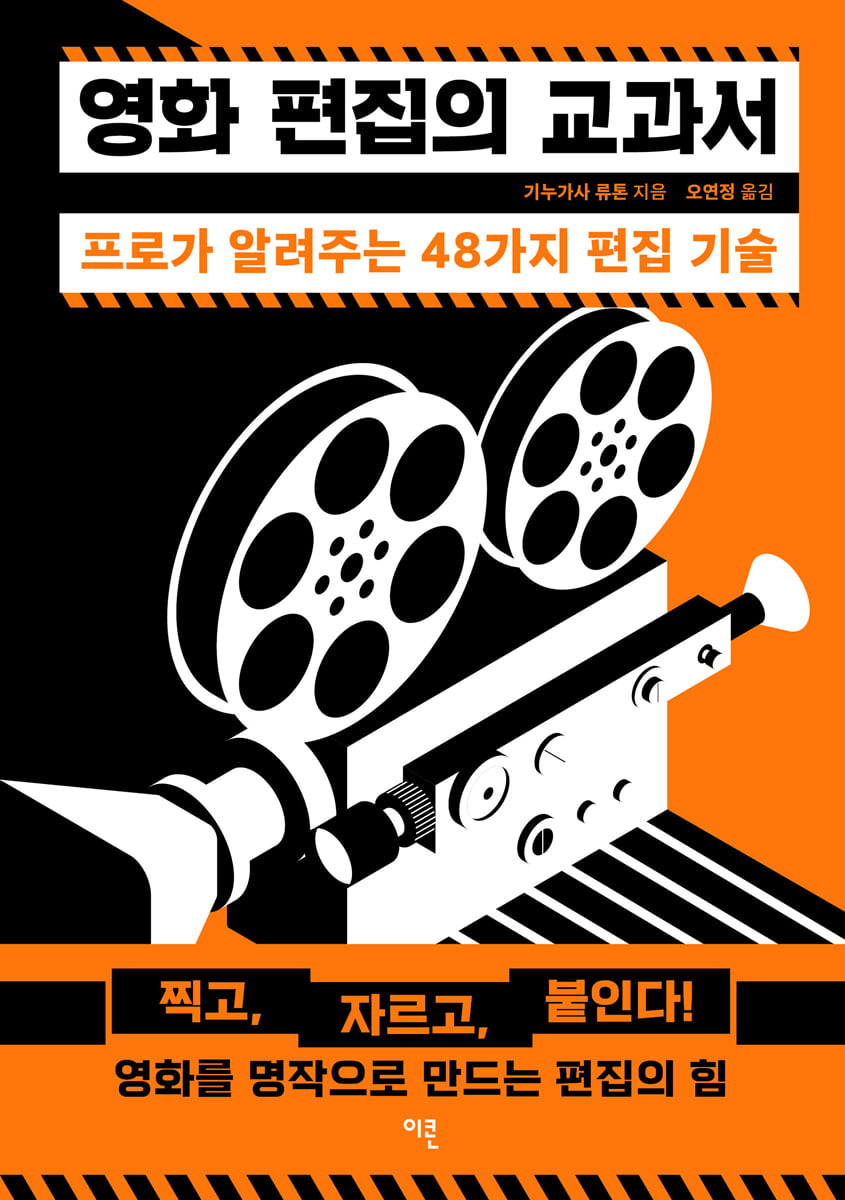 |
Description
Book Introduction
**Recommended by film director Jeong Yun-cheol!**
This book is excellent not only for its editing techniques, but also for its thorough compilation of the video grammar that editors must know.
- Jeong Yun-cheol (director of the film [Marathon])
The secret to striking visuals lies in editing.
The first step to video editing that even beginners can easily learn.
Today, we live in an age overflowing with video content.
YouTube remains the world's largest content platform, and Instagram is shifting away from its square grid and toward its video-centric Reels feature.
With countless videos being released every day, to stand out, you need to create not just a simple video, but a 'strong video'.
However, if you are new to video content creation, you may not have a sense of what makes a video memorable.
The answer lies in ‘editing’.
Editing is the key to determining the perfection of a video.
All great videos are made with editing, a skill anyone can learn.
You can transform dull videos into something sensational with simple editing techniques, and you don't need any special equipment or qualifications.
What matters is the passion and consistent effort to learn the skill.
This book introduces 48 editing techniques that are at the core of video content.
It contains only the essential information in an easy-to-follow, intuitive way, and covers everything from tool selection to shooting basics, editing flow, and final completion.
Even beginners who are new to editing will be able to learn the flow of editing through this book and develop the ability to create their own content.
Let's dive deep into the world of editing.
This book is excellent not only for its editing techniques, but also for its thorough compilation of the video grammar that editors must know.
- Jeong Yun-cheol (director of the film [Marathon])
The secret to striking visuals lies in editing.
The first step to video editing that even beginners can easily learn.
Today, we live in an age overflowing with video content.
YouTube remains the world's largest content platform, and Instagram is shifting away from its square grid and toward its video-centric Reels feature.
With countless videos being released every day, to stand out, you need to create not just a simple video, but a 'strong video'.
However, if you are new to video content creation, you may not have a sense of what makes a video memorable.
The answer lies in ‘editing’.
Editing is the key to determining the perfection of a video.
All great videos are made with editing, a skill anyone can learn.
You can transform dull videos into something sensational with simple editing techniques, and you don't need any special equipment or qualifications.
What matters is the passion and consistent effort to learn the skill.
This book introduces 48 editing techniques that are at the core of video content.
It contains only the essential information in an easy-to-follow, intuitive way, and covers everything from tool selection to shooting basics, editing flow, and final completion.
Even beginners who are new to editing will be able to learn the flow of editing through this book and develop the ability to create their own content.
Let's dive deep into the world of editing.
- You can preview some of the book's contents.
Preview
index
Introductory remarks 5
Table of Contents 6
How to Use This Book 8
CHAPTERⅠ.
Let's equip ourselves with the strongest tools
TAKE 01 Even in the computer age, the basics of editing are flipbooks 10
TAKE 02 Get to know your computer and create an environment that suits you. 12
TAKE 03 Editing and playback require different environments. Choose equipment with screening in mind. 14
TAKE 04 Streamlining editing tasks by using input devices 16
TAKE 05 Get familiar with the editing software interface 18
TAKE 06 Structure of video files that won't get lost when setting up 20
Experience Column ① Editing has been the most enjoyable part of filmmaking since the film era. 22
CHAPTERⅡ.
Editing techniques to enrich the story
TAKE 07 The essence of a story lies in change. Let's create a story by manipulating time. 24
TAKE 08 Create a captivating composition with change and excitement 26
TAKE 09 Let's combine materials to lead the audience into the story 28
TAKE 10 Let's use the Kuleshov effect. Video collisions create a story. 30
TAKE 11 Use audience illusions to induce empathy 32
TAKE 12: Be conscious of the film's hierarchical structure and create a thoroughly engaging structure. 34
TAKE 13 Manipulating psychological time with tempo and intervals 36
TAKE 14 Use order and omission to make the audience imagine the story 38
TAKE 15 Knowing the shots and cuts will help you smoothly proceed from shooting to editing. 40
TAKE 16 Depicts the inner self of a character with screen size and insert cuts 42
TAKE 17 Using Imaginal Lines to Show Character Relationships 44
TAKE 18 Create a sense of presence using cutbacks (reverse shots) 46
TAKE 19 Let's study how to connect and create a cut with movement 48
TAKE 20 Let's create the tempo of the story with frame in and frame out. 50
TAKE 21 Changing the connection method changes the story 52
TAKE 22 How you connect reactions influences the audience's impression. 54
TAKE 23 A technique with a wide range of applications, advancing and pushing back the dialogue 56
TAKE 24 Not only objective but also subjective sound, preparation and use of sound effects 58
TAKE 25 Use background music to describe the situation in the scene 60
TAKE 26 Timing is key to effective music (BGM) 62
TAKE 27 The connection between scenes and sequences that determine the tempo of the film 64
TAKE 28 How to manage version and backup edit data 66
TAKE 29 Always be aware of the overall flow, editing workflow 68
Experience Column ② Artificial Intelligence (AI) and the Future of Film Editing 70
CHAPTER Ⅲ.
Creating a worldview with color and letters
TAKE 30 Grading and Fade, Overlap 72
TAKE 31 The Color Structure of Image Representation in Digital Editing 74
TAKE 32 Expressing the brightness and color tone of an image with a videoscope 76
TAKE 33 Adjust the color of the image, primary and secondary color adjustments 78
TAKE 34 Let's adjust the brightness by knowing various parameters 80
TAKE 35 Match the color of the cut Color temperature and adjustment method 82
TAKE 36 Create a look for a film that conveys its worldview 84
TAKE 37 From cutting-edge techniques to classic techniques, this is video compositing 86
TAKE 38 Title function at your disposal, Telop and subtitle 88
TAKE 39 Main Title and Credit Title 90
Experience Column ③ 92 Movies and Books That Kinugasa Recommended as References for Editing
CHAPTER Ⅳ.
From sound tuning to delivery
TAKE 40 How to Record and Timing Your Voice 94
TAKE 41 MA (Multi Audio) 96 to finish the voice
TAKE 42 Level and Loudness Measurement 98
TAKE 43 Adjust the volume to balance the sound throughout the movie 100
TAKE 44 Sound Effects ① Equalizer, Pitch, Reverb 102
TAKE 45 Sound Effects② Volume Adjustment and Noise Reduction 104
Creating a Video File with TAKE 46 Rendering 106
TAKE 47 Final confirmation of delivery format Complete package (finished product) 108
TAKE 48 Let's create an engaging trailer that draws in audiences 110
Review 112
Table of Contents 6
How to Use This Book 8
CHAPTERⅠ.
Let's equip ourselves with the strongest tools
TAKE 01 Even in the computer age, the basics of editing are flipbooks 10
TAKE 02 Get to know your computer and create an environment that suits you. 12
TAKE 03 Editing and playback require different environments. Choose equipment with screening in mind. 14
TAKE 04 Streamlining editing tasks by using input devices 16
TAKE 05 Get familiar with the editing software interface 18
TAKE 06 Structure of video files that won't get lost when setting up 20
Experience Column ① Editing has been the most enjoyable part of filmmaking since the film era. 22
CHAPTERⅡ.
Editing techniques to enrich the story
TAKE 07 The essence of a story lies in change. Let's create a story by manipulating time. 24
TAKE 08 Create a captivating composition with change and excitement 26
TAKE 09 Let's combine materials to lead the audience into the story 28
TAKE 10 Let's use the Kuleshov effect. Video collisions create a story. 30
TAKE 11 Use audience illusions to induce empathy 32
TAKE 12: Be conscious of the film's hierarchical structure and create a thoroughly engaging structure. 34
TAKE 13 Manipulating psychological time with tempo and intervals 36
TAKE 14 Use order and omission to make the audience imagine the story 38
TAKE 15 Knowing the shots and cuts will help you smoothly proceed from shooting to editing. 40
TAKE 16 Depicts the inner self of a character with screen size and insert cuts 42
TAKE 17 Using Imaginal Lines to Show Character Relationships 44
TAKE 18 Create a sense of presence using cutbacks (reverse shots) 46
TAKE 19 Let's study how to connect and create a cut with movement 48
TAKE 20 Let's create the tempo of the story with frame in and frame out. 50
TAKE 21 Changing the connection method changes the story 52
TAKE 22 How you connect reactions influences the audience's impression. 54
TAKE 23 A technique with a wide range of applications, advancing and pushing back the dialogue 56
TAKE 24 Not only objective but also subjective sound, preparation and use of sound effects 58
TAKE 25 Use background music to describe the situation in the scene 60
TAKE 26 Timing is key to effective music (BGM) 62
TAKE 27 The connection between scenes and sequences that determine the tempo of the film 64
TAKE 28 How to manage version and backup edit data 66
TAKE 29 Always be aware of the overall flow, editing workflow 68
Experience Column ② Artificial Intelligence (AI) and the Future of Film Editing 70
CHAPTER Ⅲ.
Creating a worldview with color and letters
TAKE 30 Grading and Fade, Overlap 72
TAKE 31 The Color Structure of Image Representation in Digital Editing 74
TAKE 32 Expressing the brightness and color tone of an image with a videoscope 76
TAKE 33 Adjust the color of the image, primary and secondary color adjustments 78
TAKE 34 Let's adjust the brightness by knowing various parameters 80
TAKE 35 Match the color of the cut Color temperature and adjustment method 82
TAKE 36 Create a look for a film that conveys its worldview 84
TAKE 37 From cutting-edge techniques to classic techniques, this is video compositing 86
TAKE 38 Title function at your disposal, Telop and subtitle 88
TAKE 39 Main Title and Credit Title 90
Experience Column ③ 92 Movies and Books That Kinugasa Recommended as References for Editing
CHAPTER Ⅳ.
From sound tuning to delivery
TAKE 40 How to Record and Timing Your Voice 94
TAKE 41 MA (Multi Audio) 96 to finish the voice
TAKE 42 Level and Loudness Measurement 98
TAKE 43 Adjust the volume to balance the sound throughout the movie 100
TAKE 44 Sound Effects ① Equalizer, Pitch, Reverb 102
TAKE 45 Sound Effects② Volume Adjustment and Noise Reduction 104
Creating a Video File with TAKE 46 Rendering 106
TAKE 47 Final confirmation of delivery format Complete package (finished product) 108
TAKE 48 Let's create an engaging trailer that draws in audiences 110
Review 112
Into the book
Let's not take it seriously.
Learn post-production techniques for editing and finishing to freely express your world!
--- p.4
No matter how much we check in the editorial office, unexpected things happen.
So, I hope you do a final check in the screening environment.
If it is an internet video, it is screened online. If it is a movie theater screening, it is screened in the theater several times from the first screening or a preview screening is held during the screening.
--- p.15
The i or p indicating resolution stands for interlaced or progressive.
Old CRT TVs broadcasted one frame as two frames of high resolution.
--- p.20
What do you see?
When an actor acts, he feels the impulse of the role as if it were real, and moves his body while being especially conscious of gaze.
To the audience, this creates a convincing expression.
--- p.30
Director Yasujiro Ozu is said to have determined the number of frames from the beginning of the cut until the character enters the frame, from the frame out until the end of the cut, or until or after the character says the line.
--- p.37
Since cameras have gotten smaller recently, we don't pay as much attention to the 30-degree rule as we used to.
There are some productions that take advantage of this unnaturalness, but if you still want a natural connection, remember the 30-degree rule.
--- p.44
So where in the movement can we cut?
The order can be omitted as in the story, middle〉beginning〉last (TAKE 14).
In the case of the hand-raising action, if there is a video up to and including the hand-raising at the end, the part before and in the middle can be deleted.
--- p.50
Record sounds that are synchronized to movement, such as footsteps or the sound of doors opening and closing (foley), or the murmur of a crowd.
The hitting sound can also be made by hitting a folded cushion close to the microphone.
--- p.58
Simple methods such as pulling the sound to the front of the scene or leaving it until the next scene are also effective.
It is also often used in combination with the following various connection methods:
--- p.64
In color adjustment, there are many terms that are thrown around, such as hue, color, brightness, gamma, level, and saturation.
Depending on the context in which it is used, the meaning or definition may be subtly different.
--- p.78
The latest synthetic techniques are familiar to audiences.
So, on the contrary, reviving and using forgotten techniques can actually create a fresh taste.
--- p.87
When sound hits something, it reflects and arrives a little later than the original sound.
This is called echo, reverb, reverberation, etc.
--- p.96
Even once completed, there are cases where detailed cut replacements, addition of front and back titles, and writing of a summary may occur later due to legal reasons in each country.
Learn post-production techniques for editing and finishing to freely express your world!
--- p.4
No matter how much we check in the editorial office, unexpected things happen.
So, I hope you do a final check in the screening environment.
If it is an internet video, it is screened online. If it is a movie theater screening, it is screened in the theater several times from the first screening or a preview screening is held during the screening.
--- p.15
The i or p indicating resolution stands for interlaced or progressive.
Old CRT TVs broadcasted one frame as two frames of high resolution.
--- p.20
What do you see?
When an actor acts, he feels the impulse of the role as if it were real, and moves his body while being especially conscious of gaze.
To the audience, this creates a convincing expression.
--- p.30
Director Yasujiro Ozu is said to have determined the number of frames from the beginning of the cut until the character enters the frame, from the frame out until the end of the cut, or until or after the character says the line.
--- p.37
Since cameras have gotten smaller recently, we don't pay as much attention to the 30-degree rule as we used to.
There are some productions that take advantage of this unnaturalness, but if you still want a natural connection, remember the 30-degree rule.
--- p.44
So where in the movement can we cut?
The order can be omitted as in the story, middle〉beginning〉last (TAKE 14).
In the case of the hand-raising action, if there is a video up to and including the hand-raising at the end, the part before and in the middle can be deleted.
--- p.50
Record sounds that are synchronized to movement, such as footsteps or the sound of doors opening and closing (foley), or the murmur of a crowd.
The hitting sound can also be made by hitting a folded cushion close to the microphone.
--- p.58
Simple methods such as pulling the sound to the front of the scene or leaving it until the next scene are also effective.
It is also often used in combination with the following various connection methods:
--- p.64
In color adjustment, there are many terms that are thrown around, such as hue, color, brightness, gamma, level, and saturation.
Depending on the context in which it is used, the meaning or definition may be subtly different.
--- p.78
The latest synthetic techniques are familiar to audiences.
So, on the contrary, reviving and using forgotten techniques can actually create a fresh taste.
--- p.87
When sound hits something, it reflects and arrives a little later than the original sound.
This is called echo, reverb, reverberation, etc.
--- p.96
Even once completed, there are cases where detailed cut replacements, addition of front and back titles, and writing of a summary may occur later due to legal reasons in each country.
--- p.109
Publisher's Review
The power of editing to transform a story
Editing techniques that complete the emotional impact of a film
Editing is an essential process in film production, playing a crucial role in conveying the film's story and emotions.
In fact, its importance is so great that it is awarded separately in the editing category at the Academy Awards.
This book provides a practical guide to learning and mastering editing techniques, using real-life examples from famous films to explain them in a way that even beginners can easily follow.
By following the editing techniques and directing methods used in each case one by one, you can quickly learn your own editing style.
Additionally, through the author's 'One More Advice' included in each chapter, you can learn sensational editing techniques that can change the flow of the story and various practical methods that can be applied to create your own film.
"The Textbook of Film Editing" goes beyond simple technical content to provide a deeper understanding of how editing can enrich and enhance films.
If you follow along step by step, you will be able to advance to the next stage of film production.
From selecting the tools needed for editing to delivering the finished work.
Everything You Need to Know About Film Editing in One Book
This book details the entire process and key points of film editing, from selecting editing tools to editing techniques that enrich the flow of the story, color correction that steadily establishes the worldview, and detailed adjustments to sound and imagery to delivering the finished work.
It also features interviews with experts working on actual film sets, offering practical insights and an editor's perspective that go beyond the theoretical.
Editing can seem daunting and complex at first, but this book will teach you the necessary skills.
The important thing is to develop your own sense through consistent practice.
In fact, if you edit a lot of movies, your own style will naturally develop and you will gain a sense through experience.
As you learn and practice techniques with "Textbook of Film Editing," your latent editing sense will awaken.
Who Should Read This Book
1.
Current and prospective film editors
2. People who want to learn video editing for social media and marketing.
3.
Film industry workers
4.
An ordinary person who enjoys video production, such as on YouTube
5.
Anyone who wants to know the rules of directing and editing
Editing techniques that complete the emotional impact of a film
Editing is an essential process in film production, playing a crucial role in conveying the film's story and emotions.
In fact, its importance is so great that it is awarded separately in the editing category at the Academy Awards.
This book provides a practical guide to learning and mastering editing techniques, using real-life examples from famous films to explain them in a way that even beginners can easily follow.
By following the editing techniques and directing methods used in each case one by one, you can quickly learn your own editing style.
Additionally, through the author's 'One More Advice' included in each chapter, you can learn sensational editing techniques that can change the flow of the story and various practical methods that can be applied to create your own film.
"The Textbook of Film Editing" goes beyond simple technical content to provide a deeper understanding of how editing can enrich and enhance films.
If you follow along step by step, you will be able to advance to the next stage of film production.
From selecting the tools needed for editing to delivering the finished work.
Everything You Need to Know About Film Editing in One Book
This book details the entire process and key points of film editing, from selecting editing tools to editing techniques that enrich the flow of the story, color correction that steadily establishes the worldview, and detailed adjustments to sound and imagery to delivering the finished work.
It also features interviews with experts working on actual film sets, offering practical insights and an editor's perspective that go beyond the theoretical.
Editing can seem daunting and complex at first, but this book will teach you the necessary skills.
The important thing is to develop your own sense through consistent practice.
In fact, if you edit a lot of movies, your own style will naturally develop and you will gain a sense through experience.
As you learn and practice techniques with "Textbook of Film Editing," your latent editing sense will awaken.
Who Should Read This Book
1.
Current and prospective film editors
2. People who want to learn video editing for social media and marketing.
3.
Film industry workers
4.
An ordinary person who enjoys video production, such as on YouTube
5.
Anyone who wants to know the rules of directing and editing
GOODS SPECIFICS
- Date of issue: March 5, 2025
- Page count, weight, size: 112 pages | 244g | 148*210*10mm
- ISBN13: 9791189318666
- ISBN10: 1189318660
You may also like
카테고리
korean


korean

![GQ KOREA Mark (Monthly): December [2025]](http://librairie.coreenne.fr/cdn/shop/files/8ef265dbbfbf186523ed75ba7319009d.jpg?v=1765340328&width=3840)


