

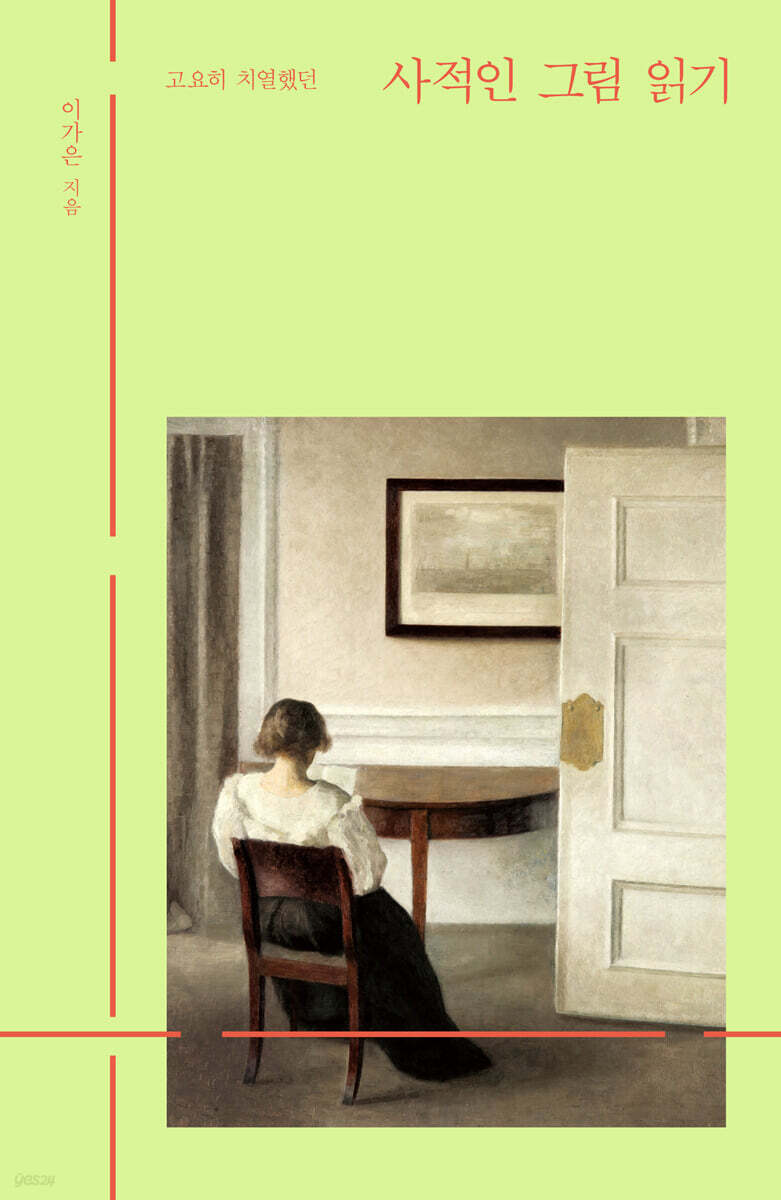
Reading private pictures
 |
Description
Book Introduction
A scene from the past that was fiercely recorded
It gave me a clue to understanding myself and my life.
My own personal and historical art museum
Read the picture as if you were studying a chapter of a history book.
My own extremely private and historical art museum
"Reading Private Paintings" is a book that simultaneously satisfies both fun and depth, as it meticulously examines paintings through historical facts and my daily life.
Lee Ga-eun, the author of this book, is a novice researcher who studied journalism and Western history, and as an individual in her 30s who cannot help but reflect on herself according to the world's various standards, she has written a unique art essay that illuminates a single painting from various perspectives.
“Before I studied history, I never thought that painting would become my subject matter.
I have enjoyed appreciating art ever since I started studying history.
At first, the pictures were useful fodder for me.
I read the picture as if I were studying a page from a history book.
“I saw as much as I knew, and as much as I saw, I put my experiences and thoughts into it and loved it as ‘mine.’” - From “Prologue”
For the author, paintings are not just objects of appreciation but also materials for historical research.
In Jean Verot's painting, which is often seen on Paris commemorative postcards, we look back at the process through which the sphere of activity of 19th century women, which was confined to the home, expanded into the public space. Looking at Antonello Damesina's "Saint Jerome in the Study," we examine the history of 'reading' from the Middle Ages to the modern era. In Jan Matejko's painting of Copernicus, we interestingly point out the 'generational conflict' triggered by the heliocentric theory at a time when the divine and the scientific awkwardly coexisted.
But each story goes beyond simply explaining historical facts; it seamlessly interweaves with the process of deriving small answers to one's own concerns.
By examining artworks within the historical context that connects distant lands and here, past and present, the author's ultimate message is the 'meaning of life.'
A woman driving a carriage down a new street in Paris, Saint Jerome engrossed in a book, scientists who changed the world view from Ptolemy to Copernicus, Galileo, and Newton, the author embodies the characters and situations in the paintings, elevating the meaning of a time that was “quietly intense.”
It gave me a clue to understanding myself and my life.
My own personal and historical art museum
Read the picture as if you were studying a chapter of a history book.
My own extremely private and historical art museum
"Reading Private Paintings" is a book that simultaneously satisfies both fun and depth, as it meticulously examines paintings through historical facts and my daily life.
Lee Ga-eun, the author of this book, is a novice researcher who studied journalism and Western history, and as an individual in her 30s who cannot help but reflect on herself according to the world's various standards, she has written a unique art essay that illuminates a single painting from various perspectives.
“Before I studied history, I never thought that painting would become my subject matter.
I have enjoyed appreciating art ever since I started studying history.
At first, the pictures were useful fodder for me.
I read the picture as if I were studying a page from a history book.
“I saw as much as I knew, and as much as I saw, I put my experiences and thoughts into it and loved it as ‘mine.’” - From “Prologue”
For the author, paintings are not just objects of appreciation but also materials for historical research.
In Jean Verot's painting, which is often seen on Paris commemorative postcards, we look back at the process through which the sphere of activity of 19th century women, which was confined to the home, expanded into the public space. Looking at Antonello Damesina's "Saint Jerome in the Study," we examine the history of 'reading' from the Middle Ages to the modern era. In Jan Matejko's painting of Copernicus, we interestingly point out the 'generational conflict' triggered by the heliocentric theory at a time when the divine and the scientific awkwardly coexisted.
But each story goes beyond simply explaining historical facts; it seamlessly interweaves with the process of deriving small answers to one's own concerns.
By examining artworks within the historical context that connects distant lands and here, past and present, the author's ultimate message is the 'meaning of life.'
A woman driving a carriage down a new street in Paris, Saint Jerome engrossed in a book, scientists who changed the world view from Ptolemy to Copernicus, Galileo, and Newton, the author embodies the characters and situations in the paintings, elevating the meaning of a time that was “quietly intense.”
- You can preview some of the book's contents.
Preview
index
Prologue - To my quietly intense day
Part 1: Solitude That Is Not Loneliness
Escape the lethargy of a rainy day - Auguste Renoir, "Umbrella"
When Life Was Boring, I Got the Wheel Jean Veraud, "The Roundabout on the Champs-Élysées"
Edward Hopper, "Nighthawks," who enjoy solitude from time to time
I want to go back to books again. Antonello Damesina, "Saint Jerome in the Study"
Just, somehow, to you who has drifted away, Edgar Degas, "The Six Friends of Dieppe"
Part 2 will be beautifully intense
Why We Loved Supa Back Then: Giuseppe Cades, "The Suicide of Ajax"
Even at 46 kilograms, Kim Go-eun couldn't do it - Alexander of Antioch, "Venus de Milo"
Artemisia Gentileschi, "Self-Portrait": Self-Expression in the Age of the Innocent
For our happy virtuous lives, Josef Danhauser, "Liszt the Piano Player"
To the old farts who keep offering me a latte - Jan Matejko, "Astronomer Copernicus, Conversations with God"
Part 3: A Time to Look Quietly
I often miss foreign countries - Claude Monet, 'London Thames' series
Moving, hoping for a better life - Joseph Mallard William Turner, "Cologne, Arrival of the Liner - Evening"
Spring always comes with snow. Vincent van Gogh, "Snow-covered Fields in Arles"
I keep moving towards the place where my first memory was left - John Constable, "The Flatford Mill"
If I Could Dance with Death - "Dance of Death" at the Cathedral of Saint-Germain
References
Part 1: Solitude That Is Not Loneliness
Escape the lethargy of a rainy day - Auguste Renoir, "Umbrella"
When Life Was Boring, I Got the Wheel Jean Veraud, "The Roundabout on the Champs-Élysées"
Edward Hopper, "Nighthawks," who enjoy solitude from time to time
I want to go back to books again. Antonello Damesina, "Saint Jerome in the Study"
Just, somehow, to you who has drifted away, Edgar Degas, "The Six Friends of Dieppe"
Part 2 will be beautifully intense
Why We Loved Supa Back Then: Giuseppe Cades, "The Suicide of Ajax"
Even at 46 kilograms, Kim Go-eun couldn't do it - Alexander of Antioch, "Venus de Milo"
Artemisia Gentileschi, "Self-Portrait": Self-Expression in the Age of the Innocent
For our happy virtuous lives, Josef Danhauser, "Liszt the Piano Player"
To the old farts who keep offering me a latte - Jan Matejko, "Astronomer Copernicus, Conversations with God"
Part 3: A Time to Look Quietly
I often miss foreign countries - Claude Monet, 'London Thames' series
Moving, hoping for a better life - Joseph Mallard William Turner, "Cologne, Arrival of the Liner - Evening"
Spring always comes with snow. Vincent van Gogh, "Snow-covered Fields in Arles"
I keep moving towards the place where my first memory was left - John Constable, "The Flatford Mill"
If I Could Dance with Death - "Dance of Death" at the Cathedral of Saint-Germain
References
Detailed image
.jpg)
Into the book
I wrote to maintain the sublimity on the line.
The tightrope walker knew the only way for an ordinary person to become noble.
A life true to one's own choices.
A life where you do your best to maximize the joy that only you know.
If I had no intention of ever getting off, it would have been a nobler decision to indulge in the joys that could only be found on the line, rather than to be tied down by constant anxiety and discontent.
---From the "Prologue"
When I first encountered “People Spending the Night,” I stared for a long time beyond the window, as if I were a passerby on the street in the painting.
The work was that absorbing.
But the feelings I felt inside were not just loneliness and desolation, as is often said.
Perhaps because I had no information about the work, I looked at it from a very personal perspective, and the disconnection and silence that overflowed in the work felt more comfort than loneliness.
---From "People Who Sometimes Enjoy Solitude"
The fact that the "Six Friends of Dieppe" who seemed to be leaving each other were actually the happiest moments of their friendship was the greatest twist in this work for me.
I thought like this.
If in the future, there comes a time when I want to turn my head toward you like in this picture, I will definitely remember the moments when you were my joy and comfort, and I will look at you and hold on to you once again.
---From "Just, Somehow, To You Who Has Gone Far Away"
What "Swoopa" showed me was the possibility of beautiful competition: that even a losing competition can have meaning, that the challenge itself can be inspiring, and that both winners and losers can shine.
Of course, the results were important to them too.
There was a mix of joy and sorrow as the judges' and the public's choices were revealed.
But at least for them, it seemed more important whether they did what they wanted to do, gave it their all, and were satisfied with themselves.
That's why each of them created a wonderful stage, and even in a competition where defeat was expected, they gave it their all until the end.
At the end of such competition, the loser's self-esteem was not destroyed because the winner 'respected' the loser.
---From "Why We Loved Supa Back Then"
As a timid servant entering the world of servants for the first time, the question I faced was, 'How should I express myself?'
Whether I like it or not, the language I use contains me.
Although I primarily write about knowledge, I cannot put together a single sentence smoothly without going through my experiences, thoughts, and philosophy.
Ultimately, every creation is meant to shout out to me in my own way.
---From "Self-expression in the Age of Obedience"
In Gentileschi's life, interest was both necessary and unavoidable.
The attention was a double-edged sword, both honoring her and hurting her.
Among them, she always spoke out as best she could, hoping that her sincerity would reach people through her work.
Of course, we can't know everything about her through her work.
Because everyone tends to interpret and express themselves in a way that benefits them.
More importantly, we are now hearing the words she most wanted to say, the words she painstakingly recorded, after a 400-year gap.
---From "Self-expression in the Age of Obedience"
If you live remembering death and preparing for it, one day death will come to you unexpectedly.
The allegory of medieval art that captures this final moment is the 'Dance of Death'.
Death here is not a cold-blooded, impersonal murderer like in 'The Triumph of Death'.
Rather, he has the appearance of a humorous musician.
Death approaches the human being who has just finished living, with a lively expression and gestures, playing music.
Their role is to guide humans who are still confused and unable to perceive death into the world of death.
The tightrope walker knew the only way for an ordinary person to become noble.
A life true to one's own choices.
A life where you do your best to maximize the joy that only you know.
If I had no intention of ever getting off, it would have been a nobler decision to indulge in the joys that could only be found on the line, rather than to be tied down by constant anxiety and discontent.
---From the "Prologue"
When I first encountered “People Spending the Night,” I stared for a long time beyond the window, as if I were a passerby on the street in the painting.
The work was that absorbing.
But the feelings I felt inside were not just loneliness and desolation, as is often said.
Perhaps because I had no information about the work, I looked at it from a very personal perspective, and the disconnection and silence that overflowed in the work felt more comfort than loneliness.
---From "People Who Sometimes Enjoy Solitude"
The fact that the "Six Friends of Dieppe" who seemed to be leaving each other were actually the happiest moments of their friendship was the greatest twist in this work for me.
I thought like this.
If in the future, there comes a time when I want to turn my head toward you like in this picture, I will definitely remember the moments when you were my joy and comfort, and I will look at you and hold on to you once again.
---From "Just, Somehow, To You Who Has Gone Far Away"
What "Swoopa" showed me was the possibility of beautiful competition: that even a losing competition can have meaning, that the challenge itself can be inspiring, and that both winners and losers can shine.
Of course, the results were important to them too.
There was a mix of joy and sorrow as the judges' and the public's choices were revealed.
But at least for them, it seemed more important whether they did what they wanted to do, gave it their all, and were satisfied with themselves.
That's why each of them created a wonderful stage, and even in a competition where defeat was expected, they gave it their all until the end.
At the end of such competition, the loser's self-esteem was not destroyed because the winner 'respected' the loser.
---From "Why We Loved Supa Back Then"
As a timid servant entering the world of servants for the first time, the question I faced was, 'How should I express myself?'
Whether I like it or not, the language I use contains me.
Although I primarily write about knowledge, I cannot put together a single sentence smoothly without going through my experiences, thoughts, and philosophy.
Ultimately, every creation is meant to shout out to me in my own way.
---From "Self-expression in the Age of Obedience"
In Gentileschi's life, interest was both necessary and unavoidable.
The attention was a double-edged sword, both honoring her and hurting her.
Among them, she always spoke out as best she could, hoping that her sincerity would reach people through her work.
Of course, we can't know everything about her through her work.
Because everyone tends to interpret and express themselves in a way that benefits them.
More importantly, we are now hearing the words she most wanted to say, the words she painstakingly recorded, after a 400-year gap.
---From "Self-expression in the Age of Obedience"
If you live remembering death and preparing for it, one day death will come to you unexpectedly.
The allegory of medieval art that captures this final moment is the 'Dance of Death'.
Death here is not a cold-blooded, impersonal murderer like in 'The Triumph of Death'.
Rather, he has the appearance of a humorous musician.
Death approaches the human being who has just finished living, with a lively expression and gestures, playing music.
Their role is to guide humans who are still confused and unable to perceive death into the world of death.
---From "If I Could Dance with Death"
Publisher's Review
Every quiet day, with the intensity that builds up little by little
A picture story written while maintaining balance in life
This book contains fifteen personal and historical essays on relatable topics such as friendship, competition, diet, indulgence, and generational differences.
Pictures and stories from the past, which provide a balance to daily life, add strength to the writing at just the right places.
Part 1, "Solitude That Is Not Loneliness," shows an attitude of meekly acknowledging loneliness while standing up for oneself, and Part 2, "Beautifully Fierce," conveys through art the efforts to not lose the sublimity while fiercely competing every day.
Part 3, “Time to Look Quietly,” explores the time to quietly contemplate what has passed and what is to come in the face of inevitable change.
▶Why are people smiling even when it's raining? Pierre-Auguste Renoir, "Umbrella"
The author doesn't like rainy days.
Especially during times when worries pile up like a mountain, even a little cloudiness can bring down your mood.
But the expressions on the faces of the people in Renoir's "Umbrellas" are strange.
The woman looking straight at the screen even has a faint smile on her face.
Until the 18th century, the general public could not afford expensive umbrellas, and the public perception of them was negative, so using an umbrella was considered a spectacle. However, from the late 18th century, umbrellas made of cheap materials were developed and prejudices were improved, so umbrellas began to be used more commonly.
At that time, the painting "Umbrella" was created by Renoir, the "painter of happiness," who captured the "excitement" of people waiting for an umbrella rather than the "rain" and transferred it to the canvas.
The author says that looking at this painting gave her the realization that there are moments of excitement even during the rainy season of life, and that she gained the courage to face all stages of life with steadfastness.
Beyond Renoir's soft brush strokes, we read a firm attitude toward life.
“I am certain that if Renoir had observed and painted my life at that time, it would have been a completely different work.
He will surely find unexpected excitement and joy even on rainy days, draw them with more care, and show them the finished painting, saying, ‘See, your time wasn’t so gloomy, was it?’ (p. 28)
▶Is losing a competition always a tragedy? Giuseppe Cades, "The Suicide of Ajax"
In ancient Greece, the purpose of competition was to hone 'arete', that is, god-given abilities, and reach excellence.
Sophocles, perhaps concerned that this spirit would be corrupted, warned that competition could become a tragedy by vividly showing the process by which the loser is ruined in the play Ajax, and many painters, including Cadeus, later painted this tragedy.
The author examines the meaning of competition by comparing the attitudes of Ajax in "The Suicide of Ajax" and the participants in the TV program "Street Woman Fighter," and argues that even if you lose in a competition, you should be able to maintain your dignity by proudly acknowledging your efforts.
Thus, it conveys the realization that the true meaning of competition lies not in winning or losing, but in the mindset of those participating in the competition.
“The Greeks wanted competition to be a comedy for everyone, and even the virtual reality on TV called ‘Supa’ spoke of how beautiful competition can be.
Even if it was a utopian fantasy and a staged show, I decided to believe in the possibility of something more than that.
“I decided to believe that when I quietly do my best for my dream, every competition I face can be beautiful.” (p. 127)
Why did Gentileschi paint his own face onto a mythological figure? Artemisia Gentileschi, "Self-Portrait"
The author entered the path of 'observance' when he began writing.
Because your message gains power when you have readers.
However, the more I became conscious of my readers, the more self-censorship I developed and my worries deepened.
At that time, Gentileschi's self-portrait and his life provided the answer.
Artemisia Gentileschi was a talented painter recognized solely for her talent in the 17th century, when female painters were rare.
But in the rigid male-dominated artistic community, Gentileschi was humiliated and vilified.
However, he did not give in and survived by demonstrating his abilities, and he made effective use of the portrait genre that emerged during the Renaissance.
As seen in “Judith Beheading Holofernes,” “Self-Portrait as Saint Catherine of Alexandria,” and “Self-Portrait as a Symbol of Painting,” she borrowed the images of specific people to portray herself as a strong and daring woman, or as a legendary woman.
Just as Gentileschi's self-portraits, which cry out, "Remember me as a painter," have become the most convincing evidence of his greatness, the author also pledges to pour his heart into his writings, which will last longer and go further than he did.
“Like it or not, all creators live off the attention they get from selling themselves.
The creator expresses himself by putting his talents, thoughts, experiences, and charms into his creations.
“The me in the work will live longer than my real self and meet more people, so I want to engrave the ‘real me’ in the most wonderful way possible so that those encounters don’t feel empty” (p. 172).
In an era where short texts and flashy images are gaining attention
Time to weave together paintings and life at your own pace
“I had no idea what awaited me at the end of the undulating road, and as the thick fog grew, I lost my balance and floundered even more.
Every time I looked down the line, I felt small.
A world teeming with people who have already succeeded, who can afford to be carefree, and who have established themselves on a stable footing.
“In contrast to the hustle and bustle there, my days were very quiet and intense.” _ From “Prologue”
Even if others don't notice, everyone has had a time when they were 'quietly intense' through their own efforts.
During a time when the author was wandering around with concerns about his studies and career path, he began posting articles on Brunch Story that weave together art, history, and self-reflection as a means of self-help.
Thanks to the new knowledge and relationships I gained along the way, I was able to move forward with my self-esteem intact, even when things were shaky.
This book is filled with the author's heart, hoping that it will provide strength in some way to all those who struggle to remain sublime in their place.
We live in an era where we can easily view paintings anywhere thanks to the quantitative and qualitative expansion of exhibitions and web content.
There are now more and more people who actively appreciate and even own works of art, rather than just viewing them as a refined pastime for the wealthy.
These days, with the number of people seeking to appreciate paintings in various ways and from various perspectives increasing, Lee Ga-eun's "Private Reading of Paintings" suggests a method for reading paintings "personally and historically," and subtly encourages the experience of making a painting truly "your own" through multi-layered reading.
"Private Painting Reading" will serve as a solid foundation for readers who wish to advance to a deeper appreciation of art.
A picture story written while maintaining balance in life
This book contains fifteen personal and historical essays on relatable topics such as friendship, competition, diet, indulgence, and generational differences.
Pictures and stories from the past, which provide a balance to daily life, add strength to the writing at just the right places.
Part 1, "Solitude That Is Not Loneliness," shows an attitude of meekly acknowledging loneliness while standing up for oneself, and Part 2, "Beautifully Fierce," conveys through art the efforts to not lose the sublimity while fiercely competing every day.
Part 3, “Time to Look Quietly,” explores the time to quietly contemplate what has passed and what is to come in the face of inevitable change.
▶Why are people smiling even when it's raining? Pierre-Auguste Renoir, "Umbrella"
The author doesn't like rainy days.
Especially during times when worries pile up like a mountain, even a little cloudiness can bring down your mood.
But the expressions on the faces of the people in Renoir's "Umbrellas" are strange.
The woman looking straight at the screen even has a faint smile on her face.
Until the 18th century, the general public could not afford expensive umbrellas, and the public perception of them was negative, so using an umbrella was considered a spectacle. However, from the late 18th century, umbrellas made of cheap materials were developed and prejudices were improved, so umbrellas began to be used more commonly.
At that time, the painting "Umbrella" was created by Renoir, the "painter of happiness," who captured the "excitement" of people waiting for an umbrella rather than the "rain" and transferred it to the canvas.
The author says that looking at this painting gave her the realization that there are moments of excitement even during the rainy season of life, and that she gained the courage to face all stages of life with steadfastness.
Beyond Renoir's soft brush strokes, we read a firm attitude toward life.
“I am certain that if Renoir had observed and painted my life at that time, it would have been a completely different work.
He will surely find unexpected excitement and joy even on rainy days, draw them with more care, and show them the finished painting, saying, ‘See, your time wasn’t so gloomy, was it?’ (p. 28)
▶Is losing a competition always a tragedy? Giuseppe Cades, "The Suicide of Ajax"
In ancient Greece, the purpose of competition was to hone 'arete', that is, god-given abilities, and reach excellence.
Sophocles, perhaps concerned that this spirit would be corrupted, warned that competition could become a tragedy by vividly showing the process by which the loser is ruined in the play Ajax, and many painters, including Cadeus, later painted this tragedy.
The author examines the meaning of competition by comparing the attitudes of Ajax in "The Suicide of Ajax" and the participants in the TV program "Street Woman Fighter," and argues that even if you lose in a competition, you should be able to maintain your dignity by proudly acknowledging your efforts.
Thus, it conveys the realization that the true meaning of competition lies not in winning or losing, but in the mindset of those participating in the competition.
“The Greeks wanted competition to be a comedy for everyone, and even the virtual reality on TV called ‘Supa’ spoke of how beautiful competition can be.
Even if it was a utopian fantasy and a staged show, I decided to believe in the possibility of something more than that.
“I decided to believe that when I quietly do my best for my dream, every competition I face can be beautiful.” (p. 127)
Why did Gentileschi paint his own face onto a mythological figure? Artemisia Gentileschi, "Self-Portrait"
The author entered the path of 'observance' when he began writing.
Because your message gains power when you have readers.
However, the more I became conscious of my readers, the more self-censorship I developed and my worries deepened.
At that time, Gentileschi's self-portrait and his life provided the answer.
Artemisia Gentileschi was a talented painter recognized solely for her talent in the 17th century, when female painters were rare.
But in the rigid male-dominated artistic community, Gentileschi was humiliated and vilified.
However, he did not give in and survived by demonstrating his abilities, and he made effective use of the portrait genre that emerged during the Renaissance.
As seen in “Judith Beheading Holofernes,” “Self-Portrait as Saint Catherine of Alexandria,” and “Self-Portrait as a Symbol of Painting,” she borrowed the images of specific people to portray herself as a strong and daring woman, or as a legendary woman.
Just as Gentileschi's self-portraits, which cry out, "Remember me as a painter," have become the most convincing evidence of his greatness, the author also pledges to pour his heart into his writings, which will last longer and go further than he did.
“Like it or not, all creators live off the attention they get from selling themselves.
The creator expresses himself by putting his talents, thoughts, experiences, and charms into his creations.
“The me in the work will live longer than my real self and meet more people, so I want to engrave the ‘real me’ in the most wonderful way possible so that those encounters don’t feel empty” (p. 172).
In an era where short texts and flashy images are gaining attention
Time to weave together paintings and life at your own pace
“I had no idea what awaited me at the end of the undulating road, and as the thick fog grew, I lost my balance and floundered even more.
Every time I looked down the line, I felt small.
A world teeming with people who have already succeeded, who can afford to be carefree, and who have established themselves on a stable footing.
“In contrast to the hustle and bustle there, my days were very quiet and intense.” _ From “Prologue”
Even if others don't notice, everyone has had a time when they were 'quietly intense' through their own efforts.
During a time when the author was wandering around with concerns about his studies and career path, he began posting articles on Brunch Story that weave together art, history, and self-reflection as a means of self-help.
Thanks to the new knowledge and relationships I gained along the way, I was able to move forward with my self-esteem intact, even when things were shaky.
This book is filled with the author's heart, hoping that it will provide strength in some way to all those who struggle to remain sublime in their place.
We live in an era where we can easily view paintings anywhere thanks to the quantitative and qualitative expansion of exhibitions and web content.
There are now more and more people who actively appreciate and even own works of art, rather than just viewing them as a refined pastime for the wealthy.
These days, with the number of people seeking to appreciate paintings in various ways and from various perspectives increasing, Lee Ga-eun's "Private Reading of Paintings" suggests a method for reading paintings "personally and historically," and subtly encourages the experience of making a painting truly "your own" through multi-layered reading.
"Private Painting Reading" will serve as a solid foundation for readers who wish to advance to a deeper appreciation of art.
GOODS SPECIFICS
- Date of issue: May 4, 2023
- Page count, weight, size: 308 pages | 500g | 142*218*18mm
- ISBN13: 9788961964340
- ISBN10: 8961964348
You may also like
카테고리
korean


korean

![GQ KOREA Mark (Monthly): December [2025]](http://librairie.coreenne.fr/cdn/shop/files/8ef265dbbfbf186523ed75ba7319009d.jpg?v=1765340328&width=3840)


