

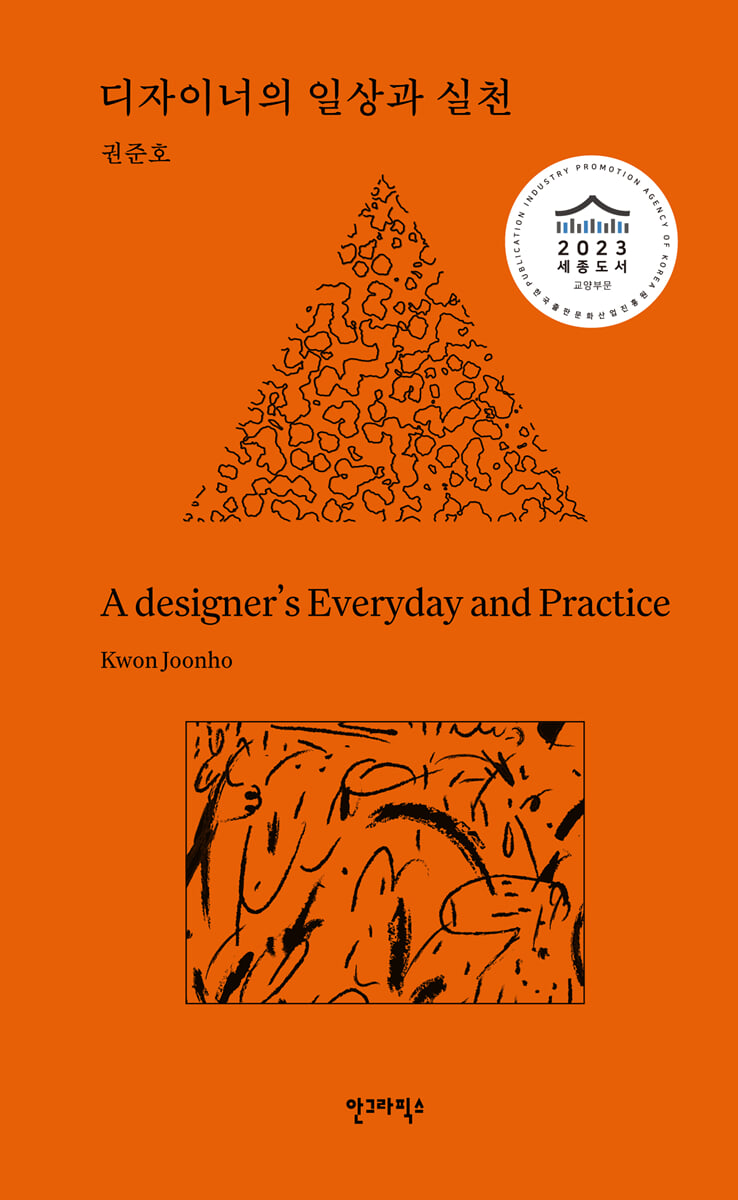
A designer's daily life and practice
 |
Description
Book Introduction
Graphic designer Kwon Jun-ho compiled notes, articles contributed to media outlets, and emails exchanged while running a design studio for 10 years.
“I do not send estimates for comparison.” “I believe that designers are also members of society, and that the results they create can have a big or small impact on the society we live in.” These are “very personal records and fairly public statements” about things I have experienced or want to practice as a current design worker, such as the tug-of-war with clients between budget and schedule, taste and purpose, moments of losing direction or having to find balance between service providers and creators, and the desire to do “my real work.”
“I do not send estimates for comparison.” “I believe that designers are also members of society, and that the results they create can have a big or small impact on the society we live in.” These are “very personal records and fairly public statements” about things I have experienced or want to practice as a current design worker, such as the tug-of-war with clients between budget and schedule, taste and purpose, moments of losing direction or having to find balance between service providers and creators, and the desire to do “my real work.”
- You can preview some of the book's contents.
Preview
index
Opening remarks
Designer's Writing
go
Available budget and a game of wits
Quotation for quote comparison
lesson
Their cohabitation
His and her circumstances
The virtue of consistency
Dream form
Letter 1
Saltflower tree
me too
age
Popular singer Shin Hae-chul
Popular design
Mr. President, our President
Designer's Print Shop
Photography as design,
Design as Photography
hot person
An unexpected relationship
Addition text
A Man Who Crosses Borders - Kim Kyung-chul
R-B
Langi's death
comic book
Mentor
Grammar and Style
Moments of learning
blacklist
Children offering bread
Letter 2
A letter to a curator
in
Work as it comes
dish wash
The joy of handwork
What to do
Service provider bidding
Ways of exercise
Origami, pasting, pasting
Letter 3
Designer's exhibition
trillion
Get out of voluntary
Typicality and Radicality
affection
Is it really okay to do this?
honor
good company
My real work
Letter 4
Letter to an Architect
Ch-pp
Creation and Labor
Qualifications of youth
Pantone Orange 021C
The Secret Beginning of Violence
What is a pro?
excuse
A letter to send
May our differences be well - Kim Eo-jin
he
Grandma's Bible
older brother and younger brother
Closing remarks
Conditions for collaboration
supplement
Conversation with the Curator
Ask anything
Designer's Writing
go
Available budget and a game of wits
Quotation for quote comparison
lesson
Their cohabitation
His and her circumstances
The virtue of consistency
Dream form
Letter 1
Saltflower tree
me too
age
Popular singer Shin Hae-chul
Popular design
Mr. President, our President
Designer's Print Shop
Photography as design,
Design as Photography
hot person
An unexpected relationship
Addition text
A Man Who Crosses Borders - Kim Kyung-chul
R-B
Langi's death
comic book
Mentor
Grammar and Style
Moments of learning
blacklist
Children offering bread
Letter 2
A letter to a curator
in
Work as it comes
dish wash
The joy of handwork
What to do
Service provider bidding
Ways of exercise
Origami, pasting, pasting
Letter 3
Designer's exhibition
trillion
Get out of voluntary
Typicality and Radicality
affection
Is it really okay to do this?
honor
good company
My real work
Letter 4
Letter to an Architect
Ch-pp
Creation and Labor
Qualifications of youth
Pantone Orange 021C
The Secret Beginning of Violence
What is a pro?
excuse
A letter to send
May our differences be well - Kim Eo-jin
he
Grandma's Bible
older brother and younger brother
Closing remarks
Conditions for collaboration
supplement
Conversation with the Curator
Ask anything
Detailed image
Into the book
One day, I ignored an email asking for a quote and an attachment with no content, and then I got a call to the studio.
When I confidently told him, "We don't send out estimates for comparison," when he asked me why I didn't send him estimates, he asked me back, "What's wrong with comparing estimates from different companies and choosing the one with the lowest price?"
Just like comparing prices on online shopping malls, I was about to refute the idea of buying designs at the lowest price, but that shaky and indifferent voice filled me with a sense of helplessness, so I simply replied, "That's not how we do things," and hung up.
In Korea, which touts itself as a design powerhouse, the indifferent attitude of the 'PR manager' who uses the '@korea.kr' email account gives us a glimpse into the extent to which Korean society still views designers.
--- p.15 From “Quotes for Quotation Comparison”
In the case of festivals or public art exhibitions targeting an unspecified number of people, the design is carried out with the general 'public' in mind, rather than a specific target group.
However, there are differing interpretations of who the 'public' referred to here is.
For the aforementioned client, the public appears to be perceived as beings who cannot read any symbolism or metaphor into images that are not explicitly explained, and as passive consumers of straightforward images that leave no room for interpretation.
However, the work, which is designed solely to suit the public's taste, does not have any expectations from the public.
It may be a design that ignores eye level.
--- p.51 From “Popular Design”
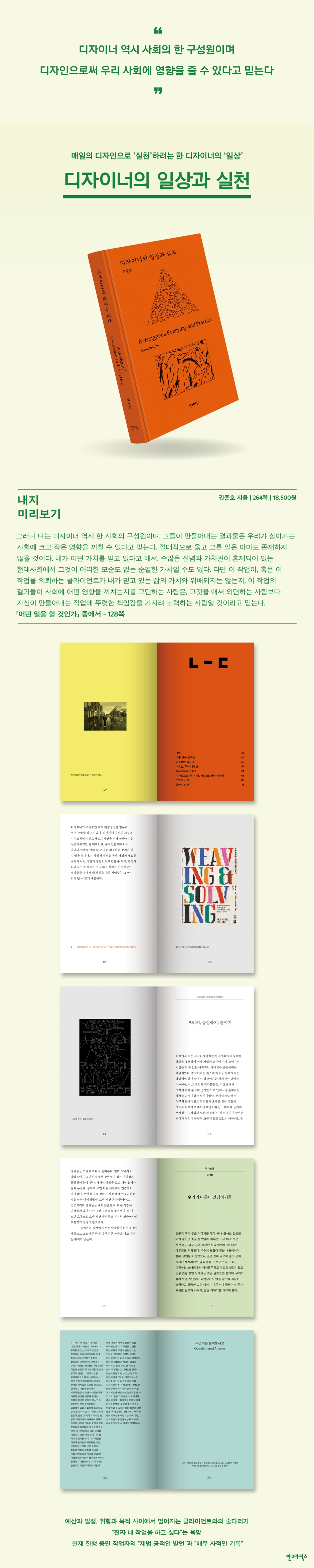
However, I believe that designers are also members of society, and that the results they produce can have a large or small impact on the society we live in.
There is probably no such thing as absolutely right or wrong.
Just because I believe in a certain value, in today's society where countless beliefs and values are mixed together, it doesn't mean that it can be a pure value without any contradictions.
However, I believe that those who consider whether this work, or the client who commissions this work, violates the values I believe in and what impact the results of this work have on society are those who strive to have a clear sense of responsibility for the work they create, rather than those who try to ignore such concerns.
--- p.128 From “What to Do”
When submitting tasks after work on Fridays, late at night, or on weekends, clearly state the designer's working hours and notify them in advance that responses outside of these hours may be difficult.
If you change your perspective and say something like, "Are you asking me to work while you play tennis on the weekend?", your request may sound very inappropriate.
If a client takes weekend work for granted, it is not a case of unconsciously exhibiting a bullying pattern, but rather a case of simply bullying. Therefore, it is better for your mental and physical health to stop doing that work before it is too late.
--- p.159 From “Escape from Voluntary Eul”
My grandmother learned Korean by copying each letter from Genesis to Revelation.
My grandmother wrote down the Bible stories she had heard for decades as if drawing pictures, and learned the structure of the letters and the order of the strokes.
The words written in the notebook my grandmother gave me were filled with the earnestness of someone trying to learn, the trembling fear of making mistakes, and the confidence of a stroke that grew in skill over time.
My grandmother commissioned me to bind a manuscript she had written, and that commission was my first experience as a designer, one that made me think about how a book should be created not as an object but as a material with a narrative.
When I confidently told him, "We don't send out estimates for comparison," when he asked me why I didn't send him estimates, he asked me back, "What's wrong with comparing estimates from different companies and choosing the one with the lowest price?"
Just like comparing prices on online shopping malls, I was about to refute the idea of buying designs at the lowest price, but that shaky and indifferent voice filled me with a sense of helplessness, so I simply replied, "That's not how we do things," and hung up.
In Korea, which touts itself as a design powerhouse, the indifferent attitude of the 'PR manager' who uses the '@korea.kr' email account gives us a glimpse into the extent to which Korean society still views designers.
--- p.15 From “Quotes for Quotation Comparison”
In the case of festivals or public art exhibitions targeting an unspecified number of people, the design is carried out with the general 'public' in mind, rather than a specific target group.
However, there are differing interpretations of who the 'public' referred to here is.
For the aforementioned client, the public appears to be perceived as beings who cannot read any symbolism or metaphor into images that are not explicitly explained, and as passive consumers of straightforward images that leave no room for interpretation.
However, the work, which is designed solely to suit the public's taste, does not have any expectations from the public.
It may be a design that ignores eye level.
--- p.51 From “Popular Design”
However, I believe that designers are also members of society, and that the results they produce can have a large or small impact on the society we live in.
There is probably no such thing as absolutely right or wrong.
Just because I believe in a certain value, in today's society where countless beliefs and values are mixed together, it doesn't mean that it can be a pure value without any contradictions.
However, I believe that those who consider whether this work, or the client who commissions this work, violates the values I believe in and what impact the results of this work have on society are those who strive to have a clear sense of responsibility for the work they create, rather than those who try to ignore such concerns.
--- p.128 From “What to Do”
When submitting tasks after work on Fridays, late at night, or on weekends, clearly state the designer's working hours and notify them in advance that responses outside of these hours may be difficult.
If you change your perspective and say something like, "Are you asking me to work while you play tennis on the weekend?", your request may sound very inappropriate.
If a client takes weekend work for granted, it is not a case of unconsciously exhibiting a bullying pattern, but rather a case of simply bullying. Therefore, it is better for your mental and physical health to stop doing that work before it is too late.
--- p.159 From “Escape from Voluntary Eul”
My grandmother learned Korean by copying each letter from Genesis to Revelation.
My grandmother wrote down the Bible stories she had heard for decades as if drawing pictures, and learned the structure of the letters and the order of the strokes.
The words written in the notebook my grandmother gave me were filled with the earnestness of someone trying to learn, the trembling fear of making mistakes, and the confidence of a stroke that grew in skill over time.
My grandmother commissioned me to bind a manuscript she had written, and that commission was my first experience as a designer, one that made me think about how a book should be created not as an object but as a material with a narrative.
--- p.219 From “Grandma’s Bible”
Publisher's Review
A designer's daily life, striving to put everyday design into practice.
On the 'Daily Practice' website, they introduce themselves as follows:
“Everyday Practice is a graphic design studio run by Kwon Jun-ho, Kim Gyeong-cheol, and Kim Eo-jin.
Everyday Practice is a small community that ponders the role that design should play in the reality we live in today, and what it can do.” Although the name Everyday Practice does not contain any words that indicate that it is a design studio, such as ‘○○ Design’ or ‘○○ Graphic,’ the two words ‘everyday’ and ‘practice’ contain the entire identity of this design studio.
How is the word design used in our society?
What exactly is meant by 'designing', or distinguishing between 'designed' and 'non-designed'.
The context behind this is to make it more beautiful, more sophisticated, and in passing, more hip.
In some ways, design is a field that allows the public to perceive modern art more closely than contemporary art.
In such a design world, this studio puts “everyday life” and “practice” that may not seem to be connected to design at first glance at the forefront, rather than special occasions.
“Practice” here doesn’t just mean designing something pretty and cool.
As a person who designs as labor, as a professional and an individual, the social practice that he believes he must carry out as a citizen of the society and community to which he belongs is the essence.
The relationship between client and service provider, represented by the phrase 'A and B', the relationship between curator and designer, which is in the position of collaborator but operates subtly within that, the desire as a creator to do "my real work" while questioning "popular design" targeting the public whose substance is unclear, are his daily life, and his practice includes thinking about design that can influence the society we live in, visiting civic groups to say that he will change "uniform design", and contacting publishers that have published "hot writings" by workers to propose that they collaborate with "the minimum effort not to ignore the problems we face in reality."
And inside and outside of all that designer identity, there's a third-grader who "floats around awkwardly and shyly" and a grandson who's compiling a book from his grandmother's handwritten Bible notes while learning to read.
This book is both a “fairly public statement” by designer Kwon Jun-ho and a “very personal record” of an ordinary citizen who has lived through Korean society.
On the 'Daily Practice' website, they introduce themselves as follows:
“Everyday Practice is a graphic design studio run by Kwon Jun-ho, Kim Gyeong-cheol, and Kim Eo-jin.
Everyday Practice is a small community that ponders the role that design should play in the reality we live in today, and what it can do.” Although the name Everyday Practice does not contain any words that indicate that it is a design studio, such as ‘○○ Design’ or ‘○○ Graphic,’ the two words ‘everyday’ and ‘practice’ contain the entire identity of this design studio.
How is the word design used in our society?
What exactly is meant by 'designing', or distinguishing between 'designed' and 'non-designed'.
The context behind this is to make it more beautiful, more sophisticated, and in passing, more hip.
In some ways, design is a field that allows the public to perceive modern art more closely than contemporary art.
In such a design world, this studio puts “everyday life” and “practice” that may not seem to be connected to design at first glance at the forefront, rather than special occasions.
“Practice” here doesn’t just mean designing something pretty and cool.
As a person who designs as labor, as a professional and an individual, the social practice that he believes he must carry out as a citizen of the society and community to which he belongs is the essence.
The relationship between client and service provider, represented by the phrase 'A and B', the relationship between curator and designer, which is in the position of collaborator but operates subtly within that, the desire as a creator to do "my real work" while questioning "popular design" targeting the public whose substance is unclear, are his daily life, and his practice includes thinking about design that can influence the society we live in, visiting civic groups to say that he will change "uniform design", and contacting publishers that have published "hot writings" by workers to propose that they collaborate with "the minimum effort not to ignore the problems we face in reality."
And inside and outside of all that designer identity, there's a third-grader who "floats around awkwardly and shyly" and a grandson who's compiling a book from his grandmother's handwritten Bible notes while learning to read.
This book is both a “fairly public statement” by designer Kwon Jun-ho and a “very personal record” of an ordinary citizen who has lived through Korean society.
GOODS SPECIFICS
- Date of issue: April 6, 2023
- Format: Hardcover book binding method guide
- Page count, weight, size: 264 pages | 336g | 120*195*20mm
- ISBN13: 9791168232105
- ISBN10: 1168232104
You may also like
카테고리
korean


korean

![GQ KOREA Mark (Monthly): December [2025]](http://librairie.coreenne.fr/cdn/shop/files/8ef265dbbfbf186523ed75ba7319009d.jpg?v=1765340328&width=3840)


