

The Science of Flavor
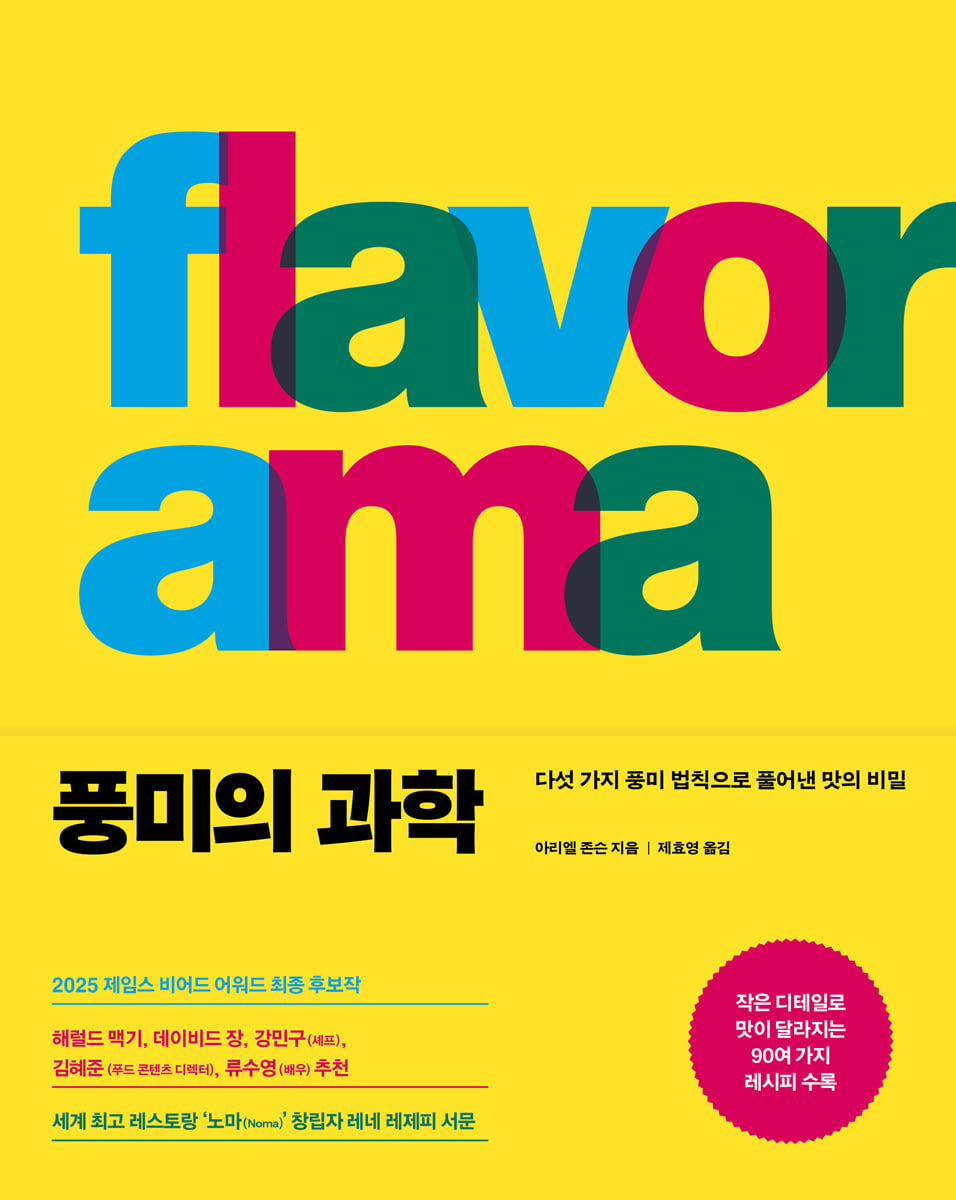 |
Description
Book Introduction
Highly recommended by Kang Min-goo (owner chef of Mingles), Kim Hye-jun (food content director), and Ryu Soo-young (actor)!
The Science of Taste: Unraveled Through Five Flavor Laws and Patterns
Harold McGee and David Chang: A clear explanation from a flavor scientist praised by world-renowned chefs.
Includes a preface by René Redzepi, founder of Noma, the world's best restaurant.
Over 90 detailed recipes to help you gain a rich understanding of ingredients and cooking methods.
2025 James Beard Award Nominees
"A book that will change the way we eat and cook every day."
―Ryu Soo-young (actor, author of "Ryu Soo-young's Lifetime Recipe")
As the saying goes, "Be sincere about eating," a food culture that values diverse flavors, tastes, and experiences is developing.
Even if I'm not an expert, it's become natural for me to take an interest in the scientific principles of taste to find the flavor combinations or recipes I want.
Understanding the unique properties of ingredients and the "flavor" that helps you choose the most appropriate cooking method, rather than relying solely on intuition and taste, has become essential for chefs and gourmets who want to create their own delicious dishes in the kitchen and at the table and encounter the tastes they desire.
A culinary science book has come out that covers everything about these flavors.
"The Science of Flavor" is a single volume that compresses the basic principles and patterns of flavor.
The value of flavor research contained in this book was first recognized by domestic and international experts.
It has received praise from the world's top chefs and culinary experts, including Harold McGee (author of "On Food and Cooking") and David Chang (founder of Momofuku), and has been recommended by local media outlets including the New York Times and the Washington Post. It was also selected as one of the best cookbooks of the year by Bloomberg and was a finalist for the 2025 James Beard Awards.
The Korean edition includes recommendations from Kang Min-gu, owner chef of 'Mingles' (author of the 2025 Michelin 3-star, 2025 James Beard Award-winning book "JANG" (Korean edition: Jang), food content director Kim Hye-jun, and actor Ryu Soo-young, who helped the author research traditional soy sauce when he visited Korea.
《The Science of Flavor》 is a book that “finds out the essence of the ‘flavor’ we feel in food and meticulously explores how to create and control flavor” (from Chef Kang Min-gu’s recommendation) and is the ultimate flavor textbook that “every chef should have in their kitchen” (from René Redzepi’s preface).
Ariel Johnson, the author of this book, is the chief advisor of the fermentation laboratory and flavor scientist at Noma, one of the world's best restaurants, which has captivated countless gourmets around the world with its experimental ingredients and creative recipes.
From a young age, Ariel was someone who, beyond experiencing the incredible flavors of truly delicious food, had a passion for exploring how those flavors came to be and what principles led to their creation.
Wanting to work with chefs in actual kitchens rather than in a formal research lab attached to a restaurant, I studied food chemistry and earned a PhD in flavor chemistry. Since then, I've been working at Noma, sharing scientific interpretations and techniques for creating delicious and delicate dishes with chefs in restaurants around the world.
Ariel, who co-founded the Noma Fermentation Lab with owner chef René Redzepi, felt the need for a single guide to compile all of his research into a single volume, and wrote The Science of Flavor, a book that encapsulates the concept of flavor and the complex process of experiencing taste.
The book begins with the most important law: “Flavor is a combination of taste molecules and odor molecules.”
Knowing how flavors work and how they combine based on the five senses of taste (gustatory) that can be sensed by the tongue—salt, sour, sweet, umami, and bitter—and the tens of thousands of smell patterns that can be sensed by the nose (olfactory) allows us to truly understand why truly delicious food is so delicious.
Here, we delve into the complex and difficult world of culinary science, with terms like pyrolysis, Maillard reaction, fermentation, and aging, to teach you how to enhance flavor and help you gradually expand the spectrum of flavors.
For example, you can study the molecule (myoglobin) that gives meat its flavor and then apply useful cooking methods (aging and heating the ingredients) in turn.
The author, above all, hopes that everyone will understand the essence of flavor and be able to cook delicious dishes easily, and he introduces everything he has explored so far to us.
It includes hand-drawn illustrations and tables of ingredients, as well as over 90 recipes compiled through actual cooking and eating, to bring out the flavor potential of ingredients and provide practical methods for applying them to cooking.
From 'The difference between sea salt and regular table salt', 'How to make sauce using the flavor characteristics of herbs', 'Underrated spices', 'How to enhance the umami flavor of cheese and pepper pasta', 'How to make miso paste by fermenting pumpkin seeds', to 'Salad dressing made with the same old method that's been around for 400 years'.
This comprehensive know-how, based on knowledge of the properties and composition of ingredients, as well as chemical and biological reactions, serves as an important guide that allows you to create and enjoy more delicious dishes by exercising intuition, experimentalism, and creativity.
Now, with "The Science of Flavor," let's uncover the scientific principles behind the flavors that steal our hearts and the secrets of flavor that make cooking enjoyable.
There will be more days when we can enjoy more delicious and enjoyable meals.
The Science of Taste: Unraveled Through Five Flavor Laws and Patterns
Harold McGee and David Chang: A clear explanation from a flavor scientist praised by world-renowned chefs.
Includes a preface by René Redzepi, founder of Noma, the world's best restaurant.
Over 90 detailed recipes to help you gain a rich understanding of ingredients and cooking methods.
2025 James Beard Award Nominees
"A book that will change the way we eat and cook every day."
―Ryu Soo-young (actor, author of "Ryu Soo-young's Lifetime Recipe")
As the saying goes, "Be sincere about eating," a food culture that values diverse flavors, tastes, and experiences is developing.
Even if I'm not an expert, it's become natural for me to take an interest in the scientific principles of taste to find the flavor combinations or recipes I want.
Understanding the unique properties of ingredients and the "flavor" that helps you choose the most appropriate cooking method, rather than relying solely on intuition and taste, has become essential for chefs and gourmets who want to create their own delicious dishes in the kitchen and at the table and encounter the tastes they desire.
A culinary science book has come out that covers everything about these flavors.
"The Science of Flavor" is a single volume that compresses the basic principles and patterns of flavor.
The value of flavor research contained in this book was first recognized by domestic and international experts.
It has received praise from the world's top chefs and culinary experts, including Harold McGee (author of "On Food and Cooking") and David Chang (founder of Momofuku), and has been recommended by local media outlets including the New York Times and the Washington Post. It was also selected as one of the best cookbooks of the year by Bloomberg and was a finalist for the 2025 James Beard Awards.
The Korean edition includes recommendations from Kang Min-gu, owner chef of 'Mingles' (author of the 2025 Michelin 3-star, 2025 James Beard Award-winning book "JANG" (Korean edition: Jang), food content director Kim Hye-jun, and actor Ryu Soo-young, who helped the author research traditional soy sauce when he visited Korea.
《The Science of Flavor》 is a book that “finds out the essence of the ‘flavor’ we feel in food and meticulously explores how to create and control flavor” (from Chef Kang Min-gu’s recommendation) and is the ultimate flavor textbook that “every chef should have in their kitchen” (from René Redzepi’s preface).
Ariel Johnson, the author of this book, is the chief advisor of the fermentation laboratory and flavor scientist at Noma, one of the world's best restaurants, which has captivated countless gourmets around the world with its experimental ingredients and creative recipes.
From a young age, Ariel was someone who, beyond experiencing the incredible flavors of truly delicious food, had a passion for exploring how those flavors came to be and what principles led to their creation.
Wanting to work with chefs in actual kitchens rather than in a formal research lab attached to a restaurant, I studied food chemistry and earned a PhD in flavor chemistry. Since then, I've been working at Noma, sharing scientific interpretations and techniques for creating delicious and delicate dishes with chefs in restaurants around the world.
Ariel, who co-founded the Noma Fermentation Lab with owner chef René Redzepi, felt the need for a single guide to compile all of his research into a single volume, and wrote The Science of Flavor, a book that encapsulates the concept of flavor and the complex process of experiencing taste.
The book begins with the most important law: “Flavor is a combination of taste molecules and odor molecules.”
Knowing how flavors work and how they combine based on the five senses of taste (gustatory) that can be sensed by the tongue—salt, sour, sweet, umami, and bitter—and the tens of thousands of smell patterns that can be sensed by the nose (olfactory) allows us to truly understand why truly delicious food is so delicious.
Here, we delve into the complex and difficult world of culinary science, with terms like pyrolysis, Maillard reaction, fermentation, and aging, to teach you how to enhance flavor and help you gradually expand the spectrum of flavors.
For example, you can study the molecule (myoglobin) that gives meat its flavor and then apply useful cooking methods (aging and heating the ingredients) in turn.
The author, above all, hopes that everyone will understand the essence of flavor and be able to cook delicious dishes easily, and he introduces everything he has explored so far to us.
It includes hand-drawn illustrations and tables of ingredients, as well as over 90 recipes compiled through actual cooking and eating, to bring out the flavor potential of ingredients and provide practical methods for applying them to cooking.
From 'The difference between sea salt and regular table salt', 'How to make sauce using the flavor characteristics of herbs', 'Underrated spices', 'How to enhance the umami flavor of cheese and pepper pasta', 'How to make miso paste by fermenting pumpkin seeds', to 'Salad dressing made with the same old method that's been around for 400 years'.
This comprehensive know-how, based on knowledge of the properties and composition of ingredients, as well as chemical and biological reactions, serves as an important guide that allows you to create and enjoy more delicious dishes by exercising intuition, experimentalism, and creativity.
Now, with "The Science of Flavor," let's uncover the scientific principles behind the flavors that steal our hearts and the secrets of flavor that make cooking enjoyable.
There will be more days when we can enjoy more delicious and enjoyable meals.
- You can preview some of the book's contents.
Preview
index
Foreword - René Redzepi
Prologue - The Science of Flavor that Will Give Your Cooking Wings
[Part 1] The First Law of Flavor: “Flavor is taste and smell.”
Chapter 1 Taste
Chapter 2 Smell
Chapter 3. The first thing to do is to properly experience the flavor.
[Part 2] The Second Law of Flavor: "Flavors Follow Predictable Patterns."
Chapter 4: Using Patterns
Chapter 5 Five Flavors
- Salty
- Sour
- Sweetness
- Savory taste
- Bitter taste
- Spicy
Chapter 6 Smell
- Fruity scent
- The scent of plants
- Spices and herbs: Intense flavors created by plants' defense strategies
- spices
- Herb
- Meat Flavor: Where Does the Flavor of Steak Come From?
[Part 3] The Third Law of Flavor: "Flavor can be concentrated, extracted, and infused."
Chapter 7 Concentration of Flavor
- Juicing and pressing
- Concentrating flavor ① Removing moisture with strong heat
- Concentration of flavor ② Low-temperature drying
Chapter 8 Extracting and Infusing Flavor
- Selective movement of flavor molecules
- Extraction is good when they are close to each other: hydrophilic and hydrophobic
- Polarity and non-polarity
- The Oily Embrace of Odor Molecules: Extraction and Leaching Using Fat
- Flavor extraction using fat
- Flavor extraction using water
- Between polar and non-polar: Extracting flavors with vinegar, alcohol, etc.
- Basic principles of extraction, widely applied
[Part 4] The Fourth Law of Flavor: “Flavor can be created and changed.”
Chapter 9 Heat and Flavor
- Caramelization: the flavor of a golden liquid
- Creating flavor by burning, charring, and smoking
- The flavor of well-roasted food: Maillard reaction
Chapter 10 Fermentation and Flavor
- Making Vinegar: Alcohol with a tart, sour taste
- Lactic acid fermentation: A small amount of sugar with a tangy sour taste
- Creating umami: Fermentation using fungi
Acknowledgements
References
Prologue - The Science of Flavor that Will Give Your Cooking Wings
[Part 1] The First Law of Flavor: “Flavor is taste and smell.”
Chapter 1 Taste
Chapter 2 Smell
Chapter 3. The first thing to do is to properly experience the flavor.
[Part 2] The Second Law of Flavor: "Flavors Follow Predictable Patterns."
Chapter 4: Using Patterns
Chapter 5 Five Flavors
- Salty
- Sour
- Sweetness
- Savory taste
- Bitter taste
- Spicy
Chapter 6 Smell
- Fruity scent
- The scent of plants
- Spices and herbs: Intense flavors created by plants' defense strategies
- spices
- Herb
- Meat Flavor: Where Does the Flavor of Steak Come From?
[Part 3] The Third Law of Flavor: "Flavor can be concentrated, extracted, and infused."
Chapter 7 Concentration of Flavor
- Juicing and pressing
- Concentrating flavor ① Removing moisture with strong heat
- Concentration of flavor ② Low-temperature drying
Chapter 8 Extracting and Infusing Flavor
- Selective movement of flavor molecules
- Extraction is good when they are close to each other: hydrophilic and hydrophobic
- Polarity and non-polarity
- The Oily Embrace of Odor Molecules: Extraction and Leaching Using Fat
- Flavor extraction using fat
- Flavor extraction using water
- Between polar and non-polar: Extracting flavors with vinegar, alcohol, etc.
- Basic principles of extraction, widely applied
[Part 4] The Fourth Law of Flavor: “Flavor can be created and changed.”
Chapter 9 Heat and Flavor
- Caramelization: the flavor of a golden liquid
- Creating flavor by burning, charring, and smoking
- The flavor of well-roasted food: Maillard reaction
Chapter 10 Fermentation and Flavor
- Making Vinegar: Alcohol with a tart, sour taste
- Lactic acid fermentation: A small amount of sugar with a tangy sour taste
- Creating umami: Fermentation using fungi
Acknowledgements
References
Detailed image

Into the book
Great cooking is well-organized chaos.
The chef responds to chaos by constantly changing the cooking conditions and ingredients.
For example, even if they are both seasonal peas, the taste of peas picked straight from the field and still warm from the sun and peas stored in the refrigerator for a day or two after harvest are completely different.
Even peas harvested at the same time may taste strongly starchy and bitter, or they may be soft and sweet like peeled grapes.
Why does horseradish, a spicy root that grows underground, vary in flavor every day after being dug up? While cultivation methods and weather are well-known to have a significant impact, understanding the diversity and differences in flavor at the molecular level allows us to more effectively utilize our sense of taste and intuition in cooking.
--- From the "Preface"
The fact that flavor is molecular is a central theme that runs through this book.
Now comes the question of where flavor molecules come from, how they are made, and where and how to obtain them to impart the desired flavor to food.
The flavor we perceive from food is a sensation caused by flavor-producing molecules.
These molecules can be used to infuse specific flavors into foods, concentrate flavors, or create new flavors.
If you separate the air from a balloon, it's just a bunch of shapeless air and a bunch of unidentifiable rubber, but when you put the two together, you can create elaborate balloon dolls that look exactly like real animals.
The same goes for flavor molecules and the flavors we experience with our senses.
--- From the "Prologue"
When we bite into a tomato, this juice (and the various molecules dissolved in it) spreads across our tongue and mixes with our saliva.
Taste receptors distributed throughout the tongue capture taste molecules like a baseball glove catches a ball.
Each taste receptor is shaped to fit the shape of a specific molecule so that it can bind to that molecule.
A signal is generated in the receptor that captures the taste molecule, and this signal is transmitted to the brain.
When taste receptors on the tongue combine with the sugars, acids, amino acids, minerals, and tannins in tomatoes and send signals, the brain creates sensations such as sweetness, sourness, and umami.
--- From "Chapter 1 Taste"
Flavor is a combination of smell and taste.
When you smell and taste at the same time, the olfactory and gustatory signals amplify each other.
So, when you taste and smell something (i.e., savor it) while eating it, the emotional experience is more intense than when you just smell the food.
One bite of a stew so similar to Grandma's beef stew instantly transports me back to the time I ate stew with Grandma, and the sense of relief, homecoming, and identity I felt while eating that stew back then all comes back to me.
There are many stories depicting such situations, such as the scene in Proust's novel where the protagonist eats a madeleine, and the scene in the movie Ratatouille.
This is a very neurobiologically accurate description.
--- From "Chapter 2 Smell"
Chemically speaking, salt is a simple molecule made up of ionic bonds and is not very interesting.
But in cooking, all flavors are enhanced when the saltiness is balanced optimally.
Getting the saltiness of food just right is so basic that there is even an expression for it, “seasoning” (or “seasoning” in English).
No matter what ingredient, how it is cooked, or what food it is, saltiness is more important than any other flavor.
If the seasoning is right, other aspects can be overlooked, but if the seasoning is not right, it is difficult to balance it with other flavors.
--- From "Chapter 5 The Five Flavors 'Salty'"
Umami is not a mineral flavor (like salt) and is not the body's primary energy source (like sweetness).
Umami comes from amino acids (glutamic acid), the basic unit of protein.
Living organisms produce countless proteins and use them for various functions.
Proteins form the organs and structures that move in our bodies, such as muscles and collagen, are involved in signal transmission throughout the body (taste and smell receptors are also proteins), and ensure that other important biochemical reactions proceed smoothly without fail.
--- From "Chapter 5 Five Flavors 'Umami'"
From a food ingredient perspective, root vegetables are divided into two types according to the characteristics of their carbohydrates.
The appropriate cooking method varies depending on the type, and the process by which the flavor of the vegetable changes also varies.
The first are root vegetables (carrots, beets, radishes, etc.) that are high in sugar and cellulose.
Vegetables in this category are sweet and crunchy when eaten raw, but when cooked, especially when roasted without moisture, the cellulose, which is the source of their crunchiness, breaks down, making them dense and soft.
It is also high in sugar, so it is good to eat after roasting or caramelizing it until golden brown.
Carrots and radishes are really delicious when covered in spices and cooked until crispy, with the spices forming a crust.
--- From "Chapter 6 Smell 'The Scent of Plants'"
If you don't wrap leftover butter carefully or put it in the same container as cheese or garlic without much thought and store it in the refrigerator, when you take it out to use it again, it will be filled with the smell of cheese, garlic, and the refrigerator.
This unpleasant change shows how well the flavors of the food are extracted.
Flavor molecules will move from their original source (garlic, cheese, etc.) to another source if given the opportunity.
--- From "Chapter 8 Extracting Flavor"
Pyrolysis is a destructive creative process that destroys food and ingredients, creating new, charred flavors.
Deliberately searing the surface of food, or burning only a small portion of it, creates a complex and appealing flavor, unlike when the food is inadvertently burned.
Mole negro and Vietnamese pho broth also utilize this thermal decomposition in the first stage of cooking, by searing the outer layers of onions and garlic, or onions and ginger, and then adding other ingredients to simmer or make a broth.
Charring the outside of onions, eggplants, or peppers creates a unique charred flavor that remains even when mixed with other ingredients.
The chef responds to chaos by constantly changing the cooking conditions and ingredients.
For example, even if they are both seasonal peas, the taste of peas picked straight from the field and still warm from the sun and peas stored in the refrigerator for a day or two after harvest are completely different.
Even peas harvested at the same time may taste strongly starchy and bitter, or they may be soft and sweet like peeled grapes.
Why does horseradish, a spicy root that grows underground, vary in flavor every day after being dug up? While cultivation methods and weather are well-known to have a significant impact, understanding the diversity and differences in flavor at the molecular level allows us to more effectively utilize our sense of taste and intuition in cooking.
--- From the "Preface"
The fact that flavor is molecular is a central theme that runs through this book.
Now comes the question of where flavor molecules come from, how they are made, and where and how to obtain them to impart the desired flavor to food.
The flavor we perceive from food is a sensation caused by flavor-producing molecules.
These molecules can be used to infuse specific flavors into foods, concentrate flavors, or create new flavors.
If you separate the air from a balloon, it's just a bunch of shapeless air and a bunch of unidentifiable rubber, but when you put the two together, you can create elaborate balloon dolls that look exactly like real animals.
The same goes for flavor molecules and the flavors we experience with our senses.
--- From the "Prologue"
When we bite into a tomato, this juice (and the various molecules dissolved in it) spreads across our tongue and mixes with our saliva.
Taste receptors distributed throughout the tongue capture taste molecules like a baseball glove catches a ball.
Each taste receptor is shaped to fit the shape of a specific molecule so that it can bind to that molecule.
A signal is generated in the receptor that captures the taste molecule, and this signal is transmitted to the brain.
When taste receptors on the tongue combine with the sugars, acids, amino acids, minerals, and tannins in tomatoes and send signals, the brain creates sensations such as sweetness, sourness, and umami.
--- From "Chapter 1 Taste"
Flavor is a combination of smell and taste.
When you smell and taste at the same time, the olfactory and gustatory signals amplify each other.
So, when you taste and smell something (i.e., savor it) while eating it, the emotional experience is more intense than when you just smell the food.
One bite of a stew so similar to Grandma's beef stew instantly transports me back to the time I ate stew with Grandma, and the sense of relief, homecoming, and identity I felt while eating that stew back then all comes back to me.
There are many stories depicting such situations, such as the scene in Proust's novel where the protagonist eats a madeleine, and the scene in the movie Ratatouille.
This is a very neurobiologically accurate description.
--- From "Chapter 2 Smell"
Chemically speaking, salt is a simple molecule made up of ionic bonds and is not very interesting.
But in cooking, all flavors are enhanced when the saltiness is balanced optimally.
Getting the saltiness of food just right is so basic that there is even an expression for it, “seasoning” (or “seasoning” in English).
No matter what ingredient, how it is cooked, or what food it is, saltiness is more important than any other flavor.
If the seasoning is right, other aspects can be overlooked, but if the seasoning is not right, it is difficult to balance it with other flavors.
--- From "Chapter 5 The Five Flavors 'Salty'"
Umami is not a mineral flavor (like salt) and is not the body's primary energy source (like sweetness).
Umami comes from amino acids (glutamic acid), the basic unit of protein.
Living organisms produce countless proteins and use them for various functions.
Proteins form the organs and structures that move in our bodies, such as muscles and collagen, are involved in signal transmission throughout the body (taste and smell receptors are also proteins), and ensure that other important biochemical reactions proceed smoothly without fail.
--- From "Chapter 5 Five Flavors 'Umami'"
From a food ingredient perspective, root vegetables are divided into two types according to the characteristics of their carbohydrates.
The appropriate cooking method varies depending on the type, and the process by which the flavor of the vegetable changes also varies.
The first are root vegetables (carrots, beets, radishes, etc.) that are high in sugar and cellulose.
Vegetables in this category are sweet and crunchy when eaten raw, but when cooked, especially when roasted without moisture, the cellulose, which is the source of their crunchiness, breaks down, making them dense and soft.
It is also high in sugar, so it is good to eat after roasting or caramelizing it until golden brown.
Carrots and radishes are really delicious when covered in spices and cooked until crispy, with the spices forming a crust.
--- From "Chapter 6 Smell 'The Scent of Plants'"
If you don't wrap leftover butter carefully or put it in the same container as cheese or garlic without much thought and store it in the refrigerator, when you take it out to use it again, it will be filled with the smell of cheese, garlic, and the refrigerator.
This unpleasant change shows how well the flavors of the food are extracted.
Flavor molecules will move from their original source (garlic, cheese, etc.) to another source if given the opportunity.
--- From "Chapter 8 Extracting Flavor"
Pyrolysis is a destructive creative process that destroys food and ingredients, creating new, charred flavors.
Deliberately searing the surface of food, or burning only a small portion of it, creates a complex and appealing flavor, unlike when the food is inadvertently burned.
Mole negro and Vietnamese pho broth also utilize this thermal decomposition in the first stage of cooking, by searing the outer layers of onions and garlic, or onions and ginger, and then adding other ingredients to simmer or make a broth.
Charring the outside of onions, eggplants, or peppers creates a unique charred flavor that remains even when mixed with other ingredients.
--- From "Chapter 9 Heat and Flavor"
Publisher's Review
As soon as I took a bite, I said, “It’s delicious!”
The Science Behind the Taste That Steals Your Heart
Think of a food that gives you the feeling of 'delicious' when you take a bite.
Dishes that highlight the savory flavor of well-aged meat, desserts that delightfully spread the flavor and aroma of sweet and sour fruits, and drinks full of the savory and spicy flavor of spices.
Truly delicious food offers a rich and diverse taste experience, showcasing the unique flavors of the ingredients or those developed through cooking methods.
'Flavor' is the fundamental key to cooking that must be understood to achieve delicate, creative, and above all, excellent taste.
But strictly speaking, taste is a part of flavor, and flavor is created only when taste and smell come together.
What does it mean?
“Flavor is made up of taste and smell, but what’s in food isn’t taste, smell, or flavor, it’s molecules.
Our nose and tongue detect such molecules, hold them in place, and send signals to the brain.
Only when signals are transmitted to the brain can the brain create perceptions of taste, smell, and flavor based on those signals.
Therefore, strictly speaking, flavor is a product of perception created when signals triggered by molecules in nature are transmitted to the brain.” (p. 19)
So, scientifically speaking, taste is a part of flavor, and flavor is the result of the meeting of taste molecules and smell molecules.
However, molecules have individuality like people, and taste molecules and smell molecules show differences from each other. While taste is relatively faithful, clean, and has the characteristic of having a strong punch, smell is very complex.
The author, who received his Ph.D. in flavor chemistry from the University of California, Davis, and co-founded the Noma Fermentation Lab, is a flavor scientist who has experienced amazing flavors since childhood and has been driven to discover how and through what principles they are created. He guides us into the fascinating world of flavor like a playful guide.
To use tomatoes as an example again, the sweetness or sourness we perceive is not something that is contained in the tomato.
Tomatoes contain taste molecules, and these molecules trick our brain into feeling sour or sweet.
Once you realize that all foods with flavor and aroma have a 'molecule' that creates that flavor and aroma, you can clearly understand the secrets of flavor hidden behind the foods you've enjoyed or the flavors you like, and apply them to actual cooking.
Fermentation, maturation, pyrolysis, Maillard reaction…
Anyone who understands the principles of flavor can become a master cook.
There are two main ways to think about how to bring new flavors to food.
First, there are chemical methods (caramelization, smoking cooking methods) that break molecular bonds and create new bonds using heat, enzymes, etc., and biological methods (fermentation) that induce microorganisms, including bacteria, to create flavor molecules, such as in kimchi, beer, yogurt, and sourdough.
The book helps you understand the essence of flavor through the following five flavor laws based on the most basic and core upper law that "flavor is a molecule."
0.
Flavor is a molecule.
1.
Flavor is taste and smell.
2.
Flavors have predictable patterns.
3.
Flavors can be concentrated, extracted, and infused.
4.
Flavor can be created and changed.
The author's analysis of the fundamental principles and patterns of flavor based on chemical research is specific and highly applicable.
If you want to make meat taste even better, you must first understand that the unique flavor that makes meat truly meaty only comes into its own when exposed to heat.
Raw meat doesn't have a strong flavor before it's heated, but once it's heated, it starts to taste like meat as we know it.
By studying the molecules (myoglobin) that give meat its flavor and applying useful cooking methods (aging and heating ingredients) one by one, you can infuse your food with subtle and deep flavors.
There are also a variety of heating methods that can be tried. For example, pyrolysis is a method of obtaining a strong burnt aroma and flavor that is created by applying high-temperature heat to food and ingredients to char and burn them, and then stopping the heating before they are completely burned, resulting in a bitter taste.
It's a fascinating recipe that infuses flavor into ingredients as a kind of destructive creation.
The Maillard reaction is also a method of obtaining the flavor that is created when ingredients are heated and cooked to a golden brown color. It occurs in a relatively low temperature environment rather than thermal decomposition, and amino acids and sugars react to heat to create a savory and savory flavor.
By further utilizing the law of flavor that flavor can be concentrated, extracted, and infused, you can maximize the flavor of meat dishes by making a delicious sauce using the 'deglazing technique', which involves pouring liquid over the leftover meat after grilling and boiling it to extract the flavor contained within.
Understanding the concept and workings of flavor molecules can help you discover unexpected, wonderful flavor combinations and create, taste, and experience more delicious and sophisticated dishes.
Understanding the detailed differences in cooking methods and diverse food cultures
Create a deeper taste experience
The author, who studied food chemistry and earned a Ph.D. in flavor chemistry, worked at Noma, creating and teaching recipes himself, hoping to work with chefs in a real kitchen rather than in a formal research lab attached to a restaurant.
This book, which weaves together and condenses knowledge of the characteristics and components of ingredients, chemical principles, and biological reactions, serves as an important guide that allows you to create and taste more delicious dishes by exercising your intuition, experimental spirit, and creativity.
Meanwhile, fueled by the culinary trend of pursuing a complex experience of 'flavor,' chefs are making various attempts to modernize traditional cooking methods such as fermentation and aging to create rich and deep flavors such as umami and unique acidity in food.
Kang Min-goo, the owner chef of 2025 Michelin 3-star Mingles, who wrote the recommendation for this book, also became a topic of conversation for his 'Jang Trio' recipe, which combines traditional Korean Jang with Western cuisine to create a new unique dish.
《The Science of Flavor》 actively introduces the process of properly understanding the inherent flavor potential of ingredients and creating unexpected new taste experiences through a broad understanding of diverse food cultures, including traditional fermented foods and pickles from not only the United States but also Europe, including France and Italy, and Asian cultures.
In particular, while writing this book, the author visited Korea and experienced Korea's traditional soybean paste and food culture at Onjium (Korean Traditional Culture Research Institute) and Jukjangyeon (traditional soybean paste company), and even tried making it himself.
Kim Hye-jun, food content director who accompanied the interview, remembered the author's expression and passion for the new experience, and highly recommended this book to gourmets who crave a deeper taste experience.
“I traveled from Seoul to Pohang with Ariel to find the origins of Korean food.
I remember his face, filled with joy at the new experience, as he grinded soybeans and made meju with beads of sweat.
I also carefully observed the wide jangdokdae of Pohang Jukjangyeon, the state of the fermenting meju, its aroma and texture, and the visually visible activity of the mold.
…I recommend "The Science of Flavor" to modern gourmets who crave a deeper, richer flavor experience and want to add wings to their cooking. It will help them gain a scientific approach to cooking and understand it better. (From a recommendation by Kim Hye-jun, Food Content Director)
The Science Behind the Taste That Steals Your Heart
Think of a food that gives you the feeling of 'delicious' when you take a bite.
Dishes that highlight the savory flavor of well-aged meat, desserts that delightfully spread the flavor and aroma of sweet and sour fruits, and drinks full of the savory and spicy flavor of spices.
Truly delicious food offers a rich and diverse taste experience, showcasing the unique flavors of the ingredients or those developed through cooking methods.
'Flavor' is the fundamental key to cooking that must be understood to achieve delicate, creative, and above all, excellent taste.
But strictly speaking, taste is a part of flavor, and flavor is created only when taste and smell come together.
What does it mean?
“Flavor is made up of taste and smell, but what’s in food isn’t taste, smell, or flavor, it’s molecules.
Our nose and tongue detect such molecules, hold them in place, and send signals to the brain.
Only when signals are transmitted to the brain can the brain create perceptions of taste, smell, and flavor based on those signals.
Therefore, strictly speaking, flavor is a product of perception created when signals triggered by molecules in nature are transmitted to the brain.” (p. 19)
So, scientifically speaking, taste is a part of flavor, and flavor is the result of the meeting of taste molecules and smell molecules.
However, molecules have individuality like people, and taste molecules and smell molecules show differences from each other. While taste is relatively faithful, clean, and has the characteristic of having a strong punch, smell is very complex.
The author, who received his Ph.D. in flavor chemistry from the University of California, Davis, and co-founded the Noma Fermentation Lab, is a flavor scientist who has experienced amazing flavors since childhood and has been driven to discover how and through what principles they are created. He guides us into the fascinating world of flavor like a playful guide.
To use tomatoes as an example again, the sweetness or sourness we perceive is not something that is contained in the tomato.
Tomatoes contain taste molecules, and these molecules trick our brain into feeling sour or sweet.
Once you realize that all foods with flavor and aroma have a 'molecule' that creates that flavor and aroma, you can clearly understand the secrets of flavor hidden behind the foods you've enjoyed or the flavors you like, and apply them to actual cooking.
Fermentation, maturation, pyrolysis, Maillard reaction…
Anyone who understands the principles of flavor can become a master cook.
There are two main ways to think about how to bring new flavors to food.
First, there are chemical methods (caramelization, smoking cooking methods) that break molecular bonds and create new bonds using heat, enzymes, etc., and biological methods (fermentation) that induce microorganisms, including bacteria, to create flavor molecules, such as in kimchi, beer, yogurt, and sourdough.
The book helps you understand the essence of flavor through the following five flavor laws based on the most basic and core upper law that "flavor is a molecule."
0.
Flavor is a molecule.
1.
Flavor is taste and smell.
2.
Flavors have predictable patterns.
3.
Flavors can be concentrated, extracted, and infused.
4.
Flavor can be created and changed.
The author's analysis of the fundamental principles and patterns of flavor based on chemical research is specific and highly applicable.
If you want to make meat taste even better, you must first understand that the unique flavor that makes meat truly meaty only comes into its own when exposed to heat.
Raw meat doesn't have a strong flavor before it's heated, but once it's heated, it starts to taste like meat as we know it.
By studying the molecules (myoglobin) that give meat its flavor and applying useful cooking methods (aging and heating ingredients) one by one, you can infuse your food with subtle and deep flavors.
There are also a variety of heating methods that can be tried. For example, pyrolysis is a method of obtaining a strong burnt aroma and flavor that is created by applying high-temperature heat to food and ingredients to char and burn them, and then stopping the heating before they are completely burned, resulting in a bitter taste.
It's a fascinating recipe that infuses flavor into ingredients as a kind of destructive creation.
The Maillard reaction is also a method of obtaining the flavor that is created when ingredients are heated and cooked to a golden brown color. It occurs in a relatively low temperature environment rather than thermal decomposition, and amino acids and sugars react to heat to create a savory and savory flavor.
By further utilizing the law of flavor that flavor can be concentrated, extracted, and infused, you can maximize the flavor of meat dishes by making a delicious sauce using the 'deglazing technique', which involves pouring liquid over the leftover meat after grilling and boiling it to extract the flavor contained within.
Understanding the concept and workings of flavor molecules can help you discover unexpected, wonderful flavor combinations and create, taste, and experience more delicious and sophisticated dishes.
Understanding the detailed differences in cooking methods and diverse food cultures
Create a deeper taste experience
The author, who studied food chemistry and earned a Ph.D. in flavor chemistry, worked at Noma, creating and teaching recipes himself, hoping to work with chefs in a real kitchen rather than in a formal research lab attached to a restaurant.
This book, which weaves together and condenses knowledge of the characteristics and components of ingredients, chemical principles, and biological reactions, serves as an important guide that allows you to create and taste more delicious dishes by exercising your intuition, experimental spirit, and creativity.
Meanwhile, fueled by the culinary trend of pursuing a complex experience of 'flavor,' chefs are making various attempts to modernize traditional cooking methods such as fermentation and aging to create rich and deep flavors such as umami and unique acidity in food.
Kang Min-goo, the owner chef of 2025 Michelin 3-star Mingles, who wrote the recommendation for this book, also became a topic of conversation for his 'Jang Trio' recipe, which combines traditional Korean Jang with Western cuisine to create a new unique dish.
《The Science of Flavor》 actively introduces the process of properly understanding the inherent flavor potential of ingredients and creating unexpected new taste experiences through a broad understanding of diverse food cultures, including traditional fermented foods and pickles from not only the United States but also Europe, including France and Italy, and Asian cultures.
In particular, while writing this book, the author visited Korea and experienced Korea's traditional soybean paste and food culture at Onjium (Korean Traditional Culture Research Institute) and Jukjangyeon (traditional soybean paste company), and even tried making it himself.
Kim Hye-jun, food content director who accompanied the interview, remembered the author's expression and passion for the new experience, and highly recommended this book to gourmets who crave a deeper taste experience.
“I traveled from Seoul to Pohang with Ariel to find the origins of Korean food.
I remember his face, filled with joy at the new experience, as he grinded soybeans and made meju with beads of sweat.
I also carefully observed the wide jangdokdae of Pohang Jukjangyeon, the state of the fermenting meju, its aroma and texture, and the visually visible activity of the mold.
…I recommend "The Science of Flavor" to modern gourmets who crave a deeper, richer flavor experience and want to add wings to their cooking. It will help them gain a scientific approach to cooking and understand it better. (From a recommendation by Kim Hye-jun, Food Content Director)
GOODS SPECIFICS
- Date of issue: November 12, 2025
- Format: Hardcover book binding method guide
- Page count, weight, size: 330 pages | 1,282g | 200*255*28mm
- ISBN13: 9791172540777
- ISBN10: 1172540772
You may also like
카테고리
korean


korean

![GQ KOREA Mark (Monthly): December [2025]](http://librairie.coreenne.fr/cdn/shop/files/8ef265dbbfbf186523ed75ba7319009d.jpg?v=1765340328&width=3840)


