

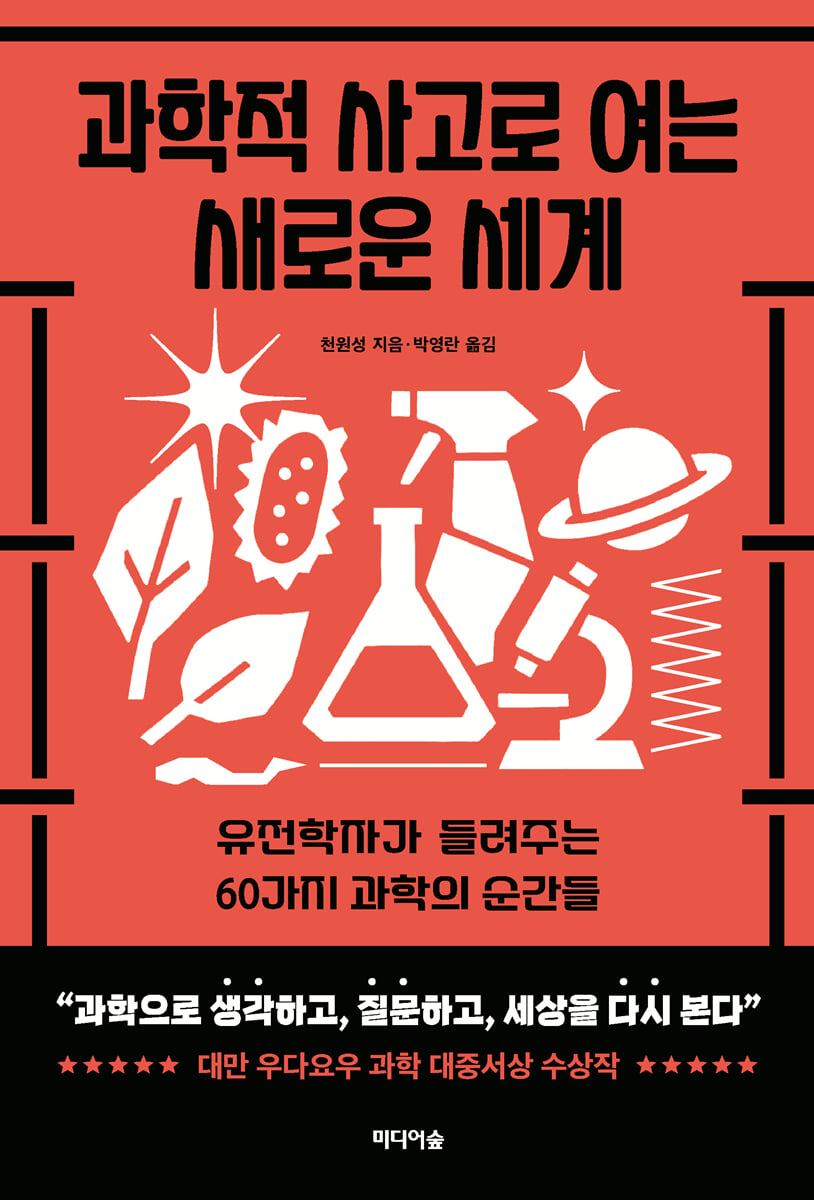
A new world opened by scientific thinking
 |
Description
Book Introduction
From everyday life on the dinner table to the genes inside our cells
“60 Scientific Perspectives on the World in a New Light”
Winner of the Udayo Science Popular Book Award
A delightful science essay by a world-renowned geneticist
"Every story is filled with surprise and exclamations of 'Ah! So that's what it was!'"
When the rice grains inside the hot cannon are pushed out by the strong pressure, they do not shatter into pieces, but rather, they maintain their original shape and transform into puffed rice cakes that have puffed up several times their size.
The infamous piranhas of the Amazon River are actually very timid and swim in schools to protect each other.
Contrary to our misconception, they are actually afraid of people.
"A New World Opened by Scientific Thinking" begins with this very trivial scene.
This book takes a fresh look at the small cracks in the world we have become so accustomed to that we have overlooked them, through the eyes of a geneticist.
The author, Cheon Won-seong, is a professor emeritus at National Yang-Ming University in Taiwan and a geneticist.
He is a person who analyzes DNA in the lab, but also observes the veins of tree leaves outside the window and thinks about the order of their structure.
As a winner of the Udayo Science Popular Book Award, this book also looks at the world through the eyes of a scientist, but expands that perspective with warmth.
More important than the results of the experiment is the attitude of asking, “Why is that so?” or, in other words, the power of questioning.
Ultimately, what this book teaches us is one thing.
Only those who think and ask questions can see the world in a new way.
When you open the book, 60 interesting articles follow each other like a continuous flow of thoughts.
The genetic code is read like sentences, and cells communicate with each other by sending and receiving signals.
While drinking soda water, I am left speechless at the thought of the atrocities humanity is inflicting on the environment, and while making coffee or frying rice noodles in the kitchen, I am explained the amazing technology called 'gel filtration'.
Following the gaze of a geneticist, a new world of scientific knowledge not covered in textbooks unfolds, allowing us to naturally understand scientific phenomena and principles hidden in our daily lives, as well as important scientific thinking methods and concepts that can easily be overlooked.
In Taiwan, the book was praised as “a living, breathing science outside the textbook.”
Another high school science teacher commented, “This book is truly an enjoyable journey through the joys of science.”
Can a scientist's writing be this warm, entertaining, and exciting? This book proves it.
“60 Scientific Perspectives on the World in a New Light”
Winner of the Udayo Science Popular Book Award
A delightful science essay by a world-renowned geneticist
"Every story is filled with surprise and exclamations of 'Ah! So that's what it was!'"
When the rice grains inside the hot cannon are pushed out by the strong pressure, they do not shatter into pieces, but rather, they maintain their original shape and transform into puffed rice cakes that have puffed up several times their size.
The infamous piranhas of the Amazon River are actually very timid and swim in schools to protect each other.
Contrary to our misconception, they are actually afraid of people.
"A New World Opened by Scientific Thinking" begins with this very trivial scene.
This book takes a fresh look at the small cracks in the world we have become so accustomed to that we have overlooked them, through the eyes of a geneticist.
The author, Cheon Won-seong, is a professor emeritus at National Yang-Ming University in Taiwan and a geneticist.
He is a person who analyzes DNA in the lab, but also observes the veins of tree leaves outside the window and thinks about the order of their structure.
As a winner of the Udayo Science Popular Book Award, this book also looks at the world through the eyes of a scientist, but expands that perspective with warmth.
More important than the results of the experiment is the attitude of asking, “Why is that so?” or, in other words, the power of questioning.
Ultimately, what this book teaches us is one thing.
Only those who think and ask questions can see the world in a new way.
When you open the book, 60 interesting articles follow each other like a continuous flow of thoughts.
The genetic code is read like sentences, and cells communicate with each other by sending and receiving signals.
While drinking soda water, I am left speechless at the thought of the atrocities humanity is inflicting on the environment, and while making coffee or frying rice noodles in the kitchen, I am explained the amazing technology called 'gel filtration'.
Following the gaze of a geneticist, a new world of scientific knowledge not covered in textbooks unfolds, allowing us to naturally understand scientific phenomena and principles hidden in our daily lives, as well as important scientific thinking methods and concepts that can easily be overlooked.
In Taiwan, the book was praised as “a living, breathing science outside the textbook.”
Another high school science teacher commented, “This book is truly an enjoyable journey through the joys of science.”
Can a scientist's writing be this warm, entertaining, and exciting? This book proves it.
- You can preview some of the book's contents.
Preview
index
Recommendation 1: A New World Opened by Scientific Thinking
Recommendation 2: Vivid Science in Everyday Life
Recommendation 3: Science, the Practice of Life
Recommendation 4: A scientist with both reason and emotion
Recommendation 5: A wondrous journey beyond the textbook
Recommendation 6: A book that will bring a bountiful harvest to its readers.
Recommendation 7: The Excitement of Science
Recommendation 8: Science in Everyday Life, Moments of Discovery
Entering_A fruit filled with satisfaction and joy
PART 1 The Science of Eating, Drinking, and Enjoying
01 Yuzu, the tree that gives generously
02 Food fired from a cannon
03 The Enlightenment of Potatoes and Fried Rice Noodles
04 Pudding and Gongbao Jiding (?保?丁)
05 Carbonated water, good for people, bad for coral
06 Nucleic Acids are the Cause of the Problem
07 Piranhas are actually afraid of people.
08 Bamboo helicopters don't know Bernoulli's principle.
09 From Billiards to Earth
10 Appropriate size
11 Statistics under the horseshoe
12 Water hanging in the air
PART 2: The Scientist's Reason and Emotion
13 The path to science is inevitably fraught with setbacks.
14 The Pigeon Breeder and the Garden Monk
15 Darwin's Deep Suffering
16 Research and Honor
17 The Paradox of Genes and the Romanticism of Physicists
18 A Creek to Be Remembered Forever
19 Mono's Ultimate Challenge
20 test tubes and pen holders
21 The Reason and Emotion of Scientists
22 Whether it's a rabbit or a turtle
23 Sunshine, volleyball, and coffee outside the lab
24 Complementary, perfect harmony
PART 3 Scientific Spirit and Research Attitude
25 Let's speak properly and do it properly
26 What to ask and how to ask it?
27 The unexpected and the unthinkable
28 Illusions of Causality
29 We must remove the unnecessary and leave the essence.
30 Skip Black Box
31 Nature never creates disconnection
32 My friend was the 'devil's advocate' 33 A necessary mistake
34 The Joy of Solving Puzzles and Discovery
35 Critical Mass Thinking
Without genes, we'd be like a deserted island.
PART 4: GENE, CODE, EVOLUTION
37 Touching the DNA of a Blind Person
38 Does it matter whether you turn left or right?
39 Remember that DNA is an acid!
40 DNA in the Bathtub 41 DNA Swimming Competition
42 The Magician of Magicians
43 Four strands of DNA encountered by chance
44 Different Paths, One Cryptosystem
45 Which came first, protein or RNA?
46 Mutations, Change and Change Again
47 When things get tough, they change, and when they change, they connect: The Story of Evolution
48 Evolution of Living Fossils
PART 5: THE PERIODS AND INTERACTIONS OF LIFE
49 The power of chain reactions
50 Hide and Seek with Viruses
51 Ways to Fight Viruses
52 Whispers of Germs
53 Herald's Cavalry 54 Identifying Allies and Enemies of the Genetic Molecule
55 Viruses that are weak to alcohol
56 Competition among peers, where does it end?
57 Enemy of the Enemy
58 The Secret of the Hidden Sequence in the Bee Genealogy
59 Bee Street Dance
60 Evolution also evolves
Recommendation 2: Vivid Science in Everyday Life
Recommendation 3: Science, the Practice of Life
Recommendation 4: A scientist with both reason and emotion
Recommendation 5: A wondrous journey beyond the textbook
Recommendation 6: A book that will bring a bountiful harvest to its readers.
Recommendation 7: The Excitement of Science
Recommendation 8: Science in Everyday Life, Moments of Discovery
Entering_A fruit filled with satisfaction and joy
PART 1 The Science of Eating, Drinking, and Enjoying
01 Yuzu, the tree that gives generously
02 Food fired from a cannon
03 The Enlightenment of Potatoes and Fried Rice Noodles
04 Pudding and Gongbao Jiding (?保?丁)
05 Carbonated water, good for people, bad for coral
06 Nucleic Acids are the Cause of the Problem
07 Piranhas are actually afraid of people.
08 Bamboo helicopters don't know Bernoulli's principle.
09 From Billiards to Earth
10 Appropriate size
11 Statistics under the horseshoe
12 Water hanging in the air
PART 2: The Scientist's Reason and Emotion
13 The path to science is inevitably fraught with setbacks.
14 The Pigeon Breeder and the Garden Monk
15 Darwin's Deep Suffering
16 Research and Honor
17 The Paradox of Genes and the Romanticism of Physicists
18 A Creek to Be Remembered Forever
19 Mono's Ultimate Challenge
20 test tubes and pen holders
21 The Reason and Emotion of Scientists
22 Whether it's a rabbit or a turtle
23 Sunshine, volleyball, and coffee outside the lab
24 Complementary, perfect harmony
PART 3 Scientific Spirit and Research Attitude
25 Let's speak properly and do it properly
26 What to ask and how to ask it?
27 The unexpected and the unthinkable
28 Illusions of Causality
29 We must remove the unnecessary and leave the essence.
30 Skip Black Box
31 Nature never creates disconnection
32 My friend was the 'devil's advocate' 33 A necessary mistake
34 The Joy of Solving Puzzles and Discovery
35 Critical Mass Thinking
Without genes, we'd be like a deserted island.
PART 4: GENE, CODE, EVOLUTION
37 Touching the DNA of a Blind Person
38 Does it matter whether you turn left or right?
39 Remember that DNA is an acid!
40 DNA in the Bathtub 41 DNA Swimming Competition
42 The Magician of Magicians
43 Four strands of DNA encountered by chance
44 Different Paths, One Cryptosystem
45 Which came first, protein or RNA?
46 Mutations, Change and Change Again
47 When things get tough, they change, and when they change, they connect: The Story of Evolution
48 Evolution of Living Fossils
PART 5: THE PERIODS AND INTERACTIONS OF LIFE
49 The power of chain reactions
50 Hide and Seek with Viruses
51 Ways to Fight Viruses
52 Whispers of Germs
53 Herald's Cavalry 54 Identifying Allies and Enemies of the Genetic Molecule
55 Viruses that are weak to alcohol
56 Competition among peers, where does it end?
57 Enemy of the Enemy
58 The Secret of the Hidden Sequence in the Bee Genealogy
59 Bee Street Dance
60 Evolution also evolves
Detailed image
.jpg)
Into the book
** Anderson sealed the starch in a test tube and heated it in an oven until the starch turned golden brown.
Then he took out the test tube, put it in a wire mesh bag, and smashed it with a hammer.
As a result, in three test tubes the starch exploded like a shotgun, but in the fourth test tube the starch was fully cooked and formed a porous mass.
Anderson observed this under a microscope and discovered that the starch granules were expanding and exploding.
He had the brilliant idea that if he could apply this technique to bread making, it might be possible to make bread rise without yeast or baking soda.
** Because the cell density of plants is generally low, the concentration of purines is also relatively low.
However, in the growing points of plants, cell division is active, so the concentration of purines is higher.
Perhaps for this reason, the purine concentration in sprouts and young leaves was 2-3 times higher than in mature parts.
On the other hand, fruits are mainly composed of carbohydrates and cellulose, so they have relatively few cells and therefore do not have a high concentration of purines.
** Darwin suffered from illness throughout his life, and his children also suffered from poor health from an early age.
Three of their ten children died before they reached the age of ten, and three of the surviving children married but had no children.
When his second and third children died in infancy, he wrote to a friend expressing his concern that the deaths might have been the result of incest.
He also wrote to the British Parliament requesting an inquiry into the frequency of consanguineous marriages and the health of their children, but Parliament declined to do so.
** Professor Walter Harm from Germany published a paper showing that caffeine inhibits the photorepair mechanism of bacteria, making it impossible for them to repair damage caused by ultraviolet rays.
Back then, we often got together with the faculty in the evenings to play volleyball, and after that, we would joke around and say, "You shouldn't drink coffee before playing volleyball."
It wasn't until years later that we realized that humans had no natural light recovery mechanism in place, and that we had been worrying for nothing.
** A certain mountainous region has clean air and residents have long practiced healthy eating, yet the cancer rate in this area is higher than the national average.
Does this mean that clean air and a healthy diet actually cause cancer? Of course not.
The real reason is that people in this area live long lives.
Because age is one of the biggest risk factors that increases the likelihood of developing cancer.
** George Bernard Shaw said this:
“If you exchange one apple for one apple, we would still have only one apple.
But if you exchange your ideas with mine, we each end up with two ideas.”
Active interaction among scientists is essential to the success of modern science.
Great scientists and great discoveries never come into existence in a vacuum.
** Based on the principle of suppressor mutations, it can be seen that the same mutation can lead to completely different results in populations with different genetic backgrounds.
In fact, if you analyze the human genome database, you will find that there are people who carry lethal pathogenic mutations but do not develop the disease.
This could be interpreted as the presence of one or more suppressor mutations in their genome that offset the lethal mutation.
** The mRNA used in the COVID-19 vaccine was designed based on the S gene, which constitutes the spike protein on the surface of the virus.
They first chemically synthesize a DNA template of the gene in question, then transcribe and perform specific chemical modifications using RNA polymerase in a test tube.
Finally, the completed mRNA is wrapped in nanolipid particles and injected into the body while protected.
After injection, these particles are taken up by dendritic cells, which specialize in presenting antigens in the bloodstream.
The mRNA released from the particles is translated into the spike protein on the surface of the COVID-19 virus, which is then presented on the cell surface to stimulate the immune system.
** A friend once asked me if hard liquor could kill the coronavirus.
The alcohol content of high-quality liquor usually varies from 38 to 63%.
High-alcohol liquor can also be used as a temporary (albeit somewhat extravagant) disinfectant in emergency situations.
However, drinking it has no effect.
Because coronaviruses invade through the respiratory tract, not the digestive tract.
** There is a sentence in 『The Outline of the Future』 that I read with great interest.
“The old notion that humans invented tools is actually only half true.
More precisely, tools invented humans.”
How can tools invent humans? He continues.
“It was not humans but apes that first used tools.
But the tools they created eventually led to their extinction.”
Then he took out the test tube, put it in a wire mesh bag, and smashed it with a hammer.
As a result, in three test tubes the starch exploded like a shotgun, but in the fourth test tube the starch was fully cooked and formed a porous mass.
Anderson observed this under a microscope and discovered that the starch granules were expanding and exploding.
He had the brilliant idea that if he could apply this technique to bread making, it might be possible to make bread rise without yeast or baking soda.
** Because the cell density of plants is generally low, the concentration of purines is also relatively low.
However, in the growing points of plants, cell division is active, so the concentration of purines is higher.
Perhaps for this reason, the purine concentration in sprouts and young leaves was 2-3 times higher than in mature parts.
On the other hand, fruits are mainly composed of carbohydrates and cellulose, so they have relatively few cells and therefore do not have a high concentration of purines.
** Darwin suffered from illness throughout his life, and his children also suffered from poor health from an early age.
Three of their ten children died before they reached the age of ten, and three of the surviving children married but had no children.
When his second and third children died in infancy, he wrote to a friend expressing his concern that the deaths might have been the result of incest.
He also wrote to the British Parliament requesting an inquiry into the frequency of consanguineous marriages and the health of their children, but Parliament declined to do so.
** Professor Walter Harm from Germany published a paper showing that caffeine inhibits the photorepair mechanism of bacteria, making it impossible for them to repair damage caused by ultraviolet rays.
Back then, we often got together with the faculty in the evenings to play volleyball, and after that, we would joke around and say, "You shouldn't drink coffee before playing volleyball."
It wasn't until years later that we realized that humans had no natural light recovery mechanism in place, and that we had been worrying for nothing.
** A certain mountainous region has clean air and residents have long practiced healthy eating, yet the cancer rate in this area is higher than the national average.
Does this mean that clean air and a healthy diet actually cause cancer? Of course not.
The real reason is that people in this area live long lives.
Because age is one of the biggest risk factors that increases the likelihood of developing cancer.
** George Bernard Shaw said this:
“If you exchange one apple for one apple, we would still have only one apple.
But if you exchange your ideas with mine, we each end up with two ideas.”
Active interaction among scientists is essential to the success of modern science.
Great scientists and great discoveries never come into existence in a vacuum.
** Based on the principle of suppressor mutations, it can be seen that the same mutation can lead to completely different results in populations with different genetic backgrounds.
In fact, if you analyze the human genome database, you will find that there are people who carry lethal pathogenic mutations but do not develop the disease.
This could be interpreted as the presence of one or more suppressor mutations in their genome that offset the lethal mutation.
** The mRNA used in the COVID-19 vaccine was designed based on the S gene, which constitutes the spike protein on the surface of the virus.
They first chemically synthesize a DNA template of the gene in question, then transcribe and perform specific chemical modifications using RNA polymerase in a test tube.
Finally, the completed mRNA is wrapped in nanolipid particles and injected into the body while protected.
After injection, these particles are taken up by dendritic cells, which specialize in presenting antigens in the bloodstream.
The mRNA released from the particles is translated into the spike protein on the surface of the COVID-19 virus, which is then presented on the cell surface to stimulate the immune system.
** A friend once asked me if hard liquor could kill the coronavirus.
The alcohol content of high-quality liquor usually varies from 38 to 63%.
High-alcohol liquor can also be used as a temporary (albeit somewhat extravagant) disinfectant in emergency situations.
However, drinking it has no effect.
Because coronaviruses invade through the respiratory tract, not the digestive tract.
** There is a sentence in 『The Outline of the Future』 that I read with great interest.
“The old notion that humans invented tools is actually only half true.
More precisely, tools invented humans.”
How can tools invent humans? He continues.
“It was not humans but apes that first used tools.
But the tools they created eventually led to their extinction.”
--- From the text
Publisher's Review
The Wonderful World as Seen by a Geneticist
Life speaks constantly
This book teaches you how to listen to that voice.
Did you know that the slice of tangerine you're eating right now actually harbors the genetic maps of three wild species that originated thousands of years ago in the southeastern Himalayas? "A New World Opened by Scientific Thinking" begins with this astonishing question.
Yuzu, which has a long history with mankind and is even mentioned in China's 『Lüshi Chunqiu』 written in 239 BC, went through a complex crossbreeding process to become the 'mother and grandmother' of today's grapefruit and sweet orange.
The author traces the evolution of yuzu, exploring how life understands itself and relates to the world.
Instead of a laboratory, this book observes everyday scenes.
The logic of science awakens in familiar objects and phenomena, and our common sense is gradually shaken.
For example, the fate of life is hidden even in the simple element of a living thing's 'size'.
Renowned evolutionary scientist JBS
Citing Haldane's paper, the author mathematically proves that if King Kong existed in reality, he would be flattened by his own weight.
A small insect will drown if it drinks a sip of water, and a huge elephant can never jump.
We come to realize that the difference in size is not a simple quantitative change, but a qualitative change that determines the structure and nature of living things.
In this way, 『A New World Opened by Scientific Thinking』 moves freely between the laboratory and the kitchen, cells and human thought.
A scientist's gaze reaches out to everyday life, and ordinary moments turn into new discoveries.
Beyond the genetic lineage of citrus and the paradoxes of organism size, this book lightly pushes the boundaries of what we know.
In the figure-eight dance of honeybees, we decipher the order of language and mathematics, and in quorum sensing, where cells sense each other's presence and cooperate, we read the principles of complex society.
Furthermore, we explore the infinite possibilities of variation in living organisms through the G-quadruplex (G4), a hidden structure in DNA.
Ultimately, all of these stories come down to one question.
“Why does life express itself so complexly and beautifully?”
Training the depth of thought and the power of questioning
60 Scientific Insights
The book contains 60 interesting stories and rich knowledge about everyday objects and creatures, such as popcorn machines, refrigerators, grapefruits and yuzu, and the dance of bees.
Spanning five core topics—science in everyday life, the research and mindset of scientists, DNA, heredity, viruses, bacteria, and biological evolution—the book explores the intersections of science, art, and philosophy.
It kindly explains how amazing and fascinating science can be.
It also reminds us that science is an attitude toward looking at the world and a ‘method of observation.’
Cells move by sensing each other's presence, and humans live by sensing each other's thoughts.
The world of life and the world of humans are no different.
The author weaves together the most interesting everyday examples with cutting-edge scientific principles to reveal the structure of their resemblance.
This book teaches us the scientific thinking we need to live in an age of scientific revolution.
It makes you relearn life, the world, and rational thinking.
As we follow the process by which cells evolve over billions of years, the order in which nature replicates itself, and the process by which humans understand the world through questions, we soon come to understand the essence of the power of thinking.
We come to realize that science is not a discipline that seeks answers, but rather a skill of the mind that is curious about the world.
It not only brings the joy of knowledge but also instantly awakens logical thinking skills.
The more people find science difficult, the more accessible this book becomes.
Even if you've never stepped foot inside a lab, if you've ever heard the pop of a popping machine or watched a documentary about a school of piranhas, you've already encountered science.
Science is not far away.
The moment you realize that, everyday life becomes a little more mysterious and the world begins to move again.
This book is seen through the eyes of a scientist, asked with the depth of a philosopher, and written in the language of a poet.
By deciphering the code of life and discovering the truth of the world, you will gradually come to understand the secrets hidden in your daily life.
Life speaks constantly
This book teaches you how to listen to that voice.
Did you know that the slice of tangerine you're eating right now actually harbors the genetic maps of three wild species that originated thousands of years ago in the southeastern Himalayas? "A New World Opened by Scientific Thinking" begins with this astonishing question.
Yuzu, which has a long history with mankind and is even mentioned in China's 『Lüshi Chunqiu』 written in 239 BC, went through a complex crossbreeding process to become the 'mother and grandmother' of today's grapefruit and sweet orange.
The author traces the evolution of yuzu, exploring how life understands itself and relates to the world.
Instead of a laboratory, this book observes everyday scenes.
The logic of science awakens in familiar objects and phenomena, and our common sense is gradually shaken.
For example, the fate of life is hidden even in the simple element of a living thing's 'size'.
Renowned evolutionary scientist JBS
Citing Haldane's paper, the author mathematically proves that if King Kong existed in reality, he would be flattened by his own weight.
A small insect will drown if it drinks a sip of water, and a huge elephant can never jump.
We come to realize that the difference in size is not a simple quantitative change, but a qualitative change that determines the structure and nature of living things.
In this way, 『A New World Opened by Scientific Thinking』 moves freely between the laboratory and the kitchen, cells and human thought.
A scientist's gaze reaches out to everyday life, and ordinary moments turn into new discoveries.
Beyond the genetic lineage of citrus and the paradoxes of organism size, this book lightly pushes the boundaries of what we know.
In the figure-eight dance of honeybees, we decipher the order of language and mathematics, and in quorum sensing, where cells sense each other's presence and cooperate, we read the principles of complex society.
Furthermore, we explore the infinite possibilities of variation in living organisms through the G-quadruplex (G4), a hidden structure in DNA.
Ultimately, all of these stories come down to one question.
“Why does life express itself so complexly and beautifully?”
Training the depth of thought and the power of questioning
60 Scientific Insights
The book contains 60 interesting stories and rich knowledge about everyday objects and creatures, such as popcorn machines, refrigerators, grapefruits and yuzu, and the dance of bees.
Spanning five core topics—science in everyday life, the research and mindset of scientists, DNA, heredity, viruses, bacteria, and biological evolution—the book explores the intersections of science, art, and philosophy.
It kindly explains how amazing and fascinating science can be.
It also reminds us that science is an attitude toward looking at the world and a ‘method of observation.’
Cells move by sensing each other's presence, and humans live by sensing each other's thoughts.
The world of life and the world of humans are no different.
The author weaves together the most interesting everyday examples with cutting-edge scientific principles to reveal the structure of their resemblance.
This book teaches us the scientific thinking we need to live in an age of scientific revolution.
It makes you relearn life, the world, and rational thinking.
As we follow the process by which cells evolve over billions of years, the order in which nature replicates itself, and the process by which humans understand the world through questions, we soon come to understand the essence of the power of thinking.
We come to realize that science is not a discipline that seeks answers, but rather a skill of the mind that is curious about the world.
It not only brings the joy of knowledge but also instantly awakens logical thinking skills.
The more people find science difficult, the more accessible this book becomes.
Even if you've never stepped foot inside a lab, if you've ever heard the pop of a popping machine or watched a documentary about a school of piranhas, you've already encountered science.
Science is not far away.
The moment you realize that, everyday life becomes a little more mysterious and the world begins to move again.
This book is seen through the eyes of a scientist, asked with the depth of a philosopher, and written in the language of a poet.
By deciphering the code of life and discovering the truth of the world, you will gradually come to understand the secrets hidden in your daily life.
GOODS SPECIFICS
- Date of issue: December 10, 2025
- Page count, weight, size: 328 pages | 153*225*30mm
- ISBN13: 9791158742584
- ISBN10: 1158742584
You may also like
카테고리
korean


korean

![GQ KOREA Mark (Monthly): December [2025]](http://librairie.coreenne.fr/cdn/shop/files/8ef265dbbfbf186523ed75ba7319009d.jpg?v=1765340328&width=3840)


