

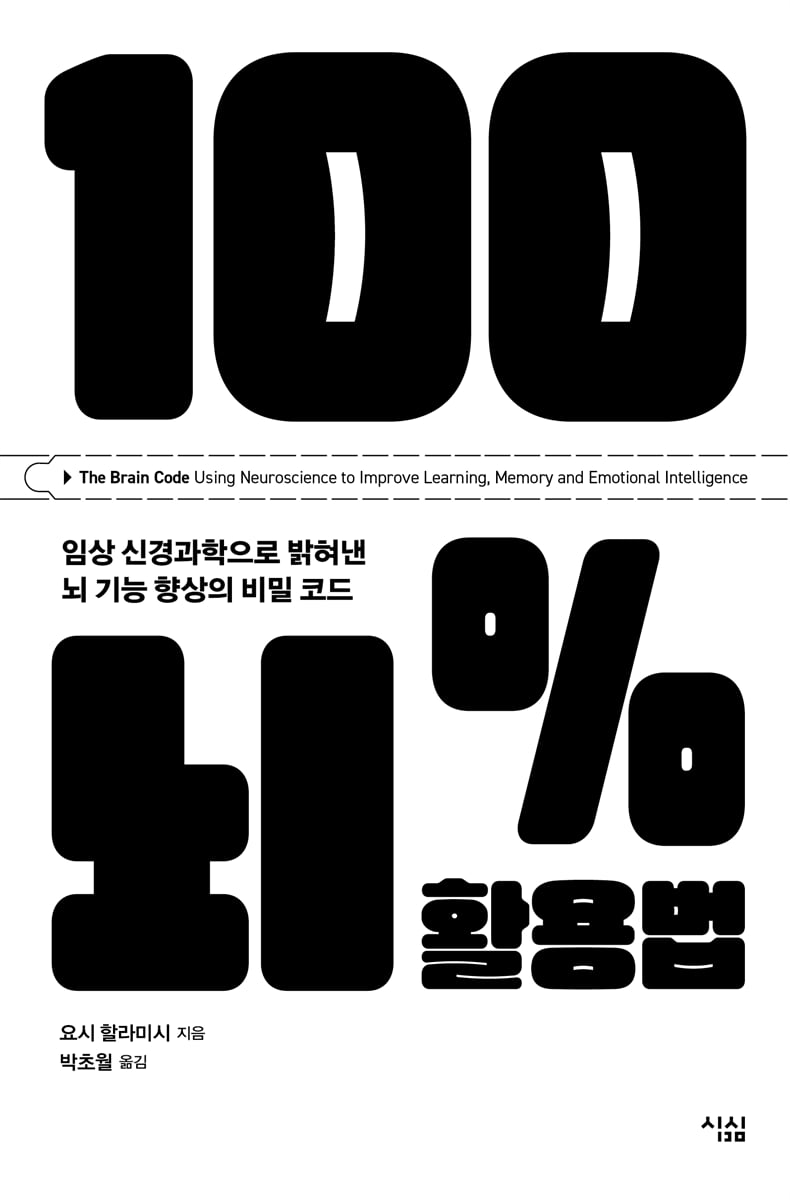
100% brain utilization
 |
Description
Book Introduction
The secret code to use your brain 100%!
Learning, memory, creativity, emotions, etc… …
How to Improve Brain Function with Brain Codes Discovered Through Clinical Neuroscience
Are brain functions like the common aptitude for learning and memory innate? Do brain functions also age over time? Can emotions like anxiety, sensations, and even personality traits be controlled and transformed through deliberate training? Based on cutting-edge clinical neuroscience, SimSim's book, "The Brain Code: Using Neuroscience to Improve Learning, Memory, and Emotional Intelligence," asserts that by harnessing the brain's operating code, we can fully awaken our brain's potential and enhance its functions.
The author, a clinical neuroscientist who graduated from the world-renowned Technion Institute of Technology, Israel's medical school, and completed a postdoctoral fellowship at the Weizmann Institute of Science, which has produced numerous Nobel Prize-winning scientists, uses the latest neuroscience research and his own clinical experience to uncover the code that drives how the brain works and guides readers through 15 chapters on how to utilize it to improve brain function.
It breaks down memory, learning, cognition, emotions, senses, eating habits, physical health, etc., and explains how the brain works and why we have always been vulnerable in certain areas. It also introduces ways to easily utilize the so-called 'brain code' in daily life.
By understanding the brain principles the author explains and applying the brain code he presents to your daily life, you can improve the reasons for forgetting, poor learning efficiency, and emotional ups and downs.
In addition, it is of great help in solving the problems that arise from not being able to concentrate on work or study, or the small and big difficulties in daily life that arise from frequently forgetting appointments.
Therefore, 『100% Brain Utilization』 is a scientific self-development book that opens up a healthier and better tomorrow by maximizing the brain's inherent potential to increase productivity while reducing stress that harms physical and mental health.
Learning, memory, creativity, emotions, etc… …
How to Improve Brain Function with Brain Codes Discovered Through Clinical Neuroscience
Are brain functions like the common aptitude for learning and memory innate? Do brain functions also age over time? Can emotions like anxiety, sensations, and even personality traits be controlled and transformed through deliberate training? Based on cutting-edge clinical neuroscience, SimSim's book, "The Brain Code: Using Neuroscience to Improve Learning, Memory, and Emotional Intelligence," asserts that by harnessing the brain's operating code, we can fully awaken our brain's potential and enhance its functions.
The author, a clinical neuroscientist who graduated from the world-renowned Technion Institute of Technology, Israel's medical school, and completed a postdoctoral fellowship at the Weizmann Institute of Science, which has produced numerous Nobel Prize-winning scientists, uses the latest neuroscience research and his own clinical experience to uncover the code that drives how the brain works and guides readers through 15 chapters on how to utilize it to improve brain function.
It breaks down memory, learning, cognition, emotions, senses, eating habits, physical health, etc., and explains how the brain works and why we have always been vulnerable in certain areas. It also introduces ways to easily utilize the so-called 'brain code' in daily life.
By understanding the brain principles the author explains and applying the brain code he presents to your daily life, you can improve the reasons for forgetting, poor learning efficiency, and emotional ups and downs.
In addition, it is of great help in solving the problems that arise from not being able to concentrate on work or study, or the small and big difficulties in daily life that arise from frequently forgetting appointments.
Therefore, 『100% Brain Utilization』 is a scientific self-development book that opens up a healthier and better tomorrow by maximizing the brain's inherent potential to increase productivity while reducing stress that harms physical and mental health.
index
As we go further, our brains can become better.
Chapter 1: A Brief Look at Brain Evolution
How Did the Brain Evolve? │The Brain's Survival Algorithm: Brain Code
Chapter 2: The Brain's Memory Techniques for Improving Survival Abilities
What is memory? │Intuition is the result of memory. │Two types of conscious memory. │Two approaches to improving memory. │The brain only thinks about the future. │Forgetting increases survival rates. │Two other ways to improve memory.
Chapter 3: Understanding the Brain and How to Control Your Emotions
Emotions Create Experiences│Two Core Emotions of Evolution│Training to Overcome Fear│Meaning Builds Mental Immunity│The Motivational Triangle: Balancing Pleasure and Fear
Chapter 4: Brain Training to Increase Positivity
The first step to improving your emotional regulation skills│The second step to improving your emotional regulation skills
Chapter 5: How to Use Your Brain to Feel Your Best
Moods that affect our perception of the world | Mood disorders that reduce brain activity | Mood disorders that increase brain activity | How to improve your mood
Chapter 6: The Eight Senses: The Core Ways Emotions Work
Sight: You only see what interests you│Taste and smell: Connections that expand taste│Touch: Emotions are conveyed just by holding hands│Nociception: Danger signals sent through pain│Equilibrium: Body balance cannot be maintained with muscles alone│Hearing: Emotions change depending on what you hear│Synesthesia: Confusing senses that have disappeared in order to survive│Connection: Emotions are conveyed through the brain
Chapter 7: How to Unleash Your Brain's Hidden Creativity
The brain decides what we should see. How to use past experiences to change the future. Seven ways to improve creativity.
Chapter 8: How to Use Your Brain to Improve Learning Ability
Motivation Drives Learning Effectiveness│Three Motivating Study Methods│The Most Effective Way to Study for Exams
Chapter 9: Using Your Brain Can Change Your Personality
Stimuli that form the foundation of personality│Sensory output that shapes personality
Chapter 10: Superior Brain Function Depends on Physical Health
How the Brain Moves the Body | Muscle Activation and Brain Function | Sleep Keeps Neurons Healthy | Simple Techniques for Quality Sleep
Chapter 11: How to Improve Your Eating Habits by Using Your Brain's Code
Why and What to Eat | False Hunger | Eating Disorders That Have Nothing to Do with Appetite | Two Ways to Detox from Sugar
Chapter 12: Red Flags for Brain Utilization: Amygdala Dysfunction
The Absence of Fear│When Anxiety Is Excessive│Two Ways to Manage Anxiety
Chapter 13: How to Keep Your Brain Functioning at Peak Level
The Brain's Manager, Executive Function | A Function That Helps Us Understand Others | The Unexpected Benefits of ADHD | Two Ways to Improve Your Theory of Mind
Chapter 14: The Self-Healing Brain
Commands from the Top│Healing Using Top-Down Commands│The Impact of Reason on Emotional Healing│How to Improve Top-Down Processing Abilities
Chapter 15: Love is possible with the head too
What is love? Even love requires motivation. How long does love at first sight last? Why do feelings of love fluctuate? Is it the head or the heart? How to improve self-love and self-esteem.
As we go out, we can control brain function and behavior.
Acknowledgements
References
Chapter 1: A Brief Look at Brain Evolution
How Did the Brain Evolve? │The Brain's Survival Algorithm: Brain Code
Chapter 2: The Brain's Memory Techniques for Improving Survival Abilities
What is memory? │Intuition is the result of memory. │Two types of conscious memory. │Two approaches to improving memory. │The brain only thinks about the future. │Forgetting increases survival rates. │Two other ways to improve memory.
Chapter 3: Understanding the Brain and How to Control Your Emotions
Emotions Create Experiences│Two Core Emotions of Evolution│Training to Overcome Fear│Meaning Builds Mental Immunity│The Motivational Triangle: Balancing Pleasure and Fear
Chapter 4: Brain Training to Increase Positivity
The first step to improving your emotional regulation skills│The second step to improving your emotional regulation skills
Chapter 5: How to Use Your Brain to Feel Your Best
Moods that affect our perception of the world | Mood disorders that reduce brain activity | Mood disorders that increase brain activity | How to improve your mood
Chapter 6: The Eight Senses: The Core Ways Emotions Work
Sight: You only see what interests you│Taste and smell: Connections that expand taste│Touch: Emotions are conveyed just by holding hands│Nociception: Danger signals sent through pain│Equilibrium: Body balance cannot be maintained with muscles alone│Hearing: Emotions change depending on what you hear│Synesthesia: Confusing senses that have disappeared in order to survive│Connection: Emotions are conveyed through the brain
Chapter 7: How to Unleash Your Brain's Hidden Creativity
The brain decides what we should see. How to use past experiences to change the future. Seven ways to improve creativity.
Chapter 8: How to Use Your Brain to Improve Learning Ability
Motivation Drives Learning Effectiveness│Three Motivating Study Methods│The Most Effective Way to Study for Exams
Chapter 9: Using Your Brain Can Change Your Personality
Stimuli that form the foundation of personality│Sensory output that shapes personality
Chapter 10: Superior Brain Function Depends on Physical Health
How the Brain Moves the Body | Muscle Activation and Brain Function | Sleep Keeps Neurons Healthy | Simple Techniques for Quality Sleep
Chapter 11: How to Improve Your Eating Habits by Using Your Brain's Code
Why and What to Eat | False Hunger | Eating Disorders That Have Nothing to Do with Appetite | Two Ways to Detox from Sugar
Chapter 12: Red Flags for Brain Utilization: Amygdala Dysfunction
The Absence of Fear│When Anxiety Is Excessive│Two Ways to Manage Anxiety
Chapter 13: How to Keep Your Brain Functioning at Peak Level
The Brain's Manager, Executive Function | A Function That Helps Us Understand Others | The Unexpected Benefits of ADHD | Two Ways to Improve Your Theory of Mind
Chapter 14: The Self-Healing Brain
Commands from the Top│Healing Using Top-Down Commands│The Impact of Reason on Emotional Healing│How to Improve Top-Down Processing Abilities
Chapter 15: Love is possible with the head too
What is love? Even love requires motivation. How long does love at first sight last? Why do feelings of love fluctuate? Is it the head or the heart? How to improve self-love and self-esteem.
As we go out, we can control brain function and behavior.
Acknowledgements
References
Detailed image
Into the book
In each chapter, readers will encounter brain functions closely related to daily life.
At first, you can gradually get to know each other by learning its functions, and eventually you can become friends.
Then we will look at how to improve each feature.
It is up to the reader to decide whether to be content with simply becoming friends or to take a more proactive approach and embark on a journey toward self-improvement.
(……) With the understanding and knowledge gained through “100% Brain Utilization,” you will be able to strengthen your immunity against diseases.
You will also gain the strength to turn everyday crises, such as not being able to focus properly at work or frequently forgetting appointments, into opportunities that lead to relationship problems.
--- p.10, from “Introduction: Our Brains Can Get Better”
Brain code is an amazing invention, but there's a problem.
This code was written millions of years ago, and since then, our environment and way of life have changed dramatically.
Today we live relatively affluent lives.
There is no need to be hunted by wild beasts anymore.
But they feel threatened by rising prices, demanding bosses, and the possibility of layoffs.
(……) Does that mean we are completely at the mercy of a brain algorithm suited to primitive humans? Absolutely not.
Of course, the brain code, the basis of brain activity, was written a long time ago.
However, we have the ability to change our brain patterns and adjust them to suit our needs.
This ability is natural and instinctive, but to use it intentionally, you must first understand the brain itself, the environment it lives in, and the brain's operating system.
--- p.23, from “Chapter 1: A Brief Look at the Evolution of the Brain”
Memories are of interest to the brain only when they help facilitate and ensure survival.
So if we can convince our brain that the message we want to preserve is essential for survival, it will encode that message, store it, and retrieve it whenever we need it.
This process works optimally only when the message is transmitted within the brain in its own language (internal algorithm).
And this language relies on five elements: motivation, focus, emotion, sensation, and a combination of different senses.
--- p.44, from “Chapter 2: Brain Memory Techniques to Increase Survival Ability”
Brain research has shown that people who find meaning in their lives and actions develop a "mental immunity" that protects them from the negative stimuli of everyday life.
Negative stimuli come in many forms, such as insults, misunderstandings, and fights.
A meaningful life increases the likelihood of achieving happiness in situations where one's strengths are lacking.
(……) Happiness is a difficult concept to define and can be interpreted in many different ways.
The philosopher Aristotle recognized over two thousand years ago that happiness comes from the combination of purpose and pleasure.
--- p.85, from “Chapter 3: Understanding the Brain and Controlling Emotions”
The key to dealing with emotions is balance.
We must react with the appropriate emotion at the appropriate moment and apply the desired intensity of emotion to the current situation.
To do this, it is a good idea to wake up in the morning and focus on various positive emotions.
It's fine to apply those emotions when you find yourself in a situation that calls for them later, but remember to use them with the appropriate intensity for the situation! (...) All negative and positive emotions can be considered derivatives of two basic core emotions: fear and pleasure, and they have similar effects on the amygdala.
Negative emotions, such as frustration and jealousy, stimulate the amygdala, causing us to perceive the environment as a threat.
Conversely, positive emotions such as joy and affection make us feel satisfied with our current situation.
(……) How rationally we think and how accurately we perceive reality is determined by the emotions we experience at that moment.
--- p.93~94, from “Chapter 4 Brain Training Methods to Increase Positivity”
The most useful emotional distinctions to understand when considering any mood-related issue are:
It is about distinguishing between emotions that trigger impulses that increase brain activity and emotions that leave the brain in a passive state without triggering a brain response.
Examples of emotions that induce brain activity include joy and jealousy.
We categorize joy as positive and jealousy as negative, but categorizing the two emotions as positive or negative has nothing to do with mood.
When considering mood, both fall into the category of increasing brain activity.
On the other hand, emotions such as satisfaction and sadness do not produce this effect and are therefore classified as a category that puts the brain in a passive state.
(……) The brain's only goal is survival.
So the brain chooses the best mood to achieve this goal at each moment.
In other words, if the brain "thinks" it needs to actively strive for survival right now, it chooses a mood that increases brain activity at the end of the mood spectrum.
Conversely, if slowing down brain activity helps you survive, you might opt for a more passive mood at the other end of the spectrum.
--- p.106~107, from “Chapter 5 How to Create the Best Mood Using Your Brain”
The sense of touch is powerful.
In particular, hugs have enormous potential to bring people closer together and foster bonds between friends, couples, parents, and children.
Hugs also serve as a medium of emotional connection between people.
The subcortex draws conclusions about the emotional state of the person hugging us based on the intensity and duration of the hug.
At the same time, our emotional state is also conveyed to the other person.
The ability to discern the emotional state of others allows for mutual empathy between friends and couples.
--- p.159, from “Chapter 6: The Core Ways Emotions Work, The Eight Senses”
The idea that the brain creates illusions about reality is not a new discovery.
As mentioned earlier, Descartes realized this fact in the 17th century.
More recently, neuroscientist Chris Frith put it well in the catchy phrase, “The mind creates our reality.”
The brain presents us with the reality that will most benefit our survival.
When we focus on a specific object (the number of times people pass a ball back and forth), our brain concludes that it is most important for our current survival.
At the same time, the senses ignore all other stimuli (gorillas) that are registered at the same time.
--- p.169, from “Chapter 7: How to Unleash the Creativity Hidden in Your Brain”
Let's think of motivation as a neural network that is activated during the learning process, with two forces acting separately or simultaneously.
And let's think of the two forces as the tendency to seek pleasure and the desire to escape from threat.
Animal training (a type of learning) is an example of how the activation of both forces is effective.
Dogs are strongly motivated to learn tricks in the pursuit of pleasure (praise, belly rubs, treats).
Training can also be done to capitalize on the instinctive desire to escape from threats.
(……) Another force that motivates is meaning.
Meaning is far more effective than the opposing forces of pleasure and fear.
When we give meaning to a particular thought or object (we consider it to be related to our family, work, or hobbies), we perceive that thought or object as very important.
The results of learning in this way tend to be much better than usual, more proportional to the resources invested.
Motivation derived from meaning is generally stable, promotes physical and mental health and well-being, and awakens curiosity and creativity.
--- p.193~194, from “Chapter 8 How to Use the Brain to Improve Learning Ability”
From what we have seen so far, we can see that personality traits influence behavior.
But the discussion about human behavior doesn't end here.
Now let's move on to the two types of behavior that characterize us.
The first type is called personality bypass behavior, or planned behavior.
(……) Let me explain with an example.
If you understand that you have to do your best in an interview, you will do whatever it takes to hide your inherently outward and insecure personality.
The good news is that we can all engage in some degree of 'planned action'.
This ability to act in ways that bypass personality allows many people to navigate awkward social situations appropriately.
(……) The second type is reactive behavior.
This behavior occurs when we are faced with unexpected situations and is an honest reflection of our personality traits.
--- p.231~232, from “Chapter 9: You Can Change Your Personality by Using Your Brain”
Brain researchers have discovered interesting insights into the link between dreams and brain health.
To manage the information that enters the brain while we are awake, the cortex must work even at night.
At this time, awareness for information processing is activated, and dreams are created in the process.
This explanation of the function of dreams does not contradict psychological theories that claim that dreams play a crucial role in bringing inner conflicts into awareness.
--- p.254, from “Chapter 10: Superior Brain Function Depends on Physical Health”
The brain can be satisfied by consuming only as much food as it needs to repair brain and body damage.
We have mental tools to regulate our intake.
And with that tool, we can determine the types and amounts of food that satisfy our actual physiological needs, not those rooted in our evolutionary history.
Of course, these changes don't happen overnight.
Success requires a learning process that requires motivation, but it is certainly possible.
Deep learning about food could reprogram the brain, shifting hunter-gatherer impulses from their basic patterns to ones more suited to modern life.
--- p.276~277, from “Chapter 11 How to Improve Eating Habits Using the Brain Code”
Anxiety is a natural emotion that forms an essential part of everyday life.
But for these emotions to do their job and be helpful, one important condition must be met.
The amygdala is supposed to respond to reality, but the problem is that it doesn't always do so.
Sometimes, even when there's no need to do so, the amygdala sounds an alarm at an overly high level, sending a warning to the rest of the brain.
There are also cases where the opposite is true.
In reality, in a threatening situation, the amygdala does not send a warning and reacts indifferently to the threat.
This is more common than you might think, as only a small number of people with highly developed emotional intelligence can effectively operate their amygdala.
--- p.289~290, from “Chapter 12: Red Flags of Brain Activity, Amygdala Dysfunction”
When emotions are not properly managed, motor functions are affected, resulting in changes in movement.
When we are under extreme stress, both the brain's ability to plan our body's movements in real time and the precision with which we do so are impaired.
Likewise, the senses do not function properly.
Stress heightens our sense of touch and focuses our gaze on threatening stimuli.
Cognitive deficits manifest as memory impairment and impaired thinking ability, while stressful situations weaken the immune system and cause malfunctions in the heart, lungs, and other organs.
But overall, emotional management goes smoothly.
This is thanks to evolution and the brain's recognition that living in harmony with others in society is essential for human survival.
--- p.313, from “Chapter 13 How to Maintain Brain Function at Peak Level”
The effectiveness of using meditation and imagery as therapeutic tools based on top-down processing has exceeded everyone's expectations.
Brain researchers have realized that imagination has a very broad impact on how the brain is shaped throughout our daily lives.
When we imagine something, we can focus on it and expect that imagination to come true.
When these two elements are combined appropriately, it can be a very effective treatment tool.
--- p.342, from “Chapter 14: The Self-Healing Brain”
The cortex's lab captures information from the senses and determines whether the person, object, or thought it perceives promotes long-term well-being.
If the judgment result is 'yes', the motivational neural network of the cortex is activated and love begins.
Let's say that love is repaid.
The warm and pleasant feelings that arise there stimulate a feeling of greater intimacy, which increases the intensity of the 'yes' response.
As feelings of love grow stronger, a greater desire for intimacy follows.
Conversely, if the lab's answer is 'no,' the motivational neural network is not activated, and feelings of love are not formed.
At first, you can gradually get to know each other by learning its functions, and eventually you can become friends.
Then we will look at how to improve each feature.
It is up to the reader to decide whether to be content with simply becoming friends or to take a more proactive approach and embark on a journey toward self-improvement.
(……) With the understanding and knowledge gained through “100% Brain Utilization,” you will be able to strengthen your immunity against diseases.
You will also gain the strength to turn everyday crises, such as not being able to focus properly at work or frequently forgetting appointments, into opportunities that lead to relationship problems.
--- p.10, from “Introduction: Our Brains Can Get Better”
Brain code is an amazing invention, but there's a problem.
This code was written millions of years ago, and since then, our environment and way of life have changed dramatically.
Today we live relatively affluent lives.
There is no need to be hunted by wild beasts anymore.
But they feel threatened by rising prices, demanding bosses, and the possibility of layoffs.
(……) Does that mean we are completely at the mercy of a brain algorithm suited to primitive humans? Absolutely not.
Of course, the brain code, the basis of brain activity, was written a long time ago.
However, we have the ability to change our brain patterns and adjust them to suit our needs.
This ability is natural and instinctive, but to use it intentionally, you must first understand the brain itself, the environment it lives in, and the brain's operating system.
--- p.23, from “Chapter 1: A Brief Look at the Evolution of the Brain”
Memories are of interest to the brain only when they help facilitate and ensure survival.
So if we can convince our brain that the message we want to preserve is essential for survival, it will encode that message, store it, and retrieve it whenever we need it.
This process works optimally only when the message is transmitted within the brain in its own language (internal algorithm).
And this language relies on five elements: motivation, focus, emotion, sensation, and a combination of different senses.
--- p.44, from “Chapter 2: Brain Memory Techniques to Increase Survival Ability”
Brain research has shown that people who find meaning in their lives and actions develop a "mental immunity" that protects them from the negative stimuli of everyday life.
Negative stimuli come in many forms, such as insults, misunderstandings, and fights.
A meaningful life increases the likelihood of achieving happiness in situations where one's strengths are lacking.
(……) Happiness is a difficult concept to define and can be interpreted in many different ways.
The philosopher Aristotle recognized over two thousand years ago that happiness comes from the combination of purpose and pleasure.
--- p.85, from “Chapter 3: Understanding the Brain and Controlling Emotions”
The key to dealing with emotions is balance.
We must react with the appropriate emotion at the appropriate moment and apply the desired intensity of emotion to the current situation.
To do this, it is a good idea to wake up in the morning and focus on various positive emotions.
It's fine to apply those emotions when you find yourself in a situation that calls for them later, but remember to use them with the appropriate intensity for the situation! (...) All negative and positive emotions can be considered derivatives of two basic core emotions: fear and pleasure, and they have similar effects on the amygdala.
Negative emotions, such as frustration and jealousy, stimulate the amygdala, causing us to perceive the environment as a threat.
Conversely, positive emotions such as joy and affection make us feel satisfied with our current situation.
(……) How rationally we think and how accurately we perceive reality is determined by the emotions we experience at that moment.
--- p.93~94, from “Chapter 4 Brain Training Methods to Increase Positivity”
The most useful emotional distinctions to understand when considering any mood-related issue are:
It is about distinguishing between emotions that trigger impulses that increase brain activity and emotions that leave the brain in a passive state without triggering a brain response.
Examples of emotions that induce brain activity include joy and jealousy.
We categorize joy as positive and jealousy as negative, but categorizing the two emotions as positive or negative has nothing to do with mood.
When considering mood, both fall into the category of increasing brain activity.
On the other hand, emotions such as satisfaction and sadness do not produce this effect and are therefore classified as a category that puts the brain in a passive state.
(……) The brain's only goal is survival.
So the brain chooses the best mood to achieve this goal at each moment.
In other words, if the brain "thinks" it needs to actively strive for survival right now, it chooses a mood that increases brain activity at the end of the mood spectrum.
Conversely, if slowing down brain activity helps you survive, you might opt for a more passive mood at the other end of the spectrum.
--- p.106~107, from “Chapter 5 How to Create the Best Mood Using Your Brain”
The sense of touch is powerful.
In particular, hugs have enormous potential to bring people closer together and foster bonds between friends, couples, parents, and children.
Hugs also serve as a medium of emotional connection between people.
The subcortex draws conclusions about the emotional state of the person hugging us based on the intensity and duration of the hug.
At the same time, our emotional state is also conveyed to the other person.
The ability to discern the emotional state of others allows for mutual empathy between friends and couples.
--- p.159, from “Chapter 6: The Core Ways Emotions Work, The Eight Senses”
The idea that the brain creates illusions about reality is not a new discovery.
As mentioned earlier, Descartes realized this fact in the 17th century.
More recently, neuroscientist Chris Frith put it well in the catchy phrase, “The mind creates our reality.”
The brain presents us with the reality that will most benefit our survival.
When we focus on a specific object (the number of times people pass a ball back and forth), our brain concludes that it is most important for our current survival.
At the same time, the senses ignore all other stimuli (gorillas) that are registered at the same time.
--- p.169, from “Chapter 7: How to Unleash the Creativity Hidden in Your Brain”
Let's think of motivation as a neural network that is activated during the learning process, with two forces acting separately or simultaneously.
And let's think of the two forces as the tendency to seek pleasure and the desire to escape from threat.
Animal training (a type of learning) is an example of how the activation of both forces is effective.
Dogs are strongly motivated to learn tricks in the pursuit of pleasure (praise, belly rubs, treats).
Training can also be done to capitalize on the instinctive desire to escape from threats.
(……) Another force that motivates is meaning.
Meaning is far more effective than the opposing forces of pleasure and fear.
When we give meaning to a particular thought or object (we consider it to be related to our family, work, or hobbies), we perceive that thought or object as very important.
The results of learning in this way tend to be much better than usual, more proportional to the resources invested.
Motivation derived from meaning is generally stable, promotes physical and mental health and well-being, and awakens curiosity and creativity.
--- p.193~194, from “Chapter 8 How to Use the Brain to Improve Learning Ability”
From what we have seen so far, we can see that personality traits influence behavior.
But the discussion about human behavior doesn't end here.
Now let's move on to the two types of behavior that characterize us.
The first type is called personality bypass behavior, or planned behavior.
(……) Let me explain with an example.
If you understand that you have to do your best in an interview, you will do whatever it takes to hide your inherently outward and insecure personality.
The good news is that we can all engage in some degree of 'planned action'.
This ability to act in ways that bypass personality allows many people to navigate awkward social situations appropriately.
(……) The second type is reactive behavior.
This behavior occurs when we are faced with unexpected situations and is an honest reflection of our personality traits.
--- p.231~232, from “Chapter 9: You Can Change Your Personality by Using Your Brain”
Brain researchers have discovered interesting insights into the link between dreams and brain health.
To manage the information that enters the brain while we are awake, the cortex must work even at night.
At this time, awareness for information processing is activated, and dreams are created in the process.
This explanation of the function of dreams does not contradict psychological theories that claim that dreams play a crucial role in bringing inner conflicts into awareness.
--- p.254, from “Chapter 10: Superior Brain Function Depends on Physical Health”
The brain can be satisfied by consuming only as much food as it needs to repair brain and body damage.
We have mental tools to regulate our intake.
And with that tool, we can determine the types and amounts of food that satisfy our actual physiological needs, not those rooted in our evolutionary history.
Of course, these changes don't happen overnight.
Success requires a learning process that requires motivation, but it is certainly possible.
Deep learning about food could reprogram the brain, shifting hunter-gatherer impulses from their basic patterns to ones more suited to modern life.
--- p.276~277, from “Chapter 11 How to Improve Eating Habits Using the Brain Code”
Anxiety is a natural emotion that forms an essential part of everyday life.
But for these emotions to do their job and be helpful, one important condition must be met.
The amygdala is supposed to respond to reality, but the problem is that it doesn't always do so.
Sometimes, even when there's no need to do so, the amygdala sounds an alarm at an overly high level, sending a warning to the rest of the brain.
There are also cases where the opposite is true.
In reality, in a threatening situation, the amygdala does not send a warning and reacts indifferently to the threat.
This is more common than you might think, as only a small number of people with highly developed emotional intelligence can effectively operate their amygdala.
--- p.289~290, from “Chapter 12: Red Flags of Brain Activity, Amygdala Dysfunction”
When emotions are not properly managed, motor functions are affected, resulting in changes in movement.
When we are under extreme stress, both the brain's ability to plan our body's movements in real time and the precision with which we do so are impaired.
Likewise, the senses do not function properly.
Stress heightens our sense of touch and focuses our gaze on threatening stimuli.
Cognitive deficits manifest as memory impairment and impaired thinking ability, while stressful situations weaken the immune system and cause malfunctions in the heart, lungs, and other organs.
But overall, emotional management goes smoothly.
This is thanks to evolution and the brain's recognition that living in harmony with others in society is essential for human survival.
--- p.313, from “Chapter 13 How to Maintain Brain Function at Peak Level”
The effectiveness of using meditation and imagery as therapeutic tools based on top-down processing has exceeded everyone's expectations.
Brain researchers have realized that imagination has a very broad impact on how the brain is shaped throughout our daily lives.
When we imagine something, we can focus on it and expect that imagination to come true.
When these two elements are combined appropriately, it can be a very effective treatment tool.
--- p.342, from “Chapter 14: The Self-Healing Brain”
The cortex's lab captures information from the senses and determines whether the person, object, or thought it perceives promotes long-term well-being.
If the judgment result is 'yes', the motivational neural network of the cortex is activated and love begins.
Let's say that love is repaid.
The warm and pleasant feelings that arise there stimulate a feeling of greater intimacy, which increases the intensity of the 'yes' response.
As feelings of love grow stronger, a greater desire for intimacy follows.
Conversely, if the lab's answer is 'no,' the motivational neural network is not activated, and feelings of love are not formed.
--- p.169, from “Chapter 15 Love is possible with the head too”
Publisher's Review
“The brain's goal is immediate survival.”
Amnesia, mood disorders, etc…
Everything the brain does is to keep us alive.
Neuroscientists cite 'forgetting' as one of the brain's greatest strengths.
The reason the human brain forgets things is to improve the present and increase the chances of survival.
If your brain has an overly good memory capacity, it wastes too much energy remembering things that aren't of much use.
In "100% Brain Utilization", this is compared to cultivating date palms.
Explains why the brain code of forgetting is necessary and what it means.
When you cut off unnecessary leaves from your date palm tree, the fewer leaves it has can absorb more nutrients and grow better.
Especially for fruit-bearing plants, it has a great advantage in terms of quality improvement.
In the process of studying the brain, researchers came to one clear realization.
One of the brain's great qualities is that it forgets details that don't help us survive.
Yadin Dudai, a scientist considered a leading figure in brain research, defines the goal of memory as follows:
“The primary goal of our memory is not to preserve the past, but to preserve the future.”
Contrary to popular belief, depression is actually one of the brain's survival tools.
Depression doesn't happen without a reason.
They can be triggered by life events, and the duration varies depending on the intensity of the event, but what clinical depression, seasonal affective disorder, and even postpartum depression have in common is that they are all mood disorders that the brain has chosen to create for survival.
So, many psychiatrists are moving away from drug treatments that only use antidepressants or anti-anxiety drugs and are using psychosocial treatments that utilize these brain codes.
Despite the proven effectiveness of antidepressants, psychiatrists have moved toward using psychosocial tools to aid recovery.
Psychosocial interventions refer to psychological treatment with the help of family and friends.
Brain research supports the idea that exposure to external stimuli and physical activity are important aids in the recovery process.
(……) Since around 1990, the number of people suffering from clinical depression has been rapidly increasing worldwide.
Experts, including neuroscientists, attribute the cause to the increasing pressure caused by our extremely materialistic society.
Applying what we discussed earlier in this chapter, we can see that clinical depression is a clever protective mechanism the brain uses to temporarily escape the pressures of the constant struggle for survival.
The brain also knows that when you're depressed, you need help from those around you.
In modern society, this fact is reflected in things like vacation systems within the workplace.
(Page 112)
In this way, the brain can control all brain functions for immediate survival.
If you understand these one by one, that is, if you know the brain code, which is the brain's operating principle, you can use the brain's survival purpose as bait and use it in reverse.
This is how you use your brain 100 percent.
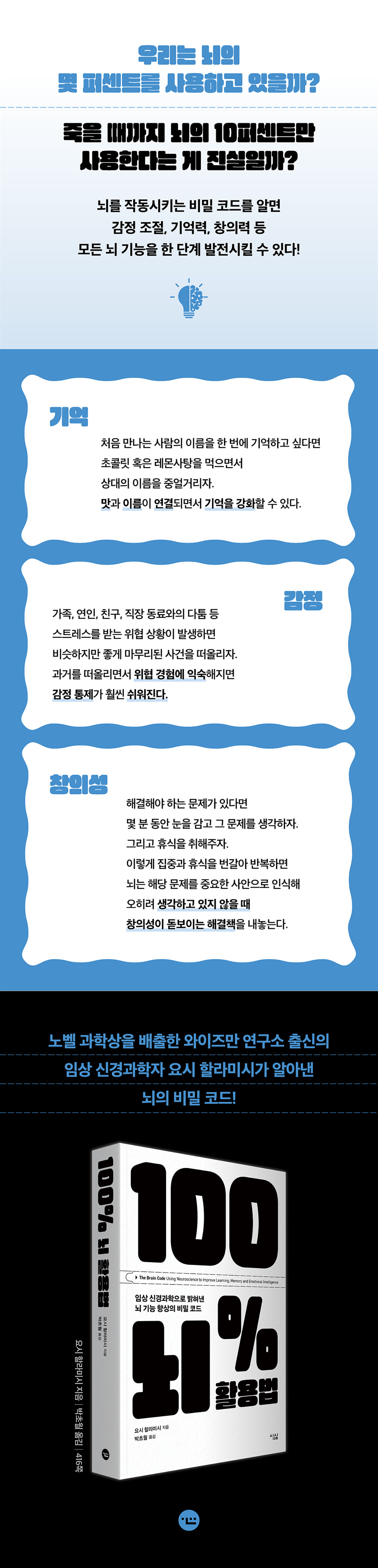
Brain Code Helps Improve Memory
How to Boost Your Memory by Connecting Your Senses to Your Brain Code
How do we remember? And how can we improve our memory? First, memory transmits stimuli received from our senses—sight, hearing, taste, smell, and touch—in the form of messages to the brain's neural network, which then processes them into "memories."
But not everything is processed by memory.
Our memories are stored in two parts, the subcortical and the cortical, and are divided into conscious and unconscious memories depending on where the memory is finally settled.
Things stored in conscious memory are always in our minds without us having to try hard to remember them.
However, things stored as unconscious memories are stored somewhere deep inside the brain because the brain determines that they are not important for immediate survival, and they are either retrieved and used again when needed or simply disappear.
So, is there no way to bring back to conscious memory those memories deemed important from among those classified as unconscious memories? Or is there no way to store them as conscious memories from the beginning, rather than as unconscious memories?
When we see a house and think, 'There's a house here,' this information is recorded in the descriptive neural network.
But after you see a house, if you don't translate it into language, the information is stored as procedural memory in other neural networks similar to declarative neural networks.
The same thing happens when we don't put music, smells, or movements into words.
What these two memories have in common is that they are the result of conscious exposure to stimuli from the environment.
(Pages 35-36)
We don't try to remember windows and doors because we open and close them every day.
But, everyone has probably had a similar experience: one day when it suddenly started pouring rain, and you couldn't quite remember whether you closed the window before going out or not.
If you want to remember clearly in this situation, just focus your thoughts on 'closing the window'.
He stares intently at the open window, his gaze never leaving the hand gripping the window handle.
And as the window closes, I focus on the scenery outside that disappears.
The brain is easily persuaded by even these brief moments of concentration, as it has simple goals.
Because if you focus even a little on something, you immediately connect it to your survival and judge it as important.
If you want to be more certain here, you can repeat “I closed the window” while closing the window.
Another way is to say, "I closed the window," and then eat the candy while looking at the closed window and half-drawn curtains.
It is a brain code that enhances memory by combining the senses of sight, which recognizes the surrounding scenery, and taste, which is the taste of candy in the mouth.
Then, when you suddenly wonder if you closed the window after going out, the words you said, the view you saw from the window at the time, and the taste of the candy will come to mind, and you will remember the closed window.
"Our bodies can be ruined by our overly simple brains."
How to Bypass the Pleasure-Survival Connection to Protect Your Body and Mind
Our brain still sees survival as the ultimate goal.
This means that our brain is still stuck in the primitive era.
Of course, we have improved a lot compared to primitive people in terms of movement, learning, and cognition, but there is one thing that still remains from the primitive era.
Eating habits are a prime example of this.
Bad weather, invasions by other tribes, and attacks by large wild animals are no longer our worries.
Food is more abundant than ever before, and the variety of flavors available has increased.
Yet, we constantly overeat.
This is because the brain is obsessed with having to 'conserve energy at all times.'
At some point, it became accepted as an established rule that we should eat three meals a day.
There was even a time when the national recommended calorie intake was presented and promoted by gender.
However, research has shown that three meals a day to meet the average 2,500 kilocalorie intake is excessive and unhealthy for modern people.
Researchers found that people in the Southern Hemisphere eat less food than those in the West.
People in the Northern Hemisphere, especially in the West, too easily accept the belief that we must eat three meals a day: breakfast, lunch, and dinner.
But in reality, even if you only eat one meal a day (or even one every other day), you will feel quite satisfied as long as you consume the proper amount of food required by the adult body.
The perception that we need three meals a day, supplemented with snacks, stems from a false sense of hunger generated in the relevant areas of the cortex.
The reason I use the word 'fake' is because our bodies don't need any more raw materials than that.
(Pages 266-267)
The reason why the modern human brain still falls for ‘false hunger’ is because of the pleasure the brain feels.
The thought of food, the taste of it, and the feeling of fullness when your stomach is full are all linked to survival, so they trigger your brain to feel pleasure.
It's like a hamster wheel, with appetite and brain pleasure stimulating each other, creating a vicious cycle.
The way out of this is to reprogram your brain to fake hunger by bypassing the connection between satiety and pleasure.
Consuming only the calories required for daily activities is sufficient for survival and, above all, is good for your health.
So, first, to avoid giving in to cravings or fake hunger itself, decide on a specific food and set a goal of 'not eating after a certain time.'
Rather than blindly doing it every day, if you succeed one day, you should enjoy the sense of accomplishment the next day.
Motivation plays a very important role in the brain, and the pride of success can be a motivating factor that helps prevent you from being fooled by fake hunger.
By repeating this, you can develop the habit of eating appropriate foods.
The brain can be satisfied by consuming only as much food as it needs to repair brain and body damage.
We have mental tools to regulate our intake.
And with that tool, we can determine the types and amounts of food that satisfy our actual physiological needs, not those rooted in our evolutionary history.
Of course, these changes don't happen overnight.
Success requires a learning process that requires motivation, but it is certainly possible.
Deep learning about food could reprogram the brain, shifting hunter-gatherer impulses from their basic patterns to ones more suited to modern life.
(Pages 276-277)
It's hard to form habits and act with willpower.
But once you understand the brain code, it's not difficult to understand and change how the brain commands us to do things.
Everything the brain does, and tries to do, is to live in the present moment.
Because the brain's goals are simple, using them to instill new patterns and guide behavior is also simple.
This book introduces brain codes that can be utilized for various situations and purposes based on these brain characteristics, and explains how to apply them in everyday life.
Now that we know the brain's single goal and the actions it takes to achieve that goal through "100% Brain Utilization," let's understand and utilize brain functions more fully.
Each chapter concludes with specific suggestions for improving memory, learning, cognition, emotions, personality, health, and more—all without much effort—in your daily life.
You don't have to read and follow along in order.
If you read only the necessary parts, learn them one by one, and practice improving them, you will awaken the hidden potential of your brain that you thought you didn't have, and you will be able to live a more comfortable and abundant life tomorrow.
Amnesia, mood disorders, etc…
Everything the brain does is to keep us alive.
Neuroscientists cite 'forgetting' as one of the brain's greatest strengths.
The reason the human brain forgets things is to improve the present and increase the chances of survival.
If your brain has an overly good memory capacity, it wastes too much energy remembering things that aren't of much use.
In "100% Brain Utilization", this is compared to cultivating date palms.
Explains why the brain code of forgetting is necessary and what it means.
When you cut off unnecessary leaves from your date palm tree, the fewer leaves it has can absorb more nutrients and grow better.
Especially for fruit-bearing plants, it has a great advantage in terms of quality improvement.
In the process of studying the brain, researchers came to one clear realization.
One of the brain's great qualities is that it forgets details that don't help us survive.
Yadin Dudai, a scientist considered a leading figure in brain research, defines the goal of memory as follows:
“The primary goal of our memory is not to preserve the past, but to preserve the future.”
Contrary to popular belief, depression is actually one of the brain's survival tools.
Depression doesn't happen without a reason.
They can be triggered by life events, and the duration varies depending on the intensity of the event, but what clinical depression, seasonal affective disorder, and even postpartum depression have in common is that they are all mood disorders that the brain has chosen to create for survival.
So, many psychiatrists are moving away from drug treatments that only use antidepressants or anti-anxiety drugs and are using psychosocial treatments that utilize these brain codes.
Despite the proven effectiveness of antidepressants, psychiatrists have moved toward using psychosocial tools to aid recovery.
Psychosocial interventions refer to psychological treatment with the help of family and friends.
Brain research supports the idea that exposure to external stimuli and physical activity are important aids in the recovery process.
(……) Since around 1990, the number of people suffering from clinical depression has been rapidly increasing worldwide.
Experts, including neuroscientists, attribute the cause to the increasing pressure caused by our extremely materialistic society.
Applying what we discussed earlier in this chapter, we can see that clinical depression is a clever protective mechanism the brain uses to temporarily escape the pressures of the constant struggle for survival.
The brain also knows that when you're depressed, you need help from those around you.
In modern society, this fact is reflected in things like vacation systems within the workplace.
(Page 112)
In this way, the brain can control all brain functions for immediate survival.
If you understand these one by one, that is, if you know the brain code, which is the brain's operating principle, you can use the brain's survival purpose as bait and use it in reverse.
This is how you use your brain 100 percent.
Brain Code Helps Improve Memory
How to Boost Your Memory by Connecting Your Senses to Your Brain Code
How do we remember? And how can we improve our memory? First, memory transmits stimuli received from our senses—sight, hearing, taste, smell, and touch—in the form of messages to the brain's neural network, which then processes them into "memories."
But not everything is processed by memory.
Our memories are stored in two parts, the subcortical and the cortical, and are divided into conscious and unconscious memories depending on where the memory is finally settled.
Things stored in conscious memory are always in our minds without us having to try hard to remember them.
However, things stored as unconscious memories are stored somewhere deep inside the brain because the brain determines that they are not important for immediate survival, and they are either retrieved and used again when needed or simply disappear.
So, is there no way to bring back to conscious memory those memories deemed important from among those classified as unconscious memories? Or is there no way to store them as conscious memories from the beginning, rather than as unconscious memories?
When we see a house and think, 'There's a house here,' this information is recorded in the descriptive neural network.
But after you see a house, if you don't translate it into language, the information is stored as procedural memory in other neural networks similar to declarative neural networks.
The same thing happens when we don't put music, smells, or movements into words.
What these two memories have in common is that they are the result of conscious exposure to stimuli from the environment.
(Pages 35-36)
We don't try to remember windows and doors because we open and close them every day.
But, everyone has probably had a similar experience: one day when it suddenly started pouring rain, and you couldn't quite remember whether you closed the window before going out or not.
If you want to remember clearly in this situation, just focus your thoughts on 'closing the window'.
He stares intently at the open window, his gaze never leaving the hand gripping the window handle.
And as the window closes, I focus on the scenery outside that disappears.
The brain is easily persuaded by even these brief moments of concentration, as it has simple goals.
Because if you focus even a little on something, you immediately connect it to your survival and judge it as important.
If you want to be more certain here, you can repeat “I closed the window” while closing the window.
Another way is to say, "I closed the window," and then eat the candy while looking at the closed window and half-drawn curtains.
It is a brain code that enhances memory by combining the senses of sight, which recognizes the surrounding scenery, and taste, which is the taste of candy in the mouth.
Then, when you suddenly wonder if you closed the window after going out, the words you said, the view you saw from the window at the time, and the taste of the candy will come to mind, and you will remember the closed window.
"Our bodies can be ruined by our overly simple brains."
How to Bypass the Pleasure-Survival Connection to Protect Your Body and Mind
Our brain still sees survival as the ultimate goal.
This means that our brain is still stuck in the primitive era.
Of course, we have improved a lot compared to primitive people in terms of movement, learning, and cognition, but there is one thing that still remains from the primitive era.
Eating habits are a prime example of this.
Bad weather, invasions by other tribes, and attacks by large wild animals are no longer our worries.
Food is more abundant than ever before, and the variety of flavors available has increased.
Yet, we constantly overeat.
This is because the brain is obsessed with having to 'conserve energy at all times.'
At some point, it became accepted as an established rule that we should eat three meals a day.
There was even a time when the national recommended calorie intake was presented and promoted by gender.
However, research has shown that three meals a day to meet the average 2,500 kilocalorie intake is excessive and unhealthy for modern people.
Researchers found that people in the Southern Hemisphere eat less food than those in the West.
People in the Northern Hemisphere, especially in the West, too easily accept the belief that we must eat three meals a day: breakfast, lunch, and dinner.
But in reality, even if you only eat one meal a day (or even one every other day), you will feel quite satisfied as long as you consume the proper amount of food required by the adult body.
The perception that we need three meals a day, supplemented with snacks, stems from a false sense of hunger generated in the relevant areas of the cortex.
The reason I use the word 'fake' is because our bodies don't need any more raw materials than that.
(Pages 266-267)
The reason why the modern human brain still falls for ‘false hunger’ is because of the pleasure the brain feels.
The thought of food, the taste of it, and the feeling of fullness when your stomach is full are all linked to survival, so they trigger your brain to feel pleasure.
It's like a hamster wheel, with appetite and brain pleasure stimulating each other, creating a vicious cycle.
The way out of this is to reprogram your brain to fake hunger by bypassing the connection between satiety and pleasure.
Consuming only the calories required for daily activities is sufficient for survival and, above all, is good for your health.
So, first, to avoid giving in to cravings or fake hunger itself, decide on a specific food and set a goal of 'not eating after a certain time.'
Rather than blindly doing it every day, if you succeed one day, you should enjoy the sense of accomplishment the next day.
Motivation plays a very important role in the brain, and the pride of success can be a motivating factor that helps prevent you from being fooled by fake hunger.
By repeating this, you can develop the habit of eating appropriate foods.
The brain can be satisfied by consuming only as much food as it needs to repair brain and body damage.
We have mental tools to regulate our intake.
And with that tool, we can determine the types and amounts of food that satisfy our actual physiological needs, not those rooted in our evolutionary history.
Of course, these changes don't happen overnight.
Success requires a learning process that requires motivation, but it is certainly possible.
Deep learning about food could reprogram the brain, shifting hunter-gatherer impulses from their basic patterns to ones more suited to modern life.
(Pages 276-277)
It's hard to form habits and act with willpower.
But once you understand the brain code, it's not difficult to understand and change how the brain commands us to do things.
Everything the brain does, and tries to do, is to live in the present moment.
Because the brain's goals are simple, using them to instill new patterns and guide behavior is also simple.
This book introduces brain codes that can be utilized for various situations and purposes based on these brain characteristics, and explains how to apply them in everyday life.
Now that we know the brain's single goal and the actions it takes to achieve that goal through "100% Brain Utilization," let's understand and utilize brain functions more fully.
Each chapter concludes with specific suggestions for improving memory, learning, cognition, emotions, personality, health, and more—all without much effort—in your daily life.
You don't have to read and follow along in order.
If you read only the necessary parts, learn them one by one, and practice improving them, you will awaken the hidden potential of your brain that you thought you didn't have, and you will be able to live a more comfortable and abundant life tomorrow.
GOODS SPECIFICS
- Date of issue: August 25, 2025
- Page count, weight, size: 416 pages | 562g | 135*205*27mm
- ISBN13: 9791172540753
You may also like
카테고리
korean


korean

![GQ KOREA Mark (Monthly): December [2025]](http://librairie.coreenne.fr/cdn/shop/files/8ef265dbbfbf186523ed75ba7319009d.jpg?v=1765340328&width=3840)


