

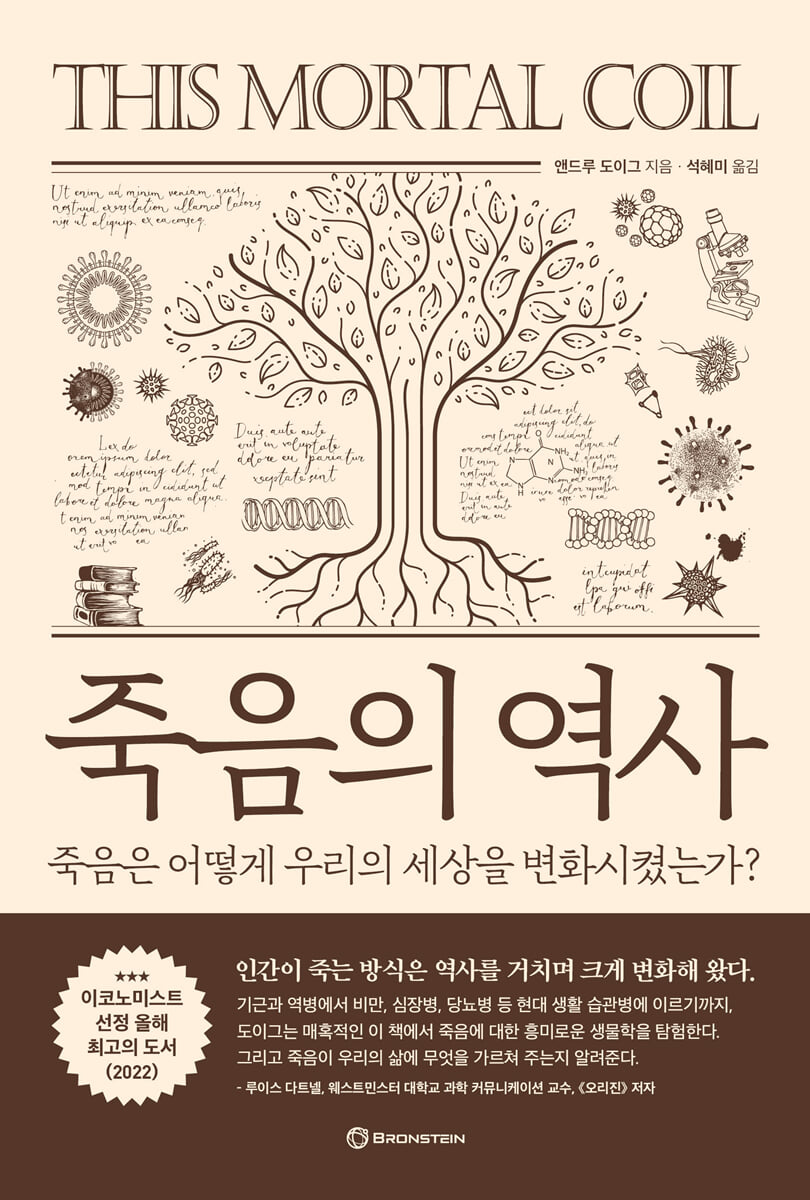
History of Death
 |
Description
Book Introduction
The Times and Observer Highlights of 2022
The Guardian's Best Science Books of 2022
The Economist's Best Books of 2022
Death is inevitable, but the form of death has changed over time!
A surprising insight into how we will live and how we will die in the future!
No living creature can escape death.
But over time, the reasons we die have changed dramatically.
In the past, infectious diseases, famine, and war were the main causes of death, but today, it is completely different from the past, with lifestyle diseases such as diabetes and heart disease, as well as cancer, stroke, and dementia.
In the past, people could die from disease or violence regardless of age, and if there were a few years of famine, their lives were in danger.
But in modern society, in most countries, food overload is a bigger problem than food shortage, and if someone dies at age 60, people are surprised that they didn't live long.
The way humans live has changed in countless ways, and the way we die has also changed.
Why did the reason we die undergo such a great change?
Andrew Doig, professor of biochemistry at the University of Manchester, tells the remarkable story of how certain causes of death, from infectious diseases to genetic diseases, violence and diet, have been dramatically reduced.
This book provides a fascinating look at the stories and developments of historical figures who dedicated themselves to reducing the most powerful cause of death in history: the Scottish doctor who discovered a cure for scurvy by discovering vitamin C; the Irish immigrant who opened the first laundromat and public baths for the poor of Liverpool to fight the epidemic; the British pastor who provided psychological counseling in a church equipped with a telephone to help people in emotional distress; the Cuban doctor who discovered that mosquitoes transmit germs and realized a way to reduce epidemics; and the American lawyer who wrote a book to reduce traffic accidents and started a movement to improve safety devices and systems.
The reason we have been able to reduce the numerous causes of death that have threatened us since the past is none other than the advancement of medical science, the social movements that made this possible, and the passion of many, little-known people.
From vaccines to eradicate infectious diseases, to statistics that quantify the causes of death, to even technologies to manipulate our fundamental genes, the combined advances of death and medical science have created a generation that, unlike previous generations who were plagued by the threat of death, now lives in a remarkably optimistic era.
This book, which covers both the history of death and the development of medical science, broadens our perspective so that we can view death as it is, but with optimism rather than despair.
If you want to know how death has positively transformed our lives and the world, I highly recommend reading this book.
The Guardian's Best Science Books of 2022
The Economist's Best Books of 2022
Death is inevitable, but the form of death has changed over time!
A surprising insight into how we will live and how we will die in the future!
No living creature can escape death.
But over time, the reasons we die have changed dramatically.
In the past, infectious diseases, famine, and war were the main causes of death, but today, it is completely different from the past, with lifestyle diseases such as diabetes and heart disease, as well as cancer, stroke, and dementia.
In the past, people could die from disease or violence regardless of age, and if there were a few years of famine, their lives were in danger.
But in modern society, in most countries, food overload is a bigger problem than food shortage, and if someone dies at age 60, people are surprised that they didn't live long.
The way humans live has changed in countless ways, and the way we die has also changed.
Why did the reason we die undergo such a great change?
Andrew Doig, professor of biochemistry at the University of Manchester, tells the remarkable story of how certain causes of death, from infectious diseases to genetic diseases, violence and diet, have been dramatically reduced.
This book provides a fascinating look at the stories and developments of historical figures who dedicated themselves to reducing the most powerful cause of death in history: the Scottish doctor who discovered a cure for scurvy by discovering vitamin C; the Irish immigrant who opened the first laundromat and public baths for the poor of Liverpool to fight the epidemic; the British pastor who provided psychological counseling in a church equipped with a telephone to help people in emotional distress; the Cuban doctor who discovered that mosquitoes transmit germs and realized a way to reduce epidemics; and the American lawyer who wrote a book to reduce traffic accidents and started a movement to improve safety devices and systems.
The reason we have been able to reduce the numerous causes of death that have threatened us since the past is none other than the advancement of medical science, the social movements that made this possible, and the passion of many, little-known people.
From vaccines to eradicate infectious diseases, to statistics that quantify the causes of death, to even technologies to manipulate our fundamental genes, the combined advances of death and medical science have created a generation that, unlike previous generations who were plagued by the threat of death, now lives in a remarkably optimistic era.
This book, which covers both the history of death and the development of medical science, broadens our perspective so that we can view death as it is, but with optimism rather than despair.
If you want to know how death has positively transformed our lives and the world, I highly recommend reading this book.
- You can preview some of the book's contents.
Preview
index
Introduction: The Four Plagues of Siena
Part 1 Cause of Death
01 What is death?
02 Observe the death statistics
03 Live a long and healthy life
Part 2: Epidemics
04 Black Death
05 Milkmaid's Hand
06 Typhus and typhoid in the Liverpool slums
07 Blue Death
08 Childbirth
09 Deadly Animals
10 Magic Bullets
Part 3: I am what I eat.
11 Hansel and Gretel
12 Treatises on Scurvy
13 The Body of Venus
Part 4: Fatal Legacy
14 Woody Guthrie and the Blonde Angel of Venezuela
15 The King's Daughters
16 The Brain of Auguste D.
17 Deaths before birth
Part 5 Bad Behavior
18 Thou shalt not kill
19 Alcohol and Addiction
20 Pesky Black Smoke
21 Not safe at any speed
Conclusion: A Hopeful Future?
Appendix: Life Table
Acknowledgements
annotation
Part 1 Cause of Death
01 What is death?
02 Observe the death statistics
03 Live a long and healthy life
Part 2: Epidemics
04 Black Death
05 Milkmaid's Hand
06 Typhus and typhoid in the Liverpool slums
07 Blue Death
08 Childbirth
09 Deadly Animals
10 Magic Bullets
Part 3: I am what I eat.
11 Hansel and Gretel
12 Treatises on Scurvy
13 The Body of Venus
Part 4: Fatal Legacy
14 Woody Guthrie and the Blonde Angel of Venezuela
15 The King's Daughters
16 The Brain of Auguste D.
17 Deaths before birth
Part 5 Bad Behavior
18 Thou shalt not kill
19 Alcohol and Addiction
20 Pesky Black Smoke
21 Not safe at any speed
Conclusion: A Hopeful Future?
Appendix: Life Table
Acknowledgements
annotation
Publisher's Review
News of death comes every now and then, as if it were a distant day.
Are we living in an age of death?
The COVID-19 pandemic, which began in December 2019, paralyzed the world for three years.
In February 2023, a major earthquake struck Turkey and Syria.
Countless lives were lost due to the earthquake.
The endless news of death makes us wonder if we are living in an age of death.
But Andrew Doig, the author of this book and professor of biochemistry at the University of Manchester, uses history and statistics to explain that we live in an age of hope, not an age of death.
Even in the past, the main causes of human death were plague and famine.
The main cause of human death today is rather overnutrition and the lifestyle diseases that come with it.
Compared to the past, the number of lives lost to death has also decreased rapidly.
In the early 1900s, the Spanish flu swept the world, killing between 50 and 100 million people.
However, the number of lives lost to COVID-19 is estimated at around 6.5 million as of early 2023.
What exactly made this difference? Death itself, human efforts to thwart it, and the advancement of science as a byproduct.
About the groundbreaking innovations and advancements made by the history of death.
How have humans died, and how will they live in the future?
The Age of Exploration, when new sea routes were being explored, was very harsh.
There was a disease that plagued sailors who wandered the seas for a long time.
That disease is scurvy.
It is common knowledge today that taking vitamin C can prevent scurvy, but that wasn't the case back then.
British Admiral George Anson and his crew of about 2,000 sailed around the world for four years before arriving in England, but the outcome was disastrous: only about 600 of the crew, including George Anson, survived.
The leading cause of death during the voyage was scurvy.
In an effort to overcome the cause of death, scurvy, military surgeon James Lind stepped forward.
After his experiments, Lind published a paper showing that lemons could cure scurvy, and he was able to escape the disease that had killed countless lives.
This book by Andrew Doig contains the history of human efforts to overcome death by solving the cause of death that took countless lives, such as the story of scurvy.
The history of death told in this book is the history of how humans and the world have changed.
Because the story of how we die is deeply connected to science, technology, economics, health, society, and everything about human behavior.
In this way, we have thoroughly analyzed the causes of death to overcome death and brought about changes in the world.
The endless news of death may bring sadness and despair, but through those deaths, we have made progress and changed the world.
In this book, Andrew Doig argues that our past efforts to thwart death can now yield greater hope, such as soaring life expectancy and plummeting infant mortality rates.
Are we living in an age of death?
The COVID-19 pandemic, which began in December 2019, paralyzed the world for three years.
In February 2023, a major earthquake struck Turkey and Syria.
Countless lives were lost due to the earthquake.
The endless news of death makes us wonder if we are living in an age of death.
But Andrew Doig, the author of this book and professor of biochemistry at the University of Manchester, uses history and statistics to explain that we live in an age of hope, not an age of death.
Even in the past, the main causes of human death were plague and famine.
The main cause of human death today is rather overnutrition and the lifestyle diseases that come with it.
Compared to the past, the number of lives lost to death has also decreased rapidly.
In the early 1900s, the Spanish flu swept the world, killing between 50 and 100 million people.
However, the number of lives lost to COVID-19 is estimated at around 6.5 million as of early 2023.
What exactly made this difference? Death itself, human efforts to thwart it, and the advancement of science as a byproduct.
About the groundbreaking innovations and advancements made by the history of death.
How have humans died, and how will they live in the future?
The Age of Exploration, when new sea routes were being explored, was very harsh.
There was a disease that plagued sailors who wandered the seas for a long time.
That disease is scurvy.
It is common knowledge today that taking vitamin C can prevent scurvy, but that wasn't the case back then.
British Admiral George Anson and his crew of about 2,000 sailed around the world for four years before arriving in England, but the outcome was disastrous: only about 600 of the crew, including George Anson, survived.
The leading cause of death during the voyage was scurvy.
In an effort to overcome the cause of death, scurvy, military surgeon James Lind stepped forward.
After his experiments, Lind published a paper showing that lemons could cure scurvy, and he was able to escape the disease that had killed countless lives.
This book by Andrew Doig contains the history of human efforts to overcome death by solving the cause of death that took countless lives, such as the story of scurvy.
The history of death told in this book is the history of how humans and the world have changed.
Because the story of how we die is deeply connected to science, technology, economics, health, society, and everything about human behavior.
In this way, we have thoroughly analyzed the causes of death to overcome death and brought about changes in the world.
The endless news of death may bring sadness and despair, but through those deaths, we have made progress and changed the world.
In this book, Andrew Doig argues that our past efforts to thwart death can now yield greater hope, such as soaring life expectancy and plummeting infant mortality rates.
GOODS SPECIFICS
- Date of issue: February 22, 2023
- Page count, weight, size: 468 pages | 664g | 152*225*22mm
- ISBN13: 9791140806409
- ISBN10: 1140806408
You may also like
카테고리
korean


korean

![ELLE 엘르 스페셜 에디션 A형 : 12월 [2025]](http://librairie.coreenne.fr/cdn/shop/files/b8e27a3de6c9538896439686c6b0e8fb.jpg?v=1766436872&width=3840)


