

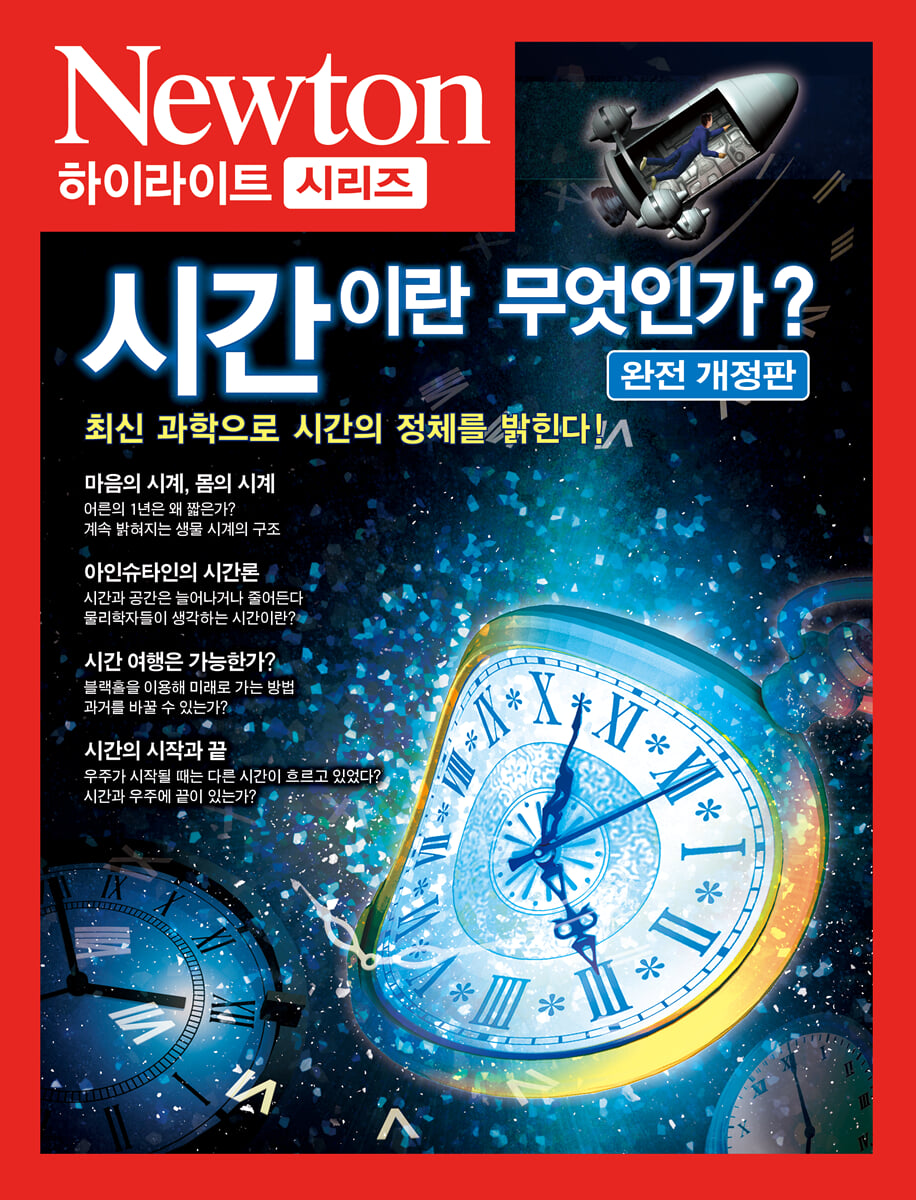
NEWTON HIGHLIGHT Newton Highlight 134 What is time?
 |
Description
Book Introduction
The meaning and properties of time from various perspectives, including physics
The ancient Roman philosopher Augustine said:
“I know what time is.
But if someone asks, I can't explain it."
This saying applies equally to us living in modern times.
We know very well what time is.
But it is never easy to explain it specifically.
What is time, really? It flows in only one direction: from past to future.
We do not know of anyone who has ever traveled back in time to a past world, or who has come to us from a future world.
But what does it mean to say that time travel to the past or future is possible? And that's not all.
Does time have a beginning and an end? Why does a year feel short as an adult? How do living things know time? Questions about time are endless.
Time continues to be a challenging problem for researchers across many disciplines, including physics, cosmology, life sciences, and psychology.
This book is a completely revised edition of What is Time?, which explained the mystery of time from various perspectives, from physics to psychology.
The content is structured in a completely different way from the first edition, and a significant amount of new information has been added, including the detailed mechanism of the biological clock, which won the 2017 Nobel Prize in Physiology or Medicine, and the mechanism and development story of the ultra-precise 'optical lattice clock' currently under development.
This book, which explains various topics related to the properties of time through clear writings and piercing illustrations by experts, will help you easily and deeply understand the reality of time, which was previously thought of only abstractly.
The ancient Roman philosopher Augustine said:
“I know what time is.
But if someone asks, I can't explain it."
This saying applies equally to us living in modern times.
We know very well what time is.
But it is never easy to explain it specifically.
What is time, really? It flows in only one direction: from past to future.
We do not know of anyone who has ever traveled back in time to a past world, or who has come to us from a future world.
But what does it mean to say that time travel to the past or future is possible? And that's not all.
Does time have a beginning and an end? Why does a year feel short as an adult? How do living things know time? Questions about time are endless.
Time continues to be a challenging problem for researchers across many disciplines, including physics, cosmology, life sciences, and psychology.
This book is a completely revised edition of What is Time?, which explained the mystery of time from various perspectives, from physics to psychology.
The content is structured in a completely different way from the first edition, and a significant amount of new information has been added, including the detailed mechanism of the biological clock, which won the 2017 Nobel Prize in Physiology or Medicine, and the mechanism and development story of the ultra-precise 'optical lattice clock' currently under development.
This book, which explains various topics related to the properties of time through clear writings and piercing illustrations by experts, will help you easily and deeply understand the reality of time, which was previously thought of only abstractly.
- You can preview some of the book's contents.
Preview
index
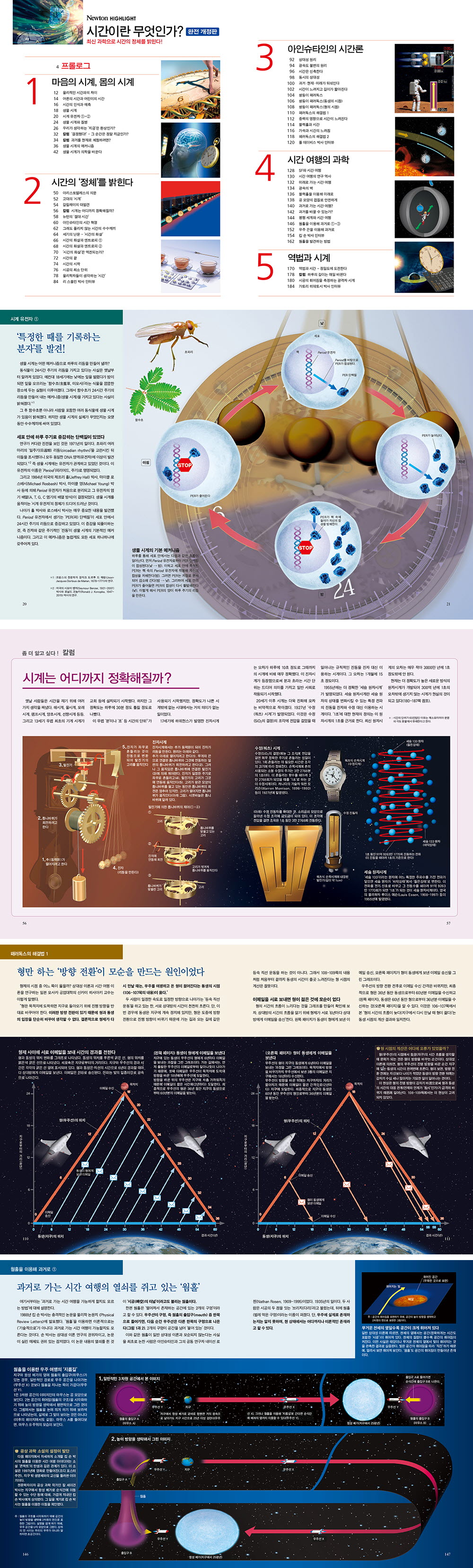
Chapter 1: The Mind's Clock, the Body's Clock
Differences from physical time / Time in adults and children / Perception and prediction of time / Biological clock / Clock genes ①~② / Biological clock and disease / Is the 'now' we think of an illusion?
Column: "I've Decided!" - Is That Moment Really Now?
How to experience the past as the present?
Mechanism of the biological clock
Biological clocks are transforming medicine.
Chapter 2: Revealing the "Status" of Time
Aristotle's Time / Ancient 'Clocks' / Galileo's Great Discovery / Newton's Absolute Time / Einstein's Time Revolution / The Unsolved Mystery of Time / The Mystery of the Century - 'The Arrow of Time' / The Arrow of Time and Entropy ① / The Arrow of Time and Entropy ② / Can the 'Arrow of Time' Be Reversed? / The End of Time / The Beginning of Time / The Minimum Unit of Space-Time / How Physicists Think About 'Time' / Interview with Dr. Lee Smolin
How accurate can column clocks become?
Chapter 3 Einstein's Theory of Time
The principle of relativity / The principle of the constancy of the speed of light / Time is elastic / The relativity of simultaneity / Past, present, and future are mixed / Time slows down and length becomes shorter / The twin paradox / The twin paradox (younger brother's perspective) / The twin paradox (older brother's perspective) / The solution to the paradox 1 / Time slows down due to the influence of gravity / Black holes and time / Acceleration and the slowing of time / The solution to the paradox 2 / Interview with Dr. Paul Davis
Chapter 4: The Science of Time Travel
Science Fiction and Time Travel / History of Time Travel Research / Time Travel into the Future / The Light Wall
Using Black Holes to Travel to the Future / Safely with a Spherical Shell / Time Travel to the Past? / Can the Past Be Changed? / Parallel Worlds and Time Travel / Using Wormholes to Travel to the Past ①-③ / Using Cosmic Strings to Travel to the Past / Interview with Dr. Kip Thorne / How to Discover Wormholes
Chapter 5 Calendar and Clocks
Calendar and Time: Challenging Precision / A Clock That Measures the Curvature of Spacetime / An Interview with Dr. Hidetoshi Katori
The length of a column day changes every day.
Differences from physical time / Time in adults and children / Perception and prediction of time / Biological clock / Clock genes ①~② / Biological clock and disease / Is the 'now' we think of an illusion?
Column: "I've Decided!" - Is That Moment Really Now?
How to experience the past as the present?
Mechanism of the biological clock
Biological clocks are transforming medicine.
Chapter 2: Revealing the "Status" of Time
Aristotle's Time / Ancient 'Clocks' / Galileo's Great Discovery / Newton's Absolute Time / Einstein's Time Revolution / The Unsolved Mystery of Time / The Mystery of the Century - 'The Arrow of Time' / The Arrow of Time and Entropy ① / The Arrow of Time and Entropy ② / Can the 'Arrow of Time' Be Reversed? / The End of Time / The Beginning of Time / The Minimum Unit of Space-Time / How Physicists Think About 'Time' / Interview with Dr. Lee Smolin
How accurate can column clocks become?
Chapter 3 Einstein's Theory of Time
The principle of relativity / The principle of the constancy of the speed of light / Time is elastic / The relativity of simultaneity / Past, present, and future are mixed / Time slows down and length becomes shorter / The twin paradox / The twin paradox (younger brother's perspective) / The twin paradox (older brother's perspective) / The solution to the paradox 1 / Time slows down due to the influence of gravity / Black holes and time / Acceleration and the slowing of time / The solution to the paradox 2 / Interview with Dr. Paul Davis
Chapter 4: The Science of Time Travel
Science Fiction and Time Travel / History of Time Travel Research / Time Travel into the Future / The Light Wall
Using Black Holes to Travel to the Future / Safely with a Spherical Shell / Time Travel to the Past? / Can the Past Be Changed? / Parallel Worlds and Time Travel / Using Wormholes to Travel to the Past ①-③ / Using Cosmic Strings to Travel to the Past / Interview with Dr. Kip Thorne / How to Discover Wormholes
Chapter 5 Calendar and Clocks
Calendar and Time: Challenging Precision / A Clock That Measures the Curvature of Spacetime / An Interview with Dr. Hidetoshi Katori
The length of a column day changes every day.
Detailed image
Publisher's Review
Over 200 high-quality illustrations that help you understand the concept of time visually.
This book examines the concept of time from various perspectives, including physics, cosmology, life sciences, and psychology.
However, since 'time' itself does not exist as an object, it is also true that it is not easy to understand without an explanation using pictures.
[Newton]'s editorial policy of "conveying scientific principles graphically" is fully demonstrated in this book, literally "making the invisible concepts and characteristics of time understandable through drawings, photographs, and graphs."
In-depth explanations from experts in physics, astronomy, biotechnology, and psychology.
Time is not a simple concept.
Everyone knows what time is, but when you try to explain it, it's difficult to say a single word about it.
This book, [What is Time?], clearly conveys the latest research on time in various fields, including physics, through expert explanations.
You can meet world-class experts such as Kip Thorne and Richard Gott through this book.
Covering everything from traditional theories of time to the latest Nobel Prize-winning research and technological developments.
Research on time is extremely diverse.
Beginning with the ancient Greek scholars' notions of time, through Galileo and Newton's 'absolute time', Boltzmann's entropy, and Einstein's theory of time, this book covers the traditional study of time, as well as the latest research findings, including the theory of time travel, the biological clock within our bodies, and the development of ultra-precise optical lattice clocks.
Includes interviews with scientists including Kip Thorne, Lisa Randle, Richard Gott, Roger Penrose, Lee Smolin, and Paul Davies.
Topics such as 'Time and space, time travel to the past or future, what is time?' can be said to be the flower of research on time.
Research results are also steadily emerging in these fields.
This book [What is Time?] covers the research of leading figures in this field, as well as interviews with them.
Through interviews that reveal the research of scientists at the forefront of time research, as well as a cross-section of a human being studying the abstract concept of time, we can take a closer look at the properties of time.
A New Model for Science Books: The Newton Highlights Series
Newton publishes the 'Newton Highlights Series', which presents key topics in all scientific fields with expert commentary and outstanding graphics.
The 100 or so sister volumes, including 『Theory of Relativity』, 『Quantum Theory』, 『Periodic Table』, 『Ions and Elements』, 『Human Body - 21st Century Anatomy』, 『Brain and Neurons (Nerve Cells)』, 『The Mysterious World of Mathematics』, 『Middle and High School Physics』, and 『Middle and High School Chemistry』, are also selling well.
This book examines the concept of time from various perspectives, including physics, cosmology, life sciences, and psychology.
However, since 'time' itself does not exist as an object, it is also true that it is not easy to understand without an explanation using pictures.
[Newton]'s editorial policy of "conveying scientific principles graphically" is fully demonstrated in this book, literally "making the invisible concepts and characteristics of time understandable through drawings, photographs, and graphs."
In-depth explanations from experts in physics, astronomy, biotechnology, and psychology.
Time is not a simple concept.
Everyone knows what time is, but when you try to explain it, it's difficult to say a single word about it.
This book, [What is Time?], clearly conveys the latest research on time in various fields, including physics, through expert explanations.
You can meet world-class experts such as Kip Thorne and Richard Gott through this book.
Covering everything from traditional theories of time to the latest Nobel Prize-winning research and technological developments.
Research on time is extremely diverse.
Beginning with the ancient Greek scholars' notions of time, through Galileo and Newton's 'absolute time', Boltzmann's entropy, and Einstein's theory of time, this book covers the traditional study of time, as well as the latest research findings, including the theory of time travel, the biological clock within our bodies, and the development of ultra-precise optical lattice clocks.
Includes interviews with scientists including Kip Thorne, Lisa Randle, Richard Gott, Roger Penrose, Lee Smolin, and Paul Davies.
Topics such as 'Time and space, time travel to the past or future, what is time?' can be said to be the flower of research on time.
Research results are also steadily emerging in these fields.
This book [What is Time?] covers the research of leading figures in this field, as well as interviews with them.
Through interviews that reveal the research of scientists at the forefront of time research, as well as a cross-section of a human being studying the abstract concept of time, we can take a closer look at the properties of time.
A New Model for Science Books: The Newton Highlights Series
Newton publishes the 'Newton Highlights Series', which presents key topics in all scientific fields with expert commentary and outstanding graphics.
The 100 or so sister volumes, including 『Theory of Relativity』, 『Quantum Theory』, 『Periodic Table』, 『Ions and Elements』, 『Human Body - 21st Century Anatomy』, 『Brain and Neurons (Nerve Cells)』, 『The Mysterious World of Mathematics』, 『Middle and High School Physics』, and 『Middle and High School Chemistry』, are also selling well.
GOODS SPECIFICS
- Publication date: December 15, 2019
- Page count, weight, size: 192 pages | 616g | 210*275*8mm
- ISBN13: 9791161960906
- ISBN10: 1161960902
You may also like
카테고리
korean


korean

![GQ KOREA Mark (Monthly): December [2025]](http://librairie.coreenne.fr/cdn/shop/files/8ef265dbbfbf186523ed75ba7319009d.jpg?v=1765340328&width=3840)


