

Newton's Principia
 |
Description
Book Introduction
The law of universal gravitation understood through the beautiful geometry of conic sections!
What Newton saw in the falling apple was none other than the 'moon'!
Is it because of the law of universal gravitation that the moon revolves around the Earth and the Earth revolves around the sun in elliptical orbits?
How did Newton discover the law of universal gravitation?
Principia, the greatest classic of mankind that led the modern scientific revolution
A well-written geometry textbook and scientific classic commentary by a Korean author.
What Newton saw in the falling apple was none other than the 'moon'!
Is it because of the law of universal gravitation that the moon revolves around the Earth and the Earth revolves around the sun in elliptical orbits?
How did Newton discover the law of universal gravitation?
Principia, the greatest classic of mankind that led the modern scientific revolution
A well-written geometry textbook and scientific classic commentary by a Korean author.
- You can preview some of the book's contents.
Preview
index
prolog
Chapter 1 Geometry
Elements and the Axiom System
Euclid's system of 『Elements』
Basics of Drawing
Chapter 2 Conic Sections
Definition of conic section
History of conic sections
Chapter 3: Circle
Definition of circle
Tangent of a circle
Power of a circle theorem
Chapter 4 Ellipse
Definition of an ellipse
Law of reflection of an ellipse
Tangent to an ellipse
Conjugate diameter of an ellipse
vertical diameter of the ellipse
Finding the center and focus of an ellipse
Ellipse power theorem
Parallelogram circumscribed to an ellipse
Chapter 5 Hyperbola
Definition of hyperbola
Hyperbolic law of reflection
Tangent of a hyperbola
Properties of rectangular hyperbolas
Hyperbola power theorem
Conjugate diameter of a hyperbola
Finding the center, asymptotes, and foci of a hyperbola
Chapter 6 Parabolas
Definition of parabola
tangent to a parabola
vertical diameter of a parabola
focus of a parabola
Law of reflection of a parabola
Chapter 7 Newton's Law of Universal Gravitation
Edmund Halley's Tribute to Isaac Newton
Newton's Principia and the Laws of Motion
Principia, Proposition 6, Theorem 5, Corollary 1
Derivation of the law of universal gravitation in elliptical orbits
Derivation of the law of gravitation for hyperbolic orbits
Derivation of the law of universal gravitation for parabolic orbits
Kepler's third law
Epilogue
History of the Principia
Isaac Newton
Newton's School and the Mathematical Triforce at Cambridge
Chapter 1 Geometry
Elements and the Axiom System
Euclid's system of 『Elements』
Basics of Drawing
Chapter 2 Conic Sections
Definition of conic section
History of conic sections
Chapter 3: Circle
Definition of circle
Tangent of a circle
Power of a circle theorem
Chapter 4 Ellipse
Definition of an ellipse
Law of reflection of an ellipse
Tangent to an ellipse
Conjugate diameter of an ellipse
vertical diameter of the ellipse
Finding the center and focus of an ellipse
Ellipse power theorem
Parallelogram circumscribed to an ellipse
Chapter 5 Hyperbola
Definition of hyperbola
Hyperbolic law of reflection
Tangent of a hyperbola
Properties of rectangular hyperbolas
Hyperbola power theorem
Conjugate diameter of a hyperbola
Finding the center, asymptotes, and foci of a hyperbola
Chapter 6 Parabolas
Definition of parabola
tangent to a parabola
vertical diameter of a parabola
focus of a parabola
Law of reflection of a parabola
Chapter 7 Newton's Law of Universal Gravitation
Edmund Halley's Tribute to Isaac Newton
Newton's Principia and the Laws of Motion
Principia, Proposition 6, Theorem 5, Corollary 1
Derivation of the law of universal gravitation in elliptical orbits
Derivation of the law of gravitation for hyperbolic orbits
Derivation of the law of universal gravitation for parabolic orbits
Kepler's third law
Epilogue
History of the Principia
Isaac Newton
Newton's School and the Mathematical Triforce at Cambridge
Detailed image
Into the book
Isaac Newton left a significant mark on the history of science by discovering the law of universal gravitation.
When you hear this, you might wonder, 'What on earth did Newton discover that he's all this fuss about?'
Newton explained universal gravitation and planetary motion in his book, Principia.
However, few modern people will read this book.
Of course, we do cover some gravitational force in high school physics classes.
But this is different from how Newton originally solved it.
Newton's Principia is written in the language of geometry.
On the other hand, the law of universal gravitation that we learn in high school physics classes is described in the language of calculus and algebra.
Why did Newton, the inventor of calculus, use geometry in such a tedious way? It was because he was considerate of his readers.
It was much later that other scholars began to understand Newton's calculus and apply it in various ways.
Therefore, if Newton had written the Principia using calculus in his time, no one would have understood it.
--- p.6
The 『Gihawonbon』 translated by Matteo Ricci and the 『Surijeongon』 version from the Kangxi Emperor's era were also introduced to Joseon.
Matteo Ricci's translation of the Geometry Original was read by some scholars, but for some reason it did not gain popularity.
In the 18th and 19th centuries, a trend of studying geometry swept through Joseon intellectuals.
However, the book that Joseon scholars read at that time was not Matteo Ricci's 『Gihawonbon』, but the 『Gihawonbon』 of 『Surijeongon』.
Lee Gyu-gyeong, a Joseon scholar, wrote in his 『Ojuyeonmunjangjeonsango』, “There are two versions of 『Gihawonbon』.
One was translated by Matteo Ricci and Seo Gwang-gye, and the other is the original version of the 『Suri Jeong-on』. Matteo Ricci's version is very precious,” he wrote.
Joseon scholars read the 『Original Geometry』 without its essential axiom system.
So perhaps Joseon scholars were not deeply impressed by the wonderful academic method called the axiomatic system.
--- pp.24-25
Newton's work was so successful that it gave rise to the Cambridge School.
It seems that the British scientists were very proud.
How much was it? At the same time as Newton, there was a poet in England named Alexander Pope.
He is a character also mentioned in the novel ‘The Da Vinci Code’.
Newton was born in Woolsthorpe, a village in Lincolnshire, England, the year Galileo Galilei died.
Inspired by these mystical facts, Pope wrote an epitaph imitating a biblical passage.
(Omitted) “Nature and its laws are hidden in the darkness of the night, but when God said, ‘Let there be Newton!’ the whole world became bright.” --- p.163
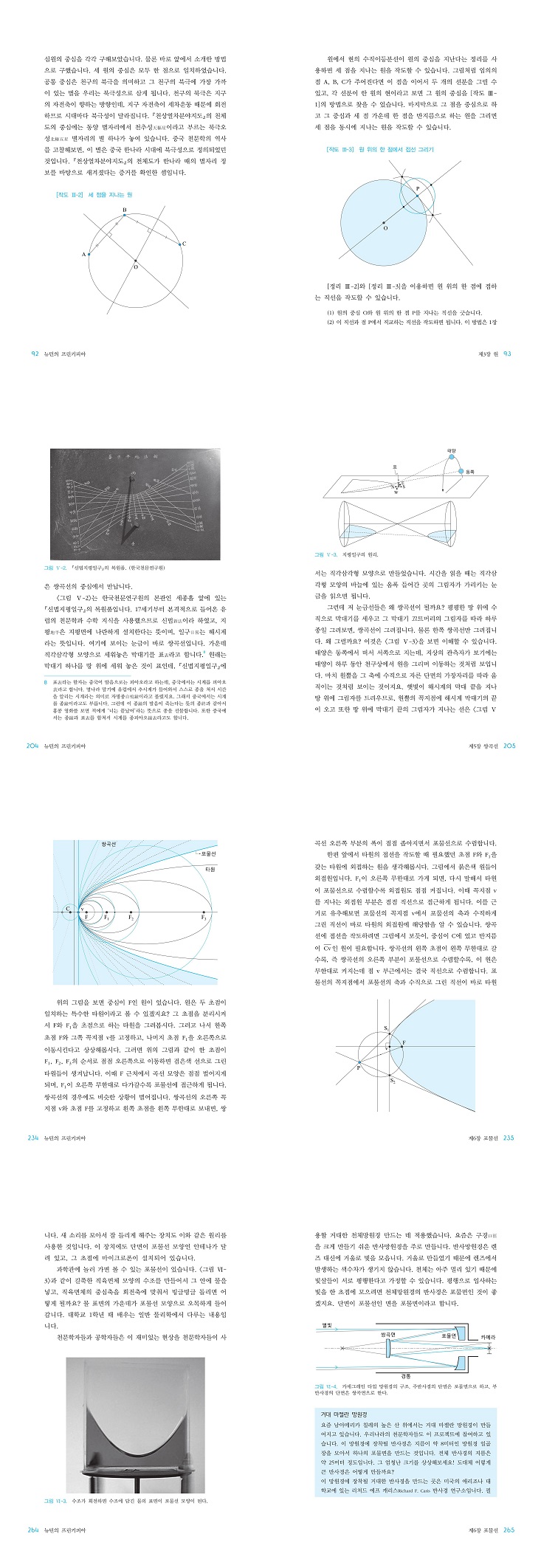
The law of reflection that applies to parabolas is a very useful property in everyday life.
What happens if you make the cross-section of a car headlight or flashlight reflector parabolic and place the bulb at the focus F? The light will form a beam along the axis of the parabola without scattering (!). Since it travels without scattering or converging, the light can travel far.
It's a very useful property, isn't it?
To watch satellite TV, you need to set up a dish antenna to receive TV signals from the satellite.
People often call this dish antenna a 'parabolic antenna'.
Parabola means parabola, and it is a name given because the cross section of the dish antenna is parabolic.
The role of the dish is not to receive the radio waves, but to focus them.
The device that actually detects the radio waves depends on the focus of the paraboloid.
--- p.263
Newton did not state universal gravitation as a law in this way in the Principia.
However, for a planet to have a conic orbit, it has been proven that the centripetal force exerted by the sun on the planet must be inversely proportional to the square of the distance, and conversely, if the centripetal force is inversely proportional to the square of the distance, the planet's orbit will be a conic section.
(Omitted) This knowledge appears at the very beginning of the Principia.
People are bound to wonder, 'How did Newton prove such amazing knowledge?'
The level of mathematics in middle and high schools in our country is so high that they can understand the explanations in Newton's Principia.
So, shall we give it a try? We've diligently explored the various properties of conic sections, but proving the inverse square law from Newton's Principia will be the highlight of this book.
--- pp.278-279
Newton had never read a math book before entering college.
However, I read a book called "Logic" by Sanderson, which was an introductory book before studying mathematics in earnest.
Newton happened to be browsing in Stourbridge Market at the beginning of his first Michaelmas term and bought a book on astronomy and astrology.
But the book was very difficult to understand.
It was because of mathematics such as geometry and trigonometry.
So Newton obtained and read Euclid's "Elements" and became completely captivated by the book.
I was very impressed by the book's clear logic.
So he obtained and read William Oughtred's "Key to Mathematics" and René Descartes' "Geometry."
(Omitted) Newton had already mastered Euclid's Elements by the second half of the semester.
He once lamented, “I wish I had learned geometry before algebra.”
--- pp.337-338
In 1684, Edmund Halley visited Newton.
At that time, Halley was interested in the motion of the moon.
Top scholars of the time, including Robert Hooke, Christiaan Huygens, Edmond Halley, and Christopher Wren, seem to have assumed that if Kepler's laws of planetary motion were correct, there would be a gravitational force between the sun and the planets, and between the earth and the moon, which would be inversely proportional to the square of the distance between them.
However, they could not deductively prove what law causes the planetary orbits to be elliptical.
Halley came to Newton and explained this very situation.
Halley asked.
“If gravity obeyed the inverse square law, what would happen to the orbits of the planets?” Newton replied curtly, as if it were nothing.
“It is an ellipse.” Newton promised Halley that he would send him a proof of this problem, which he had already written in 1679.
And as promised, this paper was sent to Halley in November 1684.
When you hear this, you might wonder, 'What on earth did Newton discover that he's all this fuss about?'
Newton explained universal gravitation and planetary motion in his book, Principia.
However, few modern people will read this book.
Of course, we do cover some gravitational force in high school physics classes.
But this is different from how Newton originally solved it.
Newton's Principia is written in the language of geometry.
On the other hand, the law of universal gravitation that we learn in high school physics classes is described in the language of calculus and algebra.
Why did Newton, the inventor of calculus, use geometry in such a tedious way? It was because he was considerate of his readers.
It was much later that other scholars began to understand Newton's calculus and apply it in various ways.
Therefore, if Newton had written the Principia using calculus in his time, no one would have understood it.
--- p.6
The 『Gihawonbon』 translated by Matteo Ricci and the 『Surijeongon』 version from the Kangxi Emperor's era were also introduced to Joseon.
Matteo Ricci's translation of the Geometry Original was read by some scholars, but for some reason it did not gain popularity.
In the 18th and 19th centuries, a trend of studying geometry swept through Joseon intellectuals.
However, the book that Joseon scholars read at that time was not Matteo Ricci's 『Gihawonbon』, but the 『Gihawonbon』 of 『Surijeongon』.
Lee Gyu-gyeong, a Joseon scholar, wrote in his 『Ojuyeonmunjangjeonsango』, “There are two versions of 『Gihawonbon』.
One was translated by Matteo Ricci and Seo Gwang-gye, and the other is the original version of the 『Suri Jeong-on』. Matteo Ricci's version is very precious,” he wrote.
Joseon scholars read the 『Original Geometry』 without its essential axiom system.
So perhaps Joseon scholars were not deeply impressed by the wonderful academic method called the axiomatic system.
--- pp.24-25
Newton's work was so successful that it gave rise to the Cambridge School.
It seems that the British scientists were very proud.
How much was it? At the same time as Newton, there was a poet in England named Alexander Pope.
He is a character also mentioned in the novel ‘The Da Vinci Code’.
Newton was born in Woolsthorpe, a village in Lincolnshire, England, the year Galileo Galilei died.
Inspired by these mystical facts, Pope wrote an epitaph imitating a biblical passage.
(Omitted) “Nature and its laws are hidden in the darkness of the night, but when God said, ‘Let there be Newton!’ the whole world became bright.” --- p.163
The law of reflection that applies to parabolas is a very useful property in everyday life.
What happens if you make the cross-section of a car headlight or flashlight reflector parabolic and place the bulb at the focus F? The light will form a beam along the axis of the parabola without scattering (!). Since it travels without scattering or converging, the light can travel far.
It's a very useful property, isn't it?
To watch satellite TV, you need to set up a dish antenna to receive TV signals from the satellite.
People often call this dish antenna a 'parabolic antenna'.
Parabola means parabola, and it is a name given because the cross section of the dish antenna is parabolic.
The role of the dish is not to receive the radio waves, but to focus them.
The device that actually detects the radio waves depends on the focus of the paraboloid.
--- p.263
Newton did not state universal gravitation as a law in this way in the Principia.
However, for a planet to have a conic orbit, it has been proven that the centripetal force exerted by the sun on the planet must be inversely proportional to the square of the distance, and conversely, if the centripetal force is inversely proportional to the square of the distance, the planet's orbit will be a conic section.
(Omitted) This knowledge appears at the very beginning of the Principia.
People are bound to wonder, 'How did Newton prove such amazing knowledge?'
The level of mathematics in middle and high schools in our country is so high that they can understand the explanations in Newton's Principia.
So, shall we give it a try? We've diligently explored the various properties of conic sections, but proving the inverse square law from Newton's Principia will be the highlight of this book.
--- pp.278-279
Newton had never read a math book before entering college.
However, I read a book called "Logic" by Sanderson, which was an introductory book before studying mathematics in earnest.
Newton happened to be browsing in Stourbridge Market at the beginning of his first Michaelmas term and bought a book on astronomy and astrology.
But the book was very difficult to understand.
It was because of mathematics such as geometry and trigonometry.
So Newton obtained and read Euclid's "Elements" and became completely captivated by the book.
I was very impressed by the book's clear logic.
So he obtained and read William Oughtred's "Key to Mathematics" and René Descartes' "Geometry."
(Omitted) Newton had already mastered Euclid's Elements by the second half of the semester.
He once lamented, “I wish I had learned geometry before algebra.”
--- pp.337-338
In 1684, Edmund Halley visited Newton.
At that time, Halley was interested in the motion of the moon.
Top scholars of the time, including Robert Hooke, Christiaan Huygens, Edmond Halley, and Christopher Wren, seem to have assumed that if Kepler's laws of planetary motion were correct, there would be a gravitational force between the sun and the planets, and between the earth and the moon, which would be inversely proportional to the square of the distance between them.
However, they could not deductively prove what law causes the planetary orbits to be elliptical.
Halley came to Newton and explained this very situation.
Halley asked.
“If gravity obeyed the inverse square law, what would happen to the orbits of the planets?” Newton replied curtly, as if it were nothing.
“It is an ellipse.” Newton promised Halley that he would send him a proof of this problem, which he had already written in 1679.
And as promised, this paper was sent to Halley in November 1684.
--- pp.341-342
Publisher's Review
A masterpiece of classical physics that discovered the law of universal gravitation!
Interpreting the Principia through Geometry
The new book, "Newton's Principia: The Most Beautiful Geometry in the World," is a book that explains Newton's law of universal gravitation, which can be said to be the theory of gravity before Einstein, in an easy-to-understand geometric way.
In the 17th century, Newton first proved that 'if the orbit of a planet is a conic section, the gravitational force between the sun and the planet follows the inverse square law.'
The inverse square law is the law of universal gravitation, which states that the force is inversely proportional to the square of the distance between the sun and a planet.
Newton wrote this in a geometrical manner in his book, Philosophiae Naturalis Principia Mathematica, or what we know as the Principia, opening a new chapter in classical physics.
While we generally understand the law of universal gravitation through the methods of calculus and algebra, author Sang-Hyeon Ahn explained the law of universal gravitation through the same geometric method that Newton used in his Principia.
The most important law of physics discovered by the great scientist Newton is the law of universal gravitation.
Newton included this discovery, that “all masses in the universe attract one another with a force inversely proportional to the square of the distance between them,” in his masterpiece, Principia.
However, the Principia, written using geometry as language, is almost impossible for general readers to understand.
So, the new book, “Newton’s Principia,” was written to help us understand “Principia” based on the geometric knowledge we learn in middle and high school.
In other words, this book is a geometry textbook and scientific classic commentary written by a domestic author, which is the greatest classic of mankind that led to the modern scientific revolution.
A feast of knowledge on 'beautiful geometry', starting from the basics of construction.
Principia for Everyone: Understanding Middle and High School Mathematics
In 『Newton's Principia』, we first review the plane geometry knowledge learned in middle and high school, understand the geometry of conic sections, and then use that knowledge to prove the law of universal gravitation, which is the essence of the Principia.
You will also experience how the laws of planetary motion discovered by Kepler are naturally derived from the law of universal gravitation.
That is, it is unique in that it allows you to experience the process of Newton making new scientific discoveries.
Additionally, the book adds to the enjoyment of reading by including stories about Newton's life and the Cambridge School, as well as questions from the Triforce exam taken by Cambridge students.
The reason why you must learn geometry from this book is because Newton explained the law of universal gravitation using geometry in Principia.
To this end, the author gradually builds on the basic geometry learned in middle school mathematics, such as basic construction knowledge such as angle bisectors, angle radiations, and perpendicular bisectors, as well as similarity and congruence of triangles.
Next, we will look at the concept of conic sections that arise depending on the direction in which a cone is cut, and examine the definition and characteristics of each conic section, such as a circle, ellipse, hyperbola, and parabola.
Various drawing methods are introduced here and there so that you can learn about conic sections and draw them yourself.
Chapter 1 explains why we should learn geometry and how axiomatic systems have developed historically and scientifically through the definition and history of geometry and axiomatic systems.
Chapters 2 through 6 introduce the principles and characteristics of conic sections such as circles, ellipses, hyperbolas, and parabolas.
In Chapter 7, based on the knowledge of the geometry of conic sections discussed previously, Newton's law of universal gravitation and Kepler's third law are derived.
The epilogue introduces events in Joseon and Europe around the time Newton published Principia from the perspective of a historian of science, and examines the life of Newton, who was called the "god of learning" in England, and his influence on classical physics and the Cambridge School.
The reason why the geometry of conic sections is so important is because planets, comets, and satellites, including the Earth we live on and the moon that orbits it, all orbit along conic sections.
After savoring the beauty of conic sections, the author uses this knowledge of geometry to derive the law of universal gravitation for each orbit in Chapter 7, leading the reader to exclaim "Eureka!"
With the "courage" to follow through to the end, let's embark on a journey through geometry, proving the law of universal gravitation, the core of the Principia, and shouting "Eureka!" This book will quench the thirst of readers who have long been thirsty for geometric knowledge.
An astronomer and historian of science tells the story
From the history of geometry in the East and the West to the Giant Magellan Telescope
As Professor Park Jeong-hyeok of the Department of Physics at Sogang University introduced him in his recommendation as “a multi-talented astronomer and historian who has been fluent in Chinese characters since childhood and knows how to read Eastern classics in their original texts,” the author, Sang-hyun Ahn, a senior researcher at the Korea Astronomy and Space Science Institute, is a true astronomer who majored in astronomy for his bachelor’s, master’s, and doctoral degrees.
He is also a historian of science with in-depth knowledge in various fields.
To write this book, the author meticulously examined not only ancient Eastern literature such as the records of comets in the Annals of the Joseon Dynasty, the Chinese Qing Dynasty's "Xinbeopyeokseo" which explains the planimetry and conic sections, and the "Pakseonpyo" which can be considered the trigonometric table of the Joseon Dynasty, but also ancient Western literature such as Euclid's "Elements", Apollonius' "Conics", and Newton's "Principia".
The author not only historically examined the development of geometry in the East and the West, but also addressed practical issues such as how conic sections, which are the core knowledge of this book within geometry, are utilized in our daily lives.
For example, the parabolic principle is used when emitting light from a car's headlights or flashlights, when receiving radio waves from a satellite antenna, and when removing kidney stones in a hospital.
Also, the giant mirror of the Giant Magellan Telescope, currently under construction at the Richard Careys Mirror Laboratory, which is about 25 meters tall, is also parabolic.
Newton and his great achievement, Principia
“See the world from the shoulders of giants!”
“If I have seen further, it is because I stood on the shoulders of giants.” This is an excerpt from a letter from Isaac Newton to Robert Hooke (British physicist and astronomer).
Newton himself said, “I don’t know what the world thinks of me, but I think of myself as a boy playing on the beach.
“Sometimes I pick up a smooth pebble or a pretty seashell and am delighted, but the sea of truth still lies before me, revealing no secrets,” he said. But he was no mere boy; he became a ‘giant of science.’
Isaac Newton was born on December 25, 1642, in a small village in Lincolnshire, England.
Even after entering Cambridge University in 1661, he had to earn his own tuition and living expenses due to financial difficulties.
In 1687, he published a book titled Mathematical Principles of Natural Philosophy, or Principia, and this monumental work contained Newton's famous three laws: the law of inertia, the law of motion (the law of acceleration), and the law of action and reaction, as well as the law of universal gravitation and the motion of celestial bodies.
He was ultimately a pioneer of modern theoretical science, creating calculus in mathematics and establishing a system of mechanics in physics.
For these achievements, he was nominated as President of the Royal Society in 1703 and was knighted in 1705.
He remained a bachelor his entire life and died on March 20, 1727, becoming the first civilian to be buried in Westminster Abbey.
Newton's great achievement, Principia, consists of three volumes.
In Volume 1, he presented the 'law of inertia', 'law of motion (F=ma)', and 'law of action-reaction', and established a method for calculating the trajectory of motion of an object subjected to a force.
In Volume 2, it was proven that an object moving in a fluid cannot move in an elliptical shape due to the fluid's resistance.
In Book 3, Galileo's law of motion was used to show that the planets and the moon experience gravitational forces pulling them towards the Sun and the Earth, respectively.
And he proved that the magnitude of that gravitational force is inversely proportional to the square of the distance and proportional to the mass.
This is the force we all know as 'universal gravity' or 'universal gravitation'.
The law of universal gravitation, the theory of gravity
What did Newton discover?
The law of universal gravitation, which states that between all objects with mass there is an attractive force proportional to the product of the two objects' masses and inversely proportional to the square of the distance between them, can be seen as the theory of gravity in classical physics. Although it was later theoretically supplemented when Einstein discovered the theory of general relativity, the law of universal gravitation still applies except in spaces where gravity is very strong.
Around the time Newton discovered the law of universal gravitation, leading scientists such as Robert Hooke, Christiaan Huygens, Edmond Halley, and Christopher Wren were arguing that there would be an inversely proportional gravitational force between the sun and planets, and between the earth and the moon, as the square of the distance between them, but no one could clearly explain it.
Newton became interested in the problem of gravity after meeting Halley in 1684, and sent Halley a paper on planetary orbits that he had written in 1679 but never published.
Newton, who is also the founder of calculus, wrote his book Principia in geometry.
But in fact, Newton used calculus in his research.
The reason Newton wrote the Principia in geometry was because at the time there were no readers in England who could understand calculus, and he believed that geometry was closer to the truth.
However, even though Newton wrote the Principia in geometry considering the readership of the time, it took 10 years for Newton's theory to be accepted in England and another 10 years for it to be accepted in continental Europe.
At Cambridge University
Is Newton still the 'god of learning'?
When the Black Death spread and Cambridge University closed, Newton returned to his hometown and devoted himself to his own research.
It was at this time that Newton realized that the moon also falls to the Earth after seeing a falling apple.
During this period, Newton completed his research on calculus, discovered the theory that light is made of particles, and discovered the law of universal gravitation.
Because these three remarkable discoveries all occurred in the same year, historians of science call 1666 the Anus Mirabilis, or "Year of Miracles."
Newton's discoveries took a long time to be accepted because they were difficult for scholars at the time to understand.
However, during Newton's lifetime, his academic achievements were recognized, and the Cambridge School of thought emerged, which had influence and followed Newton.
The author, who spent a research year at Cambridge University in 2012, reports that the culture of worshipping Newton as a "god of learning" still persists at Cambridge University.
He also directly translated and included in the book Edmund Halley's poem praising Newton, allowing readers to feel how much Newton was respected in society at the time.
A one-page summary of Newton's Principia
Reading the Principia with Newton using middle school geometry skills
Newton is sometimes considered a greater scientist than Einstein.
Everyone has probably heard the anecdote from their school days about how he saw an apple falling on its own, and came up with the idea that the moon in the sky also falls to the Earth like an apple, and thus discovered the law of universal gravitation.
The book that contained the knowledge that Newton himself discovered was 『Mathematical Principles of Natural Philosophy』, and we often call it Newton's 『Principia』 after its Latin title.
This book was written with the ambitious intention of making the core content of the Principia understandable even to readers with a middle school mathematics level.
The problem, however, is that Newton wrote the Principia in the language of geometry.
Newton invented calculus, so why did he use geometry, an ancient mathematics, instead of calculus? It was because Newton was considerate of readers who weren't yet familiar with calculus.
However, this may actually hinder modern people's understanding of Newtonian physics.
This book begins by talking about Euclidean plane geometry, which middle school students learn.
In particular, it introduces internet software that allows readers to directly experience various constructions that appear in plane geometry, and guides readers to understand geometry while allowing them to experience it firsthand.
Next, he introduced Apollonius' conic geometry.
Conic sections are quadratic curves such as circles, ellipses, hyperbolas, and parabolas. Unlike the analytical method learned in high school, it is explained in a way that even beginners can easily follow by applying plane geometry.
Armed with this mathematical knowledge, readers will then work together to prove how Newton discovered universal gravitation.
In other words, from Newton's three laws of motion, it is proven that all objects in the universe are attracted to each other by a force that is inversely proportional to the square of the distance between them.
In this passage, readers will experience a thrilling intellectual thrill due to the clarity of the axiomatic system.
Newton understood the axiomatic system that runs through monumental masterpieces of human intellectual history, such as Euclid's Elements, Ptolemy's Almagest, and Descartes' Principles of Philosophy, and wrote Principia in accordance with it.
In keeping with this, this book was designed to enable readers to experience the true flavor of science by describing geometry and Newtonian physics in accordance with the axiomatic system, the language of science.
Newton also discovered universal gravitation based on the great discoveries of his predecessors, Galileo Galilei and Johannes Kepler. He said of this, "I have been able to see a little further because I stood on the shoulders of giants."
So, in the last part of this book, we proved that when the law of universal gravitation is applied, planets in elliptical orbits follow Kepler's laws of planetary motion.
Finally, we shed light on Newton's life and introduce the unique academic culture of Cambridge University, Newton's academic home.
We also learned about the Triforce, a unique examination system at Cambridge University, and introduced the 1785 exam questions and solutions.
As readers read this book, they will feel as if they were immersed in the intellectual context of Newton's time, living at Cambridge University where he lived, and discovering universal gravitation alongside Newton.
When reading this book, I recommend that readers learn through experience, not as if they were watching a movie, but by writing at least one line of proof and drawing at least one diagram.
(Author: Sang-Hyeon Ahn)
Interpreting the Principia through Geometry
The new book, "Newton's Principia: The Most Beautiful Geometry in the World," is a book that explains Newton's law of universal gravitation, which can be said to be the theory of gravity before Einstein, in an easy-to-understand geometric way.
In the 17th century, Newton first proved that 'if the orbit of a planet is a conic section, the gravitational force between the sun and the planet follows the inverse square law.'
The inverse square law is the law of universal gravitation, which states that the force is inversely proportional to the square of the distance between the sun and a planet.
Newton wrote this in a geometrical manner in his book, Philosophiae Naturalis Principia Mathematica, or what we know as the Principia, opening a new chapter in classical physics.
While we generally understand the law of universal gravitation through the methods of calculus and algebra, author Sang-Hyeon Ahn explained the law of universal gravitation through the same geometric method that Newton used in his Principia.
The most important law of physics discovered by the great scientist Newton is the law of universal gravitation.
Newton included this discovery, that “all masses in the universe attract one another with a force inversely proportional to the square of the distance between them,” in his masterpiece, Principia.
However, the Principia, written using geometry as language, is almost impossible for general readers to understand.
So, the new book, “Newton’s Principia,” was written to help us understand “Principia” based on the geometric knowledge we learn in middle and high school.
In other words, this book is a geometry textbook and scientific classic commentary written by a domestic author, which is the greatest classic of mankind that led to the modern scientific revolution.
A feast of knowledge on 'beautiful geometry', starting from the basics of construction.
Principia for Everyone: Understanding Middle and High School Mathematics
In 『Newton's Principia』, we first review the plane geometry knowledge learned in middle and high school, understand the geometry of conic sections, and then use that knowledge to prove the law of universal gravitation, which is the essence of the Principia.
You will also experience how the laws of planetary motion discovered by Kepler are naturally derived from the law of universal gravitation.
That is, it is unique in that it allows you to experience the process of Newton making new scientific discoveries.
Additionally, the book adds to the enjoyment of reading by including stories about Newton's life and the Cambridge School, as well as questions from the Triforce exam taken by Cambridge students.
The reason why you must learn geometry from this book is because Newton explained the law of universal gravitation using geometry in Principia.
To this end, the author gradually builds on the basic geometry learned in middle school mathematics, such as basic construction knowledge such as angle bisectors, angle radiations, and perpendicular bisectors, as well as similarity and congruence of triangles.
Next, we will look at the concept of conic sections that arise depending on the direction in which a cone is cut, and examine the definition and characteristics of each conic section, such as a circle, ellipse, hyperbola, and parabola.
Various drawing methods are introduced here and there so that you can learn about conic sections and draw them yourself.
Chapter 1 explains why we should learn geometry and how axiomatic systems have developed historically and scientifically through the definition and history of geometry and axiomatic systems.
Chapters 2 through 6 introduce the principles and characteristics of conic sections such as circles, ellipses, hyperbolas, and parabolas.
In Chapter 7, based on the knowledge of the geometry of conic sections discussed previously, Newton's law of universal gravitation and Kepler's third law are derived.
The epilogue introduces events in Joseon and Europe around the time Newton published Principia from the perspective of a historian of science, and examines the life of Newton, who was called the "god of learning" in England, and his influence on classical physics and the Cambridge School.
The reason why the geometry of conic sections is so important is because planets, comets, and satellites, including the Earth we live on and the moon that orbits it, all orbit along conic sections.
After savoring the beauty of conic sections, the author uses this knowledge of geometry to derive the law of universal gravitation for each orbit in Chapter 7, leading the reader to exclaim "Eureka!"
With the "courage" to follow through to the end, let's embark on a journey through geometry, proving the law of universal gravitation, the core of the Principia, and shouting "Eureka!" This book will quench the thirst of readers who have long been thirsty for geometric knowledge.
An astronomer and historian of science tells the story
From the history of geometry in the East and the West to the Giant Magellan Telescope
As Professor Park Jeong-hyeok of the Department of Physics at Sogang University introduced him in his recommendation as “a multi-talented astronomer and historian who has been fluent in Chinese characters since childhood and knows how to read Eastern classics in their original texts,” the author, Sang-hyun Ahn, a senior researcher at the Korea Astronomy and Space Science Institute, is a true astronomer who majored in astronomy for his bachelor’s, master’s, and doctoral degrees.
He is also a historian of science with in-depth knowledge in various fields.
To write this book, the author meticulously examined not only ancient Eastern literature such as the records of comets in the Annals of the Joseon Dynasty, the Chinese Qing Dynasty's "Xinbeopyeokseo" which explains the planimetry and conic sections, and the "Pakseonpyo" which can be considered the trigonometric table of the Joseon Dynasty, but also ancient Western literature such as Euclid's "Elements", Apollonius' "Conics", and Newton's "Principia".
The author not only historically examined the development of geometry in the East and the West, but also addressed practical issues such as how conic sections, which are the core knowledge of this book within geometry, are utilized in our daily lives.
For example, the parabolic principle is used when emitting light from a car's headlights or flashlights, when receiving radio waves from a satellite antenna, and when removing kidney stones in a hospital.
Also, the giant mirror of the Giant Magellan Telescope, currently under construction at the Richard Careys Mirror Laboratory, which is about 25 meters tall, is also parabolic.
Newton and his great achievement, Principia
“See the world from the shoulders of giants!”
“If I have seen further, it is because I stood on the shoulders of giants.” This is an excerpt from a letter from Isaac Newton to Robert Hooke (British physicist and astronomer).
Newton himself said, “I don’t know what the world thinks of me, but I think of myself as a boy playing on the beach.
“Sometimes I pick up a smooth pebble or a pretty seashell and am delighted, but the sea of truth still lies before me, revealing no secrets,” he said. But he was no mere boy; he became a ‘giant of science.’
Isaac Newton was born on December 25, 1642, in a small village in Lincolnshire, England.
Even after entering Cambridge University in 1661, he had to earn his own tuition and living expenses due to financial difficulties.
In 1687, he published a book titled Mathematical Principles of Natural Philosophy, or Principia, and this monumental work contained Newton's famous three laws: the law of inertia, the law of motion (the law of acceleration), and the law of action and reaction, as well as the law of universal gravitation and the motion of celestial bodies.
He was ultimately a pioneer of modern theoretical science, creating calculus in mathematics and establishing a system of mechanics in physics.
For these achievements, he was nominated as President of the Royal Society in 1703 and was knighted in 1705.
He remained a bachelor his entire life and died on March 20, 1727, becoming the first civilian to be buried in Westminster Abbey.
Newton's great achievement, Principia, consists of three volumes.
In Volume 1, he presented the 'law of inertia', 'law of motion (F=ma)', and 'law of action-reaction', and established a method for calculating the trajectory of motion of an object subjected to a force.
In Volume 2, it was proven that an object moving in a fluid cannot move in an elliptical shape due to the fluid's resistance.
In Book 3, Galileo's law of motion was used to show that the planets and the moon experience gravitational forces pulling them towards the Sun and the Earth, respectively.
And he proved that the magnitude of that gravitational force is inversely proportional to the square of the distance and proportional to the mass.
This is the force we all know as 'universal gravity' or 'universal gravitation'.
The law of universal gravitation, the theory of gravity
What did Newton discover?
The law of universal gravitation, which states that between all objects with mass there is an attractive force proportional to the product of the two objects' masses and inversely proportional to the square of the distance between them, can be seen as the theory of gravity in classical physics. Although it was later theoretically supplemented when Einstein discovered the theory of general relativity, the law of universal gravitation still applies except in spaces where gravity is very strong.
Around the time Newton discovered the law of universal gravitation, leading scientists such as Robert Hooke, Christiaan Huygens, Edmond Halley, and Christopher Wren were arguing that there would be an inversely proportional gravitational force between the sun and planets, and between the earth and the moon, as the square of the distance between them, but no one could clearly explain it.
Newton became interested in the problem of gravity after meeting Halley in 1684, and sent Halley a paper on planetary orbits that he had written in 1679 but never published.
Newton, who is also the founder of calculus, wrote his book Principia in geometry.
But in fact, Newton used calculus in his research.
The reason Newton wrote the Principia in geometry was because at the time there were no readers in England who could understand calculus, and he believed that geometry was closer to the truth.
However, even though Newton wrote the Principia in geometry considering the readership of the time, it took 10 years for Newton's theory to be accepted in England and another 10 years for it to be accepted in continental Europe.
At Cambridge University
Is Newton still the 'god of learning'?
When the Black Death spread and Cambridge University closed, Newton returned to his hometown and devoted himself to his own research.
It was at this time that Newton realized that the moon also falls to the Earth after seeing a falling apple.
During this period, Newton completed his research on calculus, discovered the theory that light is made of particles, and discovered the law of universal gravitation.
Because these three remarkable discoveries all occurred in the same year, historians of science call 1666 the Anus Mirabilis, or "Year of Miracles."
Newton's discoveries took a long time to be accepted because they were difficult for scholars at the time to understand.
However, during Newton's lifetime, his academic achievements were recognized, and the Cambridge School of thought emerged, which had influence and followed Newton.
The author, who spent a research year at Cambridge University in 2012, reports that the culture of worshipping Newton as a "god of learning" still persists at Cambridge University.
He also directly translated and included in the book Edmund Halley's poem praising Newton, allowing readers to feel how much Newton was respected in society at the time.
A one-page summary of Newton's Principia
Reading the Principia with Newton using middle school geometry skills
Newton is sometimes considered a greater scientist than Einstein.
Everyone has probably heard the anecdote from their school days about how he saw an apple falling on its own, and came up with the idea that the moon in the sky also falls to the Earth like an apple, and thus discovered the law of universal gravitation.
The book that contained the knowledge that Newton himself discovered was 『Mathematical Principles of Natural Philosophy』, and we often call it Newton's 『Principia』 after its Latin title.
This book was written with the ambitious intention of making the core content of the Principia understandable even to readers with a middle school mathematics level.
The problem, however, is that Newton wrote the Principia in the language of geometry.
Newton invented calculus, so why did he use geometry, an ancient mathematics, instead of calculus? It was because Newton was considerate of readers who weren't yet familiar with calculus.
However, this may actually hinder modern people's understanding of Newtonian physics.
This book begins by talking about Euclidean plane geometry, which middle school students learn.
In particular, it introduces internet software that allows readers to directly experience various constructions that appear in plane geometry, and guides readers to understand geometry while allowing them to experience it firsthand.
Next, he introduced Apollonius' conic geometry.
Conic sections are quadratic curves such as circles, ellipses, hyperbolas, and parabolas. Unlike the analytical method learned in high school, it is explained in a way that even beginners can easily follow by applying plane geometry.
Armed with this mathematical knowledge, readers will then work together to prove how Newton discovered universal gravitation.
In other words, from Newton's three laws of motion, it is proven that all objects in the universe are attracted to each other by a force that is inversely proportional to the square of the distance between them.
In this passage, readers will experience a thrilling intellectual thrill due to the clarity of the axiomatic system.
Newton understood the axiomatic system that runs through monumental masterpieces of human intellectual history, such as Euclid's Elements, Ptolemy's Almagest, and Descartes' Principles of Philosophy, and wrote Principia in accordance with it.
In keeping with this, this book was designed to enable readers to experience the true flavor of science by describing geometry and Newtonian physics in accordance with the axiomatic system, the language of science.
Newton also discovered universal gravitation based on the great discoveries of his predecessors, Galileo Galilei and Johannes Kepler. He said of this, "I have been able to see a little further because I stood on the shoulders of giants."
So, in the last part of this book, we proved that when the law of universal gravitation is applied, planets in elliptical orbits follow Kepler's laws of planetary motion.
Finally, we shed light on Newton's life and introduce the unique academic culture of Cambridge University, Newton's academic home.
We also learned about the Triforce, a unique examination system at Cambridge University, and introduced the 1785 exam questions and solutions.
As readers read this book, they will feel as if they were immersed in the intellectual context of Newton's time, living at Cambridge University where he lived, and discovering universal gravitation alongside Newton.
When reading this book, I recommend that readers learn through experience, not as if they were watching a movie, but by writing at least one line of proof and drawing at least one diagram.
(Author: Sang-Hyeon Ahn)
GOODS SPECIFICS
- Date of issue: December 9, 2015
- Page count, weight, size: 364 pages | 520g | 150*220*17mm
- ISBN13: 9788962621259
- ISBN10: 8962621258
You may also like
카테고리
korean


korean

![ELLE 엘르 스페셜 에디션 A형 : 12월 [2025]](http://librairie.coreenne.fr/cdn/shop/files/b8e27a3de6c9538896439686c6b0e8fb.jpg?v=1766436872&width=3840)


