

Wildlife Tracks Guide
 |
Description
Book Introduction
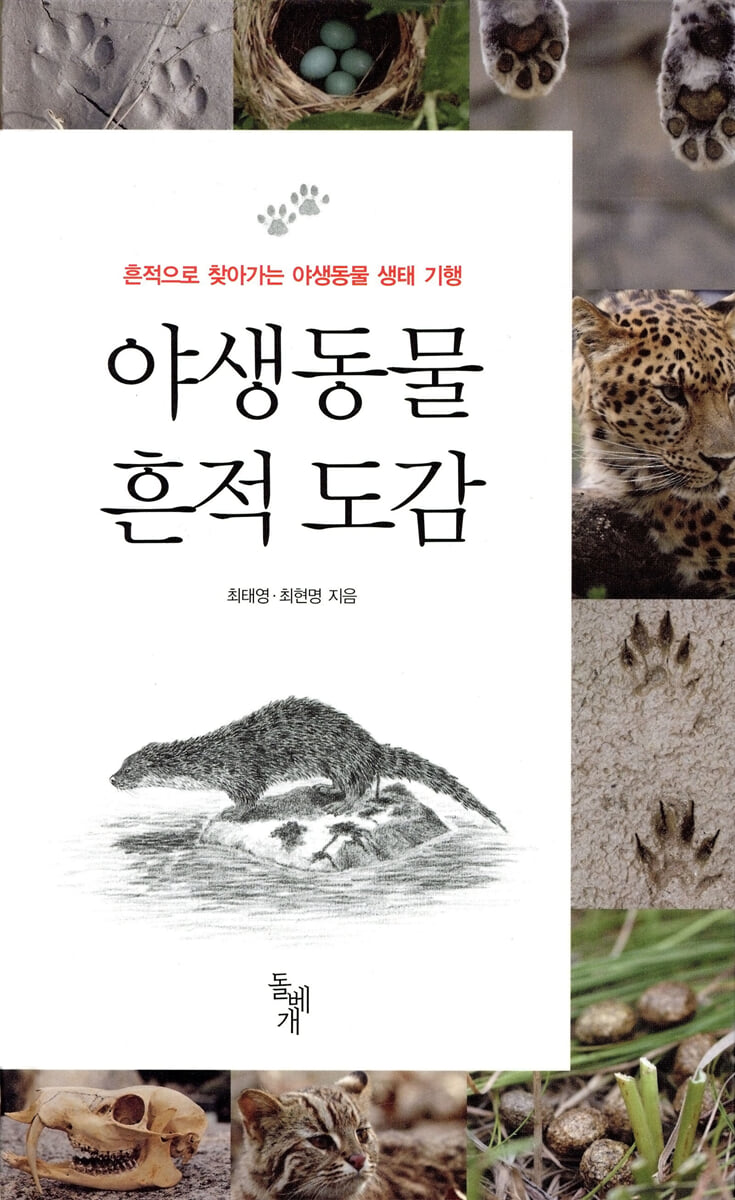
This book is a 'wildlife traces guide' that faithfully records the various traces of wild animals' lives, such as footprints, droppings, sleeping places, food traces, horn marks, and fur of about 30 species of mammals living in our mountains and fields, including moles, squirrels, wild rabbits, raccoons, wild cats, Asiatic black bears, and roe deer, with easy-to-understand explanations and over 600 photos and detailed drawings.
Part 1 provides a general explanation of the characteristics of footprints and gaits of four-legged animals that are difficult for people who walk on two legs to understand, as well as terms related to traces, excrement, food traces, and hair. Part 2 introduces traces of wild animals in detail in the order of Insectivora, Rodentia, Lagomorpha, Carnivora, and Artiodactyla, allowing for a natural understanding of commonalities in traces of animals belonging to the same order or family.
Part 3 contains traces of footprints, nests, sand baths, feathers, and other traces of about 50 species of birds commonly observed around us.
Above all, this book, which informs us about the lives and habits of wild animals through traces, will serve as a friendly guide for learning about animal ecology that the whole family can enjoy together.
Part 1 provides a general explanation of the characteristics of footprints and gaits of four-legged animals that are difficult for people who walk on two legs to understand, as well as terms related to traces, excrement, food traces, and hair. Part 2 introduces traces of wild animals in detail in the order of Insectivora, Rodentia, Lagomorpha, Carnivora, and Artiodactyla, allowing for a natural understanding of commonalities in traces of animals belonging to the same order or family.
Part 3 contains traces of footprints, nests, sand baths, feathers, and other traces of about 50 species of birds commonly observed around us.
Above all, this book, which informs us about the lives and habits of wild animals through traces, will serve as a friendly guide for learning about animal ecology that the whole family can enjoy together.
- You can preview some of the book's contents.
Preview
index
Opening Notes _ Animals, Traces, Curiosity
Part 1: The First Step to Understanding Wildlife Traces
1.
footprint
Foot Structure | Foot Classification | Footprint Interpretation | Gait | Finding Footprints
2.
excrement
Contents of stool | Shape, color, and amount of stool | Smell of stool | Excretion habits | Urine
3.
Changes in traces over time
The speed at which mud left by footprints settles | The speed at which trampled duckweed is restored | The speed at which trampled grass (wormwood) rises | The change in wildcat droppings (sunny) | The change in wildcat droppings (shady)
4.
traces of food
Herbivore feeding traces | Carnivore feeding traces | Rodent feeding traces
5.
hair
Fur of deer and roe deer | Fur of badgers and raccoons | Fur of wild cats and hares | Fur of wild boars
goat and goat hair
Part 2: Traces of the Beast
What are mammals? Species, subspecies, and speciation
Insectivores: Differences between Shrews and Rats
hedgehog
mole
Installation:
Blue squirrel
squirrel
flying squirrel
Other rodents
Lagomorpha: Differences between rabbits and rabbits
wild rabbit
raw rabbit
Carnivora Canidae:
raccoon
fox
Differences in footprints of wolves and canines
Carnivore Felidae:
Differences in footprints between canines and felines
leopard
lynx
wildcat
The difference between a cat and a wild cat
Carnivora, Mustelidae:
The difference between weasel poop and bird poop
Weasel
badger
How to recognize the similar footprints of otters and civets
otter
Carnivora: Bears
Asiatic black bear
brown bear
Right title:
elk
Different horn marks of flower deer, flower deer, roe deer, mountain goat, and goat
How to Recognize the Scratches a Deer Makes on a Tree with Its Canines
Various shapes of deer and animal droppings
Yellow
roe deer
musk deer
Difference between goat and goat
chlorine
The difference between wild boar dung and Asiatic black bear dung
Part 3: Bird's Traces
What is a bird?
1.
footprint
2.
excrement
3.
nest
4.
sand bath
5.
traces of food
6.
feathers
supplement
Terms related to wildlife traces
Collection of wild animal footprints
Collection of wild animal droppings
A collection of wild animal fur
Books and sites referenced
Find scientific names
Search
Part 1: The First Step to Understanding Wildlife Traces
1.
footprint
Foot Structure | Foot Classification | Footprint Interpretation | Gait | Finding Footprints
2.
excrement
Contents of stool | Shape, color, and amount of stool | Smell of stool | Excretion habits | Urine
3.
Changes in traces over time
The speed at which mud left by footprints settles | The speed at which trampled duckweed is restored | The speed at which trampled grass (wormwood) rises | The change in wildcat droppings (sunny) | The change in wildcat droppings (shady)
4.
traces of food
Herbivore feeding traces | Carnivore feeding traces | Rodent feeding traces
5.
hair
Fur of deer and roe deer | Fur of badgers and raccoons | Fur of wild cats and hares | Fur of wild boars
goat and goat hair
Part 2: Traces of the Beast
What are mammals? Species, subspecies, and speciation
Insectivores: Differences between Shrews and Rats
hedgehog
mole
Installation:
Blue squirrel
squirrel
flying squirrel
Other rodents
Lagomorpha: Differences between rabbits and rabbits
wild rabbit
raw rabbit
Carnivora Canidae:
raccoon
fox
Differences in footprints of wolves and canines
Carnivore Felidae:
Differences in footprints between canines and felines
leopard
lynx
wildcat
The difference between a cat and a wild cat
Carnivora, Mustelidae:
The difference between weasel poop and bird poop
Weasel
badger
How to recognize the similar footprints of otters and civets
otter
Carnivora: Bears
Asiatic black bear
brown bear
Right title:
elk
Different horn marks of flower deer, flower deer, roe deer, mountain goat, and goat
How to Recognize the Scratches a Deer Makes on a Tree with Its Canines
Various shapes of deer and animal droppings
Yellow
roe deer
musk deer
Difference between goat and goat
chlorine
The difference between wild boar dung and Asiatic black bear dung
Part 3: Bird's Traces
What is a bird?
1.
footprint
2.
excrement
3.
nest
4.
sand bath
5.
traces of food
6.
feathers
supplement
Terms related to wildlife traces
Collection of wild animal footprints
Collection of wild animal droppings
A collection of wild animal fur
Books and sites referenced
Find scientific names
Search
He was a lone wolf, a complete outsider who refused to join the pack.
It is said that animals were imprinted in his mind from a young age, without any special reason or trigger.
I majored in landscape architecture in college and graduate school, and after entering the workforce, I worked at several landscape design firms before quitting my job in 1998 after designing the Daejeon Zoo.
After that, except for a brief stay at the Korea Animal Rescue and Management Association, I visited the mountains and fields and wandered around Northeast Asia, collecting information on wild animals that are difficult to find in Korea.
My hobby is drawing, and I especially enjoy drawing felines.
His specialty is daydreaming while walking, and he says that cup ramen eaten while sitting by the water is the best food.
I currently spend a lot of time observing wildcats and raccoons, and I am also planning a book on the ecology of disappearing wildlife.
He was a lone wolf, a complete outsider who refused to join the pack.
It is said that animals were imprinted in his mind from a young age, without any special reason or trigger.
I majored in landscape architecture in college and graduate school, and after entering the workforce, I worked at several landscape design firms before quitting my job in 1998 after designing the Daejeon Zoo.
After that, except for a brief stay at the Korea Animal Rescue and Management Association, I visited the mountains and fields and wandered around Northeast Asia, collecting information on wild animals that are difficult to find in Korea.
My hobby is drawing, and I especially enjoy drawing felines.
His specialty is daydreaming while walking, and he says that cup ramen eaten while sitting by the water is the best food.
I currently spend a lot of time observing wildcats and raccoons, and I am also planning a book on the ecology of disappearing wildlife.
It is said that animals were imprinted in his mind from a young age, without any special reason or trigger.
I majored in landscape architecture in college and graduate school, and after entering the workforce, I worked at several landscape design firms before quitting my job in 1998 after designing the Daejeon Zoo.
After that, except for a brief stay at the Korea Animal Rescue and Management Association, I visited the mountains and fields and wandered around Northeast Asia, collecting information on wild animals that are difficult to find in Korea.
My hobby is drawing, and I especially enjoy drawing felines.
His specialty is daydreaming while walking, and he says that cup ramen eaten while sitting by the water is the best food.
I currently spend a lot of time observing wildcats and raccoons, and I am also planning a book on the ecology of disappearing wildlife.
He was a lone wolf, a complete outsider who refused to join the pack.
It is said that animals were imprinted in his mind from a young age, without any special reason or trigger.
I majored in landscape architecture in college and graduate school, and after entering the workforce, I worked at several landscape design firms before quitting my job in 1998 after designing the Daejeon Zoo.
After that, except for a brief stay at the Korea Animal Rescue and Management Association, I visited the mountains and fields and wandered around Northeast Asia, collecting information on wild animals that are difficult to find in Korea.
My hobby is drawing, and I especially enjoy drawing felines.
His specialty is daydreaming while walking, and he says that cup ramen eaten while sitting by the water is the best food.
I currently spend a lot of time observing wildcats and raccoons, and I am also planning a book on the ecology of disappearing wildlife.
Publisher's Review
A basic textbook for investigating natural ecosystems, Korea's only trace guidebook.
As can be seen in the author's introduction, which states that although he is studying applied science, he is also conducting basic research due to the lack of data on wild animals, despite the fact that there are only a few species of mammals that can be easily found in Korea, there is a lack of basic data such as an atlas of wild animal traces, and there are only a few experts studying traces.
Korea's first "Wild Animal Traces Atlas," which was created by directly collecting and recording the traces of our wild animals over a period of 6 to 8 years in such a harsh environment, can be used as a practical guide or basic educational material for research institutes investigating ecosystems, nature conservation organizations, and environmental groups.
Why is it important to understand wildlife tracks?
Mammals living on our land are not numerous compared to insects or birds, and many of them are now extinct, so only about 10 species of animals can be seen and felt in the forest.
Additionally, mammals, except for chipmunks and squirrels, are mostly active at night, are good at hiding, and do not make sounds audible to humans, so it is not easy to directly encounter wild animals outside of a zoo.
However, the traces left in the mountains and fields allow us to understand the world of animals without having to see them directly, and provide clues that allow us to track them regardless of time.
When it comes to understanding animals, examining traces like footprints and droppings can be far more effective than briefly seeing them at a zoo, and through these traces we can understand the lives and survival strategies of wild animals.
As we gain more knowledge about traces, our respect and affection for animals and nature, living beings other than ourselves, will deepen.
The lives and survival strategies of wild animals as seen through traces
Understanding tracks doesn't necessarily require expert knowledge of wildlife.
Large footprints indicate a large animal, and clear footprints indicate a recent visit.
If there is grass mixed in the dung, it is from a herbivore, and if there are bones and hair, it is from a carnivore.
If we cultivate curiosity before knowledge and carefully observe the footprints, droppings, food traces, and fur left in the forests around us, we will be able to understand the lives and survival strategies of animals.
Footprints, the most basic traces for understanding animal tracks
Badgers and bears have short legs and cannot run fast because they use all five toes, but they have developed sturdy forelimbs and long claws.
Wolves and tigers run on four toes, lifting their heels, so they are faster than bears and badgers, but not as fast as deer, which run on two toes.
However, wolves have developed endurance and tigers have developed sharp claws to compensate for their weaknesses.
When following footprints, the first thing to do is to determine the direction in which the animal is moving.
All footsteps are deeply pressed forward because the center of gravity is constantly shifting towards the direction of movement.
Also, when snow piles up in winter, dogs tend to drag their paws longer on the snow than cats, dragging the back of their footprints longer than the front.
Otters, weasels, and rodents often leave trails of their tails when moving on snow or sand, so their direction of movement can be determined by the trails.
Excrement, traces that tell us about the type of food an animal consumed as well as its life and behavior
Feces, like footprints, are one of the easiest traces to find.
Herbivores produce large quantities of small, round pellets of feces, while carnivores produce long, round, sausage-shaped pellets of feces.
Although the size of the droppings of young animals is smaller than that of adults, the shape of the droppings depends more on the type of food than on the age.
Just as people go in and out of the bathroom, mountain goats and raccoons have a habit of leaving their droppings in one place.
Badgers dig shallow burrows and defecate at the entrance, but cats cover them with dirt.
Animals such as weasels, martens, and otters defecate on rocks, while wildcats, leopards, tigers, and foxes prefer dry, bare ground.
Animal urine plays a major role in announcing their presence among animals, and you can even tell the species and gender of an animal by looking at the urine that falls on the snow in winter.
For example, in the case of canines, males usually lift one hind leg and urinate in a specific location, while females urinate with their hind leg slightly bent.
Some mammals have glands in their anus that secrete a specific odor, which they excrete with their feces.
This secretion is most developed during mating season, and many species also use it to mark their territory.
Food traces can help us understand animals and their surroundings more fundamentally.
Herbivores such as deer and rabbits eat less nutritious food such as grass and leaves, so they eat more than carnivores and leave more traces.
Hominids such as mountain goats, goats, and deer sometimes use their horns to peel bark from trees, not only for gnawing but also to mark territory and communicate with each other.
Traces of prey from carnivores can be found mainly on carcasses left after hunting.
The marks left on the carcass differ depending on the differences in the oral structures of mammals and birds. Mammals use their molars to crush and chew bones and feathers, while birds use their beaks to eat flesh from bones and pluck feathers.
Rodents such as squirrels and mice mainly eat tree bark during the winter when food is scarce, and they usually store nutritious seeds and fruits.
Traces that help distinguish between hairs and species and help understand species characteristics
Animal fur is fine and not easily visible, but animals are constantly shedding and growing new fur, so you can find a variety of fur and feathers in the forest.
Hair helps maintain body temperature and also serves as protective coloration.
However, some animals, such as deer and raccoons, use strategies to make their fur more visible.
As can be seen in the author's introduction, which states that although he is studying applied science, he is also conducting basic research due to the lack of data on wild animals, despite the fact that there are only a few species of mammals that can be easily found in Korea, there is a lack of basic data such as an atlas of wild animal traces, and there are only a few experts studying traces.
Korea's first "Wild Animal Traces Atlas," which was created by directly collecting and recording the traces of our wild animals over a period of 6 to 8 years in such a harsh environment, can be used as a practical guide or basic educational material for research institutes investigating ecosystems, nature conservation organizations, and environmental groups.
Why is it important to understand wildlife tracks?
Mammals living on our land are not numerous compared to insects or birds, and many of them are now extinct, so only about 10 species of animals can be seen and felt in the forest.
Additionally, mammals, except for chipmunks and squirrels, are mostly active at night, are good at hiding, and do not make sounds audible to humans, so it is not easy to directly encounter wild animals outside of a zoo.
However, the traces left in the mountains and fields allow us to understand the world of animals without having to see them directly, and provide clues that allow us to track them regardless of time.
When it comes to understanding animals, examining traces like footprints and droppings can be far more effective than briefly seeing them at a zoo, and through these traces we can understand the lives and survival strategies of wild animals.
As we gain more knowledge about traces, our respect and affection for animals and nature, living beings other than ourselves, will deepen.
The lives and survival strategies of wild animals as seen through traces
Understanding tracks doesn't necessarily require expert knowledge of wildlife.
Large footprints indicate a large animal, and clear footprints indicate a recent visit.
If there is grass mixed in the dung, it is from a herbivore, and if there are bones and hair, it is from a carnivore.
If we cultivate curiosity before knowledge and carefully observe the footprints, droppings, food traces, and fur left in the forests around us, we will be able to understand the lives and survival strategies of animals.
Footprints, the most basic traces for understanding animal tracks
Badgers and bears have short legs and cannot run fast because they use all five toes, but they have developed sturdy forelimbs and long claws.
Wolves and tigers run on four toes, lifting their heels, so they are faster than bears and badgers, but not as fast as deer, which run on two toes.
However, wolves have developed endurance and tigers have developed sharp claws to compensate for their weaknesses.
When following footprints, the first thing to do is to determine the direction in which the animal is moving.
All footsteps are deeply pressed forward because the center of gravity is constantly shifting towards the direction of movement.
Also, when snow piles up in winter, dogs tend to drag their paws longer on the snow than cats, dragging the back of their footprints longer than the front.
Otters, weasels, and rodents often leave trails of their tails when moving on snow or sand, so their direction of movement can be determined by the trails.
Excrement, traces that tell us about the type of food an animal consumed as well as its life and behavior
Feces, like footprints, are one of the easiest traces to find.
Herbivores produce large quantities of small, round pellets of feces, while carnivores produce long, round, sausage-shaped pellets of feces.
Although the size of the droppings of young animals is smaller than that of adults, the shape of the droppings depends more on the type of food than on the age.
Just as people go in and out of the bathroom, mountain goats and raccoons have a habit of leaving their droppings in one place.
Badgers dig shallow burrows and defecate at the entrance, but cats cover them with dirt.
Animals such as weasels, martens, and otters defecate on rocks, while wildcats, leopards, tigers, and foxes prefer dry, bare ground.
Animal urine plays a major role in announcing their presence among animals, and you can even tell the species and gender of an animal by looking at the urine that falls on the snow in winter.
For example, in the case of canines, males usually lift one hind leg and urinate in a specific location, while females urinate with their hind leg slightly bent.
Some mammals have glands in their anus that secrete a specific odor, which they excrete with their feces.
This secretion is most developed during mating season, and many species also use it to mark their territory.
Food traces can help us understand animals and their surroundings more fundamentally.
Herbivores such as deer and rabbits eat less nutritious food such as grass and leaves, so they eat more than carnivores and leave more traces.
Hominids such as mountain goats, goats, and deer sometimes use their horns to peel bark from trees, not only for gnawing but also to mark territory and communicate with each other.
Traces of prey from carnivores can be found mainly on carcasses left after hunting.
The marks left on the carcass differ depending on the differences in the oral structures of mammals and birds. Mammals use their molars to crush and chew bones and feathers, while birds use their beaks to eat flesh from bones and pluck feathers.
Rodents such as squirrels and mice mainly eat tree bark during the winter when food is scarce, and they usually store nutritious seeds and fruits.
Traces that help distinguish between hairs and species and help understand species characteristics
Animal fur is fine and not easily visible, but animals are constantly shedding and growing new fur, so you can find a variety of fur and feathers in the forest.
Hair helps maintain body temperature and also serves as protective coloration.
However, some animals, such as deer and raccoons, use strategies to make their fur more visible.
GOODS SPECIFICS
- Date of issue: January 2, 2007
- Format: Hardcover book binding method guide
- Page count, weight, size: 303 pages | 560g | 137*223*30mm
- ISBN13: 9788971992630
- ISBN10: 8971992638
You may also like
카테고리
korean


korean

![ELLE 엘르 스페셜 에디션 A형 : 12월 [2025]](http://librairie.coreenne.fr/cdn/shop/files/b8e27a3de6c9538896439686c6b0e8fb.jpg?v=1766436872&width=3840)


