

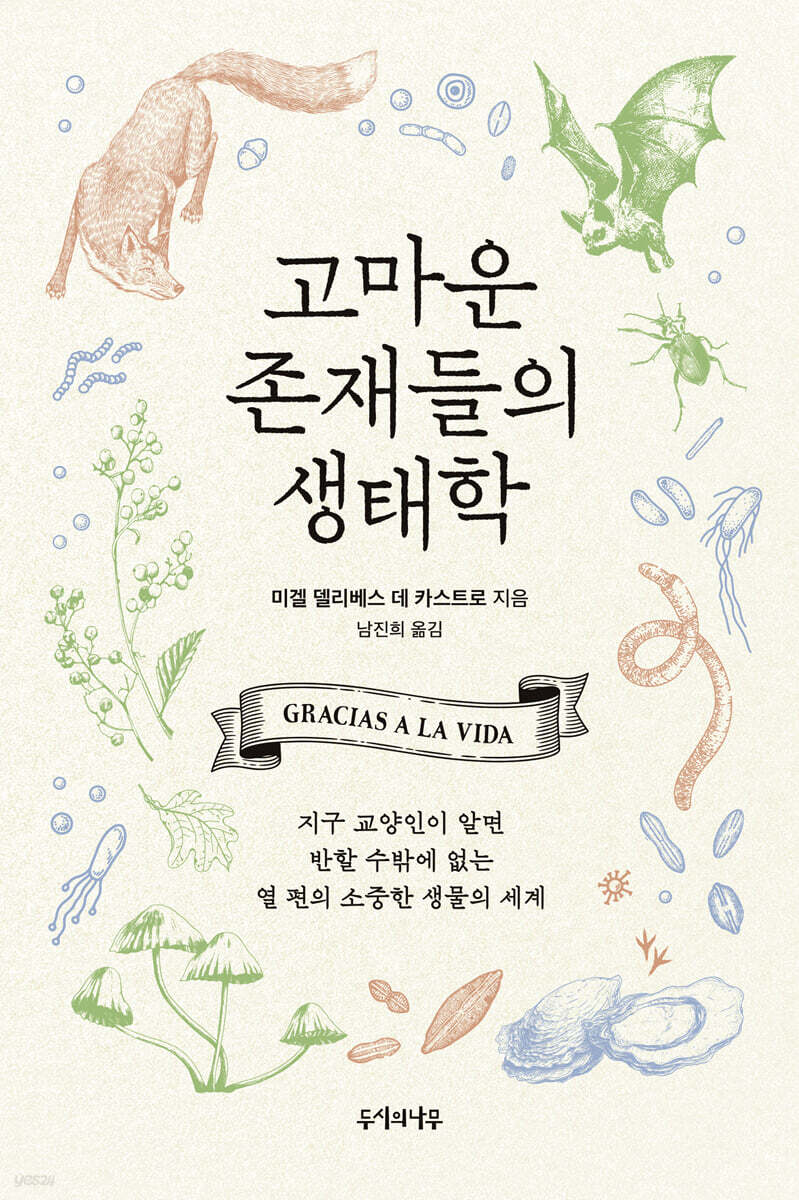
Ecology of Grateful Beings
 |
Description
Book Introduction
Bugs, weeds, fungi, microbes, bats…
People look down on, despise, or don't pay any attention to it.
A loving tribute to life from an elderly biologist
Would it be naive to think that the extinction of certain animals is a more serious problem than the environmental crisis facing humanity? The author, a biologist who pioneered ecological research in Spain, answers the question with a negative.
The conclusion reached by a scholar nearing his eighties after a lifetime of research is self-evident.
The environmental crisis facing humanity is closely intertwined with the biodiversity crisis, and we cannot survive without diverse life forms.
This book clearly shows that we are able to breathe and live thanks to living things that we either ignore or don't pay attention to: beetles that solve crop pollination problems, bats that control pest populations, condors that quickly dispose of animal carcasses, microorganisms that make up and regulate the human body, and oysters that purify water and protect coastlines.
This book, which presents a wealth of research and fascinating scientific facts in an accessible format and expresses gratitude to the precious players in the biosphere, will serve as a valuable guide for facing the severity of biodiversity loss and considering fundamental solutions to the environmental crisis.
In addition to the colorful examples of creatures that always faithfully fulfill their roles, even if they seem insignificant and insignificant to humans, the book is well-mixed with the experience, insight, and loving descriptions of a scholar.
People look down on, despise, or don't pay any attention to it.
A loving tribute to life from an elderly biologist
Would it be naive to think that the extinction of certain animals is a more serious problem than the environmental crisis facing humanity? The author, a biologist who pioneered ecological research in Spain, answers the question with a negative.
The conclusion reached by a scholar nearing his eighties after a lifetime of research is self-evident.
The environmental crisis facing humanity is closely intertwined with the biodiversity crisis, and we cannot survive without diverse life forms.
This book clearly shows that we are able to breathe and live thanks to living things that we either ignore or don't pay attention to: beetles that solve crop pollination problems, bats that control pest populations, condors that quickly dispose of animal carcasses, microorganisms that make up and regulate the human body, and oysters that purify water and protect coastlines.
This book, which presents a wealth of research and fascinating scientific facts in an accessible format and expresses gratitude to the precious players in the biosphere, will serve as a valuable guide for facing the severity of biodiversity loss and considering fundamental solutions to the environmental crisis.
In addition to the colorful examples of creatures that always faithfully fulfill their roles, even if they seem insignificant and insignificant to humans, the book is well-mixed with the experience, insight, and loving descriptions of a scholar.
- You can preview some of the book's contents.
Preview
index
Why I wrote this book: Our planet is a more comfortable place to live.
Treating our illness
Thanks to the weeds
Fertilizes the soil
Thanks to the earthworms
Supporting life on land
Thanks to fungi
Cleans the fields and saves them from diseases
Thanks to the condor
Maybe we can call it 'us' because we live inside our bodies.
Thanks to microorganisms
It helps the plants we eat grow well
Thanks to the beetle
It releases oxygen so we can breathe.
Thanks to phytoplankton
Controlling potential pests
Thanks to bats
Purifying water and protecting coasts
Thanks to the oysters
Spreading the seeds of trees and shrubs
Thanks to the fox
Epilogue: Thank you to all life that gives so much.
Acknowledgements
Treating our illness
Thanks to the weeds
Fertilizes the soil
Thanks to the earthworms
Supporting life on land
Thanks to fungi
Cleans the fields and saves them from diseases
Thanks to the condor
Maybe we can call it 'us' because we live inside our bodies.
Thanks to microorganisms
It helps the plants we eat grow well
Thanks to the beetle
It releases oxygen so we can breathe.
Thanks to phytoplankton
Controlling potential pests
Thanks to bats
Purifying water and protecting coasts
Thanks to the oysters
Spreading the seeds of trees and shrubs
Thanks to the fox
Epilogue: Thank you to all life that gives so much.
Acknowledgements
Into the book
We discussed global warming, ozone layer destruction, inequality, environmental degradation, population growth, consumption, pollution, and more, and my father was not only interested in all of these issues, but also very concerned.
But when we started to deal with the decline of biodiversity and the extinction of plant and animal populations, my father's attitude changed drastically.
“Son, I know you are concerned about the extinction of the sraccoon and are working hard to prevent it.
I don't want that either.
But it doesn't compare to the severity of other problems we've dealt with before.
It's really sad when a species disappears, but it's not dramatic.
“I don’t think it will have much of an impact on us,” he said, and eventually my father demanded that the part be removed from the book.
But when I refused (claiming that this was the only information I had personally learned), my father began to complain to my siblings at mealtime.
“Miguel only wants to talk about plants and animals.
I didn't say that such a story was meaningless.
But I think it would obscure the tragic situation we are trying to address.
People will lose interest in this book.”
At that moment, I decided that I had to convince my father.
--- "Reason for writing this article"
Statins, used to lower cholesterol levels in the blood and one of the most commonly prescribed drugs today, are also derived from fungi.
Rapamycin, an immunosuppressant used in transplant surgery, was derived from another soil bacterium on Easter Island.
There are countless other examples that can be cited.
Some biochemists believe that with the advent of chemical synthesis, where computers and artificial intelligence help design custom molecules, we will no longer need natural products.
However, according to Bernstein and Chivian, about half of the drugs patented between 1981 and 2006 were derived from wild species.
--- "Thanks to the weeds that cure our illnesses"
Just before the turn of the 21st century, another mushroom was discovered in Oregon, and as far as I know, this one currently holds the record.
The mushroom covers an area of about 965 hectares (about 1,500 soccer fields) and is estimated to be between 2,400 and 8,650 years old.
The largest living organism on Earth holds a tremendous secret.
The fact that they're literally bubbling beneath our feet without us even noticing could be a clue that fungi are doing a lot of incredibly important work out of sight?
--- "Thanks to the fungi that sustain life on land"
Researcher Sebensuy Morales of the University of Miguel Hernández and colleagues calculated the greenhouse gases emitted by transporting dead cattle to crematoriums in Spain, which they estimated would cover 50 million kilometers per year and release at least 77,300 tonnes of carbon dioxide into the atmosphere.
If Spain protects and conserves condors, it will be much easier to comply with international agreements to reduce greenhouse gas emissions than if it did not.
So we should be grateful to the condor not only for saving us from disease, but also for helping to mitigate global warming.
--- "Thanks to the condor, who clears the fields and saves them from disease"
(…) Although this expression has its own meaning, the Amazon rainforest is not the lungs of the Earth.
The Amazon rainforest produces about 6 percent of the oxygen released into the atmosphere through photosynthesis on Earth, but it consumes all of it itself (along with all living things) through respiration.
Because deforestation has accelerated in recent decades, the Amazon rainforest is releasing as much carbon back into the atmosphere as it absorbs.
In fact, most of the oxygen in the atmosphere comes from the ocean, so we could say that there was enough for us to breathe for millions of years.
(…) If there is one thing we, born on a planet with an essential oxygen supply, should be grateful for first and foremost, it is the cyanobacteria (formerly called blue-green algae) and other photosynthetic organisms that make up marine phytoplankton.
--- "Thanks to phytoplankton, which releases oxygen so we can breathe."
I was thinking about title this chapter 'Thanks to Spiders'.
Spiders are not very popular, despite limiting pests in gardens and farms.
However, after the COVID-19 outbreak, we decided to change the title.
Bats deserve not only fair treatment, but also appreciation.
Unfortunately, soon after the discovery of the now-famous SARS-CoV-2 virus, both health authorities and laypeople alike blamed bats as the source of the disease.
As Javier Juste and several colleagues have pointed out, it is clear that coronaviruses have evolved in association with bats in general, but this is not limited to bats.
It is also clear that, as far as I know, no one has proven that a specific bat species is the origin of the virus that is killing us.
But this hasn't stopped hundreds of thousands of these flying mammals from being slaughtered around the world, particularly in Asia and South America, in the name of fighting the pandemic.
In this situation, it would be valuable to extend a helping hand to bats, while also giving them a place in the hierarchy of creatures that serve humanity without any compensation.
--- "Thanks to bats, we control potential pests."
Jaime Lau, a biologist from the University of Osorno in Chile, was in Spain with his wife, Angelica, to complete his doctoral dissertation with us.
He studied the ecology of foxes living in national parks, particularly by collecting and analyzing fox droppings to find out what they eat and live on.
One autumn day, he slung his bag over his shoulder and went out to the northwest, where the sand dunes and the breeding facility were, and picked up sizable clumps of dung, placing them in paper bags.
It was the rainy season, so the excrement was still a little wet, so I thought I'd dry the specimen, put the paper bag on a plastic tray, and store it on a shelf, and to be honest, I forgot about it for a while.
Three months later, when I suddenly remembered the tray and looked for it, it had already turned into a greenhouse, and there, dozens of seeds had grown into tiny sabina and juniper seedlings.
He excitedly told me the news and let me see it for myself.
Of course, we both knew that foxes eat the berries of the sabina tree and excrete the germinable seeds, but it was exciting to see it firsthand when we hadn't expected it.
--- "Thanks to the foxes who spread the seeds of trees and shrubs"
We owe more and more to nature.
We are exploiting some resources (like biodiversity and fossil fuels) and making others pay the price.
But when natural resources are depleted, all these schemes will collapse.
We talk about wealth creation, even calculating how much we can create, but what is clear is that we live in a world that is becoming increasingly impoverished.
Pursuing economic growth at the expense of the environment cannot continue indefinitely.
It is unsustainable.
We need to adapt to the post-growth era as quickly as possible.
But when we started to deal with the decline of biodiversity and the extinction of plant and animal populations, my father's attitude changed drastically.
“Son, I know you are concerned about the extinction of the sraccoon and are working hard to prevent it.
I don't want that either.
But it doesn't compare to the severity of other problems we've dealt with before.
It's really sad when a species disappears, but it's not dramatic.
“I don’t think it will have much of an impact on us,” he said, and eventually my father demanded that the part be removed from the book.
But when I refused (claiming that this was the only information I had personally learned), my father began to complain to my siblings at mealtime.
“Miguel only wants to talk about plants and animals.
I didn't say that such a story was meaningless.
But I think it would obscure the tragic situation we are trying to address.
People will lose interest in this book.”
At that moment, I decided that I had to convince my father.
--- "Reason for writing this article"
Statins, used to lower cholesterol levels in the blood and one of the most commonly prescribed drugs today, are also derived from fungi.
Rapamycin, an immunosuppressant used in transplant surgery, was derived from another soil bacterium on Easter Island.
There are countless other examples that can be cited.
Some biochemists believe that with the advent of chemical synthesis, where computers and artificial intelligence help design custom molecules, we will no longer need natural products.
However, according to Bernstein and Chivian, about half of the drugs patented between 1981 and 2006 were derived from wild species.
--- "Thanks to the weeds that cure our illnesses"
Just before the turn of the 21st century, another mushroom was discovered in Oregon, and as far as I know, this one currently holds the record.
The mushroom covers an area of about 965 hectares (about 1,500 soccer fields) and is estimated to be between 2,400 and 8,650 years old.
The largest living organism on Earth holds a tremendous secret.
The fact that they're literally bubbling beneath our feet without us even noticing could be a clue that fungi are doing a lot of incredibly important work out of sight?
--- "Thanks to the fungi that sustain life on land"
Researcher Sebensuy Morales of the University of Miguel Hernández and colleagues calculated the greenhouse gases emitted by transporting dead cattle to crematoriums in Spain, which they estimated would cover 50 million kilometers per year and release at least 77,300 tonnes of carbon dioxide into the atmosphere.
If Spain protects and conserves condors, it will be much easier to comply with international agreements to reduce greenhouse gas emissions than if it did not.
So we should be grateful to the condor not only for saving us from disease, but also for helping to mitigate global warming.
--- "Thanks to the condor, who clears the fields and saves them from disease"
(…) Although this expression has its own meaning, the Amazon rainforest is not the lungs of the Earth.
The Amazon rainforest produces about 6 percent of the oxygen released into the atmosphere through photosynthesis on Earth, but it consumes all of it itself (along with all living things) through respiration.
Because deforestation has accelerated in recent decades, the Amazon rainforest is releasing as much carbon back into the atmosphere as it absorbs.
In fact, most of the oxygen in the atmosphere comes from the ocean, so we could say that there was enough for us to breathe for millions of years.
(…) If there is one thing we, born on a planet with an essential oxygen supply, should be grateful for first and foremost, it is the cyanobacteria (formerly called blue-green algae) and other photosynthetic organisms that make up marine phytoplankton.
--- "Thanks to phytoplankton, which releases oxygen so we can breathe."
I was thinking about title this chapter 'Thanks to Spiders'.
Spiders are not very popular, despite limiting pests in gardens and farms.
However, after the COVID-19 outbreak, we decided to change the title.
Bats deserve not only fair treatment, but also appreciation.
Unfortunately, soon after the discovery of the now-famous SARS-CoV-2 virus, both health authorities and laypeople alike blamed bats as the source of the disease.
As Javier Juste and several colleagues have pointed out, it is clear that coronaviruses have evolved in association with bats in general, but this is not limited to bats.
It is also clear that, as far as I know, no one has proven that a specific bat species is the origin of the virus that is killing us.
But this hasn't stopped hundreds of thousands of these flying mammals from being slaughtered around the world, particularly in Asia and South America, in the name of fighting the pandemic.
In this situation, it would be valuable to extend a helping hand to bats, while also giving them a place in the hierarchy of creatures that serve humanity without any compensation.
--- "Thanks to bats, we control potential pests."
Jaime Lau, a biologist from the University of Osorno in Chile, was in Spain with his wife, Angelica, to complete his doctoral dissertation with us.
He studied the ecology of foxes living in national parks, particularly by collecting and analyzing fox droppings to find out what they eat and live on.
One autumn day, he slung his bag over his shoulder and went out to the northwest, where the sand dunes and the breeding facility were, and picked up sizable clumps of dung, placing them in paper bags.
It was the rainy season, so the excrement was still a little wet, so I thought I'd dry the specimen, put the paper bag on a plastic tray, and store it on a shelf, and to be honest, I forgot about it for a while.
Three months later, when I suddenly remembered the tray and looked for it, it had already turned into a greenhouse, and there, dozens of seeds had grown into tiny sabina and juniper seedlings.
He excitedly told me the news and let me see it for myself.
Of course, we both knew that foxes eat the berries of the sabina tree and excrete the germinable seeds, but it was exciting to see it firsthand when we hadn't expected it.
--- "Thanks to the foxes who spread the seeds of trees and shrubs"
We owe more and more to nature.
We are exploiting some resources (like biodiversity and fossil fuels) and making others pay the price.
But when natural resources are depleted, all these schemes will collapse.
We talk about wealth creation, even calculating how much we can create, but what is clear is that we live in a world that is becoming increasingly impoverished.
Pursuing economic growth at the expense of the environment cannot continue indefinitely.
It is unsustainable.
We need to adapt to the post-growth era as quickly as possible.
--- "Epilogue"
Publisher's Review
“Everyone who cares about the future of this world
“You deserve to hear this story.”
★ Spanish bestseller immediately after publication ★
The value of ecosystems that a prominent biologist, approaching eighty, wants to convey immediately.
“The fate of humanity is linked to the fate of all other life.”
This book opens with a story about the song "Thank You for Life" by world-renowned singer Violeta Parra, and guides readers to facts that even this song, widely known as a hymn to human vitality, has not yet grasped.
The fact that life is much broader than us humans, that there are countless lives around us, and that we humans owe a tremendous amount of happiness to these diverse living beings.
Many people are still unaware of this fact, not only decades after the song was released, but even today.
We are able to eat, drink, breathe, and live at a comfortable temperature thanks to the countless other living things that interact with and maintain a balanced ecosystem, but we are trapped in anthropocentrism and take all of this for granted.
This book focuses on life forms like weeds, earthworms, fungi, bats, and microbes that provide us with essentials but are often not readily apparent or readily visible, helping us move beyond our human-centered world and into the vast, infinite world of life.
This book persuasively conveys that while humanity faces a crisis by destroying nature, respecting the value of life is the only and crucial way to prevent catastrophe.
There are other environmental problems that humans face more than biodiversity loss.
A book written to persuade my father who said it came first
The origins of this book date back over 20 years.
The author's father, Miguel Delibes, a famous writer of his time, suggested to his son that they write a book together, and the father and son published a book titled "La Tierra herida" (The Wounded Earth) containing their conversations about global environmental issues.
While talking with his father about this book, the author realized that even a well-educated and cultured person like his father could not properly appreciate the value of biodiversity, which signifies the richness of life.
My father believed that the tragedies directly affecting humanity, such as global warming, ozone layer destruction, and increased pollution, were more important than the extinction of plants and animals, and he believed that most people shared the same view.
The author, determined to write a letter expressing gratitude for the contributions of various creatures to convince his father (and like-minded modern people), and the letter he intended to send to his father became a book for all who care about the future of this world.
Are bats being given a bad name by the coronavirus?
The Amazon isn't the lungs of the Earth?
A fascinating science story that further solidifies the value of nature.
The author, who originally intended to treat spiders as pest control creatures, decided to change the protagonist to a bat after the COVID-19 pandemic.
While many blame bats for the coronavirus, the authors argue that the disease isn't limited to bats and that bats deserve their due.
Considering the cost of chemicals used in pest control today, the benefits bats provide us through natural pest control are incalculable.
It is also clear that we could not sustain life if phytoplankton, which are so tiny that they are difficult to detect with the naked eye, did not emit oxygen.
The lungs of the Earth are not the Amazon, as is often said, but these plankton spread widely in the ocean.
Given that nearly half of the world's coastal ecosystems have been destroyed by human activity over the past half-century, recognizing the value of these creatures is more urgent than ever.
In this way, this book focuses on beings that have escaped human attention.
Beyond bats and phytoplankton, the diverse mix of life forms is truly spectacular: weeds that seem insignificant but are important medicines for treating diseases; fungi that are invisible but spread widely underground to support plants and trees; condors that dispose of animal carcasses to prevent the spread of disease; microorganisms that are actually essential components of our bodies; oysters that purify water and protect coasts without us noticing; foxes that spread plant seeds; and more.
And as we read through these fascinating examples of ecosystems, we come to realize that humans are also included in them.
What would humanity lose if these bugs and these plants disappeared?
Instead of fearing the advent of dystopia, let's move toward respect for life.
Countless living organisms interact to reinforce a living, moving network, and the complexity of nature is inherently powerful and resilient.
Therefore, when humans eliminate species and weaken or destroy their connections, the safety of the entire ecosystem is inevitably put at risk.
The reason why infectious diseases are on the rise, the safety of water and food is being compromised, and the climate crisis is upon us today is because humans have become so obsessed with growth that they have neglected the role of each living being.
In what Martin Luther King Jr. called “an inescapable web of interconnectedness,” the fate of humanity is linked to the fate of all other living beings.
As fears about the environmental crisis grow, this book's message of gratitude for life becomes even more relevant and urgent.
“You deserve to hear this story.”
★ Spanish bestseller immediately after publication ★
The value of ecosystems that a prominent biologist, approaching eighty, wants to convey immediately.
“The fate of humanity is linked to the fate of all other life.”
This book opens with a story about the song "Thank You for Life" by world-renowned singer Violeta Parra, and guides readers to facts that even this song, widely known as a hymn to human vitality, has not yet grasped.
The fact that life is much broader than us humans, that there are countless lives around us, and that we humans owe a tremendous amount of happiness to these diverse living beings.
Many people are still unaware of this fact, not only decades after the song was released, but even today.
We are able to eat, drink, breathe, and live at a comfortable temperature thanks to the countless other living things that interact with and maintain a balanced ecosystem, but we are trapped in anthropocentrism and take all of this for granted.
This book focuses on life forms like weeds, earthworms, fungi, bats, and microbes that provide us with essentials but are often not readily apparent or readily visible, helping us move beyond our human-centered world and into the vast, infinite world of life.
This book persuasively conveys that while humanity faces a crisis by destroying nature, respecting the value of life is the only and crucial way to prevent catastrophe.
There are other environmental problems that humans face more than biodiversity loss.
A book written to persuade my father who said it came first
The origins of this book date back over 20 years.
The author's father, Miguel Delibes, a famous writer of his time, suggested to his son that they write a book together, and the father and son published a book titled "La Tierra herida" (The Wounded Earth) containing their conversations about global environmental issues.
While talking with his father about this book, the author realized that even a well-educated and cultured person like his father could not properly appreciate the value of biodiversity, which signifies the richness of life.
My father believed that the tragedies directly affecting humanity, such as global warming, ozone layer destruction, and increased pollution, were more important than the extinction of plants and animals, and he believed that most people shared the same view.
The author, determined to write a letter expressing gratitude for the contributions of various creatures to convince his father (and like-minded modern people), and the letter he intended to send to his father became a book for all who care about the future of this world.
Are bats being given a bad name by the coronavirus?
The Amazon isn't the lungs of the Earth?
A fascinating science story that further solidifies the value of nature.
The author, who originally intended to treat spiders as pest control creatures, decided to change the protagonist to a bat after the COVID-19 pandemic.
While many blame bats for the coronavirus, the authors argue that the disease isn't limited to bats and that bats deserve their due.
Considering the cost of chemicals used in pest control today, the benefits bats provide us through natural pest control are incalculable.
It is also clear that we could not sustain life if phytoplankton, which are so tiny that they are difficult to detect with the naked eye, did not emit oxygen.
The lungs of the Earth are not the Amazon, as is often said, but these plankton spread widely in the ocean.
Given that nearly half of the world's coastal ecosystems have been destroyed by human activity over the past half-century, recognizing the value of these creatures is more urgent than ever.
In this way, this book focuses on beings that have escaped human attention.
Beyond bats and phytoplankton, the diverse mix of life forms is truly spectacular: weeds that seem insignificant but are important medicines for treating diseases; fungi that are invisible but spread widely underground to support plants and trees; condors that dispose of animal carcasses to prevent the spread of disease; microorganisms that are actually essential components of our bodies; oysters that purify water and protect coasts without us noticing; foxes that spread plant seeds; and more.
And as we read through these fascinating examples of ecosystems, we come to realize that humans are also included in them.
What would humanity lose if these bugs and these plants disappeared?
Instead of fearing the advent of dystopia, let's move toward respect for life.
Countless living organisms interact to reinforce a living, moving network, and the complexity of nature is inherently powerful and resilient.
Therefore, when humans eliminate species and weaken or destroy their connections, the safety of the entire ecosystem is inevitably put at risk.
The reason why infectious diseases are on the rise, the safety of water and food is being compromised, and the climate crisis is upon us today is because humans have become so obsessed with growth that they have neglected the role of each living being.
In what Martin Luther King Jr. called “an inescapable web of interconnectedness,” the fate of humanity is linked to the fate of all other living beings.
As fears about the environmental crisis grow, this book's message of gratitude for life becomes even more relevant and urgent.
GOODS SPECIFICS
- Date of issue: November 28, 2025
- Page count, weight, size: 324 pages | 140*210*30mm
- ISBN13: 9791198876256
- ISBN10: 1198876255
You may also like
카테고리
korean


korean

![GQ KOREA Mark (Monthly): December [2025]](http://librairie.coreenne.fr/cdn/shop/files/8ef265dbbfbf186523ed75ba7319009d.jpg?v=1765340328&width=3840)


