

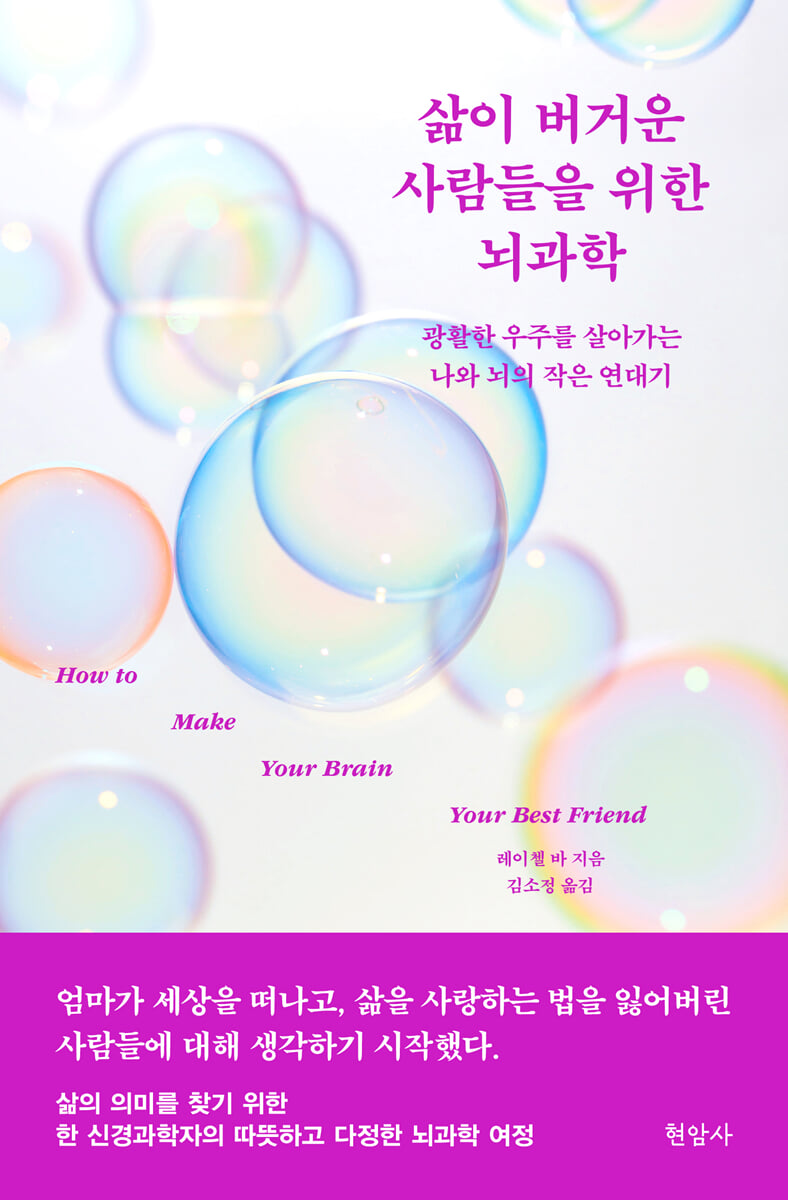
Brain Science for People Who Find Life Burdensome
 |
Description
Book Introduction
My mother passed away,
I started thinking about people who have lost the ability to love life.
The joys and sorrows, relationships, growth, and loss that permeate our lives…
A neuroscientist's warm and affectionate journey into brain science
A neuroscientist studying molecular neuroscience in Canada hears that his mother has taken her own life.
'Why couldn't I save my mother?'
Left behind by his mother's death and struggling with loss and pain, he realizes that to truly come to terms with the situation, he must first understand how the brain, which he had been studying, works.
The brain can be either your most dangerous enemy or your best friend.
I started writing a book out of guilt for not being able to save my mother and a desire to understand her. The book became a scientific account of our journey to discover the story of our lives.
"Brain Science for People Who Find Life Burdensome" is a story about how to care for your body and mind, as told by a neuroscientist, for those who face the sadness and emptiness that everyone encounters in life.
The author first started sharing this story on social media, and now has over a million followers who subscribe to his channel and seek advice on the difficulties of life.
These days, the word 'Gotsaeng' is commonly used.
A highly efficient life where you work hard, enjoy your free time, and wake up early to find time for self-development, such as exercising or studying.
Many people think that people who live a 'new life' are cool and think that they too should try harder, be more meticulous, and become a more positive person.
The author describes these whispers as "the brain plotting."
My brain naturally wants to take care of me and be on my side, but, as he puts it, "my brain, like my incredibly attentive roommate, sometimes sets the kitchen on fire." The consequences of that fire are more problematic than you might think.
It can manifest as mental problems such as self-loathing, self-blame, and depression, or it can manifest as physical problems such as insomnia or anorexia.
In some cases, it can lead to extreme cases.
Although the degree may vary, it does make our lives farther from happiness.
When life drags us down, when we can't find meaning in life, when we lose our own story, what can we do for ourselves? This book answers these questions in the surprisingly tender language of neuroscience.
I started thinking about people who have lost the ability to love life.
The joys and sorrows, relationships, growth, and loss that permeate our lives…
A neuroscientist's warm and affectionate journey into brain science
A neuroscientist studying molecular neuroscience in Canada hears that his mother has taken her own life.
'Why couldn't I save my mother?'
Left behind by his mother's death and struggling with loss and pain, he realizes that to truly come to terms with the situation, he must first understand how the brain, which he had been studying, works.
The brain can be either your most dangerous enemy or your best friend.
I started writing a book out of guilt for not being able to save my mother and a desire to understand her. The book became a scientific account of our journey to discover the story of our lives.
"Brain Science for People Who Find Life Burdensome" is a story about how to care for your body and mind, as told by a neuroscientist, for those who face the sadness and emptiness that everyone encounters in life.
The author first started sharing this story on social media, and now has over a million followers who subscribe to his channel and seek advice on the difficulties of life.
These days, the word 'Gotsaeng' is commonly used.
A highly efficient life where you work hard, enjoy your free time, and wake up early to find time for self-development, such as exercising or studying.
Many people think that people who live a 'new life' are cool and think that they too should try harder, be more meticulous, and become a more positive person.
The author describes these whispers as "the brain plotting."
My brain naturally wants to take care of me and be on my side, but, as he puts it, "my brain, like my incredibly attentive roommate, sometimes sets the kitchen on fire." The consequences of that fire are more problematic than you might think.
It can manifest as mental problems such as self-loathing, self-blame, and depression, or it can manifest as physical problems such as insomnia or anorexia.
In some cases, it can lead to extreme cases.
Although the degree may vary, it does make our lives farther from happiness.
When life drags us down, when we can't find meaning in life, when we lose our own story, what can we do for ourselves? This book answers these questions in the surprisingly tender language of neuroscience.
- You can preview some of the book's contents.
Preview
index
Preface To you who is reading this article now
Chapter 1: Know Thyself - and Be Kind to Yourself
Chapter 2: The Anatomy of Joy - Find Joy When Life Gets Hard
Chapter 3: Fair and Ordinary Loneliness: The Neuroscience of Why We Need Each Other
Chapter 4: I Sleep, Therefore I Am - A Day in the Life for the Soul
Chapter 5 Art and Soul - In Search of the Language of the Heart, Creativity
Chapter 6: A Moving Mind - A Flexible Mind, a Strong Body
Chapter 7: Me, Myself, and Wi-Fi - Getting Online
Chapter 8: Life Stories - A Journey to Discover the Meaning of Life
Acknowledgements
main
Chapter 1: Know Thyself - and Be Kind to Yourself
Chapter 2: The Anatomy of Joy - Find Joy When Life Gets Hard
Chapter 3: Fair and Ordinary Loneliness: The Neuroscience of Why We Need Each Other
Chapter 4: I Sleep, Therefore I Am - A Day in the Life for the Soul
Chapter 5 Art and Soul - In Search of the Language of the Heart, Creativity
Chapter 6: A Moving Mind - A Flexible Mind, a Strong Body
Chapter 7: Me, Myself, and Wi-Fi - Getting Online
Chapter 8: Life Stories - A Journey to Discover the Meaning of Life
Acknowledgements
main
Detailed image
.jpg)
Into the book
Our little, mean brains are always working hard.
In this constant state of change, adapting, changing, and finding new paths, these unstoppable little beings demonstrate remarkable resilience.
But the brain also has its own limitations.
We have no choice but to compromise.
That's why I wrote this book: to explain more clearly how the brain functions.
--- From the "Preface"
This is possible because several regions of the brain work together.
Perhaps the most important of these brain regions is the medial prefrontal cortex, commonly called the mPFC.
The mPFC, located in the center of the brain, acts as an editor, directing and editing the story of your life.
Imagine your mPFC sifting through sensory stimuli, memories, and a flurry of emotions to create the final manuscript for your latest quarterly journal, "You."
Articles for the magazine are diligently sourced from different parts of the brain by a tireless team of interns and staff.
The hippocampus, the center of memory, is one of those regions.
But what allows us to maintain a consistent and refined sense of self is the sharp editorial eye of the mPFC.
--- From "Chapter 1: Know Thyself"
By developing a sense of joy and a keen sense of responsiveness, you can counteract the brain's inherent tendency to lean toward negativity.
Everyone is born to be influenced by and pay more attention to negative experiences than positive ones, and to remember such experiences much better.
It's something we're born with, what psychology calls negativity bias.
In fact, this tendency is a survival tool, a gift from our ancestors, whose ability to focus on danger and destruction determined their survival.
But modern people may fall into despair because of this tool.
--- From "Chapter 2: Anatomy of Joy"
Psychologists call these mental frameworks schemas.
You can think of a schema as a mental library that organizes our experiences, feelings, and knowledge into boxes.
These boxes help us organize our thoughts quickly and efficiently, but the problem is that they can also become stereotypes for us.
In art, schemas often function as self-imposed boundaries.
It makes you think things like, 'Ballet isn't for someone like me.' or 'Classical music is only for the educated elite.'
But there's always a way to make art, even if it feels like it's so far removed from your usual experiences.
--- From "Chapter 5 Art and Soul"
The feeling of helplessness as you watch your loved one slowly drift away from your life is suffocating.
It feels like something terrible that just doesn't need to happen, like something that can be prevented.
But there's nothing you can do to stop what's already happening before your eyes.
Life constantly presents us with challenges like these.
It is our job to find a way to understand such difficulties.
In this constant state of change, adapting, changing, and finding new paths, these unstoppable little beings demonstrate remarkable resilience.
But the brain also has its own limitations.
We have no choice but to compromise.
That's why I wrote this book: to explain more clearly how the brain functions.
--- From the "Preface"
This is possible because several regions of the brain work together.
Perhaps the most important of these brain regions is the medial prefrontal cortex, commonly called the mPFC.
The mPFC, located in the center of the brain, acts as an editor, directing and editing the story of your life.
Imagine your mPFC sifting through sensory stimuli, memories, and a flurry of emotions to create the final manuscript for your latest quarterly journal, "You."
Articles for the magazine are diligently sourced from different parts of the brain by a tireless team of interns and staff.
The hippocampus, the center of memory, is one of those regions.
But what allows us to maintain a consistent and refined sense of self is the sharp editorial eye of the mPFC.
--- From "Chapter 1: Know Thyself"
By developing a sense of joy and a keen sense of responsiveness, you can counteract the brain's inherent tendency to lean toward negativity.
Everyone is born to be influenced by and pay more attention to negative experiences than positive ones, and to remember such experiences much better.
It's something we're born with, what psychology calls negativity bias.
In fact, this tendency is a survival tool, a gift from our ancestors, whose ability to focus on danger and destruction determined their survival.
But modern people may fall into despair because of this tool.
--- From "Chapter 2: Anatomy of Joy"
Psychologists call these mental frameworks schemas.
You can think of a schema as a mental library that organizes our experiences, feelings, and knowledge into boxes.
These boxes help us organize our thoughts quickly and efficiently, but the problem is that they can also become stereotypes for us.
In art, schemas often function as self-imposed boundaries.
It makes you think things like, 'Ballet isn't for someone like me.' or 'Classical music is only for the educated elite.'
But there's always a way to make art, even if it feels like it's so far removed from your usual experiences.
--- From "Chapter 5 Art and Soul"
The feeling of helplessness as you watch your loved one slowly drift away from your life is suffocating.
It feels like something terrible that just doesn't need to happen, like something that can be prevented.
But there's nothing you can do to stop what's already happening before your eyes.
Life constantly presents us with challenges like these.
It is our job to find a way to understand such difficulties.
--- From "Chapter 8: Life Stories"
Publisher's Review
Brain science that helps us endure imperfect lives
An exploration of the complexities and sufferings of life
The joys and sorrows that fill our lives, the desire to grow, relationships, love, and hate—these are all natural emotions, but it's not easy to live in harmony with them.
There, we cannot ignore the intervention of external environments, such as our society or other people.
This book contains important brain science knowledge that addresses the misconceptions we have about what constitutes a happy life and helps those who live a fulfilling life to live a healthier and better life.
It describes a smart way to utilize and understand the brain using cutting-edge neuroscience that can be applied to the real world.
When stress and stimulation that seem overwhelming to us surge into our minds, our brain, this magnificent mental machine, kicks in to protect us and teach us how to function properly.
What Dr. Barr explains is not just science.
He provides relevant examples that everyone can relate to, and shares his own experiences to show how scientific knowledge can improve our lives and relationships.
This book, consisting of eight chapters, approaches healthy living from various topics that make up our lives, such as identity, joy, sleep, exercise, and art.
Rather than simply criticizing the recently emerging "high-efficiency, high-productivity" lifestyle, I discuss the premise that people need a correct and healthy perception of themselves and their surroundings when they want to make changes in their lives.
Among the various brain science knowledge and concepts, the theory of neuroplasticity runs through this book.
The brain is a being that predicts the future through past data, and this changes our 'perception of reality'.
This theory implies that it is not a simple, fixed structure, but a flexible system that can constantly change and adapt.
This leads to the belief that even if we have wrong perceptions, we can change them if we want to.
The narratives our brains create are not fixed, and we can constantly rewrite our stories about ourselves, refining them to reflect new experiences and insights.
That's why, more than anything else, my brain and I need to become best friends.
How to be on my side in the vast and indifferent universe
Dr. Rachel Barr wrote this book sitting at her desk in her room in Canada.
And we in Korea are reading that.
All the processes through which we, who are separated by time and distance, exchange emotions and knowledge and receive comfort through books are possible because of the brain.
The agony of the brain, the complexity of the brain, the wonder of the brain.
We can endlessly rewrite the story of our lives with our best friend, the brain, accumulating new experiences and insights.
And I can live with the confidence that my life has meaning in this vast and indifferent universe.
The book says that if we knew more clearly and properly how the brain functions, this process would be less lonely and difficult.
An exploration of the complexities and sufferings of life
The joys and sorrows that fill our lives, the desire to grow, relationships, love, and hate—these are all natural emotions, but it's not easy to live in harmony with them.
There, we cannot ignore the intervention of external environments, such as our society or other people.
This book contains important brain science knowledge that addresses the misconceptions we have about what constitutes a happy life and helps those who live a fulfilling life to live a healthier and better life.
It describes a smart way to utilize and understand the brain using cutting-edge neuroscience that can be applied to the real world.
When stress and stimulation that seem overwhelming to us surge into our minds, our brain, this magnificent mental machine, kicks in to protect us and teach us how to function properly.
What Dr. Barr explains is not just science.
He provides relevant examples that everyone can relate to, and shares his own experiences to show how scientific knowledge can improve our lives and relationships.
This book, consisting of eight chapters, approaches healthy living from various topics that make up our lives, such as identity, joy, sleep, exercise, and art.
Rather than simply criticizing the recently emerging "high-efficiency, high-productivity" lifestyle, I discuss the premise that people need a correct and healthy perception of themselves and their surroundings when they want to make changes in their lives.
Among the various brain science knowledge and concepts, the theory of neuroplasticity runs through this book.
The brain is a being that predicts the future through past data, and this changes our 'perception of reality'.
This theory implies that it is not a simple, fixed structure, but a flexible system that can constantly change and adapt.
This leads to the belief that even if we have wrong perceptions, we can change them if we want to.
The narratives our brains create are not fixed, and we can constantly rewrite our stories about ourselves, refining them to reflect new experiences and insights.
That's why, more than anything else, my brain and I need to become best friends.
How to be on my side in the vast and indifferent universe
Dr. Rachel Barr wrote this book sitting at her desk in her room in Canada.
And we in Korea are reading that.
All the processes through which we, who are separated by time and distance, exchange emotions and knowledge and receive comfort through books are possible because of the brain.
The agony of the brain, the complexity of the brain, the wonder of the brain.
We can endlessly rewrite the story of our lives with our best friend, the brain, accumulating new experiences and insights.
And I can live with the confidence that my life has meaning in this vast and indifferent universe.
The book says that if we knew more clearly and properly how the brain functions, this process would be less lonely and difficult.
GOODS SPECIFICS
- Date of issue: October 10, 2025
- Page count, weight, size: 364 pages | 470g | 138*210*22mm
- ISBN13: 9788932324487
- ISBN10: 8932324484
You may also like
카테고리
korean


korean

![GQ KOREA Mark (Monthly): December [2025]](http://librairie.coreenne.fr/cdn/shop/files/8ef265dbbfbf186523ed75ba7319009d.jpg?v=1765340328&width=3840)


