

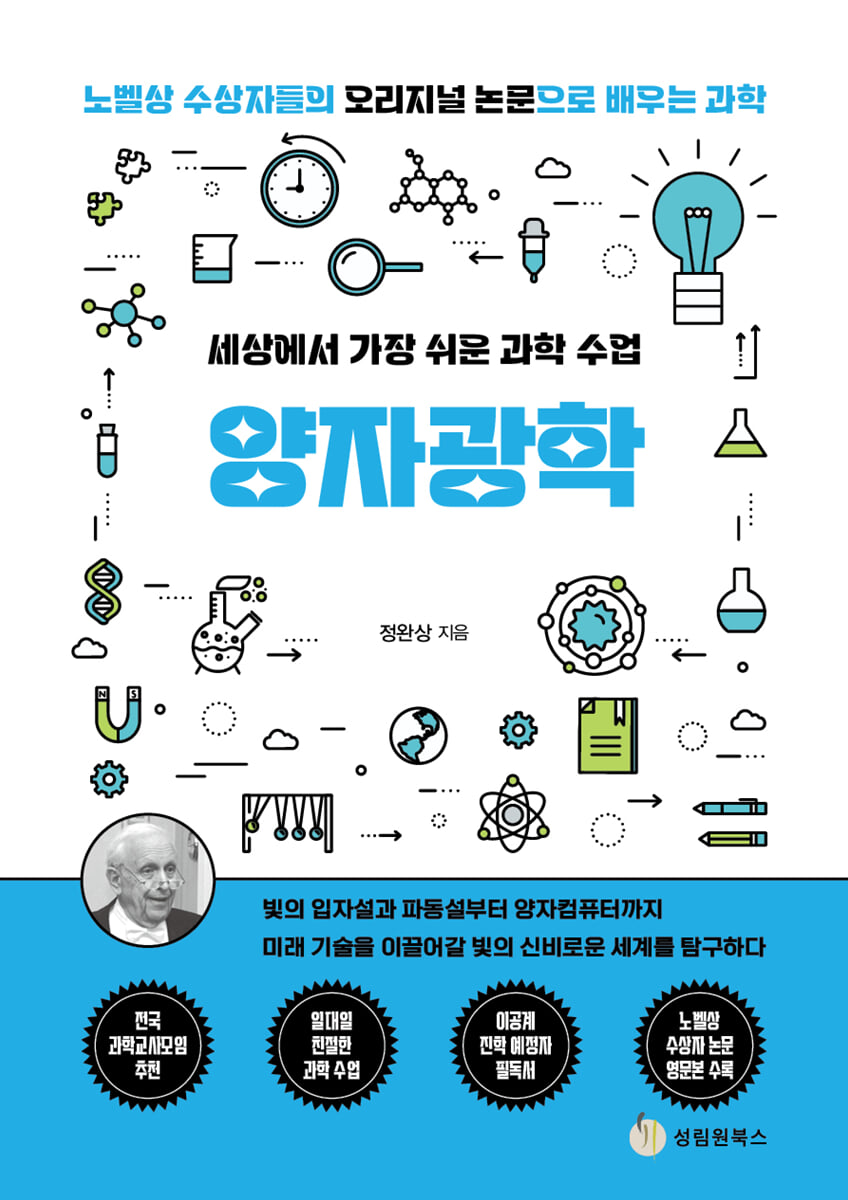
The World's Easiest Science Lesson: Quantum Optics
 |
Description
Book Introduction
Digging Deep into Quantum Optics, the Core of Future Technology
From particle and wave theories of light to quantum computers
Inside the paper of Glauber, the founder of quantum optics!
[Learn Science with Original Papers from Nobel Prize Winners] The 16th book in the series.
We will delve into quantum optics from A to Z, focusing on the 1963 paper by Roy Glauber, winner of the 2005 Nobel Prize in Physics.
Before quantum optics, we reexamined the history of the wave and particle nature of light in classical optics, and began with the history of optical communications and the story of the invention of optical fiber.
It also covers anecdotes about the invention of the maser and laser.
The theory of electromagnetic waves was explained in terms of the idea of the creation and annihilation operators of photons introduced by Dirac.
The Maxwell equations required for this were also briefly introduced.
To help readers understand the research of James and Cummings on the interaction between light and matter, we present the results using simple formulas.
He also explained the concepts of coherent states and reactive focusing introduced by Glauber.
Finally, quantum light technology using quantum optics was introduced.
We covered optical tweezers, frequency combs, invisibility cloaks using metamaterials, laser cooling, and applications in quantum information science.
The appendix includes English versions of the papers by James-Cummings, Glauber, and Pendry, as well as a list of Nobel Prize winners in Physics, to stimulate intellectual curiosity.
From particle and wave theories of light to quantum computers
Inside the paper of Glauber, the founder of quantum optics!
[Learn Science with Original Papers from Nobel Prize Winners] The 16th book in the series.
We will delve into quantum optics from A to Z, focusing on the 1963 paper by Roy Glauber, winner of the 2005 Nobel Prize in Physics.
Before quantum optics, we reexamined the history of the wave and particle nature of light in classical optics, and began with the history of optical communications and the story of the invention of optical fiber.
It also covers anecdotes about the invention of the maser and laser.
The theory of electromagnetic waves was explained in terms of the idea of the creation and annihilation operators of photons introduced by Dirac.
The Maxwell equations required for this were also briefly introduced.
To help readers understand the research of James and Cummings on the interaction between light and matter, we present the results using simple formulas.
He also explained the concepts of coherent states and reactive focusing introduced by Glauber.
Finally, quantum light technology using quantum optics was introduced.
We covered optical tweezers, frequency combs, invisibility cloaks using metamaterials, laser cooling, and applications in quantum information science.
The appendix includes English versions of the papers by James-Cummings, Glauber, and Pendry, as well as a list of Nobel Prize winners in Physics, to stimulate intellectual curiosity.
- You can preview some of the book's contents.
Preview
index
Recommendation
I hope you can understand the original papers of these genius scientists.
A Surprise Interview with Dr. Glauber-Ashkin, the Founder of Quantum Optics
First meeting.
classical optics
Particle and Wave Theory: Flying Baseball vs. Rippling Waves
The Triumph of Wave Theory: Interference Patterns and Diffraction
The Discovery of Electromagnetic Waves: Searching for Invisible Light
Second meeting.
The Birth of the Laser
The Birth of Photons: The Particles That Make Up Light
Einstein's stimulated emission theory: The basic principles of lasers
The Birth of Quantum Mechanics: Physics Satisfying Quantum Electrons
The invention of the Major: Creating an intense and precise beam
The invention of the laser: an amplified beam of visible light
Laser Applications: From Astronomy to Medicine
Third meeting.
History of Optical Communications
Graham Bell: Inventing Optical Fiber
Invention of the photophone_with light reflected from a mirror
Discovery of optical fibers: Light trapped in a glass rod
The invention of low-loss optical fiber and optical communication_More information more efficiently
Fourth meeting.
The Birth of Quantum Optics
Photon Creation/Annihilation Operators_Where to send a photon?
Vector Algebra_To convert electric and magnetic fields into operators
Maxwell's equations: complex equations describing electric and magnetic fields
Wave equation and electromagnetic waves_How are waves represented?
In the wave equation satisfied by the electromagnetic wave vector potential,
Quantization of the electromagnetic field: electromagnetic waves in solids
Fifth meeting.
Interaction between atoms and light
The Janes-Cummings model: Ground state and first excited state
Rabi vibrations: Electrons in an atom vibrate between two energy levels.
Sixth meeting.
Matching state
Glauber, the youngest scientist at Los Alamos
The state of being aligned - the clarity of light is at its maximum
Properties of a coherent state: probability, expected value, and standard deviation of the number of photons
Reaction photon collection_the phenomenon in which emitted photons are separated
Seventh meeting.
quantum light technology
Ashkin's Optical Tweezers: Grabbing Tiny Objects with a Laser Beam
Invention of the frequency comb: sharp spectral lines with regular frequency intervals
Laser Cooling: Slowing Down Atoms
Metamaterials: The Secret of the Invisibility Cloak
Reactive Light Concentration and Quantum Computers: Applications and Future of Quantum Optics
In addition to the meeting
Comparison of Quantum and Semiclassical Radiation Theories with Application to the Beam Maser_Janes-Cummings Paper English Version
Coherent and Incoherent States of the Radiation Field_English version of Glauber's paper
Controlling Electromagnetic Fields_Pendry's paper in English
Concluding our meeting with a great paper
Papers referenced for this book
Greek letters used in formulas
Introducing the Nobel Prize winners in Physics
I hope you can understand the original papers of these genius scientists.
A Surprise Interview with Dr. Glauber-Ashkin, the Founder of Quantum Optics
First meeting.
classical optics
Particle and Wave Theory: Flying Baseball vs. Rippling Waves
The Triumph of Wave Theory: Interference Patterns and Diffraction
The Discovery of Electromagnetic Waves: Searching for Invisible Light
Second meeting.
The Birth of the Laser
The Birth of Photons: The Particles That Make Up Light
Einstein's stimulated emission theory: The basic principles of lasers
The Birth of Quantum Mechanics: Physics Satisfying Quantum Electrons
The invention of the Major: Creating an intense and precise beam
The invention of the laser: an amplified beam of visible light
Laser Applications: From Astronomy to Medicine
Third meeting.
History of Optical Communications
Graham Bell: Inventing Optical Fiber
Invention of the photophone_with light reflected from a mirror
Discovery of optical fibers: Light trapped in a glass rod
The invention of low-loss optical fiber and optical communication_More information more efficiently
Fourth meeting.
The Birth of Quantum Optics
Photon Creation/Annihilation Operators_Where to send a photon?
Vector Algebra_To convert electric and magnetic fields into operators
Maxwell's equations: complex equations describing electric and magnetic fields
Wave equation and electromagnetic waves_How are waves represented?
In the wave equation satisfied by the electromagnetic wave vector potential,
Quantization of the electromagnetic field: electromagnetic waves in solids
Fifth meeting.
Interaction between atoms and light
The Janes-Cummings model: Ground state and first excited state
Rabi vibrations: Electrons in an atom vibrate between two energy levels.
Sixth meeting.
Matching state
Glauber, the youngest scientist at Los Alamos
The state of being aligned - the clarity of light is at its maximum
Properties of a coherent state: probability, expected value, and standard deviation of the number of photons
Reaction photon collection_the phenomenon in which emitted photons are separated
Seventh meeting.
quantum light technology
Ashkin's Optical Tweezers: Grabbing Tiny Objects with a Laser Beam
Invention of the frequency comb: sharp spectral lines with regular frequency intervals
Laser Cooling: Slowing Down Atoms
Metamaterials: The Secret of the Invisibility Cloak
Reactive Light Concentration and Quantum Computers: Applications and Future of Quantum Optics
In addition to the meeting
Comparison of Quantum and Semiclassical Radiation Theories with Application to the Beam Maser_Janes-Cummings Paper English Version
Coherent and Incoherent States of the Radiation Field_English version of Glauber's paper
Controlling Electromagnetic Fields_Pendry's paper in English
Concluding our meeting with a great paper
Papers referenced for this book
Greek letters used in formulas
Introducing the Nobel Prize winners in Physics
Detailed image

Into the book
Scientists have been debating this for a long time.
Whether light is a particle like a flying baseball, or a wave like a rippling ocean wave.
--- p.22
Spencer invented the microwave oven while researching radar equipment.
He took a short break next to the magnetron, one of the power components of the radar machine.
But I was surprised to find that the chocolate bar in my pocket had melted.
Out of curiosity, he placed several other objects near the magnetron and stood at a distance from the object.
The popcorn popped successfully and the eggs were cooked the next morning.
--- p.38
On June 2, 1875, Bell and Watson were conducting experiments with the multiple telegraph.
While Watson was repairing a metal reed in the next room, Bell suddenly heard Watson's voice clearly through the electrical current.
This was the invention of the telephone.
--- p.74
The first optical communication method was to wave a torch in one's hand.
Around 350,000 BC, the people of Beijing communicated with smoke, a method still used today in the Vatican to elect a pope.
In this way, the ancient Greeks could learn of the fall of Troy from a distance of over 500 kilometers.
--- p.77~78
After that, people trapped light in thin glass rods instead of streams of water, and bent these to examine the inside of the human body.
This form of light being trapped in a glass or plastic rod is called an optical fiber.
--- p.85
Photon antibunching refers to the quantum mechanical phenomenon in which individual photons are temporarily separated when emitted from a light source.
The light emitted in this way is called reactive light, and when photons show a behavior opposite to reactive light, where they gather together, it is called coherent light.
--- p.159~160
Physics Group: What are optical tweezers?
Professor Jeong: It is a device that uses a highly focused laser beam to capture or move tiny objects such as atoms, nanoparticles, and water droplets in a manner similar to tweezers.
--- p.163~164
Physics Group: Where are metamaterials used?
Professor Jeong: The fields of application of metamaterials are very broad.
It can be used to reduce noise from everyday life, including noise between floors, or in stealth submarines that cannot be detected by sonar, and also in invisibility cloaks, high-performance lenses, and small antennas.
Whether light is a particle like a flying baseball, or a wave like a rippling ocean wave.
--- p.22
Spencer invented the microwave oven while researching radar equipment.
He took a short break next to the magnetron, one of the power components of the radar machine.
But I was surprised to find that the chocolate bar in my pocket had melted.
Out of curiosity, he placed several other objects near the magnetron and stood at a distance from the object.
The popcorn popped successfully and the eggs were cooked the next morning.
--- p.38
On June 2, 1875, Bell and Watson were conducting experiments with the multiple telegraph.
While Watson was repairing a metal reed in the next room, Bell suddenly heard Watson's voice clearly through the electrical current.
This was the invention of the telephone.
--- p.74
The first optical communication method was to wave a torch in one's hand.
Around 350,000 BC, the people of Beijing communicated with smoke, a method still used today in the Vatican to elect a pope.
In this way, the ancient Greeks could learn of the fall of Troy from a distance of over 500 kilometers.
--- p.77~78
After that, people trapped light in thin glass rods instead of streams of water, and bent these to examine the inside of the human body.
This form of light being trapped in a glass or plastic rod is called an optical fiber.
--- p.85
Photon antibunching refers to the quantum mechanical phenomenon in which individual photons are temporarily separated when emitted from a light source.
The light emitted in this way is called reactive light, and when photons show a behavior opposite to reactive light, where they gather together, it is called coherent light.
--- p.159~160
Physics Group: What are optical tweezers?
Professor Jeong: It is a device that uses a highly focused laser beam to capture or move tiny objects such as atoms, nanoparticles, and water droplets in a manner similar to tweezers.
--- p.163~164
Physics Group: Where are metamaterials used?
Professor Jeong: The fields of application of metamaterials are very broad.
It can be used to reduce noise from everyday life, including noise between floors, or in stealth submarines that cannot be detected by sonar, and also in invisibility cloaks, high-performance lenses, and small antennas.
--- p.174
Publisher's Review
★ Recommended by the National Science Teachers Association ★ Friendly, one-on-one science classes
★ A must-read for those planning to pursue a science or engineering degree ★ Includes English versions of papers by Nobel Prize winners
Is the invisibility cloak from Harry Potter becoming a reality? A journey into a mysterious world of light.
If you are a fan of British author J.K. Rowling's Harry Potter series, you have probably imagined yourself wearing an invisibility cloak and sneaking around like the main character, Harry.
But what if invisibility cloaks were possible in real life, not just fantasy novels?
The invisibility cloak starts with the idea of metamaterials.
If we put an invisibility cloak made of metamaterials on an object, light will not reach the object, making it invisible to our eyes.
The fields of application of metamaterials are very broad.
It is also used in stealth submarines to reduce noise and avoid detection by sonar.
It can also be used in transparent cloaks, high-performance lenses, and small antennas.
Even today, many scientists are researching metamaterials, which have infinite possibilities.
Quantum optics is at the foundation of these metamaterials.
This book introduces the history, concepts, applications, and future of quantum optics, focusing on the research of Glauber, the founder of quantum optics.
Let's embark on a journey into the mysterious world of light through this book!
Interesting history of science and high school math level concept explanations
This book goes beyond simply listing the concepts of quantum optics.
The author invites readers on a journey through time, first taking them back to the era of classical optics, when there was a fierce debate over whether light was a particle or a wave.
It then unfolds a fascinating scientific drama, from how Einstein's theory of stimulated emission gave birth to the revolutionary light known as the laser, to the discovery of optical fibers, which trapped light in glass rods and opened up a sea of information.
Against this historical backdrop, readers naturally encounter core questions in quantum optics.
Above all, the best part of this book is the aspiration expressed in the preface: "Now that readers' level has greatly improved, I hope that they will understand the original papers of genius scientists without avoiding formulas."
The author's efforts to explain complex concepts such as the creation and annihilation operator of photons, which is the core of quantum optics, the James-Cummings model that deals with the interaction of light and atoms, and Glauber's coherent state that explains maximum interference of light, in a way that is accessible to "young people and general readers with a high school-level understanding of formulas," are truly admirable.
Beyond simply acquiring knowledge, this will be a valuable opportunity to experience the creative flow of thought that led great scientists to define and solve problems.
Industrial, medical, military, communications, ...
Exploring quantum optics closely related to our lives
Reading this book, I realized anew, "There are so many places where quantum optics is used."
Lasers, born from the concept of photons, have become an indispensable part of our lives in industries, medicine, military, communications, and more.
It is used for precise cutting and processing, treatment and examination, as a basis for attack, and for high-speed communication via optical fiber.
Going one step further, this book demonstrates that quantum optics will become the foundation of future science and technology.
"The World's Easiest Science Lesson: Quantum Optics" begins with an explanation of concepts like "quantization of electromagnetic fields," and vividly demonstrates how these fundamentals lead to the dazzling achievements of modern science and technology.
This book introduces various applications of quantum optics, from 'Ashkin's optical tweezers' that handle microscopic particles with laser beams, 'the invention of the frequency comb' that pushed the precision of atomic clocks to the limit, 'metamaterials' that control the path of light, and 'quantum computers', the core of future computing.
Immerse yourself in the world of quantum optics, essential not only for modern society but also for the future!
The significance of the "Learning Science through Original Papers by Nobel Prize Winners" series
This series aims to convey the essence of modern science based on original papers by Nobel Prize-winning scientists.
The 15 volumes published so far have covered representative theories and discoveries in various fields, including special relativity, quantum mechanics, radiation, antiparticles, quantum electrodynamics, quantum optics, climate physics, quantum information, and quark theory.
Each volume is structured to move beyond mere "knowledge transfer" to training in "scientific thinking" by encompassing the historical scientific background of a specific theory, its mathematical formalization, key concepts, and the full text of the original paper.
It is designed primarily for readers with a high school level of mathematics understanding, but is also meticulously crafted to provide new perspectives to readers with specialized physics knowledge.
★“Park Mun-ho's Special Lecture on the World of Natural Science”
The depth and sophistication of this series is also supported by evaluations from external experts.
In particular, the "The World's Easiest Science Class" series was honored with consecutive selections for Dr. Park Moon-ho's "Natural Science World Thursday Special Lecture."
Dr. Park Moon-ho has generally maintained the principle of not selecting books from the same publisher consecutively, but the second volume of the series, "Radiation and Elements," was selected for the 204th Thursday Special Lecture, and the eighth volume, "Antiparticles," was selected for the 205th Thursday Special Lecture, making this an unusual consecutive selection.
This is evidence that even experts have recognized the academic depth of the entire series and its educational suitability for public lectures.
In this way, the "World's Easiest Science Lesson" series has established itself as an academic laboratory and guide that leads to intellectual advancements for learners and readers.
★ A must-read for those planning to pursue a science or engineering degree ★ Includes English versions of papers by Nobel Prize winners
Is the invisibility cloak from Harry Potter becoming a reality? A journey into a mysterious world of light.
If you are a fan of British author J.K. Rowling's Harry Potter series, you have probably imagined yourself wearing an invisibility cloak and sneaking around like the main character, Harry.
But what if invisibility cloaks were possible in real life, not just fantasy novels?
The invisibility cloak starts with the idea of metamaterials.
If we put an invisibility cloak made of metamaterials on an object, light will not reach the object, making it invisible to our eyes.
The fields of application of metamaterials are very broad.
It is also used in stealth submarines to reduce noise and avoid detection by sonar.
It can also be used in transparent cloaks, high-performance lenses, and small antennas.
Even today, many scientists are researching metamaterials, which have infinite possibilities.
Quantum optics is at the foundation of these metamaterials.
This book introduces the history, concepts, applications, and future of quantum optics, focusing on the research of Glauber, the founder of quantum optics.
Let's embark on a journey into the mysterious world of light through this book!
Interesting history of science and high school math level concept explanations
This book goes beyond simply listing the concepts of quantum optics.
The author invites readers on a journey through time, first taking them back to the era of classical optics, when there was a fierce debate over whether light was a particle or a wave.
It then unfolds a fascinating scientific drama, from how Einstein's theory of stimulated emission gave birth to the revolutionary light known as the laser, to the discovery of optical fibers, which trapped light in glass rods and opened up a sea of information.
Against this historical backdrop, readers naturally encounter core questions in quantum optics.
Above all, the best part of this book is the aspiration expressed in the preface: "Now that readers' level has greatly improved, I hope that they will understand the original papers of genius scientists without avoiding formulas."
The author's efforts to explain complex concepts such as the creation and annihilation operator of photons, which is the core of quantum optics, the James-Cummings model that deals with the interaction of light and atoms, and Glauber's coherent state that explains maximum interference of light, in a way that is accessible to "young people and general readers with a high school-level understanding of formulas," are truly admirable.
Beyond simply acquiring knowledge, this will be a valuable opportunity to experience the creative flow of thought that led great scientists to define and solve problems.
Industrial, medical, military, communications, ...
Exploring quantum optics closely related to our lives
Reading this book, I realized anew, "There are so many places where quantum optics is used."
Lasers, born from the concept of photons, have become an indispensable part of our lives in industries, medicine, military, communications, and more.
It is used for precise cutting and processing, treatment and examination, as a basis for attack, and for high-speed communication via optical fiber.
Going one step further, this book demonstrates that quantum optics will become the foundation of future science and technology.
"The World's Easiest Science Lesson: Quantum Optics" begins with an explanation of concepts like "quantization of electromagnetic fields," and vividly demonstrates how these fundamentals lead to the dazzling achievements of modern science and technology.
This book introduces various applications of quantum optics, from 'Ashkin's optical tweezers' that handle microscopic particles with laser beams, 'the invention of the frequency comb' that pushed the precision of atomic clocks to the limit, 'metamaterials' that control the path of light, and 'quantum computers', the core of future computing.
Immerse yourself in the world of quantum optics, essential not only for modern society but also for the future!
The significance of the "Learning Science through Original Papers by Nobel Prize Winners" series
This series aims to convey the essence of modern science based on original papers by Nobel Prize-winning scientists.
The 15 volumes published so far have covered representative theories and discoveries in various fields, including special relativity, quantum mechanics, radiation, antiparticles, quantum electrodynamics, quantum optics, climate physics, quantum information, and quark theory.
Each volume is structured to move beyond mere "knowledge transfer" to training in "scientific thinking" by encompassing the historical scientific background of a specific theory, its mathematical formalization, key concepts, and the full text of the original paper.
It is designed primarily for readers with a high school level of mathematics understanding, but is also meticulously crafted to provide new perspectives to readers with specialized physics knowledge.
★“Park Mun-ho's Special Lecture on the World of Natural Science”
The depth and sophistication of this series is also supported by evaluations from external experts.
In particular, the "The World's Easiest Science Class" series was honored with consecutive selections for Dr. Park Moon-ho's "Natural Science World Thursday Special Lecture."
Dr. Park Moon-ho has generally maintained the principle of not selecting books from the same publisher consecutively, but the second volume of the series, "Radiation and Elements," was selected for the 204th Thursday Special Lecture, and the eighth volume, "Antiparticles," was selected for the 205th Thursday Special Lecture, making this an unusual consecutive selection.
This is evidence that even experts have recognized the academic depth of the entire series and its educational suitability for public lectures.
In this way, the "World's Easiest Science Lesson" series has established itself as an academic laboratory and guide that leads to intellectual advancements for learners and readers.
GOODS SPECIFICS
- Date of issue: July 17, 2025
- Page count, weight, size: 251 pages | 380g | 152*215*14mm
- ISBN13: 9791193357705
- ISBN10: 1193357705
You may also like
카테고리
korean


korean

![GQ KOREA Mark (Monthly): December [2025]](http://librairie.coreenne.fr/cdn/shop/files/8ef265dbbfbf186523ed75ba7319009d.jpg?v=1765340328&width=3840)


