

Writing a nature observation journal
 |
Description
Book Introduction
From the mindset of writing a nature observation journal, to writing tips, tools, and the basics of drawing,
Drawing various subjects such as plants, birds, animals, and landscapes, and even tips for keeping a diary.
How to see, feel, and love the wonderful world that surrounds us
Recommended by Professor Choi Jae-cheon, author Ida, Edward Wilson, and Jane Goodall
John Burroughs Award
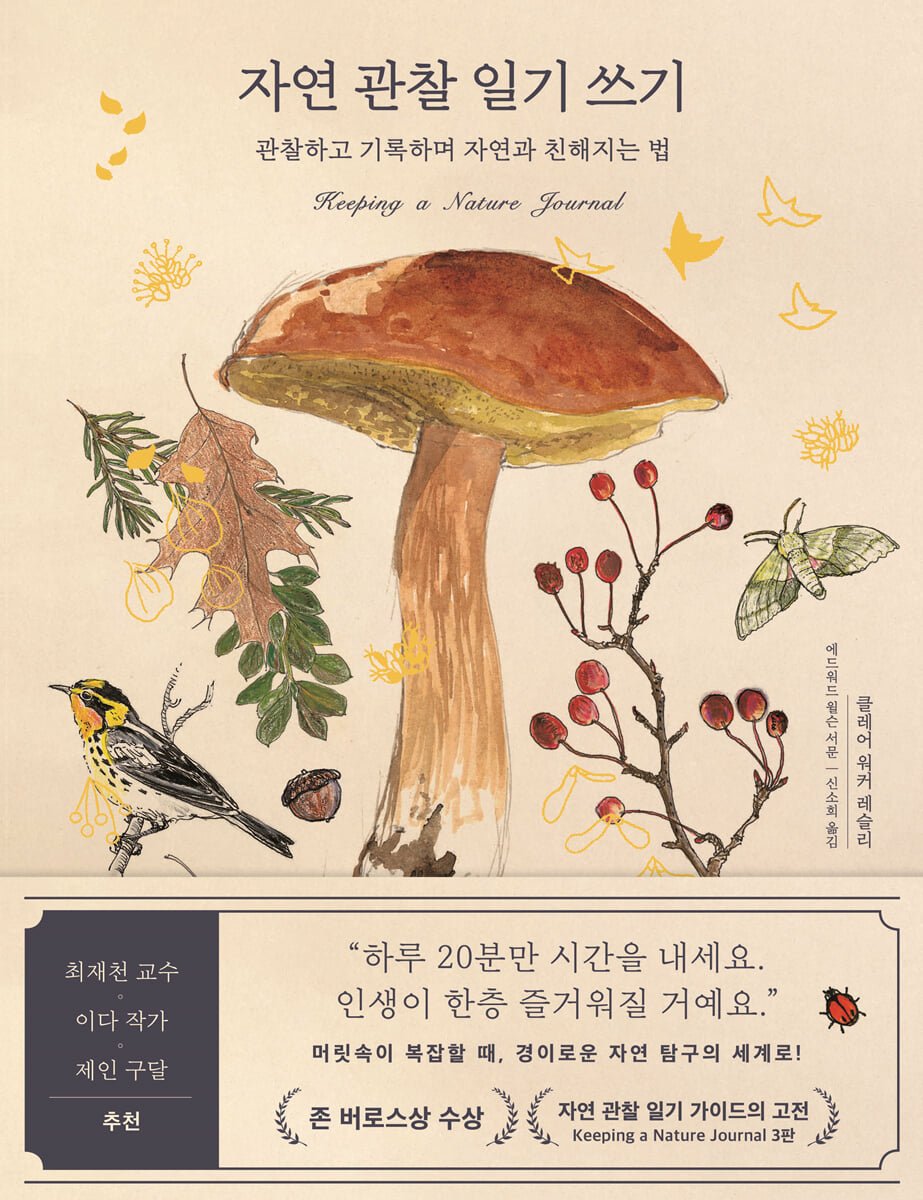
Keeping a Nature Journal, the classic nature journal guide, 3rd edition
Claire Walker Leslie, an American naturalist and educator, has released a new version of her book, Nature Observation Journal.
First published in 2000, it has been at the forefront of the nature observation and documentation movement for the past 25 years, introducing people to a different way of seeing the world and providing easy-to-follow recording and drawing methods for those who wish to fully see, feel, and connect with nature.
This completely revised third edition introduces creative techniques that allow even non-artists to observe nature in detail and deepen their observational skills through drawing, in a more accessible and concrete way.
It is a rich collection of diaries, sketches, and watercolors written and drawn by the author himself, as well as examples of nature observation diaries from his students over several generations, making it a useful guide that can be referenced on a regular basis.
Drawing various subjects such as plants, birds, animals, and landscapes, and even tips for keeping a diary.
How to see, feel, and love the wonderful world that surrounds us
Recommended by Professor Choi Jae-cheon, author Ida, Edward Wilson, and Jane Goodall
John Burroughs Award
Keeping a Nature Journal, the classic nature journal guide, 3rd edition
Claire Walker Leslie, an American naturalist and educator, has released a new version of her book, Nature Observation Journal.
First published in 2000, it has been at the forefront of the nature observation and documentation movement for the past 25 years, introducing people to a different way of seeing the world and providing easy-to-follow recording and drawing methods for those who wish to fully see, feel, and connect with nature.
This completely revised third edition introduces creative techniques that allow even non-artists to observe nature in detail and deepen their observational skills through drawing, in a more accessible and concrete way.
It is a rich collection of diaries, sketches, and watercolors written and drawn by the author himself, as well as examples of nature observation diaries from his students over several generations, making it a useful guide that can be referenced on a regular basis.
- You can preview some of the book's contents.
Preview
index
Acknowledgements
Preface to the First Edition _Edward Wilson
preface
Preparing for Part 1
Chapter 1: Why Write a Nature Observation Journal?
Chapter 2 Tools and Forms
Chapter 3: Basics of Drawing
Chapter 4 Recording Tips
Explore Part 2
Seasons and Sky
flowering plants and non-flowering plants
Trees and leaves
Bird, beak and feather
Mammals, pets and wild animals
amphibians and reptiles
insects and invertebrates
sight
Appendix: Teaching Nature Observation Journals
Recommended books and resources
Search
Preface to the First Edition _Edward Wilson
preface
Preparing for Part 1
Chapter 1: Why Write a Nature Observation Journal?
Chapter 2 Tools and Forms
Chapter 3: Basics of Drawing
Chapter 4 Recording Tips
Explore Part 2
Seasons and Sky
flowering plants and non-flowering plants
Trees and leaves
Bird, beak and feather
Mammals, pets and wild animals
amphibians and reptiles
insects and invertebrates
sight
Appendix: Teaching Nature Observation Journals
Recommended books and resources
Search
Detailed image

Into the book
I've been watching people outdoors for a long time, observing clouds, tree shapes, rain showers, butterflies, crows, sunsets, turtles, and daffodils.
Everyone was absorbed in putting what they saw, heard, felt, and learned onto paper and had fun.
Just sitting for a while, looking at the nature around you, and quietly communing with it can relieve stress, clear your mind, and bring peace to your heart.
These days, children have less and less time to rest at school, and when they get home, they rarely go out to play.
As I teach children, I've noticed that even if I go outside for a little while, children of all ages become quiet and, with amazing concentration, discover things I've never seen before.
I teach 15 or 25 students at a time and am always amazed at how well-behaved they are.
According to teachers, children's concentration improves when they return to the classroom after spending time observing, exploring, writing, and drawing in nature.
Children's innate interest in nature is always amazing.
There was even a child who insisted, “Can’t we stay out all day without eating lunch?”
--- p.22
Phenology is the continuous collection of data on various natural phenomena, such as seasonal weather changes, plant growth, and animal behavior.
Amateur and professional observers record specific dates for when buds emerge on trees and when leaves and flowers bloom.
It is also the time of the return of spring insects, the arrival and departure of migratory birds, mating and nesting, and the preparation of local animals for winter and the emergence of the following spring.
Why is this data becoming increasingly important? To understand and address future environmental challenges, scientists need climate data—evidence of changes, both normal and abnormal.
For example, long-term studies of glacier retreat and permafrost loss have made it clear that droughts and floods are becoming increasingly severe.
...
Keeping a nature observation journal is an opportunity to become a citizen scientist by conducting your own phenology research.
...
Many people feel helpless and anxious when they think about the future of the Earth.
Take action to better understand what's happening around you.
The realization that you are actually taking action on something helps to soothe feelings of helplessness and anxiety.
--- p.44
If you do a lot of sketching, I recommend a small, hardcover sketchbook with smooth, quilted paper.
You can find sketchbooks in a variety of sizes at art supply stores or stationery stores.
If you prefer to write in a paper-based manner and don't mind lines in your sketches, I recommend a lined, hardcover or spiral notebook.
If you're hesitant to use a hardcover notebook or are keeping a journal with several people, you can clip individual sheets of paper to a clipboard or secure them to a piece of hard cardboard with clips.
However, please organize all the filled out papers in chronological order and store them in a file or binder.
You can easily take it out later and trace the natural changes that occur with the seasons, as well as the development of your knowledge and personality.
If you want to record your outdoor observations on a rainy or cold day, take several sheets of paper folded into quarters or a small notepad that fits in your pocket.
This way, even if the paper gets wet, you can still redraw the journal later and add any details or colors you want.
I often do that with my students during class.
--- p.56
Be prepared for your diary to get ruined.
Even in my diary, the corners tend to wear out and the pages get wrinkled as I write.
I usually keep my diary in my car.
I also show it to my friends and students.
The diary gets wet from rain or snow, and my granddaughters doodle on the blank pages.
--- p.58
Many people burst out laughing when they draw outlines.
Regardless of age, skill level, or intention, everyone ends up drawing similar pictures! But if you look closely, you'll see the essence of your drawings.
As you draw two outlines, you will quickly gain confidence and improve your completion level.
--- p.71
Everyone is afraid of failure.
As adults, as teachers, as friends, we continually tell our students, “That’s great, keep going.
You have to say, “Try again.”
We should emulate children who are always busy and curious and don't have time to worry about how 'well' they draw.
--- p.77
Also think about why you want to draw nature and keep a diary.
If you feel obligated and don't enjoy the process of drawing or writing, don't force yourself to do it.
Just go outside for a few minutes, see, listen, and pay attention.
One of my students said this:
“I was a depressed person.
“Until I took my diary out and started noticing the nature that surrounded me.” --- p.91
I needed these moments and images so much when my mother was dying and my children were too young to understand my feelings.
The strength to drive three hours to be with my mother and take care of the children was thanks to the 'Special Images of the Day'.
But I still don't know where the term itself came from.
This habit, which began in the summer of 1993, continues to this day and always fills me with gratitude for the world.
--- p.96
I've been teaching my own nature journaling method across the United States for over 40 years.
The books I write are loved not only in North America but also all over the world.
What's the secret to this popularity? People everywhere want to connect with nature, and I offer an easy way to do so.
My students also teach what I have learned in kindergarten through high school classes, in the homes of homeschoolers, in university environmental studies programs, at camps, in retirement communities, in hospitals, prisons, and even in rehabilitation and recovery facilities.
The foundation of a nature observation journal is to be curious about and to cherish the natural communities that live alongside us in the same area.
--- p.195
The fourth graders were out on the playground, running around, excitedly observing.
The teacher who was watching those children next to me said:
“How can you rate joy?” --- p.200
Researchers at the Harvard Graduate School of Education compared Needham elementary school students who participated in the "For Big Sky" program with those who did not in 1985 and 1986.
The study found that students who participated in the program had a 37 percent higher music appreciation ability, a 13 percent higher literary reading ability, and a 5 percent higher visual arts expression ability.
--- p.205
A nature observation journal is not a handout or worksheet, but rather a study book for each child.
You should be evaluated on what you learned, not on whether you drew beautifully or wrote long text.
I love keeping a nature observation journal so much that I've seen students take their journals out of their desks every morning.
Nature observation journals are free-flowing and unstructured, making them one of the most enjoyable assignments for parents.
It's because of the pictures and text, but more than anything, it's because it reveals the process of a child learning new things over time.
Everyone was absorbed in putting what they saw, heard, felt, and learned onto paper and had fun.
Just sitting for a while, looking at the nature around you, and quietly communing with it can relieve stress, clear your mind, and bring peace to your heart.
These days, children have less and less time to rest at school, and when they get home, they rarely go out to play.
As I teach children, I've noticed that even if I go outside for a little while, children of all ages become quiet and, with amazing concentration, discover things I've never seen before.
I teach 15 or 25 students at a time and am always amazed at how well-behaved they are.
According to teachers, children's concentration improves when they return to the classroom after spending time observing, exploring, writing, and drawing in nature.
Children's innate interest in nature is always amazing.
There was even a child who insisted, “Can’t we stay out all day without eating lunch?”
--- p.22
Phenology is the continuous collection of data on various natural phenomena, such as seasonal weather changes, plant growth, and animal behavior.
Amateur and professional observers record specific dates for when buds emerge on trees and when leaves and flowers bloom.
It is also the time of the return of spring insects, the arrival and departure of migratory birds, mating and nesting, and the preparation of local animals for winter and the emergence of the following spring.
Why is this data becoming increasingly important? To understand and address future environmental challenges, scientists need climate data—evidence of changes, both normal and abnormal.
For example, long-term studies of glacier retreat and permafrost loss have made it clear that droughts and floods are becoming increasingly severe.
...
Keeping a nature observation journal is an opportunity to become a citizen scientist by conducting your own phenology research.
...
Many people feel helpless and anxious when they think about the future of the Earth.
Take action to better understand what's happening around you.
The realization that you are actually taking action on something helps to soothe feelings of helplessness and anxiety.
--- p.44
If you do a lot of sketching, I recommend a small, hardcover sketchbook with smooth, quilted paper.
You can find sketchbooks in a variety of sizes at art supply stores or stationery stores.
If you prefer to write in a paper-based manner and don't mind lines in your sketches, I recommend a lined, hardcover or spiral notebook.
If you're hesitant to use a hardcover notebook or are keeping a journal with several people, you can clip individual sheets of paper to a clipboard or secure them to a piece of hard cardboard with clips.
However, please organize all the filled out papers in chronological order and store them in a file or binder.
You can easily take it out later and trace the natural changes that occur with the seasons, as well as the development of your knowledge and personality.
If you want to record your outdoor observations on a rainy or cold day, take several sheets of paper folded into quarters or a small notepad that fits in your pocket.
This way, even if the paper gets wet, you can still redraw the journal later and add any details or colors you want.
I often do that with my students during class.
--- p.56
Be prepared for your diary to get ruined.
Even in my diary, the corners tend to wear out and the pages get wrinkled as I write.
I usually keep my diary in my car.
I also show it to my friends and students.
The diary gets wet from rain or snow, and my granddaughters doodle on the blank pages.
--- p.58
Many people burst out laughing when they draw outlines.
Regardless of age, skill level, or intention, everyone ends up drawing similar pictures! But if you look closely, you'll see the essence of your drawings.
As you draw two outlines, you will quickly gain confidence and improve your completion level.
--- p.71
Everyone is afraid of failure.
As adults, as teachers, as friends, we continually tell our students, “That’s great, keep going.
You have to say, “Try again.”
We should emulate children who are always busy and curious and don't have time to worry about how 'well' they draw.
--- p.77
Also think about why you want to draw nature and keep a diary.
If you feel obligated and don't enjoy the process of drawing or writing, don't force yourself to do it.
Just go outside for a few minutes, see, listen, and pay attention.
One of my students said this:
“I was a depressed person.
“Until I took my diary out and started noticing the nature that surrounded me.” --- p.91
I needed these moments and images so much when my mother was dying and my children were too young to understand my feelings.
The strength to drive three hours to be with my mother and take care of the children was thanks to the 'Special Images of the Day'.
But I still don't know where the term itself came from.
This habit, which began in the summer of 1993, continues to this day and always fills me with gratitude for the world.
--- p.96
I've been teaching my own nature journaling method across the United States for over 40 years.
The books I write are loved not only in North America but also all over the world.
What's the secret to this popularity? People everywhere want to connect with nature, and I offer an easy way to do so.
My students also teach what I have learned in kindergarten through high school classes, in the homes of homeschoolers, in university environmental studies programs, at camps, in retirement communities, in hospitals, prisons, and even in rehabilitation and recovery facilities.
The foundation of a nature observation journal is to be curious about and to cherish the natural communities that live alongside us in the same area.
--- p.195
The fourth graders were out on the playground, running around, excitedly observing.
The teacher who was watching those children next to me said:
“How can you rate joy?” --- p.200
Researchers at the Harvard Graduate School of Education compared Needham elementary school students who participated in the "For Big Sky" program with those who did not in 1985 and 1986.
The study found that students who participated in the program had a 37 percent higher music appreciation ability, a 13 percent higher literary reading ability, and a 5 percent higher visual arts expression ability.
--- p.205
A nature observation journal is not a handout or worksheet, but rather a study book for each child.
You should be evaluated on what you learned, not on whether you drew beautifully or wrote long text.
I love keeping a nature observation journal so much that I've seen students take their journals out of their desks every morning.
Nature observation journals are free-flowing and unstructured, making them one of the most enjoyable assignments for parents.
It's because of the pictures and text, but more than anything, it's because it reveals the process of a child learning new things over time.
--- p.207
Publisher's Review
From the mindset of writing a nature observation journal, to writing tips, tools, and the basics of drawing,
Drawing various subjects such as plants, birds, animals, and landscapes, and even tips for keeping a diary.
How to see, feel, and love the wonderful world that surrounds us
★ Recommended by Professor Choi Jae-cheon, author Ida, Edward Wilson, and Jane Goodall
★ John Burroughs Award Winner ★ Keeping a Nature Journal, 3rd Edition, a classic nature journal guide
Claire Walker Leslie, an American naturalist artist and educator, has released a new version of her book, Nature Observation Journal.
First published in 2000, it has been at the forefront of the nature observation and documentation movement for the past 25 years, introducing people to a different way of seeing the world and providing easy-to-follow recording and drawing methods for those who wish to fully see, feel, and connect with nature.
This completely revised third edition introduces creative techniques that allow even non-artists to observe nature in detail and deepen their observational skills through drawing, in a more accessible and concrete way.
It is a rich collection of diaries, sketches, and watercolors written and drawn by the author himself, as well as examples of nature observation diaries from his students over several generations, making it a useful guide that can be referenced on a regular basis.
A classic nature observation journal guide
《Keeping a Nature Journal》 is famous as a practical guide that teaches how to keep a nature observation journal with colorful examples.
Co-published in 2000 with nature/environmental educator Charles Ross, it sold over 100,000 copies worldwide, becoming a classic nature observation journal guide and winning the John Burroughs Award (for nature literature for young readers, 2004), given to a writer who has distinguished himself in natural history.
The second edition was also translated into Korean under the title “Nature Observation Diary” (translated by Park Hyeon-ju, Geomdungso, 2008).
Observing nature and recording it has been an activity that humans have engaged in since ancient times, but the publication of this book can be said to have played a decisive role in popularizing the concept of a nature observation diary among the general public.
After co-author Charles Ross passed away in 2016, Clare Walker Leslie published a third edition with significant revisions to the content and format, reorganizing the table of contents to make it easier to refer to by subject and adding content to help observe specific aspects of the natural world in any location.
The author has revealed new pages from a diary he has kept for 40 years, and also includes a wealth of examples of nature observation diaries from generations of his students.
What this book covers
The book covers virtually every topic related to nature observation diaries, from the mindset for keeping a nature observation diary, the necessity and benefits of keeping one, how to hone your observation skills, how to choose the tools you need for keeping one, from sketchbooks to watercolors, what to write in a nature observation diary, the basics of drawing and practice methods, how to draw various objects such as plants, trees, birds, animals, and landscapes, tips for keeping a diary consistently, and how to teach nature observation diaries in conjunction with school subjects.
Not only does it contain drawing methods that are immediately helpful to beginners, such as the author's own techniques, such as 'drawing outlines without looking' and 'drawing outlines while looking', perspective and foreshortening, shading, and coloring, but it also concisely introduces various natural science knowledge, from the reason why the seasons change to the names and anatomy of bird parts and the structure of insects.
Beyond simply drawing nature as a hobby, it is well-structured so that it can be utilized by teachers and students participating in nature observation education programs, as well as those interested in 'phenology' or citizen science activities.
When your mind is cluttered, enter the world of exploring the wonders of nature.
As evidenced by the steady interest in plant books and the growing number of birdwatchers, the desire to connect with nature in our digitalized world seems to be growing by the day.
Writing a nature observation journal offers modern people, surrounded by digital technology, an analog solace, a chance to let go of their complicated thoughts, observe a place thoroughly, and get to know nature, a time to slow down.
It is also a good tool for meditation to calm the mind in complex daily life.
“Keeping a nature observation journal is also a great mindfulness practice.
Regardless of age or gender, everyone goes outdoors, forgets everything else, and focuses solely on observing and recording nature.
One afternoon, I conducted a workshop with 30 teachers.
After quietly recording the nature they saw for 10 minutes in the school playground, we returned indoors and had them talk about their recent experience.
One teacher was shedding tears, so I asked him why.
He answered like this:
“I’ve never been allowed to sit still for so long, just listening and looking.” (p. 197)
A nature observation journal is an effective tool to help us learn to see, feel, and love the world around us.
Above all, this book emphasizes that we should focus on learning how to see rather than trying to draw well.
It reassures readers that observing and drawing nature does not require any special skills, artistic ability, or knowledge, and that anyone can record their observations and thereby develop a deeper connection with nature. It also encourages them to observe and draw nature carefully.
Readers who have found solace in coloring or handwriting, which were wildly popular for a while, might want to try writing a nature observation journal, a creative activity open to nature.
“Just take 20 minutes a day.
Go outside (or just look out the window) and write and draw.
Record the leaves, birds, cloud shapes, and sounds you hear on your brisk walk.
Life will become much more enjoyable.
As I will continue to emphasize in this book, don't worry about whether you draw well or not.
“In a nature observation journal, what is important is how well you ‘see’ and record it, rather than how well you write or draw.” (pp. 12-13)
Drawing various subjects such as plants, birds, animals, and landscapes, and even tips for keeping a diary.
How to see, feel, and love the wonderful world that surrounds us
★ Recommended by Professor Choi Jae-cheon, author Ida, Edward Wilson, and Jane Goodall
★ John Burroughs Award Winner ★ Keeping a Nature Journal, 3rd Edition, a classic nature journal guide
Claire Walker Leslie, an American naturalist artist and educator, has released a new version of her book, Nature Observation Journal.
First published in 2000, it has been at the forefront of the nature observation and documentation movement for the past 25 years, introducing people to a different way of seeing the world and providing easy-to-follow recording and drawing methods for those who wish to fully see, feel, and connect with nature.
This completely revised third edition introduces creative techniques that allow even non-artists to observe nature in detail and deepen their observational skills through drawing, in a more accessible and concrete way.
It is a rich collection of diaries, sketches, and watercolors written and drawn by the author himself, as well as examples of nature observation diaries from his students over several generations, making it a useful guide that can be referenced on a regular basis.
A classic nature observation journal guide
《Keeping a Nature Journal》 is famous as a practical guide that teaches how to keep a nature observation journal with colorful examples.
Co-published in 2000 with nature/environmental educator Charles Ross, it sold over 100,000 copies worldwide, becoming a classic nature observation journal guide and winning the John Burroughs Award (for nature literature for young readers, 2004), given to a writer who has distinguished himself in natural history.
The second edition was also translated into Korean under the title “Nature Observation Diary” (translated by Park Hyeon-ju, Geomdungso, 2008).
Observing nature and recording it has been an activity that humans have engaged in since ancient times, but the publication of this book can be said to have played a decisive role in popularizing the concept of a nature observation diary among the general public.
After co-author Charles Ross passed away in 2016, Clare Walker Leslie published a third edition with significant revisions to the content and format, reorganizing the table of contents to make it easier to refer to by subject and adding content to help observe specific aspects of the natural world in any location.
The author has revealed new pages from a diary he has kept for 40 years, and also includes a wealth of examples of nature observation diaries from generations of his students.
What this book covers
The book covers virtually every topic related to nature observation diaries, from the mindset for keeping a nature observation diary, the necessity and benefits of keeping one, how to hone your observation skills, how to choose the tools you need for keeping one, from sketchbooks to watercolors, what to write in a nature observation diary, the basics of drawing and practice methods, how to draw various objects such as plants, trees, birds, animals, and landscapes, tips for keeping a diary consistently, and how to teach nature observation diaries in conjunction with school subjects.
Not only does it contain drawing methods that are immediately helpful to beginners, such as the author's own techniques, such as 'drawing outlines without looking' and 'drawing outlines while looking', perspective and foreshortening, shading, and coloring, but it also concisely introduces various natural science knowledge, from the reason why the seasons change to the names and anatomy of bird parts and the structure of insects.
Beyond simply drawing nature as a hobby, it is well-structured so that it can be utilized by teachers and students participating in nature observation education programs, as well as those interested in 'phenology' or citizen science activities.
When your mind is cluttered, enter the world of exploring the wonders of nature.
As evidenced by the steady interest in plant books and the growing number of birdwatchers, the desire to connect with nature in our digitalized world seems to be growing by the day.
Writing a nature observation journal offers modern people, surrounded by digital technology, an analog solace, a chance to let go of their complicated thoughts, observe a place thoroughly, and get to know nature, a time to slow down.
It is also a good tool for meditation to calm the mind in complex daily life.
“Keeping a nature observation journal is also a great mindfulness practice.
Regardless of age or gender, everyone goes outdoors, forgets everything else, and focuses solely on observing and recording nature.
One afternoon, I conducted a workshop with 30 teachers.
After quietly recording the nature they saw for 10 minutes in the school playground, we returned indoors and had them talk about their recent experience.
One teacher was shedding tears, so I asked him why.
He answered like this:
“I’ve never been allowed to sit still for so long, just listening and looking.” (p. 197)
A nature observation journal is an effective tool to help us learn to see, feel, and love the world around us.
Above all, this book emphasizes that we should focus on learning how to see rather than trying to draw well.
It reassures readers that observing and drawing nature does not require any special skills, artistic ability, or knowledge, and that anyone can record their observations and thereby develop a deeper connection with nature. It also encourages them to observe and draw nature carefully.
Readers who have found solace in coloring or handwriting, which were wildly popular for a while, might want to try writing a nature observation journal, a creative activity open to nature.
“Just take 20 minutes a day.
Go outside (or just look out the window) and write and draw.
Record the leaves, birds, cloud shapes, and sounds you hear on your brisk walk.
Life will become much more enjoyable.
As I will continue to emphasize in this book, don't worry about whether you draw well or not.
“In a nature observation journal, what is important is how well you ‘see’ and record it, rather than how well you write or draw.” (pp. 12-13)
GOODS SPECIFICS
- Date of issue: June 18, 2025
- Page count, weight, size: 224 pages | 682g | 205*260*15mm
- ISBN13: 9791173322464
You may also like
카테고리
korean


korean

![ELLE 엘르 스페셜 에디션 A형 : 12월 [2025]](http://librairie.coreenne.fr/cdn/shop/files/b8e27a3de6c9538896439686c6b0e8fb.jpg?v=1766436872&width=3840)


