

Non-standard notes
 |
Description
Book Introduction
The notebooks we commonly use have lines drawn on them.
Usually we don't think about the lines, we think about what to write between the lines.
Let's focus on the lines drawn on the note.
Those lines are a constant function (y=c) and a group of parallel lines! The two eccentric mathematicians try something new in their notebooks.
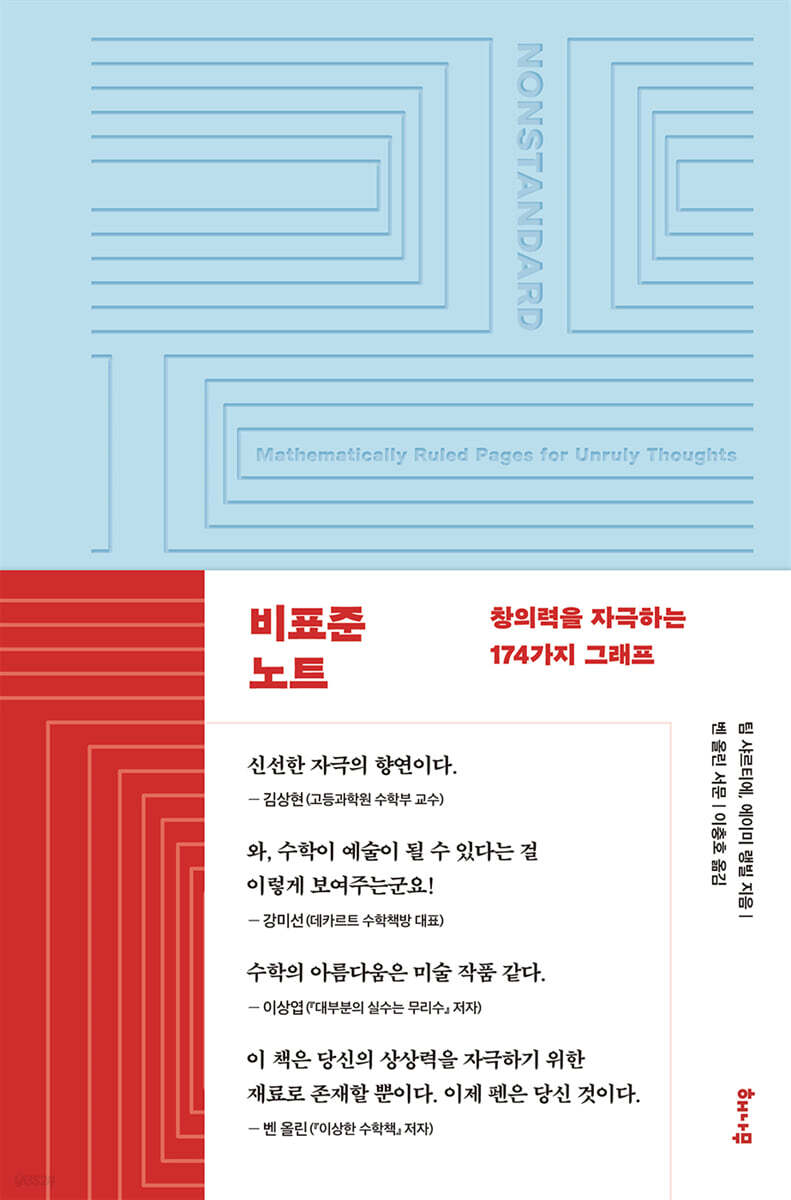
What happens when you change the pattern of parallel lines? "Non-Standard Notes" contains artistic drawings depicting various formulas, including straight lines with different directions, parabolas and waves, and the overlapping and division of circles.
It visually demonstrates the beauty of mathematics, which is often referred to, while also helping anyone approach mathematics in a comfortable way through the form of notes.
How will the new rules of note-taking change your flow of thought? Let's enjoy math with a lighter heart by experiencing a different way of writing and drawing.
Usually we don't think about the lines, we think about what to write between the lines.
Let's focus on the lines drawn on the note.
Those lines are a constant function (y=c) and a group of parallel lines! The two eccentric mathematicians try something new in their notebooks.
What happens when you change the pattern of parallel lines? "Non-Standard Notes" contains artistic drawings depicting various formulas, including straight lines with different directions, parabolas and waves, and the overlapping and division of circles.
It visually demonstrates the beauty of mathematics, which is often referred to, while also helping anyone approach mathematics in a comfortable way through the form of notes.
How will the new rules of note-taking change your flow of thought? Let's enjoy math with a lighter heart by experiencing a different way of writing and drawing.
- You can preview some of the book's contents.
Preview
index
introduction
Introduction
1. A faint strand of straight line structure
2 Parabolic_trajectory of motion
3 Polygonal Molecules
4. Ripples in the distance
5 Waves_Rhythm of Nature
6 Extreme Struggle Stories
7 Rotation_Dizzying Symmetry
8 Magnification and Reduction_Rhyme of Big and Small
9 Polar Coordinate System_The World of the Compass
10 Path_Parameters Footprint
11 Randomness_Unexpected Results from Chaos
12 3D_Paper Paradox
Concluding remarks
Acknowledgements
Introduction
1. A faint strand of straight line structure
2 Parabolic_trajectory of motion
3 Polygonal Molecules
4. Ripples in the distance
5 Waves_Rhythm of Nature
6 Extreme Struggle Stories
7 Rotation_Dizzying Symmetry
8 Magnification and Reduction_Rhyme of Big and Small
9 Polar Coordinate System_The World of the Compass
10 Path_Parameters Footprint
11 Randomness_Unexpected Results from Chaos
12 3D_Paper Paradox
Concluding remarks
Acknowledgements
Detailed image
.jpg)
Into the book
Our civilization has a curious habit of printing reams of paper full of lines.
--- From "First Sentence"
How would changing the lines affect the flow of thought? What if straight, parallel lines were replaced with curves, clusters of lines, or crosshairs? What if each plane, once uniformly identical, was given its own unique character?
--- p.10
A stone thrown into the air flies along a parabolic trajectory.
Comets wandering through space also trace parabolic trajectories.
Isaac Newton considered this fact about the orbit of a comet to be very important, and he wrote the proof of the parabolic orbit of a comet as the finale of his masterpiece of modern physics, Principia.
--- p.39
Triangles and squares form the basic shapes of great bridges, ornate opera houses, and many other monumental structures.
Another example is computer animation.
To simulate the fluidity of water or the curvature of a face, 3D animators work by layering polygons on top of each other until the desired effect is achieved.
--- p.57
Japanese Zen Buddhist Zen master Shunryu Suzuki said, “Waves are the movement of water.
“It is a mistake to talk about waves as separate from water or water as separate from waves,” he wrote.
Maybe so.
But for mathematicians, the practice of waves doesn't stop at water.
Waves are the primal form of repetition.
It is the embodiment of periodicity.
--- p.89
The concept of infinite access, which no matter how hard you try, try, and try, you can never reach, is the engine that drives modern mathematics.
In the pages that follow, you will encounter lines that get closer and closer together, vortices that grow larger and closer together, and waves that get faster and faster.
The key concept here is the limit, a destination that we are forever approaching but never reaching.
--- p.103
We are drawn to the beauty of the five-armed starfish, the six-branched snowflake, and the seven-petaled flower.
In such a form, rotation is symmetrical, an action that preserves the structure without changing it.
An object with rotational symmetry appears to rotate while at rest, and also appears to remain at rest while rotating.
--- p.119
This chapter unfolds by utilizing both concepts of size.
A passage from Neil Gaiman's book American Gods comes to mind.
There, a character looks at the night sky and says this.
“Shadow couldn’t tell if he was looking at a moon the size of a dollar a foot above his head, [or] a moon the size of the Pacific Ocean thousands of miles away.”
--- p.133
Apophenia refers to the human tendency to see patterns in everything, even when there are none in reality.
We connect the scattered stars to see constellations, and hear names and whispers amidst the noisy noise.
Sometimes, they connect unrelated events to create a huge conspiracy.
Our minds, always searching for patterns, seem never to be able to accept true randomness.
This is our blind spot.
Fortunately, that is also our extraordinary ability.
--- From "First Sentence"
How would changing the lines affect the flow of thought? What if straight, parallel lines were replaced with curves, clusters of lines, or crosshairs? What if each plane, once uniformly identical, was given its own unique character?
--- p.10
A stone thrown into the air flies along a parabolic trajectory.
Comets wandering through space also trace parabolic trajectories.
Isaac Newton considered this fact about the orbit of a comet to be very important, and he wrote the proof of the parabolic orbit of a comet as the finale of his masterpiece of modern physics, Principia.
--- p.39
Triangles and squares form the basic shapes of great bridges, ornate opera houses, and many other monumental structures.
Another example is computer animation.
To simulate the fluidity of water or the curvature of a face, 3D animators work by layering polygons on top of each other until the desired effect is achieved.
--- p.57
Japanese Zen Buddhist Zen master Shunryu Suzuki said, “Waves are the movement of water.
“It is a mistake to talk about waves as separate from water or water as separate from waves,” he wrote.
Maybe so.
But for mathematicians, the practice of waves doesn't stop at water.
Waves are the primal form of repetition.
It is the embodiment of periodicity.
--- p.89
The concept of infinite access, which no matter how hard you try, try, and try, you can never reach, is the engine that drives modern mathematics.
In the pages that follow, you will encounter lines that get closer and closer together, vortices that grow larger and closer together, and waves that get faster and faster.
The key concept here is the limit, a destination that we are forever approaching but never reaching.
--- p.103
We are drawn to the beauty of the five-armed starfish, the six-branched snowflake, and the seven-petaled flower.
In such a form, rotation is symmetrical, an action that preserves the structure without changing it.
An object with rotational symmetry appears to rotate while at rest, and also appears to remain at rest while rotating.
--- p.119
This chapter unfolds by utilizing both concepts of size.
A passage from Neil Gaiman's book American Gods comes to mind.
There, a character looks at the night sky and says this.
“Shadow couldn’t tell if he was looking at a moon the size of a dollar a foot above his head, [or] a moon the size of the Pacific Ocean thousands of miles away.”
--- p.133
Apophenia refers to the human tendency to see patterns in everything, even when there are none in reality.
We connect the scattered stars to see constellations, and hear names and whispers amidst the noisy noise.
Sometimes, they connect unrelated events to create a huge conspiracy.
Our minds, always searching for patterns, seem never to be able to accept true randomness.
This is our blind spot.
Fortunately, that is also our extraordinary ability.
--- p.179
Publisher's Review
Mathematics is beautiful 'visually' too.
A math art gallery you'll want to own
We've often heard the saying, 'Mathematics is beautiful.'
The word "beautiful" is often used to describe something immediately before our eyes, but what does it mean to say that mathematics is beautiful? Mathematicians often talk about its clean, systematic rules, the thrill of solving a difficult problem, and the wonder of mathematical order found in nature. But mathematics is actually visually beautiful, too! Applied mathematicians Tim Chartier and Amy Langville broke the rules of note-taking and created "Non-Standard Notebooks," filling pages with diverse geometric patterns and shapes using various formulas.
In this book, every page is filled with different lines.
I included the formulas used in the line drawings and also gave them literary names such as ‘Balloon Kiss’, ‘Country Scene’, and ‘Butterfly’.
This shows that formulas and geometry go together, and it also makes us feel that the pictures drawn by mathematics can touch the heart and be recognized as works of art.
Beautiful things make us want to keep them close to us.
Let's appreciate the beauty of mathematics in one notebook.
New Rules of Notes: Stimulating Creativity
Enjoy writing, drawing, and decorating your math notebook
Is there room for new ideas in the world of rules and order that is mathematics? Creativity isn't just about the ability to create something from nothing.
Rather, when there is a framework called a rule, the will to break it and novel ideas can arise.
This book is a mathematical idea notebook that breaks the common sense of notebooks and provides different rules on each page.
This book, presented in a friendly, accessible notebook format, is a practical stationery and math play tool that can be enjoyed in one's own way, such as by copying, recording, drawing, and decorating.
You may want to design your notebook pages using a graph drawing program.
This notebook is divided into 12 chapters and covers mathematical concepts ranging from simple and familiar concepts such as straight lines, parabolas, polygons, and circles to waves, limits, rotations, polar coordinates, and three dimensions, and concisely conveys the meaning and appeal of each concept.
Triangles and squares form the basic shapes of architecture and are also used in 3D animation.
Waves and limits have been concepts that have been considered in the East as well, and mathematical concepts are also utilized in literature.
You don't have to try to learn anything.
Let's enjoy math to our heart's content by looking at pictures, writing notes, and drawing.
You will be able to experience a time when mathematics naturally seeps into you.
A math art gallery you'll want to own
We've often heard the saying, 'Mathematics is beautiful.'
The word "beautiful" is often used to describe something immediately before our eyes, but what does it mean to say that mathematics is beautiful? Mathematicians often talk about its clean, systematic rules, the thrill of solving a difficult problem, and the wonder of mathematical order found in nature. But mathematics is actually visually beautiful, too! Applied mathematicians Tim Chartier and Amy Langville broke the rules of note-taking and created "Non-Standard Notebooks," filling pages with diverse geometric patterns and shapes using various formulas.
In this book, every page is filled with different lines.
I included the formulas used in the line drawings and also gave them literary names such as ‘Balloon Kiss’, ‘Country Scene’, and ‘Butterfly’.
This shows that formulas and geometry go together, and it also makes us feel that the pictures drawn by mathematics can touch the heart and be recognized as works of art.
Beautiful things make us want to keep them close to us.
Let's appreciate the beauty of mathematics in one notebook.
New Rules of Notes: Stimulating Creativity
Enjoy writing, drawing, and decorating your math notebook
Is there room for new ideas in the world of rules and order that is mathematics? Creativity isn't just about the ability to create something from nothing.
Rather, when there is a framework called a rule, the will to break it and novel ideas can arise.
This book is a mathematical idea notebook that breaks the common sense of notebooks and provides different rules on each page.
This book, presented in a friendly, accessible notebook format, is a practical stationery and math play tool that can be enjoyed in one's own way, such as by copying, recording, drawing, and decorating.
You may want to design your notebook pages using a graph drawing program.
This notebook is divided into 12 chapters and covers mathematical concepts ranging from simple and familiar concepts such as straight lines, parabolas, polygons, and circles to waves, limits, rotations, polar coordinates, and three dimensions, and concisely conveys the meaning and appeal of each concept.
Triangles and squares form the basic shapes of architecture and are also used in 3D animation.
Waves and limits have been concepts that have been considered in the East as well, and mathematical concepts are also utilized in literature.
You don't have to try to learn anything.
Let's enjoy math to our heart's content by looking at pictures, writing notes, and drawing.
You will be able to experience a time when mathematics naturally seeps into you.
GOODS SPECIFICS
- Date of issue: April 10, 2025
- Format: Hardcover book binding method guide
- Page count, weight, size: 208 pages | 506g | 140*216*19mm
- ISBN13: 9791164053049
You may also like
카테고리
korean


korean

![ELLE 엘르 스페셜 에디션 A형 : 12월 [2025]](http://librairie.coreenne.fr/cdn/shop/files/b8e27a3de6c9538896439686c6b0e8fb.jpg?v=1766436872&width=3840)


