

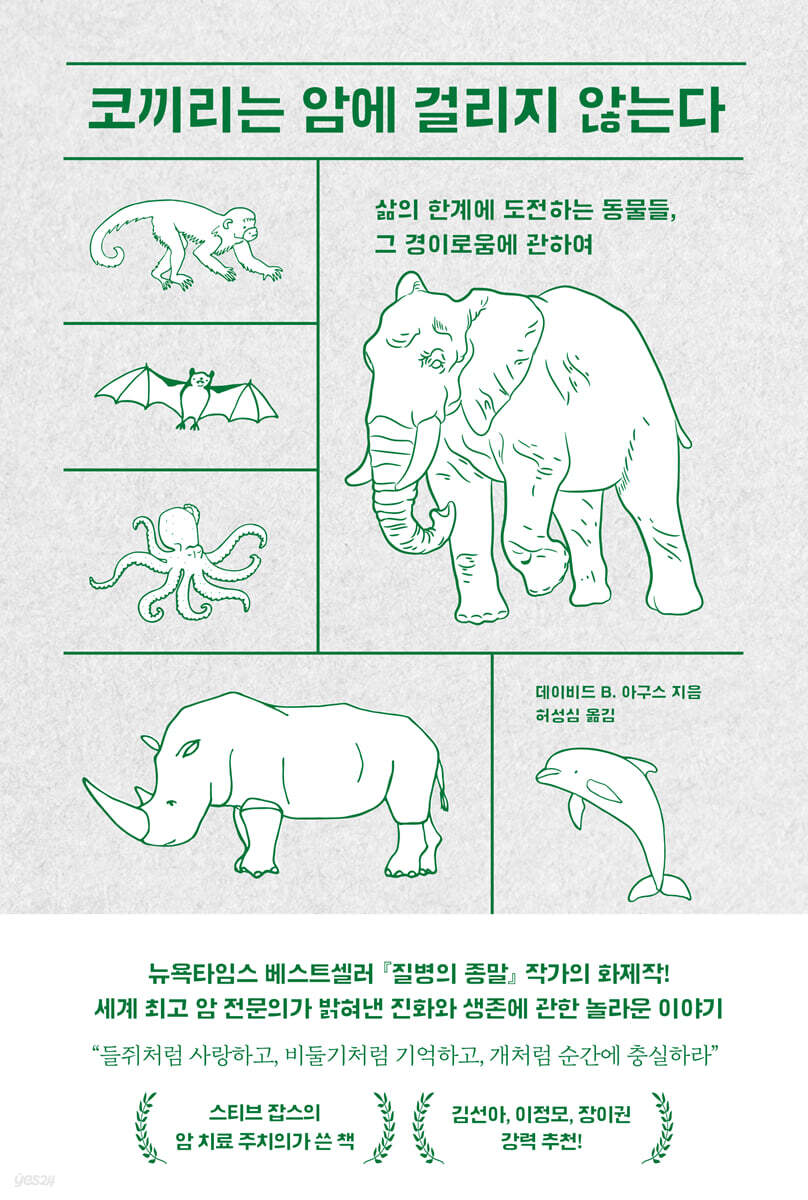
Elephants don't get cancer
 |
Description
Book Introduction
★A book written by Steve Jobs' personal physician
★The world's top cancer authority shares surprising secrets about health and happiness.
★Recommended by Kim Seon-ah (animal behavioral medicine expert), Lee Jeong-mo (former director of the National Science Museum in Gwacheon), and Jang I-kwon (behavioral ecologist)!
“Elephants Don’t Get Cancer” is a very unique book.
It takes us across taxonomy, ecology, cytology, embryology, pathology, immunology, and microbiology.
"Oh my! How do you read this? You're absolutely right! It's not burdensome at all." _Lee Jeong-mo
Disease, emotions, intelligence, and social and cognitive abilities...
Solving a human puzzle that seemed like it would never be solved
How to survive on Earth, told by our most perfect neighbors, the 'animals'!
David B., who presented a new paradigm for health and created a sensation in the medical world with his New York Times bestseller, “The End of Illness.”
Agus is back with his latest hit, "Elephants Don't Get Cancer."
David B.
Agus is a world-renowned cancer authority and scientist who has received awards such as the American Cancer Society Research Physician Award, the Sloan-Kettering Institute Clinical Physician Award, and the International Myeloma Foundation Vision Science Award. He has dedicated his life to research to improve the quality of life for humanity.
This book explores human problems, which still have clear limitations, based on past research, and presents solutions through animals in nature.
'Why are giraffes, born with long necks, free from cardiovascular disease?', 'Why do ants let some of their comrades die and others live for perfect teamwork?', 'How do pigeons always win the Monty Hall Quiz that humans can't solve?', and 'Do elephants really not get cancer?', it talks about the physical and social systems that we can learn from them in a vast and systematic way, crossing over the fields of evolutionary biology, cytology, embryology, and microbiology.
You can experience the mysteries of life science through the operating principles of hormones, genes, DNA information, and the microbiome, which are important topics covered in this process.
From his days as a T-cell immunology researcher to his current position as a medical school professor and founder of a cancer treatment research institute, David B.
Anecdotes from the various people Agus met add depth and expertise to this book.
As life expectancy increases and we live to be 100 years old, the question of 'how to live this long life' has become important.
Discussions on health, such as slow aging, zero-sugar foods, and gut microbiomes, as well as on mental well-being, such as digital detox, positive psychology, mindset, and emotional intelligence, are occurring at an unprecedented pace.
In other words, this trend, which goes beyond the simple issue of longevity and is ultimately discussed as "well-aging," has become a representative desire and trend of society, and in that sense, "Elephants Don't Get Cancer" will be a timely book that will allow us to overcome the limitations of life and take a step forward.
★The world's top cancer authority shares surprising secrets about health and happiness.
★Recommended by Kim Seon-ah (animal behavioral medicine expert), Lee Jeong-mo (former director of the National Science Museum in Gwacheon), and Jang I-kwon (behavioral ecologist)!
“Elephants Don’t Get Cancer” is a very unique book.
It takes us across taxonomy, ecology, cytology, embryology, pathology, immunology, and microbiology.
"Oh my! How do you read this? You're absolutely right! It's not burdensome at all." _Lee Jeong-mo
Disease, emotions, intelligence, and social and cognitive abilities...
Solving a human puzzle that seemed like it would never be solved
How to survive on Earth, told by our most perfect neighbors, the 'animals'!
David B., who presented a new paradigm for health and created a sensation in the medical world with his New York Times bestseller, “The End of Illness.”
Agus is back with his latest hit, "Elephants Don't Get Cancer."
David B.
Agus is a world-renowned cancer authority and scientist who has received awards such as the American Cancer Society Research Physician Award, the Sloan-Kettering Institute Clinical Physician Award, and the International Myeloma Foundation Vision Science Award. He has dedicated his life to research to improve the quality of life for humanity.
This book explores human problems, which still have clear limitations, based on past research, and presents solutions through animals in nature.
'Why are giraffes, born with long necks, free from cardiovascular disease?', 'Why do ants let some of their comrades die and others live for perfect teamwork?', 'How do pigeons always win the Monty Hall Quiz that humans can't solve?', and 'Do elephants really not get cancer?', it talks about the physical and social systems that we can learn from them in a vast and systematic way, crossing over the fields of evolutionary biology, cytology, embryology, and microbiology.
You can experience the mysteries of life science through the operating principles of hormones, genes, DNA information, and the microbiome, which are important topics covered in this process.
From his days as a T-cell immunology researcher to his current position as a medical school professor and founder of a cancer treatment research institute, David B.
Anecdotes from the various people Agus met add depth and expertise to this book.
As life expectancy increases and we live to be 100 years old, the question of 'how to live this long life' has become important.
Discussions on health, such as slow aging, zero-sugar foods, and gut microbiomes, as well as on mental well-being, such as digital detox, positive psychology, mindset, and emotional intelligence, are occurring at an unprecedented pace.
In other words, this trend, which goes beyond the simple issue of longevity and is ultimately discussed as "well-aging," has become a representative desire and trend of society, and in that sense, "Elephants Don't Get Cancer" will be a timely book that will allow us to overcome the limitations of life and take a step forward.
- You can preview some of the book's contents.
Preview
index
Praise for this book 1
Prologue 13
Chapter 1: Living in a Zoo Cage:
33 Ways Wild Animals Teach Us to Live Longer, Stronger, and Smarter
Chapter 2 Oh My Dog!:
Dogs are more than just man's best friend 57
Chapter 3: The Long Way Home:
The Power of Pattern Recognition and the Dangers of Overthinking 89
Chapter 4 The Giraffe Paradox:
How the Giraffe's Long Neck and Gravity Teach Us How to Fight Heart Disease 123
Chapter 5 “Hey, Elephant Man”:
153 Reasons Why We Need to Treat Cancer and Protect DNA
Chapter 6: Carnivore Male Chimpanzees, Permissive Female Chimpanzees:
183 Tips on Eating, Sharing, and Parenting from Our Cousins
Chapter 7 Team Effort and Herd Immunity:
The Need for Collaboration, Emergency Medical Care, and Sick Leave 217
Chapter 8: Rhinoceros, Breeding, and Running:
The Small Power of the Environment That Can Bring Great Change to Civilization 253
Chapter 9: The Smart Octopus and the Demented Dolphin:
On Intelligence and Living with a Clear Mind Forever 293
Chapter 10: The Invisible Rider:
Microbes, Microbiome, and Immortal Stem Cells 323
Chapter 11: Positivity, Character, and Suffering:
What Pigs, Squirrels, and Albatrosses Can Teach Us 349
Chapter 12: The Laws of Bonding, Sex, and Love:
What we really need is something else 383
Epilogue 413
Acknowledgments 418
Week 430
Index 467
Prologue 13
Chapter 1: Living in a Zoo Cage:
33 Ways Wild Animals Teach Us to Live Longer, Stronger, and Smarter
Chapter 2 Oh My Dog!:
Dogs are more than just man's best friend 57
Chapter 3: The Long Way Home:
The Power of Pattern Recognition and the Dangers of Overthinking 89
Chapter 4 The Giraffe Paradox:
How the Giraffe's Long Neck and Gravity Teach Us How to Fight Heart Disease 123
Chapter 5 “Hey, Elephant Man”:
153 Reasons Why We Need to Treat Cancer and Protect DNA
Chapter 6: Carnivore Male Chimpanzees, Permissive Female Chimpanzees:
183 Tips on Eating, Sharing, and Parenting from Our Cousins
Chapter 7 Team Effort and Herd Immunity:
The Need for Collaboration, Emergency Medical Care, and Sick Leave 217
Chapter 8: Rhinoceros, Breeding, and Running:
The Small Power of the Environment That Can Bring Great Change to Civilization 253
Chapter 9: The Smart Octopus and the Demented Dolphin:
On Intelligence and Living with a Clear Mind Forever 293
Chapter 10: The Invisible Rider:
Microbes, Microbiome, and Immortal Stem Cells 323
Chapter 11: Positivity, Character, and Suffering:
What Pigs, Squirrels, and Albatrosses Can Teach Us 349
Chapter 12: The Laws of Bonding, Sex, and Love:
What we really need is something else 383
Epilogue 413
Acknowledgments 418
Week 430
Index 467
Detailed image

Into the book
Many animals do not get cancer or become obese.
They do not suffer from anxiety or depression, nor do they suffer from infectious diseases.
They do not show symptoms of cardiovascular disease or suffer from neurological disorders such as dementia or Parkinson's disease.
They don't get diabetes or autoimmune diseases, and they don't even develop superficial signs of aging like thinning gray hair, wrinkles, or arthritis in the knees.
Some creatures can hear without ears, see without eyes, retain their reproductive functions until death, regenerate lost limbs, revert to previous stages in their life cycle, communicate with one another without speaking or using anything resembling language, and think without having a brain.
--- p.16
Kent focuses his research on dogs, believing they are the best models for human health and aging.
Unlike rodents or other animals used in laboratories, dogs have complex physiology.
The disease process is also similar to ours.
This means that the way certain diseases manifest and progress is similar to that in humans.
Therefore, dogs are an excellent model for testing and studying the efficacy and toxicity of new treatments.
Dogs can develop cancer, diabetes, epilepsy, and canine cognitive impairments like Alzheimer's and Crohn's disease.
Moreover, they are often exposed to environmental pathogenic factors similar to those in humans.
We share more viruses with dogs than with any other animal, and dogs have immune systems that are remarkably similar to ours.
--- p.68
It is said that pigeons move their heads back and forth quickly to fix their eyes on an object momentarily so that the surrounding scene does not shake.
Sometimes, sit on a park bench and ponder this paradox.
Since movement naturally causes the field of vision to shake, all animals need a way to keep their surroundings still.
Without that method, your vision would become blurred and dizzy.
Human eyes are connected to the brain area that tracks movement and to the nerve muscles, so when there is movement, a slight eye twitching instinctively occurs, but pigeons use their long, flexible necks to track movement.
So, instead of actually shaking your neck, you lean your head forward, fixate your gaze on an object, and then your body follows that direction.
--- p.111
The cells of giant elephants rarely mutate, so the risk of developing cancer is very low compared to humans.
The chance that an elephant will develop cancer in its lifetime is less than 5 percent.
This means that less than 5 percent of all elephants die from cancer.
Scientists have known this for decades, since Richard Peto began his research in the 1970s, but only recently have they begun to crack the code for understanding the so-called elephant's anti-cancer profile.
Elephants have a robust anti-cancer system based on a protein called p53 (which has a molecular weight of 53 kilodaltons).
The anticancer molecule and the gene that encodes it, the tumor suppressor gene TP53, have received considerable attention over the past 30 years.
In particular, it has been receiving steady attention since 『Science』 declared it the ‘Molecule of the Year’ in December 1993.
--- p.164
Alzheimer's disease is a complex disease that cannot be explained by one thing.
Not everyone with this condition has problems with insulin regulation, and other hormones may also be involved.
Because Alzheimer's disease occurs overwhelmingly in women, recent studies are investigating how estrogen signaling may influence Alzheimer's risk.
However, since more than 80 percent of all Alzheimer's patients, both men and women, do not have a properly functioning insulin signaling system, insulin control is paramount.
Moreover, insulin signaling is important not only for preventing cognitive decline like Alzheimer's, but also for metabolism, which is responsible for many vital functions in our body from waistline to brain.
They do not suffer from anxiety or depression, nor do they suffer from infectious diseases.
They do not show symptoms of cardiovascular disease or suffer from neurological disorders such as dementia or Parkinson's disease.
They don't get diabetes or autoimmune diseases, and they don't even develop superficial signs of aging like thinning gray hair, wrinkles, or arthritis in the knees.
Some creatures can hear without ears, see without eyes, retain their reproductive functions until death, regenerate lost limbs, revert to previous stages in their life cycle, communicate with one another without speaking or using anything resembling language, and think without having a brain.
--- p.16
Kent focuses his research on dogs, believing they are the best models for human health and aging.
Unlike rodents or other animals used in laboratories, dogs have complex physiology.
The disease process is also similar to ours.
This means that the way certain diseases manifest and progress is similar to that in humans.
Therefore, dogs are an excellent model for testing and studying the efficacy and toxicity of new treatments.
Dogs can develop cancer, diabetes, epilepsy, and canine cognitive impairments like Alzheimer's and Crohn's disease.
Moreover, they are often exposed to environmental pathogenic factors similar to those in humans.
We share more viruses with dogs than with any other animal, and dogs have immune systems that are remarkably similar to ours.
--- p.68
It is said that pigeons move their heads back and forth quickly to fix their eyes on an object momentarily so that the surrounding scene does not shake.
Sometimes, sit on a park bench and ponder this paradox.
Since movement naturally causes the field of vision to shake, all animals need a way to keep their surroundings still.
Without that method, your vision would become blurred and dizzy.
Human eyes are connected to the brain area that tracks movement and to the nerve muscles, so when there is movement, a slight eye twitching instinctively occurs, but pigeons use their long, flexible necks to track movement.
So, instead of actually shaking your neck, you lean your head forward, fixate your gaze on an object, and then your body follows that direction.
--- p.111
The cells of giant elephants rarely mutate, so the risk of developing cancer is very low compared to humans.
The chance that an elephant will develop cancer in its lifetime is less than 5 percent.
This means that less than 5 percent of all elephants die from cancer.
Scientists have known this for decades, since Richard Peto began his research in the 1970s, but only recently have they begun to crack the code for understanding the so-called elephant's anti-cancer profile.
Elephants have a robust anti-cancer system based on a protein called p53 (which has a molecular weight of 53 kilodaltons).
The anticancer molecule and the gene that encodes it, the tumor suppressor gene TP53, have received considerable attention over the past 30 years.
In particular, it has been receiving steady attention since 『Science』 declared it the ‘Molecule of the Year’ in December 1993.
--- p.164
Alzheimer's disease is a complex disease that cannot be explained by one thing.
Not everyone with this condition has problems with insulin regulation, and other hormones may also be involved.
Because Alzheimer's disease occurs overwhelmingly in women, recent studies are investigating how estrogen signaling may influence Alzheimer's risk.
However, since more than 80 percent of all Alzheimer's patients, both men and women, do not have a properly functioning insulin signaling system, insulin control is paramount.
Moreover, insulin signaling is important not only for preventing cognitive decline like Alzheimer's, but also for metabolism, which is responsible for many vital functions in our body from waistline to brain.
--- p.317
Publisher's Review
'Civilization disease' permitted only to humans,
It's time to break free from that chronic and entrenched system!
From some point on, instead of going out to see a movie, we started playing the movie we wanted to see on our laptops, and the way to get the food we wanted to eat or meet the person we wanted to see was also blocked.
You can order delivery from your seat in less than a minute, and replace meetings and interactions with FaceTime, which rings after a few calls.
Additionally, you can now lie down or sit all day and enjoy a variety of experiences beyond the small screen of your phone.
Ironically, the numerous technological advancements humans have made in the name of 'efficiency' and 'convenience' have made us unhappy both inside and outside of life.
David B.
Agus refers to these characteristics of modern people as 'diseases of civilization'.
Because of this, we suffer from diseases that are not found in animals, such as high blood pressure, cancer, Alzheimer's disease, and infertility, on a daily basis, and we are unable or unwilling to think beyond what we know.
Furthermore, we live in an age where it is difficult to properly understand and love others unless we are ‘me.’
So, can we really say that humans live a higher life than animals?
Now is the time to actively break free from this world that seems to have locked us in a zoo fence.
We need to learn the essential answers to questions like how to love, how to communicate and empathize, how to build stamina and health, and how to think creatively—by meeting people, experiencing things, and talking with them in the real world, not online.
That's David B.
As Agus said, it is a life where we can get closer to nature again.
Furthermore, rather than taking excessive amounts of vitamins, going on extreme diets, or following every exercise that others recommend, it is important to understand your own biological rhythm and lifestyle and live a lifestyle that suits that.
It's time to break free from that chronic and entrenched system!
From some point on, instead of going out to see a movie, we started playing the movie we wanted to see on our laptops, and the way to get the food we wanted to eat or meet the person we wanted to see was also blocked.
You can order delivery from your seat in less than a minute, and replace meetings and interactions with FaceTime, which rings after a few calls.
Additionally, you can now lie down or sit all day and enjoy a variety of experiences beyond the small screen of your phone.
Ironically, the numerous technological advancements humans have made in the name of 'efficiency' and 'convenience' have made us unhappy both inside and outside of life.
David B.
Agus refers to these characteristics of modern people as 'diseases of civilization'.
Because of this, we suffer from diseases that are not found in animals, such as high blood pressure, cancer, Alzheimer's disease, and infertility, on a daily basis, and we are unable or unwilling to think beyond what we know.
Furthermore, we live in an age where it is difficult to properly understand and love others unless we are ‘me.’
So, can we really say that humans live a higher life than animals?
Now is the time to actively break free from this world that seems to have locked us in a zoo fence.
We need to learn the essential answers to questions like how to love, how to communicate and empathize, how to build stamina and health, and how to think creatively—by meeting people, experiencing things, and talking with them in the real world, not online.
That's David B.
As Agus said, it is a life where we can get closer to nature again.
Furthermore, rather than taking excessive amounts of vitamins, going on extreme diets, or following every exercise that others recommend, it is important to understand your own biological rhythm and lifestyle and live a lifestyle that suits that.
GOODS SPECIFICS
- Date of issue: October 22, 2024
- Page count, weight, size: 480 pages | 684g | 148*220*23mm
- ISBN13: 9788932323879
You may also like
카테고리
korean


korean

![ELLE 엘르 스페셜 에디션 A형 : 12월 [2025]](http://librairie.coreenne.fr/cdn/shop/files/b8e27a3de6c9538896439686c6b0e8fb.jpg?v=1766436872&width=3840)


