

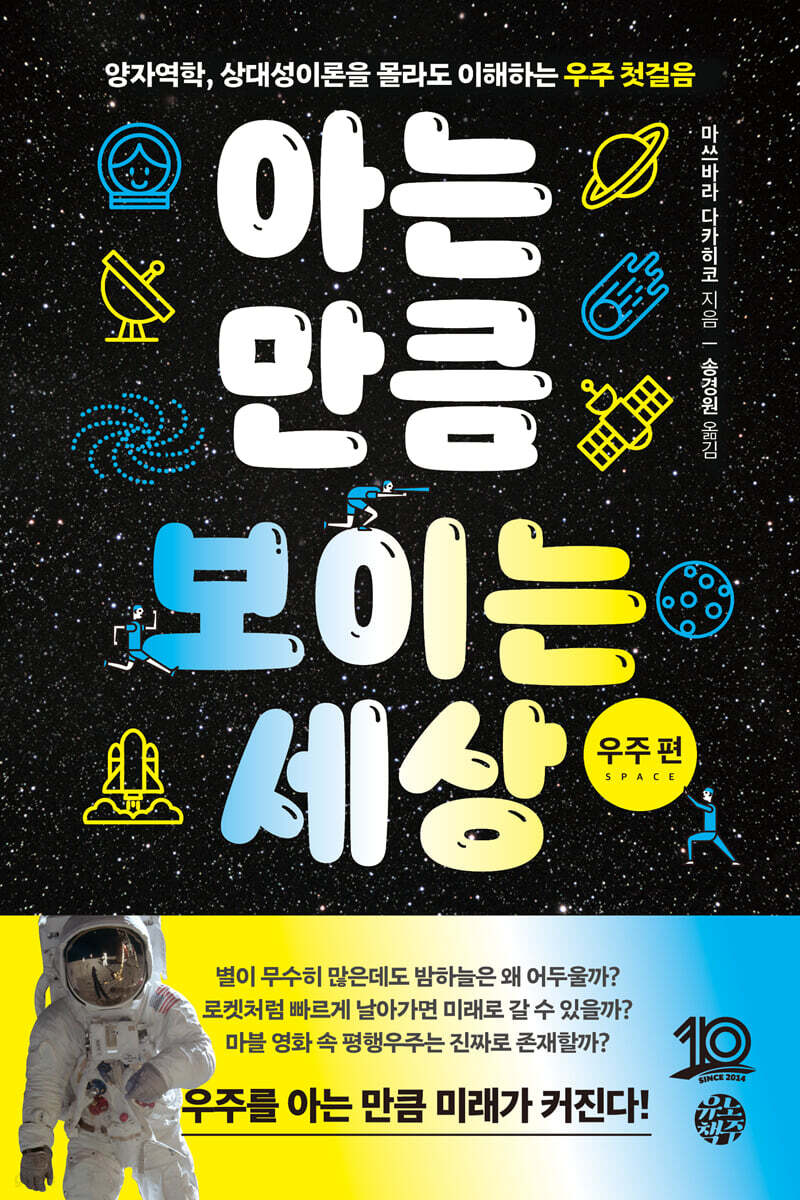
The World You See as Much as You Know: Space Edition
 |
Description
Book Introduction
Why is the night sky dark even though there are countless stars? Can we go to the future if we fly as fast as a rocket? Do parallel universes in Marvel movies really exist? “The more you know about the universe, the bigger your future becomes!” What comes to mind when you think of "space"? Twinkling stars in the night sky, black holes, satellites, and all sorts of space-themed science fiction movies. From the iconic 20th-century film Star Wars to the recent, beloved Marvel movies, stories set in space or about intelligent life in space have always garnered much attention. So then, what exactly is the universe? Numerous scientists have struggled for years to answer this question, but it still seems difficult to give a clear answer. However, there are certainly numerous efforts to keep all possibilities open and get closer to the truth. The author of this book is one of the researchers who has made countless efforts to answer this question. Beginning with the etymology of the word "universe," this book explores the ancient cosmology, various cosmic phenomena that can be proven by modern science, and even the latest theories about the universe that are theoretically possible, though unproven. First, Chapter 1 contains the story starting from the ancient cosmology and ending with the birth of the Earth. You will encounter many familiar and welcome names, such as geocentrism and heliocentrism. Chapter 2 talks about the expansion of the universe. It covers what it means for the universe to be expanding, what it has to do with Earth, etc. In Chapter 3, we will take a look at theories that help us understand the universe, such as quantum mechanics and Schrödinger's cat, which everyone has heard of at least once. Chapter 4 talks about the parallel worlds, or multiverses, that appear in the aforementioned Marvel movies. This will be a very interesting chapter. Chapter 5 explains the tiny variables that created the universe. In some ways, this could be a story that scientifically proves that fate is predetermined. Chapter 6 concludes with a discussion of time and space. There is also a story about a time machine that cannot be left out when talking about space, so don't miss it. Stories about space are fascinating, but once you delve into them, they are so difficult that it's easy to give up. However, with 『The World You See as Much as You Know: Universe』, which eliminates difficult stories as much as possible and presents interesting topics in an easy-to-understand manner, you will not only be able to preserve your fantasy about the universe, but also take a step forward toward a more scientific understanding of the universe. |
- You can preview some of the book's contents.
Preview
index
Introduction: A Journey to Find "What is the Universe?"
CHAPTER 1: When Did the Earth Become Round? │The Birth of the Universe
The True Face of Earth We Never Knew - Ancient Cosmology
Why no one can know the true shape of the universe. The dimensions of the universe.
The idea that everything revolves around the Earth, the geocentric theory
“And yet the Earth moves!”ㆍHeliocentrism
Is the universe truly endless? Infinite cosmology
Secrets of the Universe Discovered on a Train: Evidence for the Heliocentric Theory
Is There Really a Second Earth? Discovery of an Exoplanet
Why is the night sky dark even though there are stars? Olbers' Paradox
Evidence that the universe has limits: cosmic expansion
What Changes and What Never Changes: The Speed of Light and the Theory of Relativity
Dimensions are bent towards 'this' - The identity of gravity
Does Living on a High Floor Make You Age Faster? The Distortion of Time
What if there was no gravity on Earth? A state of weightlessness
CHAPTER 2 Is the Universe Still Inflating Like a Balloon? │The Structure of the Universe
The maximum visible universe/cosmic horizon
The universe is growing bigger every day!ㆍInflation theory
The universe became clear, and the universe became clear.
Balance Created by Imbalance: Cosmic Microwave Background Radiation
How Are Stars Made? Dark Matter
What does our galaxy look like?ㆍGalaxy
Dark Energy Fattens the Universe? Accelerating Cosmic Expansion and Dark Energy
"We are made of stars" - White dwarfs and supernova explosions
Why do some claim the universe is like a bubble? The large-scale structure of the universe
Is the universe truly endless? The cosmic horizon and the observable range
CHAPTER 3: Is Schrödinger's Cat Alive? │The Universe and Quantum Mechanics
The emergence of a new discipline to understand the universe: quantum mechanics
Is light a particle or a wave? The nature of light
The magic number connecting energy and vibration: Planck's constant
Where are the electrons? Atoms and wave functions
The cat in the box is both alive and dead? Schrödinger's cat
What was this thing Einstein called eerie action at a distance? Quantum entanglement
The Birth of the World's Fastest Computer: Quantum Computers
The belief that the universe was born from nothingness: the Vilenkin hypothesis
Could we also be able to pass through walls? The quantum tunneling effect
What if the universe was born from a pre-existing universe? ㆍEcropyrotic cosmology
CHAPTER 4: Could there be another me? │ Universe and Parallel Worlds
"Our universe is actually shaped like a candy cane!"ㆍThe uniformity and heterogeneity of the universe
Efforts to understand the birth of the universe: the Big Bang and inflation theory
Why isn't the universe one? Chaotic inflation
Are there countless selves in the infinitely expanding universe? Multiverse
The theory that unites all powers: the four forces that exist in the universe
"The universe we live in is actually 10-dimensional!" String theory
The existence of a universe completely different from our laws of physics, the Landscape Universe
Can't we go to different dimensions forever? Brain Universe
The meaning of the statement that something could exist but does not exist: Gödel's incompleteness theorem
What if possible and impossible probabilities coexist? The problem of interpreting quantum theory
The two major interpretations of quantum theory: the Copenhagen interpretation and the many-worlds interpretation.
"The universe exists only when humans see it!"ㆍThe principle of participatory humanity
Is This World Real? The Simulation Hypothesis
CHAPTER 5: The Scientific Evidence That Destiny Is Predestined│The Universe and Parameters
The universe was created through the overlapping of multiple miracles. Multiverse theory.
Why gravity has the same strength as it does now: parameters
The work-gravitational constant that would occur if gravity were stronger than it is now
What if the speed of light were slower than it is now? The speed of light
What happens in the microscopic world of atoms? The microscopic world and Planck's constant.
What if you had length, mass, and time? Planck scale
A world shaped by the delicate balance of love triangles: electrons, protons, and neutrons.
A tremendous event that occurred when a star undergoes nuclear fusion: deuterium
Special properties of water that are beneficial to living things and the specific heat of water
The Story of a Genius Who Came Up with the Answer Without Measuring It: The Triple Alpha Process
What if the universe is over 100 billion years old? The strong and weak anthropic principles.
"The purpose of the universe is to create humans!" - The strong principle of humanity
What Happens to Humans in Two Dimensions? Predictions Based on the Number of Dimensions
Tachyon particles: things that exist but cannot be seen
Why Einstein's biggest mistake of his life was inevitable: Spaceport and the cosmological constant
CHAPTER 6: Is Time Travel Possible? │The Future of the Universe
Again, what is the universe? Time and space
Can we travel to the future on a rocket? Time Machine
How to Transcend Space and Time: Wormholes and Black Holes
Going back in time won't change the future? Time Paradox
Each time you choose, a new universe is born. Parallel universes
Quantum Gravity: A Method for Connecting the Macro and Micro Worlds Without Contradiction
Is time a human invention? ㆍSpace-time theory
The claim that existence is possible only when it can be seen, observational cosmology
Do we need mathematics to explore the universe? Space Research
CHAPTER 1: When Did the Earth Become Round? │The Birth of the Universe
The True Face of Earth We Never Knew - Ancient Cosmology
Why no one can know the true shape of the universe. The dimensions of the universe.
The idea that everything revolves around the Earth, the geocentric theory
“And yet the Earth moves!”ㆍHeliocentrism
Is the universe truly endless? Infinite cosmology
Secrets of the Universe Discovered on a Train: Evidence for the Heliocentric Theory
Is There Really a Second Earth? Discovery of an Exoplanet
Why is the night sky dark even though there are stars? Olbers' Paradox
Evidence that the universe has limits: cosmic expansion
What Changes and What Never Changes: The Speed of Light and the Theory of Relativity
Dimensions are bent towards 'this' - The identity of gravity
Does Living on a High Floor Make You Age Faster? The Distortion of Time
What if there was no gravity on Earth? A state of weightlessness
CHAPTER 2 Is the Universe Still Inflating Like a Balloon? │The Structure of the Universe
The maximum visible universe/cosmic horizon
The universe is growing bigger every day!ㆍInflation theory
The universe became clear, and the universe became clear.
Balance Created by Imbalance: Cosmic Microwave Background Radiation
How Are Stars Made? Dark Matter
What does our galaxy look like?ㆍGalaxy
Dark Energy Fattens the Universe? Accelerating Cosmic Expansion and Dark Energy
"We are made of stars" - White dwarfs and supernova explosions
Why do some claim the universe is like a bubble? The large-scale structure of the universe
Is the universe truly endless? The cosmic horizon and the observable range
CHAPTER 3: Is Schrödinger's Cat Alive? │The Universe and Quantum Mechanics
The emergence of a new discipline to understand the universe: quantum mechanics
Is light a particle or a wave? The nature of light
The magic number connecting energy and vibration: Planck's constant
Where are the electrons? Atoms and wave functions
The cat in the box is both alive and dead? Schrödinger's cat
What was this thing Einstein called eerie action at a distance? Quantum entanglement
The Birth of the World's Fastest Computer: Quantum Computers
The belief that the universe was born from nothingness: the Vilenkin hypothesis
Could we also be able to pass through walls? The quantum tunneling effect
What if the universe was born from a pre-existing universe? ㆍEcropyrotic cosmology
CHAPTER 4: Could there be another me? │ Universe and Parallel Worlds
"Our universe is actually shaped like a candy cane!"ㆍThe uniformity and heterogeneity of the universe
Efforts to understand the birth of the universe: the Big Bang and inflation theory
Why isn't the universe one? Chaotic inflation
Are there countless selves in the infinitely expanding universe? Multiverse
The theory that unites all powers: the four forces that exist in the universe
"The universe we live in is actually 10-dimensional!" String theory
The existence of a universe completely different from our laws of physics, the Landscape Universe
Can't we go to different dimensions forever? Brain Universe
The meaning of the statement that something could exist but does not exist: Gödel's incompleteness theorem
What if possible and impossible probabilities coexist? The problem of interpreting quantum theory
The two major interpretations of quantum theory: the Copenhagen interpretation and the many-worlds interpretation.
"The universe exists only when humans see it!"ㆍThe principle of participatory humanity
Is This World Real? The Simulation Hypothesis
CHAPTER 5: The Scientific Evidence That Destiny Is Predestined│The Universe and Parameters
The universe was created through the overlapping of multiple miracles. Multiverse theory.
Why gravity has the same strength as it does now: parameters
The work-gravitational constant that would occur if gravity were stronger than it is now
What if the speed of light were slower than it is now? The speed of light
What happens in the microscopic world of atoms? The microscopic world and Planck's constant.
What if you had length, mass, and time? Planck scale
A world shaped by the delicate balance of love triangles: electrons, protons, and neutrons.
A tremendous event that occurred when a star undergoes nuclear fusion: deuterium
Special properties of water that are beneficial to living things and the specific heat of water
The Story of a Genius Who Came Up with the Answer Without Measuring It: The Triple Alpha Process
What if the universe is over 100 billion years old? The strong and weak anthropic principles.
"The purpose of the universe is to create humans!" - The strong principle of humanity
What Happens to Humans in Two Dimensions? Predictions Based on the Number of Dimensions
Tachyon particles: things that exist but cannot be seen
Why Einstein's biggest mistake of his life was inevitable: Spaceport and the cosmological constant
CHAPTER 6: Is Time Travel Possible? │The Future of the Universe
Again, what is the universe? Time and space
Can we travel to the future on a rocket? Time Machine
How to Transcend Space and Time: Wormholes and Black Holes
Going back in time won't change the future? Time Paradox
Each time you choose, a new universe is born. Parallel universes
Quantum Gravity: A Method for Connecting the Macro and Micro Worlds Without Contradiction
Is time a human invention? ㆍSpace-time theory
The claim that existence is possible only when it can be seen, observational cosmology
Do we need mathematics to explore the universe? Space Research
Introduction: A Journey to Find "What is the Universe?"
CHAPTER 1: When Did the Earth Become Round? │The Birth of the Universe
The True Face of Earth We Never Knew - Ancient Cosmology
Why no one can know the true shape of the universe. The dimensions of the universe.
The idea that everything revolves around the Earth, the geocentric theory
“And yet the Earth moves!”ㆍHeliocentrism
Is the universe truly endless? Infinite cosmology
Secrets of the Universe Discovered on a Train: Evidence for the Heliocentric Theory
Is There Really a Second Earth? Discovery of an Exoplanet
Why is the night sky dark even though there are stars? Olbers' Paradox
Evidence that the universe has limits: cosmic expansion
What Changes and What Never Changes: The Speed of Light and the Theory of Relativity
Dimensions are bent towards 'this' - The identity of gravity
Does Living on a High Floor Make You Age Faster? The Distortion of Time
What if there was no gravity on Earth? A state of weightlessness
CHAPTER 2 Is the Universe Still Inflating Like a Balloon? │The Structure of the Universe
The maximum visible universe/cosmic horizon
The universe is growing bigger every day!ㆍInflation theory
The universe became clear, and the universe became clear.
Balance Created by Imbalance: Cosmic Microwave Background Radiation
How Are Stars Made? Dark Matter
What does our galaxy look like?ㆍGalaxy
Dark Energy Fattens the Universe? Accelerating Cosmic Expansion and Dark Energy
"We are made of stars" - White dwarfs and supernova explosions
Why do some claim the universe is like a bubble? The large-scale structure of the universe
Is the universe truly endless? The cosmic horizon and the observable range
CHAPTER 3: Is Schrödinger's Cat Alive? │The Universe and Quantum Mechanics
The emergence of a new discipline to understand the universe: quantum mechanics
Is light a particle or a wave? The nature of light
The magic number connecting energy and vibration: Planck's constant
Where are the electrons? Atoms and wave functions
The cat in the box is both alive and dead? Schrödinger's cat
What was this thing Einstein called eerie action at a distance? Quantum entanglement
The Birth of the World's Fastest Computer: Quantum Computers
The belief that the universe was born from nothingness: the Vilenkin hypothesis
Could we also be able to pass through walls? The quantum tunneling effect
What if the universe was born from a pre-existing universe? Ecropyrotic cosmology
CHAPTER 4: Could there be another me? │ Universe and Parallel Worlds
"Our universe is actually shaped like a candy cane!"ㆍThe uniformity and heterogeneity of the universe
Efforts to understand the birth of the universe: the Big Bang and inflation theory
Why isn't the universe one? Chaotic inflation
Are there countless selves in the infinitely expanding universe? Multiverse
The theory that unites all powers: the four forces that exist in the universe
"The universe we live in is actually 10-dimensional!" String theory
The existence of a universe completely different from our laws of physics, the Landscape Universe
Can't we go to different dimensions forever? Brain Universe
The meaning of the statement that something could exist but does not exist: Gödel's incompleteness theorem
What if possible and impossible probabilities coexist? The problem of interpreting quantum theory
The two major interpretations of quantum theory: the Copenhagen interpretation and the many-worlds interpretation.
"The universe exists only when humans see it!"ㆍThe principle of participatory humanity
Is This World Real? The Simulation Hypothesis
CHAPTER 5: The Scientific Evidence That Destiny Is Predestined│The Universe and Parameters
The universe was created through the overlapping of multiple miracles. Multiverse theory.
Why gravity has the same strength as it does now: parameters
The work-gravity constant that would occur if gravity were stronger than it is now
What if the speed of light were slower than it is now? The speed of light
What happens in the microscopic world of atoms? The microscopic world and Planck's constant.
What if you had length, mass, and time? Planck scale
A world shaped by the delicate balance of love triangles: electrons, protons, and neutrons.
A tremendous event that occurred when a star undergoes nuclear fusion: deuterium
Special properties of water that are beneficial to living things and the specific heat of water
The Story of a Genius Who Came Up with the Answer Without Measuring It: The Triple Alpha Process
What if the universe is over 100 billion years old? The strong and weak anthropic principles.
"The purpose of the universe is to create humans!" - The strong principle of humanity
What Happens to Humans in Two Dimensions? Predictions Based on the Number of Dimensions
Tachyon particles: things that exist but cannot be seen
Why Einstein's biggest mistake of his life was inevitable: Spaceport and the cosmological constant
CHAPTER 6: Is Time Travel Possible? │The Future of the Universe
Again, what is the universe? Time and space
Can we travel to the future on a rocket? Time Machine
How to Transcend Space and Time: Wormholes and Black Holes
Going back in time won't change the future? Time Paradox
Each time you choose, a new universe is born. Parallel universes
Quantum Gravity: A Method for Connecting the Macro and Micro Worlds Without Contradiction
Is time a human invention? ㆍSpace-time theory
The claim that existence is possible only when it can be seen, observational cosmology
Do we need mathematics to explore the universe? An introduction to space research: A journey to discover "What is the universe?"
CHAPTER 1: When Did the Earth Become Round? │The Birth of the Universe
The True Face of Earth We Never Knew - Ancient Cosmology
Why no one can know the true shape of the universe. The dimensions of the universe.
The idea that everything revolves around the Earth, the geocentric theory
“And yet the Earth moves!”ㆍHeliocentrism
Is the universe truly endless? Infinite cosmology
Secrets of the Universe Discovered on a Train: Evidence for the Heliocentric Theory
Is There Really a Second Earth? Discovery of an Exoplanet
Why is the night sky dark even though there are stars? Olbers' Paradox
Evidence that the universe has limits: cosmic expansion
What Changes and What Never Changes: The Speed of Light and the Theory of Relativity
Dimensions are bent towards 'this' - The identity of gravity
Does Living on a High Floor Make You Age Faster? The Distortion of Time
What if there was no gravity on Earth? A state of weightlessness
CHAPTER 2 Is the Universe Still Inflating Like a Balloon? │The Structure of the Universe
The maximum visible universe/cosmic horizon
The universe is growing bigger every day!ㆍInflation theory
The universe became clear, and the universe became clear.
Balance Created by Imbalance: Cosmic Microwave Background Radiation
How Are Stars Made? Dark Matter
What does our galaxy look like?ㆍGalaxy
Dark Energy Fattens the Universe? Accelerating Cosmic Expansion and Dark Energy
"We are made of stars" - White dwarfs and supernova explosions
Why do some claim the universe is like a bubble? The large-scale structure of the universe
Is the universe truly endless? The cosmic horizon and the observable range
CHAPTER 3: Is Schrödinger's Cat Alive? │The Universe and Quantum Mechanics
The emergence of a new discipline to understand the universe: quantum mechanics
Is light a particle or a wave? The nature of light
The magic number connecting energy and vibration: Planck's constant
Where are the electrons? Atoms and wave functions
The cat in the box is both alive and dead? Schrödinger's cat
What was this thing Einstein called eerie action at a distance? Quantum entanglement
The Birth of the World's Fastest Computer: Quantum Computers
The belief that the universe was born from nothingness: the Vilenkin hypothesis
Could we also be able to pass through walls? The quantum tunneling effect
What if the universe was born from a pre-existing universe? ㆍEcropyrotic cosmology
CHAPTER 4: Could there be another me? │ Universe and Parallel Worlds
“Our universe is actually shaped like a candy cane!”ㆍThe uniformity and heterogeneity of the universe
Efforts to understand the birth of the universe: the Big Bang and inflation theory
Why isn't the universe one? Chaotic inflation
Are there countless selves in the infinitely expanding universe? Multiverse
The theory that unites all powers: the four forces that exist in the universe
"The universe we live in is actually 10-dimensional!" String theory
The existence of a universe completely different from our laws of physics, the Landscape Universe
Can't we go to different dimensions forever? Brain Universe
The meaning of the statement that something could exist but does not exist: Gödel's incompleteness theorem
What if possible and impossible probabilities coexist? The problem of interpreting quantum theory
The two major interpretations of quantum theory: the Copenhagen interpretation and the many-worlds interpretation.
"The universe exists only when humans see it!"ㆍThe principle of participatory humanity
Is This World Real? The Simulation Hypothesis
CHAPTER 5: The Scientific Evidence That Destiny Is Predestined│The Universe and Parameters
The universe was created through the overlapping of multiple miracles. Multiverse theory.
Why gravity has the same strength as it does now: parameters
The work-gravitational constant that would occur if gravity were stronger than it is now
What if the speed of light were slower than it is now? The speed of light
What happens in the microscopic world of atoms? The microscopic world and Planck's constant.
What if you had length, mass, and time? Planck scale
A world shaped by the delicate balance of love triangles: electrons, protons, and neutrons.
A tremendous event that occurred when a star undergoes nuclear fusion: deuterium
Special properties of water that are beneficial to living things and the specific heat of water
The Story of a Genius Who Came Up with the Answer Without Measuring It: The Triple Alpha Process
What if the universe is over 100 billion years old? The strong and weak anthropic principles.
"The purpose of the universe is to create humans!" - The strong principle of humanity
What Happens to Humans in Two Dimensions? Predictions Based on the Number of Dimensions
Tachyon particles: things that exist but cannot be seen
Why Einstein's biggest mistake of his life was inevitable: Spaceport and the cosmological constant
CHAPTER 6: Is Time Travel Possible? │The Future of the Universe
Again, what is the universe? Time and space
Can we travel to the future on a rocket? Time Machine
How to Transcend Space and Time: Wormholes and Black Holes
Going back in time won't change the future? Time Paradox
Each time you choose, a new universe is born. Parallel universes
Quantum Gravity: A Method for Connecting the Macro and Micro Worlds Without Contradiction
Is time a human invention? ㆍSpace-time theory
The claim that existence is possible only when it can be seen, observational cosmology
Do we need mathematics to explore the universe? Space Research
CHAPTER 1: When Did the Earth Become Round? │The Birth of the Universe
The True Face of Earth We Never Knew - Ancient Cosmology
Why no one can know the true shape of the universe. The dimensions of the universe.
The idea that everything revolves around the Earth, the geocentric theory
“And yet the Earth moves!”ㆍHeliocentrism
Is the universe truly endless? Infinite cosmology
Secrets of the Universe Discovered on a Train: Evidence for the Heliocentric Theory
Is There Really a Second Earth? Discovery of an Exoplanet
Why is the night sky dark even though there are stars? Olbers' Paradox
Evidence that the universe has limits: cosmic expansion
What Changes and What Never Changes: The Speed of Light and the Theory of Relativity
Dimensions are bent towards 'this' - The identity of gravity
Does Living on a High Floor Make You Age Faster? The Distortion of Time
What if there was no gravity on Earth? A state of weightlessness
CHAPTER 2 Is the Universe Still Inflating Like a Balloon? │The Structure of the Universe
The maximum visible universe/cosmic horizon
The universe is growing bigger every day!ㆍInflation theory
The universe became clear, and the universe became clear.
Balance Created by Imbalance: Cosmic Microwave Background Radiation
How Are Stars Made? Dark Matter
What does our galaxy look like?ㆍGalaxy
Dark Energy Fattens the Universe? Accelerating Cosmic Expansion and Dark Energy
"We are made of stars" - White dwarfs and supernova explosions
Why do some claim the universe is like a bubble? The large-scale structure of the universe
Is the universe truly endless? The cosmic horizon and the observable range
CHAPTER 3: Is Schrödinger's Cat Alive? │The Universe and Quantum Mechanics
The emergence of a new discipline to understand the universe: quantum mechanics
Is light a particle or a wave? The nature of light
The magic number connecting energy and vibration: Planck's constant
Where are the electrons? Atoms and wave functions
The cat in the box is both alive and dead? Schrödinger's cat
What was this thing Einstein called eerie action at a distance? Quantum entanglement
The Birth of the World's Fastest Computer: Quantum Computers
The belief that the universe was born from nothingness: the Vilenkin hypothesis
Could we also be able to pass through walls? The quantum tunneling effect
What if the universe was born from a pre-existing universe? Ecropyrotic cosmology
CHAPTER 4: Could there be another me? │ Universe and Parallel Worlds
"Our universe is actually shaped like a candy cane!"ㆍThe uniformity and heterogeneity of the universe
Efforts to understand the birth of the universe: the Big Bang and inflation theory
Why isn't the universe one? Chaotic inflation
Are there countless selves in the infinitely expanding universe? Multiverse
The theory that unites all powers: the four forces that exist in the universe
"The universe we live in is actually 10-dimensional!" String theory
The existence of a universe completely different from our laws of physics, the Landscape Universe
Can't we go to different dimensions forever? Brain Universe
The meaning of the statement that something could exist but does not exist: Gödel's incompleteness theorem
What if possible and impossible probabilities coexist? The problem of interpreting quantum theory
The two major interpretations of quantum theory: the Copenhagen interpretation and the many-worlds interpretation.
"The universe exists only when humans see it!"ㆍThe principle of participatory humanity
Is This World Real? The Simulation Hypothesis
CHAPTER 5: The Scientific Evidence That Destiny Is Predestined│The Universe and Parameters
The universe was created through the overlapping of multiple miracles. Multiverse theory.
Why gravity has the same strength as it does now: parameters
The work-gravity constant that would occur if gravity were stronger than it is now
What if the speed of light were slower than it is now? The speed of light
What happens in the microscopic world of atoms? The microscopic world and Planck's constant.
What if you had length, mass, and time? Planck scale
A world shaped by the delicate balance of love triangles: electrons, protons, and neutrons.
A tremendous event that occurred when a star undergoes nuclear fusion: deuterium
Special properties of water that are beneficial to living things and the specific heat of water
The Story of a Genius Who Came Up with the Answer Without Measuring It: The Triple Alpha Process
What if the universe is over 100 billion years old? The strong and weak anthropic principles.
"The purpose of the universe is to create humans!" - The strong principle of humanity
What Happens to Humans in Two Dimensions? Predictions Based on the Number of Dimensions
Tachyon particles: things that exist but cannot be seen
Why Einstein's biggest mistake of his life was inevitable: Spaceport and the cosmological constant
CHAPTER 6: Is Time Travel Possible? │The Future of the Universe
Again, what is the universe? Time and space
Can we travel to the future on a rocket? Time Machine
How to Transcend Space and Time: Wormholes and Black Holes
Going back in time won't change the future? Time Paradox
Each time you choose, a new universe is born. Parallel universes
Quantum Gravity: A Method for Connecting the Macro and Micro Worlds Without Contradiction
Is time a human invention? ㆍSpace-time theory
The claim that existence is possible only when it can be seen, observational cosmology
Do we need mathematics to explore the universe? An introduction to space research: A journey to discover "What is the universe?"
CHAPTER 1: When Did the Earth Become Round? │The Birth of the Universe
The True Face of Earth We Never Knew - Ancient Cosmology
Why no one can know the true shape of the universe. The dimensions of the universe.
The idea that everything revolves around the Earth, the geocentric theory
“And yet the Earth moves!”ㆍHeliocentrism
Is the universe truly endless? Infinite cosmology
Secrets of the Universe Discovered on a Train: Evidence for the Heliocentric Theory
Is There Really a Second Earth? Discovery of an Exoplanet
Why is the night sky dark even though there are stars? Olbers' Paradox
Evidence that the universe has limits: cosmic expansion
What Changes and What Never Changes: The Speed of Light and the Theory of Relativity
Dimensions are bent towards 'this' - The identity of gravity
Does Living on a High Floor Make You Age Faster? The Distortion of Time
What if there was no gravity on Earth? A state of weightlessness
CHAPTER 2 Is the Universe Still Inflating Like a Balloon? │The Structure of the Universe
The maximum visible universe/cosmic horizon
The universe is growing bigger every day!ㆍInflation theory
The universe became clear, and the universe became clear.
Balance Created by Imbalance: Cosmic Microwave Background Radiation
How Are Stars Made? Dark Matter
What does our galaxy look like?ㆍGalaxy
Dark Energy Fattens the Universe? Accelerating Cosmic Expansion and Dark Energy
"We are made of stars" - White dwarfs and supernova explosions
Why do some claim the universe is like a bubble? The large-scale structure of the universe
Is the universe truly endless? The cosmic horizon and the observable range
CHAPTER 3: Is Schrödinger's Cat Alive? │The Universe and Quantum Mechanics
The emergence of a new discipline to understand the universe: quantum mechanics
Is light a particle or a wave? The nature of light
The magic number connecting energy and vibration: Planck's constant
Where are the electrons? Atoms and wave functions
The cat in the box is both alive and dead? Schrödinger's cat
What was this thing Einstein called eerie action at a distance? Quantum entanglement
The Birth of the World's Fastest Computer: Quantum Computers
The belief that the universe was born from nothingness: the Vilenkin hypothesis
Could we also be able to pass through walls? The quantum tunneling effect
What if the universe was born from a pre-existing universe? ㆍEcropyrotic cosmology
CHAPTER 4: Could there be another me? │ Universe and Parallel Worlds
“Our universe is actually shaped like a candy cane!”ㆍThe uniformity and heterogeneity of the universe
Efforts to understand the birth of the universe: the Big Bang and inflation theory
Why isn't the universe one? Chaotic inflation
Are there countless selves in the infinitely expanding universe? Multiverse
The theory that unites all powers: the four forces that exist in the universe
"The universe we live in is actually 10-dimensional!" String theory
The existence of a universe completely different from our laws of physics, the Landscape Universe
Can't we go to different dimensions forever? Brain Universe
The meaning of the statement that something could exist but does not exist: Gödel's incompleteness theorem
What if possible and impossible probabilities coexist? The problem of interpreting quantum theory
The two major interpretations of quantum theory: the Copenhagen interpretation and the many-worlds interpretation.
"The universe exists only when humans see it!"ㆍThe principle of participatory humanity
Is This World Real? The Simulation Hypothesis
CHAPTER 5: The Scientific Evidence That Destiny Is Predestined│The Universe and Parameters
The universe was created through the overlapping of multiple miracles. Multiverse theory.
Why gravity has the same strength as it does now: parameters
The work-gravitational constant that would occur if gravity were stronger than it is now
What if the speed of light were slower than it is now? The speed of light
What happens in the microscopic world of atoms? The microscopic world and Planck's constant.
What if you had length, mass, and time? Planck scale
A world shaped by the delicate balance of love triangles: electrons, protons, and neutrons.
A tremendous event that occurred when a star undergoes nuclear fusion: deuterium
Special properties of water that are beneficial to living things and the specific heat of water
The Story of a Genius Who Came Up with the Answer Without Measuring It: The Triple Alpha Process
What if the universe is over 100 billion years old? The strong and weak anthropic principles.
"The purpose of the universe is to create humans!" - The strong principle of humanity
What Happens to Humans in Two Dimensions? Predictions Based on the Number of Dimensions
Tachyon particles: things that exist but cannot be seen
Why Einstein's biggest mistake of his life was inevitable: Spaceport and the cosmological constant
CHAPTER 6: Is Time Travel Possible? │The Future of the Universe
Again, what is the universe? Time and space
Can we travel to the future on a rocket? Time Machine
How to Transcend Space and Time: Wormholes and Black Holes
Going back in time won't change the future? Time Paradox
Each time you choose, a new universe is born. Parallel universes
Quantum Gravity: A Method for Connecting the Macro and Micro Worlds Without Contradiction
Is time a human invention? ㆍSpace-time theory
The claim that existence is possible only when it can be seen, observational cosmology
Do we need mathematics to explore the universe? Space Research
Detailed image

Into the book
In 1929, American astronomer Edwin Hubble discovered evidence that the universe was expanding.
When we say that the universe is expanding, it means that if we go back in time, the universe was once at one point.
It means that the universe had a beginning.
Today we know that the universe was born about 13.8 billion years ago.
The speed of light is finite, and the light that reaches Earth from a star 100 light years away is light that was emitted 100 years ago.
From the time the universe was born about 13.8 billion years ago until now, we can only observe the light of stars within the distance that light can reach.
Regardless of whether the universe is infinite or not, at least the size of the universe we can see is finite.
So, does the night sky get brighter over time? Ignoring the fact that the universe is expanding, it would be because the light from more distant stars increases.
Overall, the effect of redshift is small, so in simple terms, it can be seen that it gets brighter over time.
But as time goes on, the stars that are closer to us will all burn out and it will get darker.
--- From "Evidence that the universe has limits"
A star much more massive than the Sun cannot withstand its own gravity and collapses, eventually exploding.
This is a 'supernova explosion'.
As the explosion occurs, elements such as iron and carbon are released.
Also, because the energy released at the moment of a supernova explosion is enormous, elements heavier than iron, such as gold, silver, and platinum, are created.
These supernova explosions filled space with a variety of elements.
It can be said that the existence of the Earth is also thanks to supernova explosions.
A star much more massive than the Sun exploded at the end of its life, scattering elements like carbon into space, which then reassembled to form Earth.
The carbon that makes up our bodies must have once been inside a star.
Otherwise there would be no carbon in space.
There's a saying that 'we are made of stars', and it's true.
Wouldn't it be fun to imagine that the carbon in our bodies remembers that it was in some star billions of years ago?
--- From "We Are Made of Stars"
A box set to emit poison gas when it detects radiation emitted by radioactive elements.
Put the cat in this box.
You can't tell if the cat is alive or dead until you open the box.
Let's say we install this device and after a certain amount of time, there is a 50% chance that the radioactive element will decay, i.e., produce poisonous gas.
If the moment a human sees it, it is determined as one result, and if multiple results overlap when not seen, then the cat's life or death is not yet determined until the box is opened.
The cat is in a state of overlapping alive and dead, and the moment you open the box, it is determined to be in one state.
In fact, Schrödinger wanted to say through this, “Can such a ridiculous thing happen?”
If we think about it in the light of our common sense, such a thing cannot happen.
Even without opening the box, the cat is either dead or alive.
A cat can be both alive and dead at the same time! But according to quantum mechanics, it's possible.
--- From "The cat in the box is alive and dead?"
According to the concept of parallel universes, whenever you go back in time and take an action that affects the present, the universe branches off.
If a person kills his parents, the universe will be split into two: one where he killed his parents and one where he did not.
He is a child born in a universe where his parents did not die, and he does not exist in a universe where his parents died.
Then the time paradox will not occur.
As you may have already noticed, this parallel universe is a concept closely related to quantum theory.
In Everett's many-worlds interpretation, all possibilities exist in a superposition, and the worlds split apart whenever an observer perceives them.
Whether we go back to the past or not, we always exist in a parallel world.
When you make a choice, the world is divided into two worlds: the world where you made that choice and the world where you didn't make that choice.
For example, the 'me' who bought this book and the 'me' who didn't buy it exist in different worlds.
It might feel strange to imagine that there are countless slightly different 'me's', but we cannot know what is happening in other parallel worlds and cannot intervene with each other.
When we say that the universe is expanding, it means that if we go back in time, the universe was once at one point.
It means that the universe had a beginning.
Today we know that the universe was born about 13.8 billion years ago.
The speed of light is finite, and the light that reaches Earth from a star 100 light years away is light that was emitted 100 years ago.
From the time the universe was born about 13.8 billion years ago until now, we can only observe the light of stars within the distance that light can reach.
Regardless of whether the universe is infinite or not, at least the size of the universe we can see is finite.
So, does the night sky get brighter over time? Ignoring the fact that the universe is expanding, it would be because the light from more distant stars increases.
Overall, the effect of redshift is small, so in simple terms, it can be seen that it gets brighter over time.
But as time goes on, the stars that are closer to us will all burn out and it will get darker.
--- From "Evidence that the universe has limits"
A star much more massive than the Sun cannot withstand its own gravity and collapses, eventually exploding.
This is a 'supernova explosion'.
As the explosion occurs, elements such as iron and carbon are released.
Also, because the energy released at the moment of a supernova explosion is enormous, elements heavier than iron, such as gold, silver, and platinum, are created.
These supernova explosions filled space with a variety of elements.
It can be said that the existence of the Earth is also thanks to supernova explosions.
A star much more massive than the Sun exploded at the end of its life, scattering elements like carbon into space, which then reassembled to form Earth.
The carbon that makes up our bodies must have once been inside a star.
Otherwise there would be no carbon in space.
There's a saying that 'we are made of stars', and it's true.
Wouldn't it be fun to imagine that the carbon in our bodies remembers that it was in some star billions of years ago?
--- From "We Are Made of Stars"
A box set to emit poison gas when it detects radiation emitted by radioactive elements.
Put the cat in this box.
You can't tell if the cat is alive or dead until you open the box.
Let's say we install this device and after a certain amount of time, there is a 50% chance that the radioactive element will decay, i.e., produce poisonous gas.
If the moment a human sees it, it is determined as one result, and if multiple results overlap when not seen, then the cat's life or death is not yet determined until the box is opened.
The cat is in a state of overlapping alive and dead, and the moment you open the box, it is determined to be in one state.
In fact, Schrödinger wanted to say through this, “Can such a ridiculous thing happen?”
If we think about it in the light of our common sense, such a thing cannot happen.
Even without opening the box, the cat is either dead or alive.
A cat can be both alive and dead at the same time! But according to quantum mechanics, it's possible.
--- From "The cat in the box is alive and dead?"
According to the concept of parallel universes, whenever you go back in time and take an action that affects the present, the universe branches off.
If a person kills his parents, the universe will be split into two: one where he killed his parents and one where he did not.
He is a child born in a universe where his parents did not die, and he does not exist in a universe where his parents died.
Then the time paradox will not occur.
As you may have already noticed, this parallel universe is a concept closely related to quantum theory.
In Everett's many-worlds interpretation, all possibilities exist in a superposition, and the worlds split apart whenever an observer perceives them.
Whether we go back to the past or not, we always exist in a parallel world.
When you make a choice, the world is divided into two worlds: the world where you made that choice and the world where you didn't make that choice.
For example, the 'me' who bought this book and the 'me' who didn't buy it exist in different worlds.
It might feel strange to imagine that there are countless slightly different 'me's', but we cannot know what is happening in other parallel worlds and cannot intervene with each other.
--- From "Every time you choose, a new universe is born"
In 1929, American astronomer Edwin Hubble discovered evidence that the universe was expanding.
When we say that the universe is expanding, it means that if we go back in time, the universe was once at one point.
It means that the universe had a beginning.
Today we know that the universe was born about 13.8 billion years ago.
The speed of light is finite, and the light that reaches Earth from a star 100 light years away is light that was emitted 100 years ago.
From the time the universe was born about 13.8 billion years ago until now, we can only observe the light of stars within the distance that light can reach.
Regardless of whether the universe is infinite or not, at least the size of the universe we can see is finite.
So, does the night sky get brighter over time? Ignoring the fact that the universe is expanding, it would be because the light from more distant stars increases.
Overall, the effect of redshift is small, so in simple terms, it can be seen that it gets brighter over time.
But as time goes on, the stars that are closer to us will all burn out and become darker.
--- From "Evidence that the universe has limits"
A star much more massive than the Sun cannot withstand its own gravity and collapses, eventually exploding.
This is a 'supernova explosion'.
As the explosion occurs, elements such as iron and carbon are released.
Also, because the energy released at the moment of a supernova explosion is enormous, elements heavier than iron, such as gold, silver, and platinum, are created.
These supernova explosions filled space with a variety of elements.
It can be said that the existence of the Earth is also thanks to supernova explosions.
A star much more massive than the Sun exploded at the end of its life, scattering elements like carbon into space, which then reassembled to form Earth.
The carbon that makes up our bodies must have once been inside a star.
Otherwise there would be no carbon in space.
There's a saying that 'we are made of stars', and it's true.
Wouldn't it be fun to imagine that the carbon in our bodies remembers that it was in some star billions of years ago?
--- From “We Are Made of Stars”
A box set to emit poison gas when it detects radiation emitted by radioactive elements.
Put the cat in this box.
You can't tell if the cat is alive or dead until you open the box.
Let's say we install this device and after a certain amount of time, there is a 50% chance that the radioactive element will decay, i.e., produce poisonous gas.
If the moment a human sees it, it is determined as one result, and if multiple results overlap when not seen, then the cat's life or death is not yet determined until the box is opened.
The cat is in a state of overlapping alive and dead, and the moment you open the box, it is determined to be in one state.
In fact, Schrödinger wanted to say through this, “Can such a ridiculous thing happen?”
If we think about it in the light of our common sense, such a thing cannot happen.
Even without opening the box, the cat is either dead or alive.
A cat can be both alive and dead at the same time! But according to quantum mechanics, it's possible.
--- From "The cat in the box is alive and dead?"
According to the concept of parallel universes, whenever you go back in time and take an action that affects the present, the universe branches off.
If a person kills his parents, the universe will be split into two: one where he killed his parents and one where he did not.
He is a child born in a universe where his parents did not die, and he does not exist in a universe where his parents died.
Then the time paradox will not occur.
As you may have already noticed, this parallel universe is a concept closely related to quantum theory.
In Everett's many-worlds interpretation, all possibilities exist in a superposition, and the worlds split apart whenever an observer perceives them.
Whether we go back to the past or not, we always exist in a parallel world.
When you make a choice, the world is divided into two worlds: the world where you made that choice and the world where you didn't make that choice.
For example, the 'me' who bought this book and the 'me' who didn't buy it exist in different worlds.
It might feel strange to imagine that there are countless slightly different 'me's', but we cannot know what is happening in other parallel worlds and cannot intervene with each other.
In 1929, American astronomer Edwin Hubble discovered evidence that the universe was expanding.
When we say that the universe is expanding, it means that if we go back in time, the universe was once at one point.
It means that the universe had a beginning.
Today we know that the universe was born about 13.8 billion years ago.
The speed of light is finite, and the light that reaches Earth from a star 100 light years away is light that was emitted 100 years ago.
From the time the universe was born about 13.8 billion years ago until now, we can only observe the light of stars within the distance that light can reach.
Regardless of whether the universe is infinite or not, at least the size of the universe we can see is finite.
So, does the night sky get brighter over time? Ignoring the fact that the universe is expanding, it would be because the light from more distant stars increases.
Overall, the effect of redshift is small, so in simple terms, it can be seen that it gets brighter over time.
But as time goes on, the stars that are closer to us will all burn out and become darker.
--- From "Evidence that the universe has limits"
A star much more massive than the Sun cannot withstand its own gravity and collapses, eventually exploding.
This is a 'supernova explosion'.
As the explosion occurs, elements such as iron and carbon are released.
Also, because the energy released at the moment of a supernova explosion is enormous, elements heavier than iron, such as gold, silver, and platinum, are created.
These supernova explosions filled space with a variety of elements.
It can be said that the existence of the Earth is also thanks to supernova explosions.
A star much more massive than the Sun exploded at the end of its life, scattering elements like carbon into space, which then reassembled to form Earth.
The carbon that makes up our bodies must have once been inside a star.
Otherwise there would be no carbon in space.
There's a saying that 'we are made of stars', and it's true.
Wouldn't it be fun to imagine that the carbon in our bodies remembers that it was in some star billions of years ago?
--- From “We Are Made of Stars”
A box set to emit poison gas when it detects radiation emitted by radioactive elements.
Put the cat in this box.
You can't tell if the cat is alive or dead until you open the box.
Let's say we install this device and after a certain amount of time, there is a 50% chance that the radioactive element will decay, i.e., produce poisonous gas.
If the moment a human sees it, it is determined as one result, and if multiple results overlap when not seen, then the cat's life or death is not yet determined until the box is opened.
The cat is in a state of overlapping alive and dead, and the moment you open the box, it is determined to be in one state.
In fact, Schrödinger wanted to say through this, “Can such a ridiculous thing happen?”
If we think about it in the light of our common sense, such a thing cannot happen.
Even without opening the box, the cat is either dead or alive.
A cat can be both alive and dead at the same time! But according to quantum mechanics, it's possible.
--- From "The cat in the box is alive and dead?"
According to the concept of parallel universes, whenever you go back in time and take an action that affects the present, the universe branches off.
If a person kills his parents, the universe will be split into two: one where he killed his parents and one where he did not.
He is a child born in a universe where his parents did not die, and he does not exist in a universe where his parents died.
Then the time paradox does not occur.
As you may have already noticed, this parallel universe is a concept closely related to quantum theory.
In Everett's many-worlds interpretation, all possibilities exist in a superposition, and the worlds split apart whenever an observer perceives them.
Whether we go back to the past or not, we always exist in a parallel world.
When you make a choice, the world is divided into two worlds: the world where you made that choice and the world where you didn't make that choice.
For example, the 'me' who bought this book and the 'me' who didn't buy it exist in different worlds.
It might feel strange to imagine that there are countless slightly different 'me's', but we cannot know what is happening in other parallel worlds and cannot intervene with each other.
When we say that the universe is expanding, it means that if we go back in time, the universe was once at one point.
It means that the universe had a beginning.
Today we know that the universe was born about 13.8 billion years ago.
The speed of light is finite, and the light that reaches Earth from a star 100 light years away is light that was emitted 100 years ago.
From the time the universe was born about 13.8 billion years ago until now, we can only observe the light of stars within the distance that light can reach.
Regardless of whether the universe is infinite or not, at least the size of the universe we can see is finite.
So, does the night sky get brighter over time? Ignoring the fact that the universe is expanding, it would be because the light from more distant stars increases.
Overall, the effect of redshift is small, so in simple terms, it can be seen that it gets brighter over time.
But as time goes on, the stars that are closer to us will all burn out and become darker.
--- From "Evidence that the universe has limits"
A star much more massive than the Sun cannot withstand its own gravity and collapses, eventually exploding.
This is a 'supernova explosion'.
As the explosion occurs, elements such as iron and carbon are released.
Also, because the energy released at the moment of a supernova explosion is enormous, elements heavier than iron, such as gold, silver, and platinum, are created.
These supernova explosions filled space with a variety of elements.
It can be said that the existence of the Earth is also thanks to supernova explosions.
A star much more massive than the Sun exploded at the end of its life, scattering elements like carbon into space, which then reassembled to form Earth.
The carbon that makes up our bodies must have once been inside a star.
Otherwise there would be no carbon in space.
There's a saying that 'we are made of stars', and it's true.
Wouldn't it be fun to imagine that the carbon in our bodies remembers that it was in some star billions of years ago?
--- From “We Are Made of Stars”
A box set to emit poison gas when it detects radiation emitted by radioactive elements.
Put the cat in this box.
You can't tell if the cat is alive or dead until you open the box.
Let's say we install this device and after a certain amount of time, there is a 50% chance that the radioactive element will decay, i.e., produce poisonous gas.
If the moment a human sees it, it is determined as one result, and if multiple results overlap when not seen, then the cat's life or death is not yet determined until the box is opened.
The cat is in a state of overlapping alive and dead, and the moment you open the box, it is determined to be in one state.
In fact, Schrödinger wanted to say through this, “Can such a ridiculous thing happen?”
If we think about it in the light of our common sense, such a thing cannot happen.
Even without opening the box, the cat is either dead or alive.
A cat can be both alive and dead at the same time! But according to quantum mechanics, it's possible.
--- From "The cat in the box is alive and dead?"
According to the concept of parallel universes, whenever you go back in time and take an action that affects the present, the universe branches off.
If a person kills his parents, the universe will be split into two: one where he killed his parents and one where he did not.
He is a child born in a universe where his parents did not die, and he does not exist in a universe where his parents died.
Then the time paradox will not occur.
As you may have already noticed, this parallel universe is a concept closely related to quantum theory.
In Everett's many-worlds interpretation, all possibilities exist in a superposition, and the worlds split apart whenever an observer perceives them.
Whether we go back to the past or not, we always exist in a parallel world.
When you make a choice, the world is divided into two worlds: the world where you made that choice and the world where you didn't make that choice.
For example, the 'me' who bought this book and the 'me' who didn't buy it exist in different worlds.
It might feel strange to imagine that there are countless slightly different 'me's', but we cannot know what is happening in other parallel worlds and cannot intervene with each other.
In 1929, American astronomer Edwin Hubble discovered evidence that the universe was expanding.
When we say that the universe is expanding, it means that if we go back in time, the universe was once at one point.
It means that the universe had a beginning.
Today we know that the universe was born about 13.8 billion years ago.
The speed of light is finite, and the light that reaches Earth from a star 100 light years away is light that was emitted 100 years ago.
From the time the universe was born about 13.8 billion years ago until now, we can only observe the light of stars within the distance that light can reach.
Regardless of whether the universe is infinite or not, at least the size of the universe we can see is finite.
So, does the night sky get brighter over time? Ignoring the fact that the universe is expanding, it would be because the light from more distant stars increases.
Overall, the effect of redshift is small, so in simple terms, it can be seen that it gets brighter over time.
But as time goes on, the stars that are closer to us will all burn out and become darker.
--- From "Evidence that the universe has limits"
A star much more massive than the Sun cannot withstand its own gravity and collapses, eventually exploding.
This is a 'supernova explosion'.
As the explosion occurs, elements such as iron and carbon are released.
Also, because the energy released at the moment of a supernova explosion is enormous, elements heavier than iron, such as gold, silver, and platinum, are created.
These supernova explosions filled space with a variety of elements.
It can be said that the existence of the Earth is also thanks to supernova explosions.
A star much more massive than the Sun exploded at the end of its life, scattering elements like carbon into space, which then reassembled to form Earth.
The carbon that makes up our bodies must have once been inside a star.
Otherwise there would be no carbon in space.
There's a saying that 'we are made of stars', and it's true.
Wouldn't it be fun to imagine that the carbon in our bodies remembers that it was in some star billions of years ago?
--- From “We Are Made of Stars”
A box set to emit poison gas when it detects radiation emitted by radioactive elements.
Put the cat in this box.
You can't tell if the cat is alive or dead until you open the box.
Let's say we install this device and after a certain amount of time, there is a 50% chance that the radioactive element will decay, i.e., produce poisonous gas.
If the moment a human sees it, it is determined as one result, and if multiple results overlap when not seen, then the cat's life or death is not yet determined until the box is opened.
The cat is in a state of overlapping alive and dead, and the moment you open the box, it is determined to be in one state.
In fact, Schrödinger wanted to say through this, “Can such a ridiculous thing happen?”
If we think about it in the light of our common sense, such a thing cannot happen.
Even without opening the box, the cat is either dead or alive.
A cat can be both alive and dead at the same time! But according to quantum mechanics, it's possible.
--- From "The cat in the box is alive and dead?"
According to the concept of parallel universes, whenever you go back in time and take an action that affects the present, the universe branches off.
If a person kills his parents, the universe will be split into two: one where he killed his parents and one where he did not.
He is a child born in a universe where his parents did not die, and he does not exist in a universe where his parents died.
Then the time paradox does not occur.
As you may have already noticed, this parallel universe is a concept closely related to quantum theory.
In Everett's many-worlds interpretation, all possibilities exist in a superposition, and the worlds split apart whenever an observer perceives them.
Whether we go back to the past or not, we always exist in a parallel world.
When you make a choice, the world is divided into two worlds: the world where you made that choice and the world where you didn't make that choice.
For example, the 'me' who bought this book and the 'me' who didn't buy it exist in different worlds.
It might feel strange to imagine that there are countless slightly different 'me's', but we cannot know what is happening in other parallel worlds and cannot intervene with each other.
--- From "Every time you choose, a new universe is born"
Publisher's Review
What we encounter in everyday life
Into various space stories!
When looking at the countless stars in the dark night sky, there are times when you wonder, 'Why is the sky dark when there are so many stars?'
If the sky were filled with so many bright stars, it would seem that the sun would shine brightly during the day and the stars at night, but this is not the case.
Even stars emit their own light! Why is this so? This question is known as "Olbers's Paradox," and was posed in 1823 by German astronomer Heinrich Olbers.
Olbers argued that stars are evenly distributed in exquisite balance, and that there is something opaque in space that blocks the light from the stars.
As he claims, the real universe contains a thin layer of gas and dust called 'interstellar matter'.
In areas where the concentration of this substance is high, dark regions appear, and these dark regions are sometimes called 'dark nebulae'.
However, this hypothesis was abandoned when it was discovered that these dark nebulae are only a very small part of the universe and that most of the space in the universe is transparent.
Another hypothesis is called 'redshift'.
The hypothesis is that even if visible light is emitted from a very distant star, it becomes invisible radio waves by the time it reaches Earth.
This is not entirely wrong, but it is difficult to fully explain why the night sky is dark.
In this way, there are phenomena in the universe that cannot be proven through observation and experimentation alone, and what humans know through science is only a very small part.
To solve these problems, we need to use our imagination based on the facts we have discovered so far, and only by exercising this imagination can we develop various hypotheses.
From ancient times to the present, mankind has constantly sought and explored the answer to the question, “What is the universe?”
This book follows that journey, unfolding all possibilities and trying to get a little closer to the truth.
If you know it, it will expand the size of your thoughts
Almost every story about space
This book doesn't go into the distant universe from the beginning.
First, let's go back to the past.
First, we will examine ancient cosmologies and the birth of the Earth, exploring the human desire to know what lies beyond the walking distance.
This desire has moved people for a long time to solve countless difficult problems, and has established today's 'cosmic image'.
It also talks about questions about the universe that we encounter in our daily lives, such as why stars stay in the same place even when a train is moving fast, and why the night sky is dark even when there are countless stars.
Secondly, we talk about the universe we can observe.
We explore the expansion of the universe, the distance that light can reach, and even the birth of the universe, our galaxy, and Earth.
It mainly deals with stories about stars and light, and explains what Carl Sagan's famous quote, "We are made of stars!" means.
The third one is a combination of theories that we have heard of many times, such as quantum mechanics and Schrödinger's cat, even if we do not know the content, along with phenomena of the universe that we can think about.
There's a misconception that quantum mechanics is incredibly difficult, but I've explained it in a simple enough way that you can understand it as needed to meet your goal of taking your first steps into space, so don't be too intimidated and follow along.
The fourth one talks about parallel worlds and multiverses, which many people are curious about.
From a theoretical perspective, it contains stories and various hypotheses that science has revealed so far regarding whether parallel worlds can actually exist, what form they would take if they did exist, and whether we can directly experience parallel worlds.
The fifth talks about the very small variables that created the universe, the Earth, and humans of today.
This is called a 'parameter', and it scientifically explains the story that if this small variable did not exist, the universe, the Earth, and humans might not have been born even with a tiny error.
It would not be an exaggeration to say that this is a process of scientifically proving the belief that 'fate is determined'.
Finally, it contains stories about time and the future.
When talking about space, the most curious topic for most people is 'time travel'. Let's take a look at whether it is actually possible to build a time machine and what problems arise if time travel is achieved.
In fact, what has been revealed so far is that time travel is 'theoretically' possible.
If you are curious about this content, I recommend reading the last chapter carefully.
Compared to the vast and dark universe, the realm that humans have discovered may not even be as small as a speck of dust.
But since very long ago, humans have been making countless efforts to learn about this Earth on which I live and about this universe.
In the meantime, many things have come to light.
If you don't give up and continue to explore the 'why' with curiosity, you might be able to take a small step closer to understanding the secrets of the universe.
I hope that 『The World You See as Much as You Know: The Universe』 will become one of the many answers to the question, "What is the universe?"
Into various space stories!
When looking at the countless stars in the dark night sky, there are times when you wonder, 'Why is the sky dark when there are so many stars?'
If the sky were filled with so many bright stars, it would seem that the sun would shine brightly during the day and the stars at night, but this is not the case.
Even stars emit their own light! Why is this so? This question is known as "Olbers's Paradox," and was posed in 1823 by German astronomer Heinrich Olbers.
Olbers argued that stars are evenly distributed in exquisite balance, and that there is something opaque in space that blocks the light from the stars.
As he claims, the real universe contains a thin layer of gas and dust called 'interstellar matter'.
In areas where the concentration of this substance is high, dark regions appear, and these dark regions are sometimes called 'dark nebulae'.
However, this hypothesis was abandoned when it was discovered that these dark nebulae are only a very small part of the universe and that most of the space in the universe is transparent.
Another hypothesis is called 'redshift'.
The hypothesis is that even if visible light is emitted from a very distant star, it becomes invisible radio waves by the time it reaches Earth.
This is not entirely wrong, but it is difficult to fully explain why the night sky is dark.
In this way, there are phenomena in the universe that cannot be proven through observation and experimentation alone, and what humans know through science is only a very small part.
To solve these problems, we need to use our imagination based on the facts we have discovered so far, and only by exercising this imagination can we develop various hypotheses.
From ancient times to the present, mankind has constantly sought and explored the answer to the question, “What is the universe?”
This book follows that journey, unfolding all possibilities and trying to get a little closer to the truth.
If you know it, it will expand the size of your thoughts
Almost every story about space
This book doesn't go into the distant universe from the beginning.
First, let's go back to the past.
First, we will examine ancient cosmologies and the birth of the Earth, exploring the human desire to know what lies beyond the walking distance.
This desire has moved people for a long time to solve countless difficult problems, and has established today's 'cosmic image'.
It also talks about questions about the universe that we encounter in our daily lives, such as why stars stay in the same place even when a train is moving fast, and why the night sky is dark even when there are countless stars.
Secondly, we talk about the universe we can observe.
We explore the expansion of the universe, the distance that light can reach, and even the birth of the universe, our galaxy, and Earth.
It mainly deals with stories about stars and light, and explains what Carl Sagan's famous quote, "We are made of stars!" means.
The third one is a combination of theories that we have heard of many times, such as quantum mechanics and Schrödinger's cat, even if we do not know the content, along with phenomena of the universe that we can think about.
There's a misconception that quantum mechanics is incredibly difficult, but I've explained it in a simple enough way that you can understand it as needed to meet your goal of taking your first steps into space, so don't be too intimidated and follow along.
The fourth one talks about parallel worlds and multiverses, which many people are curious about.
From a theoretical perspective, it contains stories and various hypotheses that science has revealed so far regarding whether parallel worlds can actually exist, what form they would take if they did exist, and whether we can directly experience parallel worlds.
The fifth talks about the very small variables that created the universe, the Earth, and humans of today.
This is called a 'parameter', and it scientifically explains the story that if this small variable did not exist, the universe, the Earth, and humans might not have been born even with a tiny error.
It would not be an exaggeration to say that this is a process of scientifically proving the belief that 'fate is determined'.
Finally, it contains stories about time and the future.
When talking about space, the most curious topic for most people is 'time travel'. Let's take a look at whether it is actually possible to build a time machine and what problems arise if time travel is achieved.
In fact, what has been revealed so far is that time travel is 'theoretically' possible.
If you are curious about this content, I recommend reading the last chapter carefully.
Compared to the vast and dark universe, the realm that humans have discovered may not even be as small as a speck of dust.
But since very long ago, humans have been making countless efforts to learn about this Earth on which I live and about this universe.
In the meantime, many things have come to light.
If you don't give up and continue to explore the 'why' with curiosity, you might be able to take a small step closer to understanding the secrets of the universe.
I hope that 『The World You See as Much as You Know: The Universe』 will become one of the many answers to the question, "What is the universe?"
GOODS SPECIFICS
- Date of issue: October 14, 2024
- Page count, weight, size: 292 pages | 472g | 140*210*20mm
- ISBN13: 9791171830596
- ISBN10: 1171830599
You may also like
카테고리
korean


korean

![GQ KOREA Mark (Monthly): December [2025]](http://librairie.coreenne.fr/cdn/shop/files/8ef265dbbfbf186523ed75ba7319009d.jpg?v=1765340328&width=3840)


