

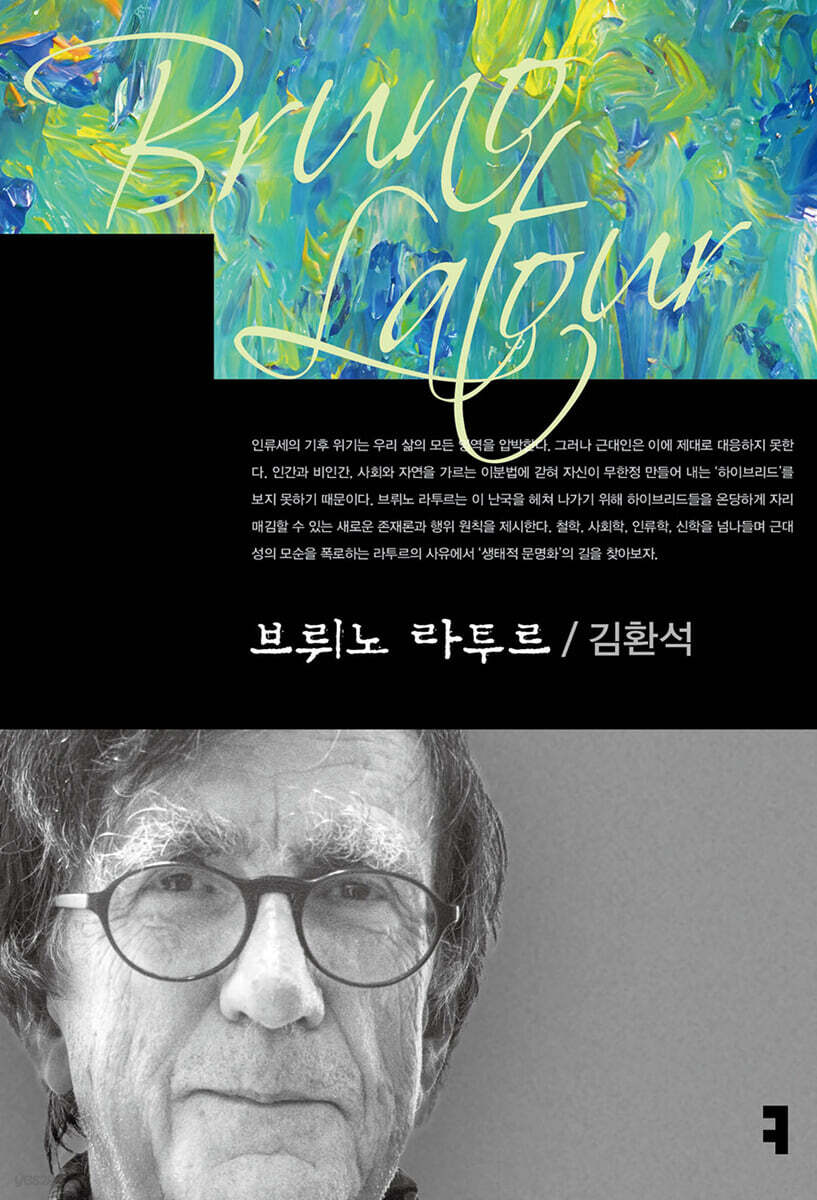
Bruno Latour
 |
Description
Book Introduction
Bruno Latour is a hybrid scholar who crosses the fields of philosophy, sociology, anthropology, and theology.
He studied science and technology and established the 'actor-network theory', which states that the world is made up of numerous combinations of humans and non-human beings.
Applying this insight to sociology, he explored various 'modes of existence' in modern times and unraveled the contradictions of the dichotomies of nature/society and non-human/human.
He reinterpreted the Gaia theory to establish a new political ecology and proposed a 'geopolitical theology' that would revolutionize religion to suit the modern era.
This book examines Latour's thought, which marked a turning point in contemporary scholarship, through ten key words.
We can discover ways to appropriately address the climate crisis of the Anthropocene.
He studied science and technology and established the 'actor-network theory', which states that the world is made up of numerous combinations of humans and non-human beings.
Applying this insight to sociology, he explored various 'modes of existence' in modern times and unraveled the contradictions of the dichotomies of nature/society and non-human/human.
He reinterpreted the Gaia theory to establish a new political ecology and proposed a 'geopolitical theology' that would revolutionize religion to suit the modern era.
This book examines Latour's thought, which marked a turning point in contemporary scholarship, through ten key words.
We can discover ways to appropriately address the climate crisis of the Anthropocene.
- You can preview some of the book's contents.
Preview
index
A hybrid scholar who suggested a path to a post-anthropocentric civilization.
01 Non-reduction
02 Actor-Network
03 Modern Constitution
04 Cosmopolitics
05 Sociology of Union
06 Anthropology of Being
07 Gaia Political Ecology
08 Production vs. Creation
09 Ecosystem level
10 Geopolitical Theology
01 Non-reduction
02 Actor-Network
03 Modern Constitution
04 Cosmopolitics
05 Sociology of Union
06 Anthropology of Being
07 Gaia Political Ecology
08 Production vs. Creation
09 Ecosystem level
10 Geopolitical Theology
Into the book
Latour exposes the contradictions inherent in Western modernism and argues that it has led to the infinite proliferation of scientific and technological products ('hybrids'), ultimately resulting in today's ecological crisis.
Furthermore, to resolve this crisis, he proposed that rather than believing in the dichotomous ontology of non-human/human and nature/society as in modernism, while in reality endlessly creating hybrids, it is necessary to establish a new ontology and principles of action that can properly position hybrids, and called this 'non-modernism'.
--- From "Hybrid Scholars Who Suggested a Path to a De-anthropocentric Civilization"
According to Latour's ontology, things do not have a lasting identity.
Rather, things are assemblages that remain together only to the extent that their various parts remain together by the forces they exert on each other.
A closer look at this seemingly radical view reveals that it has a level of intuitiveness equivalent to that of the traditional 'substantialist' view.
Consider, for example, important and defining relationships that can profoundly change us, such as friendship, love, or experiencing a traumatic event like kidnapping.
Is it reasonable to say that a person before entering a relationship is the same person as the person after entering that relationship?
--- From "01 Non-reduction"
Contrary to what the term 'cosmos' suggests, we don't need to look up at a starry sky or think about the entire universe.
We should look down, not up.
The 'cosmos' that Latour's philosophy speaks of is a collection of ordinary aggregates.
Cosmos represents the one Earth that humans share with other humans and non-human beings.
The concept of cosmos implies that we must acknowledge that there are more beings on Earth than we previously thought, and that non-humans, as well as humans, have diverse interests that must be politically considered.
--- From "Cosmopolitics"
Latour envisions the Anthropocene as a moment of opportunity for global humanity to reclaim a political form connected to the inherent and pluralistic conditions of existence on Earth.
Only a religion that is sensitive to the spaces in which actors inhabit and the historical conditions in which they operate can facilitate this transition.
This is the form of 'global' religion that Latour ultimately seeks to explore.
The theology that follows is not a transcendence to “another world,” but a geopolitical theology that leads us to “this very world understood in a fundamentally new way.”
Furthermore, to resolve this crisis, he proposed that rather than believing in the dichotomous ontology of non-human/human and nature/society as in modernism, while in reality endlessly creating hybrids, it is necessary to establish a new ontology and principles of action that can properly position hybrids, and called this 'non-modernism'.
--- From "Hybrid Scholars Who Suggested a Path to a De-anthropocentric Civilization"
According to Latour's ontology, things do not have a lasting identity.
Rather, things are assemblages that remain together only to the extent that their various parts remain together by the forces they exert on each other.
A closer look at this seemingly radical view reveals that it has a level of intuitiveness equivalent to that of the traditional 'substantialist' view.
Consider, for example, important and defining relationships that can profoundly change us, such as friendship, love, or experiencing a traumatic event like kidnapping.
Is it reasonable to say that a person before entering a relationship is the same person as the person after entering that relationship?
--- From "01 Non-reduction"
Contrary to what the term 'cosmos' suggests, we don't need to look up at a starry sky or think about the entire universe.
We should look down, not up.
The 'cosmos' that Latour's philosophy speaks of is a collection of ordinary aggregates.
Cosmos represents the one Earth that humans share with other humans and non-human beings.
The concept of cosmos implies that we must acknowledge that there are more beings on Earth than we previously thought, and that non-humans, as well as humans, have diverse interests that must be politically considered.
--- From "Cosmopolitics"
Latour envisions the Anthropocene as a moment of opportunity for global humanity to reclaim a political form connected to the inherent and pluralistic conditions of existence on Earth.
Only a religion that is sensitive to the spaces in which actors inhabit and the historical conditions in which they operate can facilitate this transition.
This is the form of 'global' religion that Latour ultimately seeks to explore.
The theology that follows is not a transcendence to “another world,” but a geopolitical theology that leads us to “this very world understood in a fundamentally new way.”
--- From "10 Earth Political Theologies"
Publisher's Review
Latour Gives Voice to the World's 'Mongrels'
A hybrid scholar who has insight into the entanglement of humans and non-humans
In the Anthropocene, climate is no longer 'outside' us.
Human activity is changing the climate, and the Earth's violent reaction to it permeates every aspect of life.
But the established modern institutions have so far failed to adequately address this crisis.
This is because we strictly distinguish between humans and non-humans, society and nature, and do not acknowledge the 'hybridization' between them that we constantly create.
Bruno Latour argues that to overcome the ecological crisis of the Anthropocene, we must confront the entanglement between humans and non-humans.
He argues that we must move toward an 'ecological civilization' by proposing new ontology and principles of action that can properly position hybrids.
The starting point of Latour's thought is science and technology studies.
Through long-term, meticulous observation of laboratories, we illuminated the role of non-humans in the production of scientific knowledge.
Through this anthropological study, Latour discovered that the world is made up of numerous combinations of humans and non-human beings, and this insight led to the Actor-Network Theory (ANT).
Furthermore, by applying ANT to sociology, he exposed the fiction of the existing category of the “social,” and by reinterpreting the Gaia theory proposed in natural science, he advocated a new political ecology.
Based on this, Latour broadly encompasses the various ‘modes of existence’ that constitute modernity, including science, technology, law, religion, and politics.
This book examines Latour's thought, which has been actively cited in various fields and has had a huge impact on contemporary scholarship, through ten keywords.
We can examine in detail the principle of 'irreduction' that underlies all works, what kind of political project 'cosmopolitics' is, and what insights 'geopolitical theology' provides us.
We can understand the true reality of this world, made up of countless networks, and find ways to achieve a post-anthropocentric civilization.
Bruno Latour (1947-2022)
He is a French scholar who has led interdisciplinary research on science and technology, crossing over philosophy, anthropology, and sociology.
The 'actor-network theory' he represents originated from science and technology studies, but today has a great influence across the humanities and social sciences.
In particular, 『We Have Never Been Modern』(1991/1993) and 『Exploration of Modes of Being』(2012/2013) received much attention for presenting a new theory of modernity.
Later in his life, he focused on research on the climate crisis of the Anthropocene, publishing political ecology books that reinterpret the Gaia theory, such as Facing Gaia (2015/2017), Coming Down to Earth (2017/2018), and The Emergence of the Ecological Class (2022).
He has also connected his studies to art exhibitions and theatrical performances, and has won the Nam June Paik International Art Award (2010), the Holmberg Prize (2013), and the Kyoto Prize (2021).
A hybrid scholar who has insight into the entanglement of humans and non-humans
In the Anthropocene, climate is no longer 'outside' us.
Human activity is changing the climate, and the Earth's violent reaction to it permeates every aspect of life.
But the established modern institutions have so far failed to adequately address this crisis.
This is because we strictly distinguish between humans and non-humans, society and nature, and do not acknowledge the 'hybridization' between them that we constantly create.
Bruno Latour argues that to overcome the ecological crisis of the Anthropocene, we must confront the entanglement between humans and non-humans.
He argues that we must move toward an 'ecological civilization' by proposing new ontology and principles of action that can properly position hybrids.
The starting point of Latour's thought is science and technology studies.
Through long-term, meticulous observation of laboratories, we illuminated the role of non-humans in the production of scientific knowledge.
Through this anthropological study, Latour discovered that the world is made up of numerous combinations of humans and non-human beings, and this insight led to the Actor-Network Theory (ANT).
Furthermore, by applying ANT to sociology, he exposed the fiction of the existing category of the “social,” and by reinterpreting the Gaia theory proposed in natural science, he advocated a new political ecology.
Based on this, Latour broadly encompasses the various ‘modes of existence’ that constitute modernity, including science, technology, law, religion, and politics.
This book examines Latour's thought, which has been actively cited in various fields and has had a huge impact on contemporary scholarship, through ten keywords.
We can examine in detail the principle of 'irreduction' that underlies all works, what kind of political project 'cosmopolitics' is, and what insights 'geopolitical theology' provides us.
We can understand the true reality of this world, made up of countless networks, and find ways to achieve a post-anthropocentric civilization.
Bruno Latour (1947-2022)
He is a French scholar who has led interdisciplinary research on science and technology, crossing over philosophy, anthropology, and sociology.
The 'actor-network theory' he represents originated from science and technology studies, but today has a great influence across the humanities and social sciences.
In particular, 『We Have Never Been Modern』(1991/1993) and 『Exploration of Modes of Being』(2012/2013) received much attention for presenting a new theory of modernity.
Later in his life, he focused on research on the climate crisis of the Anthropocene, publishing political ecology books that reinterpret the Gaia theory, such as Facing Gaia (2015/2017), Coming Down to Earth (2017/2018), and The Emergence of the Ecological Class (2022).
He has also connected his studies to art exhibitions and theatrical performances, and has won the Nam June Paik International Art Award (2010), the Holmberg Prize (2013), and the Kyoto Prize (2021).
GOODS SPECIFICS
- Date of issue: June 28, 2024
- Page count, weight, size: 180 pages | 128*188*10mm
- ISBN13: 9791128893339
- ISBN10: 1128893339
You may also like
카테고리
korean


korean

![ELLE 엘르 스페셜 에디션 A형 : 12월 [2025]](http://librairie.coreenne.fr/cdn/shop/files/b8e27a3de6c9538896439686c6b0e8fb.jpg?v=1766436872&width=3840)


