

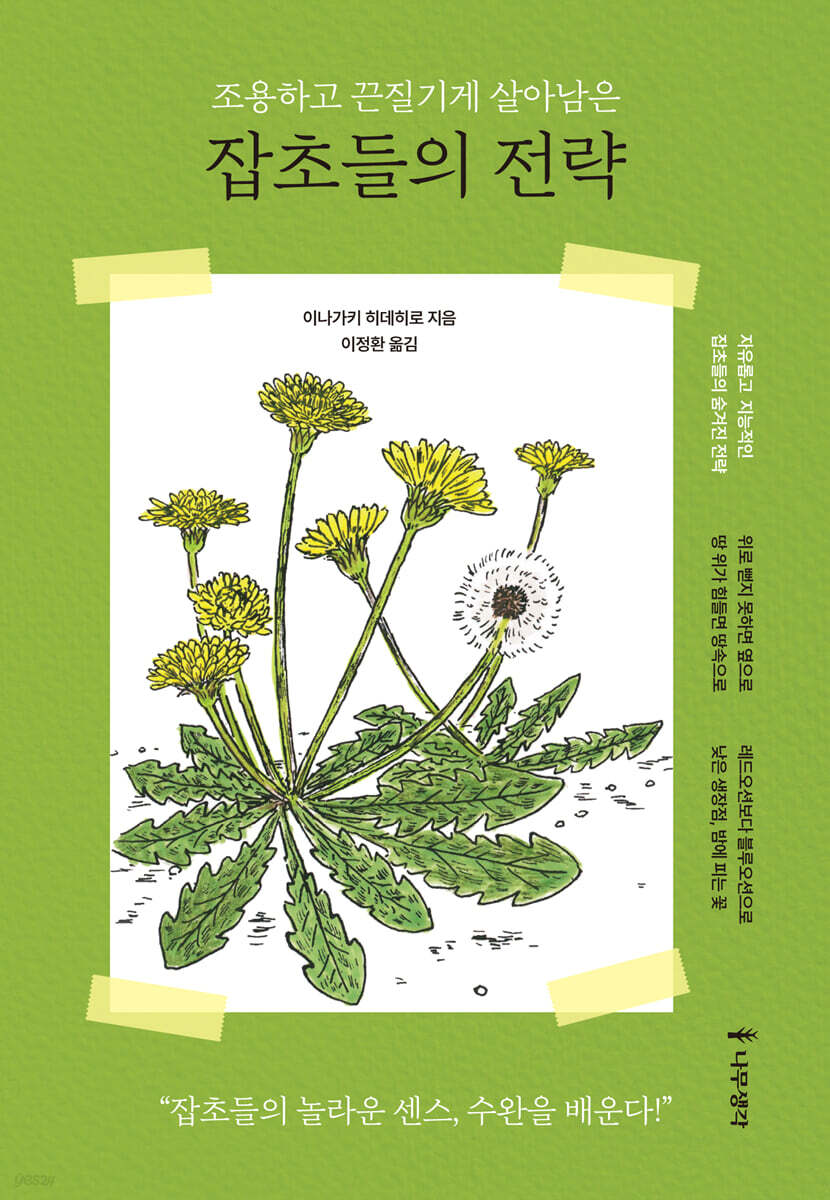
The strategy of weeds that survive quietly and tenaciously
 |
Description
Book Introduction
Turning unpredictable circumstances into opportunities
To continue life
challenging and struggling
Intelligent Strategies of Weeds
If you can't go up, go sideways!
If it's hard above ground, go underground!
From red ocean to blue ocean!
Behold the dignity of the weeds that survived the fierce competition for survival!
Even if it's not a quiet country road, there are green plants that easily catch your eye as soon as you open the door and leave the house.
There are flowers that bloom according to the season, and trees that become more lush in the summer, but there are also plants that bloom and shine green in the corners of buildings and cracks in the asphalt: weeds.
People often use the word weed to describe useless things.
But who exactly sets the standard for usefulness? Isn't it simply based on lack of utility for humans? Weeds aren't a single plant species, as we think of them, nor are they simply grasses that grow easily and haphazardly.
The 'weed' is the proud survivor of a fierce competition for survival.
The only goal of all living things is survival.
It is to survive and spread offspring so as not to become extinct.
Weeds are the creatures most true to their instincts.
Someone said that no matter how much you step on a weed, it will rise again.
But even weeds do not rise when stepped on.
There is only one reason.
Because it is an unnecessary action for survival.
Weeds are very smart plants that strategically adapt to their environment as much as possible.
To continue life
challenging and struggling
Intelligent Strategies of Weeds
If you can't go up, go sideways!
If it's hard above ground, go underground!
From red ocean to blue ocean!
Behold the dignity of the weeds that survived the fierce competition for survival!
Even if it's not a quiet country road, there are green plants that easily catch your eye as soon as you open the door and leave the house.
There are flowers that bloom according to the season, and trees that become more lush in the summer, but there are also plants that bloom and shine green in the corners of buildings and cracks in the asphalt: weeds.
People often use the word weed to describe useless things.
But who exactly sets the standard for usefulness? Isn't it simply based on lack of utility for humans? Weeds aren't a single plant species, as we think of them, nor are they simply grasses that grow easily and haphazardly.
The 'weed' is the proud survivor of a fierce competition for survival.
The only goal of all living things is survival.
It is to survive and spread offspring so as not to become extinct.
Weeds are the creatures most true to their instincts.
Someone said that no matter how much you step on a weed, it will rise again.
But even weeds do not rise when stepped on.
There is only one reason.
Because it is an unnecessary action for survival.
Weeds are very smart plants that strategically adapt to their environment as much as possible.
- You can preview some of the book's contents.
Preview
index
Weeds that turn the impossible into opportunity
Chapter 1 Every Weed Has Its Own Way of Surviving: The Secret of the Silent Struggle for Survival
Adapting resiliently to unpredictable changes? Barangi
Taking your own path, not the usual one? It's a quick fix.
Is there a trick to surviving a fall to the ground? Baby Ground Bumblebee
Blooming even in asphalt crevices? Ants
Taking the insect world's strongest ant as a bodyguard?
Column / Lowering your stance is a fundamental defensive skill.
Chapter 2: Luring with Sweet Honey and Beautiful Flowers: A Win-Win Strategy
Select only profitable partners? Clown's vine
Using the other person's flaws to your advantage? Western God
Surviving the toughest moments of competition? Dandelion
Never give up on a choice you have? Chicken gizzard shad
Surviving through diversity? The dandelion
Is it necessary to practice the right thing at the right time? Gomari
There's a reason why evening primroses bloom on dark nights.
Column / There's a reason for everything we take for granted.
Chapter 3: Setting Goals and Constantly Challenging Them: A Germination Strategy for Overcoming Unstable Environments
Turning adversity into opportunity?
In a foreign land, do you use helpers? Violet
Taking a break is also a strategy?
When the opportunity arises, they quickly sprout all at once?
The most important thing is the timing of sprouting? Dokkomari
Column / The Little Challenge of Fluffy Seeds
Chapter 4: Always One Step Ahead to Avoid Elimination: Evolutionary Strategies for Survival in Any Environment
What survives most similar to rice? Gangpi
Growing where competition has disappeared due to grass cutting? New Poa Grass
Move to a new location and become the master of the wetlands? Reeds
Traces of evolution hidden in simple forms? Reeds
Column / Growing Freshly Even Under the Hot Sun
Chapter 5: Adapting Flexibly to Changing Environments: A Response Strategy That Doesn't Fear Change
Freely changing to suit the environment?
Simple and old system, but strong?
A victory won't last long alone? Yang Mi-yeok-chwi
It's not easy to live as a parasite, is it?
Don't create unnecessary individuality? Poribangi
After finishing, the survival strategy is as free and dramatic as the number of weeds.
Chapter 1 Every Weed Has Its Own Way of Surviving: The Secret of the Silent Struggle for Survival
Adapting resiliently to unpredictable changes? Barangi
Taking your own path, not the usual one? It's a quick fix.
Is there a trick to surviving a fall to the ground? Baby Ground Bumblebee
Blooming even in asphalt crevices? Ants
Taking the insect world's strongest ant as a bodyguard?
Column / Lowering your stance is a fundamental defensive skill.
Chapter 2: Luring with Sweet Honey and Beautiful Flowers: A Win-Win Strategy
Select only profitable partners? Clown's vine
Using the other person's flaws to your advantage? Western God
Surviving the toughest moments of competition? Dandelion
Never give up on a choice you have? Chicken gizzard shad
Surviving through diversity? The dandelion
Is it necessary to practice the right thing at the right time? Gomari
There's a reason why evening primroses bloom on dark nights.
Column / There's a reason for everything we take for granted.
Chapter 3: Setting Goals and Constantly Challenging Them: A Germination Strategy for Overcoming Unstable Environments
Turning adversity into opportunity?
In a foreign land, do you use helpers? Violet
Taking a break is also a strategy?
When the opportunity arises, they quickly sprout all at once?
The most important thing is the timing of sprouting? Dokkomari
Column / The Little Challenge of Fluffy Seeds
Chapter 4: Always One Step Ahead to Avoid Elimination: Evolutionary Strategies for Survival in Any Environment
What survives most similar to rice? Gangpi
Growing where competition has disappeared due to grass cutting? New Poa Grass
Move to a new location and become the master of the wetlands? Reeds
Traces of evolution hidden in simple forms? Reeds
Column / Growing Freshly Even Under the Hot Sun
Chapter 5: Adapting Flexibly to Changing Environments: A Response Strategy That Doesn't Fear Change
Freely changing to suit the environment?
Simple and old system, but strong?
A victory won't last long alone? Yang Mi-yeok-chwi
It's not easy to live as a parasite, is it?
Don't create unnecessary individuality? Poribangi
After finishing, the survival strategy is as free and dramatic as the number of weeds.
Into the book
This is true for plants as a whole, but weeds, which are excellent at responding to unpredictable changes, also have their own resilience.
Even if it is cultivated or cut down, it survives and proliferates, and is a very resilient weed that can withstand changes.
The king crabapple tree, which can withstand being trampled, has outstanding tenacity.
Also, in environments where weeds live, where there is little stress or change, it is important to be resilient enough to outperform the competition.
If you look closely at weeds, you will see that there are many different types depending on the environment.
Weeds have the image of growing anywhere, but in reality, they live in places where they can demonstrate their individual strengths.
--- p.19
Weeds have the image of 'rising again no matter how much they are stepped on.'
Because of that image, some people emphasize 'effort' by saying, "You have to do your best with a weed-like spirit" and "You have to persevere like a weed."
But the actual appearance of the weed is different.
In fact, even a weed cannot rise if it is stepped on.
I don't know about once, but if you keep stepping on it a few times, you won't be able to get up.
The true nature of weeds is that they cannot get up when stepped on.
You might be disappointed by this appearance.
It is embarrassing to even bring up the spirit of weeds like this.
But in fact, this is the resilience of weeds.
--- p.25
People often think of ants as insignificant creatures, but in fact, ants are arguably the most powerful creatures in the insect kingdom.
When ants attack in groups, no insect can withstand them.
Such ants indiscriminately chase away any insects that approach their food storage, resulting in no pests existing near the burrows.
The ants were hired as bodyguards by the ants, using sweet honey as bait.
--- p.39
The flowers of the clown plant bloom sideways, with the upper petals covering the flowers.
And the lower petals have a round pattern drawn on them.
This pattern is a test. This pattern is a sign that says, “Come here.”
If you go this way, the bee can enter the flower that is blooming sideways.
Flies and others who do not understand this meaning sit on top of the flowers of the clown plant.
And after searching for the entrance to the flower, he eventually gives up and leaves.
The mere fact that it 'pins sideways' excludes other insects.
--- p.53
Plantains are commonly found in places where people can easily step on them.
When the seeds of the plantain get wet from rain, they produce mucus and stick to the ground.
And when a person walks over it, the seeds are transferred to the soles of their shoes and stick to them.
Just as dandelion seeds are carried by the wind, plantain seeds are carried by people.
The places where seeds stuck to shoes fall while moving are also places where people can easily step on them.
In this way, the plantains are distributed along the paths that people walk.
Even if it is cultivated or cut down, it survives and proliferates, and is a very resilient weed that can withstand changes.
The king crabapple tree, which can withstand being trampled, has outstanding tenacity.
Also, in environments where weeds live, where there is little stress or change, it is important to be resilient enough to outperform the competition.
If you look closely at weeds, you will see that there are many different types depending on the environment.
Weeds have the image of growing anywhere, but in reality, they live in places where they can demonstrate their individual strengths.
--- p.19
Weeds have the image of 'rising again no matter how much they are stepped on.'
Because of that image, some people emphasize 'effort' by saying, "You have to do your best with a weed-like spirit" and "You have to persevere like a weed."
But the actual appearance of the weed is different.
In fact, even a weed cannot rise if it is stepped on.
I don't know about once, but if you keep stepping on it a few times, you won't be able to get up.
The true nature of weeds is that they cannot get up when stepped on.
You might be disappointed by this appearance.
It is embarrassing to even bring up the spirit of weeds like this.
But in fact, this is the resilience of weeds.
--- p.25
People often think of ants as insignificant creatures, but in fact, ants are arguably the most powerful creatures in the insect kingdom.
When ants attack in groups, no insect can withstand them.
Such ants indiscriminately chase away any insects that approach their food storage, resulting in no pests existing near the burrows.
The ants were hired as bodyguards by the ants, using sweet honey as bait.
--- p.39
The flowers of the clown plant bloom sideways, with the upper petals covering the flowers.
And the lower petals have a round pattern drawn on them.
This pattern is a test. This pattern is a sign that says, “Come here.”
If you go this way, the bee can enter the flower that is blooming sideways.
Flies and others who do not understand this meaning sit on top of the flowers of the clown plant.
And after searching for the entrance to the flower, he eventually gives up and leaves.
The mere fact that it 'pins sideways' excludes other insects.
--- p.53
Plantains are commonly found in places where people can easily step on them.
When the seeds of the plantain get wet from rain, they produce mucus and stick to the ground.
And when a person walks over it, the seeds are transferred to the soles of their shoes and stick to them.
Just as dandelion seeds are carried by the wind, plantain seeds are carried by people.
The places where seeds stuck to shoes fall while moving are also places where people can easily step on them.
In this way, the plantains are distributed along the paths that people walk.
--- p.103
Publisher's Review
If you can't change it, adapt to it.
Hidehiro Inagaki is a representative Japanese botanist.
The effort and time he put into studying plants is already widely known.
He describes weeds as mystical plants.
Weeds survive not only in their natural environment but also in any environment created by humans, such as roadsides, parks, and fields.
It is not a natural phenomenon that living things survive without being destroyed.
Hidehiro Inagaki took note of the vitality of such weeds.
And we discovered that the environments in which weeds live have something in common.
The point is that 'unpredictable changes occur'.
The place where weeds live is a place where you never know when they will be stepped on or pulled out.
One day, suddenly, weed killers may be sprayed on you, or you may be cut down by a machine.
From a human perspective, it would be difficult to survive in such an unsafe and unpredictable environment.
But weeds actually enjoy such harsh environments.
No, rather, they go one step further and survive brilliantly by making the most of that environment.
The 'unpredictable change' was a golden opportunity for the weeds.
Modern society is, in fact, an 'era where the future is invisible.'
It is an era of unpredictable change, where we cannot know what will happen.
The reality of not knowing what will happen is unsettling to anyone.
And people are anxious about change.
But weeds are actually turning such unpredictable changes into opportunities and succeeding.
Important survival tips we must learn
Weeds may seem like plants that can be found everywhere, but that's not actually the case.
In fact, weeds live in confident locations that suit their respective strategies.
For example, in places that are frequently stepped on, weeds that are confident of being stepped on grow.
And through the process of being stepped on, the purpose of reproduction is achieved.
Also, in places where grass is cut, weeds that are confident in the grass are grown.
It achieves its goal of spreading its seeds by being cut down.
And if you can't stretch up, you grow by lying down and stretching out.
There are even smart ways to use helpers when you can't do it alone.
That is, weeds exist with as many different strategies as there are weeds.
In his book, Hidehiro Inagaki lists the fierce survival strategies of common weeds.
And through that strategy, we will learn important survival tips one by one.
By the time you close the book, you'll be asking yourself if weeds are really useless grass.
No, rather, you will wonder if there is another strategist who can devise a strategy as wise as a weed.
After reading this book, your perspective on the weeds growing around you will undoubtedly change.
And you may come to realize that the unpredictable future you vaguely felt anxious about is actually a 'future that guarantees success.'
That's because unpredictable changes can be opportunities to grasp.
Hidehiro Inagaki is a representative Japanese botanist.
The effort and time he put into studying plants is already widely known.
He describes weeds as mystical plants.
Weeds survive not only in their natural environment but also in any environment created by humans, such as roadsides, parks, and fields.
It is not a natural phenomenon that living things survive without being destroyed.
Hidehiro Inagaki took note of the vitality of such weeds.
And we discovered that the environments in which weeds live have something in common.
The point is that 'unpredictable changes occur'.
The place where weeds live is a place where you never know when they will be stepped on or pulled out.
One day, suddenly, weed killers may be sprayed on you, or you may be cut down by a machine.
From a human perspective, it would be difficult to survive in such an unsafe and unpredictable environment.
But weeds actually enjoy such harsh environments.
No, rather, they go one step further and survive brilliantly by making the most of that environment.
The 'unpredictable change' was a golden opportunity for the weeds.
Modern society is, in fact, an 'era where the future is invisible.'
It is an era of unpredictable change, where we cannot know what will happen.
The reality of not knowing what will happen is unsettling to anyone.
And people are anxious about change.
But weeds are actually turning such unpredictable changes into opportunities and succeeding.
Important survival tips we must learn
Weeds may seem like plants that can be found everywhere, but that's not actually the case.
In fact, weeds live in confident locations that suit their respective strategies.
For example, in places that are frequently stepped on, weeds that are confident of being stepped on grow.
And through the process of being stepped on, the purpose of reproduction is achieved.
Also, in places where grass is cut, weeds that are confident in the grass are grown.
It achieves its goal of spreading its seeds by being cut down.
And if you can't stretch up, you grow by lying down and stretching out.
There are even smart ways to use helpers when you can't do it alone.
That is, weeds exist with as many different strategies as there are weeds.
In his book, Hidehiro Inagaki lists the fierce survival strategies of common weeds.
And through that strategy, we will learn important survival tips one by one.
By the time you close the book, you'll be asking yourself if weeds are really useless grass.
No, rather, you will wonder if there is another strategist who can devise a strategy as wise as a weed.
After reading this book, your perspective on the weeds growing around you will undoubtedly change.
And you may come to realize that the unpredictable future you vaguely felt anxious about is actually a 'future that guarantees success.'
That's because unpredictable changes can be opportunities to grasp.
GOODS SPECIFICS
- Date of issue: July 10, 2024
- Page count, weight, size: 208 pages | 135*195mm
- ISBN13: 9791162182963
- ISBN10: 1162182962
You may also like
카테고리
korean


korean

![ELLE 엘르 스페셜 에디션 A형 : 12월 [2025]](http://librairie.coreenne.fr/cdn/shop/files/b8e27a3de6c9538896439686c6b0e8fb.jpg?v=1766436872&width=3840)


