

Song Ki-won's study of life
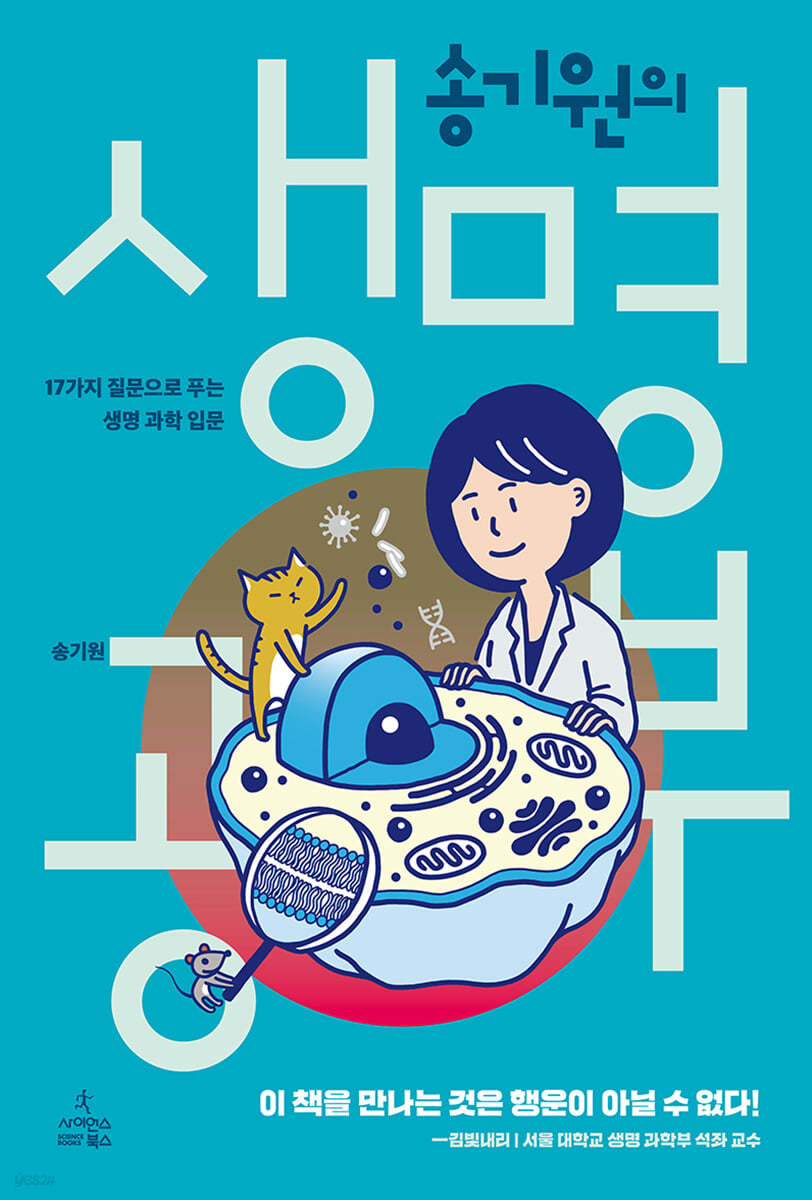 |
Description
Book Introduction
In the era of post-genomic and bio-revolution,
17 questions that penetrate the core of life science!
It must be a stroke of luck to come across this book!
Kim Bit-naeri (Director, Institute for Basic Science, Professor Emeritus, Department of Life Sciences, Seoul National University)
The best companion for studying life in our time
- Jeoncheol (Dean of Hanshin University Graduate School of Theology)
Life sciences have been developing at a very rapid pace over the past decade.
The CRISPR-Cas9 gene scissors technology that enabled gene editing developed a treatment for sickle cell anemia, a genetic disease that has long plagued humanity, and research on immunotherapies using mRNA led to the development of a vaccine for COVID-19, which has caused panic around the world.
Modern life science encompasses fundamental sciences like physics and chemistry, as well as information technology and artificial intelligence. It is making remarkable progress as a convergent discipline that is shaking up our society and civilization in all directions, from academia to industry, politics, and economics.
As our knowledge and capabilities grow, the scientific mystery surrounding life deepens, and its ethical, philosophical, religious, and legal implications become more profound.
This time, 『Song Ki-won's Study of Life: Introduction to Life Sciences with 17 Questions』, published by Science Books Co., Ltd., is a textbook and guidebook that starts from the most fundamental questions of life sciences and gradually examines the topics of thought.
Professor Song Ki-won of the Department of Biochemistry at the College of Life Systems at Yonsei University, who has been intensely contemplating life science and its social implications in Korea, fully embodies the meaning of life science that he has been exploring throughout his life.
In his previous work, 『Song Ki-won's Post-Genome Era』 (Science Books, 2018), Professor Song Ki-won argued that human civilization has already moved beyond the genomic era of reading life information and into the post-genomic era of editing and recreating life forms.
This book takes a step back from the forefront of modern biology and reflects on the fundamentals of one's own study.
From very basic questions that anyone who has studied life sciences would have thought of at least once, such as “What is life?” or “How did life begin?”, to ethical and philosophical questions such as “How does life define me and others?” or “What ethical questions does life science raise?”, this book introduces various aspects of life sciences by raising 17 of the oldest yet always new questions.
This book, which compiles the core of the popular liberal arts course "What is Life Science?" that has been taught to students in the humanities and social sciences at Yonsei University for over 20 years, will provide a comprehensive overview of modern life science, which is evolving to the next stage through the spread of CRISPR-Cas9 gene scissors technology and the coronavirus pandemic.
17 questions that penetrate the core of life science!
It must be a stroke of luck to come across this book!
Kim Bit-naeri (Director, Institute for Basic Science, Professor Emeritus, Department of Life Sciences, Seoul National University)
The best companion for studying life in our time
- Jeoncheol (Dean of Hanshin University Graduate School of Theology)
Life sciences have been developing at a very rapid pace over the past decade.
The CRISPR-Cas9 gene scissors technology that enabled gene editing developed a treatment for sickle cell anemia, a genetic disease that has long plagued humanity, and research on immunotherapies using mRNA led to the development of a vaccine for COVID-19, which has caused panic around the world.
Modern life science encompasses fundamental sciences like physics and chemistry, as well as information technology and artificial intelligence. It is making remarkable progress as a convergent discipline that is shaking up our society and civilization in all directions, from academia to industry, politics, and economics.
As our knowledge and capabilities grow, the scientific mystery surrounding life deepens, and its ethical, philosophical, religious, and legal implications become more profound.
This time, 『Song Ki-won's Study of Life: Introduction to Life Sciences with 17 Questions』, published by Science Books Co., Ltd., is a textbook and guidebook that starts from the most fundamental questions of life sciences and gradually examines the topics of thought.
Professor Song Ki-won of the Department of Biochemistry at the College of Life Systems at Yonsei University, who has been intensely contemplating life science and its social implications in Korea, fully embodies the meaning of life science that he has been exploring throughout his life.
In his previous work, 『Song Ki-won's Post-Genome Era』 (Science Books, 2018), Professor Song Ki-won argued that human civilization has already moved beyond the genomic era of reading life information and into the post-genomic era of editing and recreating life forms.
This book takes a step back from the forefront of modern biology and reflects on the fundamentals of one's own study.
From very basic questions that anyone who has studied life sciences would have thought of at least once, such as “What is life?” or “How did life begin?”, to ethical and philosophical questions such as “How does life define me and others?” or “What ethical questions does life science raise?”, this book introduces various aspects of life sciences by raising 17 of the oldest yet always new questions.
This book, which compiles the core of the popular liberal arts course "What is Life Science?" that has been taught to students in the humanities and social sciences at Yonsei University for over 20 years, will provide a comprehensive overview of modern life science, which is evolving to the next stage through the spread of CRISPR-Cas9 gene scissors technology and the coronavirus pandemic.
- You can preview some of the book's contents.
Preview
index
Publishing a new book 5
Preface: Why This Book? 13
Chapter 1: What is Life?: The Essence of Life 27
Chapter 2: How Did Life Begin?: The Origin of Life 39
Chapter 3: What Is Life Made of?: The Composition of Life 57
Chapter 4: What is the functional unit of life?: Units of Life 81
Chapter 5: How Does Life's Information Work?: Life's Information 99
Chapter 6: Decoding Genetic Information and What Does It Mean?: Decoding Life Information 125
Chapter 7: What Does the Transformation of Life by Humans Mean?: Transformation and Synthesis of Life 149
Chapter 8: Are There Boundaries to the Proofreading and Editing of Living Things?: Proofreading and Editing of Life 167
Chapter 9: How Life Makes Life Again: The Reproduction of Life 189
Chapter 10: How Life Forms from a Single Cell: The Origin and Differentiation of Life 207
Chapter 11: What is Human Control of Reproduction?: Implications of Reproductive Technology 229
Chapter 12: Why Do Living Things Age?: Life and Aging 245
Chapter 13: Are Microbes and Viruses Objects of Fear?: Life and Infection 269
Chapter 14: How Does Life Perceive and Transmit Stimuli?: Life and Response 295
Chapter 15: How Does Life Define Me and Others?: Life and Identity 321
Chapter 16: How Does Life Maintain an Optimal State in Response to Environmental Changes?: Life and Homeostasis 337
Chapter 17: What Ethical Questions Does Life Science Raise?: Life and Ethics 351
Later Zhou 366
Search 373
Preface: Why This Book? 13
Chapter 1: What is Life?: The Essence of Life 27
Chapter 2: How Did Life Begin?: The Origin of Life 39
Chapter 3: What Is Life Made of?: The Composition of Life 57
Chapter 4: What is the functional unit of life?: Units of Life 81
Chapter 5: How Does Life's Information Work?: Life's Information 99
Chapter 6: Decoding Genetic Information and What Does It Mean?: Decoding Life Information 125
Chapter 7: What Does the Transformation of Life by Humans Mean?: Transformation and Synthesis of Life 149
Chapter 8: Are There Boundaries to the Proofreading and Editing of Living Things?: Proofreading and Editing of Life 167
Chapter 9: How Life Makes Life Again: The Reproduction of Life 189
Chapter 10: How Life Forms from a Single Cell: The Origin and Differentiation of Life 207
Chapter 11: What is Human Control of Reproduction?: Implications of Reproductive Technology 229
Chapter 12: Why Do Living Things Age?: Life and Aging 245
Chapter 13: Are Microbes and Viruses Objects of Fear?: Life and Infection 269
Chapter 14: How Does Life Perceive and Transmit Stimuli?: Life and Response 295
Chapter 15: How Does Life Define Me and Others?: Life and Identity 321
Chapter 16: How Does Life Maintain an Optimal State in Response to Environmental Changes?: Life and Homeostasis 337
Chapter 17: What Ethical Questions Does Life Science Raise?: Life and Ethics 351
Later Zhou 366
Search 373
Detailed image
.jpg)
Publisher's Review
For all questions about life
In search of answers
The Age of Life Sciences: The Ultimate Convergence Textbook
―Jang Dae-ik (Professor Emeritus, College of Entrepreneurship, Gachon University)
I hope that listening to the author's voice will open our minds to a more desirable future.
―Kang Geum-sil (former Minister of Justice)
It is not difficult to get everyone to agree that many life science technologies, such as human genome information, designer babies, gene scissors, stem cells, synthetic biology, neurotransmission modulators, and organ transplants, are being used to prevent and treat diseases.
The difficulty with life science technology and the related ethical issues lies in the difficulty in distinguishing between diseases that require prevention and treatment and enhancements that simply increase the capabilities of living organisms.
The study of life sciences ultimately raises the question of what it means to be human.
The question is what makes humans human as living beings.
If we lived long, healthy lives, and all possessed beauty, would we become more human? After all, aren't humans inherently flawed and imperfect? Through "Song Gi-won's Study of Life," which accepts humans as a species subject to birth, aging, illness, and death, and encourages us to share the wisdom to survive alongside other life forms in the ecosystem, we can rediscover our humanity.
In search of answers
The Age of Life Sciences: The Ultimate Convergence Textbook
―Jang Dae-ik (Professor Emeritus, College of Entrepreneurship, Gachon University)
I hope that listening to the author's voice will open our minds to a more desirable future.
―Kang Geum-sil (former Minister of Justice)
It is not difficult to get everyone to agree that many life science technologies, such as human genome information, designer babies, gene scissors, stem cells, synthetic biology, neurotransmission modulators, and organ transplants, are being used to prevent and treat diseases.
The difficulty with life science technology and the related ethical issues lies in the difficulty in distinguishing between diseases that require prevention and treatment and enhancements that simply increase the capabilities of living organisms.
The study of life sciences ultimately raises the question of what it means to be human.
The question is what makes humans human as living beings.
If we lived long, healthy lives, and all possessed beauty, would we become more human? After all, aren't humans inherently flawed and imperfect? Through "Song Gi-won's Study of Life," which accepts humans as a species subject to birth, aging, illness, and death, and encourages us to share the wisdom to survive alongside other life forms in the ecosystem, we can rediscover our humanity.
GOODS SPECIFICS
- Date of issue: April 30, 2024
- Format: Hardcover book binding method guide
- Page count, weight, size: 384 pages | 786g | 148*220*25mm
- ISBN13: 9791192908083
- ISBN10: 1192908082
You may also like
카테고리
korean


korean

![GQ KOREA Mark (Monthly): December [2025]](http://librairie.coreenne.fr/cdn/shop/files/8ef265dbbfbf186523ed75ba7319009d.jpg?v=1765340328&width=3840)


