

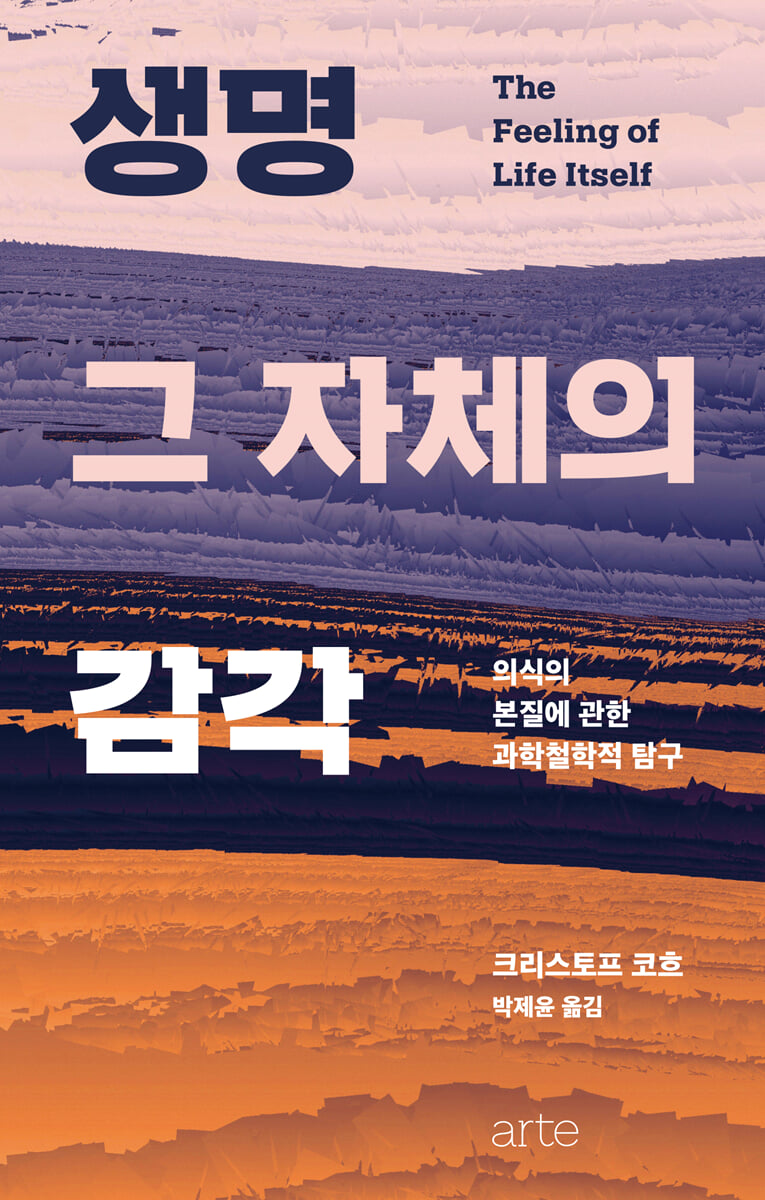
The sense of life itself
 |
Description
Book Introduction
Leading the paradigm shift in consciousness science
The cutting edge of consciousness research revealed by a world-renowned neuroscientist.
“If you’re curious about what’s happening at the forefront of consciousness, open this book!” ― Jaeseung Jeong
"It was completely piercing" - Nature
"Open science makes the difficult problem of consciousness very accessible!" ― Science
Christoph Koch, a world-renowned neuroscientist who heads the Allen Institute for Brain Science in the United States, has published a book titled “The Feeling of Life Itself: Why Consciousness Is Widespread but Can't Be Computed,” which contains scientific philosophical reflections on the “origin and nature of consciousness.”
Arte recently (September 2023) introduced Koch's theories and research papers, which have become the center of controversy in the neuroscience community, to Korea under the title "The Sense of Life Itself" (Philos Series No. 26).
As the original title suggests, this book explores the sensation of life itself, and discusses why consciousness is widespread within 'living things' (including mammals, invertebrates, single-celled microorganisms, bacteria, and plants), yet cannot be computed.
Koch explains this reason with the concept of “intrinsic causal powers.”
Additionally, we study whether 'artificial intelligence' possesses 'artificial consciousness', that is, whether digital organisms can simulate causal powers themselves.
As a leading expert in neural cell modeling research, the author has been studying 'consciousness' for over 30 years, combining neuroscience trends and philosophy.
He is a pioneer who established 'consciousness', which had been an object of philosophy, as a field of scientific inquiry, and is an important figure who led a major paradigm shift in the history of consciousness science with the discovery of the neural correlates of consciousness (NCC).
Koch has once again proposed an unprecedented radical innovation (integrated information theory) through this book, putting him at the center of recent controversy.
The two major scientific journals, Nature and Science, introduced Koch's theory as the most influential theory of consciousness at present, saying, "It's completely piercing!" and "It's the leading and 'validated' theory of consciousness that explains consciousness." However, in September 2023, Stephen Fleming and 124 other academic researchers claimed that Koch's theory was 'pseudoscience.'
The critique is that Koch's theory ["Even single-celled microorganisms have consciousness because their maximum integrated information (causal power) is not zero"] is too new and can directly or indirectly influence the ethical judgments of individuals and society regarding animal and organoid experiments, abortion, etc., and is therefore 'pseudo-science'.
Translator Park Je-yoon, an expert who has studied the philosophy of science for a long time, comments, “It is not persuasive to claim that something is pseudoscience [just because it has not been fully verified, just because it is a new paradigm].”
Philip Goff (Professor of Philosophy, Durham University) also defended Koch, saying, “Given the special nature of the field of consciousness science, it is to be expected that methodological aspects will inevitably meet, and that radical innovation is inevitable in this field.”
Neuroscientist Anil Seth also called it “a very compelling argument, based on deep research into [conscious] experience.
He praised it as “a book full of scientific insight!”
In Korea, Professor Jeong Jae-seung mentioned his academic relationship with Koch in his recommendation, saying, “If you are curious about what is happening at the forefront of consciousness, be sure to open this book.”
Christoph Koch also sets out his mission to develop a "perfect consciousness meter," suggesting an intriguing possibility that could also offer clues to clinical practitioners.
Professor Kim Young-bo (Department of Neurosurgery, Gachon University College of Medicine) commented, “This is an important book that anyone studying consciousness must read.”
If you want to delve into the most influential theory of consciousness in neuroscience today, a groundbreaking philosophy, and a thoughtful yet ambitious scientific mission, this is the book for you.
Koch's argument will serve as another major turning point and a new paradigm that will determine the future direction of consciousness theory.
The cutting edge of consciousness research revealed by a world-renowned neuroscientist.
“If you’re curious about what’s happening at the forefront of consciousness, open this book!” ― Jaeseung Jeong
"It was completely piercing" - Nature
"Open science makes the difficult problem of consciousness very accessible!" ― Science
Christoph Koch, a world-renowned neuroscientist who heads the Allen Institute for Brain Science in the United States, has published a book titled “The Feeling of Life Itself: Why Consciousness Is Widespread but Can't Be Computed,” which contains scientific philosophical reflections on the “origin and nature of consciousness.”
Arte recently (September 2023) introduced Koch's theories and research papers, which have become the center of controversy in the neuroscience community, to Korea under the title "The Sense of Life Itself" (Philos Series No. 26).
As the original title suggests, this book explores the sensation of life itself, and discusses why consciousness is widespread within 'living things' (including mammals, invertebrates, single-celled microorganisms, bacteria, and plants), yet cannot be computed.
Koch explains this reason with the concept of “intrinsic causal powers.”
Additionally, we study whether 'artificial intelligence' possesses 'artificial consciousness', that is, whether digital organisms can simulate causal powers themselves.
As a leading expert in neural cell modeling research, the author has been studying 'consciousness' for over 30 years, combining neuroscience trends and philosophy.
He is a pioneer who established 'consciousness', which had been an object of philosophy, as a field of scientific inquiry, and is an important figure who led a major paradigm shift in the history of consciousness science with the discovery of the neural correlates of consciousness (NCC).
Koch has once again proposed an unprecedented radical innovation (integrated information theory) through this book, putting him at the center of recent controversy.
The two major scientific journals, Nature and Science, introduced Koch's theory as the most influential theory of consciousness at present, saying, "It's completely piercing!" and "It's the leading and 'validated' theory of consciousness that explains consciousness." However, in September 2023, Stephen Fleming and 124 other academic researchers claimed that Koch's theory was 'pseudoscience.'
The critique is that Koch's theory ["Even single-celled microorganisms have consciousness because their maximum integrated information (causal power) is not zero"] is too new and can directly or indirectly influence the ethical judgments of individuals and society regarding animal and organoid experiments, abortion, etc., and is therefore 'pseudo-science'.
Translator Park Je-yoon, an expert who has studied the philosophy of science for a long time, comments, “It is not persuasive to claim that something is pseudoscience [just because it has not been fully verified, just because it is a new paradigm].”
Philip Goff (Professor of Philosophy, Durham University) also defended Koch, saying, “Given the special nature of the field of consciousness science, it is to be expected that methodological aspects will inevitably meet, and that radical innovation is inevitable in this field.”
Neuroscientist Anil Seth also called it “a very compelling argument, based on deep research into [conscious] experience.
He praised it as “a book full of scientific insight!”
In Korea, Professor Jeong Jae-seung mentioned his academic relationship with Koch in his recommendation, saying, “If you are curious about what is happening at the forefront of consciousness, be sure to open this book.”
Christoph Koch also sets out his mission to develop a "perfect consciousness meter," suggesting an intriguing possibility that could also offer clues to clinical practitioners.
Professor Kim Young-bo (Department of Neurosurgery, Gachon University College of Medicine) commented, “This is an important book that anyone studying consciousness must read.”
If you want to delve into the most influential theory of consciousness in neuroscience today, a groundbreaking philosophy, and a thoughtful yet ambitious scientific mission, this is the book for you.
Koch's argument will serve as another major turning point and a new paradigm that will determine the future direction of consciousness theory.
- You can preview some of the book's contents.
Preview
index
Recommendation
Introduction | Return of Consciousness
Chapter 1 | What is consciousness?
Chapter 2 | Who is conscious?
Chapter 3 | Animal Consciousness
Chapter 4 | Consciousness and the Rest
Chapter 5 | Consciousness and the Brain
Chapter 6 | Following the Footsteps of Consciousness
Chapter 7 | Why We Need a Theory of Consciousness
Chapter 8 | About the Complete
Chapter 9 | Tools for Measuring Consciousness
Chapter 10 | Transcendental Mind and Pure Consciousness
Chapter 11 | Does consciousness have a function?
Chapter 12 | Consciousness and Computationalism
Chapter 13 | Why Computers Can't Have Experience
Chapter 14 | Is Consciousness Everywhere?
Conclusion | Why This Matters
Acknowledgements
annotation
References
Translator's Note
Search
Introduction | Return of Consciousness
Chapter 1 | What is consciousness?
Chapter 2 | Who is conscious?
Chapter 3 | Animal Consciousness
Chapter 4 | Consciousness and the Rest
Chapter 5 | Consciousness and the Brain
Chapter 6 | Following the Footsteps of Consciousness
Chapter 7 | Why We Need a Theory of Consciousness
Chapter 8 | About the Complete
Chapter 9 | Tools for Measuring Consciousness
Chapter 10 | Transcendental Mind and Pure Consciousness
Chapter 11 | Does consciousness have a function?
Chapter 12 | Consciousness and Computationalism
Chapter 13 | Why Computers Can't Have Experience
Chapter 14 | Is Consciousness Everywhere?
Conclusion | Why This Matters
Acknowledgements
annotation
References
Translator's Note
Search
Into the book
According to integrated information theory, nothing could be further from the truth.
Experience does not arise from calculation.
Even if Silicon Valley's intellectual digerati had a near-religious faith, there would be no "Soul 2.0" running in the cloud.
A properly programmed algorithm could recognize images, play Go, talk to us, and drive a car, but it would never be conscious.
Even a perfect software model of the human brain would experience nothing.
--- p.
17
This is the third book I have written on the subject of experience.
Published in 2005, Exploring Consciousness: A Neurobiological Approach grew out of many years of teaching while surveying the vast psychological and neurological literature on subjective experience.
Based on this, I published “Consciousness: The Origin and Nature of Consciousness Explored at the Forefront of Modern Science” in 2012.
This book covers scientific progress and discoveries over time, while also mixing in autobiographical stories.
This book, The Sense of Life Itself, avoids such distractions.
All the reader needs to know is that I am one of seven billion random trades from the human deck of possibilities.
--- p.
19
I wake up every day in a world full of conscious experiences.
As a rational being, I try to explain the nature of this bright, luminous feeling, who feels it and who doesn't, how it arises in physics and in my body, and whether or not an engineered system could have it.
Just because defining consciousness objectively is more difficult than defining electrons, genes, or black holes, doesn't mean we should abandon the quest for a science of consciousness.
I'm just saying let's try harder.
--- p.
32
In the late 1980s, as a young assistant professor at the California Institute of Technology in Southern California, I met with Francis Crick monthly.
I was thrilled to find a comrade with whom I could discuss endlessly 'how the brain can create consciousness.'
Crick was a physical chemist who, along with James Watson, discovered the double helix structure of DNA, the molecule of heredity.
In 1976, at the age of 60, Crick's interests shifted from molecular biology to neurobiology, and he left the Old World for the New World in La Jolla, California.
Despite our forty-year age difference, Creek and I developed a close priestly relationship.
We have worked closely together for 16 years, co-authoring twenty-four scientific papers and essays.
Our cooperation continued until the day he passed away--- p.
109
This theoretical edifice is the unique intellectual creation of Giulio Tononi, a brilliant and sometimes mystical polyglot and multidisciplinary Renaissance scholar, first-rate scientist and physicist.
Giulio is the living embodiment of the Magister Ludi from Hermann Hesse's novel The Glass Bead Game (Das Glasperlenspiel), the leader of a strict order of monk-intellectuals dedicated to teaching and playing the eponymous game, a game that creates near-infinite patterns that are a synthesis of all arts and sciences.
--- p.
154
According to Integrated Information Theory (IIT), consciousness is determined by the causal properties of a physical system that operates on its own.
In other words, consciousness is a fundamental property of a mechanism that 'has causal power in itself'.
Intrinsic causal power is the extent to which the current state of an electronic circuit or neural network causally constrains its past and future states.
--- p.
163
The elements of a complete body in any state, singly or in combination, constitute primary and higher-order mechanisms that specify distinction.
All these mechanisms are linked together to form a structure, which we define as a maximally irreducible cause-effect structure.
For the set of all irreducible first- and higher-order mechanisms and their superpositions, the complexity of such structures in real circuits is astonishing, as the spider web in Figure 8.1 gives an idea of.
This theory has a surprisingly accurate answer to the question of what consciousness is and its central identity.
Experience is identical to the maximally irreducible cause-effect structure that supports the system of conscious states.
--- p.
177
I will examine and investigate the situation across the broad horizon of time to see who has an inherent existence and who does not.
Not because they can do bigger or smaller things, but because they have an inherent perspective.
Because they exist on their own.
--- p.
300
Considering the behavioral, physiological, anatomical, developmental, and genetic similarities between Homo sapiens and other mammals, there is no reason to doubt that all mammals experience the sounds and sights, the pains and pleasures of life, although not as richly as humans.
All mammals struggle to eat and drink, to reproduce, and to avoid injury and death.
They also bask in the warm sunlight, seek out their kind, fear predators, sleep, and dream.
Mammalian consciousness relies on a functioning six-layer neocortex, but this does not imply that animals without a neocortex cannot feel anything.
In other words, given the similarities in the structure, dynamics, and genetic makeup of the nervous systems of all tetrapods—mammals, amphibians, birds (especially crows, magpies, and parrots), and reptiles—I am led to infer that they, too, experience the world.
Similar inferences can be made about other creatures with backbones, such as fish.
--- p.
306
According to IIT, it seems like it might feel something like bacteria.
It's unlikely that it's upset about its own pear-shaped body, and no one is studying the psychology of microbes (i.e., no one is likely to assume they have minds?).
But a small spark of experience may arise (i.e., it may be recognized as having experience and may become a subject of study? Translator's note).
This spark will disappear when the bacteria dissolve into their constituent organelles.
Moving from biology to the simpler world of chemistry and physics, let's calculate the intrinsic causal forces of things like protein molecules, atomic nuclei, or single protons.
According to the Standard Model of physics, protons and neutrons are made of three quarks with fractional electrical charge.
Quarks themselves are not observed.
Thus, atoms can constitute an irreducible whole, a small part of the “considered” matter.
Compared to the approximately 1,026 atoms that make up the human brain, what does that atom feel? Considering its integrated information is just over zero, just a minute's bagatelle, a this-rather-than-not-this? --- p.
310
The mind does not suddenly appear in the body.
As Leibniz put it, natura non facit saltus (nature does not jump), nature does not make sudden leaps (Leibniz was the co-founder of infinitesimal calculus).
The absence of such discontinuities is also fundamental to Darwinian thought.
The inherent causal power makes the question of how mind emerges from matter unnecessary. IIT stipulates that it is always there.
--- p.
312
One might think that IIT extends physics to consciousness, the central fact of our lives.
Textbook physics deals with the interactions between objects as governed by external causal forces.
Your and my experiences are the way the brain feels internally, with its irreducible, inherent causal power.
IIT provides a principled, consistent, testable, and elegant account of the relationship between two seemingly disparate realms of existence, namely body and mind, based on extrinsic and intrinsic causal forces.
Two different kinds of causal forces are the only kinds needed to explain everything in the universe.
These forces constitute ultimate reality.
Experience does not arise from calculation.
Even if Silicon Valley's intellectual digerati had a near-religious faith, there would be no "Soul 2.0" running in the cloud.
A properly programmed algorithm could recognize images, play Go, talk to us, and drive a car, but it would never be conscious.
Even a perfect software model of the human brain would experience nothing.
--- p.
17
This is the third book I have written on the subject of experience.
Published in 2005, Exploring Consciousness: A Neurobiological Approach grew out of many years of teaching while surveying the vast psychological and neurological literature on subjective experience.
Based on this, I published “Consciousness: The Origin and Nature of Consciousness Explored at the Forefront of Modern Science” in 2012.
This book covers scientific progress and discoveries over time, while also mixing in autobiographical stories.
This book, The Sense of Life Itself, avoids such distractions.
All the reader needs to know is that I am one of seven billion random trades from the human deck of possibilities.
--- p.
19
I wake up every day in a world full of conscious experiences.
As a rational being, I try to explain the nature of this bright, luminous feeling, who feels it and who doesn't, how it arises in physics and in my body, and whether or not an engineered system could have it.
Just because defining consciousness objectively is more difficult than defining electrons, genes, or black holes, doesn't mean we should abandon the quest for a science of consciousness.
I'm just saying let's try harder.
--- p.
32
In the late 1980s, as a young assistant professor at the California Institute of Technology in Southern California, I met with Francis Crick monthly.
I was thrilled to find a comrade with whom I could discuss endlessly 'how the brain can create consciousness.'
Crick was a physical chemist who, along with James Watson, discovered the double helix structure of DNA, the molecule of heredity.
In 1976, at the age of 60, Crick's interests shifted from molecular biology to neurobiology, and he left the Old World for the New World in La Jolla, California.
Despite our forty-year age difference, Creek and I developed a close priestly relationship.
We have worked closely together for 16 years, co-authoring twenty-four scientific papers and essays.
Our cooperation continued until the day he passed away--- p.
109
This theoretical edifice is the unique intellectual creation of Giulio Tononi, a brilliant and sometimes mystical polyglot and multidisciplinary Renaissance scholar, first-rate scientist and physicist.
Giulio is the living embodiment of the Magister Ludi from Hermann Hesse's novel The Glass Bead Game (Das Glasperlenspiel), the leader of a strict order of monk-intellectuals dedicated to teaching and playing the eponymous game, a game that creates near-infinite patterns that are a synthesis of all arts and sciences.
--- p.
154
According to Integrated Information Theory (IIT), consciousness is determined by the causal properties of a physical system that operates on its own.
In other words, consciousness is a fundamental property of a mechanism that 'has causal power in itself'.
Intrinsic causal power is the extent to which the current state of an electronic circuit or neural network causally constrains its past and future states.
--- p.
163
The elements of a complete body in any state, singly or in combination, constitute primary and higher-order mechanisms that specify distinction.
All these mechanisms are linked together to form a structure, which we define as a maximally irreducible cause-effect structure.
For the set of all irreducible first- and higher-order mechanisms and their superpositions, the complexity of such structures in real circuits is astonishing, as the spider web in Figure 8.1 gives an idea of.
This theory has a surprisingly accurate answer to the question of what consciousness is and its central identity.
Experience is identical to the maximally irreducible cause-effect structure that supports the system of conscious states.
--- p.
177
I will examine and investigate the situation across the broad horizon of time to see who has an inherent existence and who does not.
Not because they can do bigger or smaller things, but because they have an inherent perspective.
Because they exist on their own.
--- p.
300
Considering the behavioral, physiological, anatomical, developmental, and genetic similarities between Homo sapiens and other mammals, there is no reason to doubt that all mammals experience the sounds and sights, the pains and pleasures of life, although not as richly as humans.
All mammals struggle to eat and drink, to reproduce, and to avoid injury and death.
They also bask in the warm sunlight, seek out their kind, fear predators, sleep, and dream.
Mammalian consciousness relies on a functioning six-layer neocortex, but this does not imply that animals without a neocortex cannot feel anything.
In other words, given the similarities in the structure, dynamics, and genetic makeup of the nervous systems of all tetrapods—mammals, amphibians, birds (especially crows, magpies, and parrots), and reptiles—I am led to infer that they, too, experience the world.
Similar inferences can be made about other creatures with backbones, such as fish.
--- p.
306
According to IIT, it seems like it might feel something like bacteria.
It's unlikely that it's upset about its own pear-shaped body, and no one is studying the psychology of microbes (i.e., no one is likely to assume they have minds?).
But a small spark of experience may arise (i.e., it may be recognized as having experience and may become a subject of study? Translator's note).
This spark will disappear when the bacteria dissolve into their constituent organelles.
Moving from biology to the simpler world of chemistry and physics, let's calculate the intrinsic causal forces of things like protein molecules, atomic nuclei, or single protons.
According to the Standard Model of physics, protons and neutrons are made of three quarks with fractional electrical charge.
Quarks themselves are not observed.
Thus, atoms can constitute an irreducible whole, a small part of the “considered” matter.
Compared to the approximately 1,026 atoms that make up the human brain, what does that atom feel? Considering its integrated information is just over zero, just a minute's bagatelle, a this-rather-than-not-this? --- p.
310
The mind does not suddenly appear in the body.
As Leibniz put it, natura non facit saltus (nature does not jump), nature does not make sudden leaps (Leibniz was the co-founder of infinitesimal calculus).
The absence of such discontinuities is also fundamental to Darwinian thought.
The inherent causal power makes the question of how mind emerges from matter unnecessary. IIT stipulates that it is always there.
--- p.
312
One might think that IIT extends physics to consciousness, the central fact of our lives.
Textbook physics deals with the interactions between objects as governed by external causal forces.
Your and my experiences are the way the brain feels internally, with its irreducible, inherent causal power.
IIT provides a principled, consistent, testable, and elegant account of the relationship between two seemingly disparate realms of existence, namely body and mind, based on extrinsic and intrinsic causal forces.
Two different kinds of causal forces are the only kinds needed to explain everything in the universe.
These forces constitute ultimate reality.
--- p.
322
322
Publisher's Review
A book that boldly expands the horizons of science!
The most influential theory in the current 'theory of consciousness',
Speaking of Integrated Information Theory (IIT)
“Christoph Koch, who has presented some of the most controversial hypotheses about the origins of consciousness, addresses the question of consciousness more deeply than his previous works.
In this book, readers can comprehensively view the various theories of consciousness that have emerged in the world over the past 20 years and read his own interpretation.
Above all, the virtue of this book is that it most persuasively describes what the 'integrated information theory' he proposed is.” ― Jaeseung Jeong
The two most prominent hypotheses explaining consciousness in neuroscience today are:
Integrated Information Theory (IIT), which is based on panpsychism but embraces and quantifies it to overcome its limitations, and Global Neuronal Workspace Theory (GNWT), which attempts a functionalist explanation of consciousness based on a computational perspective.
Koch criticizes GNWT for its complete lack of interest in the 'causal powers [properties]' of the fundamental system (within living organisms), and for pointing out that 'purely computational explanations' have fatal limitations.
Furthermore, empirical studies have shown that the brain region involved in conscious states is the 'posterior cortical hot zone' claimed by IIT, not the 'prefrontal cortex' claimed by GNWT.
The author cites numerous cases in the book where people retain conscious experience even when the prefrontal cortex is damaged or even removed.
Thus, Koch argues that IIT is currently the most influential and persuasive theory in the theory of consciousness.
Research supporting the author's claims is also in full swing.
Since 2019, cognitive neuroscience researchers have been conducting pioneering experiments to validate these two leading theories of consciousness, exploring what they call an "antagonistic cooperative relationship" to determine which theory holds the most promise for uncovering the mechanisms of consciousness.
This study (Testing Hypotheses by Adversarial Collaboration) mainly tests the following three hypotheses.
① Which brain regions are involved in the state of consciousness? ② How is conscious perception maintained? ③ What is the connectivity between cortical regions during perception?
The predictions for ① and ② are leaning towards IIT dominance, and the prediction for ③ is inconclusive.
As such, the current neuroscience community and the two major scientific journals, Nature and Science, accept IIT as a 'verified' theory as a strong theory of consciousness, but it is also controversial as it is a very innovative theory that influences the ethical judgments of individuals and society.
But the emergence of a new paradigm always begins with discussions that seem impossible to imagine.
In The Sense of Life Itself, Koch defends and strengthens this theory, taking numerous critical perspectives into account, and develops a 'very sophisticated theoretical account' of consciousness.
Additionally, the philosophical approach, which refers to the 20-year intellectual landscape in the neurobiology of consciousness, also serves as a major axis of this discussion.
As the translator points out, in a word, this book is “a philosophical and scientific book on the theory of consciousness.”
In this book, Koch integrates and condenses the various components of the theoretical explanations presented in his previous works on consciousness, 『Consciousness』 and 『Explorations of Consciousness』, and presents a fundamental theory of the 'nature of consciousness'.
As Professor Jeong Jae-seung notes, the virtue of this book is that it delves deeper into the question of consciousness than previous works, and that it “provides the most persuasive account of what integrated information theory is.”
Consciousness is about 'being'
The challenge of defining consciousness as 'experience'!
- What evokes the 'experience' of life?
- Does artificial intelligence imply artificial 'consciousness'?
“The Sense of Life Itself” is a book that answers the question, “What is consciousness?” with “The Sense of Life Itself.”
In other words, we see consciousness as the totality of our experiences [feelings] and the totality of our senses in life.
This process of consciousness is explained neuroscientifically, and the relationship between experience and cerebral cortex activity (activation) is experimentally proven, and the 'integrated information theory' is presented as the key to solving the mystery of consciousness.
It shares the broad framework of the problem presented by panpsychism, but goes beyond the limitations of panpsychism and shows that the neural mechanism of consciousness is ‘quantitative’, ‘consistent’, and ‘provable’ through experiments.
How does the brain generate subjective "experience"? What are the undeniable properties (axioms, postulates) of "experience"? Koch states, "Every feeling I use is an experience," and, contrary to the conventional wisdom that regards experience as a higher-order category than feeling, defines experience and feeling as equivalent.
In other words, we focus on ‘experience’ and conduct and analyze various thought experiments and research.
He argues for the validity of 'integrated information theory', a quantitative theory that starts from 'experience' and moves to 'brain', by mentioning perception-response tests, optical illusion and illusion experiments, zombie actors, split-brain and brain-wiring experiments, the case of Terry Schiavo, who was in a vegetative state for 15 years, examples of people with consciousness disorders or living without parts of the brain, the Leibniz Mill thought experiment, and in silico evolutionary games.
This view of Koch's is very challenging, and it is also a special and solid foundation for supporting the theory of consciousness.
As the translator mentioned in the translator's note at the end, examples of mentioning the legitimacy of a theory through 'axiomatic systematization' are rare these days, but Koch explains that he attempted 'axiomatic systematization' to show how meticulous the integrated information theory is, just like Newton's 'Mathematical Principles of Natural Philosophy'.
How does the brain generate subjective (conscious) experiences?
What is experience?
- All animals 'experience' the spectacle of life.
- No program model can have 'experience'.
[Conscious] experience has five undeniable properties.
First, experience essentially “exists in itself” without an observer (the immanent existence postulate).
Second, any experience is “structured.”
The sensory aspects, including hearing, smell, feeling and emotion, are intricately interwoven.
The structure of this experience has a physical basis in synapses, neurons, and brain activation (constitutive postulate).
Third, any experience is highly informative and rich in “specific content” (information postulate).
Fourth, the experience is integrative.
Although we can describe an experience by breaking it down into its components, the actual experience is experienced as “the whole, including my body” (integration postulate).
Fifth, any experience is “limited in content and time and space.”
What happens outside of me is excluded from my experience (exclusion postulate).
In this way, the five postulates of experience serve as the foundation that enables integrated information theory.
This leads them to infer that all animals experience the sights and sounds of life, and, contrary to conventional wisdom, argues that no program model can have true experience and consciousness.
Even a perfect software model of the brain claims that there is no consciousness.
The author questions, “Why aren’t astrophysicists simulating black holes sucked into supercomputers?”
If their models are so faithful to reality, one might ask, why doesn't spacetime close around the computer they're modeling, and why don't black holes form?
That is because ‘existence’ is not a calculation.
Through the integrated information theory, Koch makes it clear that consciousness is a 'realm of nature' and that consciousness is about 'existence'.
“A computer treated as a mechanism has subtle inherent cause-and-effect forces at the level of metal, at the level of transistors, capacitors, wires, etc.
However, computers do not exist as a whole, but only as small pieces.
And this is equally true whether you are simulating a black hole or a brain.” (p. 292)
Analyzing and quantifying consciousness
mathematical model
Integrated information theory proposes a 'mathematical model' for analyzing consciousness.
This ultimately explains why a physical system called the brain is involved in consciousness.
According to Koch's integrated information theory, the system's "consciousness" (what it is subjectively) is correlated with the system's "causal power" (what it is objectively).
Therefore, it is possible to explain the conscious experience of a physical system by unfolding the full “causal powers [properties]” of the physical system.
This can also be seen this way.
“If you have causal power, even if it is weak, you have consciousness.” “If you replicate causal power, consciousness follows.”
Integrated information theory is a quantitative, rigorous, consistent, and empirically testable theory that begins with experience and progresses to basic neural mechanisms, revealing that it can quantify (reduce) the degree to which a system [organism], whether simple or complex, is determined by its past state and thus its “intrinsic causal power”—that is, the extent to which its future can be influenced by its past state.
The greater the integrated information of a system [living thing], quantified by Φ (pi or phi), the higher the level of consciousness of that system.
In cases where there is no causal power in itself, such as in the case of a neural network that forms the basis of machine learning (in the case of a feedforward network structure), Φ is 0.
In other words, the maximum integrated information value is 0, so there is no consciousness.
Matthew Owen, a professor at the University of Michigan's Center for Consciousness Science, says:
“The greatest strength of integrated information theory is that it is a theoretical approach that makes its basic philosophical commitments ‘explicit.’
While we may disagree with specific commitments, it is undeniable that this approach is very useful for analyzing such commitments and their epistemic role.
Philosophers will undoubtedly debate the philosophical content of 『The Sense of Life Itself』.
But even the most ardent philosophical opponents must acknowledge that this content has a prominent and important role to play in the integrated information theory approach to the study of consciousness.
In this book, Koch makes clear the interdisciplinary nature of consciousness studies while simultaneously addressing a wide range of timeless and timely issues in an accessible manner.” (From a review of this book, “Conscious Matter and Matters of Conscience”)
A 'Philosophical Question' for All Wholes
A Scientific Mission to Develop the Perfect Consciousness Meter
As Matthew Owen has argued in his defense of Koch's theoretical orientation, this explicit commitment (approach) is a very powerful strength of the theory, but it has also been a point of criticism from philosophers as well as scientists.
However, it is regrettable to simply state that this is a limitation of the theorization (quantification) of panpsychism.
Rather, it can be seen as a paradigm shift that boldly expands the scientific horizon.
Koch called the 'physical mechanism of consciousness' the Whole (a concept expressed poetically with a capital W).
By focusing on the senses and 'experience' itself possessed by each living being, we finally reach panpsychism and overcome the limitations of panpsychism with a specific mathematical model theory (Chapter 11: Does consciousness have a function?, Chapter 12: Consciousness and computationalism, Chapter 13: Why computers cannot have experiences).
The process is philosophical and poetic, but also engineering and scientific.
The author says:
According to the integrated information theory, mammals, reptiles, amphibians, birds, and even invertebrates such as insects, octopuses, single-celled microorganisms, and bacteria are conscious.
Plants may also be conscious.
Therefore, the moral status of all subjects (living beings) must be accepted.
“How to cure the narcissism of humanity (human exceptionalism)?”
This question extends to the following aspiration:
“If only we could perfectly measure consciousness!” the author made a public bet with journalist Per Snafrud, confident that research on a perfect consciousness-measuring device would be completed by the end of 2028. (p. 204) Through clinical case studies of brain-damaged patients with impaired consciousness, Koch empathizes with their “despair of being cut off from the world” and advocates for the welfare of fish.
They argue that humans should be held accountable for the cruelty of catching fish with live, wriggling bait and then painfully suffocating them to death.
“Integrated information theory provides a precise answer to the question of who can experience.
Anything whose maximum integrated information value is not 0, anything that has intrinsic causal power, is a complete thing.
What that whole feels, that is, what experience is, is given by a maximally irreducible cause-effect structure.
It exists in itself, has an internal perspective, and is somewhat irreducible.
And that means that there are countless perfections.” (p. 308)
The Path Forward for Consciousness Science
How widespread is consciousness throughout the universe? According to integrated information theory, [conscious] experience could exist in all animals, large and small, bacteria, atoms, perhaps even plants and "inanimate objects," even in unexpected places.
The ethical context of integrated information theory allows us to recognize that humans are not at the center of the universe, nor is nature suited to human purposes.
In keeping with this, Christoph Koch, who cherishes all things, has deep affection for his pets, and lives a life of vegetarianism based on his beliefs after studying consciousness, is a well-mannered scientist who lives a life befitting his theories.
This book addresses the problem of consciousness by relying on the two theories pursued by the author, the Neural Correlates of Consciousness (NCC) and the Integrated Information Theory (IIT), but it is a book that raises rich questions that enhance the scientific understanding of consciousness based on these theories.
By meticulously covering interesting topics related to consciousness, such as the problem of consciousness and non-consciousness (p. 57), other related problems such as consciousness and attention (p. 88), quantum mechanics and consciousness (p. 143), consciousness and biology, especially the problem related to evolution (p. 237), and the relationship with panpsychism (p. 315), it reminds us of the fierce challenge of science that is not bound by limitations.
This will provide an important starting point for suggesting the path forward for consciousness science, a path that explores what consciousness is through reflective thinking.
The most influential theory in the current 'theory of consciousness',
Speaking of Integrated Information Theory (IIT)
“Christoph Koch, who has presented some of the most controversial hypotheses about the origins of consciousness, addresses the question of consciousness more deeply than his previous works.
In this book, readers can comprehensively view the various theories of consciousness that have emerged in the world over the past 20 years and read his own interpretation.
Above all, the virtue of this book is that it most persuasively describes what the 'integrated information theory' he proposed is.” ― Jaeseung Jeong
The two most prominent hypotheses explaining consciousness in neuroscience today are:
Integrated Information Theory (IIT), which is based on panpsychism but embraces and quantifies it to overcome its limitations, and Global Neuronal Workspace Theory (GNWT), which attempts a functionalist explanation of consciousness based on a computational perspective.
Koch criticizes GNWT for its complete lack of interest in the 'causal powers [properties]' of the fundamental system (within living organisms), and for pointing out that 'purely computational explanations' have fatal limitations.
Furthermore, empirical studies have shown that the brain region involved in conscious states is the 'posterior cortical hot zone' claimed by IIT, not the 'prefrontal cortex' claimed by GNWT.
The author cites numerous cases in the book where people retain conscious experience even when the prefrontal cortex is damaged or even removed.
Thus, Koch argues that IIT is currently the most influential and persuasive theory in the theory of consciousness.
Research supporting the author's claims is also in full swing.
Since 2019, cognitive neuroscience researchers have been conducting pioneering experiments to validate these two leading theories of consciousness, exploring what they call an "antagonistic cooperative relationship" to determine which theory holds the most promise for uncovering the mechanisms of consciousness.
This study (Testing Hypotheses by Adversarial Collaboration) mainly tests the following three hypotheses.
① Which brain regions are involved in the state of consciousness? ② How is conscious perception maintained? ③ What is the connectivity between cortical regions during perception?
The predictions for ① and ② are leaning towards IIT dominance, and the prediction for ③ is inconclusive.
As such, the current neuroscience community and the two major scientific journals, Nature and Science, accept IIT as a 'verified' theory as a strong theory of consciousness, but it is also controversial as it is a very innovative theory that influences the ethical judgments of individuals and society.
But the emergence of a new paradigm always begins with discussions that seem impossible to imagine.
In The Sense of Life Itself, Koch defends and strengthens this theory, taking numerous critical perspectives into account, and develops a 'very sophisticated theoretical account' of consciousness.
Additionally, the philosophical approach, which refers to the 20-year intellectual landscape in the neurobiology of consciousness, also serves as a major axis of this discussion.
As the translator points out, in a word, this book is “a philosophical and scientific book on the theory of consciousness.”
In this book, Koch integrates and condenses the various components of the theoretical explanations presented in his previous works on consciousness, 『Consciousness』 and 『Explorations of Consciousness』, and presents a fundamental theory of the 'nature of consciousness'.
As Professor Jeong Jae-seung notes, the virtue of this book is that it delves deeper into the question of consciousness than previous works, and that it “provides the most persuasive account of what integrated information theory is.”
Consciousness is about 'being'
The challenge of defining consciousness as 'experience'!
- What evokes the 'experience' of life?
- Does artificial intelligence imply artificial 'consciousness'?
“The Sense of Life Itself” is a book that answers the question, “What is consciousness?” with “The Sense of Life Itself.”
In other words, we see consciousness as the totality of our experiences [feelings] and the totality of our senses in life.
This process of consciousness is explained neuroscientifically, and the relationship between experience and cerebral cortex activity (activation) is experimentally proven, and the 'integrated information theory' is presented as the key to solving the mystery of consciousness.
It shares the broad framework of the problem presented by panpsychism, but goes beyond the limitations of panpsychism and shows that the neural mechanism of consciousness is ‘quantitative’, ‘consistent’, and ‘provable’ through experiments.
How does the brain generate subjective "experience"? What are the undeniable properties (axioms, postulates) of "experience"? Koch states, "Every feeling I use is an experience," and, contrary to the conventional wisdom that regards experience as a higher-order category than feeling, defines experience and feeling as equivalent.
In other words, we focus on ‘experience’ and conduct and analyze various thought experiments and research.
He argues for the validity of 'integrated information theory', a quantitative theory that starts from 'experience' and moves to 'brain', by mentioning perception-response tests, optical illusion and illusion experiments, zombie actors, split-brain and brain-wiring experiments, the case of Terry Schiavo, who was in a vegetative state for 15 years, examples of people with consciousness disorders or living without parts of the brain, the Leibniz Mill thought experiment, and in silico evolutionary games.
This view of Koch's is very challenging, and it is also a special and solid foundation for supporting the theory of consciousness.
As the translator mentioned in the translator's note at the end, examples of mentioning the legitimacy of a theory through 'axiomatic systematization' are rare these days, but Koch explains that he attempted 'axiomatic systematization' to show how meticulous the integrated information theory is, just like Newton's 'Mathematical Principles of Natural Philosophy'.
How does the brain generate subjective (conscious) experiences?
What is experience?
- All animals 'experience' the spectacle of life.
- No program model can have 'experience'.
[Conscious] experience has five undeniable properties.
First, experience essentially “exists in itself” without an observer (the immanent existence postulate).
Second, any experience is “structured.”
The sensory aspects, including hearing, smell, feeling and emotion, are intricately interwoven.
The structure of this experience has a physical basis in synapses, neurons, and brain activation (constitutive postulate).
Third, any experience is highly informative and rich in “specific content” (information postulate).
Fourth, the experience is integrative.
Although we can describe an experience by breaking it down into its components, the actual experience is experienced as “the whole, including my body” (integration postulate).
Fifth, any experience is “limited in content and time and space.”
What happens outside of me is excluded from my experience (exclusion postulate).
In this way, the five postulates of experience serve as the foundation that enables integrated information theory.
This leads them to infer that all animals experience the sights and sounds of life, and, contrary to conventional wisdom, argues that no program model can have true experience and consciousness.
Even a perfect software model of the brain claims that there is no consciousness.
The author questions, “Why aren’t astrophysicists simulating black holes sucked into supercomputers?”
If their models are so faithful to reality, one might ask, why doesn't spacetime close around the computer they're modeling, and why don't black holes form?
That is because ‘existence’ is not a calculation.
Through the integrated information theory, Koch makes it clear that consciousness is a 'realm of nature' and that consciousness is about 'existence'.
“A computer treated as a mechanism has subtle inherent cause-and-effect forces at the level of metal, at the level of transistors, capacitors, wires, etc.
However, computers do not exist as a whole, but only as small pieces.
And this is equally true whether you are simulating a black hole or a brain.” (p. 292)
Analyzing and quantifying consciousness
mathematical model
Integrated information theory proposes a 'mathematical model' for analyzing consciousness.
This ultimately explains why a physical system called the brain is involved in consciousness.
According to Koch's integrated information theory, the system's "consciousness" (what it is subjectively) is correlated with the system's "causal power" (what it is objectively).
Therefore, it is possible to explain the conscious experience of a physical system by unfolding the full “causal powers [properties]” of the physical system.
This can also be seen this way.
“If you have causal power, even if it is weak, you have consciousness.” “If you replicate causal power, consciousness follows.”
Integrated information theory is a quantitative, rigorous, consistent, and empirically testable theory that begins with experience and progresses to basic neural mechanisms, revealing that it can quantify (reduce) the degree to which a system [organism], whether simple or complex, is determined by its past state and thus its “intrinsic causal power”—that is, the extent to which its future can be influenced by its past state.
The greater the integrated information of a system [living thing], quantified by Φ (pi or phi), the higher the level of consciousness of that system.
In cases where there is no causal power in itself, such as in the case of a neural network that forms the basis of machine learning (in the case of a feedforward network structure), Φ is 0.
In other words, the maximum integrated information value is 0, so there is no consciousness.
Matthew Owen, a professor at the University of Michigan's Center for Consciousness Science, says:
“The greatest strength of integrated information theory is that it is a theoretical approach that makes its basic philosophical commitments ‘explicit.’
While we may disagree with specific commitments, it is undeniable that this approach is very useful for analyzing such commitments and their epistemic role.
Philosophers will undoubtedly debate the philosophical content of 『The Sense of Life Itself』.
But even the most ardent philosophical opponents must acknowledge that this content has a prominent and important role to play in the integrated information theory approach to the study of consciousness.
In this book, Koch makes clear the interdisciplinary nature of consciousness studies while simultaneously addressing a wide range of timeless and timely issues in an accessible manner.” (From a review of this book, “Conscious Matter and Matters of Conscience”)
A 'Philosophical Question' for All Wholes
A Scientific Mission to Develop the Perfect Consciousness Meter
As Matthew Owen has argued in his defense of Koch's theoretical orientation, this explicit commitment (approach) is a very powerful strength of the theory, but it has also been a point of criticism from philosophers as well as scientists.
However, it is regrettable to simply state that this is a limitation of the theorization (quantification) of panpsychism.
Rather, it can be seen as a paradigm shift that boldly expands the scientific horizon.
Koch called the 'physical mechanism of consciousness' the Whole (a concept expressed poetically with a capital W).
By focusing on the senses and 'experience' itself possessed by each living being, we finally reach panpsychism and overcome the limitations of panpsychism with a specific mathematical model theory (Chapter 11: Does consciousness have a function?, Chapter 12: Consciousness and computationalism, Chapter 13: Why computers cannot have experiences).
The process is philosophical and poetic, but also engineering and scientific.
The author says:
According to the integrated information theory, mammals, reptiles, amphibians, birds, and even invertebrates such as insects, octopuses, single-celled microorganisms, and bacteria are conscious.
Plants may also be conscious.
Therefore, the moral status of all subjects (living beings) must be accepted.
“How to cure the narcissism of humanity (human exceptionalism)?”
This question extends to the following aspiration:
“If only we could perfectly measure consciousness!” the author made a public bet with journalist Per Snafrud, confident that research on a perfect consciousness-measuring device would be completed by the end of 2028. (p. 204) Through clinical case studies of brain-damaged patients with impaired consciousness, Koch empathizes with their “despair of being cut off from the world” and advocates for the welfare of fish.
They argue that humans should be held accountable for the cruelty of catching fish with live, wriggling bait and then painfully suffocating them to death.
“Integrated information theory provides a precise answer to the question of who can experience.
Anything whose maximum integrated information value is not 0, anything that has intrinsic causal power, is a complete thing.
What that whole feels, that is, what experience is, is given by a maximally irreducible cause-effect structure.
It exists in itself, has an internal perspective, and is somewhat irreducible.
And that means that there are countless perfections.” (p. 308)
The Path Forward for Consciousness Science
How widespread is consciousness throughout the universe? According to integrated information theory, [conscious] experience could exist in all animals, large and small, bacteria, atoms, perhaps even plants and "inanimate objects," even in unexpected places.
The ethical context of integrated information theory allows us to recognize that humans are not at the center of the universe, nor is nature suited to human purposes.
In keeping with this, Christoph Koch, who cherishes all things, has deep affection for his pets, and lives a life of vegetarianism based on his beliefs after studying consciousness, is a well-mannered scientist who lives a life befitting his theories.
This book addresses the problem of consciousness by relying on the two theories pursued by the author, the Neural Correlates of Consciousness (NCC) and the Integrated Information Theory (IIT), but it is a book that raises rich questions that enhance the scientific understanding of consciousness based on these theories.
By meticulously covering interesting topics related to consciousness, such as the problem of consciousness and non-consciousness (p. 57), other related problems such as consciousness and attention (p. 88), quantum mechanics and consciousness (p. 143), consciousness and biology, especially the problem related to evolution (p. 237), and the relationship with panpsychism (p. 315), it reminds us of the fierce challenge of science that is not bound by limitations.
This will provide an important starting point for suggesting the path forward for consciousness science, a path that explores what consciousness is through reflective thinking.
GOODS SPECIFICS
- Date of issue: February 7, 2024
- Format: Hardcover book binding method guide
- Page count, weight, size: 432 pages | 605g | 135*218*30mm
- ISBN13: 9791171173846
- ISBN10: 1171173849
You may also like
카테고리
korean


korean

![ELLE 엘르 스페셜 에디션 A형 : 12월 [2025]](http://librairie.coreenne.fr/cdn/shop/files/b8e27a3de6c9538896439686c6b0e8fb.jpg?v=1766436872&width=3840)


