

Next-generation semiconductors
 |
Description
Book Introduction
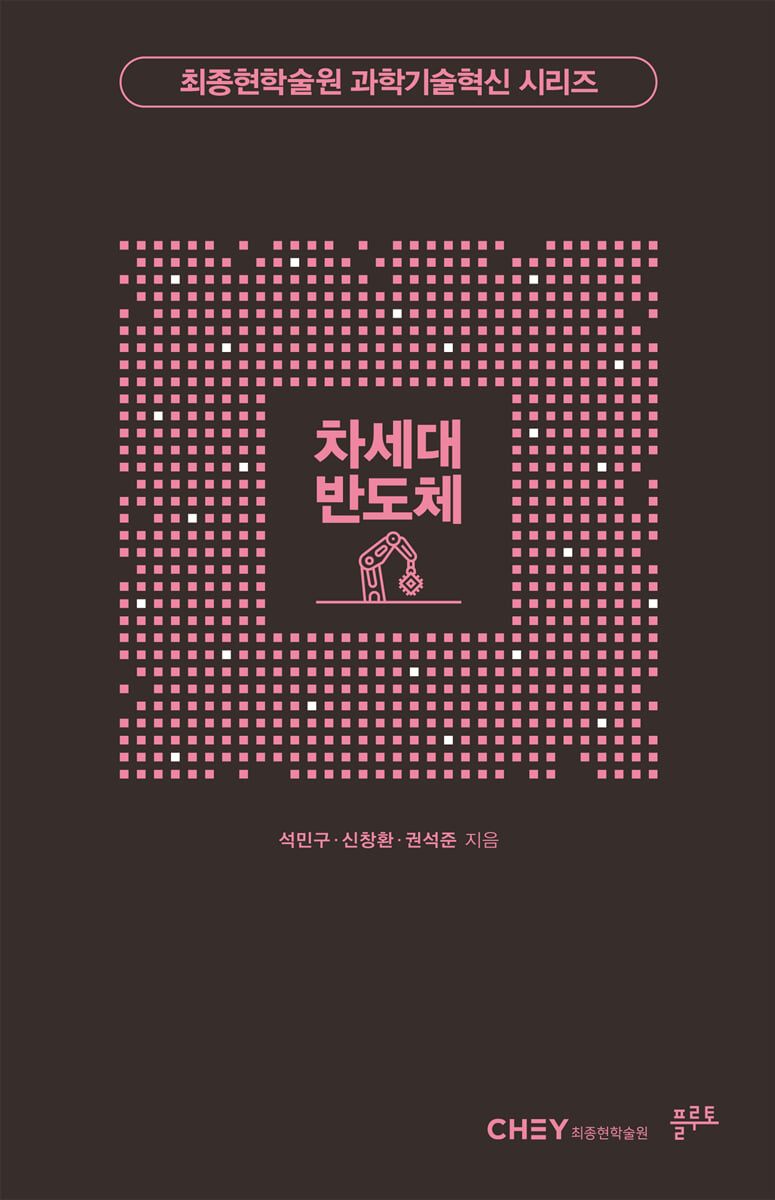
"Next-Generation Semiconductors" is a book that reconstructs the lectures and discussions from the webinar "Next-Generation Semiconductor Technology and the Future," part of the Choi Jong-hyun Academy's Science Innovation Series 17, held by the Choi Jong-hyun Academy in April 2023.
This book is largely divided into two topics: an explanation of the development of semiconductor technology and future strategies for the Korean semiconductor industry.
From a technological perspective, it provides a comprehensive overview of semiconductor fundamentals and technologies that will emerge in the near future. From a future strategy perspective, it presents a comprehensive overview of the whirlwind of change that the global semiconductor industry will face and Korea's response strategies.
This book is largely divided into two topics: an explanation of the development of semiconductor technology and future strategies for the Korean semiconductor industry.
From a technological perspective, it provides a comprehensive overview of semiconductor fundamentals and technologies that will emerge in the near future. From a future strategy perspective, it presents a comprehensive overview of the whirlwind of change that the global semiconductor industry will face and Korea's response strategies.
- You can preview some of the book's contents.
Preview
index
Preface
Chapter 1: Latest Semiconductor Integrated Circuit Design Trends - Seok Min-gu
Small but mighty: semiconductors
The three major semiconductor industries: logic, memory, and analog.
Logic Chip Technology Trends: A Comprehensive Effort to Become Cutting-Edge
CPU and GPU on one chip?
Logic chips for mobile devices
DRAM Technology Trends - Speed and Density
3D integration - increasing density by stacking like a skyscraper
NAND Flash Technology Trends - Beyond 3D to 4D
Vertical Integration: A New Wind in the Semiconductor Ecosystem
What if big tech companies made their own chips?
Chip manufacturing will soon become a competitive edge for your products.
Chapter 2: Designing Next-Generation Architectures That Overcome the Limitations of the Von Neumann Architecture - Seok Min-gu
Von Neumann computing hits its limits at the pinnacle of innovation.
Is the belly button really bigger than the stomach?
We can no longer rely solely on versatility.
In search of a new computing architecture
In-memory computing emerges as a solution for multiplication and accumulation operations.
Can custom hardware catch up with the human brain?
Maximize memory space
Next-generation memory technology for the Warring States period
3D packaging that transcends space constraints
Is complete integration of logic and memory possible?
Semiconductor Technology: Understanding Even Halfway Through Chapter 3 - Shin Chang-hwan
What is a semiconductor?
Semiconductor Manufacturing Processes - From Sand to Wafer Production
Semiconductor Packaging Process - From Wafer to Final Product
Fundamentals of Semiconductor Structure - Metal-Oxide Semiconductors
Stress Engineering and High Dielectrics Raise the Bar for Processing
FinFET and multi-bridge channel FET, which opened the door to three-dimensional device structures.
Technology leadership now lies in Northeast Asia
Driving voltage: why is it difficult to lower it?
Aiming for big change with small changes
Chapter 4: The Global Semiconductor Technology Hegemony Race and Supply Chain Restructuring - Shin Chang-hwan
How is the semiconductor value chain structured?
Which country is good at what?
The emerging memory semiconductor market
The US-China semiconductor hegemony race
Semiconductor Supply Chain: What Will Be the US Regulations and China's Response?
Semiconductor advancements require preparation for supply chain disruptions.
What are Korea's concerns amid the US-China semiconductor competition?
Chapter 5: Key Issues and Future Outlook for the Global Semiconductor Industry - Seokjun Kwon
Changing geopolitical dynamics surrounding semiconductors
US semiconductor export restrictions
Restructuring the Global Semiconductor Supply Chain
The core of next-generation semiconductor technology
Chapter 6: Discussion on Korea's Semiconductor Industry Strategy in the AI Era
Moderator: Jeon Dong-seok, Interviewees: Seok Min-gu, Shin Chang-hwan, Kwon Seok-jun
AI Semiconductors in the ChatGPT Era
The Rise of AI: New Opportunities in the Memory Market
Integrated semiconductor companies vs.
Fabless vs.
Foundry - What is Korea's strategy?
COVID-19 exposes supply chain vulnerabilities
Is cooperation over in the semiconductor industry, where everyone is struggling to survive?
What's important in next-generation semiconductor education?
Figure/table sources, references
Chapter 1: Latest Semiconductor Integrated Circuit Design Trends - Seok Min-gu
Small but mighty: semiconductors
The three major semiconductor industries: logic, memory, and analog.
Logic Chip Technology Trends: A Comprehensive Effort to Become Cutting-Edge
CPU and GPU on one chip?
Logic chips for mobile devices
DRAM Technology Trends - Speed and Density
3D integration - increasing density by stacking like a skyscraper
NAND Flash Technology Trends - Beyond 3D to 4D
Vertical Integration: A New Wind in the Semiconductor Ecosystem
What if big tech companies made their own chips?
Chip manufacturing will soon become a competitive edge for your products.
Chapter 2: Designing Next-Generation Architectures That Overcome the Limitations of the Von Neumann Architecture - Seok Min-gu
Von Neumann computing hits its limits at the pinnacle of innovation.
Is the belly button really bigger than the stomach?
We can no longer rely solely on versatility.
In search of a new computing architecture
In-memory computing emerges as a solution for multiplication and accumulation operations.
Can custom hardware catch up with the human brain?
Maximize memory space
Next-generation memory technology for the Warring States period
3D packaging that transcends space constraints
Is complete integration of logic and memory possible?
Semiconductor Technology: Understanding Even Halfway Through Chapter 3 - Shin Chang-hwan
What is a semiconductor?
Semiconductor Manufacturing Processes - From Sand to Wafer Production
Semiconductor Packaging Process - From Wafer to Final Product
Fundamentals of Semiconductor Structure - Metal-Oxide Semiconductors
Stress Engineering and High Dielectrics Raise the Bar for Processing
FinFET and multi-bridge channel FET, which opened the door to three-dimensional device structures.
Technology leadership now lies in Northeast Asia
Driving voltage: why is it difficult to lower it?
Aiming for big change with small changes
Chapter 4: The Global Semiconductor Technology Hegemony Race and Supply Chain Restructuring - Shin Chang-hwan
How is the semiconductor value chain structured?
Which country is good at what?
The emerging memory semiconductor market
The US-China semiconductor hegemony race
Semiconductor Supply Chain: What Will Be the US Regulations and China's Response?
Semiconductor advancements require preparation for supply chain disruptions.
What are Korea's concerns amid the US-China semiconductor competition?
Chapter 5: Key Issues and Future Outlook for the Global Semiconductor Industry - Seokjun Kwon
Changing geopolitical dynamics surrounding semiconductors
US semiconductor export restrictions
Restructuring the Global Semiconductor Supply Chain
The core of next-generation semiconductor technology
Chapter 6: Discussion on Korea's Semiconductor Industry Strategy in the AI Era
Moderator: Jeon Dong-seok, Interviewees: Seok Min-gu, Shin Chang-hwan, Kwon Seok-jun
AI Semiconductors in the ChatGPT Era
The Rise of AI: New Opportunities in the Memory Market
Integrated semiconductor companies vs.
Fabless vs.
Foundry - What is Korea's strategy?
COVID-19 exposes supply chain vulnerabilities
Is cooperation over in the semiconductor industry, where everyone is struggling to survive?
What's important in next-generation semiconductor education?
Figure/table sources, references
Detailed image

Into the book
In early 2022, media reported that Hyundai Motor Company was discussing a project with Samsung Electronics to design a high-performance autonomous driving chip.
When I was studying at university, integrated circuit (IC) design was an important field only for semiconductor manufacturers, but these days, it is even entering the finished vehicle industry.
As semiconductor design capabilities increasingly directly impact product competitiveness, and companies that are leading the way in chip manufacturing are actually gaining an edge over their competitors, the trend toward vertical integration is likely to accelerate.
Going forward, chip design is likely to play a more significant role as a lever for technological innovation in a wider range of fields.
--- p.29
In advanced DRAM memory processes, a single completed semiconductor wafer contains more than 2,000 chips.
In order to properly connect the numerous transistors created in the previous process and quickly process complex calculations, a metal wiring layer must be created on the upper layer of the completed substrate through an electroplating process.
Afterwards, as several micro-patterns become entangled, the uneven surface is chemically and mechanically polished (CMP), and impurities mixed in through several processes are also removed.
--- p.67
The US excels in design and equipment, Korea and Taiwan excel in front-end processes, Taiwan and China excel in back-end processes, and Japan excels in advanced materials.
The United States is virtually leading the way in advanced semiconductor design.
However, Korea is leading in DRAM design.
And the design automation software and design asset core IP cores required for semiconductor design are mainly supplied by the US and UK.
--- p.87
Taiwan and Korea are the only countries that can produce semiconductors of 10 nanometers or less, which is considered advanced technology.
The United States cannot produce, and this is precisely what the United States fears most.
So, you'll want to bring your advanced semiconductor manufacturing capabilities, down to 10 nanometers or less, to North America.
This is also why the United States and China are competing fiercely.
--- p.91
Meanwhile, China, which accounts for 65% of the world's germanium ore production, could disrupt the semiconductor supply chain.
Russia and Canada dominate the process and supply chain for separating zirconium and hafnium, so we need to prepare for supply chain issues that arise from these countries.
Most countries depend on Japan for blank masks, quartz, and photoresists for extreme ultraviolet processes.
Therefore, if Japan enters the DRAM memory market in earnest, it could be used to disrupt the supply chain.
--- p.99
Faced with the crisis of the US's strict export restrictions on China and the disruption of China's supply chain, how should Korea prepare for the future? Among the questions we must consider and answer, the first one concerning China is as follows:
From a technological perspective, how far can China's advanced semiconductor capabilities develop? I believe they will be able to implement a 5nm process within three years.
So, what are the constraints on China's development of advanced semiconductors, and how will the Chinese government address them? And to what extent can China truly establish a domestically-focused supply chain?
--- p.100
Where will the semiconductor industry's key battlegrounds lie in the future? Let's examine which technologies are currently attracting attention or will be worthy of attention in the future.
Generative AI services like ChatGPT, which has been trending since the second half of 2023 and is based on large language models (LLMs), are specialized in processing massive amounts of data, interpreting and inferring multi-modal information, and predicting and generating information.
Such AI will be a major factor in rapidly increasing the demand for computational resources capable of quickly and accurately processing diverse and massive amounts of data.
--- p.113
Semiconductor technology advances through the accumulation of innovations in basic sciences such as physics and chemistry over several generations.
We will also need strategies to predict what knowledge will become important in the field of basic science in the future and how to accumulate that knowledge.
For example, research on non-electron signal transmission systems, including low-dimensional materials, topological insulators, and quasi-articles, which are actively being studied in the fields of condensed matter physics and solid-state physics, is expected to provide a driving force for future semiconductor innovation.
--- p.116
The reality that Moore's Law is reaching its limits is also a factor promoting semiconductor diversification.
In the past, chip performance could be improved by reducing transistor size and increasing integration, regardless of the type of semiconductor.
But now it has become very difficult to make components that have become so small even smaller.
This is a situation where we have no choice but to adopt a strategy of optimizing the architecture rather than the component level.
In the future, a diverse lineup of AI semiconductors will emerge as architectures are optimized to suit the usage environment.
When I was studying at university, integrated circuit (IC) design was an important field only for semiconductor manufacturers, but these days, it is even entering the finished vehicle industry.
As semiconductor design capabilities increasingly directly impact product competitiveness, and companies that are leading the way in chip manufacturing are actually gaining an edge over their competitors, the trend toward vertical integration is likely to accelerate.
Going forward, chip design is likely to play a more significant role as a lever for technological innovation in a wider range of fields.
--- p.29
In advanced DRAM memory processes, a single completed semiconductor wafer contains more than 2,000 chips.
In order to properly connect the numerous transistors created in the previous process and quickly process complex calculations, a metal wiring layer must be created on the upper layer of the completed substrate through an electroplating process.
Afterwards, as several micro-patterns become entangled, the uneven surface is chemically and mechanically polished (CMP), and impurities mixed in through several processes are also removed.
--- p.67
The US excels in design and equipment, Korea and Taiwan excel in front-end processes, Taiwan and China excel in back-end processes, and Japan excels in advanced materials.
The United States is virtually leading the way in advanced semiconductor design.
However, Korea is leading in DRAM design.
And the design automation software and design asset core IP cores required for semiconductor design are mainly supplied by the US and UK.
--- p.87
Taiwan and Korea are the only countries that can produce semiconductors of 10 nanometers or less, which is considered advanced technology.
The United States cannot produce, and this is precisely what the United States fears most.
So, you'll want to bring your advanced semiconductor manufacturing capabilities, down to 10 nanometers or less, to North America.
This is also why the United States and China are competing fiercely.
--- p.91
Meanwhile, China, which accounts for 65% of the world's germanium ore production, could disrupt the semiconductor supply chain.
Russia and Canada dominate the process and supply chain for separating zirconium and hafnium, so we need to prepare for supply chain issues that arise from these countries.
Most countries depend on Japan for blank masks, quartz, and photoresists for extreme ultraviolet processes.
Therefore, if Japan enters the DRAM memory market in earnest, it could be used to disrupt the supply chain.
--- p.99
Faced with the crisis of the US's strict export restrictions on China and the disruption of China's supply chain, how should Korea prepare for the future? Among the questions we must consider and answer, the first one concerning China is as follows:
From a technological perspective, how far can China's advanced semiconductor capabilities develop? I believe they will be able to implement a 5nm process within three years.
So, what are the constraints on China's development of advanced semiconductors, and how will the Chinese government address them? And to what extent can China truly establish a domestically-focused supply chain?
--- p.100
Where will the semiconductor industry's key battlegrounds lie in the future? Let's examine which technologies are currently attracting attention or will be worthy of attention in the future.
Generative AI services like ChatGPT, which has been trending since the second half of 2023 and is based on large language models (LLMs), are specialized in processing massive amounts of data, interpreting and inferring multi-modal information, and predicting and generating information.
Such AI will be a major factor in rapidly increasing the demand for computational resources capable of quickly and accurately processing diverse and massive amounts of data.
--- p.113
Semiconductor technology advances through the accumulation of innovations in basic sciences such as physics and chemistry over several generations.
We will also need strategies to predict what knowledge will become important in the field of basic science in the future and how to accumulate that knowledge.
For example, research on non-electron signal transmission systems, including low-dimensional materials, topological insulators, and quasi-articles, which are actively being studied in the fields of condensed matter physics and solid-state physics, is expected to provide a driving force for future semiconductor innovation.
--- p.116
The reality that Moore's Law is reaching its limits is also a factor promoting semiconductor diversification.
In the past, chip performance could be improved by reducing transistor size and increasing integration, regardless of the type of semiconductor.
But now it has become very difficult to make components that have become so small even smaller.
This is a situation where we have no choice but to adopt a strategy of optimizing the architecture rather than the component level.
In the future, a diverse lineup of AI semiconductors will emerge as architectures are optimized to suit the usage environment.
--- p.123
Publisher's Review
The beginning and future of modern society,
A look at the changes in semiconductor technology!
The era of advanced semiconductor warfare,
Suggesting the direction for Korea's semiconductor industry and policies!
A book on the "technology and future strategies" of next-generation semiconductors.
《Next-Generation Semiconductors》 is a book that reconstructs the lectures and discussions from the webinar titled 'Next-Generation Semiconductor Technology and the Future', part of the 17th Science Innovation Series of the Choi Jong-hyun Academy of Sciences, held by the Choi Jong-hyun Academy of Sciences in April 2023.
This book, written by Professors Seok Min-gu, Shin Chang-hwan, and Kwon Seok-jun, who are leading the way in semiconductor-related fields by teaching future talents and providing extensive advice and insight to the industry, is largely composed of two topics: an analysis of the flow of semiconductor technology development and future strategies for the Korean semiconductor industry.
In terms of technological advancement, it provides a macroscopic and microscopic view, ranging from semiconductor-related fundamentals to emerging technologies in the near future. In terms of future strategy, it presents a multifaceted overview of the whirlwind of change that the global semiconductor industry will face and Korea's response strategies.
A Look at the Future of Semiconductor Technology
-Technological evolution and the future of the Korean semiconductor industry presented by leading scholars.
Semiconductors have now gone beyond the familiar metaphor of being the "rice of industry" and become like the air that modern people breathe.
This is because it has become essential to our daily lives, from smart devices to home appliances, AI, various infrastructures, and the core of the national economy and national security.
Accordingly, several advanced countries are focusing on developing semiconductor technology and fiercely competing to secure hegemony in the semiconductor industry as a future strategy.
With the technological and industrial environment constantly changing, and the US and China competing for semiconductor hegemony, what path should the Korean semiconductor industry take in the face of the international situation?
Three authors, who currently have significant influence in the semiconductor-related academic and industrial circles, look back on the history of technological advancement and suggest future solutions for the Korean semiconductor industry.
Chapter 1 examines the evolution of semiconductor integrated circuits, recent technological trends, changes in the semiconductor industry ecosystem, and trends in chip design dedicated to global big tech companies' products.
Chapter 2 presents a new computing structure and next-generation technology for designing next-generation architectures that overcome the limitations of existing von Neumann architecture semiconductors.
Chapter 3 provides an overview of the manufacturing process, from sand to wafer fabrication to final product packaging, and introduces innovations in the process.
Furthermore, it also covers low-power, low-voltage semiconductor device technology toward carbon neutrality.
Chapters 4 and 5 examine the current state of the global semiconductor ecosystem, trends among global companies, and the restructuring of the value chain.
Through this, we analyze the nature of the difficulties facing the Korean semiconductor industry amid the US's semiconductor hegemony competition with China and its efforts to reorganize the supply chain. We also present expected scenarios, future directions, and technologies that deserve attention.
In Chapter 6, three authors discuss the changing semiconductor landscape in the AI era and future strategies for the Korean semiconductor industry.
We examine the semiconductor industry in the AI era, represented by ChatGPT, and the direction Korea is taking, the semiconductor hegemony competition between the US and China and the resulting restructuring of the international semiconductor ecosystem, and the critical issue of training the personnel responsible for next-generation semiconductors.
The great significance of "Next Generation Semiconductors" lies not only in its overview of the diverse technological developments and process fields of advanced semiconductors, but also in its comprehensive analysis of strategies for the national future industry.
This book will serve as a landmark for all readers who wish to gain a comprehensive understanding of the history of semiconductor development, its diverse technologies, the international competition for semiconductor supremacy, geopolitical dynamics, future technological trends, and the future of the Korean semiconductor industry.
A look at the changes in semiconductor technology!
The era of advanced semiconductor warfare,
Suggesting the direction for Korea's semiconductor industry and policies!
A book on the "technology and future strategies" of next-generation semiconductors.
《Next-Generation Semiconductors》 is a book that reconstructs the lectures and discussions from the webinar titled 'Next-Generation Semiconductor Technology and the Future', part of the 17th Science Innovation Series of the Choi Jong-hyun Academy of Sciences, held by the Choi Jong-hyun Academy of Sciences in April 2023.
This book, written by Professors Seok Min-gu, Shin Chang-hwan, and Kwon Seok-jun, who are leading the way in semiconductor-related fields by teaching future talents and providing extensive advice and insight to the industry, is largely composed of two topics: an analysis of the flow of semiconductor technology development and future strategies for the Korean semiconductor industry.
In terms of technological advancement, it provides a macroscopic and microscopic view, ranging from semiconductor-related fundamentals to emerging technologies in the near future. In terms of future strategy, it presents a multifaceted overview of the whirlwind of change that the global semiconductor industry will face and Korea's response strategies.
A Look at the Future of Semiconductor Technology
-Technological evolution and the future of the Korean semiconductor industry presented by leading scholars.
Semiconductors have now gone beyond the familiar metaphor of being the "rice of industry" and become like the air that modern people breathe.
This is because it has become essential to our daily lives, from smart devices to home appliances, AI, various infrastructures, and the core of the national economy and national security.
Accordingly, several advanced countries are focusing on developing semiconductor technology and fiercely competing to secure hegemony in the semiconductor industry as a future strategy.
With the technological and industrial environment constantly changing, and the US and China competing for semiconductor hegemony, what path should the Korean semiconductor industry take in the face of the international situation?
Three authors, who currently have significant influence in the semiconductor-related academic and industrial circles, look back on the history of technological advancement and suggest future solutions for the Korean semiconductor industry.
Chapter 1 examines the evolution of semiconductor integrated circuits, recent technological trends, changes in the semiconductor industry ecosystem, and trends in chip design dedicated to global big tech companies' products.
Chapter 2 presents a new computing structure and next-generation technology for designing next-generation architectures that overcome the limitations of existing von Neumann architecture semiconductors.
Chapter 3 provides an overview of the manufacturing process, from sand to wafer fabrication to final product packaging, and introduces innovations in the process.
Furthermore, it also covers low-power, low-voltage semiconductor device technology toward carbon neutrality.
Chapters 4 and 5 examine the current state of the global semiconductor ecosystem, trends among global companies, and the restructuring of the value chain.
Through this, we analyze the nature of the difficulties facing the Korean semiconductor industry amid the US's semiconductor hegemony competition with China and its efforts to reorganize the supply chain. We also present expected scenarios, future directions, and technologies that deserve attention.
In Chapter 6, three authors discuss the changing semiconductor landscape in the AI era and future strategies for the Korean semiconductor industry.
We examine the semiconductor industry in the AI era, represented by ChatGPT, and the direction Korea is taking, the semiconductor hegemony competition between the US and China and the resulting restructuring of the international semiconductor ecosystem, and the critical issue of training the personnel responsible for next-generation semiconductors.
The great significance of "Next Generation Semiconductors" lies not only in its overview of the diverse technological developments and process fields of advanced semiconductors, but also in its comprehensive analysis of strategies for the national future industry.
This book will serve as a landmark for all readers who wish to gain a comprehensive understanding of the history of semiconductor development, its diverse technologies, the international competition for semiconductor supremacy, geopolitical dynamics, future technological trends, and the future of the Korean semiconductor industry.
GOODS SPECIFICS
- Publication date: December 29, 2023
- Page count, weight, size: 164 pages | 316g | 136*211*12mm
- ISBN13: 9791188569564
You may also like
카테고리
korean


korean

![GQ KOREA Mark (Monthly): December [2025]](http://librairie.coreenne.fr/cdn/shop/files/8ef265dbbfbf186523ed75ba7319009d.jpg?v=1765340328&width=3840)


