

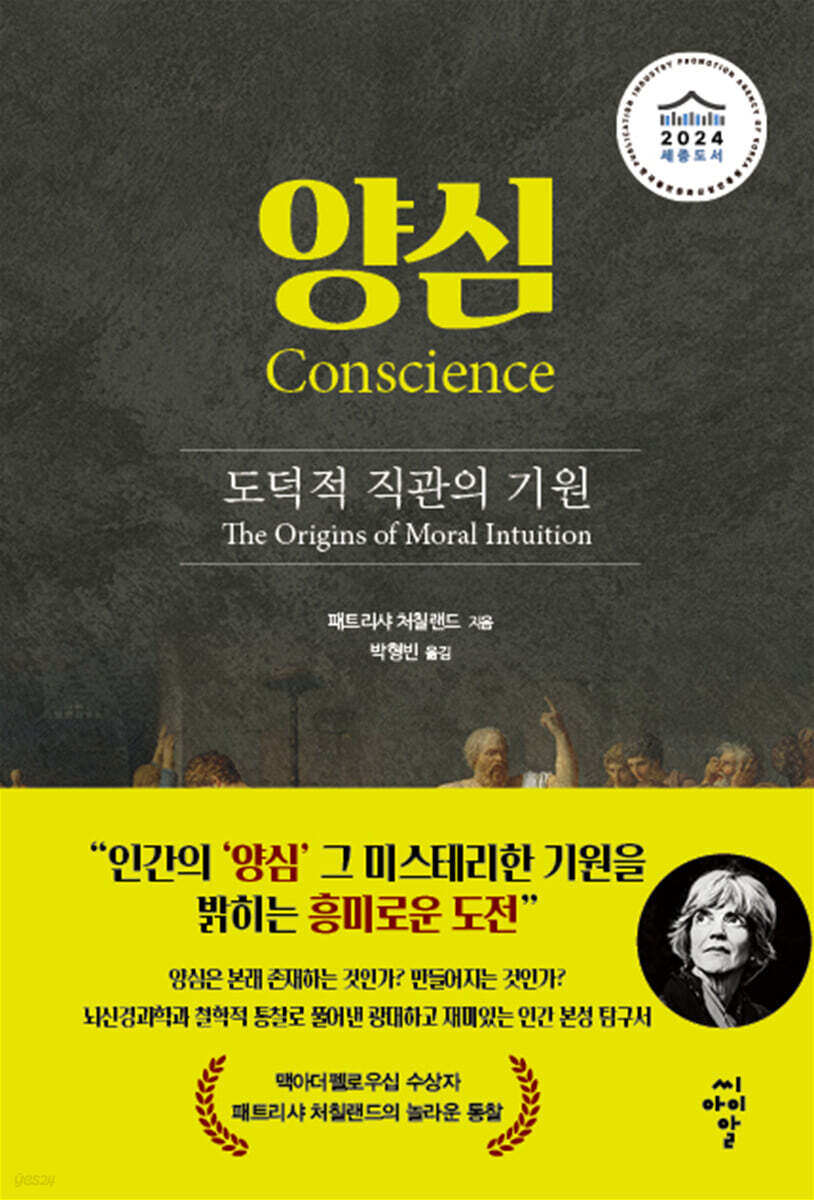
Conscience: The Origins of Moral Intuition
 |
Description
Book Introduction
“Is human morality innate?” Exploring the very essence of human morality, the last stronghold of orthodox philosophy. _The Convergence of Neuroscience and Philosophy as Seen by Neurophilosopher Patricia Churchland Where do our moral feelings originate? Are they, as Mencius argued in his "theory of inherent goodness," endowed by Heaven with inherent goodness? Or are they, as Xunzi argued in his "theory of inherent evil," an artificial result of acquired learning, inherently evil? In this book, "Conscience," Patricia examines their origins not from a philosophical perspective, but from a neuroscientific perspective. This book argues that the traditional philosophical questions about humanity are actually within the realm of brain science. Furthermore, the fundamental cause that makes humans behave morally is being sought in the brain's reward system and the moral molecule 'oxytocin'. Going beyond simply considering the brain as a dimension of information judgment and processing ability, it provides an interesting explanation of how our brain is related to moral origins through various cases and experimental results. That is, it attempted to connect science and philosophy by providing neurophilosophical answers to questions that were considered to be within the realm of traditional philosophy. Patricia warns modern moral philosophers that “if you discuss morality without grounding it in solid realities like evolution or the brain, no matter how confident you are, you are ultimately just floating in a sea of opinions.” In order to objectively examine human nature and morality, substantial and appropriate data from 'neuroscience', 'evolutionary biology', and 'genetic science' are absolutely necessary. Nevertheless, there are still many things that neuroscience and brain science have not been able to elucidate. But now is the time for a new approach to the brain, the human mind, and, more broadly, the origins of morality. I hope this book will bring about a new paradigm shift in the last stronghold of orthodox philosophy, 'human morality.' |
- You can preview some of the book's contents.
Preview
index
Translator's Note
INTRODUCTION Access to Care
CHAPTER 1: A Hug for Survival
CHAPTER 2: BECOMING ATTACHED
CHAPTER 3 Learning and Getting Along
CHAPTER 4 Norms and Values
CHAPTER 5 I'm just that kind of person
CHAPTER 6 Conscience and Its Anomalies
CHAPTER 7 What does love have to do with it?
CHAPTER 8 Practical Aspects
Acknowledgements
Epilogue
INTRODUCTION Access to Care
CHAPTER 1: A Hug for Survival
CHAPTER 2: BECOMING ATTACHED
CHAPTER 3 Learning and Getting Along
CHAPTER 4 Norms and Values
CHAPTER 5 I'm just that kind of person
CHAPTER 6 Conscience and Its Anomalies
CHAPTER 7 What does love have to do with it?
CHAPTER 8 Practical Aspects
Acknowledgements
Epilogue
Publisher's Review
It is true that we humans have long relegated human morality to the realm of philosophy.
However, this traditional view is facing a new phase with the development of neuroscience technology.
Conscience explores why all social groups have moral systems and how these systems are formed.
Drawing on our understanding of neuroscience, genetics, and the influence of our physical environment, we explore how our brains are wired to empathize and care for others, while also exploring the origins of psychopathy.
Churchland then looks through the lens of philosophy to understand how morality is passed down through generations and how this morality becomes the foundation of all societies.
'Free will'.
It is a topic that has been hotly debated by philosophers for thousands of years.
Do we humans really have free will?
Now, neuroscientists and neuroscientists are starting to add their voices to this philosophical debate.
Uncovering the source of free will.
A new study is beginning to uncover the origins of free will, a long-standing puzzle for humanity.
I recommend this book at the crossroads of a new paradigm that reveals the illusion of free will and its true nature.
However, this traditional view is facing a new phase with the development of neuroscience technology.
Conscience explores why all social groups have moral systems and how these systems are formed.
Drawing on our understanding of neuroscience, genetics, and the influence of our physical environment, we explore how our brains are wired to empathize and care for others, while also exploring the origins of psychopathy.
Churchland then looks through the lens of philosophy to understand how morality is passed down through generations and how this morality becomes the foundation of all societies.
'Free will'.
It is a topic that has been hotly debated by philosophers for thousands of years.
Do we humans really have free will?
Now, neuroscientists and neuroscientists are starting to add their voices to this philosophical debate.
Uncovering the source of free will.
A new study is beginning to uncover the origins of free will, a long-standing puzzle for humanity.
I recommend this book at the crossroads of a new paradigm that reveals the illusion of free will and its true nature.
GOODS SPECIFICS
- Date of issue: January 20, 2024
- Page count, weight, size: 320 pages | 576g | 152*224*20mm
- ISBN13: 9791168561731
- ISBN10: 1168561736
You may also like
카테고리
korean


korean

![GQ KOREA Mark (Monthly): December [2025]](http://librairie.coreenne.fr/cdn/shop/files/8ef265dbbfbf186523ed75ba7319009d.jpg?v=1765340328&width=3840)


