

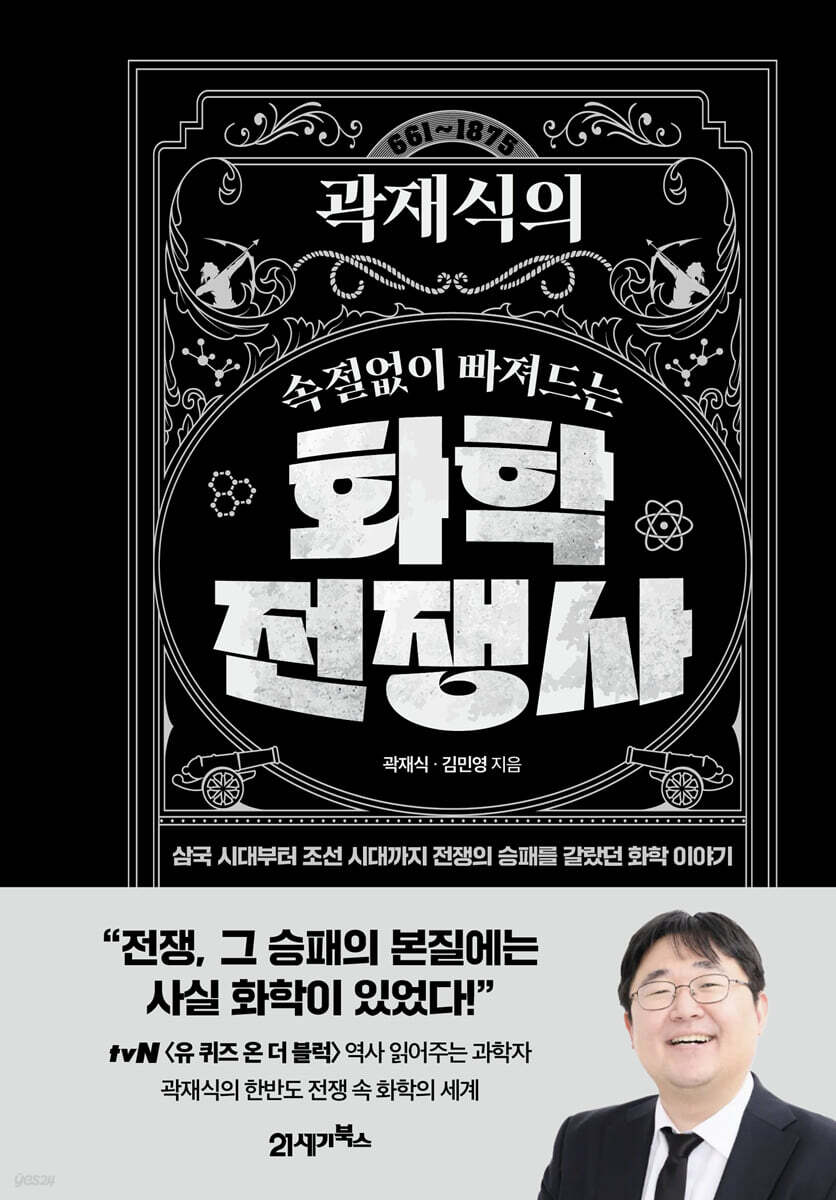
Kwak Jae-sik's captivating history of chemical warfare
 |
Description
Book Introduction
A time to add wisdom to my life, 'Life's Great River' “In war, the essence of victory or defeat is actually chemistry!” Kwak Jae-sik's Hidden Chemical Knowledge Class in the History of the Korean War All the essential knowledge you need for life is gathered together! The twentieth book in the "Life Lectures" series, a fascinating knowledge experience presented by Korea's leading professors, has been published. The Life Lectures series, which transcribes the lectures of the best professors in various fields from universities across the country, including history, philosophy, science, medicine, and art, into books, provides readers with useful knowledge to live today and insight to look forward to tomorrow. It is a knowledge and culture brand that allows you to encounter the best knowledge content in everyday life through not only books but also online lectures, YouTube, and podcasts. In an era of clashes between powers, how did the Korean Peninsula develop while battling against diverse nations? "Kwak Jae-sik's Helplessly Immersive History of Chemical Warfare" is a book that contains four stories of chemical knowledge and war, interpreted by Professor Kwak Jae-sik, spanning from the unification of the Three Kingdoms in the 7th century to the Unyoho Incident in the 19th century. From the chemical composition of the rope used to make pochas to the secrets of the chemical energy of the Japanese coal-fired warship Un'yo, which destroyed the Korean Peninsula, it narrates historical stories related to various wars in a chain. You will be able to immerse yourself in the story of the 'chemical warfare on the Korean Peninsula' that made the present possible, such as the chemistry of gun carriages, the chemistry of cavalry, and the chemistry of steam engines, as if reading a novel. |
- You can preview some of the book's contents.
Preview
index
prolog
Chapter 1: The Chemistry of Pocha, Which Led to the Unification of the Three Kingdoms
1.
The main weapon of the Three Kingdoms War, the catapult
2.
Use of various weapons and catapults for attack
3.
Rope, a key ingredient for making good pocha
4.
Chemistry for Strong Ropes
Chapter 2: Hwakhwa, who led the cavalry of Later Baekje's Gyeon Hwon
1.
The Later Three Kingdoms, a time of chaos and heroes
2.
Language usage during the Later Three Kingdoms period
3.
How can a man outrun a horse?
4.
Wang Geon, the last victor of the Later Three Kingdoms
Chapter 3: Adhesive: The Pretext for Yi Seong-gye to Found Joseon
1.
Yi Seong-gye's once-in-a-lifetime decision: the Wihwado Retreat
2.
What is the 'Cross of the Bow'?
3.
How is glue used as an adhesive and what is bonding?
4.
Modern adhesives
5.
Korea's cutting-edge industry created by adhesives
Chapter 4: The Coal-Fired Warship that Destroyed the Korean Peninsula, the Unyo
1.
Joseon's technological prowess and Japan's technological prowess
2.
lump of carbon, coal
3.
Britain, which moved the world with coal
4.
Opening a new era with the steam engine
5.
Joseon collapsed under the weight of a single Japanese warship
6.
Energy after coal
Main keywords
References
Chapter 1: The Chemistry of Pocha, Which Led to the Unification of the Three Kingdoms
1.
The main weapon of the Three Kingdoms War, the catapult
2.
Use of various weapons and catapults for attack
3.
Rope, a key ingredient for making good pocha
4.
Chemistry for Strong Ropes
Chapter 2: Hwakhwa, who led the cavalry of Later Baekje's Gyeon Hwon
1.
The Later Three Kingdoms, a time of chaos and heroes
2.
Language usage during the Later Three Kingdoms period
3.
How can a man outrun a horse?
4.
Wang Geon, the last victor of the Later Three Kingdoms
Chapter 3: Adhesive: The Pretext for Yi Seong-gye to Found Joseon
1.
Yi Seong-gye's once-in-a-lifetime decision: the Wihwado Retreat
2.
What is the 'Cross of the Bow'?
3.
How is glue used as an adhesive and what is bonding?
4.
Modern adhesives
5.
Korea's cutting-edge industry created by adhesives
Chapter 4: The Coal-Fired Warship that Destroyed the Korean Peninsula, the Unyo
1.
Joseon's technological prowess and Japan's technological prowess
2.
lump of carbon, coal
3.
Britain, which moved the world with coal
4.
Opening a new era with the steam engine
5.
Joseon collapsed under the weight of a single Japanese warship
6.
Energy after coal
Main keywords
References
Detailed image

Into the book
There are many stories related to chemistry related to issues related to war, the most fiercely contested conflict in history.
So, in this book, I tried to explain in a more vivid way how chemistry is connected to various problems, and to explain how wars in history are related to certain chemical problems.
That is why this book has attempted to explain the relationship between chemistry and war from a perspective that is relatively less explored in other books.
Although not covered in this book, there are many more important and well-known events in the history of chemistry that are often linked to war.
However, even if it is not a grand problem, I have selected a separate topic to point out that human life is always deeply related to chemistry.
--- p.8
The Joseon Dynasty is the dynasty closest to modern times, and it has many stories to tell. As there are many stories to tell, there is also a wealth of material. As there is a wealth of material, writers and production staff are skilled at creating various stories set in the Joseon Dynasty. In addition, broadcasting stations have many Joseon Dynasty props, such as Joseon Dynasty costumes, Joseon Dynasty weapons, and Joseon Dynasty helmets.
However, during the Joseon Dynasty, catapults were not used very often.
Why is that? Because gunpowder had already been developed during the Joseon Dynasty, making it possible to fire cannons.
There's no need to go through the trouble of building a catapult and having soldiers scramble to get rocks to lift them up and hurl them at the enemy when you can simply fire a cannon and inflict terrifying damage in a much simpler and more powerful way.
That's why it's difficult to see catapults on Korean TV, which has many historical dramas set in the Joseon Dynasty.
Although they have been used extensively throughout history and played an important role in battles, catapults feel like exotic weapons because they are rarely seen in historical dramas.
However, if you look into when catapults were used in our country's history, you can surprisingly find examples of their use everywhere.
Let's clear up some of the misconceptions that 'Koreans don't seem to have used catapults like that.'
--- p.16~17
Why on earth do horses run so well? It's a question you've probably wondered at least once as a child.
Horses run much better and are stronger than people.
People eat meat and vegetables, but horses only eat grass, so how can they be so strong? (…) The most important component in muscle fibers, which are like threads, is a substance called myosin.
When this myosin releases ATP (adenosine tri-phosphate) under the right conditions, the ATP changes into a substance called ADP (adenosine diphosphate).
And myosin has the characteristic of changing its shape for a moment as if it were bent by its influence.
This is the root of all the movements we do.
Walking, running, lifting heavy objects, holding someone's hand, hugging someone, clapping when you're happy, shaking your fist in the air when you're angry, and even doing breathing exercises that move your chest and stomach a little.
All of this movement happens because of a chemical reaction that causes a substance called myosin to bend when ATP changes to ADP.
--- p.82~83
The principle of glue-like adhesives is to use the property of proteins to change shape depending on various conditions, spread proteins that appear to be in a watery state here and there, dry them appropriately, make them stick well to each other, and then harden them again.
In particular, it is easiest to utilize the property of proteins to change when the temperature changes.
When making steamed eggs, if you cut up green onions or carrots and sprinkle them on the eggs and steam them, the green onions and carrots will harden and stick to the eggs. The principle behind this and the adhesive principle of fish glue are quite similar.
But what happens when humidity increases? The increased moisture in the surroundings can cause moisture to seep between the tangled proteins.
Then, it would be difficult to utilize the intended properties of the proteins, which are twisted and connected in their own way.
Depending on the type of protein, the coiling may become slightly looser.
That is why Lee Seong-gye said that he was against the conquest of Liaodong because the high humidity in the summer could cause the glue to loosen and weaken.
So, in this book, I tried to explain in a more vivid way how chemistry is connected to various problems, and to explain how wars in history are related to certain chemical problems.
That is why this book has attempted to explain the relationship between chemistry and war from a perspective that is relatively less explored in other books.
Although not covered in this book, there are many more important and well-known events in the history of chemistry that are often linked to war.
However, even if it is not a grand problem, I have selected a separate topic to point out that human life is always deeply related to chemistry.
--- p.8
The Joseon Dynasty is the dynasty closest to modern times, and it has many stories to tell. As there are many stories to tell, there is also a wealth of material. As there is a wealth of material, writers and production staff are skilled at creating various stories set in the Joseon Dynasty. In addition, broadcasting stations have many Joseon Dynasty props, such as Joseon Dynasty costumes, Joseon Dynasty weapons, and Joseon Dynasty helmets.
However, during the Joseon Dynasty, catapults were not used very often.
Why is that? Because gunpowder had already been developed during the Joseon Dynasty, making it possible to fire cannons.
There's no need to go through the trouble of building a catapult and having soldiers scramble to get rocks to lift them up and hurl them at the enemy when you can simply fire a cannon and inflict terrifying damage in a much simpler and more powerful way.
That's why it's difficult to see catapults on Korean TV, which has many historical dramas set in the Joseon Dynasty.
Although they have been used extensively throughout history and played an important role in battles, catapults feel like exotic weapons because they are rarely seen in historical dramas.
However, if you look into when catapults were used in our country's history, you can surprisingly find examples of their use everywhere.
Let's clear up some of the misconceptions that 'Koreans don't seem to have used catapults like that.'
--- p.16~17
Why on earth do horses run so well? It's a question you've probably wondered at least once as a child.
Horses run much better and are stronger than people.
People eat meat and vegetables, but horses only eat grass, so how can they be so strong? (…) The most important component in muscle fibers, which are like threads, is a substance called myosin.
When this myosin releases ATP (adenosine tri-phosphate) under the right conditions, the ATP changes into a substance called ADP (adenosine diphosphate).
And myosin has the characteristic of changing its shape for a moment as if it were bent by its influence.
This is the root of all the movements we do.
Walking, running, lifting heavy objects, holding someone's hand, hugging someone, clapping when you're happy, shaking your fist in the air when you're angry, and even doing breathing exercises that move your chest and stomach a little.
All of this movement happens because of a chemical reaction that causes a substance called myosin to bend when ATP changes to ADP.
--- p.82~83
The principle of glue-like adhesives is to use the property of proteins to change shape depending on various conditions, spread proteins that appear to be in a watery state here and there, dry them appropriately, make them stick well to each other, and then harden them again.
In particular, it is easiest to utilize the property of proteins to change when the temperature changes.
When making steamed eggs, if you cut up green onions or carrots and sprinkle them on the eggs and steam them, the green onions and carrots will harden and stick to the eggs. The principle behind this and the adhesive principle of fish glue are quite similar.
But what happens when humidity increases? The increased moisture in the surroundings can cause moisture to seep between the tangled proteins.
Then, it would be difficult to utilize the intended properties of the proteins, which are twisted and connected in their own way.
Depending on the type of protein, the coiling may become slightly looser.
That is why Lee Seong-gye said that he was against the conquest of Liaodong because the high humidity in the summer could cause the glue to loosen and weaken.
--- p.139~140
Publisher's Review
“A special class that covers both history and science at the same time!”
Interesting historical facts that follow one after another
Chemistry knowledge hidden everywhere!
● Is the reason Silla achieved the unification of the three kingdoms due to the chemical composition of Goguryeo gun carriage rope?
● During the Later Three Kingdoms period, the cavalry battle between Wang Geon and Gyeon Hwon was centered around the muscle fibers of the horse!
● Did Lee Seong-gye use the adhesive principle of fish glue to launch the Wihwado Rebellion?
● What is the secret of the coal-fired warship Unyo, which became the signal for Japanese colonial rule?
When most people picture a scientist, they probably picture him or her in a white coat, bubbling chemicals in a laboratory.
Many of the hygiene products we commonly use in our daily lives are chemical products, and cutting-edge technologies for treating diseases are also the result of chemical research.
Therefore, it is only natural that 'war', the most fierce conflict in history, is closely related to chemistry.
『Kwak Jae-sik's Helplessly Immersive History of Chemical Warfare』 is a fusion textbook of history and chemistry in which Professor Kwak Jae-sik, who graduated early from KAIST and is currently working as a convergence scientist who crosses the boundaries of the humanities and sciences, unravels the fascinating stories hidden behind history from a scientist's perspective.
In 661, when Goguryeo attacked Silla, it describes the cannonball used by the Goguryeo general Noeumsin and explains the chemical composition of the rope used in the cannonball. It also introduces the Japanese coal-fired warship Unyo, which destroyed the Korean Peninsula, and delves into the past and present of coal energy.
As you become engrossed in the author's witty banter, which interweaves and interweaves war episodes across the boundaries of history and chemistry, you will find yourself becoming familiar with both history and chemistry, which were once unfamiliar to you.
“How did ancient people discover chemical knowledge and use it wisely in their tactics?”
Even in ancient and medieval times, not in the age of science,
Chemistry was moving the world!
At the end of the Goryeo Dynasty, Yi Seong-gye claimed that the fourth reason for opposing the conquest of Liaodong was that 'the glue on the bow would loosen.'
This is because in the summer, when humidity is high, moisture can easily enter between the tangled protein particles, which can cause the elasticity of the glue to loosen.
Yi Seong-gye opposed the conquest of Liaodong using the excuse of the change in elasticity of the glue, and was able to establish a new nation called Joseon by withdrawing his troops from Wihwado.
The justification for the rebellion was found in the chemical composition of proteins.
This book rekindles interest in the relatively little-discussed history of chemical warfare on the Korean Peninsula, and presents a new possibility for the fusion of science and history through a more vivid and engaging narrative.
The author says, 'Chemistry is the most familiar science in our lives.'
Chemistry has been moving the world, whether we know it or not, since ancient times and the Middle Ages, and today it continues to spread into various areas of life, leading to the expansion of knowledge and innovation.
Professor Kwak Jae-sik's comprehensive history book, which introduces the keyword "war history" to the field of chemistry, will open new horizons in humanities and scientific knowledge.
In today's world, where the need for convergent thinking is paramount, I hope you will seize the opportunity to gain a richer perspective on the world by reading the exchanges between the humanities and natural sciences.
Interesting historical facts that follow one after another
Chemistry knowledge hidden everywhere!
● Is the reason Silla achieved the unification of the three kingdoms due to the chemical composition of Goguryeo gun carriage rope?
● During the Later Three Kingdoms period, the cavalry battle between Wang Geon and Gyeon Hwon was centered around the muscle fibers of the horse!
● Did Lee Seong-gye use the adhesive principle of fish glue to launch the Wihwado Rebellion?
● What is the secret of the coal-fired warship Unyo, which became the signal for Japanese colonial rule?
When most people picture a scientist, they probably picture him or her in a white coat, bubbling chemicals in a laboratory.
Many of the hygiene products we commonly use in our daily lives are chemical products, and cutting-edge technologies for treating diseases are also the result of chemical research.
Therefore, it is only natural that 'war', the most fierce conflict in history, is closely related to chemistry.
『Kwak Jae-sik's Helplessly Immersive History of Chemical Warfare』 is a fusion textbook of history and chemistry in which Professor Kwak Jae-sik, who graduated early from KAIST and is currently working as a convergence scientist who crosses the boundaries of the humanities and sciences, unravels the fascinating stories hidden behind history from a scientist's perspective.
In 661, when Goguryeo attacked Silla, it describes the cannonball used by the Goguryeo general Noeumsin and explains the chemical composition of the rope used in the cannonball. It also introduces the Japanese coal-fired warship Unyo, which destroyed the Korean Peninsula, and delves into the past and present of coal energy.
As you become engrossed in the author's witty banter, which interweaves and interweaves war episodes across the boundaries of history and chemistry, you will find yourself becoming familiar with both history and chemistry, which were once unfamiliar to you.
“How did ancient people discover chemical knowledge and use it wisely in their tactics?”
Even in ancient and medieval times, not in the age of science,
Chemistry was moving the world!
At the end of the Goryeo Dynasty, Yi Seong-gye claimed that the fourth reason for opposing the conquest of Liaodong was that 'the glue on the bow would loosen.'
This is because in the summer, when humidity is high, moisture can easily enter between the tangled protein particles, which can cause the elasticity of the glue to loosen.
Yi Seong-gye opposed the conquest of Liaodong using the excuse of the change in elasticity of the glue, and was able to establish a new nation called Joseon by withdrawing his troops from Wihwado.
The justification for the rebellion was found in the chemical composition of proteins.
This book rekindles interest in the relatively little-discussed history of chemical warfare on the Korean Peninsula, and presents a new possibility for the fusion of science and history through a more vivid and engaging narrative.
The author says, 'Chemistry is the most familiar science in our lives.'
Chemistry has been moving the world, whether we know it or not, since ancient times and the Middle Ages, and today it continues to spread into various areas of life, leading to the expansion of knowledge and innovation.
Professor Kwak Jae-sik's comprehensive history book, which introduces the keyword "war history" to the field of chemistry, will open new horizons in humanities and scientific knowledge.
In today's world, where the need for convergent thinking is paramount, I hope you will seize the opportunity to gain a richer perspective on the world by reading the exchanges between the humanities and natural sciences.
GOODS SPECIFICS
- Date of issue: January 17, 2024
- Format: Hardcover book binding method guide
- Page count, weight, size: 232 pages | 384g | 128*188*18mm
- ISBN13: 9791171173013
- ISBN10: 1171173016
You may also like
카테고리
korean


korean

![ELLE 엘르 스페셜 에디션 A형 : 12월 [2025]](http://librairie.coreenne.fr/cdn/shop/files/b8e27a3de6c9538896439686c6b0e8fb.jpg?v=1766436872&width=3840)


