

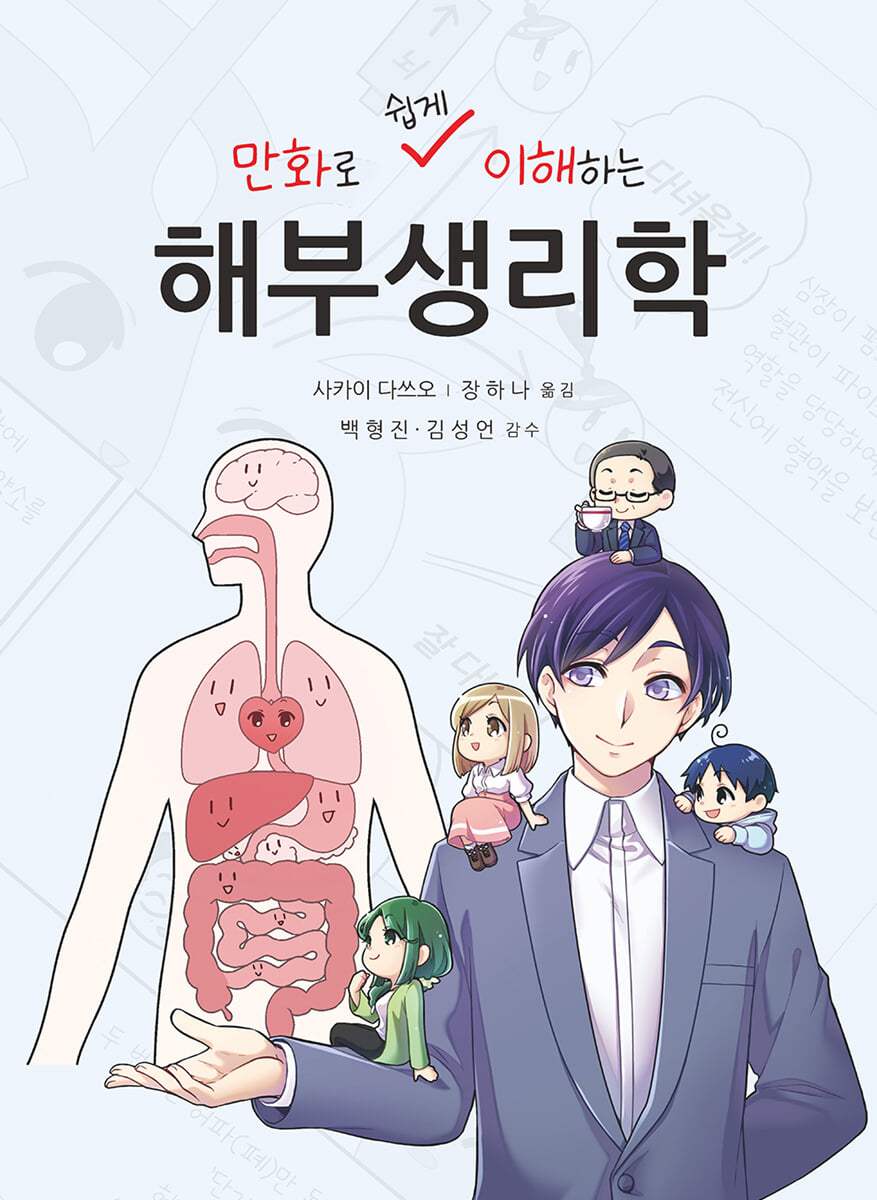
Anatomy and Physiology Made Easy with Cartoons
 |
Description
Book Introduction
What exactly is "anatomy and physiology"? It's the study of the structure and function of the human body for those seeking medical and health-related careers.
Because it is a part of medicine that is studied professionally, it deals with somewhat unfamiliar terms and content.
It covers similar content to 『Structure of the Human Body』, which was written for the general public, but it differs in that it covers all the important parts of the human body comprehensively and systematically.
Recently, the number of people studying anatomy and physiology to work in medical fields has been rapidly increasing.
And what these medical and veterinary students are concerned about is anatomy and physiology, the first gateway to medicine.
There are many different professions in the medical field besides doctors and dentists.
There are professions that require national qualifications, such as pharmacists, nurses, physical therapists, occupational therapists, radiographers, clinical pathologists, emergency medical technicians, and dental hygienists, but there are also various related fields, such as chiropractic, sports trainers, yoga instructors, and cosmetology.
Anatomy and physiology can be beneficial not only to students pursuing medical qualifications and related fields, but also to a wide range of people interested in beauty, health, and sports.
Among those aiming for these diverse careers or interested in health, many find themselves discouraged by the sheer number of technical terms and difficult content presented when they open an anatomy and physiology textbook to begin their studies.
Even in such cases, I took on the responsibility of reviewing this book because I wanted to convey the idea that one can learn about the structure and functions of the human body in an interesting way and become familiar with difficult terminology.
I have been teaching anatomy and physiology to medical and health care students for 44 years.
And I have been engaged in writing, translating, and editing textbooks and reference books for students.
The majority of medical and health science students use one of the anatomy or physiology textbooks that I have developed.
In that sense, I think it would not be an exaggeration to call the author a master of anatomy or anatomy and physiology.
Teaching anatomy and physiology in a comic format this time may seem a bit far removed from the image of studying medicine diligently in medical and health schools.
However, if you take it one step at a time and understand the structure and function of the human body, anatomy and physiology will not be difficult at all.
I hope this book helps.
Because it is a part of medicine that is studied professionally, it deals with somewhat unfamiliar terms and content.
It covers similar content to 『Structure of the Human Body』, which was written for the general public, but it differs in that it covers all the important parts of the human body comprehensively and systematically.
Recently, the number of people studying anatomy and physiology to work in medical fields has been rapidly increasing.
And what these medical and veterinary students are concerned about is anatomy and physiology, the first gateway to medicine.
There are many different professions in the medical field besides doctors and dentists.
There are professions that require national qualifications, such as pharmacists, nurses, physical therapists, occupational therapists, radiographers, clinical pathologists, emergency medical technicians, and dental hygienists, but there are also various related fields, such as chiropractic, sports trainers, yoga instructors, and cosmetology.
Anatomy and physiology can be beneficial not only to students pursuing medical qualifications and related fields, but also to a wide range of people interested in beauty, health, and sports.
Among those aiming for these diverse careers or interested in health, many find themselves discouraged by the sheer number of technical terms and difficult content presented when they open an anatomy and physiology textbook to begin their studies.
Even in such cases, I took on the responsibility of reviewing this book because I wanted to convey the idea that one can learn about the structure and functions of the human body in an interesting way and become familiar with difficult terminology.
I have been teaching anatomy and physiology to medical and health care students for 44 years.
And I have been engaged in writing, translating, and editing textbooks and reference books for students.
The majority of medical and health science students use one of the anatomy or physiology textbooks that I have developed.
In that sense, I think it would not be an exaggeration to call the author a master of anatomy or anatomy and physiology.
Teaching anatomy and physiology in a comic format this time may seem a bit far removed from the image of studying medicine diligently in medical and health schools.
However, if you take it one step at a time and understand the structure and function of the human body, anatomy and physiology will not be difficult at all.
I hope this book helps.
- You can preview some of the book's contents.
Preview
index
PROLOGUE
Fundamentals of Anatomy and Physiology
1.
Understanding the Structure of the Human Body 16
torso and limbs
Major names of each body part
Spaces and organs of the human body
Terms indicating the three-way reference plane and direction
A term indicating the direction of movement
2.
Understanding the Components of the Human Body 21
Hierarchy of human structure
Cell structure
Structure of the cell membrane
Material transport structures in cell membranes
3.
Understanding the Functions of the Human Body 24
Classification by plant function and animal function
Changes in external and internal environments
Chapter 1: 'Vegetable Functions' that Sustain Life
circulatory system
1.
Structure and Circulation of the Heart 26
Blood circulates throughout the body in about one minute.
The heart acts as a pump to pump blood throughout the body.
· 28
The four chambers of the heart, valves, and blood vessels connecting each chamber / Does the heart also have a skeleton?
2.
Heartbeat 30
The heart sound is made up of two sounds: 'thump' and 'bang'.
The heartbeat is a source of electrical excitement · 32
The structure of electrical impulses transmitted to the heart / What can be learned from irregular waveforms [electrocardiogram]
3.
Structure of Blood Vessels 34
Blood pressure is the driving force that pumps blood throughout the body.
3 types of blood vessels: arteries, veins, and capillaries 36
Types and structures of blood vessels
4.
Blood Path ① Artery 38
Arteries, like the heart, beat at a regular rhythm.
Arterial blood branches off from the aorta and flows throughout the body. 40
The arterial system that circulates throughout the body
5.
Blood Path ② Veins 42
Veins pump blood with the help of muscles.
Blood circulation path between the upper and lower body · 44
The venous system/portal system that circulates throughout the body
6.
Blood Components 46
Blood is the messenger that delivers various things throughout the body.
Blood = Cellular component + Liquid component · 48
Composition and function of blood
7.
Lymphatic circulation 50
Lymph is a drainage system that absorbs excess fluid and waste products.
Lymph absorbs waste products from the body.
· 52
The lymphatic system that circulates throughout the body
respiratory system
1.
Structure of the upper respiratory tract 54
The nasal cavity is a place that warms the air.
The mouth and nose are the entrances and exits of air · 56
Structure and airflow of the upper respiratory tract / Structure of the larynx and the structure through which the voice is produced
2.
Structure of the lower respiratory tract and lungs 58
The lower respiratory tract is thoroughly cleaned, removing even the smallest foreign substances.
The bronchi become thinner as they divide into branches.
· 60
Structure of the trachea, bronchi, and lungs / Pleura covering the lung surface
3.
External and internal breathing 62
The structure of gas exchange moves from high concentration to low concentration.
Gas Exchange in the Alveoli and Periphery · 64
Structure of the alveoli / Oxygen dissociation curve
4.
Breathing Exercise 66
The lungs cannot expand or contract on their own.
The power of the muscles that help move the lungs · 68
The structure of diaphragmatic breathing / The alveoli are protected by the action of surfactants.
5.
Breathing control (respiratory center) 70
The rate and depth of breathing are self-regulated.
Breathing is controlled by the brain's commands · 72
respiratory capacity / vital capacity
digestive system
1.
Mouth and Esophagus 74
The human body is like a tunnel.
Chewing (masticating) device at the entrance of the digestive tract · 76
Structure of the mouth
2.
Structure 78 above
The above is a temporary storage warehouse, so you can live without it.
The stomach is composed of an exquisite balance of gastric juice.
· 80
The above structure and main roles
3.
Structure of the Small Intestine 82
Digestion and absorption of nutrients are mostly the role of the small intestine.
The small intestine plays a key role in digestion and absorption. 84
Structure and function of the small intestine and the annular folds of the small intestine wall
4.
Structure of the Large Intestine 86
The large intestine absorbs water to form stool.
The large intestine is the final stage of digestion · 88
Structure of the large intestine and the structure of defecation
5.
Structure of the Liver and Gallbladder 90
The liver stores and detoxifies nutrients.
The liver is the center of metabolism and detoxification. 92
Structure of the liver and names of each part / Structure of the liver lobules
6.
Interest Structure 94
Bile and pancreatic juice are secreted simultaneously.
The role of the pancreas is digestion and regulation of blood sugar levels. 96
The structure of interest and the names of each part
urinary system
1.
Kidney Structure 98
The kidneys strictly control the inflow and outflow of water and salt.
The kidneys maintain homeostasis by regulating body fluid composition. 100
Structure of the kidney and names of each part / Structure of maintaining homeostasis
2.
Urine production 102
The amount of urine produced per day is approximately three times the body weight.
Urine is produced through a two-stage process of filtration and reabsorption.
· 104
Structure of the renal corpuscle and filtration / Structure of the urinary tubule and major substances entering and exiting it
3.
Structure of Urine 106
Is holding your urine a test of willpower?
The brain decides whether or not to urinate · 108
Structure of the bladder and urethra / How water flows in and out of the body
Chapter 2: The 'Information Management Function' that Regulates Life
Endocrine and nervous systems
1.
Regulation by the Endocrine System 110
Water-soluble and water-insoluble hormones
The purpose of endocrine function is to maintain homeostasis · 112
Major Endocrine Glands / Types of Hormones (Classification by Chemical Structure)
2.
Endocrine Glands ① Hypothalamus - Pituitary System 114
Hormones that promote the secretion of other hormones
Central organ that regulates hormone secretion · 116
Location of the hypothalamus and pituitary gland /
Structure of the hypothalamus and pituitary gland and their respective hormones
3.
Endocrine Gland ② Pancreas 118
Only insulin lowers blood sugar levels
Hormones regulate blood sugar levels.
· 120
Structure of the islets of Langerhans / Interrelationships between hormones secreted from the islets
4.
Regulation of Hormone Secretion 122
Hormones that are resistant to stress
Regulation of Hormone Secretion and Feedback Function · 124
Feedback structures that regulate hormone secretion
5.
Regulation by the Nervous System 126
The sympathetic and parasympathetic nerves have antagonistic effects.
It promotes the regulation of organs in the autonomic nervous system.
· 128
Dominance of the sympathetic and parasympathetic nerves
6.
Neurotransmitter 130
Neurotransmitters stimulate target organs.
Neurotransmitters and Receptors · 132
Central nervous system and sympathetic nervous system (autonomic nervous system) /
Neurotransmitters of presynaptic and postsynaptic fibers
immune system
1.
Nonspecific defense mechanisms 134
We live with viruses and bacteria.
The skin acts as a barrier to prevent bacterial invasion · 136
First barrier = 3-layer structure of the skin / Example of a structure that removes invading bacteria
2.
Specific defense mechanisms 138
Are antigens and antibodies like a key and a keyhole?
Eliminates microorganisms and toxins that have invaded the body · 140
Differentiation process of immune cells
3.
142 organs involved in defense
Blood types also have antigens and antibodies.
Lymph nodes, which act as filters in the body · 144
Structure of the lymph nodes/spleen throughout the body
Protects the body's environment
1.
Skin 146
Why does my face turn blue?
The skin is a treasure trove that protects the body. 148
The epidermal structure of the skin / the organ responsible for skin sensation
2.
Ambassadors and Exercises 150
The food we eat is converted into energy through metabolism.
Metabolism is the chemical changes that occur within the body · 152
Example of ATP production (glucose metabolism) / Excess energy supply during exercise
3.
Body Temperature and Regulation 154
Humans are living creatures that try to maintain a constant body temperature.
Changes in body temperature also affect metabolism.
· 156
Heat production and heat dissipation
reproductive system
1.
Male genitalia 158
Sperm are produced at a rate of 30 million per day.
Sperm comes out in the middle through the same path as urine.
· 160
Structure of the male reproductive organs (testes and accessory gonads)
2.
Female genitalia 162
The eggs mature one by one and are ovulated.
From egg production to ovulation · 164
Structure of the female genitalia and vulva/perineum / Female breast and its cross-section
3.
Genetic information of germ cells 166
The sex of a male or female is determined by the combination of sex chromosomes.
Undifferentiated germ cells determine whether a person is male or female.
· 168
Meiosis, which creates gametes (sperm and eggs)
4.
170 from conception to birth
The placenta connects the infant and the mother.
Repeated cell division creates the human form.
· 172
Mechanism of fertilization / embryo development
Chapter 3: 'Animal Functions' that Utilize Life
nervous system
1.
Structure of Nerve Cells 174
Neurons have cells that help them.
Characteristics of the Central and Peripheral Nervous System · 176
Basic structure of neurons and supporting cells / Support cells of the central nervous system
2.
The Contagion of Excitement 178
Information is transmitted through excitement.
'Excitation' is an action potential that occurs at the cellular level. 180
Structure and transmission of synapses / Structure of excitation conduction
3.
Structure of the Nervous System 182
The central nervous system of the command tower and the peripheral nervous system of information transmission
The central part is gray matter, and the peripheral part is nerve fibers. · 184
Organization of the central nervous system (cross-section of the cerebrum) / Structure of the peripheral nervous system (spinal nerves)
4.
Central Nervous System ① Structure of the Brain and Spinal Cord 186
The brain and spinal cord float in fluid.
A collection of essential functions for survival · 188
Overall view of the brain / Structure of the cerebral cortex
5.
Central Nervous System ② Functional Areas of the Brain 190
The brain has maps and 'dwarfs' too.
The functions of the cerebral cortex are determined by region.
· 192
The four regions of the cerebral cortex and their roles
6.
Peripheral nerve ① Spinal nerve 194
Motor nerves are connected to the front of the spinal cord, and sensory nerves are connected to the back.
The nerve conduction pathways that connect the brain and the whole body · 196
Names and functions of spinal nerves
7.
Peripheral nerves ② Cranial nerves 198
The traces of gills create an expression.
Organs that were once gills exist in humans.
· 200
Classification and names of cranial nerves (12 pairs)
sensory system
1.
Types of Sense Organs 202
Senses can be divided into three types.
The sensation travels along the ascending nerve pathway to the brain · 204
Pathway from receptor to brain
2.
Time 206
The eye is protected by three layers of walls.
Information seen by the eyes travels from the retina to the brain · 208
Structure of the eye / optic tract
3.
Hearing 210
The ears visible from the outside are only a very small part of the whole.
Air vibration → Water vibration → Electrical signal · 212
Structure of the ear and sound transmission / Role of the atrium and semicircular canals
4.
Smell and Taste 214
'Spicy' is not included in the sense of taste.
About the parts that detect taste and smell · 216
Structure of the gustatory organ / Structure of the olfactory organ
5.
Touch and Pain 218
Pain is classified according to the location where it occurs.
Location of pain and structure that feels pain · 220
Substances that cause pain / Process of pain perception
Skeletal system and muscles
1.
Skeletal Structure 222
The forms of humans and dolls are different.
The skeleton is composed of three materials.
· 224
Bone Tissue Structure / The Three Types of Components That Make Up the Skeleton and Their Main Features
2.
Bone Function and Metabolism 226
Bones become stronger when force is applied to them.
It creates new bone as well as blood.
· 228
Bone remodeling / internal structure of bone
3.
Structure of the connecting part 230
The direction in which a joint moves is determined by the joint surface.
Bone Connection Patterns - Immobile and Movable Joints · 232
The bone connection pattern… in the case of floating joint /
The connection pattern of bones… in the case of floating joints
4.
Structure of Skeletal Muscles 234
The only muscles that move at will are skeletal muscles.
The names of skeletal muscles indicate their functions.
· 236
Leg muscles (left back) / Arm muscles (left arm)
5.
Muscle contraction 238
How do muscles contract?
A muscle fiber is a single long cell.
· 240
Structure of skeletal muscle / Mechanism of muscle contraction (myofibril)
6.
Exercise Structure 242
Muscle movement also reflexively receives sensory information!
Motor nerves transmit commands from top to bottom.
· 244
Descending nerve pathways of voluntary movement (e.g., from the brain to the spinal cord) /
Examples of spinal reflexes
Understanding the human body is knowing life!
Search · 248
Fundamentals of Anatomy and Physiology
1.
Understanding the Structure of the Human Body 16
torso and limbs
Major names of each body part
Spaces and organs of the human body
Terms indicating the three-way reference plane and direction
A term indicating the direction of movement
2.
Understanding the Components of the Human Body 21
Hierarchy of human structure
Cell structure
Structure of the cell membrane
Material transport structures in cell membranes
3.
Understanding the Functions of the Human Body 24
Classification by plant function and animal function
Changes in external and internal environments
Chapter 1: 'Vegetable Functions' that Sustain Life
circulatory system
1.
Structure and Circulation of the Heart 26
Blood circulates throughout the body in about one minute.
The heart acts as a pump to pump blood throughout the body.
· 28
The four chambers of the heart, valves, and blood vessels connecting each chamber / Does the heart also have a skeleton?
2.
Heartbeat 30
The heart sound is made up of two sounds: 'thump' and 'bang'.
The heartbeat is a source of electrical excitement · 32
The structure of electrical impulses transmitted to the heart / What can be learned from irregular waveforms [electrocardiogram]
3.
Structure of Blood Vessels 34
Blood pressure is the driving force that pumps blood throughout the body.
3 types of blood vessels: arteries, veins, and capillaries 36
Types and structures of blood vessels
4.
Blood Path ① Artery 38
Arteries, like the heart, beat at a regular rhythm.
Arterial blood branches off from the aorta and flows throughout the body. 40
The arterial system that circulates throughout the body
5.
Blood Path ② Veins 42
Veins pump blood with the help of muscles.
Blood circulation path between the upper and lower body · 44
The venous system/portal system that circulates throughout the body
6.
Blood Components 46
Blood is the messenger that delivers various things throughout the body.
Blood = Cellular component + Liquid component · 48
Composition and function of blood
7.
Lymphatic circulation 50
Lymph is a drainage system that absorbs excess fluid and waste products.
Lymph absorbs waste products from the body.
· 52
The lymphatic system that circulates throughout the body
respiratory system
1.
Structure of the upper respiratory tract 54
The nasal cavity is a place that warms the air.
The mouth and nose are the entrances and exits of air · 56
Structure and airflow of the upper respiratory tract / Structure of the larynx and the structure through which the voice is produced
2.
Structure of the lower respiratory tract and lungs 58
The lower respiratory tract is thoroughly cleaned, removing even the smallest foreign substances.
The bronchi become thinner as they divide into branches.
· 60
Structure of the trachea, bronchi, and lungs / Pleura covering the lung surface
3.
External and internal breathing 62
The structure of gas exchange moves from high concentration to low concentration.
Gas Exchange in the Alveoli and Periphery · 64
Structure of the alveoli / Oxygen dissociation curve
4.
Breathing Exercise 66
The lungs cannot expand or contract on their own.
The power of the muscles that help move the lungs · 68
The structure of diaphragmatic breathing / The alveoli are protected by the action of surfactants.
5.
Breathing control (respiratory center) 70
The rate and depth of breathing are self-regulated.
Breathing is controlled by the brain's commands · 72
respiratory capacity / vital capacity
digestive system
1.
Mouth and Esophagus 74
The human body is like a tunnel.
Chewing (masticating) device at the entrance of the digestive tract · 76
Structure of the mouth
2.
Structure 78 above
The above is a temporary storage warehouse, so you can live without it.
The stomach is composed of an exquisite balance of gastric juice.
· 80
The above structure and main roles
3.
Structure of the Small Intestine 82
Digestion and absorption of nutrients are mostly the role of the small intestine.
The small intestine plays a key role in digestion and absorption. 84
Structure and function of the small intestine and the annular folds of the small intestine wall
4.
Structure of the Large Intestine 86
The large intestine absorbs water to form stool.
The large intestine is the final stage of digestion · 88
Structure of the large intestine and the structure of defecation
5.
Structure of the Liver and Gallbladder 90
The liver stores and detoxifies nutrients.
The liver is the center of metabolism and detoxification. 92
Structure of the liver and names of each part / Structure of the liver lobules
6.
Interest Structure 94
Bile and pancreatic juice are secreted simultaneously.
The role of the pancreas is digestion and regulation of blood sugar levels. 96
The structure of interest and the names of each part
urinary system
1.
Kidney Structure 98
The kidneys strictly control the inflow and outflow of water and salt.
The kidneys maintain homeostasis by regulating body fluid composition. 100
Structure of the kidney and names of each part / Structure of maintaining homeostasis
2.
Urine production 102
The amount of urine produced per day is approximately three times the body weight.
Urine is produced through a two-stage process of filtration and reabsorption.
· 104
Structure of the renal corpuscle and filtration / Structure of the urinary tubule and major substances entering and exiting it
3.
Structure of Urine 106
Is holding your urine a test of willpower?
The brain decides whether or not to urinate · 108
Structure of the bladder and urethra / How water flows in and out of the body
Chapter 2: The 'Information Management Function' that Regulates Life
Endocrine and nervous systems
1.
Regulation by the Endocrine System 110
Water-soluble and water-insoluble hormones
The purpose of endocrine function is to maintain homeostasis · 112
Major Endocrine Glands / Types of Hormones (Classification by Chemical Structure)
2.
Endocrine Glands ① Hypothalamus - Pituitary System 114
Hormones that promote the secretion of other hormones
Central organ that regulates hormone secretion · 116
Location of the hypothalamus and pituitary gland /
Structure of the hypothalamus and pituitary gland and their respective hormones
3.
Endocrine Gland ② Pancreas 118
Only insulin lowers blood sugar levels
Hormones regulate blood sugar levels.
· 120
Structure of the islets of Langerhans / Interrelationships between hormones secreted from the islets
4.
Regulation of Hormone Secretion 122
Hormones that are resistant to stress
Regulation of Hormone Secretion and Feedback Function · 124
Feedback structures that regulate hormone secretion
5.
Regulation by the Nervous System 126
The sympathetic and parasympathetic nerves have antagonistic effects.
It promotes the regulation of organs in the autonomic nervous system.
· 128
Dominance of the sympathetic and parasympathetic nerves
6.
Neurotransmitter 130
Neurotransmitters stimulate target organs.
Neurotransmitters and Receptors · 132
Central nervous system and sympathetic nervous system (autonomic nervous system) /
Neurotransmitters of presynaptic and postsynaptic fibers
immune system
1.
Nonspecific defense mechanisms 134
We live with viruses and bacteria.
The skin acts as a barrier to prevent bacterial invasion · 136
First barrier = 3-layer structure of the skin / Example of a structure that removes invading bacteria
2.
Specific defense mechanisms 138
Are antigens and antibodies like a key and a keyhole?
Eliminates microorganisms and toxins that have invaded the body · 140
Differentiation process of immune cells
3.
142 organs involved in defense
Blood types also have antigens and antibodies.
Lymph nodes, which act as filters in the body · 144
Structure of the lymph nodes/spleen throughout the body
Protects the body's environment
1.
Skin 146
Why does my face turn blue?
The skin is a treasure trove that protects the body. 148
The epidermal structure of the skin / the organ responsible for skin sensation
2.
Ambassadors and Exercises 150
The food we eat is converted into energy through metabolism.
Metabolism is the chemical changes that occur within the body · 152
Example of ATP production (glucose metabolism) / Excess energy supply during exercise
3.
Body Temperature and Regulation 154
Humans are living creatures that try to maintain a constant body temperature.
Changes in body temperature also affect metabolism.
· 156
Heat production and heat dissipation
reproductive system
1.
Male genitalia 158
Sperm are produced at a rate of 30 million per day.
Sperm comes out in the middle through the same path as urine.
· 160
Structure of the male reproductive organs (testes and accessory gonads)
2.
Female genitalia 162
The eggs mature one by one and are ovulated.
From egg production to ovulation · 164
Structure of the female genitalia and vulva/perineum / Female breast and its cross-section
3.
Genetic information of germ cells 166
The sex of a male or female is determined by the combination of sex chromosomes.
Undifferentiated germ cells determine whether a person is male or female.
· 168
Meiosis, which creates gametes (sperm and eggs)
4.
170 from conception to birth
The placenta connects the infant and the mother.
Repeated cell division creates the human form.
· 172
Mechanism of fertilization / embryo development
Chapter 3: 'Animal Functions' that Utilize Life
nervous system
1.
Structure of Nerve Cells 174
Neurons have cells that help them.
Characteristics of the Central and Peripheral Nervous System · 176
Basic structure of neurons and supporting cells / Support cells of the central nervous system
2.
The Contagion of Excitement 178
Information is transmitted through excitement.
'Excitation' is an action potential that occurs at the cellular level. 180
Structure and transmission of synapses / Structure of excitation conduction
3.
Structure of the Nervous System 182
The central nervous system of the command tower and the peripheral nervous system of information transmission
The central part is gray matter, and the peripheral part is nerve fibers. · 184
Organization of the central nervous system (cross-section of the cerebrum) / Structure of the peripheral nervous system (spinal nerves)
4.
Central Nervous System ① Structure of the Brain and Spinal Cord 186
The brain and spinal cord float in fluid.
A collection of essential functions for survival · 188
Overall view of the brain / Structure of the cerebral cortex
5.
Central Nervous System ② Functional Areas of the Brain 190
The brain has maps and 'dwarfs' too.
The functions of the cerebral cortex are determined by region.
· 192
The four regions of the cerebral cortex and their roles
6.
Peripheral nerve ① Spinal nerve 194
Motor nerves are connected to the front of the spinal cord, and sensory nerves are connected to the back.
The nerve conduction pathways that connect the brain and the whole body · 196
Names and functions of spinal nerves
7.
Peripheral nerves ② Cranial nerves 198
The traces of gills create an expression.
Organs that were once gills exist in humans.
· 200
Classification and names of cranial nerves (12 pairs)
sensory system
1.
Types of Sense Organs 202
Senses can be divided into three types.
The sensation travels along the ascending nerve pathway to the brain · 204
Pathway from receptor to brain
2.
Time 206
The eye is protected by three layers of walls.
Information seen by the eyes travels from the retina to the brain · 208
Structure of the eye / optic tract
3.
Hearing 210
The ears visible from the outside are only a very small part of the whole.
Air vibration → Water vibration → Electrical signal · 212
Structure of the ear and sound transmission / Role of the atrium and semicircular canals
4.
Smell and Taste 214
'Spicy' is not included in the sense of taste.
About the parts that detect taste and smell · 216
Structure of the gustatory organ / Structure of the olfactory organ
5.
Touch and Pain 218
Pain is classified according to the location where it occurs.
Location of pain and structure that feels pain · 220
Substances that cause pain / Process of pain perception
Skeletal system and muscles
1.
Skeletal Structure 222
The forms of humans and dolls are different.
The skeleton is composed of three materials.
· 224
Bone Tissue Structure / The Three Types of Components That Make Up the Skeleton and Their Main Features
2.
Bone Function and Metabolism 226
Bones become stronger when force is applied to them.
It creates new bone as well as blood.
· 228
Bone remodeling / internal structure of bone
3.
Structure of the connecting part 230
The direction in which a joint moves is determined by the joint surface.
Bone Connection Patterns - Immobile and Movable Joints · 232
The bone connection pattern… in the case of floating joint /
The connection pattern of bones… in the case of floating joints
4.
Structure of Skeletal Muscles 234
The only muscles that move at will are skeletal muscles.
The names of skeletal muscles indicate their functions.
· 236
Leg muscles (left back) / Arm muscles (left arm)
5.
Muscle contraction 238
How do muscles contract?
A muscle fiber is a single long cell.
· 240
Structure of skeletal muscle / Mechanism of muscle contraction (myofibril)
6.
Exercise Structure 242
Muscle movement also reflexively receives sensory information!
Motor nerves transmit commands from top to bottom.
· 244
Descending nerve pathways of voluntary movement (e.g., from the brain to the spinal cord) /
Examples of spinal reflexes
Understanding the human body is knowing life!
Search · 248
Detailed image
.jpg)
GOODS SPECIFICS
- Date of issue: December 18, 2023
- Page count, weight, size: 264 pages | 836g | 190*260*20mm
- ISBN13: 9788964980842
- ISBN10: 8964980840
You may also like
카테고리
korean


korean

![ELLE 엘르 스페셜 에디션 A형 : 12월 [2025]](http://librairie.coreenne.fr/cdn/shop/files/b8e27a3de6c9538896439686c6b0e8fb.jpg?v=1766436872&width=3840)


