

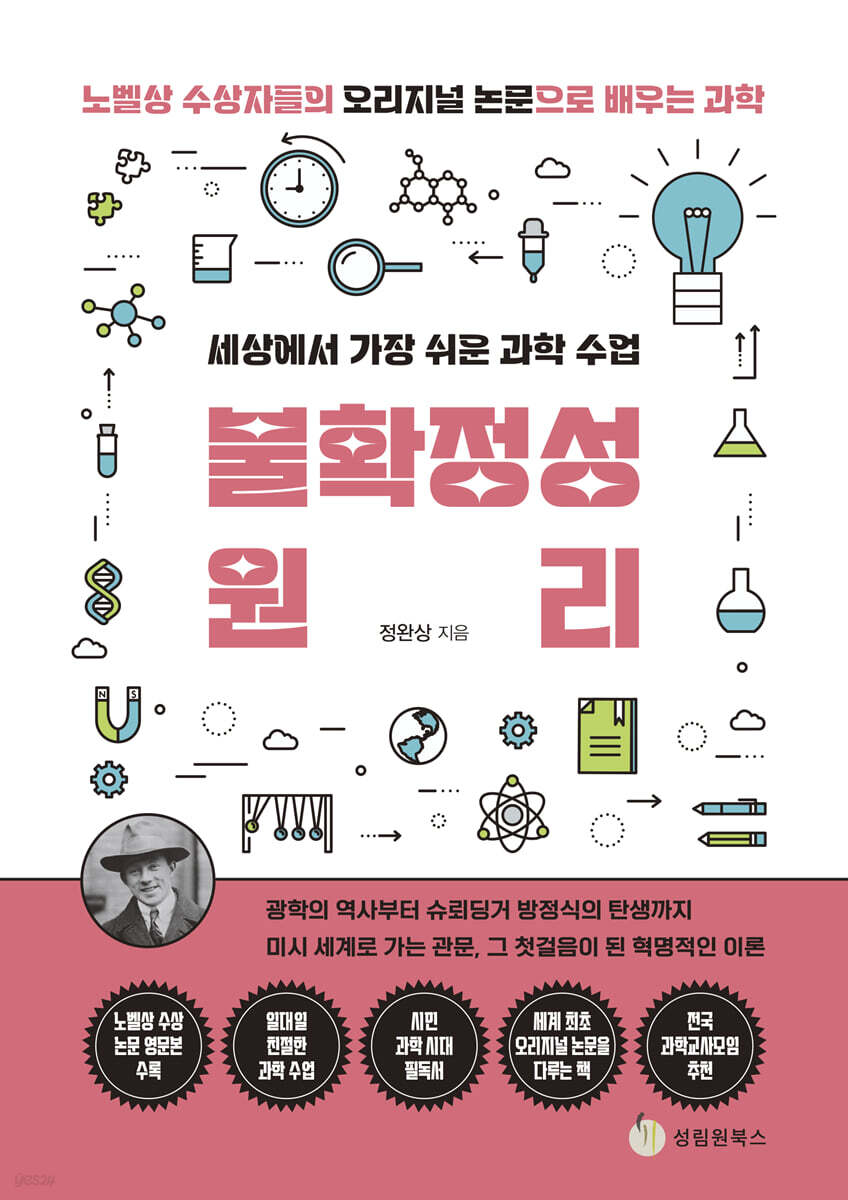
The World's Easiest Science Lesson: The Uncertainty Principle
 |
Description
Book Introduction
From the history of optics to the birth of the Schrödinger equation
Let's delve into the groundbreaking paper that opened the door to quantum mechanics!
The uncertainty principle, which opened the door to quantum mechanics and the exploration of the microscopic world.
Into the revolutionary paper that ushered in a new era of science!
The fifth book in the [Learn Science with Original Papers from Nobel Prize Winners] series.
This book covers in detail the birth of quantum mechanics, focusing on Heisenberg's uncertainty principle, which opened the door to quantum mechanics.
While solving the paper, we do not ignore the formulas, but help with understanding naturally along with the historical background of the theory.
The three years from 1924 to 1926 were a formative period for quantum mechanics, with many excellent theoretical physicists emerging.
This book introduces, in order, de Broglie's 1924 paper on matter waves, Heisenberg's 1925 paper on the uncertainty principle, Born and Jordan's 1925 paper on the uncertainty principle, and Schrödinger's 1926 paper on the Schrödinger equation.
To help readers understand, I started the story with the history of optics.
The debate over whether light is a particle or a wave has been going on for a very long time.
De Broglie's theory of matter waves, which put an end to it, played a major role in Heisenberg's publication of his paper on the uncertainty principle the following year.
The story of Born and Jordan, who studied the uncertainty principle around the same time as Heisenberg, was also included.
Additionally, it helped me understand the papers presented in the book by explaining the history of Fourier series and analytical mechanics, which I learned in my second year of college, using high school level mathematics.
This book will provide an opportunity to reflect on the mindset we should have as we dream of winning the Nobel Prize in science by examining the stories of the early heroes of quantum mechanics along with their papers.
Let's delve into the groundbreaking paper that opened the door to quantum mechanics!
The uncertainty principle, which opened the door to quantum mechanics and the exploration of the microscopic world.
Into the revolutionary paper that ushered in a new era of science!
The fifth book in the [Learn Science with Original Papers from Nobel Prize Winners] series.
This book covers in detail the birth of quantum mechanics, focusing on Heisenberg's uncertainty principle, which opened the door to quantum mechanics.
While solving the paper, we do not ignore the formulas, but help with understanding naturally along with the historical background of the theory.
The three years from 1924 to 1926 were a formative period for quantum mechanics, with many excellent theoretical physicists emerging.
This book introduces, in order, de Broglie's 1924 paper on matter waves, Heisenberg's 1925 paper on the uncertainty principle, Born and Jordan's 1925 paper on the uncertainty principle, and Schrödinger's 1926 paper on the Schrödinger equation.
To help readers understand, I started the story with the history of optics.
The debate over whether light is a particle or a wave has been going on for a very long time.
De Broglie's theory of matter waves, which put an end to it, played a major role in Heisenberg's publication of his paper on the uncertainty principle the following year.
The story of Born and Jordan, who studied the uncertainty principle around the same time as Heisenberg, was also included.
Additionally, it helped me understand the papers presented in the book by explaining the history of Fourier series and analytical mechanics, which I learned in my second year of college, using high school level mathematics.
This book will provide an opportunity to reflect on the mindset we should have as we dream of winning the Nobel Prize in science by examining the stories of the early heroes of quantum mechanics along with their papers.
- You can preview some of the book's contents.
Preview
index
Recommendation
I hope you can understand the original papers of these genius scientists.
Opening the Door to Quantum Mechanics: A Surprise Interview with Dr. Feynman
First Encounter│History of Optics
Snell's Law: Reflection and Refraction of Light
Fermat's principle of least time - Proving Snell's law
Hooke's Law and Simple Vibration _ Let's go back to the beginning!
Newton's particle theory and Huygens' wave theory: Is light a particle or a wave?
Young's Experiment and the Wave Theory of Light: Observing Bright and Dark Patterns
The discovery of electromagnetic waves and the beginning of wireless communication
Second Encounter│The Duality of Matter
De Broglie asserts the duality of matter - both wave and particle properties!
Matter waves and Bohr's atomic model: Conditions for non-annihilation of waves
The Discovery of Matter Waves: A Great Mistake
Third Encounter│Fourier Series and Fourier Transforms
Euler's Formula: The Relationship Between Trigonometric and Exponential Functions
Fourier series _ Representing periodic functions as sines and cosines
Fourier series in complex numbers - Let's go one step further
Fourth Encounter│Inside the Uncertainty Principle Paper
Heisenberg's Young Years: The Eve of a New Quantum Theory
Heisenberg vs. Born: The Three Musketeers of Matrix Mechanics
Heisenberg's uncertainty principle: discontinuity versus continuity
Application of the new multiplication rule to Bohr's quantization conditions
Quantum monoharmonic oscillation problem - Discontinuous position shift in quantum theory
Born's uncertainty principle: focusing on position and velocity
Fifth Meeting│History of Interpretive Mechanics
Euler's Variational Calculus - Shortest Path Between Two Points
Lagrange's Analytical Mechanics: Applying Variational Calculus to Mechanics
Hamilton's Equations: Describing Dynamics in a Different Way
Hamilton-Jacobi equations _ equations satisfied by the action
The Sixth Meeting│The Birth of the Schrödinger Equation and the Completion of the Uncertainty Principle
Schrödinger's Appearance: The Discovery of a New Equation
Inside Schrödinger's Thesis: The Birth of the Equations That Govern Quantum Mechanics
Heisenberg-Born-Jordan relation and Schrödinger equation - look different, but are ultimately the same
Born's interpretation of probability and Ehrenfest's expected value: solving complex number problems
Schrödinger, Unraveling Monotonic Oscillations with Quantum Mechanics - In Search of One Answer
Completion of the uncertainty principle: simultaneous and accurate measurements are impossible.
Heisenberg's Lecture: A Virtual Experiment of Viewing Objects Through a Microscope
In addition to the meeting
On the Quantum Reinterpretation of Kinematical and Mechanical Relationships _ English version of Heisenberg's paper
An Undulatory Theory of the Mechanics of Atoms and Molecules _ Schrödinger's paper in English
Concluding our meeting with a great paper
Papers referenced for this book
Greek letters used in formulas
Introducing the Nobel Prize winners in Physics
I hope you can understand the original papers of these genius scientists.
Opening the Door to Quantum Mechanics: A Surprise Interview with Dr. Feynman
First Encounter│History of Optics
Snell's Law: Reflection and Refraction of Light
Fermat's principle of least time - Proving Snell's law
Hooke's Law and Simple Vibration _ Let's go back to the beginning!
Newton's particle theory and Huygens' wave theory: Is light a particle or a wave?
Young's Experiment and the Wave Theory of Light: Observing Bright and Dark Patterns
The discovery of electromagnetic waves and the beginning of wireless communication
Second Encounter│The Duality of Matter
De Broglie asserts the duality of matter - both wave and particle properties!
Matter waves and Bohr's atomic model: Conditions for non-annihilation of waves
The Discovery of Matter Waves: A Great Mistake
Third Encounter│Fourier Series and Fourier Transforms
Euler's Formula: The Relationship Between Trigonometric and Exponential Functions
Fourier series _ Representing periodic functions as sines and cosines
Fourier series in complex numbers - Let's go one step further
Fourth Encounter│Inside the Uncertainty Principle Paper
Heisenberg's Young Years: The Eve of a New Quantum Theory
Heisenberg vs. Born: The Three Musketeers of Matrix Mechanics
Heisenberg's uncertainty principle: discontinuity versus continuity
Application of the new multiplication rule to Bohr's quantization conditions
Quantum monoharmonic oscillation problem - Discontinuous position shift in quantum theory
Born's uncertainty principle: focusing on position and velocity
Fifth Meeting│History of Interpretive Mechanics
Euler's Variational Calculus - Shortest Path Between Two Points
Lagrange's Analytical Mechanics: Applying Variational Calculus to Mechanics
Hamilton's Equations: Describing Dynamics in a Different Way
Hamilton-Jacobi equations _ equations satisfied by the action
The Sixth Meeting│The Birth of the Schrödinger Equation and the Completion of the Uncertainty Principle
Schrödinger's Appearance: The Discovery of a New Equation
Inside Schrödinger's Thesis: The Birth of the Equations That Govern Quantum Mechanics
Heisenberg-Born-Jordan relation and Schrödinger equation - look different, but are ultimately the same
Born's interpretation of probability and Ehrenfest's expected value: solving complex number problems
Schrödinger, Unraveling Monotonic Oscillations with Quantum Mechanics - In Search of One Answer
Completion of the uncertainty principle: simultaneous and accurate measurements are impossible.
Heisenberg's Lecture: A Virtual Experiment of Viewing Objects Through a Microscope
In addition to the meeting
On the Quantum Reinterpretation of Kinematical and Mechanical Relationships _ English version of Heisenberg's paper
An Undulatory Theory of the Mechanics of Atoms and Molecules _ Schrödinger's paper in English
Concluding our meeting with a great paper
Papers referenced for this book
Greek letters used in formulas
Introducing the Nobel Prize winners in Physics
Detailed image
.jpg)
Into the book
After graduating from university, Fermat worked as a lawyer in Bordeaux, western France.
During this time, I read many books, and after reading the treatises of the ancient Greek mathematician Apollonius, I fell in love with the beauty of mathematics.
After that, I started studying mathematics as a hobby and delved deeper into it.
And he exchanged letters with famous mathematicians such as Descartes and Mersenne.
--- p.28
Napoleon, who loved mathematics and science, was friendly with mathematicians, and Fourier was one of his favorite mathematicians.
Fourier accompanied Napoleon on his expedition to Egypt in 1798 as a scientific advisor.
He was also appointed secretary at the Egyptian Institute (Cairo Institute) established by Napoleon in Cairo, where he conducted mathematical research.
--- p.95
Upon his return to Göttingen, he handed the paper, which had not yet been submitted to a journal, to his colleague Born for reading in early July.
And he said this.
“The content of the paper is so revolutionary that I don’t have the confidence to submit it to an academic journal.”
--- p.117
Euler, who had been studying all day, continued to study even after losing the sight in his right eye, and eventually developed a cataract that made him lose the sight in his other eye.
So he lived blind for about 17 years from 1766 until his death.
Even after his blindness, Euler did not stop his research.
He did all the calculations in his head and published more papers than before he lost his eyesight.
--- p.153~154
The approaches to quantum mechanics of Heisenberg-Born-Jordan and Schrödinger were different.
Now physicists had to show that the two methods were equivalent.
That is, we had to prove that the Heisenberg-Born-Jordan relation and the Schrödinger equation are the same.
--- p.199
Schrödinger was not happy with the appearance of imaginary numbers in physics.
So I wrote it in the paper without using false numbers.
He thought that the wave function of the electron he had obtained had a physical meaning.
Later Schrödinger changed his mind.
That is, the necessity of imaginary numbers has been recognized in quantum mechanics.
--- p.202
Heisenberg described the uncertainty principle as follows:
“The position and momentum of an electron cannot be measured precisely at the same time.”
--- p.227
Because Planck's constant is so small, we cannot really feel the uncertainty principle in the world we live in (the macroscopic world).
However, in the very small world (microscopic world) where electrons live, the uncertainty principle plays a very important role.
During this time, I read many books, and after reading the treatises of the ancient Greek mathematician Apollonius, I fell in love with the beauty of mathematics.
After that, I started studying mathematics as a hobby and delved deeper into it.
And he exchanged letters with famous mathematicians such as Descartes and Mersenne.
--- p.28
Napoleon, who loved mathematics and science, was friendly with mathematicians, and Fourier was one of his favorite mathematicians.
Fourier accompanied Napoleon on his expedition to Egypt in 1798 as a scientific advisor.
He was also appointed secretary at the Egyptian Institute (Cairo Institute) established by Napoleon in Cairo, where he conducted mathematical research.
--- p.95
Upon his return to Göttingen, he handed the paper, which had not yet been submitted to a journal, to his colleague Born for reading in early July.
And he said this.
“The content of the paper is so revolutionary that I don’t have the confidence to submit it to an academic journal.”
--- p.117
Euler, who had been studying all day, continued to study even after losing the sight in his right eye, and eventually developed a cataract that made him lose the sight in his other eye.
So he lived blind for about 17 years from 1766 until his death.
Even after his blindness, Euler did not stop his research.
He did all the calculations in his head and published more papers than before he lost his eyesight.
--- p.153~154
The approaches to quantum mechanics of Heisenberg-Born-Jordan and Schrödinger were different.
Now physicists had to show that the two methods were equivalent.
That is, we had to prove that the Heisenberg-Born-Jordan relation and the Schrödinger equation are the same.
--- p.199
Schrödinger was not happy with the appearance of imaginary numbers in physics.
So I wrote it in the paper without using false numbers.
He thought that the wave function of the electron he had obtained had a physical meaning.
Later Schrödinger changed his mind.
That is, the necessity of imaginary numbers has been recognized in quantum mechanics.
--- p.202
Heisenberg described the uncertainty principle as follows:
“The position and momentum of an electron cannot be measured precisely at the same time.”
--- p.227
Because Planck's constant is so small, we cannot really feel the uncertainty principle in the world we live in (the macroscopic world).
However, in the very small world (microscopic world) where electrons live, the uncertainty principle plays a very important role.
--- p.228
Publisher's Review
★ Recommended by the National Science Teachers Association ★ A must-read for the era of citizen science
★ A must-read for those planning to pursue a science or engineering degree ★ The world's first book to feature original papers by a Nobel Prize winner
★ One-on-one friendly science classes ★ Original papers in English included
Quantum mechanics, which changed the world, began with the uncertainty principle.
The global competition surrounding quantum computers, dubbed “dream computers,” is intensifying.
While American companies such as Google and IBM are nearing commercialization, powerful countries such as China, Japan, and Europe are engaging in fierce competition.
Quantum computers are built on the theory of quantum mechanics, which deals with the microscopic world, such as atoms.
Quantum computers are already surpassing supercomputers in computational power, and industry is rapidly developing research to utilize them in AI, new drugs, space, and the military.
South Korea also plans to invest 3 trillion won with the goal of joining the ranks of the top four bilateral powers by 2035.
[Chosun Ilbo article, September 12, 2023]
The computers we use today are based on the binary system.
It is a method of recognizing and calculating either 0 or 1 as a unit of information.
However, the recently emerging quantum computer presents a new logic based on quantum mechanics in physics.
By applying the uncertainty principle of quantum mechanics, two states, 0 and 1, can be displayed simultaneously.
Thus, information processing capabilities are significantly faster than those of existing computers.
Problems that would take 10,000 years to solve with today's supercomputers can be solved in just a few hundred seconds.
Quantum mechanics has changed the world, and will continue to do so.
At the very beginning was Heisenberg's uncertainty principle.
Heisenberg's uncertainty principle, along with Schrödinger's equation, ushered in the era of quantum mechanics.
From then on, when dealing with the microscopic world, quantum mechanics, not classical physics, was used.
Quantum mechanics has been actively applied to the study of nuclei, solids, and stars, creating new fields of physics such as nuclear physics, solid-state physics, and stellar physics.
By reading this book, let's delve deeper into the uncertainty principle that opened a new era in science.
Digging deep into the revolutionary paper that laid the foundation for quantum mechanics.
“The content of the paper is so revolutionary that I don’t have the confidence to submit it to a journal.” - Heisenberg
“If anyone is not puzzled by quantum mechanics, he does not really understand it.” - Bohr
It is not easy to properly understand the uncertainty principle, which is the foundation of quantum mechanics.
However, if we just skim over it, the uncertainty principle is a very core theory in quantum mechanics.
《The World's Easiest Science Lesson: The Uncertainty Principle》 is an effort to kill two birds with one stone: science and history.
First, we started with the story of the history of optics, which served as the background for establishing the theory in order to properly approach the uncertainty principle.
The particle and wave theories of light, and de Broglie's theory of matter waves that put an end to them.
These make it easier to get into the uncertainty principle.
Additionally, to help understand the central Heisenberg and Schrödinger papers of the book, explanations of Fourier series and analytical mechanics have been added.
The main feature of this book is that it does not simply explain the historical facts or background of the great Nobel Prize-winning theories, but directly challenges the formulas that are at the core of the thesis.
So, the purpose is to feel the spirit of the scientist who achieved this outstanding achievement and to take a step forward toward the Nobel Prize in Science.
In addition, we made it easier to approach the subject by teaching it step-by-step through one-on-one conversations between professors and students.
Heisenberg, the ideal talent for this era, who combines science and philosophy.
This book also introduces the life of Heisenberg, the central figure.
Contrary to the stereotype that some might have of him being a theoretical physicist, he was a skilled piano player and received a considerable amount of philosophical education from a young age.
His famous books include “Physics and Philosophy” and “The Part and the Whole.” In particular, “The Part and the Whole” deals with various philosophical, ethical, social, political, and religious topics raised in quantum mechanics.
Perhaps this convergence of science and philosophy influenced the bold breaking of the framework of classical science? Heisenberg, indeed, embodies the ideal talent our times demand.
I hope that readers will also feel the need for convergent thinking through his life and develop the power of thinking to view the world in a broader way.
★ A must-read for those planning to pursue a science or engineering degree ★ The world's first book to feature original papers by a Nobel Prize winner
★ One-on-one friendly science classes ★ Original papers in English included
Quantum mechanics, which changed the world, began with the uncertainty principle.
The global competition surrounding quantum computers, dubbed “dream computers,” is intensifying.
While American companies such as Google and IBM are nearing commercialization, powerful countries such as China, Japan, and Europe are engaging in fierce competition.
Quantum computers are built on the theory of quantum mechanics, which deals with the microscopic world, such as atoms.
Quantum computers are already surpassing supercomputers in computational power, and industry is rapidly developing research to utilize them in AI, new drugs, space, and the military.
South Korea also plans to invest 3 trillion won with the goal of joining the ranks of the top four bilateral powers by 2035.
[Chosun Ilbo article, September 12, 2023]
The computers we use today are based on the binary system.
It is a method of recognizing and calculating either 0 or 1 as a unit of information.
However, the recently emerging quantum computer presents a new logic based on quantum mechanics in physics.
By applying the uncertainty principle of quantum mechanics, two states, 0 and 1, can be displayed simultaneously.
Thus, information processing capabilities are significantly faster than those of existing computers.
Problems that would take 10,000 years to solve with today's supercomputers can be solved in just a few hundred seconds.
Quantum mechanics has changed the world, and will continue to do so.
At the very beginning was Heisenberg's uncertainty principle.
Heisenberg's uncertainty principle, along with Schrödinger's equation, ushered in the era of quantum mechanics.
From then on, when dealing with the microscopic world, quantum mechanics, not classical physics, was used.
Quantum mechanics has been actively applied to the study of nuclei, solids, and stars, creating new fields of physics such as nuclear physics, solid-state physics, and stellar physics.
By reading this book, let's delve deeper into the uncertainty principle that opened a new era in science.
Digging deep into the revolutionary paper that laid the foundation for quantum mechanics.
“The content of the paper is so revolutionary that I don’t have the confidence to submit it to a journal.” - Heisenberg
“If anyone is not puzzled by quantum mechanics, he does not really understand it.” - Bohr
It is not easy to properly understand the uncertainty principle, which is the foundation of quantum mechanics.
However, if we just skim over it, the uncertainty principle is a very core theory in quantum mechanics.
《The World's Easiest Science Lesson: The Uncertainty Principle》 is an effort to kill two birds with one stone: science and history.
First, we started with the story of the history of optics, which served as the background for establishing the theory in order to properly approach the uncertainty principle.
The particle and wave theories of light, and de Broglie's theory of matter waves that put an end to them.
These make it easier to get into the uncertainty principle.
Additionally, to help understand the central Heisenberg and Schrödinger papers of the book, explanations of Fourier series and analytical mechanics have been added.
The main feature of this book is that it does not simply explain the historical facts or background of the great Nobel Prize-winning theories, but directly challenges the formulas that are at the core of the thesis.
So, the purpose is to feel the spirit of the scientist who achieved this outstanding achievement and to take a step forward toward the Nobel Prize in Science.
In addition, we made it easier to approach the subject by teaching it step-by-step through one-on-one conversations between professors and students.
Heisenberg, the ideal talent for this era, who combines science and philosophy.
This book also introduces the life of Heisenberg, the central figure.
Contrary to the stereotype that some might have of him being a theoretical physicist, he was a skilled piano player and received a considerable amount of philosophical education from a young age.
His famous books include “Physics and Philosophy” and “The Part and the Whole.” In particular, “The Part and the Whole” deals with various philosophical, ethical, social, political, and religious topics raised in quantum mechanics.
Perhaps this convergence of science and philosophy influenced the bold breaking of the framework of classical science? Heisenberg, indeed, embodies the ideal talent our times demand.
I hope that readers will also feel the need for convergent thinking through his life and develop the power of thinking to view the world in a broader way.
GOODS SPECIFICS
- Date of issue: November 6, 2023
- Page count, weight, size: 288 pages | 152*215*20mm
- ISBN13: 9791193357194
- ISBN10: 1193357195
You may also like
카테고리
korean


korean

![GQ KOREA Mark (Monthly): December [2025]](http://librairie.coreenne.fr/cdn/shop/files/8ef265dbbfbf186523ed75ba7319009d.jpg?v=1765340328&width=3840)


