

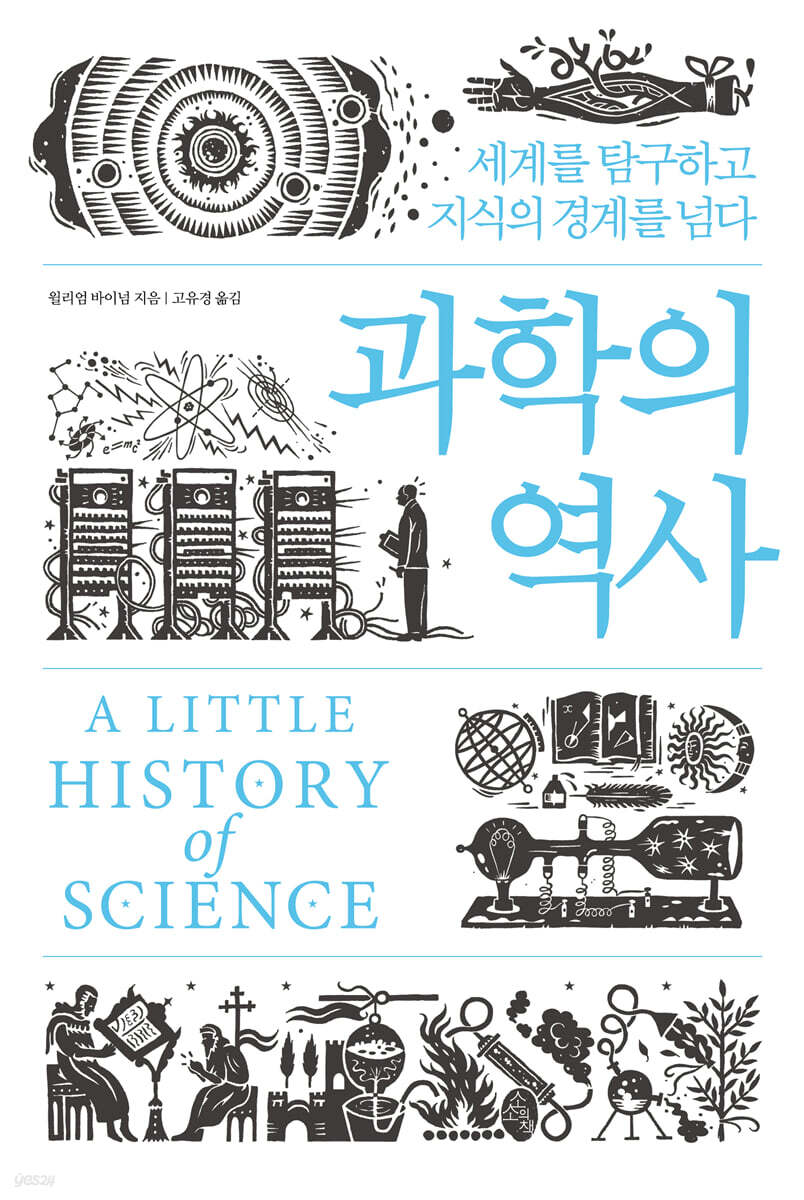
History of Science
 |
Description
Book Introduction
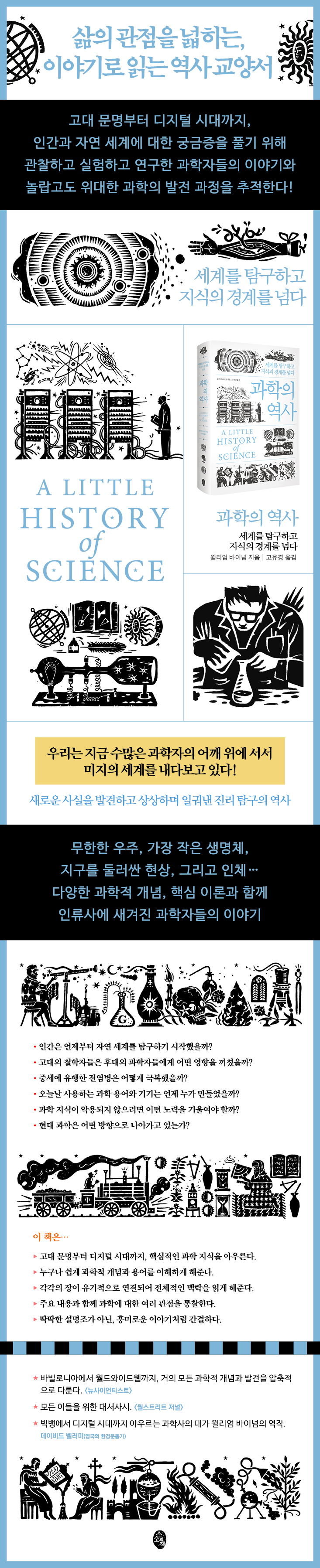
From ancient civilizations to the digital age,
Scientific concepts and scientists who have driven human history
A masterpiece that concisely outlines important events and key concepts in the history of science.
Science is always wonderful and exciting.
Our curiosity about the world we live in, about humanity, and our endless imagination have served as the driving force behind scientific advancement.
In ancient times, magic, religion, technology, and science were intertwined, but from the Dark Ages to the modern era, when science has become increasingly specialized, science has achieved remarkable results.
Science has made tremendous progress, including debates surrounding the Earth and the universe, the composition and working principles of the human body, the Newtonian revolution, the study of elements and radioactivity, the theory of relativity, the Big Bang, and the Internet and computer revolutions.
This book clearly covers such important points in the history of science and contains the stories of scientists who established a wide range of knowledge and theories through continuous research.
Scientific concepts and scientists who have driven human history
A masterpiece that concisely outlines important events and key concepts in the history of science.
Science is always wonderful and exciting.
Our curiosity about the world we live in, about humanity, and our endless imagination have served as the driving force behind scientific advancement.
In ancient times, magic, religion, technology, and science were intertwined, but from the Dark Ages to the modern era, when science has become increasingly specialized, science has achieved remarkable results.
Science has made tremendous progress, including debates surrounding the Earth and the universe, the composition and working principles of the human body, the Newtonian revolution, the study of elements and radioactivity, the theory of relativity, the Big Bang, and the Internet and computer revolutions.
This book clearly covers such important points in the history of science and contains the stories of scientists who established a wide range of knowledge and theories through continuous research.
- You can preview some of the book's contents.
Preview
index
1. The First Step to Science
2 needles and numbers
3 atoms and space
4. Father of Medicine _ Hippocrates
5. Teacher of Intellectuals _ Aristotle
6 Emperor's Physician _ Galen
7 Islamic Science
8 Out of the Darkness
9 In Search of the Philosopher's Stone
10 Uncovering the Secrets of the Human Body
11 Where is the center of the universe?
12 Towers and Telescopes │Galileo
13 Round and Round _ Harvey
14 Knowledge is power _ Bacon and Descartes
15 New Chemistry
16 What goes up must come down _ Newton
17 Bright Flames
18 The Clockwork Universe
19 World Order
20 Air and Gases
21 The very small particles that make up matter
22 Forces, Fields, and Magnetism
23 Dinosaur Excavation
24 History of Earth
25 The Greatest Show on Earth
26 A little box filled with life
27 Coughing, Sneezing, and Illness
28 Engines and Energy
Table of 29 elements
Into the 30 atoms
31 Radiation
32 Changing the Game _ Einstein
33 Moving Continents
34 What Do We Inherit?
35 Human Studies
36 Miracle Medicine
37 Components of the human body
38 Reading the 'Book of Life' _ The Human Genome Project
39 Big Bang
40 Science in the Digital Age
Translator's Note
Search
2 needles and numbers
3 atoms and space
4. Father of Medicine _ Hippocrates
5. Teacher of Intellectuals _ Aristotle
6 Emperor's Physician _ Galen
7 Islamic Science
8 Out of the Darkness
9 In Search of the Philosopher's Stone
10 Uncovering the Secrets of the Human Body
11 Where is the center of the universe?
12 Towers and Telescopes │Galileo
13 Round and Round _ Harvey
14 Knowledge is power _ Bacon and Descartes
15 New Chemistry
16 What goes up must come down _ Newton
17 Bright Flames
18 The Clockwork Universe
19 World Order
20 Air and Gases
21 The very small particles that make up matter
22 Forces, Fields, and Magnetism
23 Dinosaur Excavation
24 History of Earth
25 The Greatest Show on Earth
26 A little box filled with life
27 Coughing, Sneezing, and Illness
28 Engines and Energy
Table of 29 elements
Into the 30 atoms
31 Radiation
32 Changing the Game _ Einstein
33 Moving Continents
34 What Do We Inherit?
35 Human Studies
36 Miracle Medicine
37 Components of the human body
38 Reading the 'Book of Life' _ The Human Genome Project
39 Big Bang
40 Science in the Digital Age
Translator's Note
Search
Detailed image
Into the book
Aristotle spent a lot of time trying to figure out what plants and animals were made of and how they functioned.
He wanted to know how plants and animals grow before they come into the world, that is, before they hatch or germinate.
Although he didn't have a microscope, he must have had good eyesight.
Aristotle described in detail the process by which a chick grows from an egg.
After preparing the eggs laid by the chickens at the same time, I broke them one by one each day.
The first sign of life discovered was a tiny drop of blood beating in what would become the chick's heart.
Aristotle witnessed this and came to consider the heart as the vital organ of animals.
He believed that the heart served as the center of emotions and mental functions.
Plato and the Hippocratic scholars thought that such mental functions were performed in the brain, and in fact they were right.
However, Aristotle's theory is not entirely foolish, as our hearts beat faster when we are scared, nervous, or in love.
Aristotle believed that the functions of higher animals such as humans were the result of the operation of a 'soul' with various abilities.
The human soul has six main functions: nutrition, reproduction, sensation, desire, movement, imagination, and reason.
---From "The Teachers of the Four Intellectuals"
It is not known exactly when Copernicus first claimed that his model of the universe, now called the "solar model," better explained thousands of years of accumulated observations.
However, in 1514, after writing a short manuscript, Copernicus showed it to a few trusted friends, not daring to publish it.
The manuscript clearly stated that 'the center of the Earth is not the center of the universe' and that 'we revolve around the sun like other planets.'
This claim was quite firm, and for the next 30 years Copernicus quietly worked on his theory that the Sun, not the Earth, was at the center of the universe.
While he spent a lot of time observing the sky directly, he also looked at the observations of other astronomers and tried his best to solve the problems with existing theories by assuming that the planets revolved around the sun.
As a result, mysteries such as the phenomenon of eclipses and the motion of planets in transit or retrograde motion were solved.
Moreover, because the sun plays a very important role in human life, providing warmth and light, the view that puts the sun at the center meant acknowledging that life on Earth could not exist without the sun.
---From "Where is the center of the universe?"
During this time of plague, Newton was also studying mechanics, the laws that govern moving objects.
Earlier we looked at how Galileo, Kepler, Descartes, and others developed their ideas to explain and mathematically solve what happens when a cannonball is fired or when the Earth revolves around the Sun.
Robert Hooke was also interested in this issue.
Newton went one step further by reading the books of these scholars.
Newton wrote to Hooke:
"If I've seen further, it's because I stood on the shoulders of giants." Remember standing on your parents' shoulders? Suddenly, you feel two or three times taller, revealing things you couldn't see on your own.
That's exactly what Newton was after.
Newton's wonderful analogy illustrates how each scientist and each generation of scientists benefit from the insights of previous generations.
This is the essence of science.
---From "'16 What Goes Up Must Fall'"
Darwin made biological evolution a valid scientific theory.
Some scientists were unconvinced, but most accepted it and even proposed their own theories about how and why biological evolution occurred.
Many of the details of Darwin's great book have been revised by later scientific research.
It wasn't perfect.
But it didn't have to be perfect.
That's what science is.
In his study and garden at Down House, Darwin became convinced that we would never again look at life on Earth in quite the same way.
The evolutionary history of our planet has been nothing short of the greatest show on Earth.
---From "25 The Greatest Show on Earth"
By the 1850s, chemistry had reached maturity.
During this exciting time, there was much debate about what atomic weight was, how molecules, which are groups of atoms, bond together, and what the difference was between 'organic' and 'inorganic' compounds.
In 1860, an event occurred that helped modernize chemistry.
It may seem quite ordinary today, but it was unusual at the time.
An international conference was held right away.
In a time before telephones or email and travel was difficult, scientists rarely met in person and usually communicated only by letter.
It was rare for a scientist from abroad to present his research results and then engage in a public discussion with an audience.
As travel by train and steamship became more common in the 1850s, international conferences began to be held, where people could meet and talk with colleagues from other countries.
The international conference announced a belief widely shared in the scientific community.
Science was said to be objective and universal, transcending religion and politics, which often divide societies and plunge nations into the maelstrom of war.
---From "Table of 29 Elements"
Tools and techniques used on animals like horses and hippos are used to reconstruct the human family tree using fossils from different eras and locations.
Of course, if it's a human and not a hippopotamus, emotions are much more involved.
But the evidence is there, and experts including paleontologists, anthropologists, and archaeologists are continuing to piece together the pieces.
The researchers finally concluded that hominins like Homo sapiens initially lived in Africa and gradually spread to other regions.
Much remains unknown about the migrations of these early hominins.
Could we have migrated from Africa multiple times? How could the large brains that distinguish our species from our cousins have evolved so quickly? Science deals with "how," not "why."
This seems especially true when we think of the human family tree or, as Huxley put it, 'man's place in nature'.
He wanted to know how plants and animals grow before they come into the world, that is, before they hatch or germinate.
Although he didn't have a microscope, he must have had good eyesight.
Aristotle described in detail the process by which a chick grows from an egg.
After preparing the eggs laid by the chickens at the same time, I broke them one by one each day.
The first sign of life discovered was a tiny drop of blood beating in what would become the chick's heart.
Aristotle witnessed this and came to consider the heart as the vital organ of animals.
He believed that the heart served as the center of emotions and mental functions.
Plato and the Hippocratic scholars thought that such mental functions were performed in the brain, and in fact they were right.
However, Aristotle's theory is not entirely foolish, as our hearts beat faster when we are scared, nervous, or in love.
Aristotle believed that the functions of higher animals such as humans were the result of the operation of a 'soul' with various abilities.
The human soul has six main functions: nutrition, reproduction, sensation, desire, movement, imagination, and reason.
---From "The Teachers of the Four Intellectuals"
It is not known exactly when Copernicus first claimed that his model of the universe, now called the "solar model," better explained thousands of years of accumulated observations.
However, in 1514, after writing a short manuscript, Copernicus showed it to a few trusted friends, not daring to publish it.
The manuscript clearly stated that 'the center of the Earth is not the center of the universe' and that 'we revolve around the sun like other planets.'
This claim was quite firm, and for the next 30 years Copernicus quietly worked on his theory that the Sun, not the Earth, was at the center of the universe.
While he spent a lot of time observing the sky directly, he also looked at the observations of other astronomers and tried his best to solve the problems with existing theories by assuming that the planets revolved around the sun.
As a result, mysteries such as the phenomenon of eclipses and the motion of planets in transit or retrograde motion were solved.
Moreover, because the sun plays a very important role in human life, providing warmth and light, the view that puts the sun at the center meant acknowledging that life on Earth could not exist without the sun.
---From "Where is the center of the universe?"
During this time of plague, Newton was also studying mechanics, the laws that govern moving objects.
Earlier we looked at how Galileo, Kepler, Descartes, and others developed their ideas to explain and mathematically solve what happens when a cannonball is fired or when the Earth revolves around the Sun.
Robert Hooke was also interested in this issue.
Newton went one step further by reading the books of these scholars.
Newton wrote to Hooke:
"If I've seen further, it's because I stood on the shoulders of giants." Remember standing on your parents' shoulders? Suddenly, you feel two or three times taller, revealing things you couldn't see on your own.
That's exactly what Newton was after.
Newton's wonderful analogy illustrates how each scientist and each generation of scientists benefit from the insights of previous generations.
This is the essence of science.
---From "'16 What Goes Up Must Fall'"
Darwin made biological evolution a valid scientific theory.
Some scientists were unconvinced, but most accepted it and even proposed their own theories about how and why biological evolution occurred.
Many of the details of Darwin's great book have been revised by later scientific research.
It wasn't perfect.
But it didn't have to be perfect.
That's what science is.
In his study and garden at Down House, Darwin became convinced that we would never again look at life on Earth in quite the same way.
The evolutionary history of our planet has been nothing short of the greatest show on Earth.
---From "25 The Greatest Show on Earth"
By the 1850s, chemistry had reached maturity.
During this exciting time, there was much debate about what atomic weight was, how molecules, which are groups of atoms, bond together, and what the difference was between 'organic' and 'inorganic' compounds.
In 1860, an event occurred that helped modernize chemistry.
It may seem quite ordinary today, but it was unusual at the time.
An international conference was held right away.
In a time before telephones or email and travel was difficult, scientists rarely met in person and usually communicated only by letter.
It was rare for a scientist from abroad to present his research results and then engage in a public discussion with an audience.
As travel by train and steamship became more common in the 1850s, international conferences began to be held, where people could meet and talk with colleagues from other countries.
The international conference announced a belief widely shared in the scientific community.
Science was said to be objective and universal, transcending religion and politics, which often divide societies and plunge nations into the maelstrom of war.
---From "Table of 29 Elements"
Tools and techniques used on animals like horses and hippos are used to reconstruct the human family tree using fossils from different eras and locations.
Of course, if it's a human and not a hippopotamus, emotions are much more involved.
But the evidence is there, and experts including paleontologists, anthropologists, and archaeologists are continuing to piece together the pieces.
The researchers finally concluded that hominins like Homo sapiens initially lived in Africa and gradually spread to other regions.
Much remains unknown about the migrations of these early hominins.
Could we have migrated from Africa multiple times? How could the large brains that distinguish our species from our cousins have evolved so quickly? Science deals with "how," not "why."
This seems especially true when we think of the human family tree or, as Huxley put it, 'man's place in nature'.
---From "35 Human Studies"
Publisher's Review
How was the foundation of scientific knowledge as we know it built?
“If I have seen further, it is because I have stood on the shoulders of giants.”
What is science? Throughout human history, science has been used to understand and control the world.
At first, technology focused on ‘action’ was more important than science, which pursues ‘knowledge.’
The most prominent 'science' fields were arithmetic, astronomy, and medicine.
If you wanted to grow crops, make clothes, or cook, you had to know how to do it.
There was no need to know 'why' some berries were poisonous or 'why' some plants were edible.
There was no need to know why the sun rose and set every morning and evening.
But humans not only had the ability to understand the world around them, they were also very curious.
That was the central axis of science.
This book clearly shows how the first steps in science, sparked by simple curiosity, have produced remarkable results.
From Copernicus to Galileo, science transformed the world over a century.
The Earth is no longer at the center of the universe, and new discoveries in anatomy, physiology, chemistry, and physics have shown that ancient people did not know everything.
Yet, there is still much to discover in the world.
And the pace of scientific advancement is accelerating, becoming more specialized, and the ways we research and communicate are constantly changing.
What the author wants to show in this book is that science at any moment in history is a product of that particular moment.
Hippocrates' moment was different from Galileo's or Lavoisier's.
They each dressed, ate, and thought like other people of their time, but they had the ability to think more sharply and communicate their thoughts.
That is why the thoughts and writings they left behind are worth remembering.
In fact, many of the scientific concepts, terms, and instruments we know and learn today are the result of individual scientists dedicating their lives to studying, observing, researching, and repeatedly failing.
So how do individual scientists and each generation of scientists benefit from the insights of previous generations, leading to new research results? This is the essence of science.
The representative scientist is Isaac Newton.
He was more creative than any other scientist and contributed immensely to our understanding of the universe.
His Principia was the pinnacle of astronomy and physics studied by many scholars, including Kepler, Galileo, and Descartes, and established the foundation of physics used by scientists until the 20th century, when people like Einstein showed that the universe held many more secrets.
In chemistry, Avogadro's theory solved many problems and is now the basis for understanding atoms.
Louis Pasteur's theories still play a central role in understanding the link between germs and disease and the role microorganisms play in many aspects of daily life.
Charles Darwin made biological evolution a valid scientific theory.
Although many of the details in his book have been revised by later scientific research, Darwin was convinced that we will never look at life on Earth in quite the same way again.
Einstein, who worked at a desk or blackboard rather than in a laboratory, completely changed the way we understand the universe.
The theory of relativity he presented revealed that in nature, not 'one or the other' but 'both' is possible, as in the case of mass and energy, waves and particles, time and space.
In addition, this book concisely describes major events in the history of science and the foundations of scientific knowledge that are still in use today, such as nuclear physics and quantum physics, which were at the cutting edge of 20th century knowledge, Mendeleev's periodic table, research on X-rays and radioactivity, Wegener's theory of continental drift, the debate between the biometric and Mendelian schools, the discovery of insulin, the development of the atomic bomb, and the revolution of the World Wide Web and personal computers.
Meanwhile, the book also mentions the general changing aspects of modern science.
A representative example is the Human Genome Project (1990-2003).
The project was of such global interest that it became a symbol of modern science.
The cost was incomparably higher than before, involving thousands of researchers and computers, and concerns were raised about the commercial pursuit and hype surrounding science.
Modern science needs the help of collaborative research.
Nowadays, scientists rarely work alone.
It is quite common for scientific papers to have dozens or even hundreds of authors.
Research requires multiple individuals with different skills.
It was a long time ago that William Harvey studied the heart alone and Lavoisier worked in the laboratory with his wife as his only assistant.
As such, there is a high possibility that science and technology will be abused or misused rather than used for the public good.
Therefore, the author adds, we need a public eye to monitor whether science is being used to make the world we live in a better place.
We take a look at the surprising facts discovered by science and the development of scientific theories.
A vivid story of scientific events and characters that anyone can easily read.
In addition to specific scientific theories or discoveries, this book covers major events that have had a significant impact on scientific development or have led to new changes.
One of them is the 'Hippocratic Oath', which any medical school student has probably heard of at least once.
This oath, written over 2,000 years ago, speaks to the ethical behavior doctors should have toward their patients.
In particular, ‘acts that do not harm patients’ remain a goal that doctors must naturally pursue.
Lavoisier, known as the 'father of modern chemistry,' believed that the language used in chemistry must be precise.
The idea was to correctly refer to compounds and elements so that any chemist anywhere in the world could be sure they were dealing with the same substance.
Since then, chemists have increasingly begun to use a common chemical language.
Also of interest are when the microscope, which allows us to see the minute components of living things, began to be of great help in medical and biological research, and why chemists ignored Mendeleev's original periodic table.
In 1860, an event occurred that helped modernize chemistry.
An international conference was held right away.
In a time before telephones or email and travel was difficult, scientists rarely met in person and usually communicated only by letter.
It was rare for a scientist from abroad to present his research results and then engage in a public discussion with an audience.
As travel by train and steamship became more common in the 1850s, international conferences began to be held, where people could meet and talk with colleagues from other countries.
The international conference announced a belief widely shared in the scientific community.
Science was said to be objective and universal, transcending religion and politics, which often divide societies and plunge nations into the maelstrom of war.
Science has not always played a positive role.
In the 1930s, the German Nazi invasion of Europe and the rise of fascism in Italy led to a "brain drain" of many scientists leaving their homeland.
And many scientists participated in the Manhattan Project, which was carried out in secret in the United States, and World War II broke out, leading to the tragic situation of the atomic bomb being dropped.
As hundreds of thousands of civilians were sacrificed, people realized the power of science.
This made us keep in mind that as science advances, its risks also increase.
Science is dynamic, building on concepts and discoveries passed from one generation to the next, and making huge leaps forward when completely new facts are discovered.
Aristotle said, "All human beings instinctively want to know," and he always valued curiosity.
Charles Darwin, whose theory of evolution changed the way we think about ourselves, was also called a "man of curiosity."
We must also use our imagination to ‘break stereotypes.’
Of course, they conduct research in the lab, comparing and confirming their own ideas with the evidence before them, but all great scientists use their imagination.
Science deals with how, not why.
As in any scientific field, there are both religious and non-religious physicists and cosmologists.
That is science, and science can develop in an atmosphere where people are willing to accept objectively valid points while arguing with each other.
This book not only allows anyone to easily comprehend the vast history of science, but also provides ample room for reflection on what constitutes a proper scientific spirit and how the nature and requirements of scientific development have changed over time.
Since ancient times, the passion and spirit of inquiry of countless scientists have accumulated to create the rich scientific knowledge we know today.
Through a series of processes of observing the world invisible to the naked eye, digging underground to find fossils of plants and animals, discovering patterns and consistencies to create formulas that can be calculated, and publicizing and persuading people to change their perceptions, science has established a more solid body of knowledge.
It would be very meaningful to entrust oneself to this great historical flow through this book and to estimate the future course of scientific development.
From Babylonia to the World Wide Web, it covers most major scientific fields while concisely covering virtually every scientific concept and discovery.
- [New Scientist]
An epic for everyone.
The vividness felt in the writing comes from the author's clean sentences and efficient narrative sense that convey important scientific events for humanity.
- [Wall Street Journal]
William Bynum guides us to understand with a warm heart how 'difficult' past scientific advances were and to be generous in forgiving historical errors.
- [Guardian]
Thoughtful and lucid, anyone can join us on this special journey from ignorance to intelligence.
- [BBC Focus]
William Bynum is a great guide who believes that fostering a spirit of inquiry is more valuable than providing definitive answers.
- [History Today]
A fun history for curious teens and adult readers.
- [Publisher's Weekly]
It is an introductory book to science that is easily accessible to everyone.
- [Booklist]
“If I have seen further, it is because I have stood on the shoulders of giants.”
What is science? Throughout human history, science has been used to understand and control the world.
At first, technology focused on ‘action’ was more important than science, which pursues ‘knowledge.’
The most prominent 'science' fields were arithmetic, astronomy, and medicine.
If you wanted to grow crops, make clothes, or cook, you had to know how to do it.
There was no need to know 'why' some berries were poisonous or 'why' some plants were edible.
There was no need to know why the sun rose and set every morning and evening.
But humans not only had the ability to understand the world around them, they were also very curious.
That was the central axis of science.
This book clearly shows how the first steps in science, sparked by simple curiosity, have produced remarkable results.
From Copernicus to Galileo, science transformed the world over a century.
The Earth is no longer at the center of the universe, and new discoveries in anatomy, physiology, chemistry, and physics have shown that ancient people did not know everything.
Yet, there is still much to discover in the world.
And the pace of scientific advancement is accelerating, becoming more specialized, and the ways we research and communicate are constantly changing.
What the author wants to show in this book is that science at any moment in history is a product of that particular moment.
Hippocrates' moment was different from Galileo's or Lavoisier's.
They each dressed, ate, and thought like other people of their time, but they had the ability to think more sharply and communicate their thoughts.
That is why the thoughts and writings they left behind are worth remembering.
In fact, many of the scientific concepts, terms, and instruments we know and learn today are the result of individual scientists dedicating their lives to studying, observing, researching, and repeatedly failing.
So how do individual scientists and each generation of scientists benefit from the insights of previous generations, leading to new research results? This is the essence of science.
The representative scientist is Isaac Newton.
He was more creative than any other scientist and contributed immensely to our understanding of the universe.
His Principia was the pinnacle of astronomy and physics studied by many scholars, including Kepler, Galileo, and Descartes, and established the foundation of physics used by scientists until the 20th century, when people like Einstein showed that the universe held many more secrets.
In chemistry, Avogadro's theory solved many problems and is now the basis for understanding atoms.
Louis Pasteur's theories still play a central role in understanding the link between germs and disease and the role microorganisms play in many aspects of daily life.
Charles Darwin made biological evolution a valid scientific theory.
Although many of the details in his book have been revised by later scientific research, Darwin was convinced that we will never look at life on Earth in quite the same way again.
Einstein, who worked at a desk or blackboard rather than in a laboratory, completely changed the way we understand the universe.
The theory of relativity he presented revealed that in nature, not 'one or the other' but 'both' is possible, as in the case of mass and energy, waves and particles, time and space.
In addition, this book concisely describes major events in the history of science and the foundations of scientific knowledge that are still in use today, such as nuclear physics and quantum physics, which were at the cutting edge of 20th century knowledge, Mendeleev's periodic table, research on X-rays and radioactivity, Wegener's theory of continental drift, the debate between the biometric and Mendelian schools, the discovery of insulin, the development of the atomic bomb, and the revolution of the World Wide Web and personal computers.
Meanwhile, the book also mentions the general changing aspects of modern science.
A representative example is the Human Genome Project (1990-2003).
The project was of such global interest that it became a symbol of modern science.
The cost was incomparably higher than before, involving thousands of researchers and computers, and concerns were raised about the commercial pursuit and hype surrounding science.
Modern science needs the help of collaborative research.
Nowadays, scientists rarely work alone.
It is quite common for scientific papers to have dozens or even hundreds of authors.
Research requires multiple individuals with different skills.
It was a long time ago that William Harvey studied the heart alone and Lavoisier worked in the laboratory with his wife as his only assistant.
As such, there is a high possibility that science and technology will be abused or misused rather than used for the public good.
Therefore, the author adds, we need a public eye to monitor whether science is being used to make the world we live in a better place.
We take a look at the surprising facts discovered by science and the development of scientific theories.
A vivid story of scientific events and characters that anyone can easily read.
In addition to specific scientific theories or discoveries, this book covers major events that have had a significant impact on scientific development or have led to new changes.
One of them is the 'Hippocratic Oath', which any medical school student has probably heard of at least once.
This oath, written over 2,000 years ago, speaks to the ethical behavior doctors should have toward their patients.
In particular, ‘acts that do not harm patients’ remain a goal that doctors must naturally pursue.
Lavoisier, known as the 'father of modern chemistry,' believed that the language used in chemistry must be precise.
The idea was to correctly refer to compounds and elements so that any chemist anywhere in the world could be sure they were dealing with the same substance.
Since then, chemists have increasingly begun to use a common chemical language.
Also of interest are when the microscope, which allows us to see the minute components of living things, began to be of great help in medical and biological research, and why chemists ignored Mendeleev's original periodic table.
In 1860, an event occurred that helped modernize chemistry.
An international conference was held right away.
In a time before telephones or email and travel was difficult, scientists rarely met in person and usually communicated only by letter.
It was rare for a scientist from abroad to present his research results and then engage in a public discussion with an audience.
As travel by train and steamship became more common in the 1850s, international conferences began to be held, where people could meet and talk with colleagues from other countries.
The international conference announced a belief widely shared in the scientific community.
Science was said to be objective and universal, transcending religion and politics, which often divide societies and plunge nations into the maelstrom of war.
Science has not always played a positive role.
In the 1930s, the German Nazi invasion of Europe and the rise of fascism in Italy led to a "brain drain" of many scientists leaving their homeland.
And many scientists participated in the Manhattan Project, which was carried out in secret in the United States, and World War II broke out, leading to the tragic situation of the atomic bomb being dropped.
As hundreds of thousands of civilians were sacrificed, people realized the power of science.
This made us keep in mind that as science advances, its risks also increase.
Science is dynamic, building on concepts and discoveries passed from one generation to the next, and making huge leaps forward when completely new facts are discovered.
Aristotle said, "All human beings instinctively want to know," and he always valued curiosity.
Charles Darwin, whose theory of evolution changed the way we think about ourselves, was also called a "man of curiosity."
We must also use our imagination to ‘break stereotypes.’
Of course, they conduct research in the lab, comparing and confirming their own ideas with the evidence before them, but all great scientists use their imagination.
Science deals with how, not why.
As in any scientific field, there are both religious and non-religious physicists and cosmologists.
That is science, and science can develop in an atmosphere where people are willing to accept objectively valid points while arguing with each other.
This book not only allows anyone to easily comprehend the vast history of science, but also provides ample room for reflection on what constitutes a proper scientific spirit and how the nature and requirements of scientific development have changed over time.
Since ancient times, the passion and spirit of inquiry of countless scientists have accumulated to create the rich scientific knowledge we know today.
Through a series of processes of observing the world invisible to the naked eye, digging underground to find fossils of plants and animals, discovering patterns and consistencies to create formulas that can be calculated, and publicizing and persuading people to change their perceptions, science has established a more solid body of knowledge.
It would be very meaningful to entrust oneself to this great historical flow through this book and to estimate the future course of scientific development.
From Babylonia to the World Wide Web, it covers most major scientific fields while concisely covering virtually every scientific concept and discovery.
- [New Scientist]
An epic for everyone.
The vividness felt in the writing comes from the author's clean sentences and efficient narrative sense that convey important scientific events for humanity.
- [Wall Street Journal]
William Bynum guides us to understand with a warm heart how 'difficult' past scientific advances were and to be generous in forgiving historical errors.
- [Guardian]
Thoughtful and lucid, anyone can join us on this special journey from ignorance to intelligence.
- [BBC Focus]
William Bynum is a great guide who believes that fostering a spirit of inquiry is more valuable than providing definitive answers.
- [History Today]
A fun history for curious teens and adult readers.
- [Publisher's Weekly]
It is an introductory book to science that is easily accessible to everyone.
- [Booklist]
GOODS SPECIFICS
- Date of issue: June 26, 2023
- Format: Hardcover book binding method guide
- Page count, weight, size: 368 pages | 610g | 145*218*26mm
- ISBN13: 9791188941957
- ISBN10: 118894195X
You may also like
카테고리
korean


korean

![GQ KOREA Mark (Monthly): December [2025]](http://librairie.coreenne.fr/cdn/shop/files/8ef265dbbfbf186523ed75ba7319009d.jpg?v=1765340328&width=3840)


