

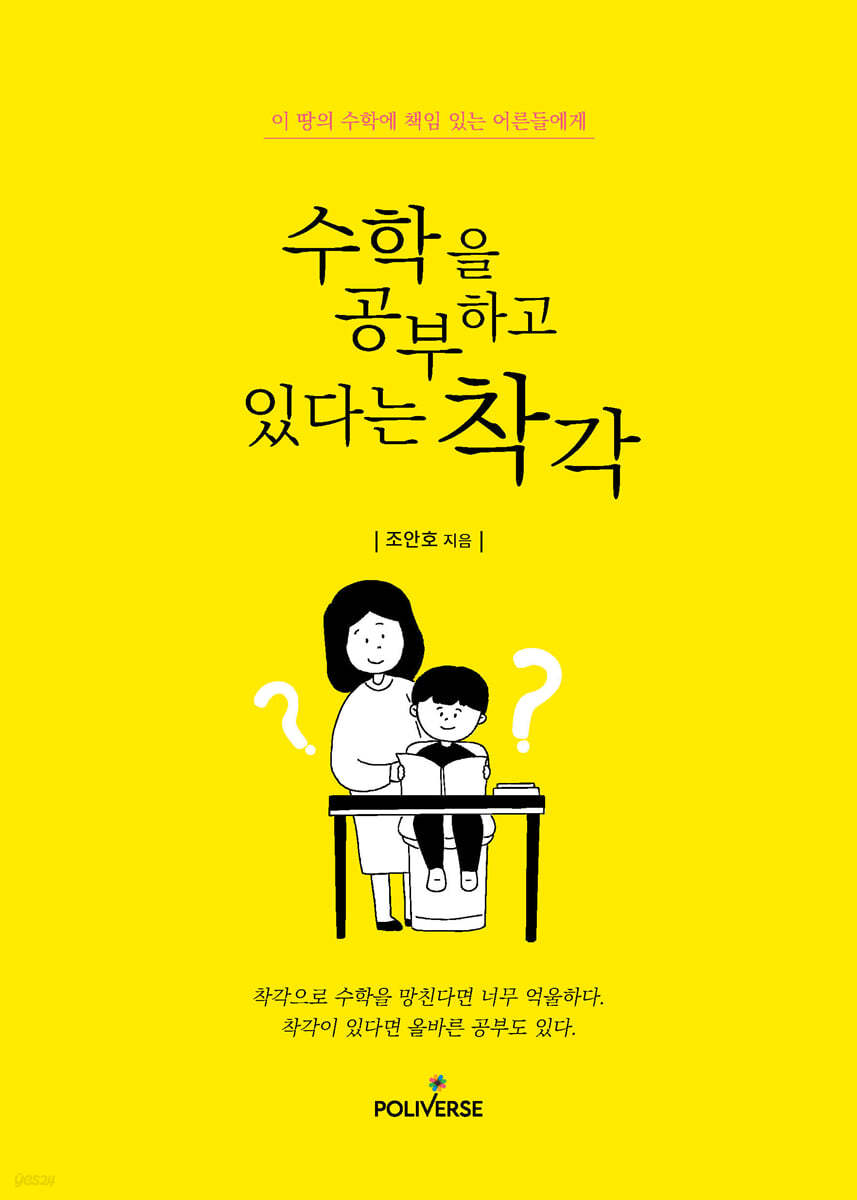
The illusion of studying math
 |
Description
Book Introduction
There is a saying, 'If only I knew then what I know now.' But, “When I teach my children and students the math study methods that adults know today, “Can those kids really be good at math?” This book answers the question of what we, as adults in this country, should do for students who struggle with math no matter what we do. Additionally, it will help adults who have suffered from feelings of inferiority due to being terrible at math in the past regain their self-esteem, even if it is late, by letting them know that it was not their fault. |
- You can preview some of the book's contents.
Preview
index
prolog
Now, not just math educators, but everyone needs to step up.
Part 1.
Experts' Mistakes
1-1.
There are no math education experts.
〈Tip〉Why do we cut off both ends of a turkey?
1-2.
The Expert's Paradox
〈Tip〉 Whose fault is it most?
1-3.
See if the knowledge you are trying to teach is the result of objective experimentation.
Tip: The Ikea Effect
1-4.
The safest way to teach mathematics is to teach it according to definition.
〈Tip〉 Concepts in Mathematics
1-5.
Don't fight over deepening and good deeds.
〈Tip〉Why do textbooks and teachers have no concept?
Part 2.
Parents' Misconceptions
2-1.
Parents were set up by experts.
〈Tip〉Being positive and being optimistic are different.
2-2.
'Methods for getting good grades in elementary and middle school' are brainwashing and ruining high school math.
〈Tip〉The sudden death of field mice
2-3.
The child studies.
〈Tip〉 Give your child a chance to change, and the people around them should change too.
2-4.
All solution education is wrong.
Goals for instrumentalizing the 〈Tip〉 operation
2-5.
Turning an Ordinary Child into a Genius
〈Tip〉It's the same whether I teach 4 people or 400 people.
Part 3.
Students' misconceptions
3-1.
The most common mistake students make their parents make: "They're capable, but lazy."
〈Tip〉If someone believes in you, will math work?
3-2.
The pain of not learning or being unable to learn is greater than the difficulty of learning.
〈Tip〉To relax your body, you must first relax your body.
3-3.
Instinct makes mistakes.
〈Tip〉 Cognitive dissonance
3-4.
Don't study too many new or difficult things at once.
〈Tip〉Just as each part of Korean beef has a different taste, each area of mathematics has a different character.
3-5.
Get rid of the illusion that what is printed is always correct.
Tip: The World's Best Education: Apprenticeship
Part 4.
The illusion of proper education
4-1.
The illusion of mastery learning
Tip: The illusion of teaching math
4-2.
The fallacy of the constructivists who created textbooks
〈Tip〉What is needed in mathematics education now is not psychology, but logic.
Epilogue
What have you done to ensure proper math education for your children?
Now, not just math educators, but everyone needs to step up.
Part 1.
Experts' Mistakes
1-1.
There are no math education experts.
〈Tip〉Why do we cut off both ends of a turkey?
1-2.
The Expert's Paradox
〈Tip〉 Whose fault is it most?
1-3.
See if the knowledge you are trying to teach is the result of objective experimentation.
Tip: The Ikea Effect
1-4.
The safest way to teach mathematics is to teach it according to definition.
〈Tip〉 Concepts in Mathematics
1-5.
Don't fight over deepening and good deeds.
〈Tip〉Why do textbooks and teachers have no concept?
Part 2.
Parents' Misconceptions
2-1.
Parents were set up by experts.
〈Tip〉Being positive and being optimistic are different.
2-2.
'Methods for getting good grades in elementary and middle school' are brainwashing and ruining high school math.
〈Tip〉The sudden death of field mice
2-3.
The child studies.
〈Tip〉 Give your child a chance to change, and the people around them should change too.
2-4.
All solution education is wrong.
Goals for instrumentalizing the 〈Tip〉 operation
2-5.
Turning an Ordinary Child into a Genius
〈Tip〉It's the same whether I teach 4 people or 400 people.
Part 3.
Students' misconceptions
3-1.
The most common mistake students make their parents make: "They're capable, but lazy."
〈Tip〉If someone believes in you, will math work?
3-2.
The pain of not learning or being unable to learn is greater than the difficulty of learning.
〈Tip〉To relax your body, you must first relax your body.
3-3.
Instinct makes mistakes.
〈Tip〉 Cognitive dissonance
3-4.
Don't study too many new or difficult things at once.
〈Tip〉Just as each part of Korean beef has a different taste, each area of mathematics has a different character.
3-5.
Get rid of the illusion that what is printed is always correct.
Tip: The World's Best Education: Apprenticeship
Part 4.
The illusion of proper education
4-1.
The illusion of mastery learning
Tip: The illusion of teaching math
4-2.
The fallacy of the constructivists who created textbooks
〈Tip〉What is needed in mathematics education now is not psychology, but logic.
Epilogue
What have you done to ensure proper math education for your children?
Detailed image
.jpg)
Publisher's Review
This book answers the question of what we, as adults in this country, should do for students who struggle with math no matter what we do.
Additionally, it will help adults who have suffered from feelings of inferiority due to their poor math skills in the past regain their self-esteem, even if it is late, by letting them know that it was not their fault.
If, over the past 70 years, mathematics educators have taught mathematics independently, gaining recognition for their expertise and authority, and as a result, 80% of the population has become mathematics dropouts, then it is time to acknowledge the failure of mathematics education and put aside their self-righteousness and stubbornness.
An expert is someone who has done something deeply and if he or she is good at solving problems, his or her authority should be recognized.
However, if not, you may end up falling into the trap of being an expert and may become an object of avoidance.
No one would rely solely on climatologists to solve the problem of global warming.
Scientists, businesspeople, and people around the world will feel the need to speak up and contribute to the cause in their respective fields.
We must abandon the idea that we can only rely on mathematics educators who have repeatedly failed, and recognize that the crisis in mathematics is a community problem.
The goals of mathematics education have been damaged by the flawed mathematics education that mathematics educators have created, preventing students from developing their abilities.
In the end, for 70 years, the subjects of mathematics education were subjected to incorrect logic and became entangled.
Due to the so-called misconceptions of teachers and experts, parents, and students, it has become a situation where it appears that people are studying mathematics, but they are not studying mathematics.
Identifying the problem is important for proper problem solving, but if there is no solution, it only adds to the burden.
This book addresses the misconceptions people make to avoid problems and suggests solutions.
You can expect the author's sharp problem awareness and excellent solutions.
Additionally, it will help adults who have suffered from feelings of inferiority due to their poor math skills in the past regain their self-esteem, even if it is late, by letting them know that it was not their fault.
If, over the past 70 years, mathematics educators have taught mathematics independently, gaining recognition for their expertise and authority, and as a result, 80% of the population has become mathematics dropouts, then it is time to acknowledge the failure of mathematics education and put aside their self-righteousness and stubbornness.
An expert is someone who has done something deeply and if he or she is good at solving problems, his or her authority should be recognized.
However, if not, you may end up falling into the trap of being an expert and may become an object of avoidance.
No one would rely solely on climatologists to solve the problem of global warming.
Scientists, businesspeople, and people around the world will feel the need to speak up and contribute to the cause in their respective fields.
We must abandon the idea that we can only rely on mathematics educators who have repeatedly failed, and recognize that the crisis in mathematics is a community problem.
The goals of mathematics education have been damaged by the flawed mathematics education that mathematics educators have created, preventing students from developing their abilities.
In the end, for 70 years, the subjects of mathematics education were subjected to incorrect logic and became entangled.
Due to the so-called misconceptions of teachers and experts, parents, and students, it has become a situation where it appears that people are studying mathematics, but they are not studying mathematics.
Identifying the problem is important for proper problem solving, but if there is no solution, it only adds to the burden.
This book addresses the misconceptions people make to avoid problems and suggests solutions.
You can expect the author's sharp problem awareness and excellent solutions.
GOODS SPECIFICS
- Date of issue: January 4, 2023
- Page count, weight, size: 241 pages | 313g | 150*210*20mm
- ISBN13: 9791197620720
- ISBN10: 1197620729
You may also like
카테고리
korean


korean

![GQ KOREA Mark (Monthly): December [2025]](http://librairie.coreenne.fr/cdn/shop/files/8ef265dbbfbf186523ed75ba7319009d.jpg?v=1765340328&width=3840)


