

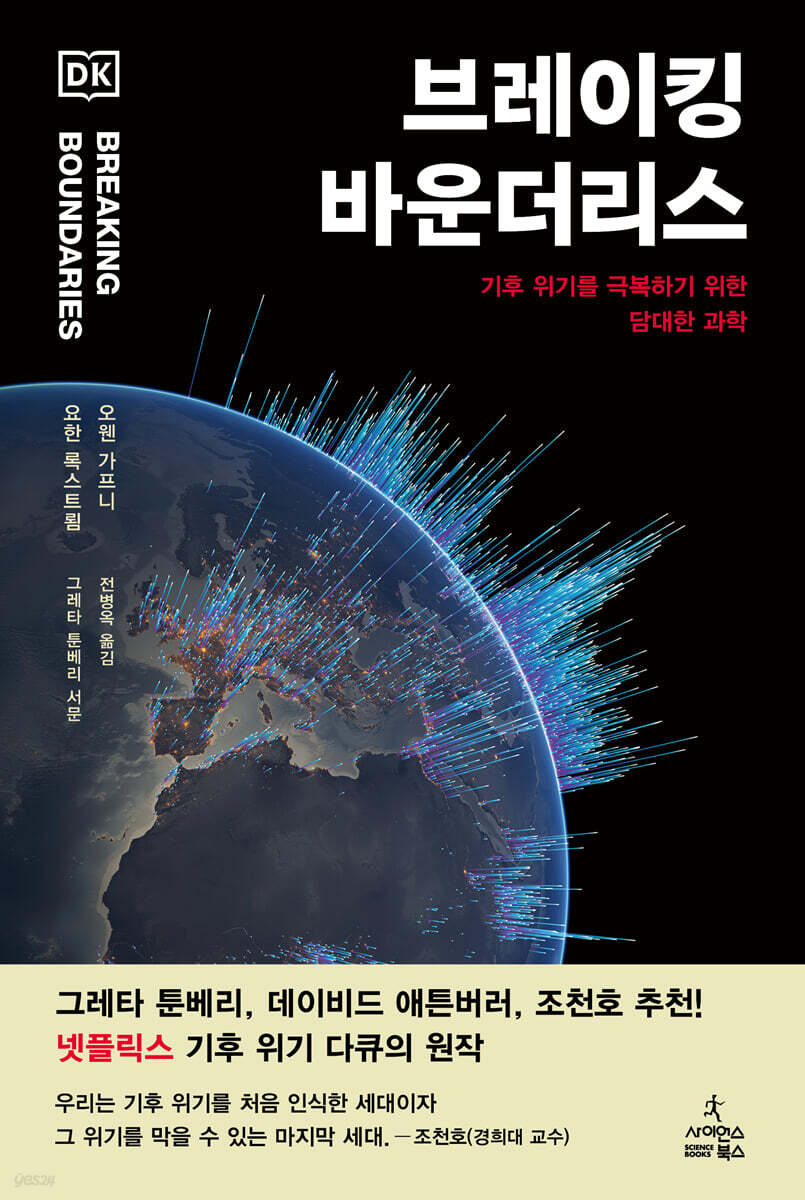
Breaking Boundaries
 |
Description
Book Introduction
Recommended by Greta Thunberg, David Attenborough, and Cho Cheon-ho
Netflix's original "Breaking Boundaries: The Science of Earth"
The phenomenon of record-breaking heat waves and heavy rains occurring every year is worsening worldwide.
The climate crisis has been a topic of debate for a long time since it was first brought to light.
From Carl Sagan, who discovered the greenhouse effect in the atmosphere of Venus, to the Nobel Committee, which awarded the 2021 Nobel Prize in Physics for climate change modeling research, most of the global scientific community has clearly recognized and warned that global climate warming caused by human activities since the Industrial Revolution is a clear fact and a danger that threatens the future of humanity. Despite this, many with a stake in this issue, from individuals and corporations to powers and nations, have denied climate warming and have obstructed global climate action.
But now that climate change has long been a scientific issue, climate action like carbon neutrality to halt warming has become an economic and political issue, as well as a duty as a global citizen.
A book has been published by Science Books that examines what is happening on the front lines of scientists and activists surrounding the climate crisis, not ideologically biased environmental fundamentalist claims, but rather scientific methods that look back on the prerequisites for human survival, examine the limits of sustainable development, and seek a rational path to prosperity, peace, freedom, and equality in the rapidly changing Earth environment on a global and geological scale.
Netflix's original "Breaking Boundaries: The Science of Earth"
The phenomenon of record-breaking heat waves and heavy rains occurring every year is worsening worldwide.
The climate crisis has been a topic of debate for a long time since it was first brought to light.
From Carl Sagan, who discovered the greenhouse effect in the atmosphere of Venus, to the Nobel Committee, which awarded the 2021 Nobel Prize in Physics for climate change modeling research, most of the global scientific community has clearly recognized and warned that global climate warming caused by human activities since the Industrial Revolution is a clear fact and a danger that threatens the future of humanity. Despite this, many with a stake in this issue, from individuals and corporations to powers and nations, have denied climate warming and have obstructed global climate action.
But now that climate change has long been a scientific issue, climate action like carbon neutrality to halt warming has become an economic and political issue, as well as a duty as a global citizen.
A book has been published by Science Books that examines what is happening on the front lines of scientists and activists surrounding the climate crisis, not ideologically biased environmental fundamentalist claims, but rather scientific methods that look back on the prerequisites for human survival, examine the limits of sustainable development, and seek a rational path to prosperity, peace, freedom, and equality in the rapidly changing Earth environment on a global and geological scale.
- You can preview some of the book's contents.
Preview
index
Foreword (Greta Thunberg) 5 / Introduction (Johan Rockström, Owen Gaffney) 13
Code of Conduct I / Chapter 1: Three Revolutions That Created the Earth as We Know It (29) / Chapter 2: Events That Changed the Earth (51) / Chapter 3: The Appearance of the "Wise Man" (63) / Chapter 4: The Goldilocks Era (75)
Code of Conduct II / Chapter 5: Three Scientific Insights 103 / Chapter 6: The Planetary Danger Line 117 / Chapter 7: The Steaming Earth 141 / Chapter 8: Declaring a Climate Emergency 153
Code of Conduct III / Chapter 9 Stewardship of the Earth 171 / Chapter 10 Energy Transition 189 / Chapter 11 Food Production for 10 Billion People 207 / Chapter 12 Inequality That Shakes the Earth 225 / Chapter 13 Building the Cities of the Future 245 / Chapter 14 Easing Population Growth Rates 261 / Chapter 15 Taming the World of Technology 271 / Chapter 16 Earth Risk Limits and the Global Economy 289 / Chapter 17 Politics and Policies for Earth Recovery 315 / Chapter 18 A Chaotic Decade 329 / Chapter 19 Living Wisely on Earth 353
Postscript 367 / References 373 / Acknowledgments 385 / Translator's Note 387 / Index 390 / Illustration Copyright 398
Code of Conduct I / Chapter 1: Three Revolutions That Created the Earth as We Know It (29) / Chapter 2: Events That Changed the Earth (51) / Chapter 3: The Appearance of the "Wise Man" (63) / Chapter 4: The Goldilocks Era (75)
Code of Conduct II / Chapter 5: Three Scientific Insights 103 / Chapter 6: The Planetary Danger Line 117 / Chapter 7: The Steaming Earth 141 / Chapter 8: Declaring a Climate Emergency 153
Code of Conduct III / Chapter 9 Stewardship of the Earth 171 / Chapter 10 Energy Transition 189 / Chapter 11 Food Production for 10 Billion People 207 / Chapter 12 Inequality That Shakes the Earth 225 / Chapter 13 Building the Cities of the Future 245 / Chapter 14 Easing Population Growth Rates 261 / Chapter 15 Taming the World of Technology 271 / Chapter 16 Earth Risk Limits and the Global Economy 289 / Chapter 17 Politics and Policies for Earth Recovery 315 / Chapter 18 A Chaotic Decade 329 / Chapter 19 Living Wisely on Earth 353
Postscript 367 / References 373 / Acknowledgments 385 / Translator's Note 387 / Index 390 / Illustration Copyright 398
Detailed image

Publisher's Review
Recommended by Greta Thunberg, David Attenborough, and Cho Cheon-ho
Netflix's original "Breaking Boundaries: The Science of Earth"
Our planet is burning. Greta Thunberg (environmental activist)
I was born in the Holocene, a time when, 12,000 years ago, humanity was provided with suitable weather for farming and living, ultimately leading to the development of civilization. But now the Holocene is over, and the Garden of Eden is gone.
This new era has been named the Anthropocene, or the Age of Humans. David Attenborough (environmental activist, zoologist)
The planetary risk threshold is a key concept in understanding today's global crisis.
Only within these limits can humanity survive and develop civilization.
On the other hand, if we exceed this limit, the Earth's conditions for human survival will be exhausted before our desires can be met.
The future is not yet set and is still in our hands.
What the future holds will depend on how humanity manages the planet's risk limits over the next decade. Cho Cheon-ho (Atmospheric Scientist, Professor of Climate Change at Kyung Hee Cyber University, Former Director of the National Institute of Meteorological Sciences)
The phenomenon of record-breaking heat waves and heavy rains occurring every year is worsening worldwide.
The climate crisis has been a topic of debate for a long time since it was first brought to light.
From Carl Sagan, who discovered the greenhouse effect in the atmosphere of Venus, to the Nobel Committee, which awarded the 2021 Nobel Prize in Physics for climate change modeling research, most of the global scientific community has clearly recognized and warned that global climate warming caused by human activities since the Industrial Revolution is a clear fact and a danger that threatens the future of humanity. Despite this, many with a stake in this issue, from individuals and corporations to powers and nations, have denied climate warming and have obstructed global climate action.
But now that climate change has long been a scientific issue, climate action like carbon neutrality to halt warming has become an economic and political issue, as well as a duty as a global citizen.
A book has been published by Science Books that examines what is happening on the front lines of scientists and activists surrounding the climate crisis, not ideologically biased environmental fundamentalist claims, but rather scientific methods that look back on the prerequisites for human survival, examine the limits of sustainable development, and seek a rational path to prosperity, peace, freedom, and equality in the rapidly changing Earth environment on a global and geological scale.
That book is Breaking Boundaries: The Science of Our Planet, by Johan Rockström, an activist and earth scientist and founder of the Stockholm Resilience Centre in Sweden, and Owen Gaffney.
The concept of 'Planetary Boundaries', announced by Johan Rockström's research team in 2009, was a framework for analyzing whether nine factors that could play a fatal role in human survival, namely climate change, the stratospheric ozone layer, atmospheric aerosol concentration, ocean acidity, bio-geological cycles of chemicals such as nitrogen and phosphorus, freshwater use, land use patterns, biodiversity, and new substances, were in a dangerous or safe state.
As climate change, driven by global warming, breaches the Earth's danger threshold and enters a dangerous state, even the boundaries of the safe zone will collapse.
The nine indicators serve as scientific headlights for a future Earth that is hurtling toward dangerous environmental limits, and also as guardrails that guarantee future generations the right to pursue happiness and the resources to achieve it.
With a foreword by Greta Thunberg, who started the one-person school strike that grew into the Fridays for Future movement, a global movement of teenagers demanding climate action in August 2018, this book is the basis for the Netflix environmental documentary Breaking Boundaries: The Science of Earth (2021), narrated by ecologist David Attenborough, and captures the essence of Rockström and Gaffney's research and beliefs.
Sixteen pages of color illustrations and maps, prepared by the non-profit environmental organization Globaia, provide a glimpse into the key findings of the latest research.
It is also a book strongly recommended by Professor Cho Cheon-ho, a special lecturer in climate change at Kyunghee Cyber University and former director of the National Institute of Meteorological Sciences.
The creator of the Earth's Danger Line and the Anthropocene Equation tells us
The science and worldview of future civilization!
We must boldly break away from the path humanity has taken and find a new path.
Our concern is not with past errors, but with future strategies. —From the text
The authors of this book are first-rate scholars in the field of global climate science and prominent figures with significant influence on global policies related to the climate crisis and carbon neutrality.
As stated in the author's bio, Johan Rockström was born in 1965 when the carbon dioxide concentration in Earth's atmosphere was 320 parts per million, and by the time Owen Gaffney was born in 1969, the carbon dioxide concentration had reached 324 parts per million.
And last year, the figure hit 416 ppm, making climate change the most intense threat to Earth's critical boundaries.
Johan Rockström is an internationally renowned Swedish environmental scientist specializing in global sustainability.
He was co-founder and director of the Stockholm Resilience Centre for 12 years and has been director of the Potsdam Institute for Climate Impact Research, based in Germany, since October 2018.
At the same time, he researches and teaches on the topic of global sustainability at the University of Potsdam in Germany and Stockholm University in Sweden.
Amidst the rapid changes in the Earth's environment, we devised and scientifically formalized a new concept called the "Earth Risk Line," which will enable us to scientifically understand the prerequisites and limits for humanity's safe survival.
This concept, that if we keep to these boundaries and operate within them, we might be able to avoid environmental changes on Earth that could wipe out humanity, was published in a 2009 paper by Rockström and the Earth League, an international organization of 28 prominent scientists.
In this paper, Rockström classified nine systems that serve as prerequisites for human survival and defined the limits of each.
And he has published over 150 papers on this topic.
His research on the Earth's critical boundaries has attracted explosive interest since the 2010s, alongside the growing climate crisis, and the analytics firm Clarivate recently announced that he was among the top 1 percent of most cited researchers in the field over the past decade.
He has had a significant impact on research and government policy related to the European climate crisis, and in 2009 he was awarded the 'Swedish of the Year' award by Focus for his contributions to bridging science and society.
The Swedish environmental economics magazine Miljoaktuellt named him the second most influential person in Sweden on environmental issues, and the country's leading economics magazine VeckansAffarer awarded him the "Social Capitalist" award in 2010.
Rockström also chaired the Nobel Laureate Symposium on Global Sustainability in Stockholm.
He is also an executive or fellow of organizations with great influence in the political and business circles of Europe and the United States regarding the climate crisis and carbon neutrality, such as the EAT Foundation, KR Foundation, Global Challenges Foundation, Earth League, Future Earth, and Earth Commission. He has also been a lecturer or organizer at the World Economic Forum, the United Nations General Assembly, the United Nations Sustainable Development Solutions Network (SDSN), and the United Nations Framework Convention on Climate Change (UNFCCC). He is also a regular member of the advisory group of the European Investment Bank (EIB), and has been providing various advice and proposals to various sectors of European society, including politics, business, and civil society, since the declaration of carbon neutrality.
Co-author Owen Gaffney is also a highly regarded scientist and activist in the fields of climate change and earth environmental science.
He became particularly famous for his 'Anthropocene Equation' published in 2017.
He is famous for putting an end to the long-standing debate since Paul Crutzen first proposed the idea of the Anthropocene in 2000 by publishing the Anthropocene Equation, which explains in a single formula how the Earth's environment has completely changed since the Industrial Revolution, in other words, how humans have acquired the power to cause global changes such as asteroid impacts. This has provided a framework for scientifically dealing with the Anthropocene.
He founded the first educational website about the Anthropocene (http://anthropocene.info) and, together with Globia founder Felix Palandeschenes, produced and directed the short film Welcome to the Anthropocene (2012), which premiered at the opening ceremony of the UN Rio+20 Summit.
Gaffney, who focuses on topics such as sustainable development, carbon-reducing industrial policy, and the trajectory of the Anthropocene, while also being an activist calling for a systemic shift to address the climate crisis, has worked with Rockström for many years on research at the Stockholm Resilience Centre and the Potsdam Institute, and is a Fellow of Future Earth, a global network of scientists, and the Edmund Hillary Foundation, a research network in New Zealand.
He is involved in the establishment of the Exponential Roadmap Initiative and GAIAXIA STUDIOS, and is active in various media outlets advocating for the climate crisis.
Human civilization has reached the limit of Earth's danger,
Is there a formula for a systemic change that will overcome this crisis?
Breaking Boundaries consists of 19 chapters in 3 parts.
It consists of Part 1 (Code of Conduct I), which scientifically and calmly explains the process of reaching the crossroads between the boundary between the Holocene and the Anthropocene, a safe zone where 10 billion people can live in sustainable development, and a danger zone where we are exponentially falling into a global ecological disaster; Part 2 (Code of Conduct II), which summarizes the current state of the Earth's climate crisis based on recent discoveries and observations; and Part 3 (Code of Conduct III), which presents specific solutions for the transformation of the Earth's environmental system that supports civilization, social systems, and the survival of humanity.
This book focuses on solutions to problems.
Transitions must occur in six systems that are essential for maintaining a healthy Earth's ecosystem and for the stability and prosperity of the economic system: energy, land and food, inequality, urbanization, population and health, and technology.
Such a systemic transformation can only be realized if four aspects—social change, political change, economic change, and technological innovation—work simultaneously.
What are our most important values? What kind of society do we desire? Can we rebuild our economic system? Can we restore the Earth's ecosystem? The core concepts of each part of "Breaking Boundaries" are, in order, Earth 5.0, Earth's Danger Line, and System Transition 6.
A brief overview of each is as follows:
Earth 5.0
In Code of Conduct I, the authors condense the period from Earth 1.0 to 5.0, from the formation of the Earth to the emergence of life, the evolution of humanity, the emergence of civilization, the end of the Holocene, and the beginning of the Anthropocene.
This conceptualization clearly explains the grand history of our planet and humanity.
Three major events have dramatically changed the Earth: life, photosynthesis, and the emergence of the species Homo sapiens.
Where is humanity headed in the future?
* Earth 1.0: 4.6 billion years ago~ A barren Earth with a primitive environment.
* Earth 2.0: 3.5 billion years ago ~ Life appears.
* Earth 3.0: 2.4 billion years ago ~ Creation of an ecosystem through photosynthesis.
* Earth 4.0: 600 million years ago ~ Diverse and sophisticated ecosystems formed thanks to the evolution of life.
* Earth 5.0: Present, the emergence of the wise Earth stewards.
Earth's danger limit
Code of Conduct II explains the concept of global risk limits, which made Rockström famous.
This limit is a prerequisite for our survival and is also the upper limit within which humanity can live in pursuit of its own desires.
It is also the boundary that our planet will tolerate our activities.
The flow of soil, freshwater, and nutrients determines how species survive, while ocean currents and ice sheets that flow across the ocean floor combine with greenhouse gases within the biosphere to determine the final state of the climate.
If one boundary collapses, others will become rapidly more dangerous.
* Biodiversity: High-risk areas well beyond the red line.
The limits of functional diversity are uncertain compared to genetic diversity.
* Bio-geochemical cycles: High-risk areas well beyond the limits.
* Changes in land use: risk areas.
* Climate change: a significant risk area.
* Ocean acidification: A relatively safe zone.
* Freshwater usage: Safe area.
* Stratospheric ozone layer: safe zone.
* Aerosols in the atmosphere: Specific limits are not yet established.
* New material: Specific limits are not yet determined.
System Transition 6
In Code of Conduct III, the authors present their alternatives and solutions in detail.
The core strategic objectives of the solution must be implemented in conjunction with six system transformations.
This idea will serve as a large platform to unite the numerous climate crisis solutions that are being proposed and discussed without any system or realism.
* Energy Transition: Transforming the fossil fuel-centric economic structure.
* Food Transition: Realizing a healthy diet for the planet in food production and consumption.
* Transforming inequality: As equality is realized, social responsibility for common goals is heightened.
* Urban Transformation: Cities, the front lines of civilization, must be transformed into environmentally friendly cities.
* Health Transition: Overcoming peak child mortality and improving population and health indicators.
* Technological innovation: Driving the right system transition through digital revolution and geoengineering.
The End of the Holocene and the Rise of the Anthropocene
Part 1, "Code of Conduct I," summarizes the historical events that brought the Earth to its current state.
The Earth has gone through three states: a hothouse Earth that is 4 degrees warmer than the present, an icehouse Earth that is 5 degrees colder and 1 degree warmer than the present, and finally a snowball Earth that freezes everything solid.
If we take the average global temperature from 1961 to 1990, that is, the Holocene epoch, as the baseline and set it at 0 degrees, 2021 would be 4 degrees higher than that.
To avoid a Hot Earth scenario similar to the polar heatwave 55 million years ago, urgent greenhouse gas reductions are needed to cool the planet before the Northern Hemisphere's ice shelves melt.
We must implement the Earth Recovery Plan to return the planet to a mild and stable climate environment in the Holocene.
Chapters 1-3 go back approximately 4.5 billion years and outline the three revolutions that marked the beginning of a new era: the birth of life, oxygen and photosynthesis, and the emergence of complex life forms. They also examine the mechanisms of greenhouse gas increases through tracking the Ice Ages.
If humanity is truly wise, we must find a breakthrough turning point to restore our ecosystems before 2030.
Chapter 4, "The Goldilocks Age," defines the Holocene as a period of remarkable civilizational development, thanks to the unusual climate that occurred between ice ages, neither too hot nor too cold.
Future progress depends on using the incredibly powerful tool we have built—the capitalist economic system—to restore the Earth's environment and end poverty.
Finding the Tipping Point: The Warming Limits Toward Planet 5.0
Part 2, "Code of Conduct II," reveals that from the Amazon rainforest to Antarctica, climate change is bringing us very close to tipping points—those danger zones of no return.
Beyond this point is a hothouse earth, where not only human civilization but humanity itself could become extinct.
Chapter 5, "Three Scientific Insights," summarizes three scientific findings that suggest we are living in a new geological epoch, that the Holocene Earth's environment was unusually stable, and that a turning point in Earth's environment is just around the corner.
Chapter 6, "Earth's Danger Lines," covers the authors' research on danger lines, first presented in 2009 and supplemented in 2015, while Chapter 7, "Steamy Earth," covers the authors' paper on the hot Earth, published amid the unusually high temperatures that gripped the Northern Hemisphere in 2018.
To determine what urgent action is needed, a team of scientists is analyzing and researching nine critical thresholds for the Earth's environment.
Should all global risk thresholds be treated with equal weight? Climate and biodiversity, at the very heart of the crisis, serve as engines that enable the planet to enter a new state and are deeply intertwined with other thresholds.
In a closely interconnected climate system, an explosion in one part can cascade like dominoes to other parts, creating a chain reaction of explosions.
Chapter 8, “Declaring a Climate Emergency,” examines the responsibilities of the global community through the UN Paris Climate Agreement, which sets a goal of keeping global warming to within 2 degrees Celsius, but declares that 1.5 degrees Celsius must be a practical principle of action.
An Era of Transition for Future Generations
Part 3, “Code of Conduct III,” focuses on the practical aspects.
Social consensus and public awareness are essential for transitioning to an eco-friendly economic structure.
A series of social movements called the Earth Restoration Movement declare that future generations must be guaranteed the same right to pursue happiness as we have.
Here's why teens need more exposure to climate science and need to get out of school and assert their rights.
Furthermore, we must all become part of the Earth restoration movement and protect the common property of the entire planet.
Chapter 9, “Earth Stewardship,” emphasizes that the united power of the community can prevent the rapid collapse of the ecosystem that is currently taking place.
The work to protect the Earth has already begun.
There are only regional differences.
To restore the planet, the authors of this book dedicate 10 to 15 chapters each to suggesting transitions in six areas: energy, food, inequality, urbanization, health, and geoengineering.
The problem will not be solved by simply living like this until 2049 without any concrete measures to achieve the 2050 carbon neutrality goal and then developing amazing technologies at the last minute.
The 'Carbon Law' means that it is more important to reduce carbon emissions by half every decade rather than reaching zero.
The Carbon Law is not a distant future goal, but rather has greater significance in the present time and place.
In every sector, we need to cut our carbon emissions in half, and those who emit the most carbon must reduce their emissions by that much.
Overcoming poverty and hunger is a key part of the UN's Sustainable Development Goals, which must be achieved by 2030. The only solution to the food transition is a healthy diet for the planet that reduces food waste, increases efficiency from raw materials to final consumption, develops sustainable food production methods, and minimizes the use of new substances such as fertilizers to build a sustainable food production system.
It is projected that 3 billion people will become climate refugees within 80 years.
Reducing inequality is the most important political and economic solution to keeping the planet's risk limits in check, and is also closely linked to Earth stewardship.
Inequality that began in the economy is expanding into political chaos and spreading across the world.
We must employ methods to change inequality, such as reducing the income gap.
Prior to the Green Deal, efforts to address other inequalities in society, such as those based on race or gender, may need to be prioritized. This is a task for both present and future generations.
Growth through water and sewage systems accessible to all city residents, the establishment of efficient and eco-friendly urban systems rather than indiscriminate expansion, the establishment of an efficient transportation system, and the circulation and regeneration of resources to ensure that the future city truly serves as a living, giant organism, guaranteeing a quality of life can also lead to an elevation of civic consciousness.
As the COVID-19 pandemic has clearly demonstrated, public health is a precious asset for humanity. Rapid investment in and improvement of public health will ultimately benefit humanity's future.
Meanwhile, the goal of geoengineering is to develop a large-scale action plan to mitigate climate change by combining innovative technologies that can save the planet in the worst-case scenario where the five transition tasks discussed above fail.
While the advancement of technological innovation is important, the political and economic leadership to put it into practice is also crucial.
As Chapter 16, “Planetary Risk Boundaries and the Global Economy,” highlights, the conceptual framework of planetary risk bounds was designed to productively shift the debate between green growth and degrowth advocates, but these bounds only indicate where the safe zone is, not how the global economy can reach it or stay within it.
For the happiness of future generations, a transition to an eco-friendly economic structure is essential, and a '3R' strategy must be established.
In times of transition and turmoil, we must build a resilient economy, while regenerating resources and recycling everything.
In addition, instead of the current economic growth model that forces sacrifices on the Earth's ecosystem, we must adopt the 'KIDSS' (Knowledge, Information, Digitalization, Services, Sharing) economic model.
If these elements work together, we can bring about positive changes in the Earth's environment and ultimately gain the capacity to manage the Earth with care.
Chapter 17, "Politics and Policies for Earth Restoration," explores the implementation of four policies that restructure markets to foster economic development centered on the planet and humanity.
These proposals are based on the latest science and economics for sustainable development.
We need to legislate 'Carbon Neutrality 2050' and 'Natural Recovery 2030', stop investing in fossil fuel development, stop subsidies that promote fossil fuel use, and put a price on carbon.
Chapter 18, "The Chaotic Decade," focuses on four tipping points that have the power to drive societal transformation: civic movements, government policies, trustworthy markets, and technological innovation.
Since beginning her protests outside the Swedish parliament ahead of the Swedish general election, carrying signs reading “School Strike for Climate,” Thunberg’s outpouring of concern has led to the largest-ever demonstrations of teenagers in history, with 6 to 8 million participating in 4,500 locations in 150 countries over the next 13 months.
The fact that school strikes are spreading to older generations means that concerns about global warming are spreading and gaining sympathy among citizens.
A survey of CEOs attending the 2020 World Economic Forum found that 25 percent of them were extremely concerned about climate change.
The 21-25 percent zone is where qualitative change occurs, as citizens with new opinions initially form a minority and gradually gain power.
It is a social tipping point where one person in a family of four initiates change.
Chapter 19, “Wise Life on Earth,” once again emphasizes the time and direction given to humanity.
The current climate crisis is the responsibility of a few Western countries, and it is also meaningful to view the expression "we" as implying a situation where the benefits are monopolized by a few while the responsibility is distributed fairly.
But to heal the Earth, the world must turn the wheel now.
The Earth won't end in January 2031, but a gradual transition is also too late.
Because we are very close to a tipping point of irreversible climate change.
From the law of carbon to cool the steaming earth
Reduce carbon emissions by 50% every decade!
Over the past decade, several "sustainability solutions" have been developed and implemented within the safety zone of the Earth's ecosystem, aiming to return the planet to a more temperate climate before a dangerous situation arises and to define what urgent actions are needed.
We must find a way to secure this safe zone by 2050, the year when humanity is predicted to leave it.
The immediate priority is to achieve the maximum possible by 2030.
Just as unprecedented measures were taken to land on the moon (Moonshot) in the 1960s, we must implement an Earthshot plan in the 2020s.
The goal of the Earth Recovery Plan is to stabilize Earth's life support systems.
The goal of the Earth Recovery Plan is to stabilize Earth's life support systems.
This will be the most dramatic moment in human history for the Earth's ecosystem and future generations.
Netflix's original "Breaking Boundaries: The Science of Earth"
Our planet is burning. Greta Thunberg (environmental activist)
I was born in the Holocene, a time when, 12,000 years ago, humanity was provided with suitable weather for farming and living, ultimately leading to the development of civilization. But now the Holocene is over, and the Garden of Eden is gone.
This new era has been named the Anthropocene, or the Age of Humans. David Attenborough (environmental activist, zoologist)
The planetary risk threshold is a key concept in understanding today's global crisis.
Only within these limits can humanity survive and develop civilization.
On the other hand, if we exceed this limit, the Earth's conditions for human survival will be exhausted before our desires can be met.
The future is not yet set and is still in our hands.
What the future holds will depend on how humanity manages the planet's risk limits over the next decade. Cho Cheon-ho (Atmospheric Scientist, Professor of Climate Change at Kyung Hee Cyber University, Former Director of the National Institute of Meteorological Sciences)
The phenomenon of record-breaking heat waves and heavy rains occurring every year is worsening worldwide.
The climate crisis has been a topic of debate for a long time since it was first brought to light.
From Carl Sagan, who discovered the greenhouse effect in the atmosphere of Venus, to the Nobel Committee, which awarded the 2021 Nobel Prize in Physics for climate change modeling research, most of the global scientific community has clearly recognized and warned that global climate warming caused by human activities since the Industrial Revolution is a clear fact and a danger that threatens the future of humanity. Despite this, many with a stake in this issue, from individuals and corporations to powers and nations, have denied climate warming and have obstructed global climate action.
But now that climate change has long been a scientific issue, climate action like carbon neutrality to halt warming has become an economic and political issue, as well as a duty as a global citizen.
A book has been published by Science Books that examines what is happening on the front lines of scientists and activists surrounding the climate crisis, not ideologically biased environmental fundamentalist claims, but rather scientific methods that look back on the prerequisites for human survival, examine the limits of sustainable development, and seek a rational path to prosperity, peace, freedom, and equality in the rapidly changing Earth environment on a global and geological scale.
That book is Breaking Boundaries: The Science of Our Planet, by Johan Rockström, an activist and earth scientist and founder of the Stockholm Resilience Centre in Sweden, and Owen Gaffney.
The concept of 'Planetary Boundaries', announced by Johan Rockström's research team in 2009, was a framework for analyzing whether nine factors that could play a fatal role in human survival, namely climate change, the stratospheric ozone layer, atmospheric aerosol concentration, ocean acidity, bio-geological cycles of chemicals such as nitrogen and phosphorus, freshwater use, land use patterns, biodiversity, and new substances, were in a dangerous or safe state.
As climate change, driven by global warming, breaches the Earth's danger threshold and enters a dangerous state, even the boundaries of the safe zone will collapse.
The nine indicators serve as scientific headlights for a future Earth that is hurtling toward dangerous environmental limits, and also as guardrails that guarantee future generations the right to pursue happiness and the resources to achieve it.
With a foreword by Greta Thunberg, who started the one-person school strike that grew into the Fridays for Future movement, a global movement of teenagers demanding climate action in August 2018, this book is the basis for the Netflix environmental documentary Breaking Boundaries: The Science of Earth (2021), narrated by ecologist David Attenborough, and captures the essence of Rockström and Gaffney's research and beliefs.
Sixteen pages of color illustrations and maps, prepared by the non-profit environmental organization Globaia, provide a glimpse into the key findings of the latest research.
It is also a book strongly recommended by Professor Cho Cheon-ho, a special lecturer in climate change at Kyunghee Cyber University and former director of the National Institute of Meteorological Sciences.
The creator of the Earth's Danger Line and the Anthropocene Equation tells us
The science and worldview of future civilization!
We must boldly break away from the path humanity has taken and find a new path.
Our concern is not with past errors, but with future strategies. —From the text
The authors of this book are first-rate scholars in the field of global climate science and prominent figures with significant influence on global policies related to the climate crisis and carbon neutrality.
As stated in the author's bio, Johan Rockström was born in 1965 when the carbon dioxide concentration in Earth's atmosphere was 320 parts per million, and by the time Owen Gaffney was born in 1969, the carbon dioxide concentration had reached 324 parts per million.
And last year, the figure hit 416 ppm, making climate change the most intense threat to Earth's critical boundaries.
Johan Rockström is an internationally renowned Swedish environmental scientist specializing in global sustainability.
He was co-founder and director of the Stockholm Resilience Centre for 12 years and has been director of the Potsdam Institute for Climate Impact Research, based in Germany, since October 2018.
At the same time, he researches and teaches on the topic of global sustainability at the University of Potsdam in Germany and Stockholm University in Sweden.
Amidst the rapid changes in the Earth's environment, we devised and scientifically formalized a new concept called the "Earth Risk Line," which will enable us to scientifically understand the prerequisites and limits for humanity's safe survival.
This concept, that if we keep to these boundaries and operate within them, we might be able to avoid environmental changes on Earth that could wipe out humanity, was published in a 2009 paper by Rockström and the Earth League, an international organization of 28 prominent scientists.
In this paper, Rockström classified nine systems that serve as prerequisites for human survival and defined the limits of each.
And he has published over 150 papers on this topic.
His research on the Earth's critical boundaries has attracted explosive interest since the 2010s, alongside the growing climate crisis, and the analytics firm Clarivate recently announced that he was among the top 1 percent of most cited researchers in the field over the past decade.
He has had a significant impact on research and government policy related to the European climate crisis, and in 2009 he was awarded the 'Swedish of the Year' award by Focus for his contributions to bridging science and society.
The Swedish environmental economics magazine Miljoaktuellt named him the second most influential person in Sweden on environmental issues, and the country's leading economics magazine VeckansAffarer awarded him the "Social Capitalist" award in 2010.
Rockström also chaired the Nobel Laureate Symposium on Global Sustainability in Stockholm.
He is also an executive or fellow of organizations with great influence in the political and business circles of Europe and the United States regarding the climate crisis and carbon neutrality, such as the EAT Foundation, KR Foundation, Global Challenges Foundation, Earth League, Future Earth, and Earth Commission. He has also been a lecturer or organizer at the World Economic Forum, the United Nations General Assembly, the United Nations Sustainable Development Solutions Network (SDSN), and the United Nations Framework Convention on Climate Change (UNFCCC). He is also a regular member of the advisory group of the European Investment Bank (EIB), and has been providing various advice and proposals to various sectors of European society, including politics, business, and civil society, since the declaration of carbon neutrality.
Co-author Owen Gaffney is also a highly regarded scientist and activist in the fields of climate change and earth environmental science.
He became particularly famous for his 'Anthropocene Equation' published in 2017.
He is famous for putting an end to the long-standing debate since Paul Crutzen first proposed the idea of the Anthropocene in 2000 by publishing the Anthropocene Equation, which explains in a single formula how the Earth's environment has completely changed since the Industrial Revolution, in other words, how humans have acquired the power to cause global changes such as asteroid impacts. This has provided a framework for scientifically dealing with the Anthropocene.
He founded the first educational website about the Anthropocene (http://anthropocene.info) and, together with Globia founder Felix Palandeschenes, produced and directed the short film Welcome to the Anthropocene (2012), which premiered at the opening ceremony of the UN Rio+20 Summit.
Gaffney, who focuses on topics such as sustainable development, carbon-reducing industrial policy, and the trajectory of the Anthropocene, while also being an activist calling for a systemic shift to address the climate crisis, has worked with Rockström for many years on research at the Stockholm Resilience Centre and the Potsdam Institute, and is a Fellow of Future Earth, a global network of scientists, and the Edmund Hillary Foundation, a research network in New Zealand.
He is involved in the establishment of the Exponential Roadmap Initiative and GAIAXIA STUDIOS, and is active in various media outlets advocating for the climate crisis.
Human civilization has reached the limit of Earth's danger,
Is there a formula for a systemic change that will overcome this crisis?
Breaking Boundaries consists of 19 chapters in 3 parts.
It consists of Part 1 (Code of Conduct I), which scientifically and calmly explains the process of reaching the crossroads between the boundary between the Holocene and the Anthropocene, a safe zone where 10 billion people can live in sustainable development, and a danger zone where we are exponentially falling into a global ecological disaster; Part 2 (Code of Conduct II), which summarizes the current state of the Earth's climate crisis based on recent discoveries and observations; and Part 3 (Code of Conduct III), which presents specific solutions for the transformation of the Earth's environmental system that supports civilization, social systems, and the survival of humanity.
This book focuses on solutions to problems.
Transitions must occur in six systems that are essential for maintaining a healthy Earth's ecosystem and for the stability and prosperity of the economic system: energy, land and food, inequality, urbanization, population and health, and technology.
Such a systemic transformation can only be realized if four aspects—social change, political change, economic change, and technological innovation—work simultaneously.
What are our most important values? What kind of society do we desire? Can we rebuild our economic system? Can we restore the Earth's ecosystem? The core concepts of each part of "Breaking Boundaries" are, in order, Earth 5.0, Earth's Danger Line, and System Transition 6.
A brief overview of each is as follows:
Earth 5.0
In Code of Conduct I, the authors condense the period from Earth 1.0 to 5.0, from the formation of the Earth to the emergence of life, the evolution of humanity, the emergence of civilization, the end of the Holocene, and the beginning of the Anthropocene.
This conceptualization clearly explains the grand history of our planet and humanity.
Three major events have dramatically changed the Earth: life, photosynthesis, and the emergence of the species Homo sapiens.
Where is humanity headed in the future?
* Earth 1.0: 4.6 billion years ago~ A barren Earth with a primitive environment.
* Earth 2.0: 3.5 billion years ago ~ Life appears.
* Earth 3.0: 2.4 billion years ago ~ Creation of an ecosystem through photosynthesis.
* Earth 4.0: 600 million years ago ~ Diverse and sophisticated ecosystems formed thanks to the evolution of life.
* Earth 5.0: Present, the emergence of the wise Earth stewards.
Earth's danger limit
Code of Conduct II explains the concept of global risk limits, which made Rockström famous.
This limit is a prerequisite for our survival and is also the upper limit within which humanity can live in pursuit of its own desires.
It is also the boundary that our planet will tolerate our activities.
The flow of soil, freshwater, and nutrients determines how species survive, while ocean currents and ice sheets that flow across the ocean floor combine with greenhouse gases within the biosphere to determine the final state of the climate.
If one boundary collapses, others will become rapidly more dangerous.
* Biodiversity: High-risk areas well beyond the red line.
The limits of functional diversity are uncertain compared to genetic diversity.
* Bio-geochemical cycles: High-risk areas well beyond the limits.
* Changes in land use: risk areas.
* Climate change: a significant risk area.
* Ocean acidification: A relatively safe zone.
* Freshwater usage: Safe area.
* Stratospheric ozone layer: safe zone.
* Aerosols in the atmosphere: Specific limits are not yet established.
* New material: Specific limits are not yet determined.
System Transition 6
In Code of Conduct III, the authors present their alternatives and solutions in detail.
The core strategic objectives of the solution must be implemented in conjunction with six system transformations.
This idea will serve as a large platform to unite the numerous climate crisis solutions that are being proposed and discussed without any system or realism.
* Energy Transition: Transforming the fossil fuel-centric economic structure.
* Food Transition: Realizing a healthy diet for the planet in food production and consumption.
* Transforming inequality: As equality is realized, social responsibility for common goals is heightened.
* Urban Transformation: Cities, the front lines of civilization, must be transformed into environmentally friendly cities.
* Health Transition: Overcoming peak child mortality and improving population and health indicators.
* Technological innovation: Driving the right system transition through digital revolution and geoengineering.
The End of the Holocene and the Rise of the Anthropocene
Part 1, "Code of Conduct I," summarizes the historical events that brought the Earth to its current state.
The Earth has gone through three states: a hothouse Earth that is 4 degrees warmer than the present, an icehouse Earth that is 5 degrees colder and 1 degree warmer than the present, and finally a snowball Earth that freezes everything solid.
If we take the average global temperature from 1961 to 1990, that is, the Holocene epoch, as the baseline and set it at 0 degrees, 2021 would be 4 degrees higher than that.
To avoid a Hot Earth scenario similar to the polar heatwave 55 million years ago, urgent greenhouse gas reductions are needed to cool the planet before the Northern Hemisphere's ice shelves melt.
We must implement the Earth Recovery Plan to return the planet to a mild and stable climate environment in the Holocene.
Chapters 1-3 go back approximately 4.5 billion years and outline the three revolutions that marked the beginning of a new era: the birth of life, oxygen and photosynthesis, and the emergence of complex life forms. They also examine the mechanisms of greenhouse gas increases through tracking the Ice Ages.
If humanity is truly wise, we must find a breakthrough turning point to restore our ecosystems before 2030.
Chapter 4, "The Goldilocks Age," defines the Holocene as a period of remarkable civilizational development, thanks to the unusual climate that occurred between ice ages, neither too hot nor too cold.
Future progress depends on using the incredibly powerful tool we have built—the capitalist economic system—to restore the Earth's environment and end poverty.
Finding the Tipping Point: The Warming Limits Toward Planet 5.0
Part 2, "Code of Conduct II," reveals that from the Amazon rainforest to Antarctica, climate change is bringing us very close to tipping points—those danger zones of no return.
Beyond this point is a hothouse earth, where not only human civilization but humanity itself could become extinct.
Chapter 5, "Three Scientific Insights," summarizes three scientific findings that suggest we are living in a new geological epoch, that the Holocene Earth's environment was unusually stable, and that a turning point in Earth's environment is just around the corner.
Chapter 6, "Earth's Danger Lines," covers the authors' research on danger lines, first presented in 2009 and supplemented in 2015, while Chapter 7, "Steamy Earth," covers the authors' paper on the hot Earth, published amid the unusually high temperatures that gripped the Northern Hemisphere in 2018.
To determine what urgent action is needed, a team of scientists is analyzing and researching nine critical thresholds for the Earth's environment.
Should all global risk thresholds be treated with equal weight? Climate and biodiversity, at the very heart of the crisis, serve as engines that enable the planet to enter a new state and are deeply intertwined with other thresholds.
In a closely interconnected climate system, an explosion in one part can cascade like dominoes to other parts, creating a chain reaction of explosions.
Chapter 8, “Declaring a Climate Emergency,” examines the responsibilities of the global community through the UN Paris Climate Agreement, which sets a goal of keeping global warming to within 2 degrees Celsius, but declares that 1.5 degrees Celsius must be a practical principle of action.
An Era of Transition for Future Generations
Part 3, “Code of Conduct III,” focuses on the practical aspects.
Social consensus and public awareness are essential for transitioning to an eco-friendly economic structure.
A series of social movements called the Earth Restoration Movement declare that future generations must be guaranteed the same right to pursue happiness as we have.
Here's why teens need more exposure to climate science and need to get out of school and assert their rights.
Furthermore, we must all become part of the Earth restoration movement and protect the common property of the entire planet.
Chapter 9, “Earth Stewardship,” emphasizes that the united power of the community can prevent the rapid collapse of the ecosystem that is currently taking place.
The work to protect the Earth has already begun.
There are only regional differences.
To restore the planet, the authors of this book dedicate 10 to 15 chapters each to suggesting transitions in six areas: energy, food, inequality, urbanization, health, and geoengineering.
The problem will not be solved by simply living like this until 2049 without any concrete measures to achieve the 2050 carbon neutrality goal and then developing amazing technologies at the last minute.
The 'Carbon Law' means that it is more important to reduce carbon emissions by half every decade rather than reaching zero.
The Carbon Law is not a distant future goal, but rather has greater significance in the present time and place.
In every sector, we need to cut our carbon emissions in half, and those who emit the most carbon must reduce their emissions by that much.
Overcoming poverty and hunger is a key part of the UN's Sustainable Development Goals, which must be achieved by 2030. The only solution to the food transition is a healthy diet for the planet that reduces food waste, increases efficiency from raw materials to final consumption, develops sustainable food production methods, and minimizes the use of new substances such as fertilizers to build a sustainable food production system.
It is projected that 3 billion people will become climate refugees within 80 years.
Reducing inequality is the most important political and economic solution to keeping the planet's risk limits in check, and is also closely linked to Earth stewardship.
Inequality that began in the economy is expanding into political chaos and spreading across the world.
We must employ methods to change inequality, such as reducing the income gap.
Prior to the Green Deal, efforts to address other inequalities in society, such as those based on race or gender, may need to be prioritized. This is a task for both present and future generations.
Growth through water and sewage systems accessible to all city residents, the establishment of efficient and eco-friendly urban systems rather than indiscriminate expansion, the establishment of an efficient transportation system, and the circulation and regeneration of resources to ensure that the future city truly serves as a living, giant organism, guaranteeing a quality of life can also lead to an elevation of civic consciousness.
As the COVID-19 pandemic has clearly demonstrated, public health is a precious asset for humanity. Rapid investment in and improvement of public health will ultimately benefit humanity's future.
Meanwhile, the goal of geoengineering is to develop a large-scale action plan to mitigate climate change by combining innovative technologies that can save the planet in the worst-case scenario where the five transition tasks discussed above fail.
While the advancement of technological innovation is important, the political and economic leadership to put it into practice is also crucial.
As Chapter 16, “Planetary Risk Boundaries and the Global Economy,” highlights, the conceptual framework of planetary risk bounds was designed to productively shift the debate between green growth and degrowth advocates, but these bounds only indicate where the safe zone is, not how the global economy can reach it or stay within it.
For the happiness of future generations, a transition to an eco-friendly economic structure is essential, and a '3R' strategy must be established.
In times of transition and turmoil, we must build a resilient economy, while regenerating resources and recycling everything.
In addition, instead of the current economic growth model that forces sacrifices on the Earth's ecosystem, we must adopt the 'KIDSS' (Knowledge, Information, Digitalization, Services, Sharing) economic model.
If these elements work together, we can bring about positive changes in the Earth's environment and ultimately gain the capacity to manage the Earth with care.
Chapter 17, "Politics and Policies for Earth Restoration," explores the implementation of four policies that restructure markets to foster economic development centered on the planet and humanity.
These proposals are based on the latest science and economics for sustainable development.
We need to legislate 'Carbon Neutrality 2050' and 'Natural Recovery 2030', stop investing in fossil fuel development, stop subsidies that promote fossil fuel use, and put a price on carbon.
Chapter 18, "The Chaotic Decade," focuses on four tipping points that have the power to drive societal transformation: civic movements, government policies, trustworthy markets, and technological innovation.
Since beginning her protests outside the Swedish parliament ahead of the Swedish general election, carrying signs reading “School Strike for Climate,” Thunberg’s outpouring of concern has led to the largest-ever demonstrations of teenagers in history, with 6 to 8 million participating in 4,500 locations in 150 countries over the next 13 months.
The fact that school strikes are spreading to older generations means that concerns about global warming are spreading and gaining sympathy among citizens.
A survey of CEOs attending the 2020 World Economic Forum found that 25 percent of them were extremely concerned about climate change.
The 21-25 percent zone is where qualitative change occurs, as citizens with new opinions initially form a minority and gradually gain power.
It is a social tipping point where one person in a family of four initiates change.
Chapter 19, “Wise Life on Earth,” once again emphasizes the time and direction given to humanity.
The current climate crisis is the responsibility of a few Western countries, and it is also meaningful to view the expression "we" as implying a situation where the benefits are monopolized by a few while the responsibility is distributed fairly.
But to heal the Earth, the world must turn the wheel now.
The Earth won't end in January 2031, but a gradual transition is also too late.
Because we are very close to a tipping point of irreversible climate change.
From the law of carbon to cool the steaming earth
Reduce carbon emissions by 50% every decade!
Over the past decade, several "sustainability solutions" have been developed and implemented within the safety zone of the Earth's ecosystem, aiming to return the planet to a more temperate climate before a dangerous situation arises and to define what urgent actions are needed.
We must find a way to secure this safe zone by 2050, the year when humanity is predicted to leave it.
The immediate priority is to achieve the maximum possible by 2030.
Just as unprecedented measures were taken to land on the moon (Moonshot) in the 1960s, we must implement an Earthshot plan in the 2020s.
The goal of the Earth Recovery Plan is to stabilize Earth's life support systems.
The goal of the Earth Recovery Plan is to stabilize Earth's life support systems.
This will be the most dramatic moment in human history for the Earth's ecosystem and future generations.
GOODS SPECIFICS
- Publication date: August 26, 2022
- Format: Hardcover book binding method guide
- Page count, weight, size: 416 pages | 838g | 148*220*30mm
- ISBN13: 9791192107141
- ISBN10: 1192107144
You may also like
카테고리
korean


korean

![GQ KOREA Mark (Monthly): December [2025]](http://librairie.coreenne.fr/cdn/shop/files/8ef265dbbfbf186523ed75ba7319009d.jpg?v=1765340328&width=3840)


